


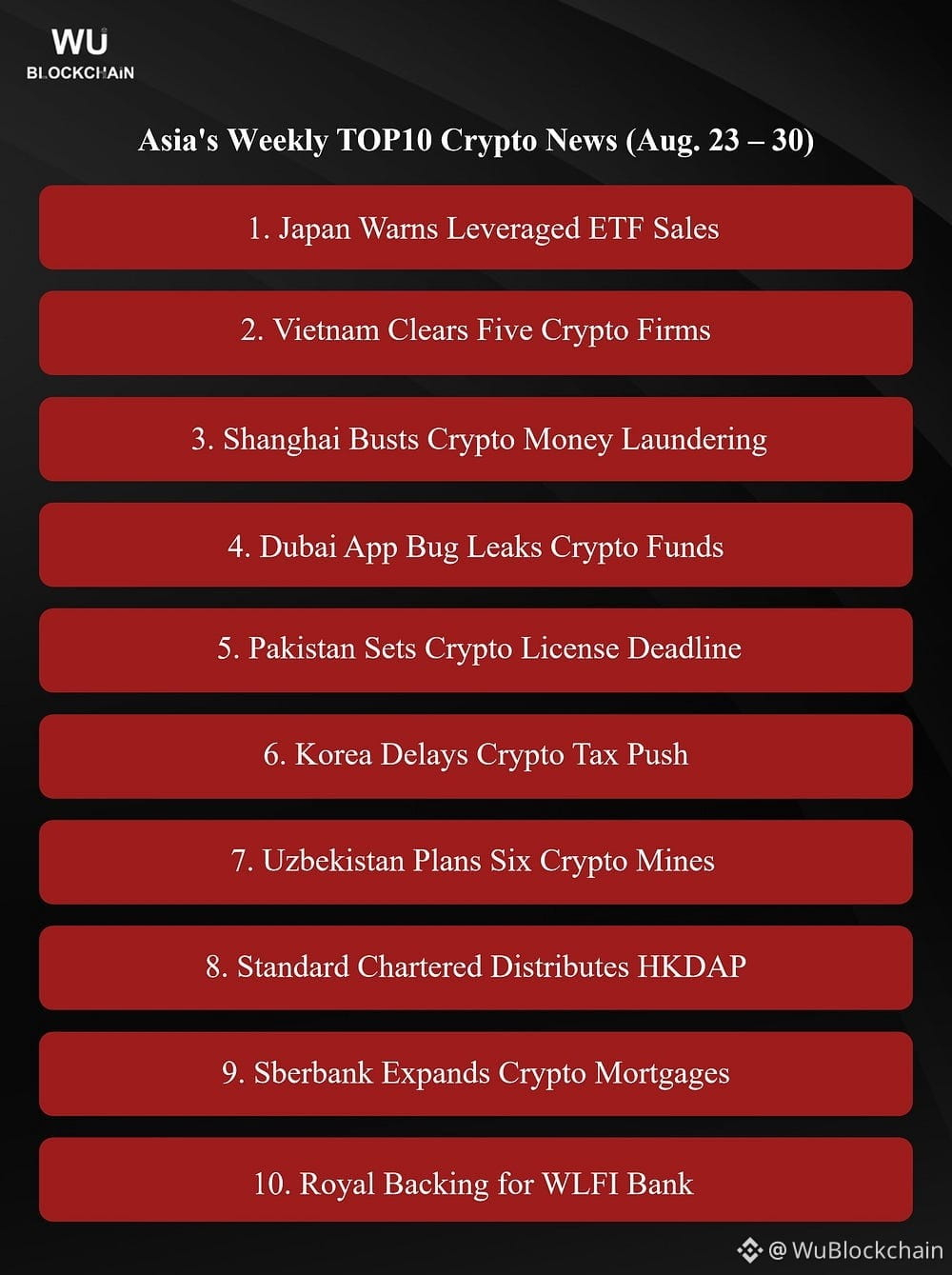
1. Japan’s FSA Warns Against Overseas Single‑Stock Leveraged ETF Sales, Deems Them Contrary to Public Interest link
Japan’s Financial Services Agency (FSA) revised its Q&A guidelines for financial‑instruments business on August 27. It explicitly states that selling overseas‑listed leveraged ETFs tracking Japanese individual stocks within Japan is “inappropriate from a public‑interest perspective”. The move aims to curb the de‑facto distribution of products not approved in Japan, and prevent excessive capital concentration that could distort pricing of specific stocks and trigger sharp market swings. Japan does not yet permit the listing of single‑stock leveraged ETFs. Previously, market participants were concerned that overseas issuances of such products might be sold back into Japan via the “foreign investment trust” channel.
2. Five Vietnamese Firms Pass Initial Crypto Exchange Assessment; No Licenses Yet Issued link
According to Vietnam News Agency, Vietnam has yet to issue its first crypto‑asset exchange license, though five firms have passed the first‑round evaluation. They must next meet Level‑4 information‑system security requirements and deploy minimum capital of 10 trillion Vietnamese dong (approximately $383 million). Meanwhile, new regulations imposing penalties for crypto‑asset‑market violations will take effect on September 1. Experts cited in the report note domestic investors will not face immediate penalties for using unlicensed platforms upon the effective date. Under the current pilot framework, domestic investors are required to trade solely via licensed platforms only six months after the Ministry of Finance grants the first service‑provider license.
3. Shanghai Police Dismantle Virtual‑Currency‑Facilitated Underground Banking Ring Involved in $28‑Billion‑Equivalent Cross‑Border Remittances link
According to a notice from the Shanghai Public Security Bureau, Shanghai police have recently cracked a major underground‑banking case involving illegal cross‑border foreign‑exchange transactions via virtual currencies, arresting 19 suspects with case‑related funds reaching nearly 20 billion yuan. Police stated that starting from August 2024, the gang conducted cross‑border currency exchange through the path of “Renminbi‑virtual currency‑foreign currency”. They first purchased virtual currencies with domestic funds, then sold them via overseas channels for foreign currencies which were transferred to accounts designated by clients, and collected service fees for the operations. Five key suspects have been approved for arrest on suspicion of illegal business operations and aiding information‑network criminal activities. The case remains under further investigation.
4. Security Flaw Exposes Users’ Crypto Assets on Dubai‑Based Chinese‑Focused Food‑Delivery App ComeCome link
Major security vulnerabilities have been exposed in ComeCome, a leading Chinese‑language food‑delivery app based in Dubai. Independent security analysis reveals that version 2.9.3 of the application available on the App Store embedded malicious statistical code dubbed “DKStatistics”. Upon user launch, it attempts to escape the iOS sandbox and read directories of commonly‑used crypto wallets, notes apps, WhatsApp and other applications in the background. On‑chain data shows more than 50,000 USDT was stolen from users starting August 22. The hacker’s aggregation address received approximately 1.3 million USDT in illicit funds within four days, all of which were converted into Ethereum and routed through Tornado Cash for money‑laundering purposes by August 25. Back in February 2025, Kaspersky named ComeCome when disclosing SparkCat, an espionage campaign targeting crypto users. Though the app was updated to version 2.9.5 on August 27, full removal of the malicious component remains pending further verification.
5. Pakistan Orders Crypto Platforms to Secure Licenses by Sep 5 or Cease Operations link
Pakistan Virtual Assets Regulatory Authority (PVARA) has opened licensing applications for crypto platforms. Exchanges, custodians and other service providers already operating locally prior to the March 5 effective date of the Virtual Assets Act must submit No‑Objection Certificate (NOC) applications by September 5, or cease relevant services. Platforms that submit complete applications on time may continue operations during review, yet PVARA may impose restrictions on new‑user registration, product offerings, trading volumes or custodial services. An NOC represents only preliminary regulatory clearance and is not equivalent to a formal license. Continued operations without submitting an application will constitute an offence. Binance and HTX obtained NOCs in December 2025 and may proceed directly to apply for full formal licenses.
6. South Korea’s 2027 Crypto‑Tax Implementation Faces Petition with Over 10,000 Signatures for Delay link
South Korea’s government and the ruling Democratic Party of Korea still plan to enforce the virtual‑asset income tax starting January 1, 2027. A combined 22‑percent tax rate will apply to portions of annual gains from trading or lending virtual assets exceeding 2.5 million won. South Korea’s National Tax Service held an expert meeting this week to discuss concrete enforcement guidelines. Meanwhile, a parliamentary petition seeking a further two‑year delay of the crypto tax has garnered more than 10,000 signatures. Should it reach 50,000 signatures by September 20, it will go for formal review by a National Assembly committee. A lawmaker from the main opposition party has also tabled a bill pushing the enforcement date to 2030.
7. Karakalpakstan, Uzbekistan, Plans Six Mining and Data‑Center Projects Worth $5.11‑Billion Total Investment link
Amanbay Orynbayev, Chairman of the Parliament of Karakalpakstan, Uzbekistan, stated that three cryptocurrency‑mining hubs and three data centers are under local construction with a total project investment of 5.11 billion US dollars. In April this year, the entire territory of Karakalpakstan was designated as Besqala Mining Valley, a special mining zone. Under Uzbekistan’s regulations, cryptocurrency mining is permitted only for legal entities and should predominantly run on renewable‑energy sources. Power drawn from the national unified grid incurs double‑rate electricity tariffs. The country’s National Agency for Perspective Projects is in charge of issuing mining licenses.
8. Standard Chartered Becomes First Distributor of Hong Kong‑Regulated HKD‑Pegged Stablecoin HKDAP link
Standard Chartered has become the first bank to distribute HKDAP, Hong Kong’s regulated Hong Kong‑dollar stablecoin. Standard Chartered plans to roll out tokenised money‑market fund subscription and settlement services with international and local asset managers in the fourth quarter. It will test intra‑group settlement using HKDAP across its network in the near term, while exploring application scenarios including cross‑border payments and treasury management. HKDAP is issued by Anchorpoint Financial, in which Standard Chartered holds an equity stake.
9. Russia’s Sberbank to Expand Crypto‑Backed Mortgages Accepting BTC, ETH and USDT link
Anatoly Popov, Deputy Chairman of Sberbank, Russia’s largest bank, stated that the bank intends to further develop lending secured by digital‑asset collateral. Beyond Bitcoin, it plans to accept Ethereum and stablecoin USDT as collateral in the future. Popov noted Sberbank already has hands‑on experience with digital‑asset operations. Upon the full entry into force of the new regulatory framework, the bank will revise its existing offerings and gradually expand its product lineup. The plan remains subject to regulatory approval. Popov emphasised that assets such as ETH and USDT can only be adopted as collateral once the Central Bank of Russia permits their public circulation.
10. Abu Dhabi Royal Tahnoon and Co‑Investors Hold 49% Stake in World Liberty’s New Bank‑Holding Entity link
Tahnoon bin Zayed al Nahyan, member of Abu Dhabi’s royal family and UAE National Security Advisor, together with co‑investors holds a 49‑percent stake in WLTC Holdings, the holding entity for World Liberty Financial’s new banking business, making them its largest shareholder. Entities affiliated with the Trump family hold approximately 38‑percent equity. The US Office of the Comptroller of the Currency (OCC) granted preliminary conditional approval this month for World Liberty to establish a national trust bank to issue, redeem and custody its stablecoin USD1. Last year, Tahnoon also invested 500 million US dollars into World Liberty via another entity to secure a 49‑percent stake, of which around 263 million US dollars flowed to Trump‑family‑related entities.
Follow us
Twitter: https://twitter.com/WuBlockchain
Telegram: https://t.me/wublockchainenglish