
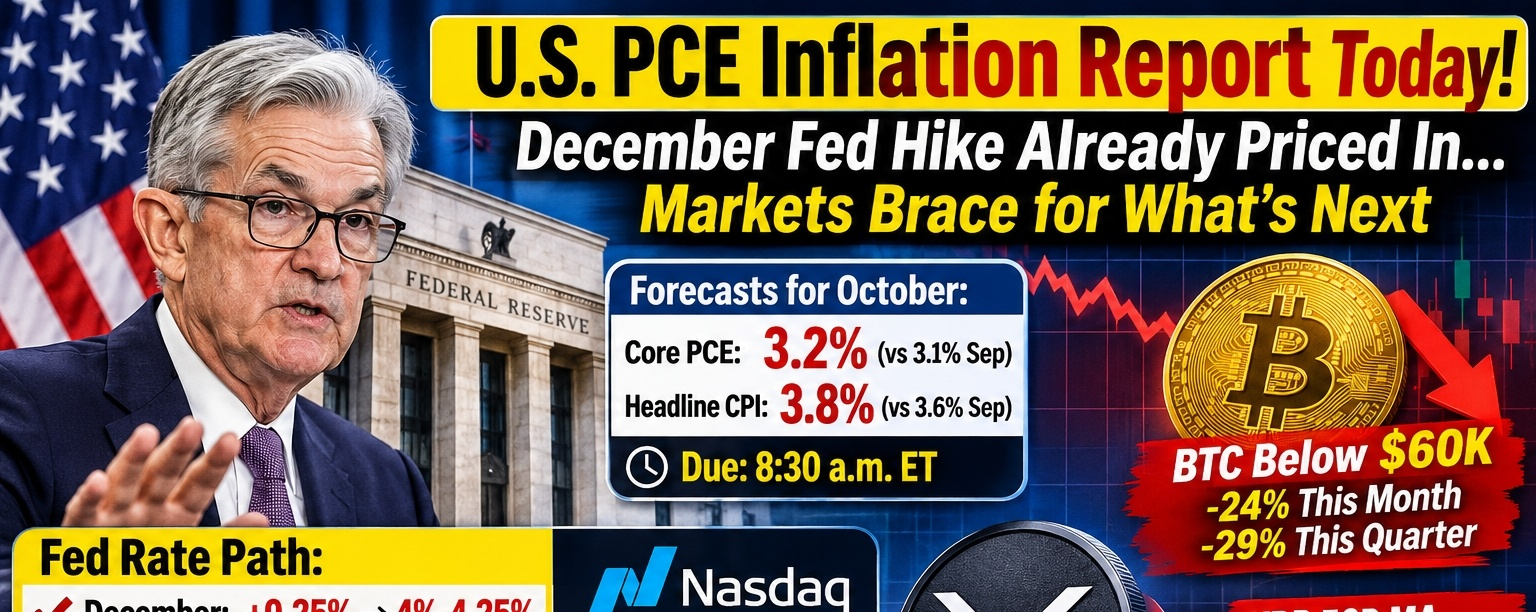

Wednesday’s U.S. core personal consumption expenditures price index report for October arrives with a December Fed interest-rate increase already priced in, leaving bitcoin and other battered markets with little to be concerned about. Core PCE, which strips out food and energy prices, is the Fed’s preferred inflation gauge, and forecasts tracked by the Wall Street Journal point to the annual rate rising to 3.2% in October from 3.1% in September, while headline inflation is forecast to have accelerated to 3.8% on the year from 3.6%. The report was due at 8:30 a.m. ET. Markets have already priced in a quarter-point increase in December, which would lift the Fed’s benchmark borrowing cost to the 4%-4.25% range, with a further increase in January priced at roughly 60% and JPMorgan expecting another in March. These projections have already caused damage to risk assets: bitcoin slid to near $55,000 over the weekend and now trades below $60,000, a decline of about 24% this month and 29% this quarter, while the Nasdaq has dropped over 7% this month and 13% for the quarter. That is why the bar for a hawkish surprise looks high: with that many rate hikes already in the price, it is hard to say how much further the market could fall on this report unless core PCE comes in well above expectations, and if the number is in line with forecasts or softer, the market may barely move, or it could see an oversold bounce. Dick Lo, founder of quant trading firm TDX Strategies, said the print alone is unlikely to force a dovish Fed pivot, though an in-line reading could offer much-needed relief, and that if credit conditions deteriorate across the capex-heavy AI sector and broader markets, the decisive catalyst could arrive at the December FOMC meeting should the Fed shift its focus from rear-view inflation to forward credit risk. Neil Steinhardt, head of Nexo U.S., said the area between $62,000 and $64,000 is the zone buyers would need to reclaim, with the weekend low near $55,000 the reference point on the downside. Today’s signal: XRP’s 50-day moving average crossed below its 200-day average over the weekend, a so-called “death cross” in technical analysis, which signals that the near-term trend is underperforming the broader trajectory and could translate into a deeper bear market, while bitcoin’s 50-day average is also falling fast but has yet to cross below its 200-day. Stay alert.