
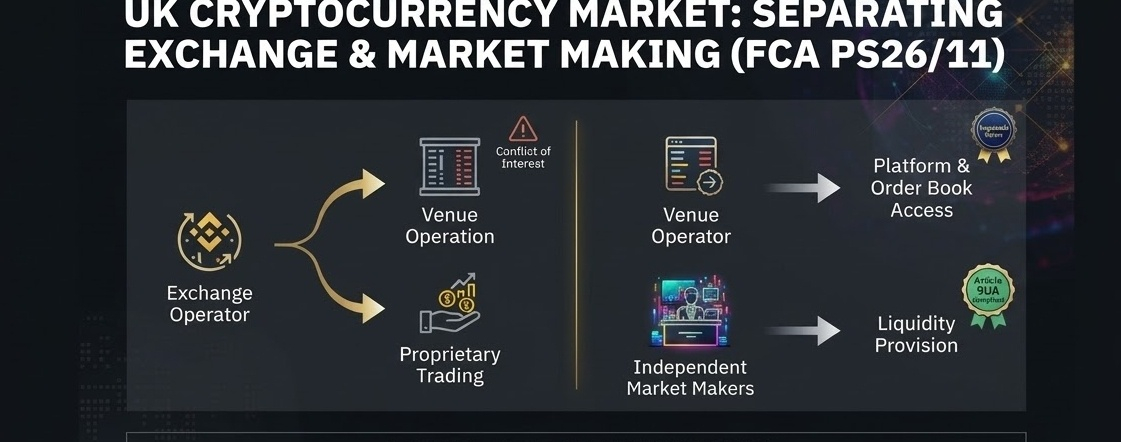

Starting October 25, 2027, UK crypto exchange operators will be barred from using their own proprietary capital to execute orders or act as market makers on qualifying cryptoasset trading platforms (QCATPs) they operate. Under the FCA’s PS26/11 rulebook, the goal is to separate venue operation from proprietary trading and eliminate structural conflicts of interest where an exchange sees order flow first.
At the same time, HM Treasury’s November 18, 2026 amendment added Article 9UA, excluding independent market-making on qualifying platforms from regulated dealing-as-principal permissions. Independent third-party market makers can provide liquidity—including in spot Bitcoin—without needing a separate dealing license, while venues must monitor market-making activity and disclose liquidity incentive terms.
Why does this matter for market structure? Historically, crypto venues often blurred the line between running the order book and trading on their own account. While banning proprietary market-making by the operator removes a core conflict of interest, it also forces exchanges that relied on in-house desks for depth or revenue to restructure ahead of the October 25, 2027 go-live (with February 28, 2027 serving as the key FCA authorisation application window for transitional protection).
What about potential "back doors" or workarounds?
Spinning up a separate entity or affiliate: Separate affiliates are not categorically barred from trading on a platform, but they cannot receive preferential order-book, speed, or information access. Venues must enforce non-discriminatory access, non-discretionary execution, conflict-of-interest controls, and transparency over incentive arrangements.
External corporate investments: An exchange or related firm can make general commercial or venture investments in an outside company. However, turning an invested entity into a de facto in-house desk with privileged access or hidden control runs straight into conflict-of-interest, governance, and market-abuse rules.
Offshore entities and shared order books: UK rules apply to qualifying platforms serving UK users, regardless of where the parent company is headquartered. If an offshore affiliate routes proprietary liquidity into a shared order book accessible by UK users, that triggers UK compliance exposure—forcing global groups to choose between ring-fenced UK setups, strict compliance, or stepping back from the UK market.
Rather than eliminating liquidity overnight, this framework shifts liquidity provision toward independent market makers under tighter oversight. Heading into 2027, the real test will be how exchanges adjust their liquidity models, how transparent incentive schemes become, and how global order books are segmented.
Official Sources & Links:
FCA New Regime for Cryptoasset Regulation: https://www.fca.org.uk/firms/new-regime-cryptoasset-regulation
FCA PS26/11 (Regulated Cryptoasset Activities): https://www.fca.org.uk/publication/policy/ps26-11.pdf
GOV.UK / HM Treasury Cryptoasset Regulations Policy Note: https://www.gov.uk/government/publications/policy-note-draft-statutory-instrument-amending-the-cryptoasset-regulations/draft-statutory-instrument-amending-the-financial-services-and-markets-act-2020-cryptoassets-regulations-2026-policy-note
#FCA A rules bar #UK exchange operators from proprietary market-making on their own platforms from October 25, 2027, while Article 9UA eases the path for independent market makers.