
Aria Bloom 阿莉娅
504 Publicaciones
Aria Bloom 阿莉娅
Aria Bloom | Learning, growing, and exploring crypto with patience and purpose. Every step is progress 💞
Abrir trade
Traders de alta frecuencia
1.5 año(s)
317 Siguiendo
9.1K+ Seguidores
3.8K+ Me gusta
Publicaciones
Cartera
Todo
Citas
😍

Dream Spicer 梦想家
·
--
Hawk Is Still Learning to Fly 🦅
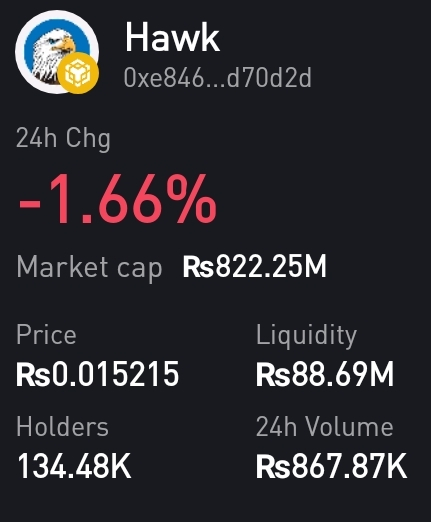
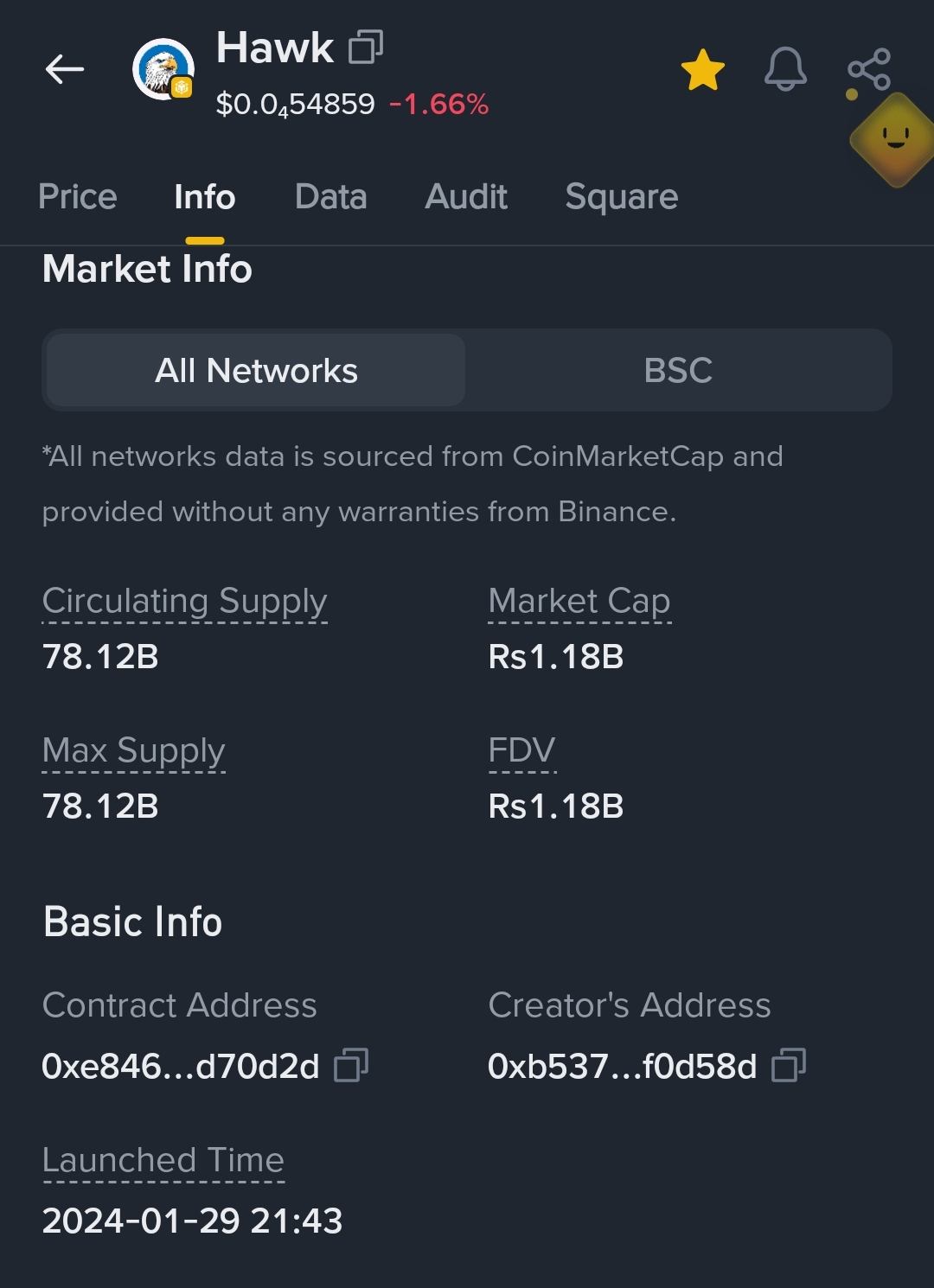
The more I study $HAWK , the more I think it’s still too early to judge HawkFi by where it is today.
I see the current phase more like flight training.
The pieces are starting to come together liquidity tools, DLMM-focused strategies, automation, pool discovery and the move toward agent based trading. But having the tools is one thing. Proving they work reliably across different market conditions is another.
That’s the part I find interesting.
A liquidity agent has to deal with much more than simply finding a pool. It needs to think about fees, price ranges, inventory, volatility, rebalancing and execution. When markets get messy, that’s where the real test begins.
So I’m not looking at $HAWK and trying to guess a future price.
I’m watching whether the product keeps becoming more useful, more automated and more capable of handling real liquidity problems.
Hawk doesn’t need to be flying at full altitude yet.
Right now, it’s learning how to control its wings.
And honestly, that early stage is what makes it worth watching.
#HAWK #HawkFi #DeFi #BNB @Hawk自由哥
The more I study $HAWK , the more I think it’s still too early to judge HawkFi by where it is today.
I see the current phase more like flight training.
The pieces are starting to come together liquidity tools, DLMM-focused strategies, automation, pool discovery and the move toward agent based trading. But having the tools is one thing. Proving they work reliably across different market conditions is another.
That’s the part I find interesting.
A liquidity agent has to deal with much more than simply finding a pool. It needs to think about fees, price ranges, inventory, volatility, rebalancing and execution. When markets get messy, that’s where the real test begins.
So I’m not looking at $HAWK and trying to guess a future price.
I’m watching whether the product keeps becoming more useful, more automated and more capable of handling real liquidity problems.
Hawk doesn’t need to be flying at full altitude yet.
Right now, it’s learning how to control its wings.
And honestly, that early stage is what makes it worth watching.
#HAWK #HawkFi #DeFi #BNB @Hawk自由哥
😍

rabi coin
·
--
$BTC is holding around $77.6K after the recent pullback.
The market still looks cautious, so I’m watching the next move closely.
#Binance #BTC
The market still looks cautious, so I’m watching the next move closely.
#Binance #BTC
😍


AI随缘俱乐部
·
--
UXUY × SUBB 专场 | 币安广场AMA重磅来袭!
📅 时间:8月29日(今晚)21:00 - 22:00
📍 锁定:周周1688直播间
我们将围绕 UXUY 与 SUBB 生态 展开深度对话,开启实时问答互动,与行业伙伴一起聊聊 Web3 的新机遇。
🎁 现场互动福利多多,参与即有机会赢取惊喜!
#SUBB #UXUY #币安广场AMA
📅 时间:8月29日(今晚)21:00 - 22:00
📍 锁定:周周1688直播间
我们将围绕 UXUY 与 SUBB 生态 展开深度对话,开启实时问答互动,与行业伙伴一起聊聊 Web3 的新机遇。
🎁 现场互动福利多多,参与即有机会赢取惊喜!
#SUBB #UXUY #币安广场AMA

😇
小姨妈lily
·
--
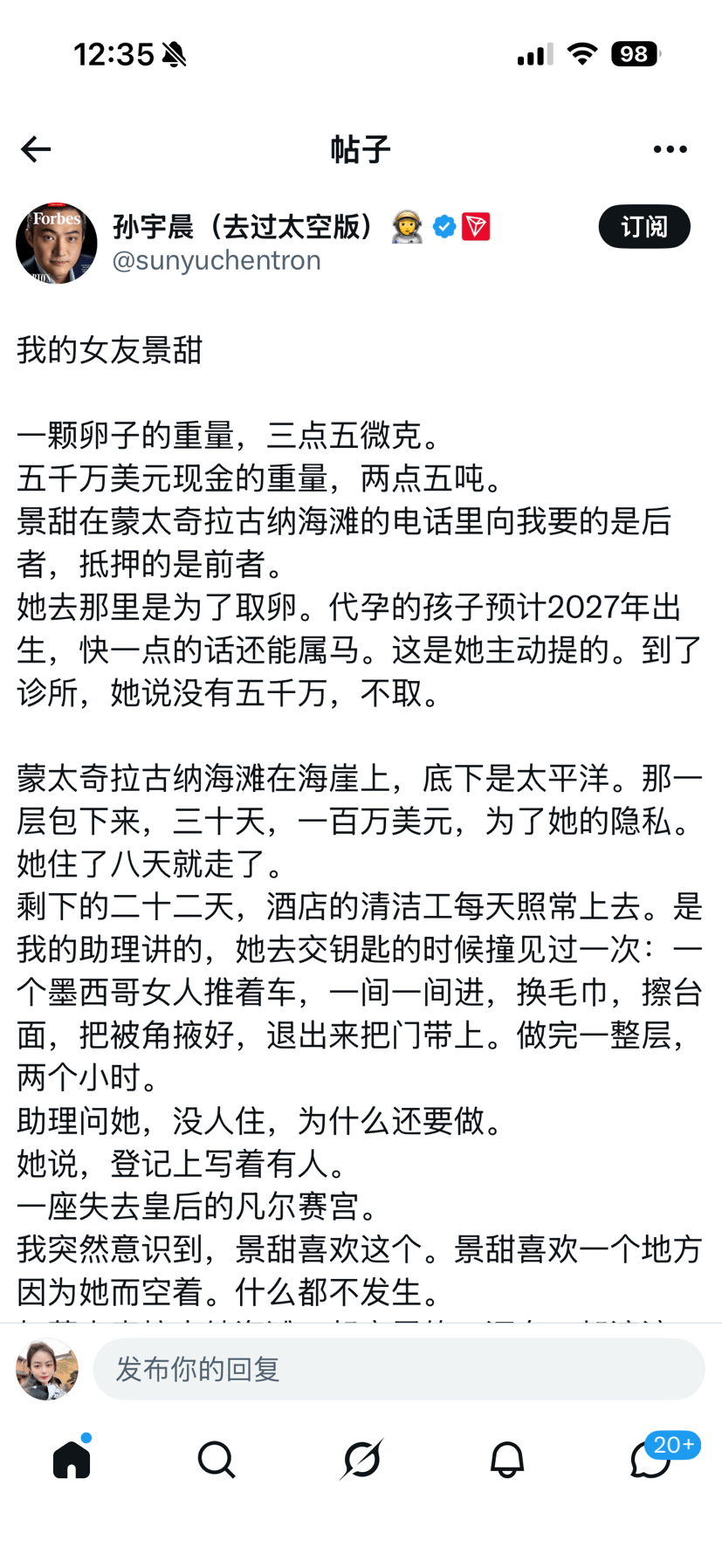
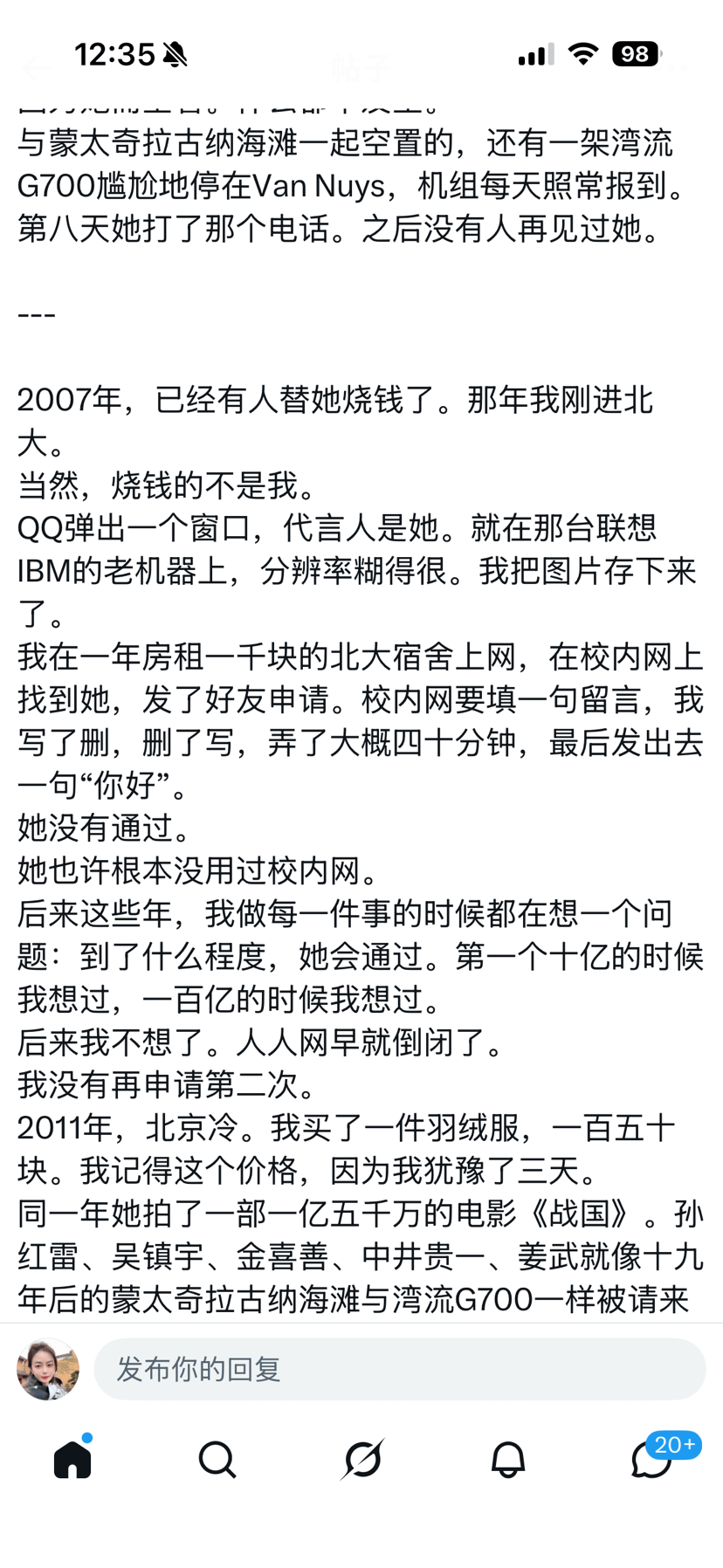
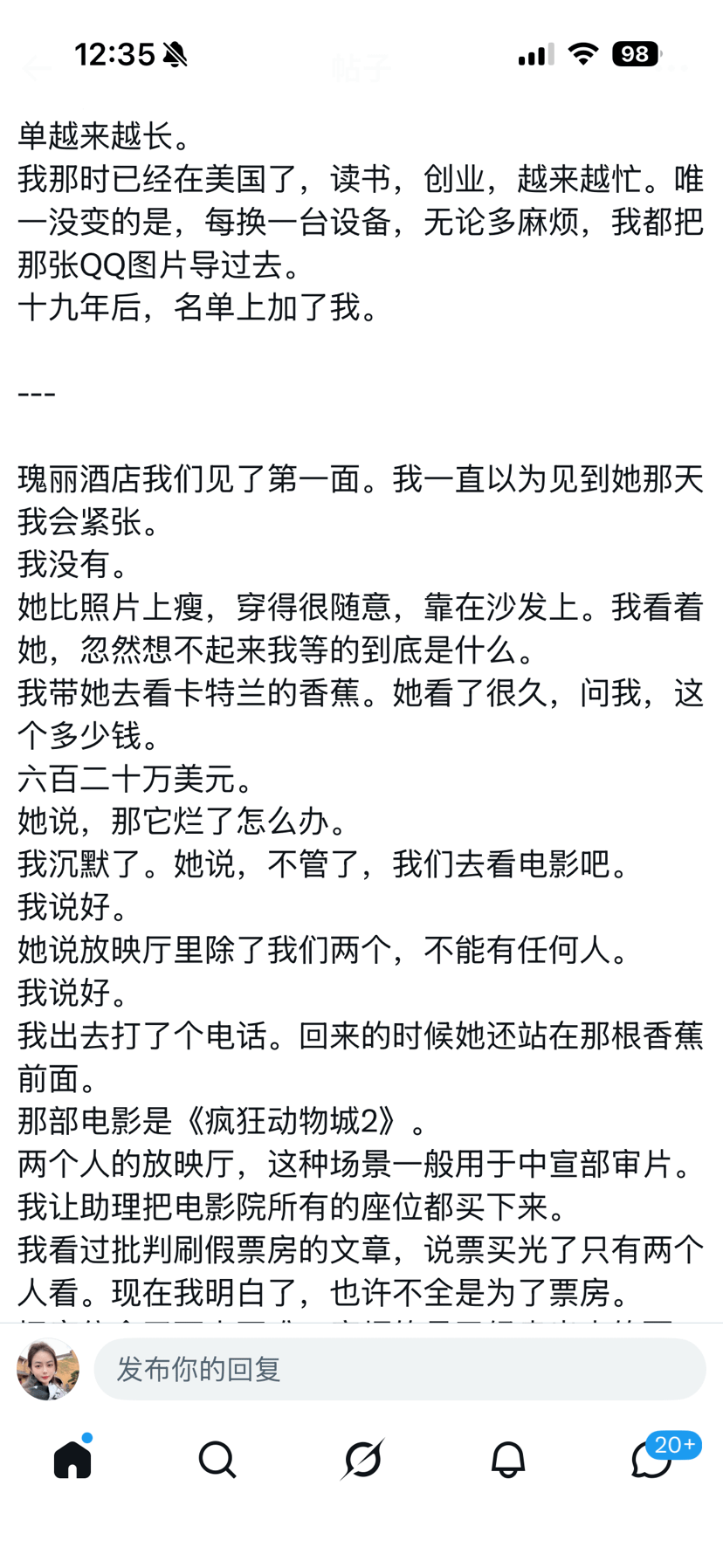
币圈男有几个典型特点:精算、赌性强、爱套利,能白嫖绝不付费。
这个其实也没办法,币圈可能是全球金融衍生品最齐全、套利机会最多的市场之一。一个原本完全不懂金融的人,在币圈摸爬滚打几年,经历过合约、期权、杠杆、清算、套保,再玩过一轮 DeFi,实际金融博弈经验未必比金融 PhD 差。
尤其 DeFi 出来以后,借贷、循环贷、LP、对冲、套利,各种金融结构天天拿真金白银练手。
所以真要把币圈男当“猎物”,其实是最难捞的一群人。
你以为你在算他的钱,他可能从第一天就在算你的赔率、成本和退出路径。
就算前面真让你捞到了,最后也很容易被反向套利。
所以捞女去捞币圈男,往往是最不划算的一门生意。
你以为自己在做局,他可能从认识你的第一天,就已经把风险收益比算完了。
币圈最不缺的,就是见过泡沫、骗局、暴涨暴跌之后,还能面不改色的人。
这个其实也没办法,币圈可能是全球金融衍生品最齐全、套利机会最多的市场之一。一个原本完全不懂金融的人,在币圈摸爬滚打几年,经历过合约、期权、杠杆、清算、套保,再玩过一轮 DeFi,实际金融博弈经验未必比金融 PhD 差。
尤其 DeFi 出来以后,借贷、循环贷、LP、对冲、套利,各种金融结构天天拿真金白银练手。
所以真要把币圈男当“猎物”,其实是最难捞的一群人。
你以为你在算他的钱,他可能从第一天就在算你的赔率、成本和退出路径。
就算前面真让你捞到了,最后也很容易被反向套利。
所以捞女去捞币圈男,往往是最不划算的一门生意。
你以为自己在做局,他可能从认识你的第一天,就已经把风险收益比算完了。
币圈最不缺的,就是见过泡沫、骗局、暴涨暴跌之后,还能面不改色的人。
😍
路人1688-luren
·
--
绝大多数人这辈子的情感痛苦,都源于一个致命执念。 总以为真心可以永恒,相伴可以长久,爱意可以一成不变。
总以为当下的热烈、笃定、深情,就是一辈子的标准答案。
总以为陪自己走过一程的人,就会陪自己走完余生。 我们拼命执着圆满,强求不变,对抗离散。
可越执着,越内耗;越强求,越痛苦。 因为我们从一开始,就看错了这个世界的底层规则。$AAPLB
总以为当下的热烈、笃定、深情,就是一辈子的标准答案。
总以为陪自己走过一程的人,就会陪自己走完余生。 我们拼命执着圆满,强求不变,对抗离散。
可越执着,越内耗;越强求,越痛苦。 因为我们从一开始,就看错了这个世界的底层规则。$AAPLB

😍

GLOW_PK
·
--
SOL red packet dropped ❤️🩹🧧
and suddenly nobody🫀✨️
needs sleep anymore 😂🎁
Everyone refreshing nonstop🎁🧧
like their salary depends on it 🤣💸🚀
Clim it Fast 🎁🤗💞🔐
$NVDAB $AAPLB $SOL
#Claim #Redpaicket #SECSendsCryptoCustodyRuleToWhiteHouse #SECSendsCryptoCustodyRuleToWhiteHouse #XRPRallies44%InAWeek
and suddenly nobody🫀✨️
needs sleep anymore 😂🎁
Everyone refreshing nonstop🎁🧧
like their salary depends on it 🤣💸🚀
Clim it Fast 🎁🤗💞🔐
$NVDAB $AAPLB $SOL
#Claim #Redpaicket #SECSendsCryptoCustodyRuleToWhiteHouse #SECSendsCryptoCustodyRuleToWhiteHouse #XRPRallies44%InAWeek

😍

奕澤YiiiiiZze
·
--
在光明社区的发展历程中,LUCIC作为唯一代币,一直扮演着凝聚共识的重要角色。它记录着每一位社区成员的努力与付出。展望未来,我们期待 LUCIC 能发挥更实际的价值,让社区的每一份子都能从中受益,共同见证它的平稳成长与光明前景。
点赞&关注&转发领取🎁🎁🎁
点赞&关注&转发领取🎁🎁🎁
The journey isn’t always about numbers, markets, and targets. Sometimes, it’s about stepping away for a moment, enjoying the beauty of nature, and appreciating the peaceful moments that make life meaningful. ✨
A beautiful view, calm waters, and my little companion by my side. 🐱🤍
Simple moments, unforgettable memories.
Keep moving forward, stay positive, and enjoy every part of the journey. 🚀✨
$BTR $GIGGLE $SOL
A beautiful view, calm waters, and my little companion by my side. 🐱🤍
Simple moments, unforgettable memories.
Keep moving forward, stay positive, and enjoy every part of the journey. 🚀✨
$BTR $GIGGLE $SOL
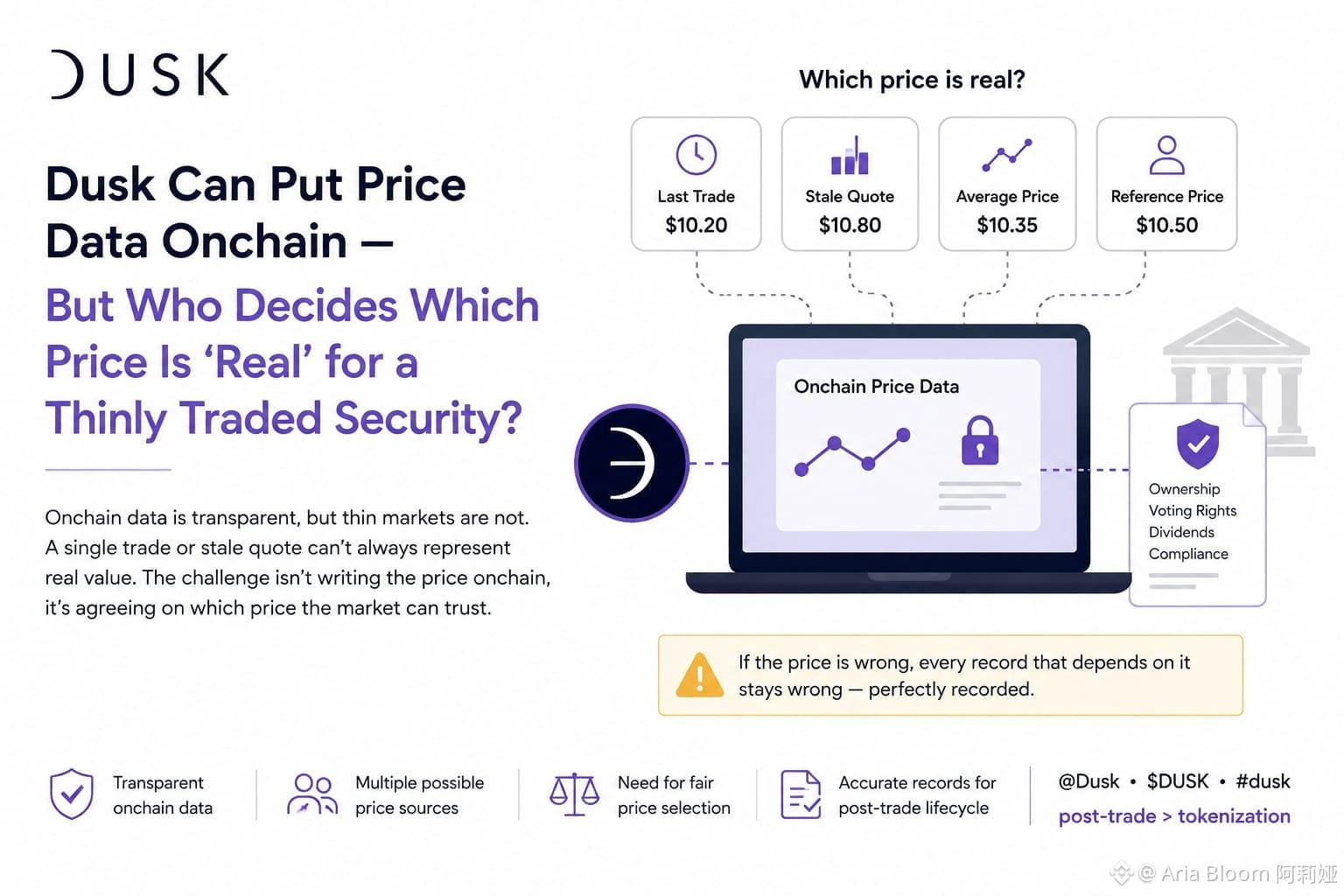
I’ve been thinking about Dusk’s onchain price data a bit differently lately. Putting a price onchain sounds straightforward until I imagine a security that barely trades. If it moves once every few days which price actually represents the market? The last trade? A stale quote? An average? Or some reference value agreed by the system?
That matters because tokenization doesn’t automatically make the underlying asset more measurable. The chain can preserve a number very accurately but it can’t decide by itself whether that number still reflects reality. For a thinly traded security a single small transaction could look meaningful even when it tells us very little about what another buyer would actually pay.
I think this is where Dusk’s post-trade focus gets more interesting to me. The source material makes the point that the hard part is keeping records correct after trading including rights payments and compliance. But there’s another dependency sitting underneath those records: the inputs have to be trustworthy in the first place. If eligibility or valuation eventually depends on price data.
bad inputs can stay perfectly recorded onchain.
I’d want to see how Dusk handles stale or disputed prices in practice. Who gets the final say when the market itself barely speaks?
#dusk $DUSK @Dusk
That matters because tokenization doesn’t automatically make the underlying asset more measurable. The chain can preserve a number very accurately but it can’t decide by itself whether that number still reflects reality. For a thinly traded security a single small transaction could look meaningful even when it tells us very little about what another buyer would actually pay.
I think this is where Dusk’s post-trade focus gets more interesting to me. The source material makes the point that the hard part is keeping records correct after trading including rights payments and compliance. But there’s another dependency sitting underneath those records: the inputs have to be trustworthy in the first place. If eligibility or valuation eventually depends on price data.
bad inputs can stay perfectly recorded onchain.
I’d want to see how Dusk handles stale or disputed prices in practice. Who gets the final say when the market itself barely speaks?
#dusk $DUSK @Dusk
#dusk $DUSK @Dusk
Dusk’s approach feels genuinely refreshing in crypto.
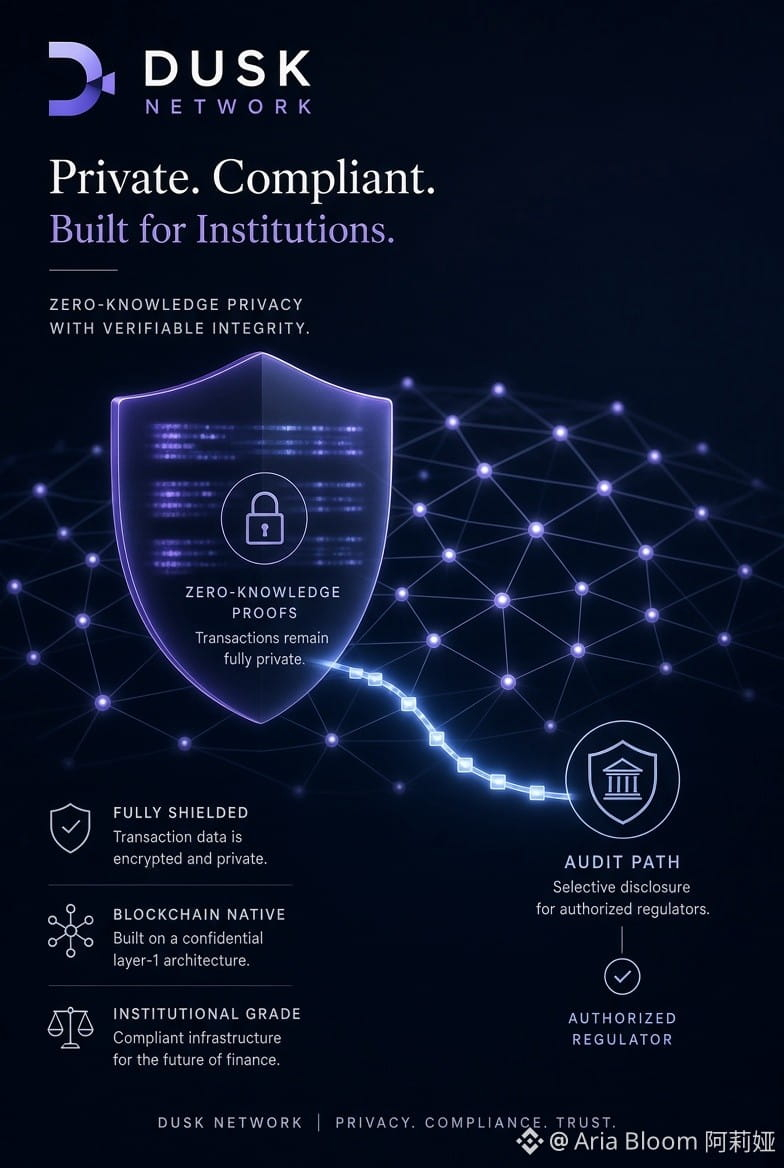
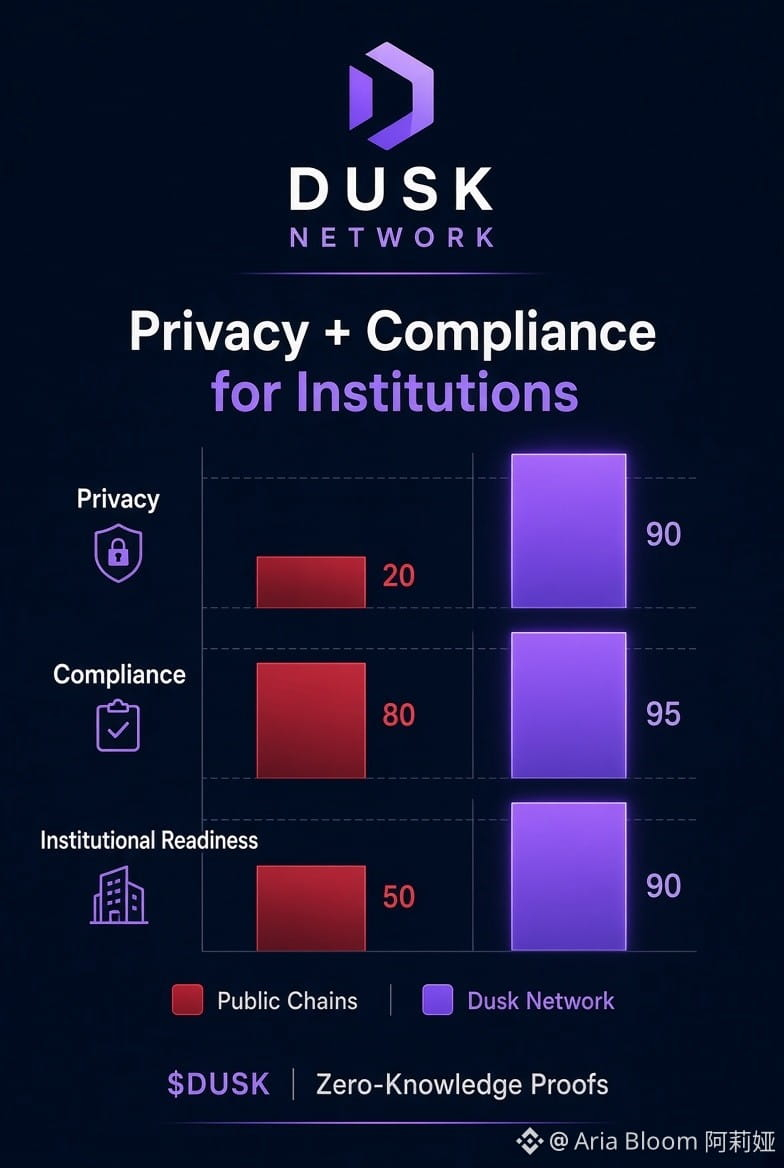
On most chains, every transaction is fully public amounts, parties, everything. Institutions hate this. They need privacy, yet regulators still demand full audit trails. It’s a hard conflict.
Dusk solves it cleanly. Their system separates transaction truth from transaction disclosure Using zero-knowledge proofs, the network can verify that a transaction is valid, rules were followed, and balances check out without revealing the actual details.
Only authorized parties and regulators can see the real data. Everyone else just sees confirmation that it’s legitimate.
That’s why Dusk is becoming a serious contender for real-world assets and regulated finance. Privacy and compliance finally work together.
For institutions, this removes a major barrier. Public chains no longer feel like such a risk.
They’re quietly building something that actually solves a real problem. Worth watching.
Dusk’s approach feels genuinely refreshing in crypto.
On most chains, every transaction is fully public amounts, parties, everything. Institutions hate this. They need privacy, yet regulators still demand full audit trails. It’s a hard conflict.
Dusk solves it cleanly. Their system separates transaction truth from transaction disclosure Using zero-knowledge proofs, the network can verify that a transaction is valid, rules were followed, and balances check out without revealing the actual details.
Only authorized parties and regulators can see the real data. Everyone else just sees confirmation that it’s legitimate.
That’s why Dusk is becoming a serious contender for real-world assets and regulated finance. Privacy and compliance finally work together.
For institutions, this removes a major barrier. Public chains no longer feel like such a risk.
They’re quietly building something that actually solves a real problem. Worth watching.
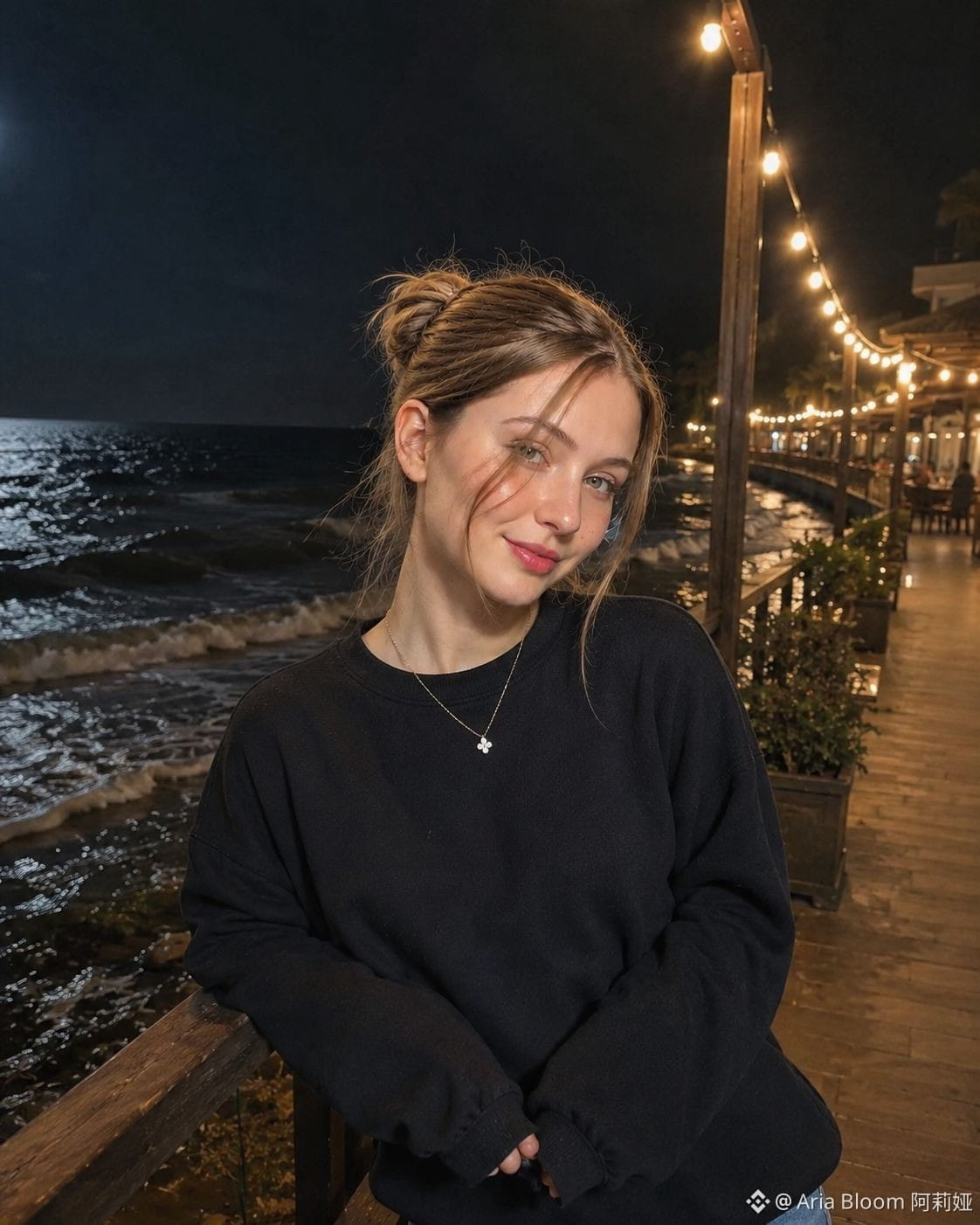
Night by the sea, soft lights, and a little peace in the air 🌊
Just me, the waves, and this quiet moment.
Ocean breeze, string lights, and a soft smile ✨
Sometimes the best nights are the quiet ones.
Sea, lights, aur thodi si sukoon 🌊
Bas yahi moment feel kar rahi hun.
Night vibes only 🌙🌊
Soft lights, soft smile.
Where the waves meet the lights and everything feels a little softer $DUSK #BTC
Just me, the waves, and this quiet moment.
Ocean breeze, string lights, and a soft smile ✨
Sometimes the best nights are the quiet ones.
Sea, lights, aur thodi si sukoon 🌊
Bas yahi moment feel kar rahi hun.
Night vibes only 🌙🌊
Soft lights, soft smile.
Where the waves meet the lights and everything feels a little softer $DUSK #BTC
Sometimes the best moments are the simplest ones ☕🌹✨
A peaceful moment, a warm cup of coffee, and a little beauty in the day. ❤️
$DUSK $BTC
A peaceful moment, a warm cup of coffee, and a little beauty in the day. ❤️
$DUSK $BTC

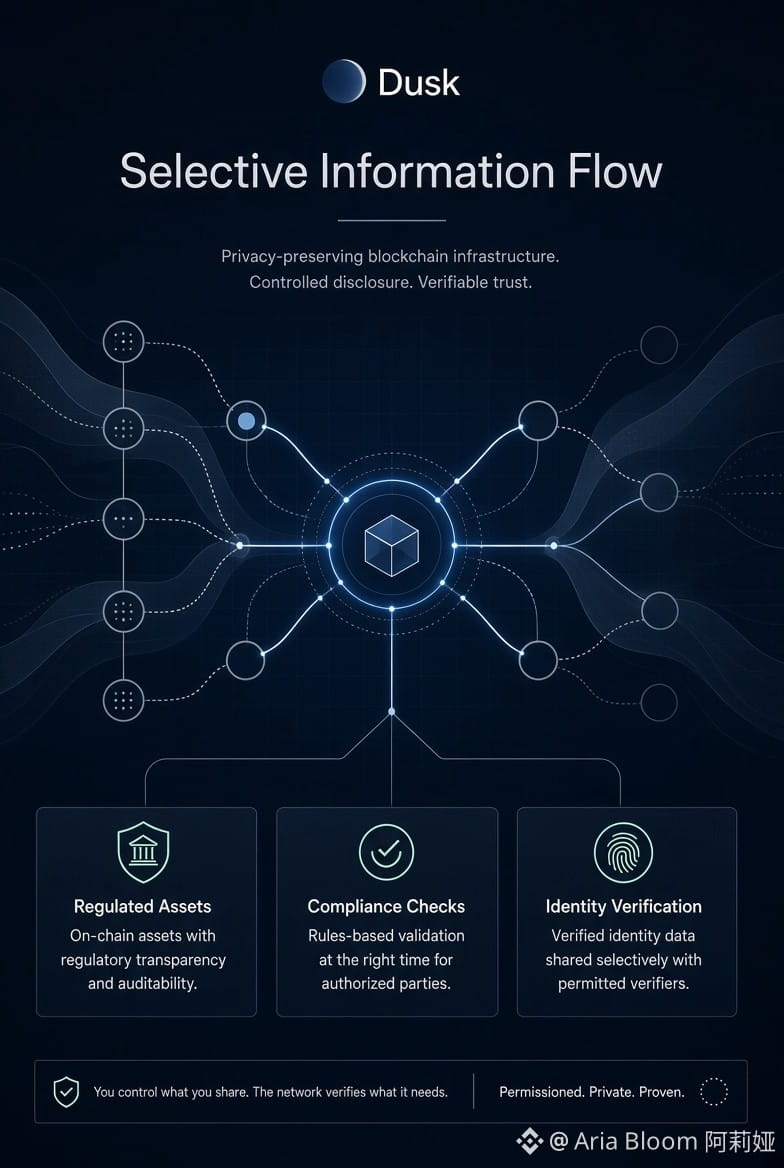
I’ve started thinking about Dusk’s privacy model less as hiding transactions and more as controlling how information moves.
That distinction matters. On a public blockchain the problem isn’t only that data is visible. It’s that small pieces of visible information can be connected over time. A transaction an identity check, an asset transfer or a relationship between addresses can become part of a much larger picture.
What interests me about @Dusk is the idea that privacy can be designed around selective information flow instead. The goal isn’t necessarily to make everything invisible. It’s to let the network verify what actually needs to be verified without automatically exposing everything surrounding it.
That feels particularly important for regulated assets. Institutions may need to prove compliance, ownership, eligibility, or transaction validity, but that doesn’t mean every participant should receive the full underlying dataset.
The difficult part is getting the balance right. Too much transparency creates unnecessary exposure. Too much privacy can make verification and compliance harder.
For me, that’s where $DUSK becomes interesting. The real question isn’t simply whether a transaction is private. It’s who gets to learn what, when they learn it, and why that information is necessary.
That’s a much more useful way to think about blockchain privacy.
#dusk $DUSK @Dusk
That distinction matters. On a public blockchain the problem isn’t only that data is visible. It’s that small pieces of visible information can be connected over time. A transaction an identity check, an asset transfer or a relationship between addresses can become part of a much larger picture.
What interests me about @Dusk is the idea that privacy can be designed around selective information flow instead. The goal isn’t necessarily to make everything invisible. It’s to let the network verify what actually needs to be verified without automatically exposing everything surrounding it.
That feels particularly important for regulated assets. Institutions may need to prove compliance, ownership, eligibility, or transaction validity, but that doesn’t mean every participant should receive the full underlying dataset.
The difficult part is getting the balance right. Too much transparency creates unnecessary exposure. Too much privacy can make verification and compliance harder.
For me, that’s where $DUSK becomes interesting. The real question isn’t simply whether a transaction is private. It’s who gets to learn what, when they learn it, and why that information is necessary.
That’s a much more useful way to think about blockchain privacy.
#dusk $DUSK @Dusk
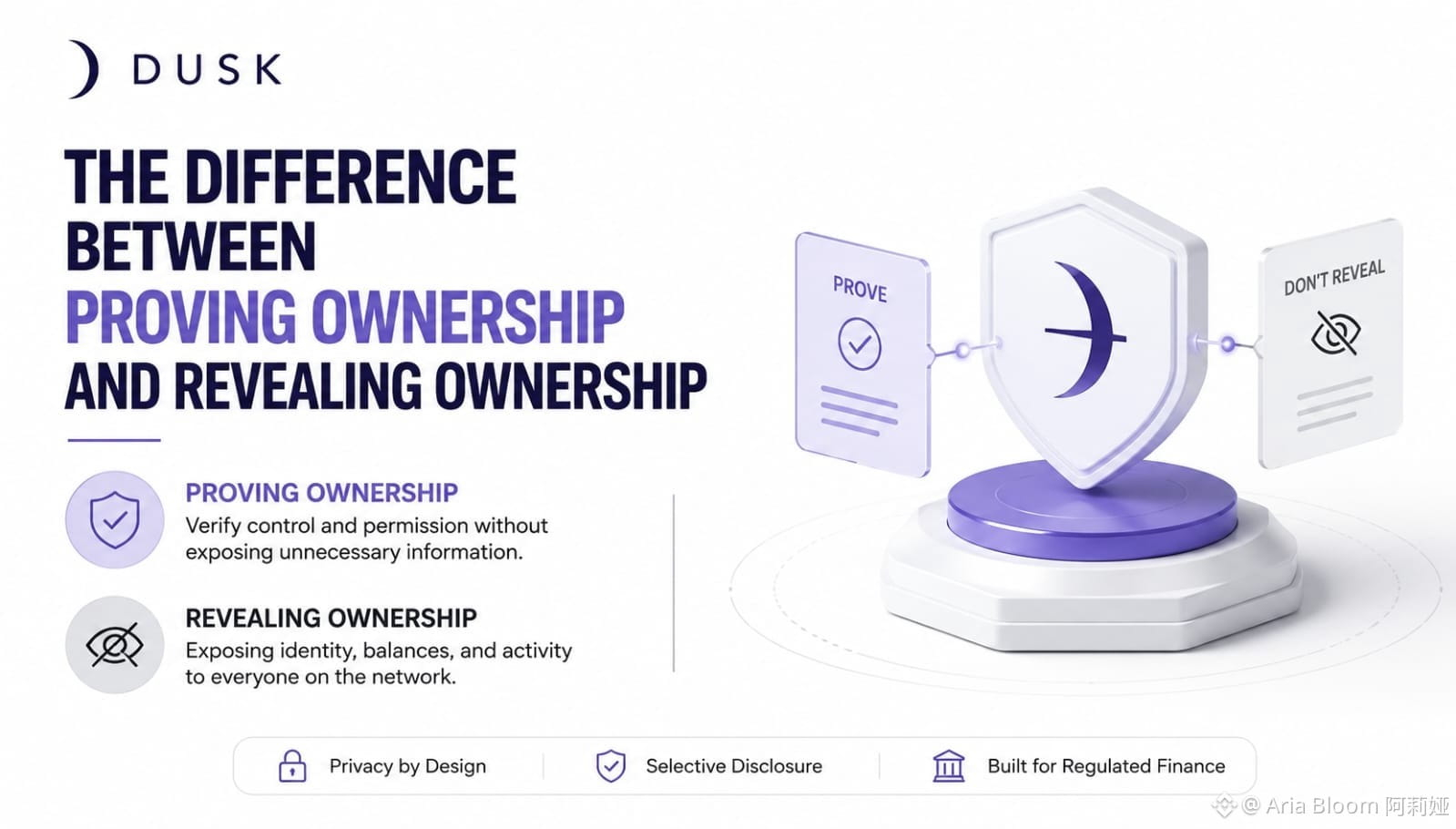
I think one of the biggest misconceptions in crypto is that ownership always has to be visible in order to be trusted.
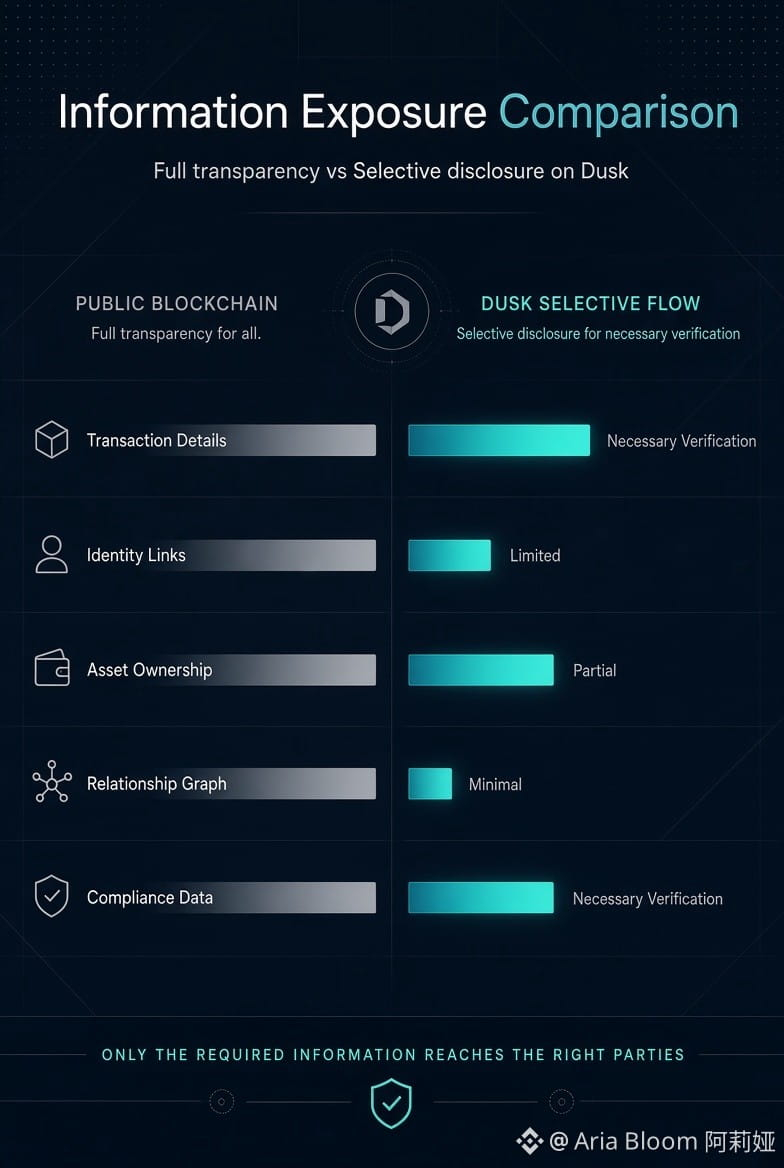
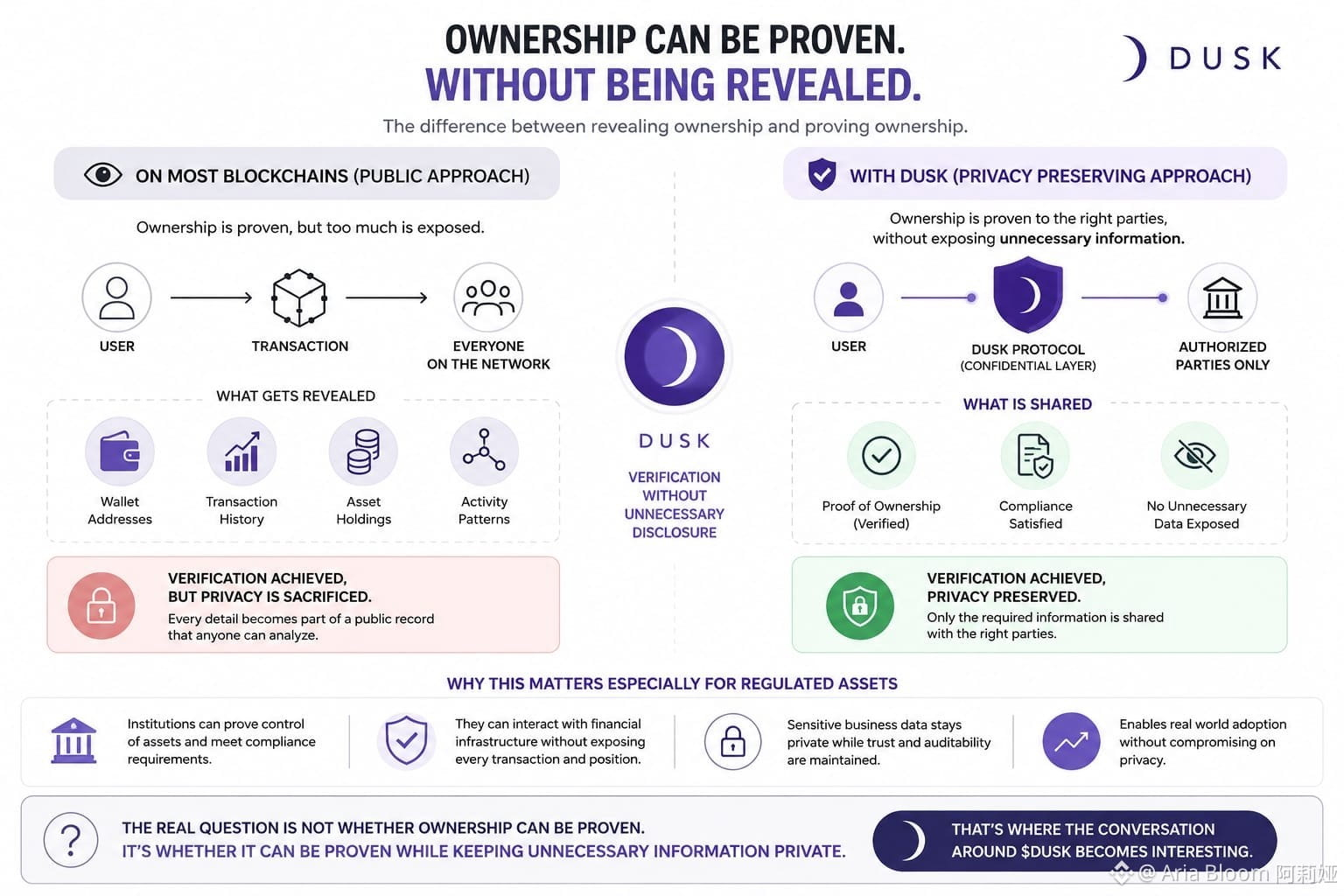
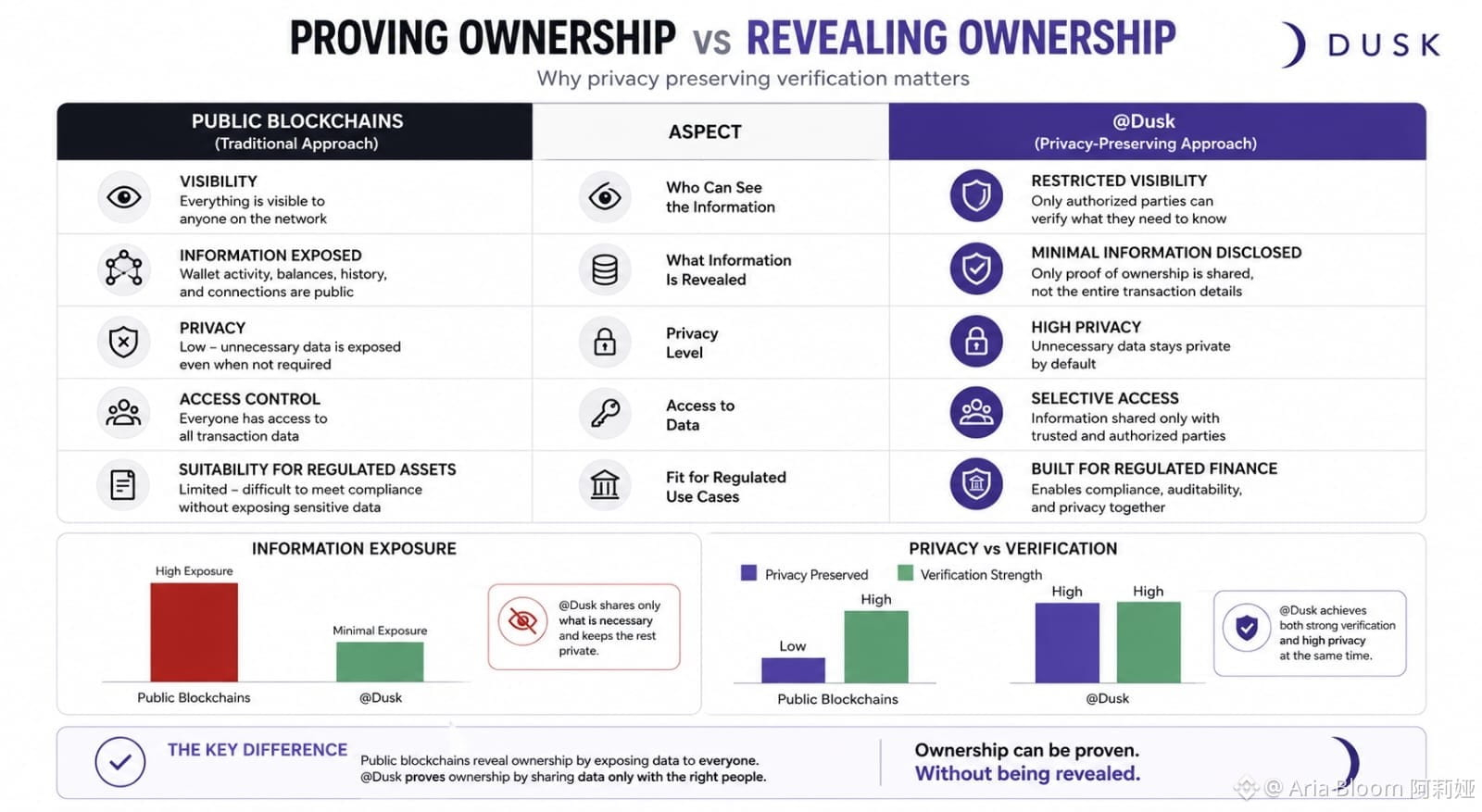
When someone proves ownership on most blockchains they often reveal much more than necessary. Wallet activity asset holdings and transaction history can become part of a public record that anyone can analyze. Verification is achieved but privacy is sacrificed along the way.
What caught my attention about @Dusk is the different approach. The goal is not to hide ownership from those who need to verify it. The goal is to allow verification without turning every detail into public information.
That distinction becomes more interesting when thinking about regulated assets. Businesses and institutions may need to prove control satisfy compliance requirements and interact with financial infrastructure but they may not want every movement and position exposed to the entire network.
To me the future question is not whether ownership can be proven. Blockchain already solved that. The more important question is whether ownership can be proven while keeping unnecessary information private.
That is where the conversation around becomes interesting.
#dusk $DUSK @Dusk
When someone proves ownership on most blockchains they often reveal much more than necessary. Wallet activity asset holdings and transaction history can become part of a public record that anyone can analyze. Verification is achieved but privacy is sacrificed along the way.
What caught my attention about @Dusk is the different approach. The goal is not to hide ownership from those who need to verify it. The goal is to allow verification without turning every detail into public information.
That distinction becomes more interesting when thinking about regulated assets. Businesses and institutions may need to prove control satisfy compliance requirements and interact with financial infrastructure but they may not want every movement and position exposed to the entire network.
To me the future question is not whether ownership can be proven. Blockchain already solved that. The more important question is whether ownership can be proven while keeping unnecessary information private.
That is where the conversation around becomes interesting.
#dusk $DUSK @Dusk
Verificado
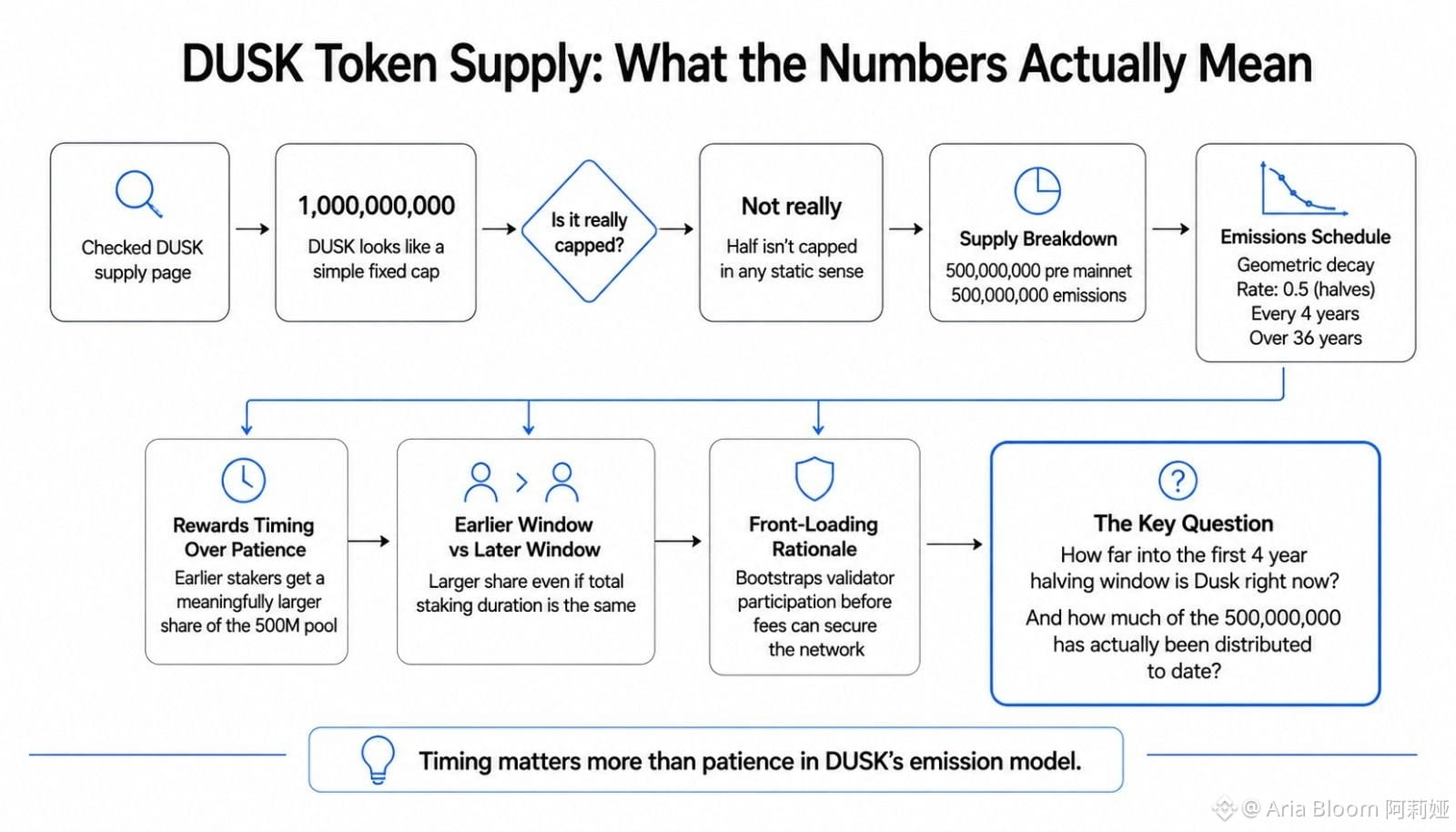
I checked DUSK's supply page expecting a simple fixed cap 1,000,000,000 DUSK looked like exactly that at first glance.
The figure alone is weak here since half of it isn't really capped in any static sense 500,000,000 DUSK already exists from the pre mainnet supply.The remaining 500,000,000 gets released through a geometric decay schedule with a reduction rate of 0.5.It halves every 4 years across a full 36 year emission window rather than arriving all at once.
That structure quietly rewards timing more than patience alone,a provisioner staking during an earlier 4 year window collects a meaningfully larger share of that 500,000,000 pool than one joining after several halvings have already passed.That holds even if both eventually stake for the same total number of years.
Front loading emissions this way is a reasonable design choicen it helps bootstrap validator participation before transaction fees alone could sustain network security.
Which raises a specific question nobody seems to track publicly how far into that first 4 year halving window is Dusk right now?And how much of the 500,000,000 has actually been distributed to date?
#dusk $DUSK @Dusk
The figure alone is weak here since half of it isn't really capped in any static sense 500,000,000 DUSK already exists from the pre mainnet supply.The remaining 500,000,000 gets released through a geometric decay schedule with a reduction rate of 0.5.It halves every 4 years across a full 36 year emission window rather than arriving all at once.
That structure quietly rewards timing more than patience alone,a provisioner staking during an earlier 4 year window collects a meaningfully larger share of that 500,000,000 pool than one joining after several halvings have already passed.That holds even if both eventually stake for the same total number of years.
Front loading emissions this way is a reasonable design choicen it helps bootstrap validator participation before transaction fees alone could sustain network security.
Which raises a specific question nobody seems to track publicly how far into that first 4 year halving window is Dusk right now?And how much of the 500,000,000 has actually been distributed to date?
#dusk $DUSK @Dusk
Trading with Purpose. Executing with Discipline. 📊
Currently focused on refining my trading strategy and building consistency through Binance.
My approach is simple: analyze the market, identify high-probability setups, manage risk carefully, and execute with patience. I believe successful trading is not about predicting every move — it’s about making informed decisions and maintaining discipline over time.
Analyze. Execute. Manage Risk. Improve.
#Binance #CryptoTrading #TradingSignals $DUSK $GIGGLE
Currently focused on refining my trading strategy and building consistency through Binance.
My approach is simple: analyze the market, identify high-probability setups, manage risk carefully, and execute with patience. I believe successful trading is not about predicting every move — it’s about making informed decisions and maintaining discipline over time.
Analyze. Execute. Manage Risk. Improve.
#Binance #CryptoTrading #TradingSignals $DUSK $GIGGLE

Verificado
I went to check Dusk's migration process myself and the contract details are more specific than the still building an L1 narrative that gets repeated.Mainnet's first immutable block landed January 7, 2025, after an onramp phase that started December 20, 2024 so the chain itself has been live for over a year now.
What's still live and relevant is the original ERC 20/BEP 20 to native migrationit's one way but it's not a dead end. Dusk runs a separate bridge to send native DUSK back out to BEP20 on BSC with a flat 1 DUSK fee per transaction.
The conversion math is also oddly specific. Native DUSK runs 9 decimals against 18 for the old ERC 20/BEP 20 token. 1 LUX equals exactly 10^9 DUSK wei.Amounts below that minimum are rejected outright rather than rounded.
That two bridge structure isn't sloppy design. It keeps the original migration simple while still giving holders an exit path without letting old and new supply float around interchangeably forever.
Still open is how much DUSK sits un migrated on Ethereum and BSC right now and whether Dusk tracks or publishes that number anywhere.
#dusk $DUSK @Dusk
What's still live and relevant is the original ERC 20/BEP 20 to native migrationit's one way but it's not a dead end. Dusk runs a separate bridge to send native DUSK back out to BEP20 on BSC with a flat 1 DUSK fee per transaction.
The conversion math is also oddly specific. Native DUSK runs 9 decimals against 18 for the old ERC 20/BEP 20 token. 1 LUX equals exactly 10^9 DUSK wei.Amounts below that minimum are rejected outright rather than rounded.
That two bridge structure isn't sloppy design. It keeps the original migration simple while still giving holders an exit path without letting old and new supply float around interchangeably forever.
Still open is how much DUSK sits un migrated on Ethereum and BSC right now and whether Dusk tracks or publishes that number anywhere.
#dusk $DUSK @Dusk
Mostly migrated
83%
Still a lot left
0%
Not sure
17%
Both work fine
0%
6 Voto(s) • Votación cerrada
#dusk $DUSK @Dusk
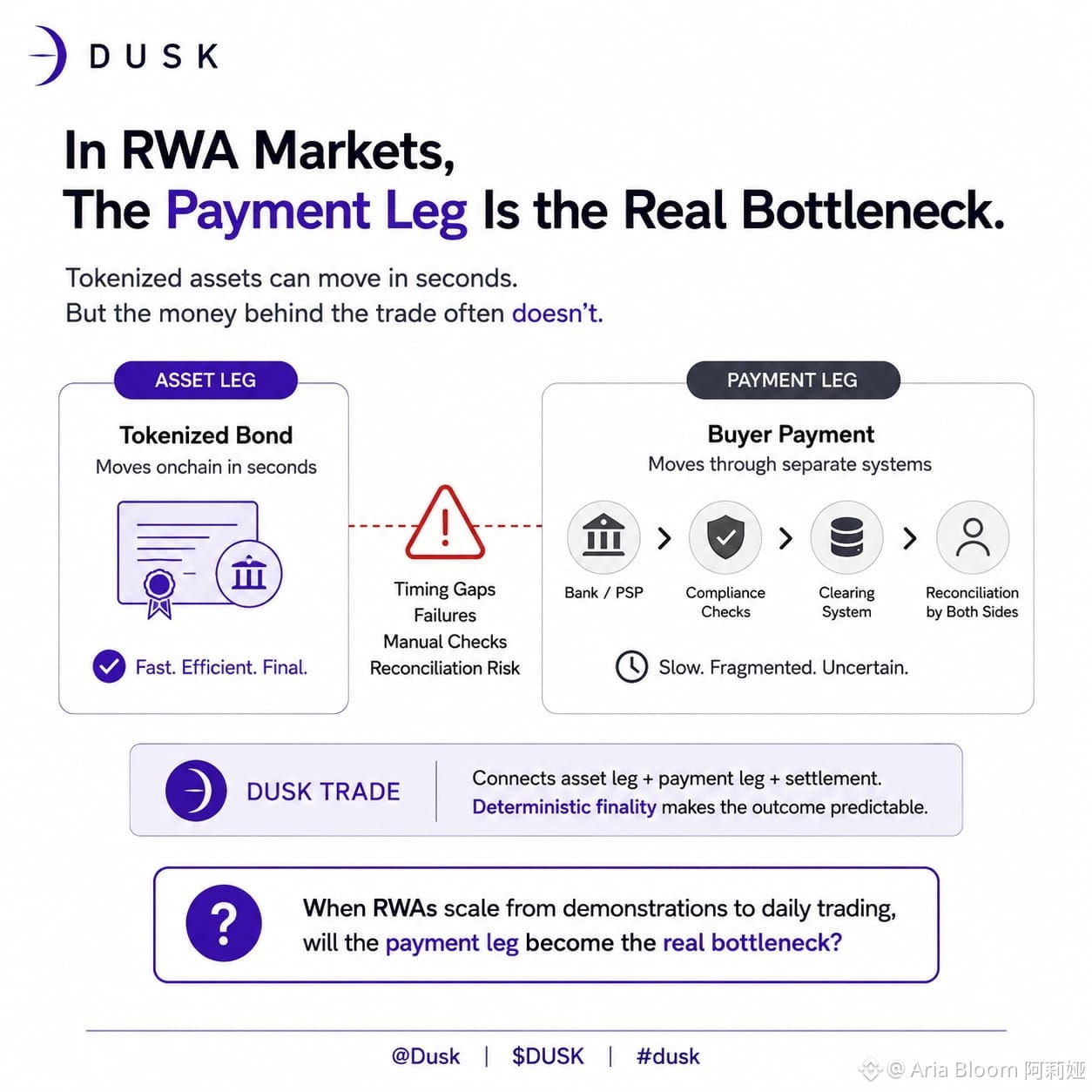
I keep seeing RWA tokenization discussed as if creating the asset is the hard part. I’m starting to think the payment leg may be where the real friction shows up.
Imagine a tokenized bond changing hands in seconds but the buyer’s payment still has to move through a separate system then both sides need to reconcile whether the asset and money actually settled together. The token is fast, but the transaction around it is still slow. That gap matters more as volumes grow because every extra handoff creates another place for timing mismatches failed payments or manual checks.
What caught my attention about Dusk is that its market infrastructure treats payment coordination as part of the workflow rather than something that can simply be ignored after tokenization. Its Dusk Trade design connects the asset leg with the payment leg and settlement process, while Dusk’s deterministic finality is meant to make the result predictable.
But there is a practical question here. A cleaner onchain settlement path only matters if the payment side can actually support the liquidity, compliance checks and user behaviour that real markets require. Otherwise we could end up with beautifully tokenized assets waiting on old financial rails.
So I’m curious when RWAs scale from demonstrations to daily trading will the payment leg become the real bottleneck?
I keep seeing RWA tokenization discussed as if creating the asset is the hard part. I’m starting to think the payment leg may be where the real friction shows up.
Imagine a tokenized bond changing hands in seconds but the buyer’s payment still has to move through a separate system then both sides need to reconcile whether the asset and money actually settled together. The token is fast, but the transaction around it is still slow. That gap matters more as volumes grow because every extra handoff creates another place for timing mismatches failed payments or manual checks.
What caught my attention about Dusk is that its market infrastructure treats payment coordination as part of the workflow rather than something that can simply be ignored after tokenization. Its Dusk Trade design connects the asset leg with the payment leg and settlement process, while Dusk’s deterministic finality is meant to make the result predictable.
But there is a practical question here. A cleaner onchain settlement path only matters if the payment side can actually support the liquidity, compliance checks and user behaviour that real markets require. Otherwise we could end up with beautifully tokenized assets waiting on old financial rails.
So I’m curious when RWAs scale from demonstrations to daily trading will the payment leg become the real bottleneck?
#dusk $DUSK @Dusk
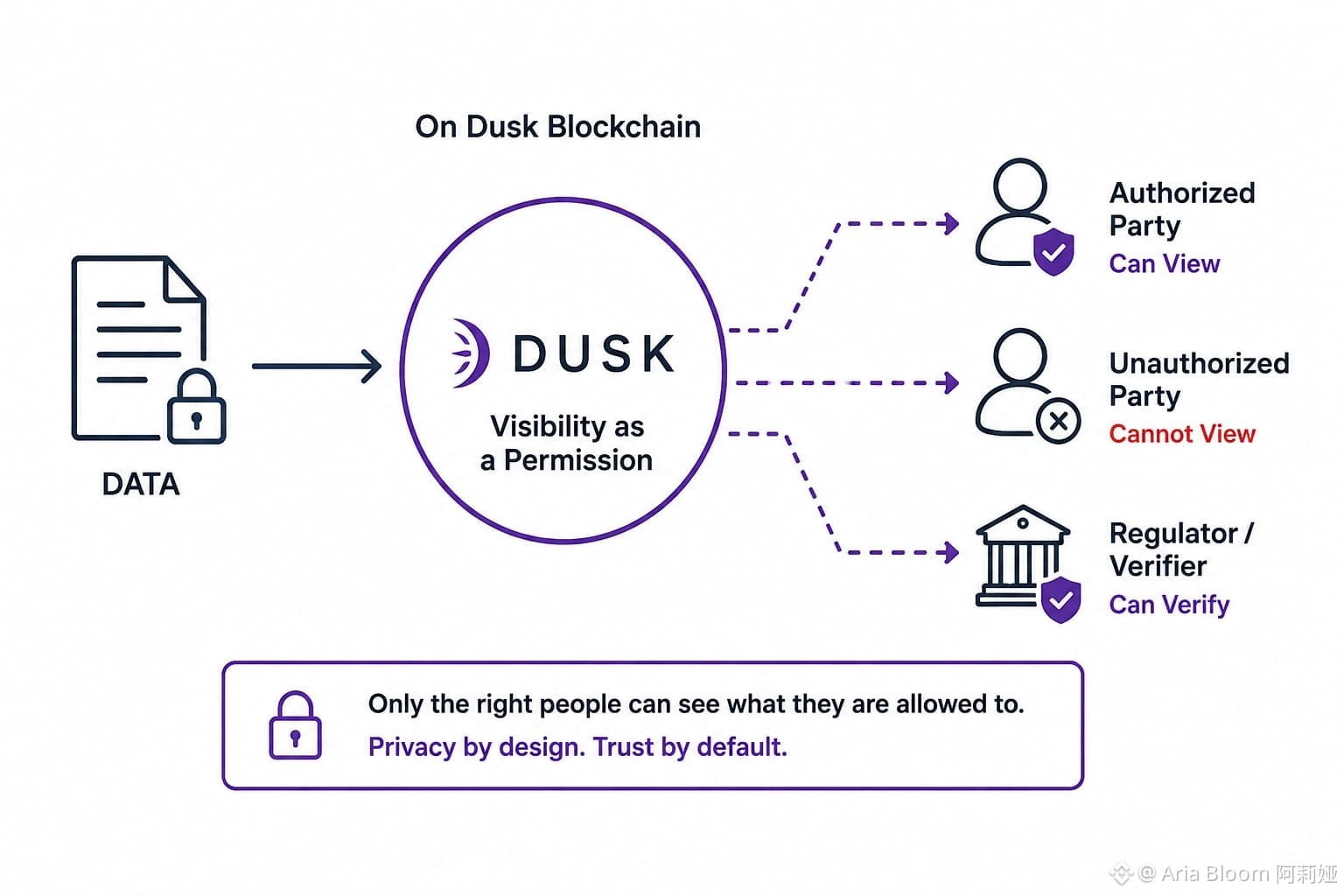
i used to think blockchain transparency meant everything should be visible by default. Dusk makes me question that assumption.
There are situations where proving something happened is enough while exposing every detail creates unnecessary risk. A business may need to prove that a transaction follows certain rules without revealing its entire financial history. A user may need to show they are eligible without handing over information that was never required in the first place.
That is where qDusk feels different to me. The interesting idea is not simply hiding data. It is treating visibility itself as something that can be controlled through permissions and cryptographic proofs.
Instead of asking whether information is public or private the better question becomes who actually needs to see it and what exactly do they need to verify?
That shift could make blockchain more practical for real financial and regulated applications. Privacy stops being an afterthought and becomes part of how the network works.
For me that is the bigger idea behind
i used to think blockchain transparency meant everything should be visible by default. Dusk makes me question that assumption.
There are situations where proving something happened is enough while exposing every detail creates unnecessary risk. A business may need to prove that a transaction follows certain rules without revealing its entire financial history. A user may need to show they are eligible without handing over information that was never required in the first place.
That is where qDusk feels different to me. The interesting idea is not simply hiding data. It is treating visibility itself as something that can be controlled through permissions and cryptographic proofs.
Instead of asking whether information is public or private the better question becomes who actually needs to see it and what exactly do they need to verify?
That shift could make blockchain more practical for real financial and regulated applications. Privacy stops being an afterthought and becomes part of how the network works.
For me that is the bigger idea behind
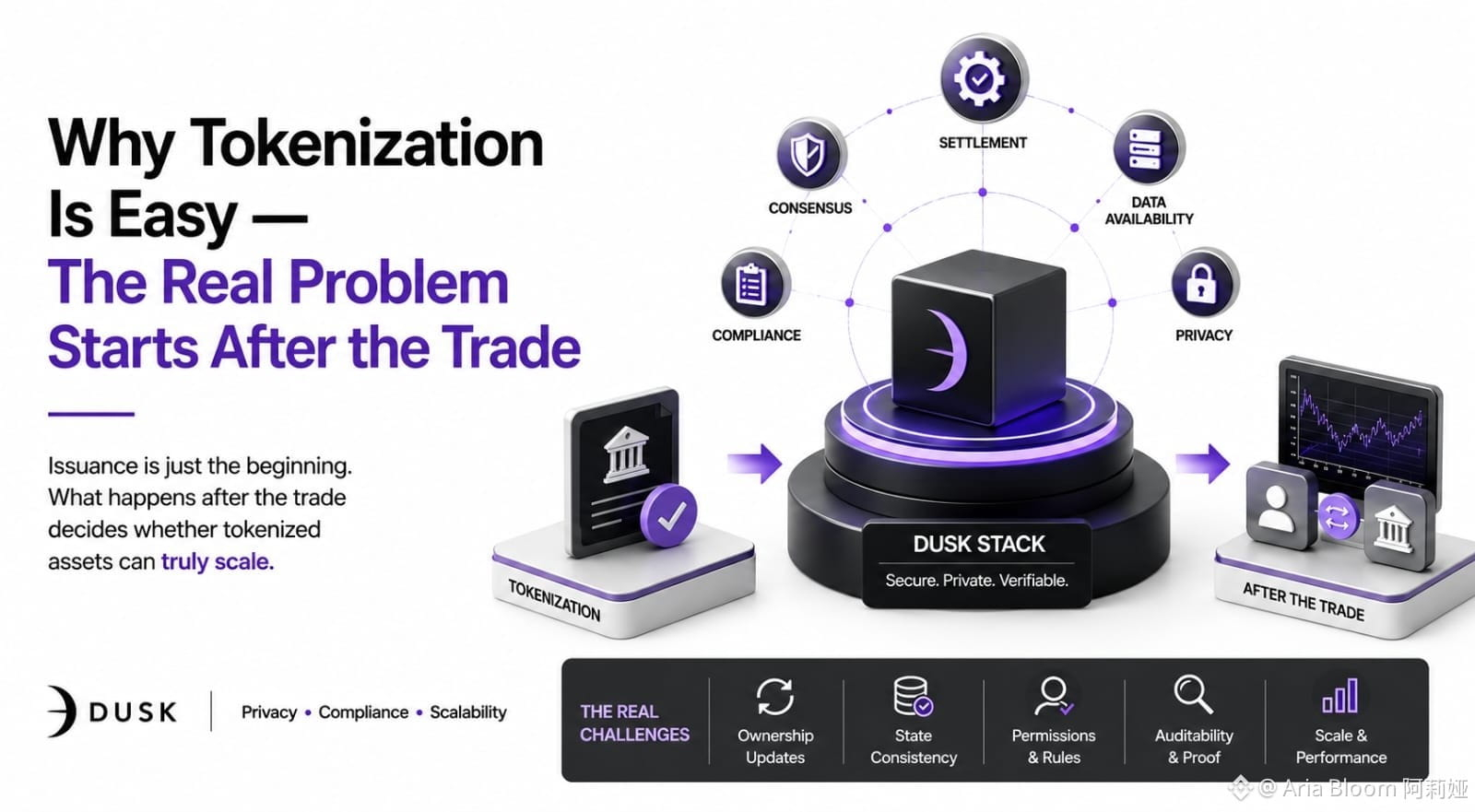
i used to think tokenizing an asset was mostly an issuance problem. Put the asset onchain give it a token let people trade it. But the more I look at what happens after the trade the less convincing that sounds.
Imagine a tokenized share changes hands ten times in one day. The difficult part is not recording ten transfers. It is keeping the ownership state settlement conditions permissions and related data consistent after every transfer. One broken assumption can create a gap between what the token says and what the system is actually supposed to recognize.
That is where I find Dusk more interesting than a simple tokenization story. DuskEVM gives developers a familiar EVM environment, while the underlying Dusk stack is designed to handle consensus, settlement and data availability. For me that separation matters because post trade infrastructure is where complexity starts piling up.
There is also a practical question around privacy. Financial assets cannot always expose every detail of every transaction publicly yet the system still needs enough information to verify that the right state was reached.
So I am less interested in how easily an asset can become a token, and more interested in what happens on transaction number 10000. Can Dusk keep that state reliable private and usable as activity scales?
#dusk $DUSK @Dusk
Imagine a tokenized share changes hands ten times in one day. The difficult part is not recording ten transfers. It is keeping the ownership state settlement conditions permissions and related data consistent after every transfer. One broken assumption can create a gap between what the token says and what the system is actually supposed to recognize.
That is where I find Dusk more interesting than a simple tokenization story. DuskEVM gives developers a familiar EVM environment, while the underlying Dusk stack is designed to handle consensus, settlement and data availability. For me that separation matters because post trade infrastructure is where complexity starts piling up.
There is also a practical question around privacy. Financial assets cannot always expose every detail of every transaction publicly yet the system still needs enough information to verify that the right state was reached.
So I am less interested in how easily an asset can become a token, and more interested in what happens on transaction number 10000. Can Dusk keep that state reliable private and usable as activity scales?
#dusk $DUSK @Dusk
Inicia sesión para explorar más contenidos