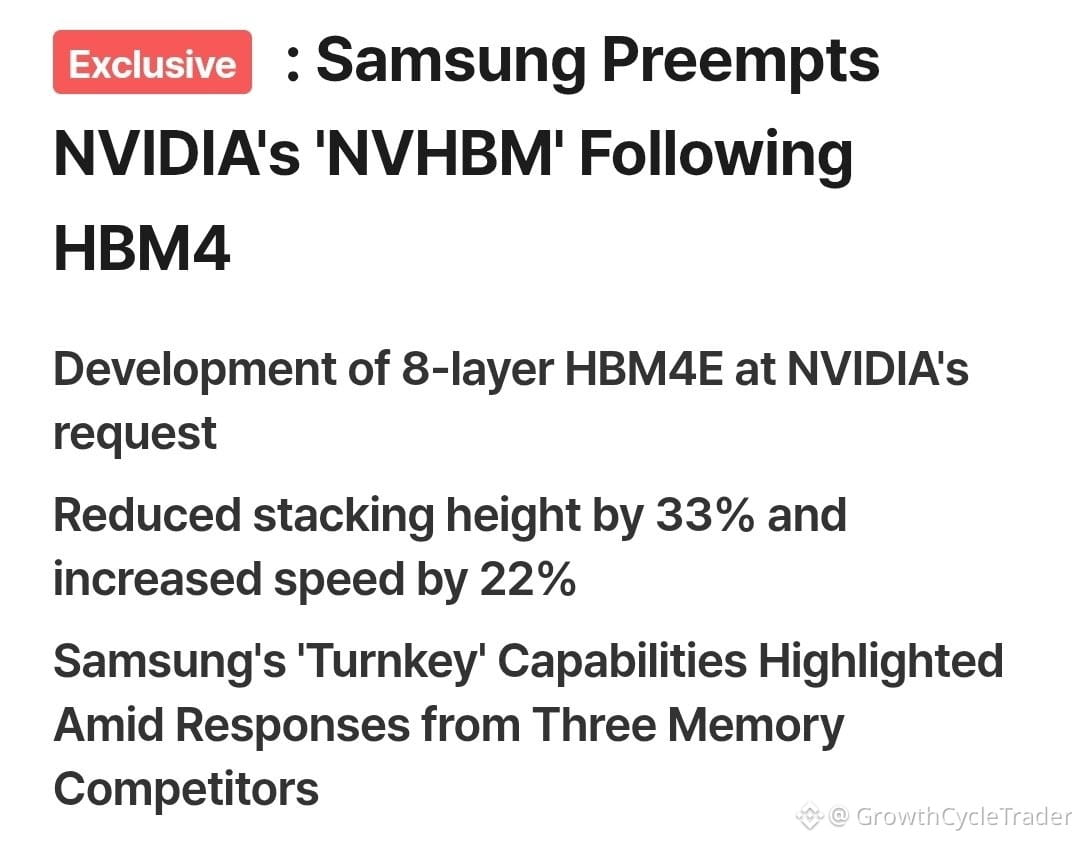
Samsung is moving first on $NVDA's custom NVHBM — and the spec is the opposite of what everyone expected.
Seoul Economic Daily reports Samsung is building an 8-high HBM4E stack at NVIDIA's request, not the 12-high or 16-high products it had prepared. Stack height is being cut by about 33%. Target speed is 17–18 Gbps, roughly 22% faster than Samsung's earlier 14.4 Gbps samples.
For years the race was to stack more layers and raise capacity. Taller stacks mean thinner dies, harder packaging, lower yields. An 8-high part is easier to manufacture and easier to ship in volume. NVIDIA appears to be trading some capacity per GPU for more units and higher pin speed.
The product is expected to land in Rubin Ultra, the next AI GPU generation. That platform is designed to scale GPU-to-GPU connections from 72 to as many as 576. Lower memory per chip can be offset by tying many faster GPUs together.
Samsung's edge here is turnkey capability. NVHBM needs both DRAM and a logic-based base die. Samsung can design and make both in-house. SK Hynix and Micron are also responding, but the report argues Samsung's foundry-plus-memory setup is better suited to a custom spec.
NVIDIA is not abandoning the three-supplier model. It is changing the spec: fewer layers, higher speed, and a custom interface. Volume and yield may matter more than maximum stack height in the next cycle.
How much of Rubin Ultra demand do you expect to land on 8-high NVHBM versus taller conventional HBM4E stacks?
Seoul Economic Daily reports Samsung is building an 8-high HBM4E stack at NVIDIA's request, not the 12-high or 16-high products it had prepared. Stack height is being cut by about 33%. Target speed is 17–18 Gbps, roughly 22% faster than Samsung's earlier 14.4 Gbps samples.
For years the race was to stack more layers and raise capacity. Taller stacks mean thinner dies, harder packaging, lower yields. An 8-high part is easier to manufacture and easier to ship in volume. NVIDIA appears to be trading some capacity per GPU for more units and higher pin speed.
The product is expected to land in Rubin Ultra, the next AI GPU generation. That platform is designed to scale GPU-to-GPU connections from 72 to as many as 576. Lower memory per chip can be offset by tying many faster GPUs together.
Samsung's edge here is turnkey capability. NVHBM needs both DRAM and a logic-based base die. Samsung can design and make both in-house. SK Hynix and Micron are also responding, but the report argues Samsung's foundry-plus-memory setup is better suited to a custom spec.
NVIDIA is not abandoning the three-supplier model. It is changing the spec: fewer layers, higher speed, and a custom interface. Volume and yield may matter more than maximum stack height in the next cycle.
How much of Rubin Ultra demand do you expect to land on 8-high NVHBM versus taller conventional HBM4E stacks?