I have a bad habit when I use crypto apps.
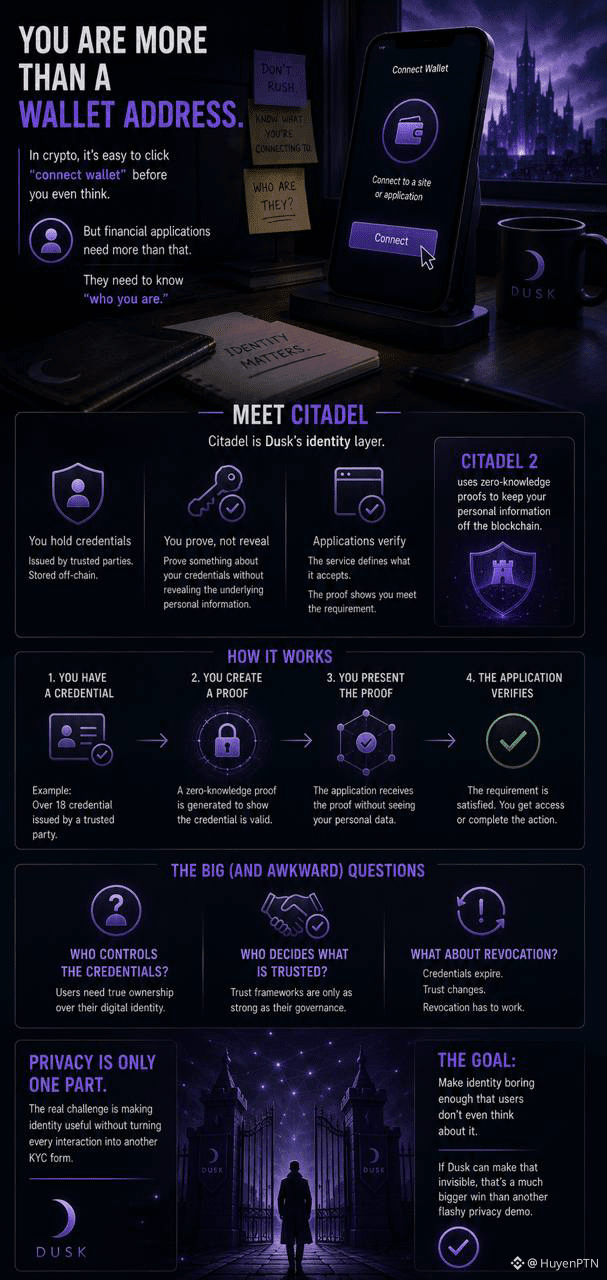
I usually click “connect wallet” before I even think about what I’m connecting to.
Probably not the best habit.
That got me thinking about Dusk’s approach to identity.
Because if Dusk wants financial applications to work on-chain, “who are you?” becomes a much bigger question than just knowing someone’s wallet address.
That’s where Citadel started making more sense to me.
The basic idea is that a user can hold credentials and later prove something about them without simply dumping all of the underlying personal information onto the blockchain.
Say an application needs to know that I’m eligible to use a service.
It doesn’t necessarily need my entire identity.
Dusk’s Citadel 2 uses zero-knowledge proofs to let users prove that a credential is valid while keeping the actual personal information off-chain. The service can define what it accepts, while the proof establishes that the requirement has been satisfied.
I like the direction.
But I also think there’s an awkward question hiding here.
Who controls the credentials?
Who decides which credentials are trusted?
And what happens when a credential needs to be revoked?
Those problems don’t disappear just because zero-knowledge proofs are involved.
That’s probably why I’m more interested in Dusk’s identity architecture than the usual “privacy” headline.
Privacy is only one part.
The harder part is making identity useful without turning every financial interaction into another giant KYC form.
If Dusk can make that boring process feel invisible to the user, I’d consider that a much bigger win than another flashy privacy demo.
#dusk $DUSK @Dusk
I usually click “connect wallet” before I even think about what I’m connecting to.
Probably not the best habit.
That got me thinking about Dusk’s approach to identity.
Because if Dusk wants financial applications to work on-chain, “who are you?” becomes a much bigger question than just knowing someone’s wallet address.
That’s where Citadel started making more sense to me.
The basic idea is that a user can hold credentials and later prove something about them without simply dumping all of the underlying personal information onto the blockchain.
Say an application needs to know that I’m eligible to use a service.
It doesn’t necessarily need my entire identity.
Dusk’s Citadel 2 uses zero-knowledge proofs to let users prove that a credential is valid while keeping the actual personal information off-chain. The service can define what it accepts, while the proof establishes that the requirement has been satisfied.
I like the direction.
But I also think there’s an awkward question hiding here.
Who controls the credentials?
Who decides which credentials are trusted?
And what happens when a credential needs to be revoked?
Those problems don’t disappear just because zero-knowledge proofs are involved.
That’s probably why I’m more interested in Dusk’s identity architecture than the usual “privacy” headline.
Privacy is only one part.
The harder part is making identity useful without turning every financial interaction into another giant KYC form.
If Dusk can make that boring process feel invisible to the user, I’d consider that a much bigger win than another flashy privacy demo.
#dusk $DUSK @Dusk