

#usjulyjobsunexpectedlyfall
usjulyjobsunexpectedlyfall
177,692 vistas
1,179 están debatiendo
Hot
Lo último

·
--
#USJulyJobsUnexpectedlyFall
🔥 #USJulyJobsUnexpectedlyFall — El mercado laboral de EE. UU. lanza una advertencia
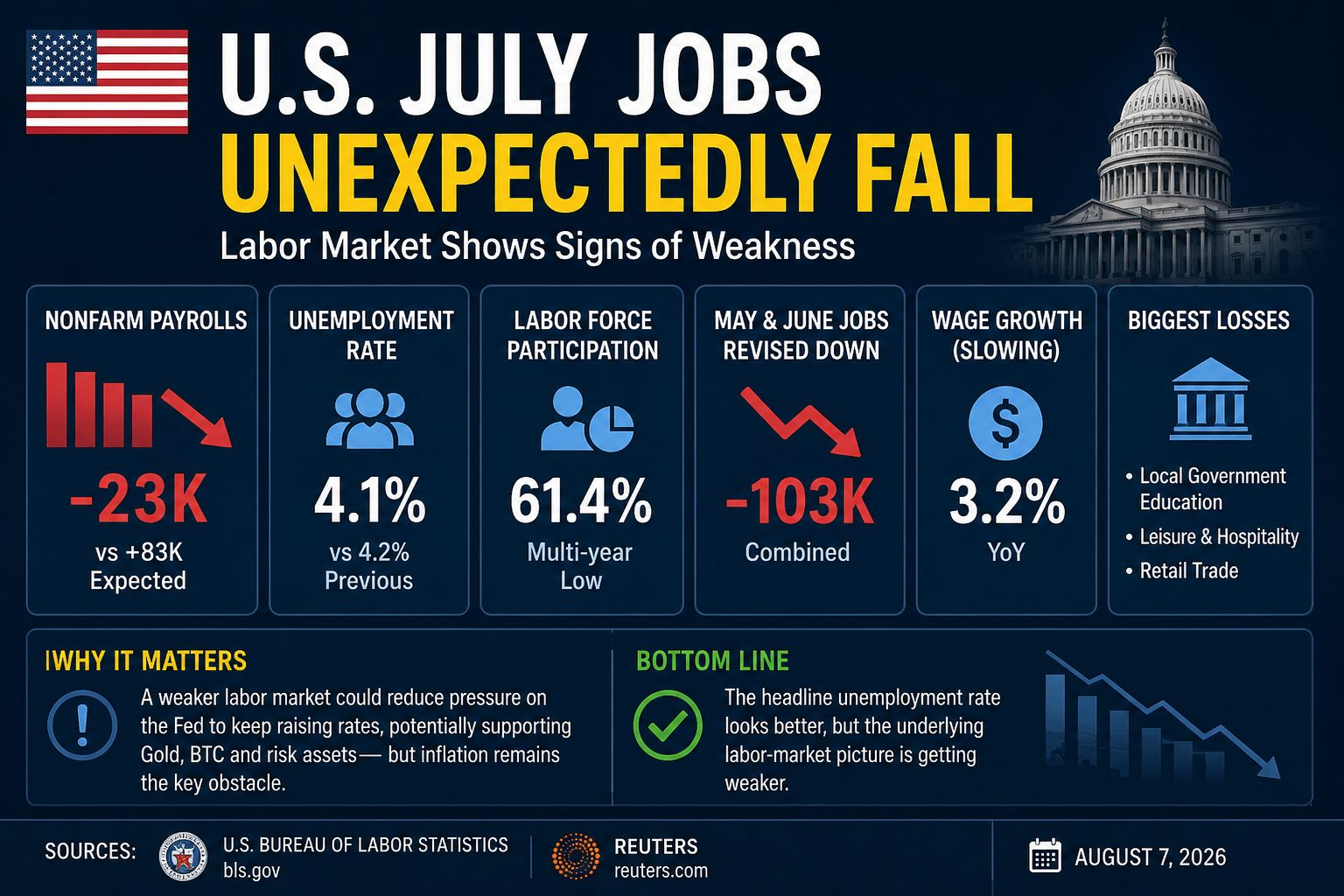
🇺🇸 Las nóminas de EE. UU. cayeron inesperadamente en 23,000 en julio, por debajo de las expectativas de alrededor de +83,000 empleos. Esto marca el primer descenso mensual del empleo en cinco meses.
📊 Cifras clave:
🔻 Nóminas: -23K
📉 Tasa de desempleo: 4.1% frente a 4.2%
👥 Participación en la fuerza laboral: 61.4%, el nivel más bajo de varios años
⚠️ Los empleos de mayo y junio se revisaron a la baja en 103K en conjunto
💰 El crecimiento salarial se desaceleró hasta alrededor de 3.2% interanual
🏛️ Mayores pérdidas: educación del gobierno local, ocio y hospitalidad, y minoristas
Por qué importa a los mercados:
Un mercado laboral más débil podría reducir la presión sobre la Fed para seguir subiendo las tasas, lo que potencialmente respaldaría el oro, el BTC y los activos de riesgo; pero la inflación sigue siendo el principal obstáculo.
📌 Conclusión: La tasa de desempleo general parece mejor, pero el panorama subyacente del mercado laboral se está debilitando.
#USJobs #NFP #Gold
#USJulyJobsUnexpectedlyFall
🔥 #USJulyJobsUnexpectedlyFall — El mercado laboral de EE. UU. lanza una advertencia
🇺🇸 Las nóminas de EE. UU. cayeron inesperadamente en 23,000 en julio, por debajo de las expectativas de alrededor de +83,000 empleos. Esto marca el primer descenso mensual del empleo en cinco meses.
📊 Cifras clave:
🔻 Nóminas: -23K
📉 Tasa de desempleo: 4.1% frente a 4.2%
👥 Participación en la fuerza laboral: 61.4%, el nivel más bajo de varios años
⚠️ Los empleos de mayo y junio se revisaron a la baja en 103K en conjunto
💰 El crecimiento salarial se desaceleró hasta alrededor de 3.2% interanual
🏛️ Mayores pérdidas: educación del gobierno local, ocio y hospitalidad, y minoristas
Por qué importa a los mercados:
Un mercado laboral más débil podría reducir la presión sobre la Fed para seguir subiendo las tasas, lo que potencialmente respaldaría el oro, el BTC y los activos de riesgo; pero la inflación sigue siendo el principal obstáculo.
📌 Conclusión: La tasa de desempleo general parece mejor, pero el panorama subyacente del mercado laboral se está debilitando.
#USJobs #NFP #Gold
🔥 #USJulyJobsUnexpectedlyFall — El mercado laboral de EE. UU. lanza una advertencia
🇺🇸 Las nóminas de EE. UU. cayeron inesperadamente en 23,000 en julio, por debajo de las expectativas de alrededor de +83,000 empleos. Esto marca el primer descenso mensual del empleo en cinco meses.
📊 Cifras clave:
🔻 Nóminas: -23K
📉 Tasa de desempleo: 4.1% frente a 4.2%
👥 Participación en la fuerza laboral: 61.4%, el nivel más bajo de varios años
⚠️ Los empleos de mayo y junio se revisaron a la baja en 103K en conjunto
💰 El crecimiento salarial se desaceleró hasta alrededor de 3.2% interanual
🏛️ Mayores pérdidas: educación del gobierno local, ocio y hospitalidad, y minoristas
Por qué importa a los mercados:
Un mercado laboral más débil podría reducir la presión sobre la Fed para seguir subiendo las tasas, lo que potencialmente respaldaría el oro, el BTC y los activos de riesgo; pero la inflación sigue siendo el principal obstáculo.
📌 Conclusión: La tasa de desempleo general parece mejor, pero el panorama subyacente del mercado laboral se está debilitando.
#USJobs #NFP #Gold
1
133

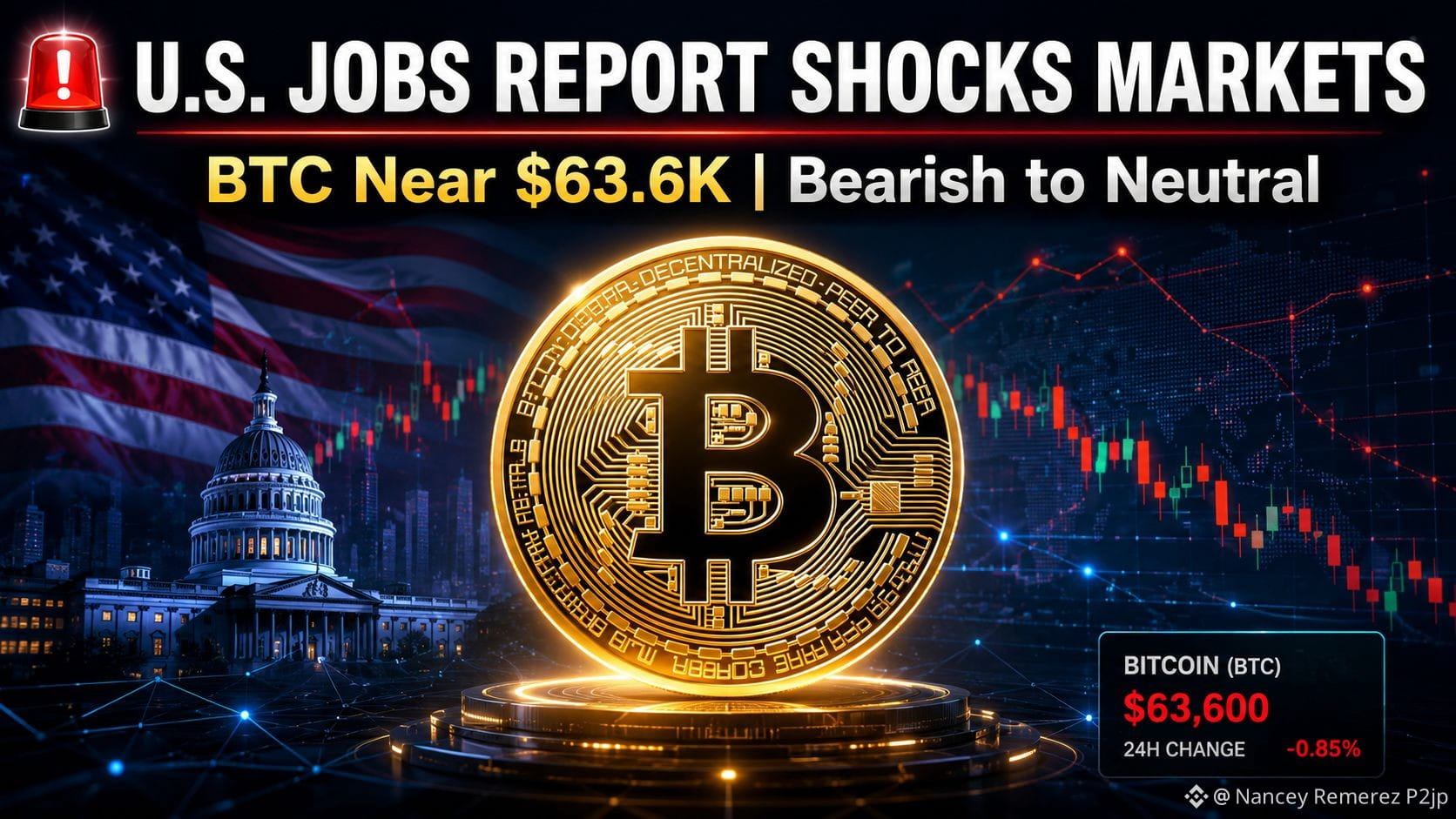
#USJulyJobsUnexpectedlyFall 🚨 "Los empleos de julio en EE. UU. caen inesperadamente." El mercado laboral de EE. UU. sorprendió a los economistas al perder 23.000 empleos en julio, elevando las expectativas de que la Reserva Federal pueda pausar los aumentos de tasas. Los datos laborales más débiles podrían aliviar la presión sobre las tasas de interés, algo que a menudo se ve como favorable para Bitcoin y las criptomonedas. Ahora, los traders observan los próximos datos de inflación como la próxima gran señal para el mercado. ¿Qué opinas? ¿Esto es alcista para Bitcoin? #NFP #USJulyJobsUnexpectedlyFall #bitcoin #CryptoNewss
#USJulyJobsUnexpectedlyFall 🚨 "Los empleos de julio en EE. UU. caen inesperadamente." El mercado laboral de EE. UU. sorprendió a los economistas al perder 23.000 empleos en julio, elevando las expectativas de que la Reserva Federal pueda pausar los aumentos de tasas. Los datos laborales más débiles podrían aliviar la presión sobre las tasas de interés, algo que a menudo se ve como favorable para Bitcoin y las criptomonedas. Ahora, los traders observan los próximos datos de inflación como la próxima gran señal para el mercado. ¿Qué opinas? ¿Esto es alcista para Bitcoin? #NFP #USJulyJobsUnexpectedlyFall #bitcoin #CryptoNewss
2
96

#USJulyJobsUnexpectedlyFall El mercado laboral de EE. UU. ofreció una sorpresa inesperada en julio de 2026, ya que la economía perdió alrededor de 23.000 empleos no agrícolas en lugar de añadir puestos de trabajo como habían previsto los economistas. Esto marcó la primera caída mensual del empleo en cinco meses y generó nuevas preocupaciones sobre la solidez de la economía estadounidense.
La debilidad se hizo especialmente visible en educación de gobiernos locales, ocio y hostelería, comercio minorista y actividades financieras. Al mismo tiempo, algunos sectores, como sanidad, construcción y manufactura, siguieron registrando modestos aumentos de empleo. Las cifras de empleo anteriores de mayo y junio también se revisaron significativamente a la baja, lo que hizo que el panorama general del mercado laboral fuera más débil de lo que se había informado inicialmente.
De manera interesante, la tasa de desempleo bajó ligeramente hasta el 4,1% desde el 4,2%. Sin embargo, esta caída estuvo vinculada en parte a una reducción en la tasa de participación en la fuerza laboral, que cayó hasta el 61,4%. El crecimiento salarial también se desaceleró hasta aproximadamente el 3,2% interanual.
Los datos más débiles sobre empleo podrían influir en las expectativas sobre la política de tipos de interés de la Reserva Federal. Los mercados han reducido las expectativas de una subida de tipos en septiembre tras el informe. Sin embargo, un mes débil no significa necesariamente que la economía de EE. UU. esté entrando en una recesión. Los inversores observarán de cerca los próximos datos sobre empleo, inflación y gasto de los consumidores para determinar si la debilidad de julio es temporal o parte de una desaceleración más amplia.
#USJulyJobsUnexpectedlyFall El mercado laboral de EE. UU. ofreció una sorpresa inesperada en julio de 2026, ya que la economía perdió alrededor de 23.000 empleos no agrícolas en lugar de añadir puestos de trabajo como habían previsto los economistas. Esto marcó la primera caída mensual del empleo en cinco meses y generó nuevas preocupaciones sobre la solidez de la economía estadounidense.
La debilidad se hizo especialmente visible en educación de gobiernos locales, ocio y hostelería, comercio minorista y actividades financieras. Al mismo tiempo, algunos sectores, como sanidad, construcción y manufactura, siguieron registrando modestos aumentos de empleo. Las cifras de empleo anteriores de mayo y junio también se revisaron significativamente a la baja, lo que hizo que el panorama general del mercado laboral fuera más débil de lo que se había informado inicialmente.
De manera interesante, la tasa de desempleo bajó ligeramente hasta el 4,1% desde el 4,2%. Sin embargo, esta caída estuvo vinculada en parte a una reducción en la tasa de participación en la fuerza laboral, que cayó hasta el 61,4%. El crecimiento salarial también se desaceleró hasta aproximadamente el 3,2% interanual.
Los datos más débiles sobre empleo podrían influir en las expectativas sobre la política de tipos de interés de la Reserva Federal. Los mercados han reducido las expectativas de una subida de tipos en septiembre tras el informe. Sin embargo, un mes débil no significa necesariamente que la economía de EE. UU. esté entrando en una recesión. Los inversores observarán de cerca los próximos datos sobre empleo, inflación y gasto de los consumidores para determinar si la debilidad de julio es temporal o parte de una desaceleración más amplia.
La debilidad se hizo especialmente visible en educación de gobiernos locales, ocio y hostelería, comercio minorista y actividades financieras. Al mismo tiempo, algunos sectores, como sanidad, construcción y manufactura, siguieron registrando modestos aumentos de empleo. Las cifras de empleo anteriores de mayo y junio también se revisaron significativamente a la baja, lo que hizo que el panorama general del mercado laboral fuera más débil de lo que se había informado inicialmente.
De manera interesante, la tasa de desempleo bajó ligeramente hasta el 4,1% desde el 4,2%. Sin embargo, esta caída estuvo vinculada en parte a una reducción en la tasa de participación en la fuerza laboral, que cayó hasta el 61,4%. El crecimiento salarial también se desaceleró hasta aproximadamente el 3,2% interanual.
Los datos más débiles sobre empleo podrían influir en las expectativas sobre la política de tipos de interés de la Reserva Federal. Los mercados han reducido las expectativas de una subida de tipos en septiembre tras el informe. Sin embargo, un mes débil no significa necesariamente que la economía de EE. UU. esté entrando en una recesión. Los inversores observarán de cerca los próximos datos sobre empleo, inflación y gasto de los consumidores para determinar si la debilidad de julio es temporal o parte de una desaceleración más amplia.
75

$BTC
{spot}(BTCUSDT)
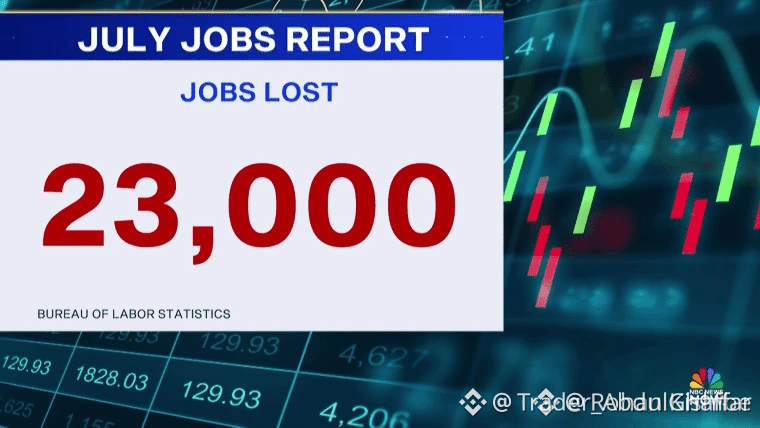
#USJulyJobsUnexpectedlyFall #SpaceXMayCompleteCursorDealAsEarlyAsNextWeekend #USSolarStocksRisePremarket #SKHynixToInvest19.1TWonInM17Plant #TSEPlansReReviewForMajorBusinessChanges Los empleadores de EE. UU. eliminaron 23.000 empleos en julio — la primera caída mensual desde febrero — frente a +80.000 esperados. Y la revisión fue más dura: mayo y junio se revisaron a la baja en un total de 103.000 empleos. Los economistas lo calificaron como una "sorpresa masiva".
🔍 Qué hay debajo de la superficie
El desempleo bajó a 4,1% (desde 4,2%) — pero por la razón equivocada: la participación en la fuerza laboral siguió cayendo (61,4%), lo que significa que menos personas incluso están buscando trabajo. Es la tasa de desempleo más baja en dos años, pero es una "publicación suave", según el portavoz de la Fed, Nick Timiraos.
El desglose importa: el sector privado en realidad añadió +30K empleos; toda la caída neta provino del gobierno (-53K, en su mayoría ruido estacional de la educación local). Así que esto se está enfriando, no colapsando (El desglose de Viral Patel — opinión personal, solo como referencia).Los salarios +3,2% interanual — todavía lo bastante rígidos como para mantener la inflación
$BTC
#USJulyJobsUnexpectedlyFall #SpaceXMayCompleteCursorDealAsEarlyAsNextWeekend #USSolarStocksRisePremarket #SKHynixToInvest19.1TWonInM17Plant #TSEPlansReReviewForMajorBusinessChanges Los empleadores de EE. UU. eliminaron 23.000 empleos en julio — la primera caída mensual desde febrero — frente a +80.000 esperados. Y la revisión fue más dura: mayo y junio se revisaron a la baja en un total de 103.000 empleos. Los economistas lo calificaron como una "sorpresa masiva".
🔍 Qué hay debajo de la superficie
El desempleo bajó a 4,1% (desde 4,2%) — pero por la razón equivocada: la participación en la fuerza laboral siguió cayendo (61,4%), lo que significa que menos personas incluso están buscando trabajo. Es la tasa de desempleo más baja en dos años, pero es una "publicación suave", según el portavoz de la Fed, Nick Timiraos.
El desglose importa: el sector privado en realidad añadió +30K empleos; toda la caída neta provino del gobierno (-53K, en su mayoría ruido estacional de la educación local). Así que esto se está enfriando, no colapsando (El desglose de Viral Patel — opinión personal, solo como referencia).Los salarios +3,2% interanual — todavía lo bastante rígidos como para mantener la inflación
#USJulyJobsUnexpectedlyFall #SpaceXMayCompleteCursorDealAsEarlyAsNextWeekend #USSolarStocksRisePremarket #SKHynixToInvest19.1TWonInM17Plant #TSEPlansReReviewForMajorBusinessChanges Los empleadores de EE. UU. eliminaron 23.000 empleos en julio — la primera caída mensual desde febrero — frente a +80.000 esperados. Y la revisión fue más dura: mayo y junio se revisaron a la baja en un total de 103.000 empleos. Los economistas lo calificaron como una "sorpresa masiva".
🔍 Qué hay debajo de la superficie
El desempleo bajó a 4,1% (desde 4,2%) — pero por la razón equivocada: la participación en la fuerza laboral siguió cayendo (61,4%), lo que significa que menos personas incluso están buscando trabajo. Es la tasa de desempleo más baja en dos años, pero es una "publicación suave", según el portavoz de la Fed, Nick Timiraos.
El desglose importa: el sector privado en realidad añadió +30K empleos; toda la caída neta provino del gobierno (-53K, en su mayoría ruido estacional de la educación local). Así que esto se está enfriando, no colapsando (El desglose de Viral Patel — opinión personal, solo como referencia).Los salarios +3,2% interanual — todavía lo bastante rígidos como para mantener la inflación
88

·
--
#usjulyjobsunexpectedlyfall
📊 Los empleos de EE. UU. caen inesperadamente en julio: impacto macro y perspectiva cripto
El mercado laboral de EE. UU. se enfrió inesperadamente: las nóminas no agrícolas de julio cayeron 23.000 frente a las expectativas de una ganancia de ~80.000. La contracción laboral ha impulsado expectativas de recortes de tipos, impulsando una postura de “risk-on” a corto plazo sobre los principales activos digitales.
$BTC
{spot}(BTCUSDT)
Volvió a subir por encima de la marca de 65.000 dólares tras el dato, ya que los traders ajustaron las expectativas de una política monetaria más flexible.
$ETH
{spot}(ETHUSDT)
Gana tracción alcista junto con los activos de mayor riesgo al aliviarse las condiciones de liquidez con el descenso de los rendimientos de los Bonos del Tesoro.
$SOL
{spot}(SOLUSDT)
Muestra un volumen de compra activo en niveles de soporte, beneficiado por la rotación de capital hacia ecosistemas “layer-1” de alta beta.
📌 Idea clave: El deterioro de los indicadores laborales incrementa las expectativas de flexibilización monetaria, brindando un viento de cola favorable de liquidez para los principales activos cripto. Mantén una gestión de riesgo estricta de cara a las próximas publicaciones del IPC.
#BTC #ETH #BinanceSquare
#usjulyjobsunexpectedlyfall
📊 Los empleos de EE. UU. caen inesperadamente en julio: impacto macro y perspectiva cripto
El mercado laboral de EE. UU. se enfrió inesperadamente: las nóminas no agrícolas de julio cayeron 23.000 frente a las expectativas de una ganancia de ~80.000. La contracción laboral ha impulsado expectativas de recortes de tipos, impulsando una postura de “risk-on” a corto plazo sobre los principales activos digitales.
$BTC
Volvió a subir por encima de la marca de 65.000 dólares tras el dato, ya que los traders ajustaron las expectativas de una política monetaria más flexible.
$ETH
Gana tracción alcista junto con los activos de mayor riesgo al aliviarse las condiciones de liquidez con el descenso de los rendimientos de los Bonos del Tesoro.
$SOL
Muestra un volumen de compra activo en niveles de soporte, beneficiado por la rotación de capital hacia ecosistemas “layer-1” de alta beta.
📌 Idea clave: El deterioro de los indicadores laborales incrementa las expectativas de flexibilización monetaria, brindando un viento de cola favorable de liquidez para los principales activos cripto. Mantén una gestión de riesgo estricta de cara a las próximas publicaciones del IPC.
#BTC #ETH #BinanceSquare
📊 Los empleos de EE. UU. caen inesperadamente en julio: impacto macro y perspectiva cripto
El mercado laboral de EE. UU. se enfrió inesperadamente: las nóminas no agrícolas de julio cayeron 23.000 frente a las expectativas de una ganancia de ~80.000. La contracción laboral ha impulsado expectativas de recortes de tipos, impulsando una postura de “risk-on” a corto plazo sobre los principales activos digitales.
$BTC
Volvió a subir por encima de la marca de 65.000 dólares tras el dato, ya que los traders ajustaron las expectativas de una política monetaria más flexible.
$ETH
Gana tracción alcista junto con los activos de mayor riesgo al aliviarse las condiciones de liquidez con el descenso de los rendimientos de los Bonos del Tesoro.
$SOL
Muestra un volumen de compra activo en niveles de soporte, beneficiado por la rotación de capital hacia ecosistemas “layer-1” de alta beta.
📌 Idea clave: El deterioro de los indicadores laborales incrementa las expectativas de flexibilización monetaria, brindando un viento de cola favorable de liquidez para los principales activos cripto. Mantén una gestión de riesgo estricta de cara a las próximas publicaciones del IPC.
#BTC #ETH #BinanceSquare

92

#USJulyJobsUnexpectedlyFall
🇺🇸 INFORME DE EMPLEO DE EE. UU. ACABA DE SALIR — Y FUE MÁS DÉBIL DE LO ESPERADO
El mercado laboral de EE. UU. acaba de sorprender al mercado.
📉 Nóminas no agrícolas de julio: -23K
📊 Se esperaba: +80K a +85K
🔻 Los meses anteriores también se revisaron a la baja en alrededor de 103K empleos
A primera vista, esto parece negativo para la economía de EE. UU.
Pero para los traders de cripto, hay otra cara de la historia 👀
Un mercado laboral más débil podría aumentar las expectativas de una Reserva Federal más “dovish” (más laxa), lo que eventualmente puede significar tasas más bajas y condiciones financieras más fáciles.
Eso puede ser positivo para el BTC y otros activos de riesgo.
⚠️ Pero no se emocionen todavía.
Los datos de inflación siguen siendo extremadamente importantes, y la Fed estará observando si el empleo más débil se está convirtiendo en un frenazo económico real.
Mi opinión:
Empleos débiles = potencialmente alcista para cripto 📈
Pero se necesita confirmación de inflación + expectativas de la Fed.
#Bitcoin #BTC #Crypto #Fed #USJobs #NFP #Binance #CryptoMarket
#USJulyJobsUnexpectedlyFall
🇺🇸 INFORME DE EMPLEO DE EE. UU. ACABA DE SALIR — Y FUE MÁS DÉBIL DE LO ESPERADO
El mercado laboral de EE. UU. acaba de sorprender al mercado.
📉 Nóminas no agrícolas de julio: -23K
📊 Se esperaba: +80K a +85K
🔻 Los meses anteriores también se revisaron a la baja en alrededor de 103K empleos
A primera vista, esto parece negativo para la economía de EE. UU.
Pero para los traders de cripto, hay otra cara de la historia 👀
Un mercado laboral más débil podría aumentar las expectativas de una Reserva Federal más “dovish” (más laxa), lo que eventualmente puede significar tasas más bajas y condiciones financieras más fáciles.
Eso puede ser positivo para el BTC y otros activos de riesgo.
⚠️ Pero no se emocionen todavía.
Los datos de inflación siguen siendo extremadamente importantes, y la Fed estará observando si el empleo más débil se está convirtiendo en un frenazo económico real.
Mi opinión:
Empleos débiles = potencialmente alcista para cripto 📈
Pero se necesita confirmación de inflación + expectativas de la Fed.
#Bitcoin #BTC #Crypto #Fed #USJobs #NFP #Binance #CryptoMarket
🇺🇸 INFORME DE EMPLEO DE EE. UU. ACABA DE SALIR — Y FUE MÁS DÉBIL DE LO ESPERADO
El mercado laboral de EE. UU. acaba de sorprender al mercado.
📉 Nóminas no agrícolas de julio: -23K
📊 Se esperaba: +80K a +85K
🔻 Los meses anteriores también se revisaron a la baja en alrededor de 103K empleos
A primera vista, esto parece negativo para la economía de EE. UU.
Pero para los traders de cripto, hay otra cara de la historia 👀
Un mercado laboral más débil podría aumentar las expectativas de una Reserva Federal más “dovish” (más laxa), lo que eventualmente puede significar tasas más bajas y condiciones financieras más fáciles.
Eso puede ser positivo para el BTC y otros activos de riesgo.
⚠️ Pero no se emocionen todavía.
Los datos de inflación siguen siendo extremadamente importantes, y la Fed estará observando si el empleo más débil se está convirtiendo en un frenazo económico real.
Mi opinión:
Empleos débiles = potencialmente alcista para cripto 📈
Pero se necesita confirmación de inflación + expectativas de la Fed.
#Bitcoin #BTC #Crypto #Fed #USJobs #NFP #Binance #CryptoMarket
74

#USJulyJobsUnexpectedlyFall
🚨 Los mercados del mercado laboral de EE. UU. sufren shocks con la primera pérdida de empleo en cinco meses.
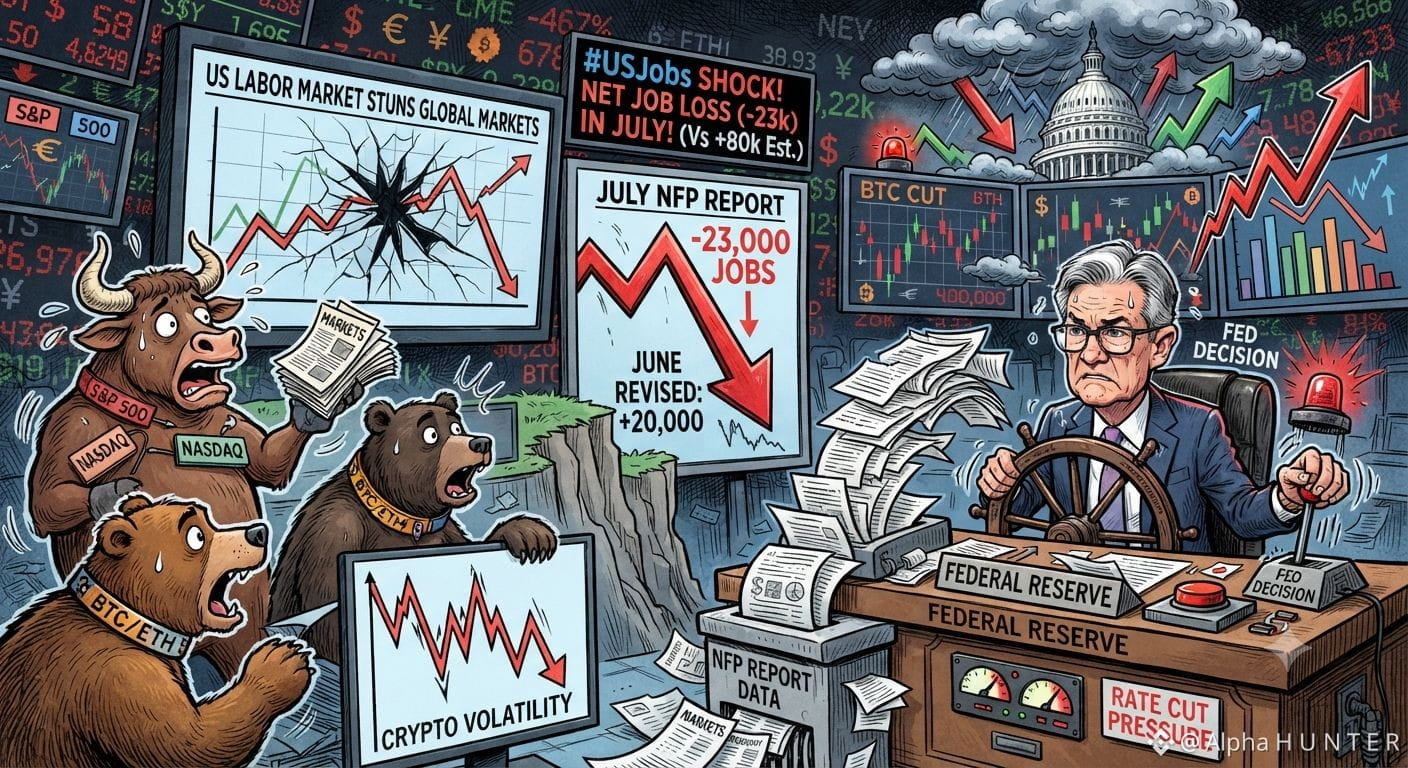
El último informe de Nóminas No Agrícolas (Nonfarm Payrolls) de EE. UU. para julio trajo una gran sorpresa: reveló una pérdida neta de 23.000 empleos, quedando muy por debajo de lo esperado para ~80.000 puestos nuevos. Mientras tanto, las cifras de junio fueron revisadas a la baja de forma considerable, hasta quedar en apenas +20.000.
A pesar de que la tasa oficial de desempleo bajó a 4,1% y el crecimiento salarial se mantuvo en 3,2% interanual, los datos subyacentes señalan una pérdida notable de dinamismo económico. Un mercado laboral más débil incrementa con fuerza la presión sobre la Reserva Federal respecto a los próximos recortes de tasas de interés, impulsando una mayor volatilidad en los mercados tradicionales y de cripto. ¡Mantente alerta! 📉📊
#USJobs #Macroeconomics #Crypto #Fed
$CYS
{future}(CYSUSDT)
$CAP
{future}(CAPUSDT)
$SKYAI
{future}(SKYAIUSDT)
#USJulyJobsUnexpectedlyFall
🚨 Los mercados del mercado laboral de EE. UU. sufren shocks con la primera pérdida de empleo en cinco meses.
El último informe de Nóminas No Agrícolas (Nonfarm Payrolls) de EE. UU. para julio trajo una gran sorpresa: reveló una pérdida neta de 23.000 empleos, quedando muy por debajo de lo esperado para ~80.000 puestos nuevos. Mientras tanto, las cifras de junio fueron revisadas a la baja de forma considerable, hasta quedar en apenas +20.000.
A pesar de que la tasa oficial de desempleo bajó a 4,1% y el crecimiento salarial se mantuvo en 3,2% interanual, los datos subyacentes señalan una pérdida notable de dinamismo económico. Un mercado laboral más débil incrementa con fuerza la presión sobre la Reserva Federal respecto a los próximos recortes de tasas de interés, impulsando una mayor volatilidad en los mercados tradicionales y de cripto. ¡Mantente alerta! 📉📊
#USJobs #Macroeconomics #Crypto #Fed
$CYS
$CAP
$SKYAI
🚨 Los mercados del mercado laboral de EE. UU. sufren shocks con la primera pérdida de empleo en cinco meses.
El último informe de Nóminas No Agrícolas (Nonfarm Payrolls) de EE. UU. para julio trajo una gran sorpresa: reveló una pérdida neta de 23.000 empleos, quedando muy por debajo de lo esperado para ~80.000 puestos nuevos. Mientras tanto, las cifras de junio fueron revisadas a la baja de forma considerable, hasta quedar en apenas +20.000.
A pesar de que la tasa oficial de desempleo bajó a 4,1% y el crecimiento salarial se mantuvo en 3,2% interanual, los datos subyacentes señalan una pérdida notable de dinamismo económico. Un mercado laboral más débil incrementa con fuerza la presión sobre la Reserva Federal respecto a los próximos recortes de tasas de interés, impulsando una mayor volatilidad en los mercados tradicionales y de cripto. ¡Mantente alerta! 📉📊
#USJobs #Macroeconomics #Crypto #Fed
$CYS
$CAP
$SKYAI
1
537

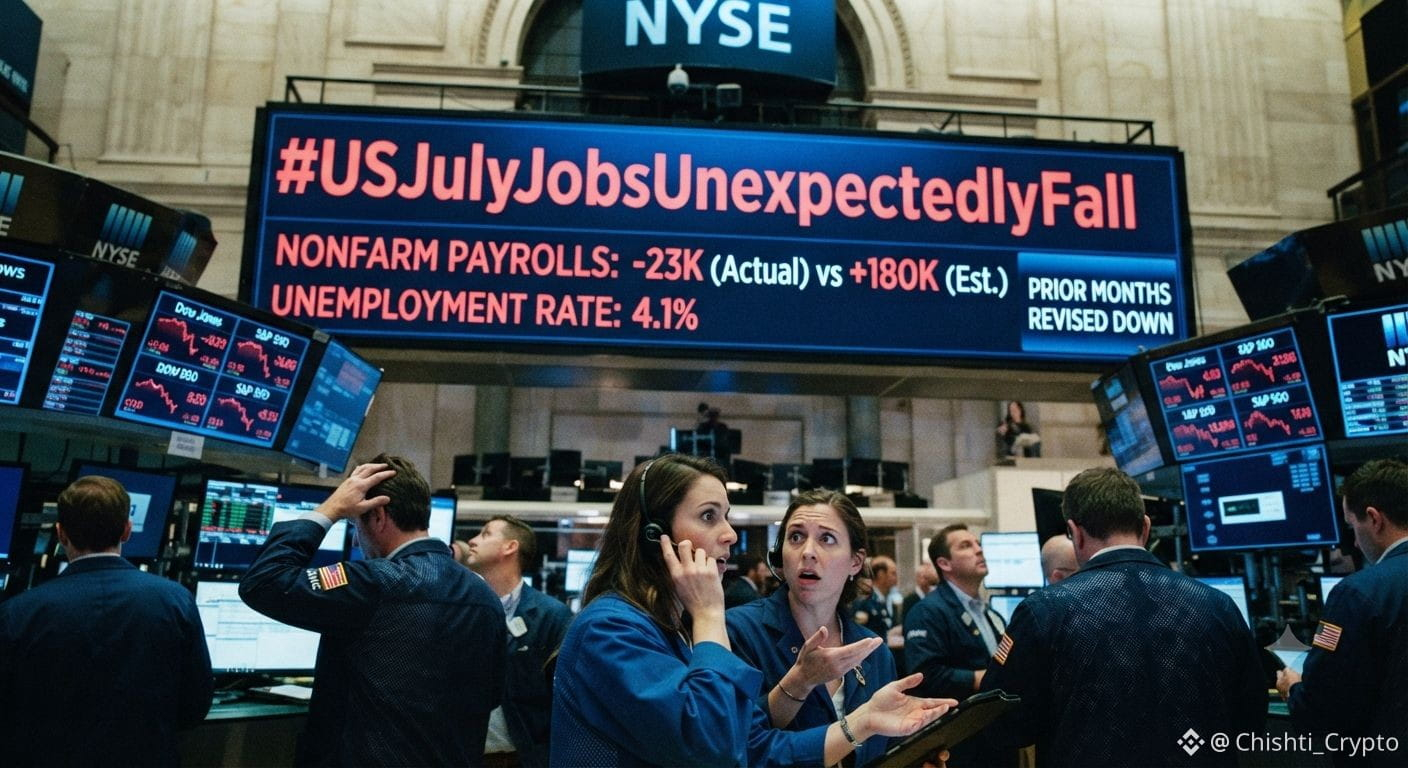
#USJulyJobsUnexpectedlyFall El mercado laboral de EE. UU. acaba de entregar un enorme golpe de onda. #USJulyJobsUnexpectedlyFall
Las nóminas no agrícolas cayeron inesperadamente en 23.000 empleos en julio, fallando las expectativas por completo, mientras que los meses previos registraron fuertes revisiones a la baja. Aunque la tasa de desempleo general bajó hasta el 4,1%, fue en gran medida impulsada por una caída en la tasa de participación de la fuerza laboral, ya que los trabajadores salieron del grupo.
Esta repentina pérdida de impulso altera por completo el relato macroeconómico. Con la contratación desacelerándose y aumentando la fricción económica, crece la presión sobre la Reserva Federal para que cambie su postura, lo que arrastra a la baja los rendimientos de los bonos del Tesoro y el dólar estadounidense.
¿Se trata de una fase de enfriamiento temporal o el inicio de una desaceleración económica más amplia? Los mercados reaccionan rápido: se esperan niveles altos de volatilidad por delante.
#USSolarStocksRisePremarket #SKHynixToInvest19.1TWonInM17Plant #TSEPlansReReviewForMajorBusinessChanges
$BTC
{spot}(BTCUSDT)
$ETH
{spot}(ETHUSDT)
$BNB
{spot}(BNBUSDT)
#USJulyJobsUnexpectedlyFall El mercado laboral de EE. UU. acaba de entregar un enorme golpe de onda. #USJulyJobsUnexpectedlyFall
Las nóminas no agrícolas cayeron inesperadamente en 23.000 empleos en julio, fallando las expectativas por completo, mientras que los meses previos registraron fuertes revisiones a la baja. Aunque la tasa de desempleo general bajó hasta el 4,1%, fue en gran medida impulsada por una caída en la tasa de participación de la fuerza laboral, ya que los trabajadores salieron del grupo.
Esta repentina pérdida de impulso altera por completo el relato macroeconómico. Con la contratación desacelerándose y aumentando la fricción económica, crece la presión sobre la Reserva Federal para que cambie su postura, lo que arrastra a la baja los rendimientos de los bonos del Tesoro y el dólar estadounidense.
¿Se trata de una fase de enfriamiento temporal o el inicio de una desaceleración económica más amplia? Los mercados reaccionan rápido: se esperan niveles altos de volatilidad por delante.
#USSolarStocksRisePremarket #SKHynixToInvest19.1TWonInM17Plant #TSEPlansReReviewForMajorBusinessChanges
$BTC
$ETH
$BNB
Las nóminas no agrícolas cayeron inesperadamente en 23.000 empleos en julio, fallando las expectativas por completo, mientras que los meses previos registraron fuertes revisiones a la baja. Aunque la tasa de desempleo general bajó hasta el 4,1%, fue en gran medida impulsada por una caída en la tasa de participación de la fuerza laboral, ya que los trabajadores salieron del grupo.
Esta repentina pérdida de impulso altera por completo el relato macroeconómico. Con la contratación desacelerándose y aumentando la fricción económica, crece la presión sobre la Reserva Federal para que cambie su postura, lo que arrastra a la baja los rendimientos de los bonos del Tesoro y el dólar estadounidense.
¿Se trata de una fase de enfriamiento temporal o el inicio de una desaceleración económica más amplia? Los mercados reaccionan rápido: se esperan niveles altos de volatilidad por delante.
#USSolarStocksRisePremarket #SKHynixToInvest19.1TWonInM17Plant #TSEPlansReReviewForMajorBusinessChanges
$BTC
$ETH
$BNB
80

·
--
Alcista
Verificado
El mercado laboral de EE. UU. dio una sorpresa en julio: las nóminas no agrícolas cayeron en 23.000 empleos, lo que marca la primera contracción mensual en cinco meses. La tasa de desempleo apenas bajó hasta el 4.1%, pero principalmente porque menos personas permanecieron en la fuerza laboral.
El informe, más débil de lo esperado, ha suscitado preocupaciones sobre una desaceleración del ritmo de contratación y ha reducido las expectativas de una próxima subida de tasas por parte de la Reserva Federal en el corto plazo.
Conclusión para el mercado: un mercado laboral estadounidense más débil podría influir en el USD, los rendimientos de los Treasury, las acciones, el oro y los mercados de cripto, mientras los inversores recalibran el próximo movimiento de la Fed.
(Fuente: blsgov | reuters)
No es asesoramiento financiero. #NFA #USJulyJobsUnexpectedlyFall
El mercado laboral de EE. UU. dio una sorpresa en julio: las nóminas no agrícolas cayeron en 23.000 empleos, lo que marca la primera contracción mensual en cinco meses. La tasa de desempleo apenas bajó hasta el 4.1%, pero principalmente porque menos personas permanecieron en la fuerza laboral.
El informe, más débil de lo esperado, ha suscitado preocupaciones sobre una desaceleración del ritmo de contratación y ha reducido las expectativas de una próxima subida de tasas por parte de la Reserva Federal en el corto plazo.
Conclusión para el mercado: un mercado laboral estadounidense más débil podría influir en el USD, los rendimientos de los Treasury, las acciones, el oro y los mercados de cripto, mientras los inversores recalibran el próximo movimiento de la Fed.
(Fuente: blsgov | reuters)
No es asesoramiento financiero. #NFA #USJulyJobsUnexpectedlyFall
El informe, más débil de lo esperado, ha suscitado preocupaciones sobre una desaceleración del ritmo de contratación y ha reducido las expectativas de una próxima subida de tasas por parte de la Reserva Federal en el corto plazo.
Conclusión para el mercado: un mercado laboral estadounidense más débil podría influir en el USD, los rendimientos de los Treasury, las acciones, el oro y los mercados de cripto, mientras los inversores recalibran el próximo movimiento de la Fed.
(Fuente: blsgov | reuters)
No es asesoramiento financiero. #NFA #USJulyJobsUnexpectedlyFall

3
190

·
--
Alcista
#usjulyjobsunexpectedlyfall
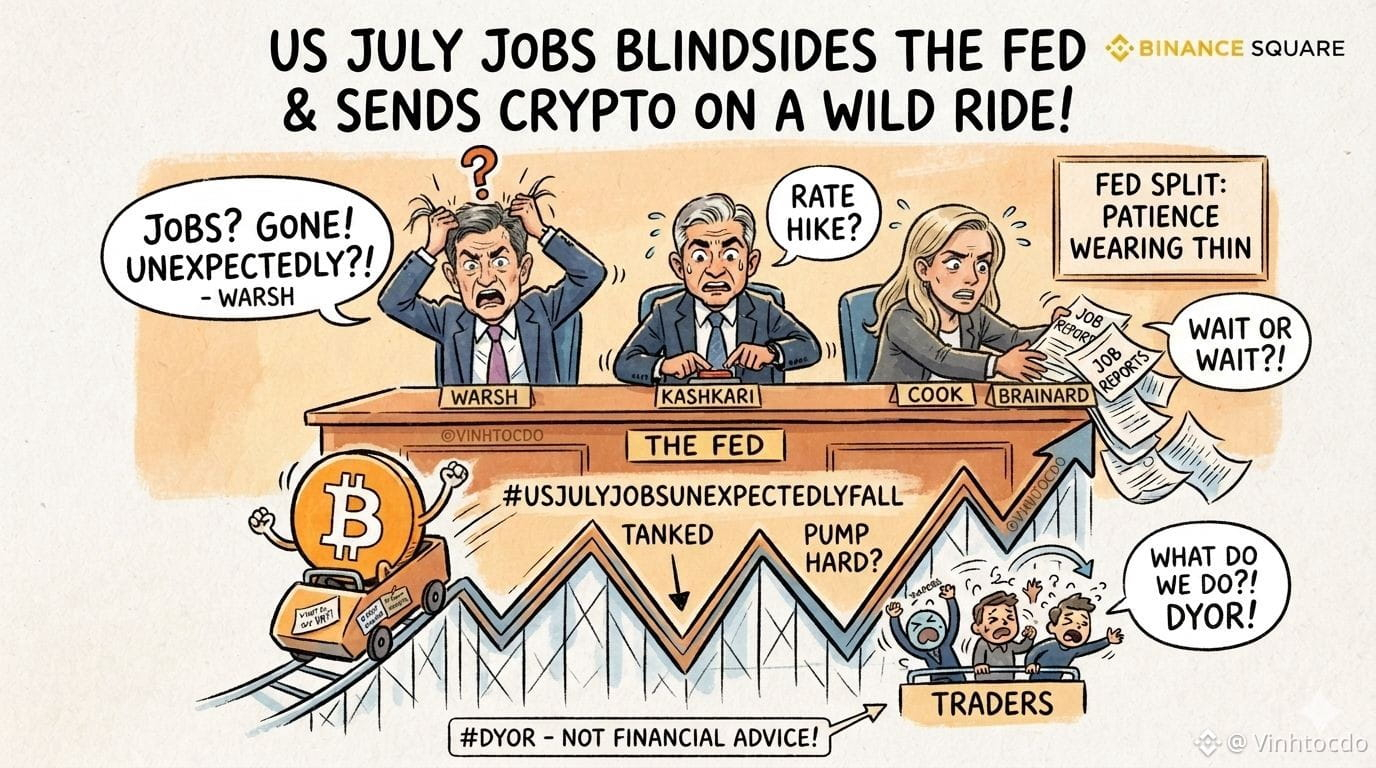
A todos nos dejaron con la guardia baja por #usjulyjobsinesperadamente en caída! 🤯 Exageramos demasiado las expectativas con informes de empleo previos, pero ¡boom! El sector público, el ocio y la hostelería se desplomaron fuerte.
Entonces, ¿ahora el cripto podría dispararse con fuerza? 🚀 Si bajan los empleos, los que suben las tasas de la Fed podrían perder paciencia, pero la Fed está profundamente dividida sobre las tasas tras años de inflación alta. Este caos normalmente desata una volatilidad extrema.
¿Qué deberían hacer los traders? Ajusten el cinturón, gestionen el riesgo y no caigan en el FOMO. Usa mi código de referidos VINHTOCDO si eres nuevo. ¡DYOR, no es asesoramiento financiero! 🤫
#FedSplit #InflationPatience #CryptoVolatility #VINHTOCDO
$BTC
{future}(BTCUSDT)
$ETH
{future}(ETHUSDT)
$SAFE
{future}(SAFEUSDT)
#usjulyjobsunexpectedlyfall
A todos nos dejaron con la guardia baja por #usjulyjobsinesperadamente en caída! 🤯 Exageramos demasiado las expectativas con informes de empleo previos, pero ¡boom! El sector público, el ocio y la hostelería se desplomaron fuerte.
Entonces, ¿ahora el cripto podría dispararse con fuerza? 🚀 Si bajan los empleos, los que suben las tasas de la Fed podrían perder paciencia, pero la Fed está profundamente dividida sobre las tasas tras años de inflación alta. Este caos normalmente desata una volatilidad extrema.
¿Qué deberían hacer los traders? Ajusten el cinturón, gestionen el riesgo y no caigan en el FOMO. Usa mi código de referidos VINHTOCDO si eres nuevo. ¡DYOR, no es asesoramiento financiero! 🤫
#FedSplit #InflationPatience #CryptoVolatility #VINHTOCDO
$BTC
$ETH
$SAFE
A todos nos dejaron con la guardia baja por #usjulyjobsinesperadamente en caída! 🤯 Exageramos demasiado las expectativas con informes de empleo previos, pero ¡boom! El sector público, el ocio y la hostelería se desplomaron fuerte.
Entonces, ¿ahora el cripto podría dispararse con fuerza? 🚀 Si bajan los empleos, los que suben las tasas de la Fed podrían perder paciencia, pero la Fed está profundamente dividida sobre las tasas tras años de inflación alta. Este caos normalmente desata una volatilidad extrema.
¿Qué deberían hacer los traders? Ajusten el cinturón, gestionen el riesgo y no caigan en el FOMO. Usa mi código de referidos VINHTOCDO si eres nuevo. ¡DYOR, no es asesoramiento financiero! 🤫
#FedSplit #InflationPatience #CryptoVolatility #VINHTOCDO
$BTC
$ETH
$SAFE
4
1.4k

·
--
Alcista
#USJulyJobsUnexpectedlyFall $ETH
{spot}(ETHUSDT)
🚨 LOS TRABAJOS EN EE. UU. ACABAN DE TRAER UNA GRAN SORPRESA
🇺🇸 La economía de EE. UU. perdió 23.000 empleos en julio, aunque los economistas esperaban crecimiento del empleo.
Aún más importante: los meses anteriores se revisaron drásticamente a la baja, con mayo y junio revisados en conjunto por -103.000 empleos. Mientras tanto, el desempleo bajó hasta el 4,1%, pero la tasa de participación en la fuerza laboral cayó al 61,4%. (Reuters)
🔥 Por qué los traders de cripto deberían prestar atención:
Un mercado laboral más débil puede cambiar las expectativas sobre la Reserva Federal y las tasas de interés. Los mercados ya han reducido las expectativas de una subida de tipos en septiembre tras el informe. (Reuters)
Esto NO es una señal automática de recesión — pero sí es un dato que la Fed y los mercados no pueden ignorar.
👀 Próximo a mirar: expectativas de la Fed • rendimientos de EE. UU. • DXY • BTC • Oro
¿Crees que los datos de empleo más débiles son ALCISTAS o BAJISTAS para Bitcoin? 👇
🔔 Sigue a JALILORD9 para actualizaciones rápidas de macro + mercados cripto.
#USJulyJobsUnexpectedlyFall #Bitcoin #BTC #Crypto #Fed #JobsReport #Macro #JALILORD9
#USJulyJobsUnexpectedlyFall $ETH
🚨 LOS TRABAJOS EN EE. UU. ACABAN DE TRAER UNA GRAN SORPRESA
🇺🇸 La economía de EE. UU. perdió 23.000 empleos en julio, aunque los economistas esperaban crecimiento del empleo.
Aún más importante: los meses anteriores se revisaron drásticamente a la baja, con mayo y junio revisados en conjunto por -103.000 empleos. Mientras tanto, el desempleo bajó hasta el 4,1%, pero la tasa de participación en la fuerza laboral cayó al 61,4%. (Reuters)
🔥 Por qué los traders de cripto deberían prestar atención:
Un mercado laboral más débil puede cambiar las expectativas sobre la Reserva Federal y las tasas de interés. Los mercados ya han reducido las expectativas de una subida de tipos en septiembre tras el informe. (Reuters)
Esto NO es una señal automática de recesión — pero sí es un dato que la Fed y los mercados no pueden ignorar.
👀 Próximo a mirar: expectativas de la Fed • rendimientos de EE. UU. • DXY • BTC • Oro
¿Crees que los datos de empleo más débiles son ALCISTAS o BAJISTAS para Bitcoin? 👇
🔔 Sigue a JALILORD9 para actualizaciones rápidas de macro + mercados cripto.
#USJulyJobsUnexpectedlyFall #Bitcoin #BTC #Crypto #Fed #JobsReport #Macro #JALILORD9
🚨 LOS TRABAJOS EN EE. UU. ACABAN DE TRAER UNA GRAN SORPRESA
🇺🇸 La economía de EE. UU. perdió 23.000 empleos en julio, aunque los economistas esperaban crecimiento del empleo.
Aún más importante: los meses anteriores se revisaron drásticamente a la baja, con mayo y junio revisados en conjunto por -103.000 empleos. Mientras tanto, el desempleo bajó hasta el 4,1%, pero la tasa de participación en la fuerza laboral cayó al 61,4%. (Reuters)
🔥 Por qué los traders de cripto deberían prestar atención:
Un mercado laboral más débil puede cambiar las expectativas sobre la Reserva Federal y las tasas de interés. Los mercados ya han reducido las expectativas de una subida de tipos en septiembre tras el informe. (Reuters)
Esto NO es una señal automática de recesión — pero sí es un dato que la Fed y los mercados no pueden ignorar.
👀 Próximo a mirar: expectativas de la Fed • rendimientos de EE. UU. • DXY • BTC • Oro
¿Crees que los datos de empleo más débiles son ALCISTAS o BAJISTAS para Bitcoin? 👇
🔔 Sigue a JALILORD9 para actualizaciones rápidas de macro + mercados cripto.
#USJulyJobsUnexpectedlyFall #Bitcoin #BTC #Crypto #Fed #JobsReport #Macro #JALILORD9

1
73

·
--
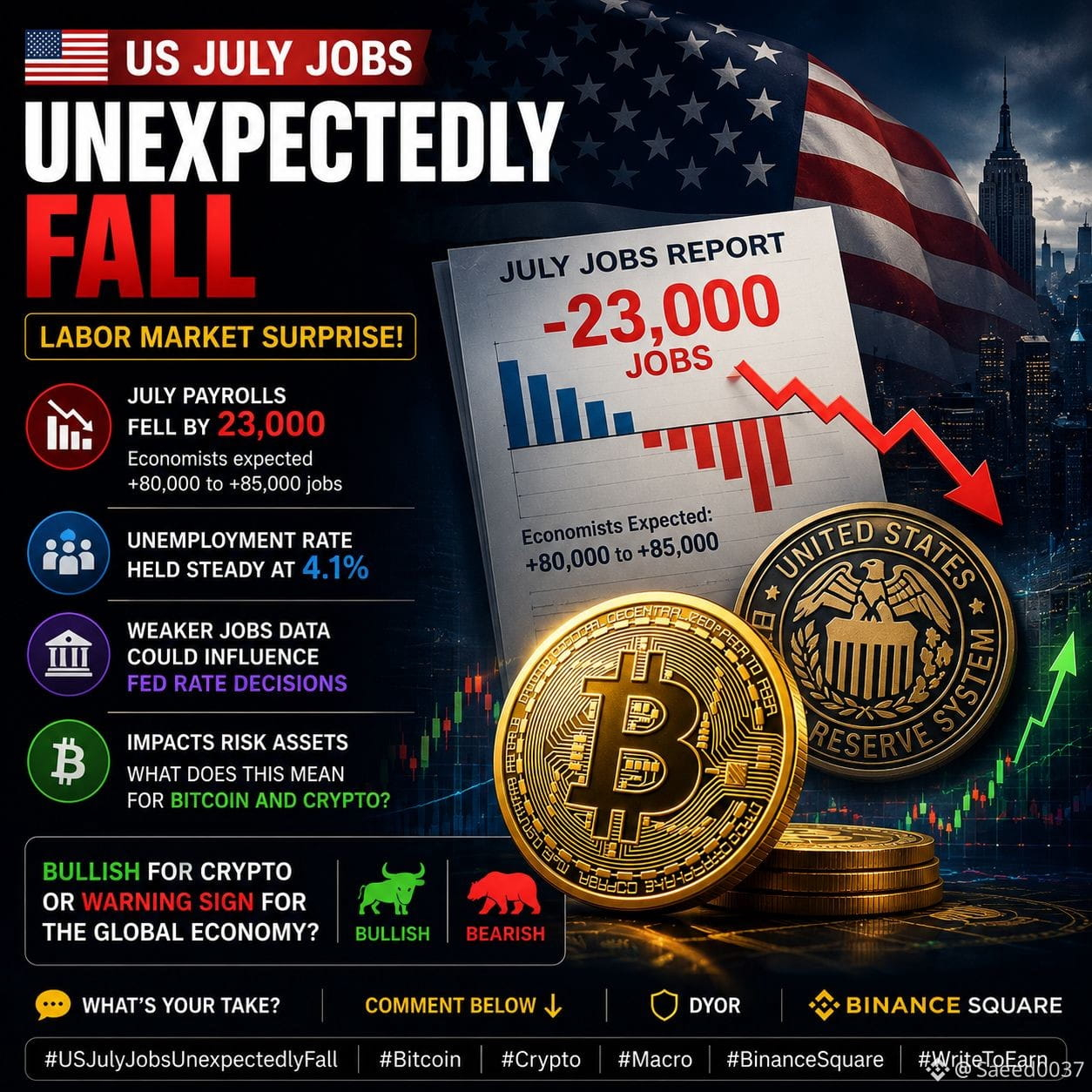
#USJulyJobsUnexpectedlyFall US Los empleos de julio cayeron inesperadamente
El mercado laboral de EE. UU. acaba de dar una sorpresa.
Las nóminas de julio cayeron en 23.000, mientras que los economistas esperaban crecimiento del empleo. Los meses anteriores también se ajustaron a la baja.
Un mercado laboral más débil podría influir en las decisiones de tasas de la Reserva Federal y aumentar la atención en activos de riesgo como $BTC.
Pero, ¿esto se volverá alcista para Bitcoin, o es una señal de advertencia para la economía global?
¿Qué opinas?
¿Alcista o bajista?
#USJulyJobsUnexpectedlyFall #Bitcoin #BTC #Crypto #BinanceSquare #Macro #WriteToEarn
#USJulyJobsUnexpectedlyFall US Los empleos de julio cayeron inesperadamente
El mercado laboral de EE. UU. acaba de dar una sorpresa.
Las nóminas de julio cayeron en 23.000, mientras que los economistas esperaban crecimiento del empleo. Los meses anteriores también se ajustaron a la baja.
Un mercado laboral más débil podría influir en las decisiones de tasas de la Reserva Federal y aumentar la atención en activos de riesgo como $BTC.
Pero, ¿esto se volverá alcista para Bitcoin, o es una señal de advertencia para la economía global?
¿Qué opinas?
¿Alcista o bajista?
#USJulyJobsUnexpectedlyFall #Bitcoin #BTC #Crypto #BinanceSquare #Macro #WriteToEarn
El mercado laboral de EE. UU. acaba de dar una sorpresa.
Las nóminas de julio cayeron en 23.000, mientras que los economistas esperaban crecimiento del empleo. Los meses anteriores también se ajustaron a la baja.
Un mercado laboral más débil podría influir en las decisiones de tasas de la Reserva Federal y aumentar la atención en activos de riesgo como $BTC.
Pero, ¿esto se volverá alcista para Bitcoin, o es una señal de advertencia para la economía global?
¿Qué opinas?
¿Alcista o bajista?
#USJulyJobsUnexpectedlyFall #Bitcoin #BTC #Crypto #BinanceSquare #Macro #WriteToEarn
103

·
--
Bajista
Verificado
#usjulyjobsunexpectedlyfall
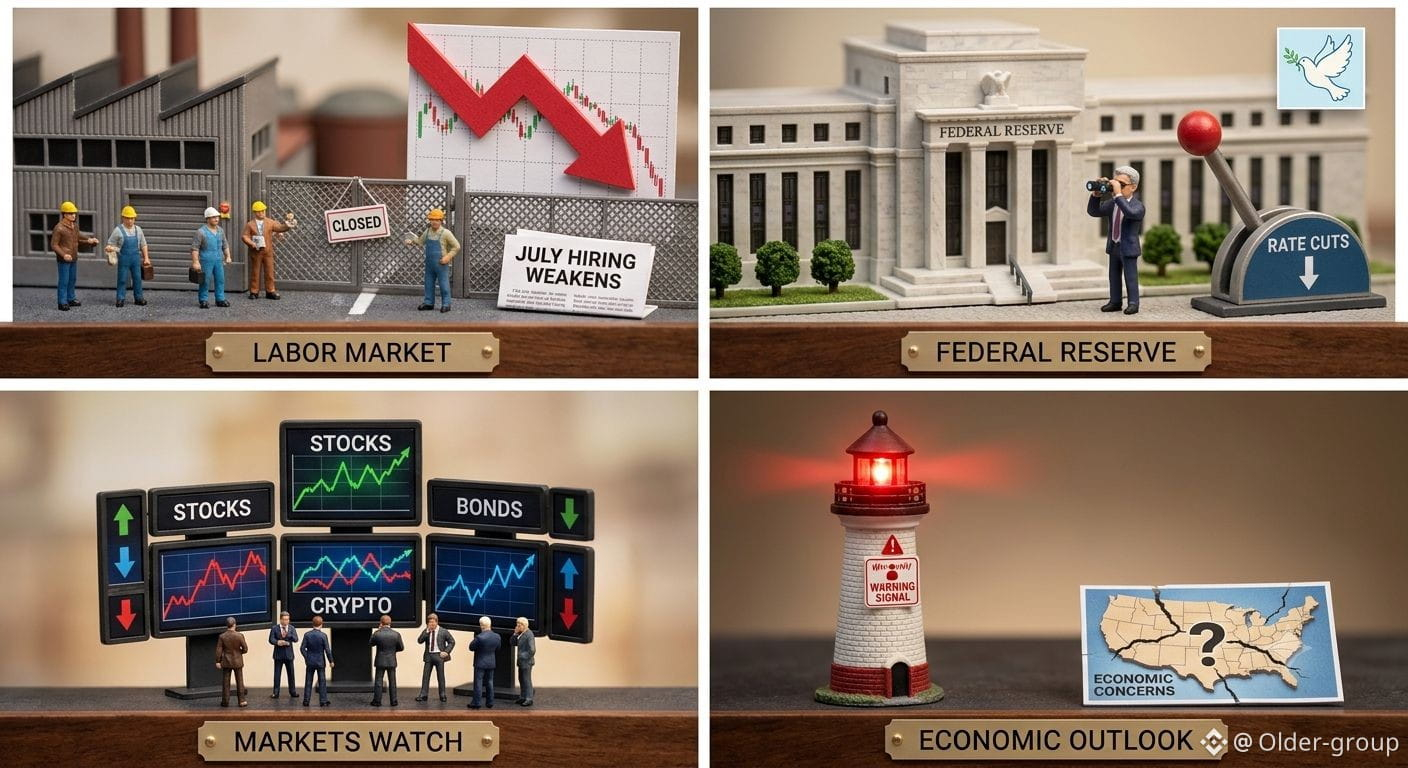
🚨 El mercado laboral de EE. UU. lanza una señal de advertencia.
La contratación de julio se debilitó inesperadamente, poniendo de nuevo el foco en la salud de la economía de EE. UU.
📉 Trabajos más débiles = preocupaciones económicas
🏦 Vuelve a estar en el centro la política de la Fed
💰 Las expectativas de recortes de tasas podrían aumentar
📊 Las acciones, los bonos y el cripto podrían ver una mayor volatilidad
La gran pregunta ahora es: ¿La menor ocupación empujará a la Fed hacia una postura más “dovish” (más acomodaticia)?
🔥 Los mercados están siguiendo de cerca los próximos datos económicos.
#USJobs #Fed #InterestRates #Economy $BANK $NVDAB
{spot}(NVDABUSDT)
{future}(BANKUSDT)
#usjulyjobsunexpectedlyfall
🚨 El mercado laboral de EE. UU. lanza una señal de advertencia.
La contratación de julio se debilitó inesperadamente, poniendo de nuevo el foco en la salud de la economía de EE. UU.
📉 Trabajos más débiles = preocupaciones económicas
🏦 Vuelve a estar en el centro la política de la Fed
💰 Las expectativas de recortes de tasas podrían aumentar
📊 Las acciones, los bonos y el cripto podrían ver una mayor volatilidad
La gran pregunta ahora es: ¿La menor ocupación empujará a la Fed hacia una postura más “dovish” (más acomodaticia)?
🔥 Los mercados están siguiendo de cerca los próximos datos económicos.
#USJobs #Fed #InterestRates #Economy $BANK $NVDAB
🚨 El mercado laboral de EE. UU. lanza una señal de advertencia.
La contratación de julio se debilitó inesperadamente, poniendo de nuevo el foco en la salud de la economía de EE. UU.
📉 Trabajos más débiles = preocupaciones económicas
🏦 Vuelve a estar en el centro la política de la Fed
💰 Las expectativas de recortes de tasas podrían aumentar
📊 Las acciones, los bonos y el cripto podrían ver una mayor volatilidad
La gran pregunta ahora es: ¿La menor ocupación empujará a la Fed hacia una postura más “dovish” (más acomodaticia)?
🔥 Los mercados están siguiendo de cerca los próximos datos económicos.
#USJobs #Fed #InterestRates #Economy $BANK $NVDAB
2.6k

Verificado
#usjulyjobsunexpectedlyfall
Hay datos económicos que asustan al mercado.
Y hay otros que, paradójicamente, lo hacen respirar.
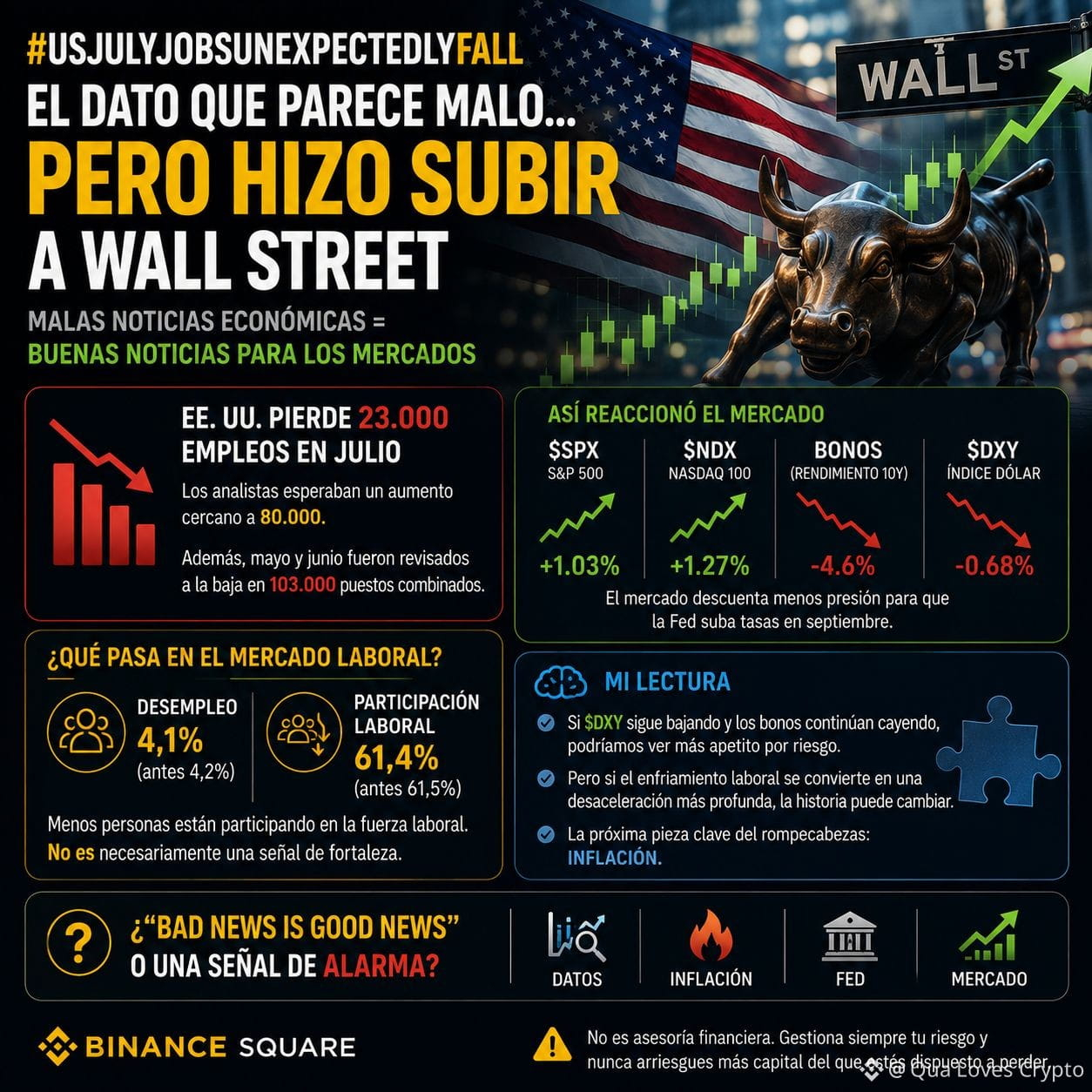
En julio, Estados Unidos perdió 23.000 empleos, cuando los analistas esperaban un aumento cercano a 80.000. Además, las cifras de mayo y junio fueron revisadas a la baja en 103.000 puestos combinados.
Pero aquí viene lo interesante:
📉 Menos empleo
📉 Menor crecimiento laboral
📉 Menor presión para que la Fed suba las tasas
Por eso Standard and Poor's y $NDAQ.US reaccionaron al alza, mientras los rendimientos de los bonos y el dólar retrocedieron. El mercado empezó a descontar que la Reserva Federal tendrá menos motivos para endurecer su política monetaria en septiembre.
Es el clásico escenario de: “malas noticias económicas = buenas noticias para los mercados”. Pero yo tendría cuidado con esa lectura.
El desempleo bajó ligeramente hasta 4,1%, aunque la participación laboral también descendió hasta 61,4%. Es decir, el mercado laboral no necesariamente está mejorando; parte de la caída del desempleo refleja que menos personas están participando en la fuerza laboral.
Ahora mismo vigilaría tres cosas: dólar ↓ → bonos ↓ → expectativas de la Fed ↓
Si esta combinación continúa, podría mantener el apetito por activos de riesgo.
Pero si los próximos datos muestran que el enfriamiento laboral está convirtiéndose en una desaceleración económica más profunda, la narrativa puede cambiar rápidamente.
Y la próxima pieza del rompecabezas será clave: inflación.
Porque una economía enfriándose con inflación controlada es una historia. Una economía enfriándose mientras los precios siguen altos es otra completamente distinta.
#usjulyjobsunexpectedlyfall
Hay datos económicos que asustan al mercado.
Y hay otros que, paradójicamente, lo hacen respirar.
En julio, Estados Unidos perdió 23.000 empleos, cuando los analistas esperaban un aumento cercano a 80.000. Además, las cifras de mayo y junio fueron revisadas a la baja en 103.000 puestos combinados.
Pero aquí viene lo interesante:
📉 Menos empleo
📉 Menor crecimiento laboral
📉 Menor presión para que la Fed suba las tasas
Por eso Standard and Poor's y $NDAQ.US reaccionaron al alza, mientras los rendimientos de los bonos y el dólar retrocedieron. El mercado empezó a descontar que la Reserva Federal tendrá menos motivos para endurecer su política monetaria en septiembre.
Es el clásico escenario de: “malas noticias económicas = buenas noticias para los mercados”. Pero yo tendría cuidado con esa lectura.
El desempleo bajó ligeramente hasta 4,1%, aunque la participación laboral también descendió hasta 61,4%. Es decir, el mercado laboral no necesariamente está mejorando; parte de la caída del desempleo refleja que menos personas están participando en la fuerza laboral.
Ahora mismo vigilaría tres cosas: dólar ↓ → bonos ↓ → expectativas de la Fed ↓
Si esta combinación continúa, podría mantener el apetito por activos de riesgo.
Pero si los próximos datos muestran que el enfriamiento laboral está convirtiéndose en una desaceleración económica más profunda, la narrativa puede cambiar rápidamente.
Y la próxima pieza del rompecabezas será clave: inflación.
Porque una economía enfriándose con inflación controlada es una historia. Una economía enfriándose mientras los precios siguen altos es otra completamente distinta.
Hay datos económicos que asustan al mercado.
Y hay otros que, paradójicamente, lo hacen respirar.
En julio, Estados Unidos perdió 23.000 empleos, cuando los analistas esperaban un aumento cercano a 80.000. Además, las cifras de mayo y junio fueron revisadas a la baja en 103.000 puestos combinados.
Pero aquí viene lo interesante:
📉 Menos empleo
📉 Menor crecimiento laboral
📉 Menor presión para que la Fed suba las tasas
Por eso Standard and Poor's y $NDAQ.US reaccionaron al alza, mientras los rendimientos de los bonos y el dólar retrocedieron. El mercado empezó a descontar que la Reserva Federal tendrá menos motivos para endurecer su política monetaria en septiembre.
Es el clásico escenario de: “malas noticias económicas = buenas noticias para los mercados”. Pero yo tendría cuidado con esa lectura.
El desempleo bajó ligeramente hasta 4,1%, aunque la participación laboral también descendió hasta 61,4%. Es decir, el mercado laboral no necesariamente está mejorando; parte de la caída del desempleo refleja que menos personas están participando en la fuerza laboral.
Ahora mismo vigilaría tres cosas: dólar ↓ → bonos ↓ → expectativas de la Fed ↓
Si esta combinación continúa, podría mantener el apetito por activos de riesgo.
Pero si los próximos datos muestran que el enfriamiento laboral está convirtiéndose en una desaceleración económica más profunda, la narrativa puede cambiar rápidamente.
Y la próxima pieza del rompecabezas será clave: inflación.
Porque una economía enfriándose con inflación controlada es una historia. Una economía enfriándose mientras los precios siguen altos es otra completamente distinta.
1.3k

·
--
Alcista
Verificado
𝐂𝐨𝐝𝐫 𝐩𝐨𝐝𝐫 𝐝𝐞𝐬𝐚𝐲𝐮𝐧𝐚𝐫 𝐥𝐨𝐬 𝐞𝐦𝐩𝐥𝐞𝐨𝐬 𝐝𝐞 𝐥𝐨𝐬 𝐔.𝐒. 𝐜𝐚𝐦𝐛𝐢𝐚𝐫 𝐞𝐥 𝐞𝐬𝐭𝐚𝐝𝐨 𝐝𝐞 𝐥𝐨𝐬 𝐦𝐞𝐫𝐜𝐚𝐝𝐨𝐬? 🇺🇸📉
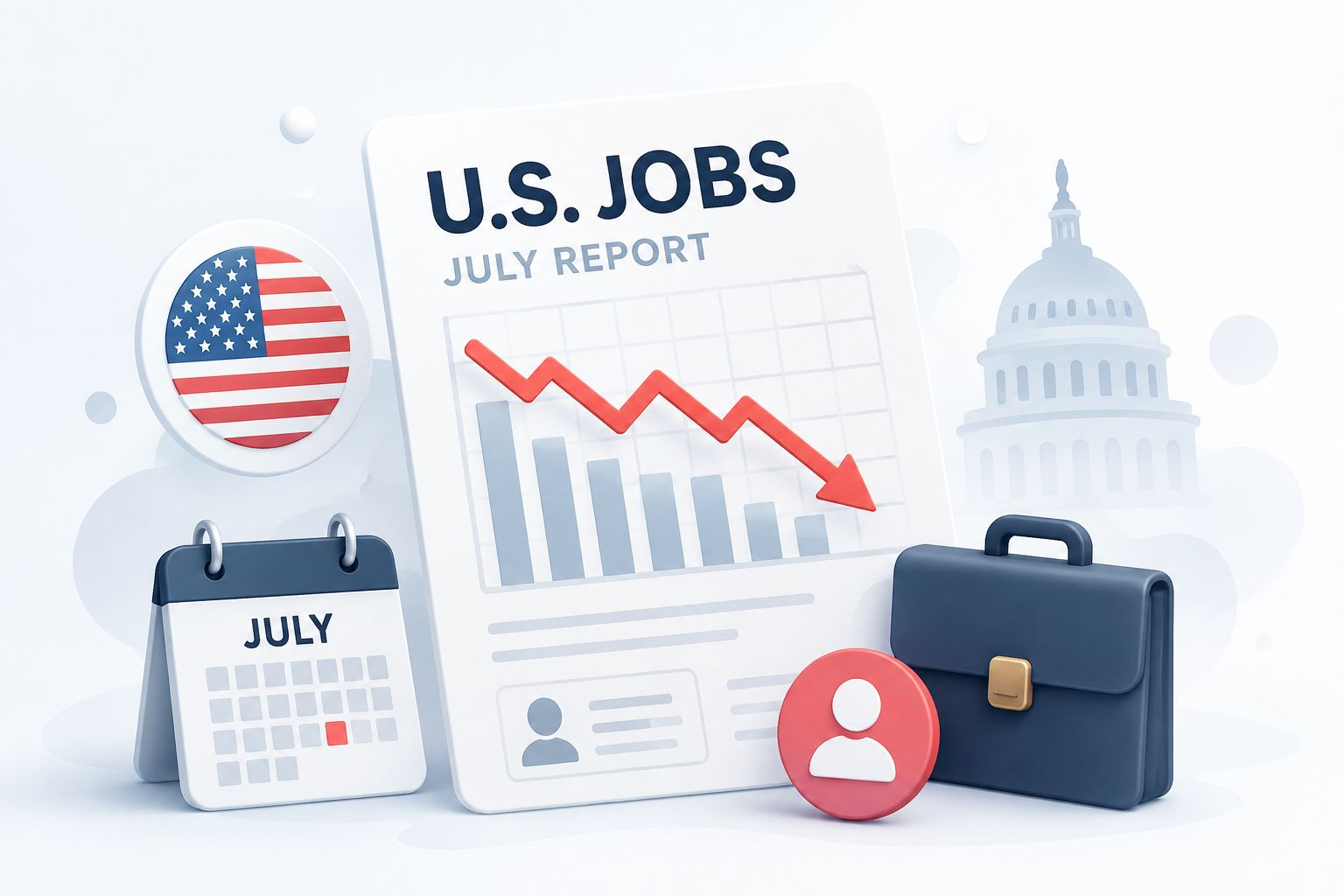
El informe de empleo de julio entregó una sorpresa: mostró que el mercado laboral de EE. UU. está perdiendo impulso.
🔹 Nóminas no agrícolas: -23,000 empleos en julio
🔹 Pronóstico: +80,000 empleos
🔹 Tasa de desempleo: 4.1%, por debajo de 4.2%
🔹 Participación en la fuerza laboral: 61.4%
🔹 Empleos de mayo y junio: revisados a la baja en 103,000 en conjunto
🔹 Crecimiento salarial: se desaceleró hasta alrededor de 3.2% interanual
Para los mercados, un empleo más débil puede significar menos presión para que la Fed mantenga las tasas más altas. Eso podría ser positivo para activos de riesgo como acciones y cripto si los inversores empiezan a anticipar una Fed más “dovish”.
Pero un solo informe no confirma una tendencia. 👀
¿Qué opinas: alcista o bajista para BTC? 🚀🐻
#usjulyjobsunexpectedlyfall
𝐂𝐨𝐝𝐫 𝐩𝐨𝐝𝐫 𝐝𝐞𝐬𝐚𝐲𝐮𝐧𝐚𝐫 𝐥𝐨𝐬 𝐞𝐦𝐩𝐥𝐞𝐨𝐬 𝐝𝐞 𝐥𝐨𝐬 𝐔.𝐒. 𝐜𝐚𝐦𝐛𝐢𝐚𝐫 𝐞𝐥 𝐞𝐬𝐭𝐚𝐝𝐨 𝐝𝐞 𝐥𝐨𝐬 𝐦𝐞𝐫𝐜𝐚𝐝𝐨𝐬? 🇺🇸📉
El informe de empleo de julio entregó una sorpresa: mostró que el mercado laboral de EE. UU. está perdiendo impulso.
🔹 Nóminas no agrícolas: -23,000 empleos en julio
🔹 Pronóstico: +80,000 empleos
🔹 Tasa de desempleo: 4.1%, por debajo de 4.2%
🔹 Participación en la fuerza laboral: 61.4%
🔹 Empleos de mayo y junio: revisados a la baja en 103,000 en conjunto
🔹 Crecimiento salarial: se desaceleró hasta alrededor de 3.2% interanual
Para los mercados, un empleo más débil puede significar menos presión para que la Fed mantenga las tasas más altas. Eso podría ser positivo para activos de riesgo como acciones y cripto si los inversores empiezan a anticipar una Fed más “dovish”.
Pero un solo informe no confirma una tendencia. 👀
¿Qué opinas: alcista o bajista para BTC? 🚀🐻
#usjulyjobsunexpectedlyfall
El informe de empleo de julio entregó una sorpresa: mostró que el mercado laboral de EE. UU. está perdiendo impulso.
🔹 Nóminas no agrícolas: -23,000 empleos en julio
🔹 Pronóstico: +80,000 empleos
🔹 Tasa de desempleo: 4.1%, por debajo de 4.2%
🔹 Participación en la fuerza laboral: 61.4%
🔹 Empleos de mayo y junio: revisados a la baja en 103,000 en conjunto
🔹 Crecimiento salarial: se desaceleró hasta alrededor de 3.2% interanual
Para los mercados, un empleo más débil puede significar menos presión para que la Fed mantenga las tasas más altas. Eso podría ser positivo para activos de riesgo como acciones y cripto si los inversores empiezan a anticipar una Fed más “dovish”.
Pero un solo informe no confirma una tendencia. 👀
¿Qué opinas: alcista o bajista para BTC? 🚀🐻
#usjulyjobsunexpectedlyfall
2
1.7k

·
--
Verificado
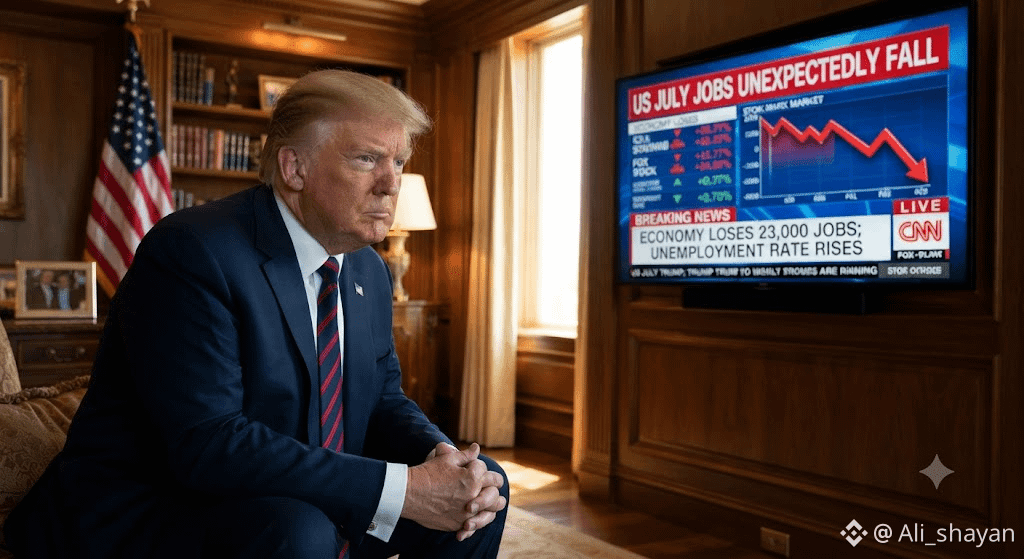
#usjulyjobsunexpectedlyfall El último informe de empleo de EE. UU. llegó hoy como una gran sorpresa para los mercados. En lugar de crear nuevos puestos, la economía inesperadamente perdió 23.000 empleos en julio. Los analistas habían estado pronosticando un crecimiento positivo, por lo que esta fuerte caída es una causa real de preocupación. Además, las ganancias de empleo anteriores de mayo y junio se revisaron a la baja de forma significativa. Aunque la tasa de desempleo bajó ligeramente hasta el 4,1 por ciento, esta caída ocurrió principalmente porque menos personas estaban buscando activamente trabajo.
HAGA CLIC A CONTINUACIÓN PARA OPERAR : $BTC $ETH $US
{future}(USUSDT)
{future}(ETHUSDT)
{future}(BTCUSDT)
#usjulyjobsunexpectedlyfall El último informe de empleo de EE. UU. llegó hoy como una gran sorpresa para los mercados. En lugar de crear nuevos puestos, la economía inesperadamente perdió 23.000 empleos en julio. Los analistas habían estado pronosticando un crecimiento positivo, por lo que esta fuerte caída es una causa real de preocupación. Además, las ganancias de empleo anteriores de mayo y junio se revisaron a la baja de forma significativa. Aunque la tasa de desempleo bajó ligeramente hasta el 4,1 por ciento, esta caída ocurrió principalmente porque menos personas estaban buscando activamente trabajo.
HAGA CLIC A CONTINUACIÓN PARA OPERAR : $BTC $ETH $US
HAGA CLIC A CONTINUACIÓN PARA OPERAR : $BTC $ETH $US
4
1
1.4k
·
--
Verificado
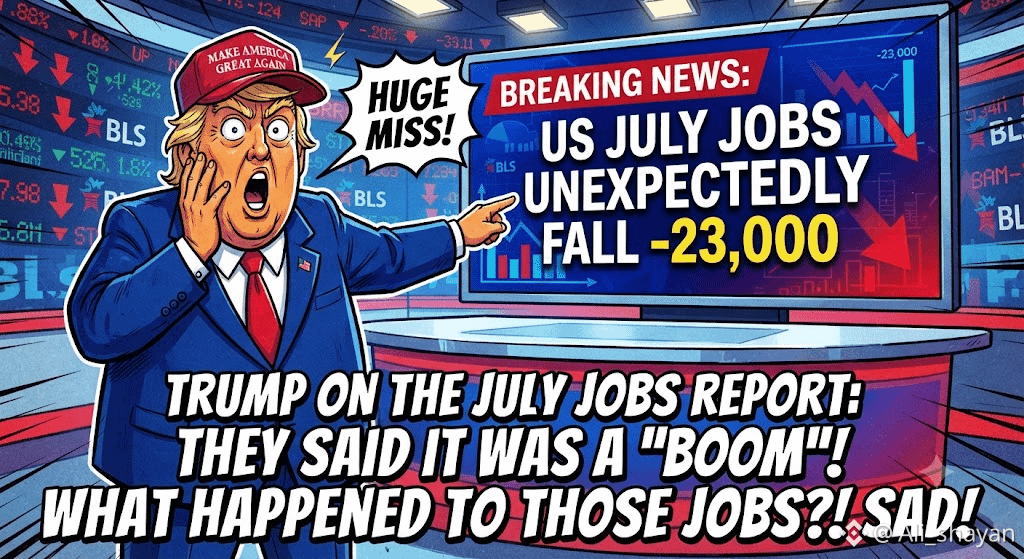
#usjulyjobsunexpectedlyfall El mercado laboral de Estados Unidos registró un golpe sorprendente en julio, ya que la economía perdió inesperadamente 23.000 empleos, quedando muy por debajo de las previsiones. Los datos divulgados por la Oficina de Estadísticas Laborales también mostraron revisiones a la baja pronunciadas para mayo y junio. Las pérdidas se debieron principalmente a la educación del gobierno local y al comercio minorista. Mientras tanto, la tasa de desempleo bajó ligeramente hasta el 4,1% porque menos personas estaban buscando activamente trabajo. Esta desaceleración inesperada ha aliviado la presión sobre la Reserva Federal con respecto a las tasas de interés.
HAGA CLIC ABAJO PARA OPERAR : $BTC $BNB $BANK
{future}(BANKUSDT)
{future}(BNBUSDT)
{future}(BTCUSDT)
#usjulyjobsunexpectedlyfall El mercado laboral de Estados Unidos registró un golpe sorprendente en julio, ya que la economía perdió inesperadamente 23.000 empleos, quedando muy por debajo de las previsiones. Los datos divulgados por la Oficina de Estadísticas Laborales también mostraron revisiones a la baja pronunciadas para mayo y junio. Las pérdidas se debieron principalmente a la educación del gobierno local y al comercio minorista. Mientras tanto, la tasa de desempleo bajó ligeramente hasta el 4,1% porque menos personas estaban buscando activamente trabajo. Esta desaceleración inesperada ha aliviado la presión sobre la Reserva Federal con respecto a las tasas de interés.
HAGA CLIC ABAJO PARA OPERAR : $BTC $BNB $BANK
HAGA CLIC ABAJO PARA OPERAR : $BTC $BNB $BANK
2.4k


·
--
Verificado
🇺🇸🇺🇲🇺🇲🇺🇲🇺🇲🇺🇲🇺🇲🇺🇲🇺🇲🇺🇲🇺🇲🇺🇲🇺🇲
Trump Media cancela los planes de acuerdos de criptomonedas con Crypto․com
ÚLTIMA HORA:
💰🇺🇸
El presidente Trump dice "las criptomonedas son un gran tema".
"Veo cada vez más a personas pagando con Bitcoin. Ya ni siquiera saben de efectivo".
🇺🇸🚨🇺🇲🚨🇺🇲🚨🇺🇲🚨🇺🇲🚨🇺🇲🚨
Los empleadores de EE. UU. recortan 23.000 empleos en julio, quedando por debajo de la previsión de un aumento de 80.000.
#TRUMP #US #DollarSetForBestDayInTwoWeeks
#USJulyJobsUnexpectedlyFall
#USSolarStocksRisePremarket
$TRUMP
{future}(TRUMPUSDT)
$BTC
{future}(BTCUSDT)
🇺🇸🇺🇲🇺🇲🇺🇲🇺🇲🇺🇲🇺🇲🇺🇲🇺🇲🇺🇲🇺🇲🇺🇲🇺🇲
Trump Media cancela los planes de acuerdos de criptomonedas con Crypto․com
ÚLTIMA HORA:
💰🇺🇸
El presidente Trump dice "las criptomonedas son un gran tema".
"Veo cada vez más a personas pagando con Bitcoin. Ya ni siquiera saben de efectivo".
🇺🇸🚨🇺🇲🚨🇺🇲🚨🇺🇲🚨🇺🇲🚨🇺🇲🚨
Los empleadores de EE. UU. recortan 23.000 empleos en julio, quedando por debajo de la previsión de un aumento de 80.000.
#TRUMP #US #DollarSetForBestDayInTwoWeeks
#USJulyJobsUnexpectedlyFall
#USSolarStocksRisePremarket
$TRUMP
$BTC
Trump Media cancela los planes de acuerdos de criptomonedas con Crypto․com
ÚLTIMA HORA:
💰🇺🇸
El presidente Trump dice "las criptomonedas son un gran tema".
"Veo cada vez más a personas pagando con Bitcoin. Ya ni siquiera saben de efectivo".
🇺🇸🚨🇺🇲🚨🇺🇲🚨🇺🇲🚨🇺🇲🚨🇺🇲🚨
Los empleadores de EE. UU. recortan 23.000 empleos en julio, quedando por debajo de la previsión de un aumento de 80.000.
#TRUMP #US #DollarSetForBestDayInTwoWeeks
#USJulyJobsUnexpectedlyFall
#USSolarStocksRisePremarket
$TRUMP
$BTC

2
19
2.7k

·
--
Verificado
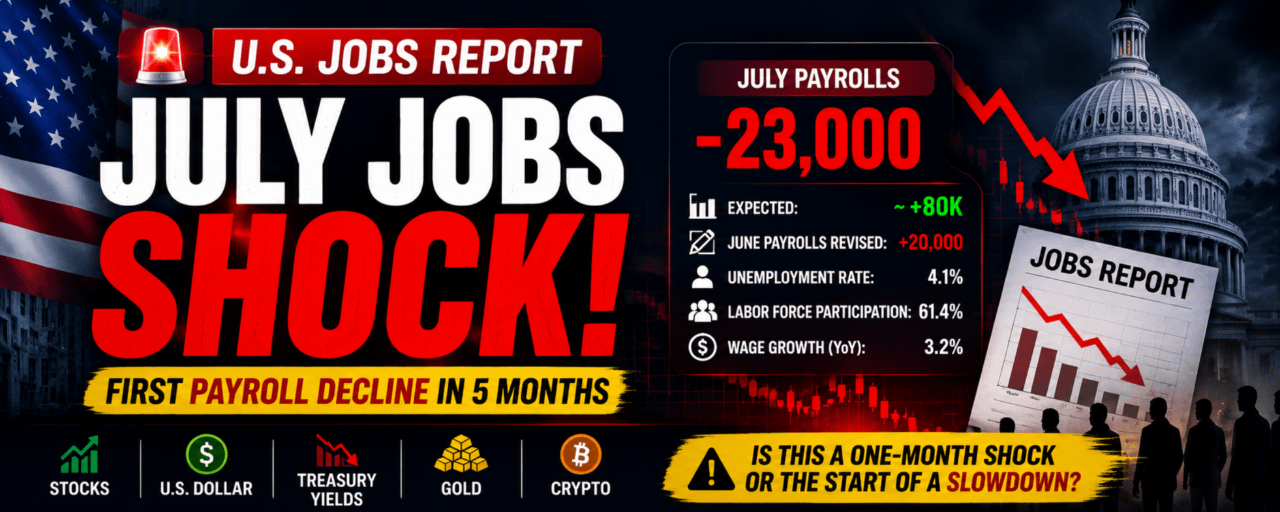
Artículo
EL MERCADO DE EMPLEOS EN EE. UU. OFRECE UNA SORPRESA IMPACTANTE#usjulyjobsunexpectedlyfall
El mercado laboral de EE. UU. mostró una señal clara de debilidad en julio: las nóminas no agrícolas cayeron en 23.000 empleos en lugar del aumento esperado de aproximadamente 80K+. 📉🇺🇸
📊 NÚMEROS CLAVE
• Nóminas de julio: -23K ❌
• Se esperaba: ~+83K
• Nóminas de junio: revisadas a +20K
• Tasa de desempleo: 4,1%
• Participación en la fuerza laboral: 61,4%
• Crecimiento salarial: 3,2% interanual
Julio marcó la primera caída mensual del empleo en nóminas en cinco meses. Aún más importante, mayo y junio se revisaron a la baja en 103.000 empleos en conjunto, lo que apunta a una tendencia de contratación más débil de lo que sugerían los informes anteriores.
EL MERCADO DE EMPLEOS EN EE. UU. OFRECE UNA SORPRESA IMPACTANTE
#usjulyjobsunexpectedlyfall
El mercado laboral de EE. UU. mostró una señal clara de debilidad en julio: las nóminas no agrícolas cayeron en 23.000 empleos en lugar del aumento esperado de aproximadamente 80K+. 📉🇺🇸
📊 NÚMEROS CLAVE
• Nóminas de julio: -23K ❌
• Se esperaba: ~+83K
• Nóminas de junio: revisadas a +20K
• Tasa de desempleo: 4,1%
• Participación en la fuerza laboral: 61,4%
• Crecimiento salarial: 3,2% interanual
Julio marcó la primera caída mensual del empleo en nóminas en cinco meses. Aún más importante, mayo y junio se revisaron a la baja en 103.000 empleos en conjunto, lo que apunta a una tendencia de contratación más débil de lo que sugerían los informes anteriores.
El mercado laboral de EE. UU. mostró una señal clara de debilidad en julio: las nóminas no agrícolas cayeron en 23.000 empleos en lugar del aumento esperado de aproximadamente 80K+. 📉🇺🇸
📊 NÚMEROS CLAVE
• Nóminas de julio: -23K ❌
• Se esperaba: ~+83K
• Nóminas de junio: revisadas a +20K
• Tasa de desempleo: 4,1%
• Participación en la fuerza laboral: 61,4%
• Crecimiento salarial: 3,2% interanual
Julio marcó la primera caída mensual del empleo en nóminas en cinco meses. Aún más importante, mayo y junio se revisaron a la baja en 103.000 empleos en conjunto, lo que apunta a una tendencia de contratación más débil de lo que sugerían los informes anteriores.
8
6.6k
·
--
Verificado
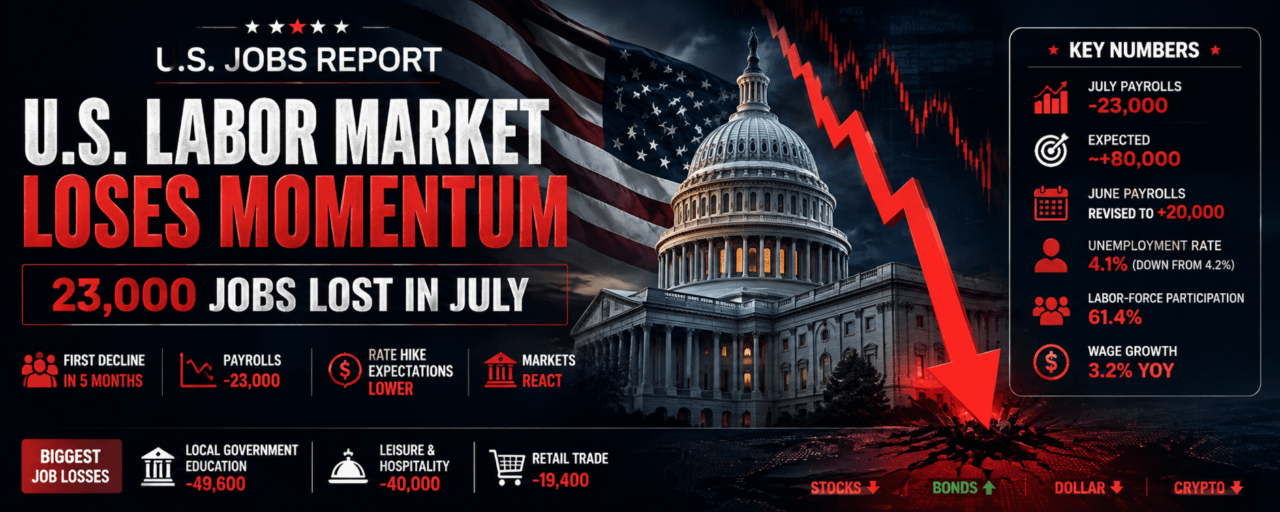
Artículo
El mercado laboral de EE. UU. sorprende con fuerza: la economía pierde 23.000 empleos en julio#usjulyjobsunexpectedlyfall
El mercado laboral de EE. UU. dio una gran sorpresa en julio: las nóminas no agrícolas cayeron en 23.000 empleos, quedando muy por debajo de las expectativas de los economistas de alrededor de 80.000 empleos nuevos.
Esto marca la primera caída mensual del empleo en EE. UU. en cinco meses y se suma a las señales cada vez mayores de que el mercado laboral estadounidense está perdiendo impulso.
📉 Cifras clave
• Nóminas No Agrícolas (Nonfarm Payrolls): -23.000
• Se esperaba: +80.000
• Nóminas de junio: revisadas a +20.000
• Tasa de desempleo: 4,1% vs. 4,2% anteriormente
• Participación de la fuerza laboral: 61,4%
El mercado laboral de EE. UU. sorprende con fuerza: la economía pierde 23.000 empleos en julio
#usjulyjobsunexpectedlyfall
El mercado laboral de EE. UU. dio una gran sorpresa en julio: las nóminas no agrícolas cayeron en 23.000 empleos, quedando muy por debajo de las expectativas de los economistas de alrededor de 80.000 empleos nuevos.
Esto marca la primera caída mensual del empleo en EE. UU. en cinco meses y se suma a las señales cada vez mayores de que el mercado laboral estadounidense está perdiendo impulso.
📉 Cifras clave
• Nóminas No Agrícolas (Nonfarm Payrolls): -23.000
• Se esperaba: +80.000
• Nóminas de junio: revisadas a +20.000
• Tasa de desempleo: 4,1% vs. 4,2% anteriormente
• Participación de la fuerza laboral: 61,4%
El mercado laboral de EE. UU. dio una gran sorpresa en julio: las nóminas no agrícolas cayeron en 23.000 empleos, quedando muy por debajo de las expectativas de los economistas de alrededor de 80.000 empleos nuevos.
Esto marca la primera caída mensual del empleo en EE. UU. en cinco meses y se suma a las señales cada vez mayores de que el mercado laboral estadounidense está perdiendo impulso.
📉 Cifras clave
• Nóminas No Agrícolas (Nonfarm Payrolls): -23.000
• Se esperaba: +80.000
• Nóminas de junio: revisadas a +20.000
• Tasa de desempleo: 4,1% vs. 4,2% anteriormente
• Participación de la fuerza laboral: 61,4%
2
1
5.8k
Inicia sesión para explorar más contenidos
Únete a usuarios globales de criptomonedas en Binance Square
⚡️ Obtén información útil y actualizada sobre criptos.
💬 Avalado por el mayor exchange de criptomonedas en el mundo.
👍 Descubre perspectivas reales de creadores verificados.
Email/número de teléfono
Temas populares
1
#EarningsSeason
197,371 vistas
1,802 están debatiendo
2
#BitwiseLaunchesFirstSpotNEARETF
6,567 vistas
255 están debatiendo
3
#USJobOpeningsFallToFiveMonthLow
10,178 vistas
193 están debatiendo
4
#ECBToTestAIAgentsInDigitalEuroPayments
13,038 vistas
362 están debatiendo
5
#JapanFSABacksFourthStablecoinTradeSettlementPilot
15,105 vistas
415 están debatiendo
6
#BitgetHackerFailsToMoveStolenFunds
29,352 vistas
533 están debatiendo
7
#BitMineETHHoldingsTop6Million
26,334 vistas
653 están debatiendo
8
#StrategyAdds1666BTCHoldingsReach847666
22,641 vistas
456 están debatiendo
9
#NvidiaApproves$150BBuyback
4,376 vistas
68 están debatiendo
10
#OpenAIDelaysGPT6.1OverSafetyIssues
34,975 vistas
821 están debatiendo