
MD EMRAN MONDOL
2.3k Posts

MD EMRAN MONDOL
Report
Block User
CRIPTO TREADOR , SINGNAL, MARKET ANALYSIS,FOR BTC, SOL, ETH, XAUT E,T,C ...KITE-1782127
596 Following
11.5K+ Followers
2.4K+ Liked
Posts
All
Quotes
Live
PINNED
·
--
Bullish
Verified
AI agents can already do a lot. The problem is what happens when they need to spend real money.
Giving an agent a wallet and saying “go handle it” is not exactly a great security model. You need limits. You need to know what it paid for. You need to be able to stop it.
That’s the part of Kite I find more interesting. Kite Agent Passport lets you approve a spending session with a passkey, set the budget and scope, and let the agent pay for services within those rules. Every action can be tracked, and access can be revoked.
No magic. Just trying to solve a very real problem: autonomous agents need a way to use money without getting unlimited control over it.
Kite Mainnet is live, and $KITE is building around that agent-payment infrastructure.
Worth watching if the agent economy is actually going to become useful, not just another crypto narrative.
@GoKiteAI $KITE #KiteBBW
{spot}(KITEUSDT)
AI agents can already do a lot. The problem is what happens when they need to spend real money.
Giving an agent a wallet and saying “go handle it” is not exactly a great security model. You need limits. You need to know what it paid for. You need to be able to stop it.
That’s the part of Kite I find more interesting. Kite Agent Passport lets you approve a spending session with a passkey, set the budget and scope, and let the agent pay for services within those rules. Every action can be tracked, and access can be revoked.
No magic. Just trying to solve a very real problem: autonomous agents need a way to use money without getting unlimited control over it.
Kite Mainnet is live, and $KITE is building around that agent-payment infrastructure.
Worth watching if the agent economy is actually going to become useful, not just another crypto narrative.
@KITE AI 中文 $KITE #KiteBBW

9
9
138
Verified
30D trade $SUI 764.7 USDT
Sui is slowly building something that goes beyond market hype.
From Samsung Wallet bringing USDC payments to Galaxy users to Google Cloud working on AI agent oversight, the ecosystem is moving toward real-world use. Mercado Bitcoin is also helping expand access in Brazil, while new cloud integrations are opening more possibilities for agent payments.
What I find interesting is the direction. Payments, stablecoins, and AI are becoming important parts of the bigger picture.
It is still early, and adoption will take time. But these are the kind of developments worth watching.
$SUI $SAMSUNG

SUI-0.42%
GOOGUS-3.44%
1
624
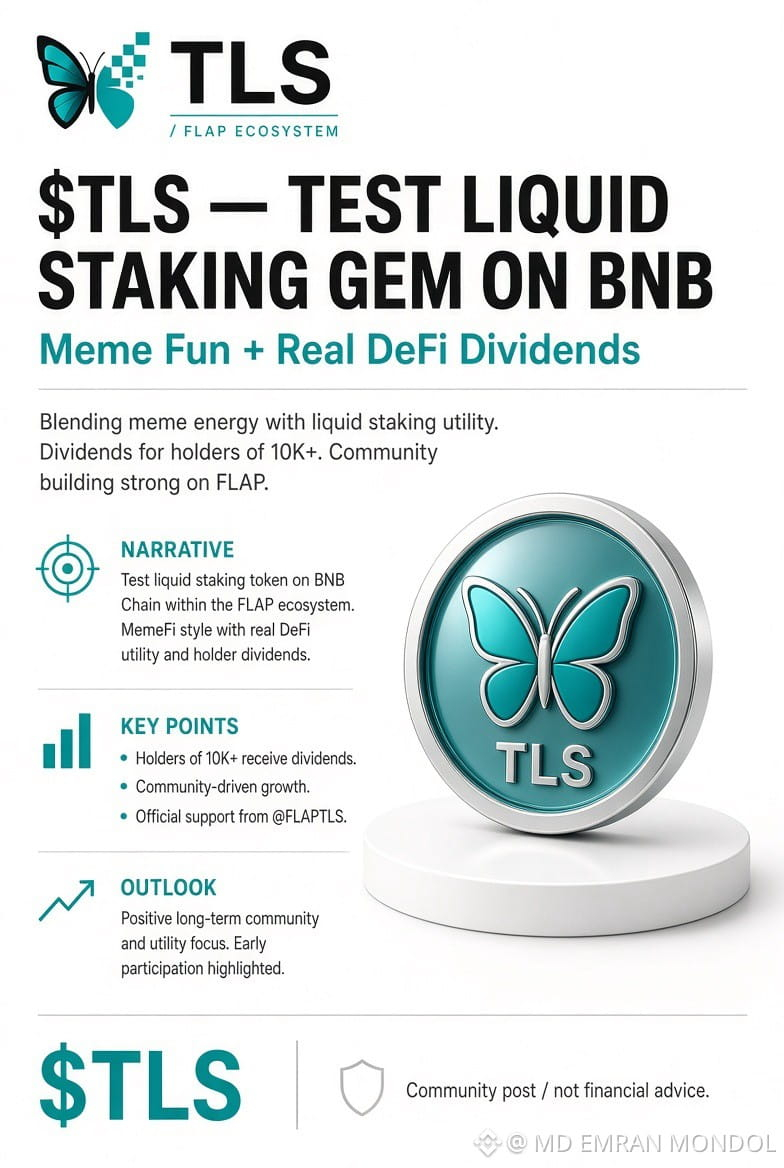
HEY EVERYONE! JUST GRABBED SOME TLS COIN AND FEELING SUPER POSITIVE ABOUT IT. THIS TEST LIQUID STAKING GEM ON BNB IS BLENDING MEME FUN WITH REAL DEFI DIVIDENDS FOR HOLDERS OF 10K+. COMMUNITY IS BUILDING STRONG AND I AM LUCKY TO BE PART OF IT. GRAB A GIFT BY JOINING THE MOVEMENT EARLY AND WATCH IT GROW WITH THE OFFICIAL TEAM. TAGGING @flaptls S FOR THE OFFICIAL VIBES AND SUPPORT. LETS GROW TOGETHER WITH POSITIVE ENERGY AND LONG TERM VALUE IN THE MEMEFI SPACE! #TLS #MEMEFI #FLAP $TLS.US
{stock_us}(TLS.US)
HEY EVERYONE! JUST GRABBED SOME TLS COIN AND FEELING SUPER POSITIVE ABOUT IT. THIS TEST LIQUID STAKING GEM ON BNB IS BLENDING MEME FUN WITH REAL DEFI DIVIDENDS FOR HOLDERS OF 10K+. COMMUNITY IS BUILDING STRONG AND I AM LUCKY TO BE PART OF IT. GRAB A GIFT BY JOINING THE MOVEMENT EARLY AND WATCH IT GROW WITH THE OFFICIAL TEAM. TAGGING @FLAPTLS S FOR THE OFFICIAL VIBES AND SUPPORT. LETS GROW TOGETHER WITH POSITIVE ENERGY AND LONG TERM VALUE IN THE MEMEFI SPACE! #TLS #MEMEFI #FLAP $TLS.US
TLSUS-1.77%
2
123
Article
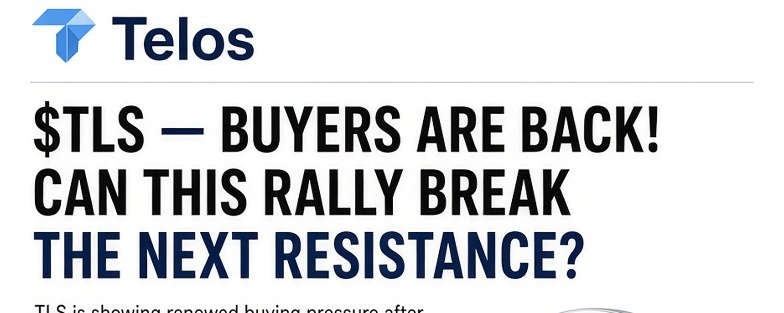
$TLS — BUYERS ARE BACK! CAN THIS RALLY BREAK THE NEXT RESISTANCE? | LONG SETUPTLS is showing renewed buying pressure after a sharp recovery. On November 11, TLS traded near $7.80–$7.85, gaining around 2.3% on the day while extending its recent advance from levels near $4–$5. Trading volume has picked up notably during the move, reflecting increased market activity. This is a clear sign of stronger interest, but traders should remember that a sharp rally can attract profit-taking just as quickly.
Telos focuses on technology solutions for enterprise and government clients, giving TLS an interesting narrative in the software and infrastructure space. However, price momentum alone does not prove sustained upside. Another factor worth watching is overall market conditions and how the stock holds above its recent breakout levels.
Technically, the $7.90–$8.10 zone is the immediate resistance area. A strong breakout with sustained volume could open the door toward $8.30–$8.50. On the downside, $7.50–$7.60 and $7.00–$7.20 are important short-term support references. RSI has risen with the rally, so momentum is positive but elevated, and chasing the current move carries risk.
LONG $TLS — DCA ENTRIES
EP1: $7.60 — 40%
EP2: $7.20 — 30%
EP3: $6.80 — 30%
SL: $6.30
TP1: $8.10
TP2: $8.40
TP3: $8.80
WHY THIS SETUP?
- Strong recent buying activity after the breakout.
- Positive short-term momentum.
- Potential support around the DCA entry zone.
- A breakout above $8.10 could strengthen bullish continuation.
MONEY MANAGEMENT:Risk a maximum of 1% of your total trading capital on this setup. Divide entries according to the planned allocation, not emotion. Avoid excessive leverage and keep enough USDT available for other opportunities.
RISK MANAGEMENT: Do not enter all positions at once. Wait for confirmation at each entry level. If the stop loss is hit, accept the loss instead of moving it lower. Never use borrowed money or funds needed for essential expenses.
My view: TLS has regained attention after the sharp move higher, but the next resistance will decide whether this is a genuine continuation or just a temporary recovery. Patience is more valuable than chasing green candles.
This is my personal market analysis, not financial advice. Trading involves significant risk. Always do your own research.
Market data checked November 11, 2026. Sources: aggregated public market data
$TLS.US
{stock_us}(TLS.US)
@flaptls @Perry_KaKa @kshuren @Square-Creator-9b3586602cb99 S @eggtartcake_grape @Square-Creator-485ecf745 @Square-Creator-661563688
$TLS — BUYERS ARE BACK! CAN THIS RALLY BREAK THE NEXT RESISTANCE? | LONG SETUP
TLS is showing renewed buying pressure after a sharp recovery. On November 11, TLS traded near $7.80–$7.85, gaining around 2.3% on the day while extending its recent advance from levels near $4–$5. Trading volume has picked up notably during the move, reflecting increased market activity. This is a clear sign of stronger interest, but traders should remember that a sharp rally can attract profit-taking just as quickly.
Telos focuses on technology solutions for enterprise and government clients, giving TLS an interesting narrative in the software and infrastructure space. However, price momentum alone does not prove sustained upside. Another factor worth watching is overall market conditions and how the stock holds above its recent breakout levels.
Technically, the $7.90–$8.10 zone is the immediate resistance area. A strong breakout with sustained volume could open the door toward $8.30–$8.50. On the downside, $7.50–$7.60 and $7.00–$7.20 are important short-term support references. RSI has risen with the rally, so momentum is positive but elevated, and chasing the current move carries risk.
LONG $TLS — DCA ENTRIES
EP1: $7.60 — 40%
EP2: $7.20 — 30%
EP3: $6.80 — 30%
SL: $6.30
TP1: $8.10
TP2: $8.40
TP3: $8.80
WHY THIS SETUP?
- Strong recent buying activity after the breakout.
- Positive short-term momentum.
- Potential support around the DCA entry zone.
- A breakout above $8.10 could strengthen bullish continuation.
MONEY MANAGEMENT:Risk a maximum of 1% of your total trading capital on this setup. Divide entries according to the planned allocation, not emotion. Avoid excessive leverage and keep enough USDT available for other opportunities.
RISK MANAGEMENT: Do not enter all positions at once. Wait for confirmation at each entry level. If the stop loss is hit, accept the loss instead of moving it lower. Never use borrowed money or funds needed for essential expenses.
My view: TLS has regained attention after the sharp move higher, but the next resistance will decide whether this is a genuine continuation or just a temporary recovery. Patience is more valuable than chasing green candles.
This is my personal market analysis, not financial advice. Trading involves significant risk. Always do your own research.
Market data checked November 11, 2026. Sources: aggregated public market data
$TLS.US
@FLAPTLS @KaKa_MemeUp @TLS_龙哥 @心有灵兮_TLS S @Eggtartcake @MooN 国王 @静心1688
TLSUS-1.77%
1
101
$AGT — BUYERS ARE BACK! CAN THIS RALLY BREAK THE NEXT RESISTANCE? | LONG SETUP$AGT is showing strong renewed buying pressure. On November 11, AGT traded near $0.056–$0.059, gaining around 130–140% in 24 hours, while weekly performance also remained positive. Trading volume climbed sharply, reflecting a clear surge in market activity. This is a clear sign of increased interest, but traders should remember that a sharp rally can attract profit-taking just as quickly.
The project’s focus on AI-related governance and infrastructure gives AGT an interesting narrative in the AI and data sectors. However, price momentum alone does not prove long-term adoption. Another factor worth watching is token supply dynamics and overall liquidity as activity expands.
Technically, the $0.060–$0.062 zone is the immediate resistance area. A strong breakout with sustained volume could open the door toward $0.070–$0.075. On the downside, $0.050–$0.052 and $0.045–$0.047 are important short-term support references. RSI has moved higher with the rally, so momentum is positive, but chasing the current move carries risk.
**LONG $AGT — DCA ENTRIES**
EP1: $0.0540 — 40%
EP2: $0.0480 — 30%
EP3: $0.0420 — 30%
SL: $0.0360
TP1: $0.0620
TP2: $0.0700
TP3: $0.0780
**WHY THIS SETUP?**
- Strong 24-hour buying activity.
- Positive short-term momentum after the rally.
- Potential support around the DCA entry zone.
- A breakout above $0.062 could strengthen bullish continuation.
**MONEY MANAGEMENT:** Risk a maximum of 1% of your total trading capital on this setup. Divide entries according to the planned allocation, not emotion. Avoid excessive leverage and keep enough USDT available for other opportunities.
**RISK MANAGEMENT:** Do not enter all positions at once. Wait for confirmation at each entry level. If the stop loss is hit, accept the loss instead of moving it lower. Never use borrowed money or funds needed for essential expenses.
My view: AGT has regained strong attention, but the next resistance will decide whether this is a genuine continuation or just a temporary recovery. Patience is more valuable than chasing green candles.
This is my personal market analysis, not financial advice. Crypto trading involves significant risk. Always do your own research.
Market data checked November 11, 2026. Sources: aggregated public market data
$AGT
$AGT — BUYERS ARE BACK! CAN THIS RALLY BREAK THE NEXT RESISTANCE? | LONG SETUP
$AGT is showing strong renewed buying pressure. On November 11, AGT traded near $0.056–$0.059, gaining around 130–140% in 24 hours, while weekly performance also remained positive. Trading volume climbed sharply, reflecting a clear surge in market activity. This is a clear sign of increased interest, but traders should remember that a sharp rally can attract profit-taking just as quickly.
The project’s focus on AI-related governance and infrastructure gives AGT an interesting narrative in the AI and data sectors. However, price momentum alone does not prove long-term adoption. Another factor worth watching is token supply dynamics and overall liquidity as activity expands.
Technically, the $0.060–$0.062 zone is the immediate resistance area. A strong breakout with sustained volume could open the door toward $0.070–$0.075. On the downside, $0.050–$0.052 and $0.045–$0.047 are important short-term support references. RSI has moved higher with the rally, so momentum is positive, but chasing the current move carries risk.
**LONG $AGT — DCA ENTRIES**
EP1: $0.0540 — 40%
EP2: $0.0480 — 30%
EP3: $0.0420 — 30%
SL: $0.0360
TP1: $0.0620
TP2: $0.0700
TP3: $0.0780
**WHY THIS SETUP?**
- Strong 24-hour buying activity.
- Positive short-term momentum after the rally.
- Potential support around the DCA entry zone.
- A breakout above $0.062 could strengthen bullish continuation.
**MONEY MANAGEMENT:** Risk a maximum of 1% of your total trading capital on this setup. Divide entries according to the planned allocation, not emotion. Avoid excessive leverage and keep enough USDT available for other opportunities.
**RISK MANAGEMENT:** Do not enter all positions at once. Wait for confirmation at each entry level. If the stop loss is hit, accept the loss instead of moving it lower. Never use borrowed money or funds needed for essential expenses.
My view: AGT has regained strong attention, but the next resistance will decide whether this is a genuine continuation or just a temporary recovery. Patience is more valuable than chasing green candles.
This is my personal market analysis, not financial advice. Crypto trading involves significant risk. Always do your own research.
Market data checked November 11, 2026. Sources: aggregated public market data
$AGT
239
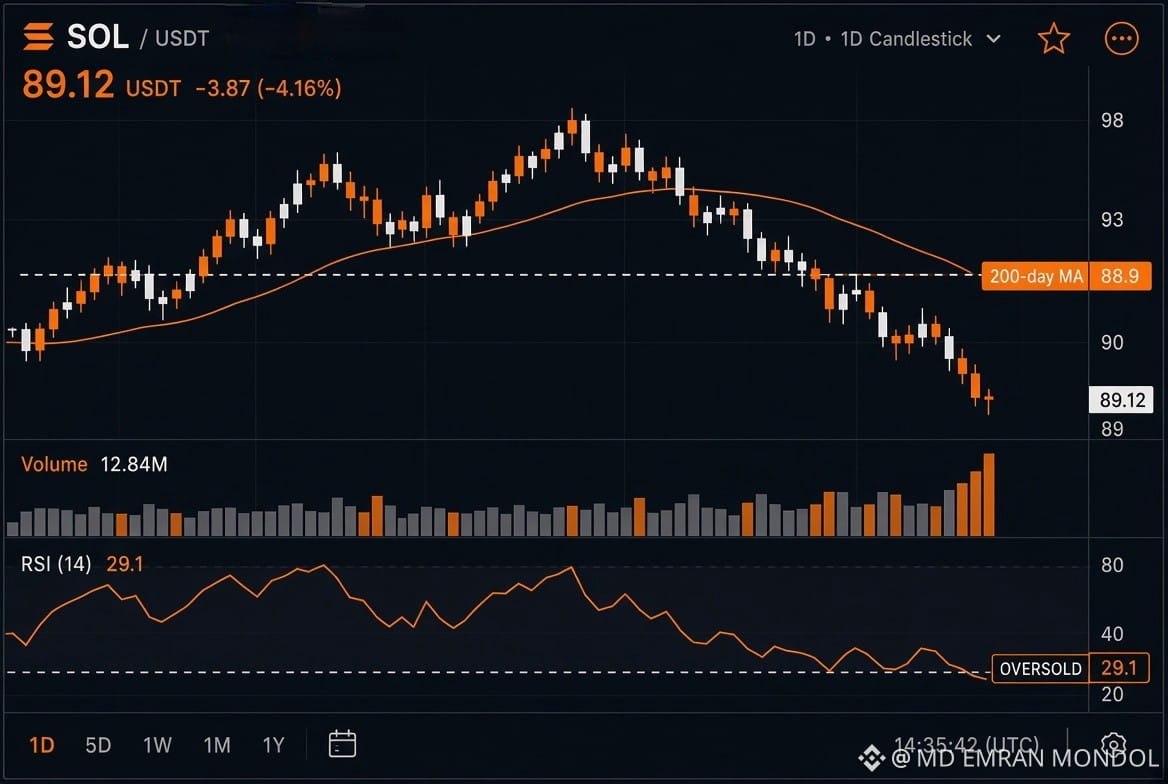
$SOL is showing a test of its 200-day moving average after a sharp pullback.
Looking at the recent structure, price has slipped toward the $89–$90 zone with elevated volume, sitting right on the 200-day MA near $88.9. Daily RSI has reached oversold territory around 29, while prior resistance sits near $93–$98. On the fundamental side, the Alpenglow upgrade is live (targeting ~150ms finality), Samsung Wallet now supports USDC on Solana for eligible U.S. users, and DEX activity remains strong even as ETF flows have been mixed to negative recently. Social sentiment currently leans cautious after the multi-week decline.
I’m personally watching a daily close above or below the $88.9–$90 area for clearer confirmation. If it loses that zone cleanly, the short-term structure weakens further toward the mid-to-low $80s.
Not financial advice — always do your own research and manage risk.
$SOL
{future}(SOLUSDT)
$SOL is showing a test of its 200-day moving average after a sharp pullback.
Looking at the recent structure, price has slipped toward the $89–$90 zone with elevated volume, sitting right on the 200-day MA near $88.9. Daily RSI has reached oversold territory around 29, while prior resistance sits near $93–$98. On the fundamental side, the Alpenglow upgrade is live (targeting ~150ms finality), Samsung Wallet now supports USDC on Solana for eligible U.S. users, and DEX activity remains strong even as ETF flows have been mixed to negative recently. Social sentiment currently leans cautious after the multi-week decline.
I’m personally watching a daily close above or below the $88.9–$90 area for clearer confirmation. If it loses that zone cleanly, the short-term structure weakens further toward the mid-to-low $80s.
Not financial advice — always do your own research and manage risk.
$SOL

1
187
·
--
Bearish
$BTC $SOL $ZEC selling Peshawar on ck market
{future}(BTCUSDT)
{future}(SOLUSDT)
{future}(ZECUSDT)
$BTC $SOL $ZEC selling Peshawar on ck market
296
·
--
Bullish
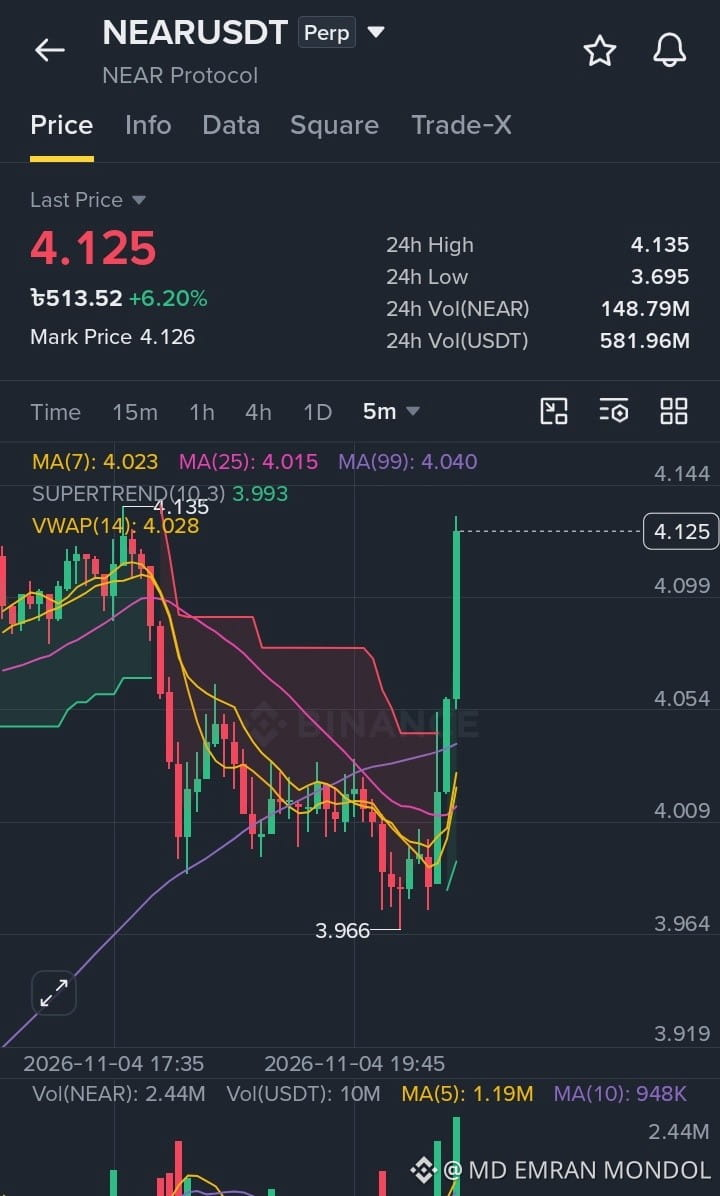
$NEAR — BULLISH BREAKOUT | LONG SETUP 🚀
LONG $NEAR — DCA ENTRIES
EP1: $4.090 – 40%
EP2: $4.055 – 30%
EP3: $4.020 – 30%
SL: $3.965
TP1: $4.135
TP2: $4.190
TP3: $4.250
Reason:
- Strong bullish candle with a significant volume spike.
- Price has reclaimed MA7, MA25, MA99 and VWAP on the 5-minute chart.
Wait for a pullback and confirmation. Avoid chasing the breakout.
This is my personal analysis only. Not financial advice. Trading involves risk. Do your own research.
$NEAR
{spot}(NEARUSDT)
$NEAR — BULLISH BREAKOUT | LONG SETUP 🚀
LONG $NEAR — DCA ENTRIES
EP1: $4.090 – 40%
EP2: $4.055 – 30%
EP3: $4.020 – 30%
SL: $3.965
TP1: $4.135
TP2: $4.190
TP3: $4.250
Reason:
- Strong bullish candle with a significant volume spike.
- Price has reclaimed MA7, MA25, MA99 and VWAP on the 5-minute chart.
Wait for a pullback and confirmation. Avoid chasing the breakout.
This is my personal analysis only. Not financial advice. Trading involves risk. Do your own research.
$NEAR
151
Verified
NVIDIA Is Still Making Billions, But the Market Is Starting to Ask Hard Questions$NVIDIA is still one of the biggest names in AI, but that doesn't mean buying NVDA at every dip is a smart move. The stock has faced selling pressure, and investors are getting more careful about how much money companies are throwing into AI infrastructure. Everyone wants AI growth. The question is whether the spending will keep paying off.
NVDA closed around $206.69 on November 3, up 2.29% during the session. But the recent weakness is worth watching. Shares have struggled to hold their previous momentum, and the broader chip market has been under pressure. A strong business can still have a weak stock price. People seem to forget that.
The numbers are still hard to ignore. NVIDIA reported $96.2 billion in second-quarter fiscal 2027 revenue, up 106% from a year earlier. Data Center revenue reached $89 billion, up 117%. That's serious demand. But the next earnings report on November 17 will matter a lot. NVIDIA has guided for $108 billion in third-quarter revenue. Investors will want to see whether actual demand can keep up with those expectations.
There is another problem. NVIDIA depends heavily on continued spending from major cloud and technology companies. If those companies slow their AI investment, the impact could reach the entire semiconductor market. Competition is also getting stronger, and restrictions on advanced chip sales to China remain a risk. Great products don't make a company immune to market pressure.
Still, I wouldn't count NVIDIA out. Its Blackwell and Vera Rubin platforms give it a strong position in AI computing, and its software ecosystem makes it harder for competitors to catch up. But the stock needs more than exciting announcements. It needs earnings that justify the expectations already built into its price.
For now, $200 is an important level to watch. If buyers defend it and push the price above $210, the recovery could gain some strength. But another break below $200 would make things less comfortable. I'd rather wait for confirmation than buy just because NVIDIA has a famous name.
Trading outlook: Neutral to cautiously bullish above $200.
ENTRY: $201–$205
TP1: $215
TP2: $225
SL: $196
RISK MANAGEMENT: Keep position size controlled. Watch the November 17 earnings report closely. A break below $200 weakens the bullish setup.
$NVDA
NVIDIA Is Still Making Billions, But the Market Is Starting to Ask Hard Questions
$NVIDIA is still one of the biggest names in AI, but that doesn't mean buying NVDA at every dip is a smart move. The stock has faced selling pressure, and investors are getting more careful about how much money companies are throwing into AI infrastructure. Everyone wants AI growth. The question is whether the spending will keep paying off.
NVDA closed around $206.69 on November 3, up 2.29% during the session. But the recent weakness is worth watching. Shares have struggled to hold their previous momentum, and the broader chip market has been under pressure. A strong business can still have a weak stock price. People seem to forget that.
The numbers are still hard to ignore. NVIDIA reported $96.2 billion in second-quarter fiscal 2027 revenue, up 106% from a year earlier. Data Center revenue reached $89 billion, up 117%. That's serious demand. But the next earnings report on November 17 will matter a lot. NVIDIA has guided for $108 billion in third-quarter revenue. Investors will want to see whether actual demand can keep up with those expectations.
There is another problem. NVIDIA depends heavily on continued spending from major cloud and technology companies. If those companies slow their AI investment, the impact could reach the entire semiconductor market. Competition is also getting stronger, and restrictions on advanced chip sales to China remain a risk. Great products don't make a company immune to market pressure.
Still, I wouldn't count NVIDIA out. Its Blackwell and Vera Rubin platforms give it a strong position in AI computing, and its software ecosystem makes it harder for competitors to catch up. But the stock needs more than exciting announcements. It needs earnings that justify the expectations already built into its price.
For now, $200 is an important level to watch. If buyers defend it and push the price above $210, the recovery could gain some strength. But another break below $200 would make things less comfortable. I'd rather wait for confirmation than buy just because NVIDIA has a famous name.
Trading outlook: Neutral to cautiously bullish above $200.
ENTRY: $201–$205
TP1: $215
TP2: $225
SL: $196
RISK MANAGEMENT: Keep position size controlled. Watch the November 17 earnings report closely. A break below $200 weakens the bullish setup.
$NVDA
1
112
NEAR Is Cutting Token Inflation, But the Price Is Still Taking a Beating$NEAR is having a rough few days. The token has fallen below $4, and buyers haven't shown much strength yet. It is frustrating because the project has plenty going on, but the market clearly isn't rewarding every development. NEAR is trading around $3.82, down roughly 4.2% over 24 hours and nearly 15% over seven days.
The interesting part is that NEAR just approved a major change to its token economics. Its House of Stake voted to reduce maximum annual token issuance from 2.5% to 1.6% over 24 months. That's meant to reduce dilution and long-term selling pressure. But don't celebrate too early. The proposal still needs further review and a validator upgrade before it becomes active.
There is also more happening beyond the token price. NEAR Intents is building cross-chain trading infrastructure, allowing users to move assets across different networks without dealing with the usual bridging mess. NEAR is also pushing into private AI infrastructure and autonomous agents. Those ideas sound useful, but the real test is whether people keep using them when the hype disappears.
The problem is that good technology doesn't automatically create demand for a token. NEAR needs real activity, consistent fees and stronger buying pressure. The recent issuance proposal is a positive step, but lower inflation alone won't fix a weak market.
For now, $3.50–$3.70 is an important support area to watch. If buyers defend that zone, a recovery toward $4.00 could become possible. But if support breaks, things could get uglier. I would rather wait for a proper recovery than pretend every dip is an opportunity.
NEAR isn't a project I would ignore. There is actual infrastructure being built here. But the market wants results, not another big roadmap. That's fair.
Trading outlook: Short-term bearish, watching for a support recovery.
ENTRY: $3.70–$3.85
TP1: $4.00
TP2: $4.30
SL: $3.48
RISK MANAGEMENT: Keep exposure small. Wait for buyers to defend support before entering. A break below $3.50 weakens this setup.
$NEAR
NEAR Is Cutting Token Inflation, But the Price Is Still Taking a Beating
$NEAR is having a rough few days. The token has fallen below $4, and buyers haven't shown much strength yet. It is frustrating because the project has plenty going on, but the market clearly isn't rewarding every development. NEAR is trading around $3.82, down roughly 4.2% over 24 hours and nearly 15% over seven days.
The interesting part is that NEAR just approved a major change to its token economics. Its House of Stake voted to reduce maximum annual token issuance from 2.5% to 1.6% over 24 months. That's meant to reduce dilution and long-term selling pressure. But don't celebrate too early. The proposal still needs further review and a validator upgrade before it becomes active.
There is also more happening beyond the token price. NEAR Intents is building cross-chain trading infrastructure, allowing users to move assets across different networks without dealing with the usual bridging mess. NEAR is also pushing into private AI infrastructure and autonomous agents. Those ideas sound useful, but the real test is whether people keep using them when the hype disappears.
The problem is that good technology doesn't automatically create demand for a token. NEAR needs real activity, consistent fees and stronger buying pressure. The recent issuance proposal is a positive step, but lower inflation alone won't fix a weak market.
For now, $3.50–$3.70 is an important support area to watch. If buyers defend that zone, a recovery toward $4.00 could become possible. But if support breaks, things could get uglier. I would rather wait for a proper recovery than pretend every dip is an opportunity.
NEAR isn't a project I would ignore. There is actual infrastructure being built here. But the market wants results, not another big roadmap. That's fair.
Trading outlook: Short-term bearish, watching for a support recovery.
ENTRY: $3.70–$3.85
TP1: $4.00
TP2: $4.30
SL: $3.48
RISK MANAGEMENT: Keep exposure small. Wait for buyers to defend support before entering. A break below $3.50 weakens this setup.
$NEAR
1
18
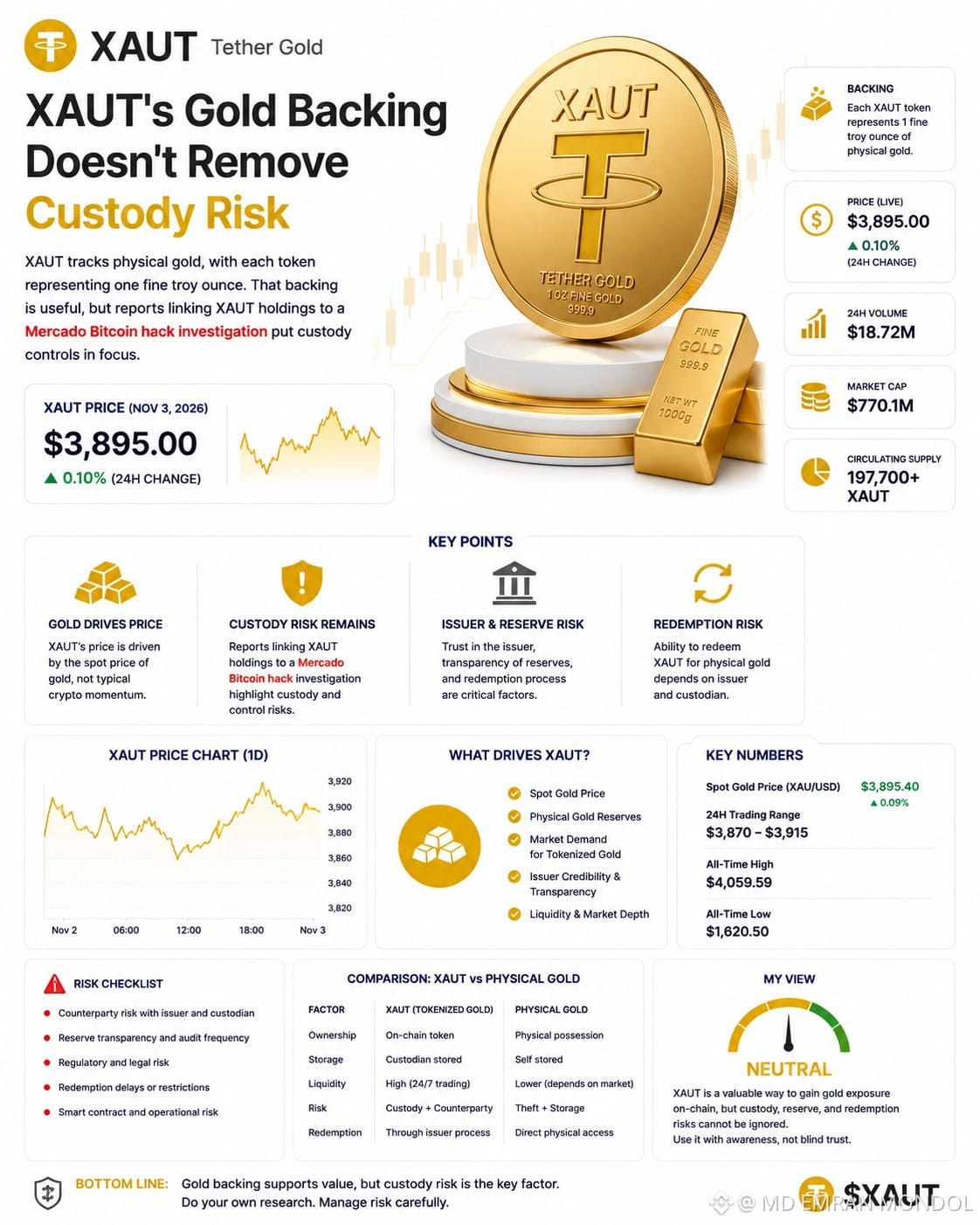
$XAUT 's Gold Backing Doesn't Remove Custody Risk
XAUT tracks physical gold, with each token representing one fine troy ounce.
That backing is useful, but reports linking XAUT holdings to a Mercado Bitcoin hack investigation put custody controls in focus.
It trades near $3,895, up about 0.1% in 24 hours.
Gold drives its price, not typical crypto momentum.
Still, issuer, reserve and redemption risks matter. My view is Neutral.
$XAUT
{spot}(XAUTUSDT)
$XAUT 's Gold Backing Doesn't Remove Custody Risk
XAUT tracks physical gold, with each token representing one fine troy ounce.
That backing is useful, but reports linking XAUT holdings to a Mercado Bitcoin hack investigation put custody controls in focus.
It trades near $3,895, up about 0.1% in 24 hours.
Gold drives its price, not typical crypto momentum.
Still, issuer, reserve and redemption risks matter. My view is Neutral.
$XAUT
115
Binance suffered a record ~$6.3 billion hot-wallet hack on October 29, attributed by the FBI to North Korea’s TraderTraitor group.
CZ confirmed that withdrawals have been fully restored, systems are back to normal, and all user funds are covered — users suffered zero losses. Roughly $3 billion of the stolen assets have already been frozen with help from U.S. authorities and industry partners.
CZ also noted that “there’s no 100% security” and urged the industry to invest more heavily in security and AI-powered defenses$BTC $ETH $SOL
{spot}(SOLUSDT)
{future}(ETHUSDT)
{spot}(BTCUSDT)
Binance suffered a record ~$6.3 billion hot-wallet hack on October 29, attributed by the FBI to North Korea’s TraderTraitor group.
CZ confirmed that withdrawals have been fully restored, systems are back to normal, and all user funds are covered — users suffered zero losses. Roughly $3 billion of the stolen assets have already been frozen with help from U.S. authorities and industry partners.
CZ also noted that “there’s no 100% security” and urged the industry to invest more heavily in security and AI-powered defenses$BTC $ETH $SOL

2
132
$IDOL — BEARISH BREAKDOWN | SHORT SETUP
SHORT $IDOL — DCA ENTRIES
EP1: $0.0180 – 40%
EP2: $0.0190 – 30%
EP3: $0.0200 – 30%
SL: $0.0215
TP1: $0.0170
TP2: $0.0160
TP3: $0.0145
Reason:
IDOL dropped over 30% in 24 hours after its recent rally.
Selling pressure remains high, with resistance near $0.020.
Wait for a rejection confirmation before entering. Volatility is extremely high.
This is my personal analysis only. Not financial advice. Trading involves risk. Do your own research.
$IDOL
{future}(IDOLUSDT)
$IDOL — BEARISH BREAKDOWN | SHORT SETUP
SHORT $IDOL — DCA ENTRIES
EP1: $0.0180 – 40%
EP2: $0.0190 – 30%
EP3: $0.0200 – 30%
SL: $0.0215
TP1: $0.0170
TP2: $0.0160
TP3: $0.0145
Reason:
IDOL dropped over 30% in 24 hours after its recent rally.
Selling pressure remains high, with resistance near $0.020.
Wait for a rejection confirmation before entering. Volatility is extremely high.
This is my personal analysis only. Not financial advice. Trading involves risk. Do your own research.
$IDOL
1
2
157
$TRX — BEARISH STRUCTURE | SHORT SETUP
SHORT $TRX — DCA ENTRIES
EP1: $0.3250 – 40%
EP2: $0.3300 – 30%
EP3: $0.3350 – 30%
SL: $0.3420
TP1: $0.3160
TP2: $0.3078
TP3: $0.3000
Reason:
Daily and 4H indicators show bearish trend pressure.
$0.3260–$0.3350 is a key resistance zone.
Wait for rejection confirmation before entering. Avoid chasing price.
This is my personal analysis only. Not financial advice. Trading involves risk. Do your own research.
$TRX
{future}(TRXUSDT)
$TRX — BEARISH STRUCTURE | SHORT SETUP
SHORT $TRX — DCA ENTRIES
EP1: $0.3250 – 40%
EP2: $0.3300 – 30%
EP3: $0.3350 – 30%
SL: $0.3420
TP1: $0.3160
TP2: $0.3078
TP3: $0.3000
Reason:
Daily and 4H indicators show bearish trend pressure.
$0.3260–$0.3350 is a key resistance zone.
Wait for rejection confirmation before entering. Avoid chasing price.
This is my personal analysis only. Not financial advice. Trading involves risk. Do your own research.
$TRX
2
42
Bitcoin Is Losing Momentum, and the $76K Support Zone Is Becoming CriticalBitcoin is going through another uncomfortable moment. After struggling to maintain its recent recovery, BTC is trading around $77,064 on November 3, down approximately 0.9% over the last 24 hours. The price action is not particularly encouraging, especially when buyers are failing to build strong momentum around important resistance levels.
One thing worth watching is the recent movement in institutional money. US spot Bitcoin ETFs reportedly recorded around $398.6 million in net outflows, adding pressure to an already fragile market. When institutional investors start reducing exposure, it becomes harder for Bitcoin to recover quickly, particularly when retail demand is not strong enough to absorb the selling.
But the bigger picture is not entirely negative. Bitcoin still has something that most other crypto assets cannot easily replicate: deep liquidity, global recognition and an established position in the financial market. Its fixed maximum supply of 21 million BTC also remains an important part of its long-term investment narrative. The question is whether those advantages can attract buyers during the current weakness.
Looking at the technical structure, $76,177 is an important support level, while $77,246 is the nearest resistance. Bitcoin's daily RSI is around 36.8, suggesting that momentum remains weak. Interestingly, the weekly outlook is stronger than the short-term picture, which means this decline does not automatically confirm a long-term bearish reversal. Still, a breakdown below support could open the door toward $74,856.
For the next 24 hours, I would pay close attention to how Bitcoin behaves around $76,000–$77,250. A successful recovery above resistance could bring buyers back into the market, but another rejection may extend the current correction. Personally, I would rather wait for confirmation than chase a quick bounce. Bitcoin has seen enough volatility to remind everyone that patience is often more valuable than guessing the next move.
1-DAY TRADING SIGNAL
Direction: Bearish-to-Neutral
ENTRY: $76,100–$76,300 (short only after a confirmed breakdown and retest)
TP1: $74,856
TP2: $71,857
SL: $77,300
RISK MANAGEMENT: Wait for confirmation, avoid excessive leverage and risk only a small portion of trading capital. This is a conditional setup, not a guaranteed prediction.
$BTC
Bitcoin Is Losing Momentum, and the $76K Support Zone Is Becoming Critical
Bitcoin is going through another uncomfortable moment. After struggling to maintain its recent recovery, BTC is trading around $77,064 on November 3, down approximately 0.9% over the last 24 hours. The price action is not particularly encouraging, especially when buyers are failing to build strong momentum around important resistance levels.
One thing worth watching is the recent movement in institutional money. US spot Bitcoin ETFs reportedly recorded around $398.6 million in net outflows, adding pressure to an already fragile market. When institutional investors start reducing exposure, it becomes harder for Bitcoin to recover quickly, particularly when retail demand is not strong enough to absorb the selling.
But the bigger picture is not entirely negative. Bitcoin still has something that most other crypto assets cannot easily replicate: deep liquidity, global recognition and an established position in the financial market. Its fixed maximum supply of 21 million BTC also remains an important part of its long-term investment narrative. The question is whether those advantages can attract buyers during the current weakness.
Looking at the technical structure, $76,177 is an important support level, while $77,246 is the nearest resistance. Bitcoin's daily RSI is around 36.8, suggesting that momentum remains weak. Interestingly, the weekly outlook is stronger than the short-term picture, which means this decline does not automatically confirm a long-term bearish reversal. Still, a breakdown below support could open the door toward $74,856.
For the next 24 hours, I would pay close attention to how Bitcoin behaves around $76,000–$77,250. A successful recovery above resistance could bring buyers back into the market, but another rejection may extend the current correction. Personally, I would rather wait for confirmation than chase a quick bounce. Bitcoin has seen enough volatility to remind everyone that patience is often more valuable than guessing the next move.
1-DAY TRADING SIGNAL
Direction: Bearish-to-Neutral
ENTRY: $76,100–$76,300 (short only after a confirmed breakdown and retest)
TP1: $74,856
TP2: $71,857
SL: $77,300
RISK MANAGEMENT: Wait for confirmation, avoid excessive leverage and risk only a small portion of trading capital. This is a conditional setup, not a guaranteed prediction.
$BTC
1
9
SUI Has Strong Technology, But the Market Still Needs a Reason to Believe
Sui has built an interesting position in the Layer-1 blockchain space, but its token is facing a difficult market right now. On November 3, SUI is trading around $0.865, down approximately 2.6% over the past 24 hours. The decline shows that strong technology alone is not enough to keep buyers interested.
There are still meaningful developments behind the project. Sui's object-based architecture and Move programming language give it a different approach to blockchain execution. Its growing ecosystem across DeFi, payments and digital assets also creates opportunities for long-term adoption.
One development worth watching is the Samsung Wallet integration, which aims to bring USDC on Sui to millions of eligible Galaxy users in the United States. Mercado Bitcoin has also announced plans to expand access to SUI and related assets in Brazil. These developments could help improve real-world usage over time.
However, the negative side cannot be ignored. Reports of a BlueMove DEX exploit involving more than 710,000 SUI have raised fresh security concerns across the ecosystem. At the same time, the token remains far below its previous all-time high of $5.35. Investors need to see stronger demand, not just new announcements.
For the next 24 hours, the $0.86 area is an important support zone. Holding above it could give SUI room for a short recovery toward $0.89–$0.92. But a confirmed breakdown below support could expose the $0.80 area. For now, I would rather see buyers defend support before calling this a meaningful recovery.
1-DAY TRADING SIGNAL
Direction: Bearish-to-Neutral
ENTRY: $0.858–$0.865 (only after confirmed breakdown and retest)
TP1: $0.840
TP2: $0.800
SL: $0.885
RISK MANAGEMENT: Keep position size small, avoid chasing price, and risk only what you can afford to lose. This is a conditional setup, not a guaranteed outcome.
$SUI
{spot}(SUIUSDT)
SUI Has Strong Technology, But the Market Still Needs a Reason to Believe
Sui has built an interesting position in the Layer-1 blockchain space, but its token is facing a difficult market right now. On November 3, SUI is trading around $0.865, down approximately 2.6% over the past 24 hours. The decline shows that strong technology alone is not enough to keep buyers interested.
There are still meaningful developments behind the project. Sui's object-based architecture and Move programming language give it a different approach to blockchain execution. Its growing ecosystem across DeFi, payments and digital assets also creates opportunities for long-term adoption.
One development worth watching is the Samsung Wallet integration, which aims to bring USDC on Sui to millions of eligible Galaxy users in the United States. Mercado Bitcoin has also announced plans to expand access to SUI and related assets in Brazil. These developments could help improve real-world usage over time.
However, the negative side cannot be ignored. Reports of a BlueMove DEX exploit involving more than 710,000 SUI have raised fresh security concerns across the ecosystem. At the same time, the token remains far below its previous all-time high of $5.35. Investors need to see stronger demand, not just new announcements.
For the next 24 hours, the $0.86 area is an important support zone. Holding above it could give SUI room for a short recovery toward $0.89–$0.92. But a confirmed breakdown below support could expose the $0.80 area. For now, I would rather see buyers defend support before calling this a meaningful recovery.
1-DAY TRADING SIGNAL
Direction: Bearish-to-Neutral
ENTRY: $0.858–$0.865 (only after confirmed breakdown and retest)
TP1: $0.840
TP2: $0.800
SL: $0.885
RISK MANAGEMENT: Keep position size small, avoid chasing price, and risk only what you can afford to lose. This is a conditional setup, not a guaranteed outcome.
$SUI
1
115
$BMT — BULLISH MOMENTUM | LONG SETUP 🚀
LONG $BMT — DCA ENTRIES
EP1: $0.0230 – 40%
EP2: $0.0218 – 30%
EP3: $0.0205 – 30%
SL: $0.0190
TP1: $0.0242
TP2: $0.0266
TP3: $0.0308
Reason:
- Daily trend remains bullish, with price above major moving averages.
- Strong buying activity supports a possible continuation, but volatility remains high.
Wait for pullback confirmation before entering. Avoid chasing the pump.
This is my personal analysis only. Not financial advice. Trading involves risk. Do your own research.
$BMT
2
192
$UAI — BEARISH STRUCTURE | SHORT SETUP
SHORT $UAI — DCA ENTRIES
EP1: $0.1600 – 40%
EP2: $0.1660 – 30%
EP3: $0.1720 – 30%
SL: $0.1810
TP1: $0.1530
TP2: $0.1450
TP3: $0.1350
Reason:
- 1H and 4H indicators show bearish momentum.
- Price remains below key moving averages despite a short-term bounce.
Wait for resistance rejection before entering. Avoid chasing volatility.
This is my personal analysis only. Not financial advice. Trading involves risk. Do your own research.
$UAI
{future}(UAIUSDT)
$UAI — BEARISH STRUCTURE | SHORT SETUP
SHORT $UAI — DCA ENTRIES
EP1: $0.1600 – 40%
EP2: $0.1660 – 30%
EP3: $0.1720 – 30%
SL: $0.1810
TP1: $0.1530
TP2: $0.1450
TP3: $0.1350
Reason:
- 1H and 4H indicators show bearish momentum.
- Price remains below key moving averages despite a short-term bounce.
Wait for resistance rejection before entering. Avoid chasing volatility.
This is my personal analysis only. Not financial advice. Trading involves risk. Do your own research.
$UAI
1
306
$ICNT — BULLISH MOMENTUM | LONG SETUP 🚀
LONG $ICNT — DCA ENTRIES
EP1: $0.1880 – 40%
EP2: $0.1835 – 30%
EP3: $0.1785 – 30%
SL: $0.1675
TP1: $0.1990
TP2: $0.2070
TP3: $0.2130
Reason:
- Daily RSI near 60 supports bullish momentum.
- 4H trend remains upward, with $0.183 support as an important level.
Wait for a confirmed bounce before entering. Avoid chasing the pump.
This is my personal analysis only. Not financial advice. Trading involves risk. Do your own research.
$ICNT
160
Article
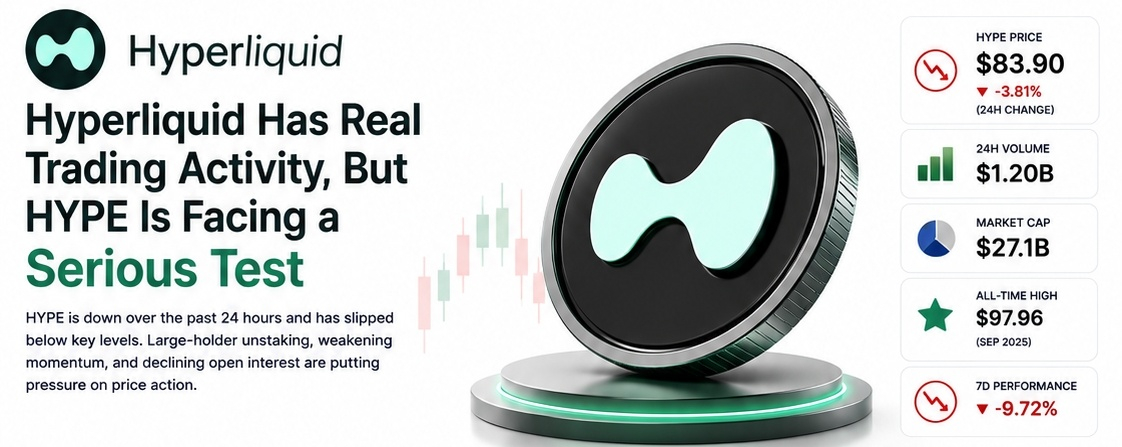
Hyperliquid Has Real Trading Activity, But HYPE Is Facing a Serious TestHYPE is trading around $83–$84 on November 3, 2026, down roughly 3–5% over the past 24 hours, depending on the exchange and data snapshot. Daily trading volume is around $1.2 billion. That is still a lot of activity, but the price action is not looking healthy. HYPE has slipped below the important $85 area, and sellers are currently having more influence than buyers.
The biggest concern is not simply the market-wide weakness. Paradigm reportedly unstaked around 2.55 million HYPE, worth approximately $224 million, over two days. That is a meaningful amount of capital moving out of staking. It does not automatically mean every token will be sold, but traders are right to pay attention. When a large holder reduces exposure during a weak market, confidence can disappear quickly.
There is still a strong argument behind Hyperliquid. It is not just another token trying to build a story around DeFi. Its perpetual futures platform has real trading activity, and the ecosystem is expanding into more markets. The proposed ICE and trade[XYZ] initiative to bring regulated perpetual futures to US markets is an important development. If it moves forward, it could introduce Hyperliquid's technology to a much larger financial audience. But a partnership announcement is not the same as confirmed revenue or guaranteed adoption.
The protocol's Assistance Fund also provides a potential source of buying pressure through HYPE buybacks. That matters, but buybacks should not be treated as a magic floor. If large holders are unstaking and market participants are reducing leveraged exposure, regular buybacks may not be enough to reverse the trend. Recent reporting also points to declining futures open interest, which suggests some traders are pulling back rather than aggressively positioning for another rally.
For the chart, $80–$82 is the first area I would watch. Losing that zone could open the door to a deeper move toward the mid-$70s. On the other side, HYPE needs to reclaim $85–$86 and hold above it before a recovery starts looking convincing. A move back above that range with stronger volume would improve the short-term picture. Until then, buying every dip is a risky approach.
My view is cautious. Hyperliquid has a stronger product story than many speculative tokens, and its trading activity gives HYPE a real foundation to build on. But the market does not reward a good product story every day. Right now, large-holder movements, weakening momentum and the upcoming token distribution are more immediate concerns than the long-term opportunity. I would rather see buyers defend support and reclaim $85 than rush into a rebound that has not been confirmed.
$HYPE
{spot}(HYPEUSDT)
Hyperliquid Has Real Trading Activity, But HYPE Is Facing a Serious Test
HYPE is trading around $83–$84 on November 3, 2026, down roughly 3–5% over the past 24 hours, depending on the exchange and data snapshot. Daily trading volume is around $1.2 billion. That is still a lot of activity, but the price action is not looking healthy. HYPE has slipped below the important $85 area, and sellers are currently having more influence than buyers.
The biggest concern is not simply the market-wide weakness. Paradigm reportedly unstaked around 2.55 million HYPE, worth approximately $224 million, over two days. That is a meaningful amount of capital moving out of staking. It does not automatically mean every token will be sold, but traders are right to pay attention. When a large holder reduces exposure during a weak market, confidence can disappear quickly.
There is still a strong argument behind Hyperliquid. It is not just another token trying to build a story around DeFi. Its perpetual futures platform has real trading activity, and the ecosystem is expanding into more markets. The proposed ICE and trade[XYZ] initiative to bring regulated perpetual futures to US markets is an important development. If it moves forward, it could introduce Hyperliquid's technology to a much larger financial audience. But a partnership announcement is not the same as confirmed revenue or guaranteed adoption.
The protocol's Assistance Fund also provides a potential source of buying pressure through HYPE buybacks. That matters, but buybacks should not be treated as a magic floor. If large holders are unstaking and market participants are reducing leveraged exposure, regular buybacks may not be enough to reverse the trend. Recent reporting also points to declining futures open interest, which suggests some traders are pulling back rather than aggressively positioning for another rally.
For the chart, $80–$82 is the first area I would watch. Losing that zone could open the door to a deeper move toward the mid-$70s. On the other side, HYPE needs to reclaim $85–$86 and hold above it before a recovery starts looking convincing. A move back above that range with stronger volume would improve the short-term picture. Until then, buying every dip is a risky approach.
My view is cautious. Hyperliquid has a stronger product story than many speculative tokens, and its trading activity gives HYPE a real foundation to build on. But the market does not reward a good product story every day. Right now, large-holder movements, weakening momentum and the upcoming token distribution are more immediate concerns than the long-term opportunity. I would rather see buyers defend support and reclaim $85 than rush into a rebound that has not been confirmed.
$HYPE
411
Log in to explore more content
Join global crypto users on Binance Square
⚡️ Get latest and useful information about crypto.
💬 Trusted by the world’s largest crypto exchange.
👍 Discover real insights from verified creators.
Email / Phone number
Trending Topics
A Packed Week of Earnings and Data Tests Markets
69,610 views
452 Discussing
Nvidia Earnings, Fed Minutes and Anthropic IPO Set to Test AI Stocks and Crypto
Binance News
·146 Likes
·24.5k views
AnthropicIPOTestsInvestorAppetiteForAI
137,115 views
1,527 Discussing
NvidiaBoardNotConsideringHuang’sReturnasCEO
2,869 views
100 Discussing