
聚万财
207 Posts

聚万财
Report
Block User
我想挣钱
17 Following
85 Followers
118 Liked
Posts
·
--
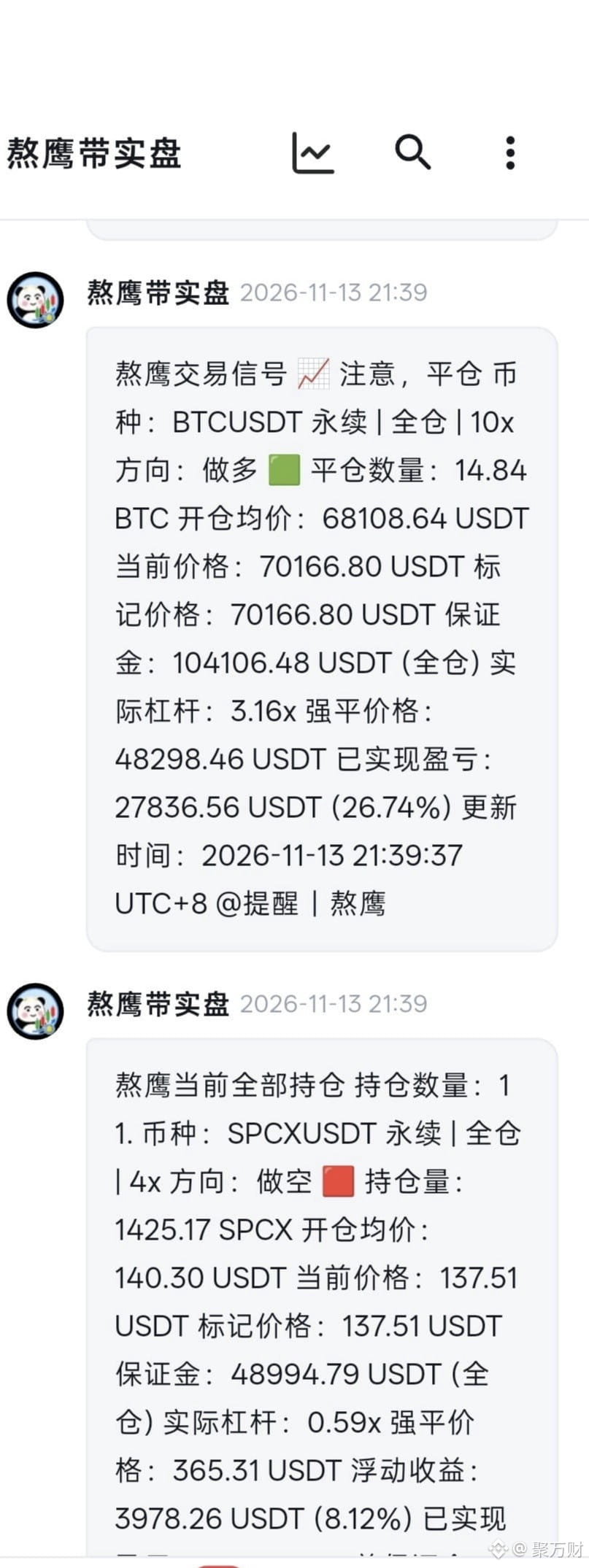
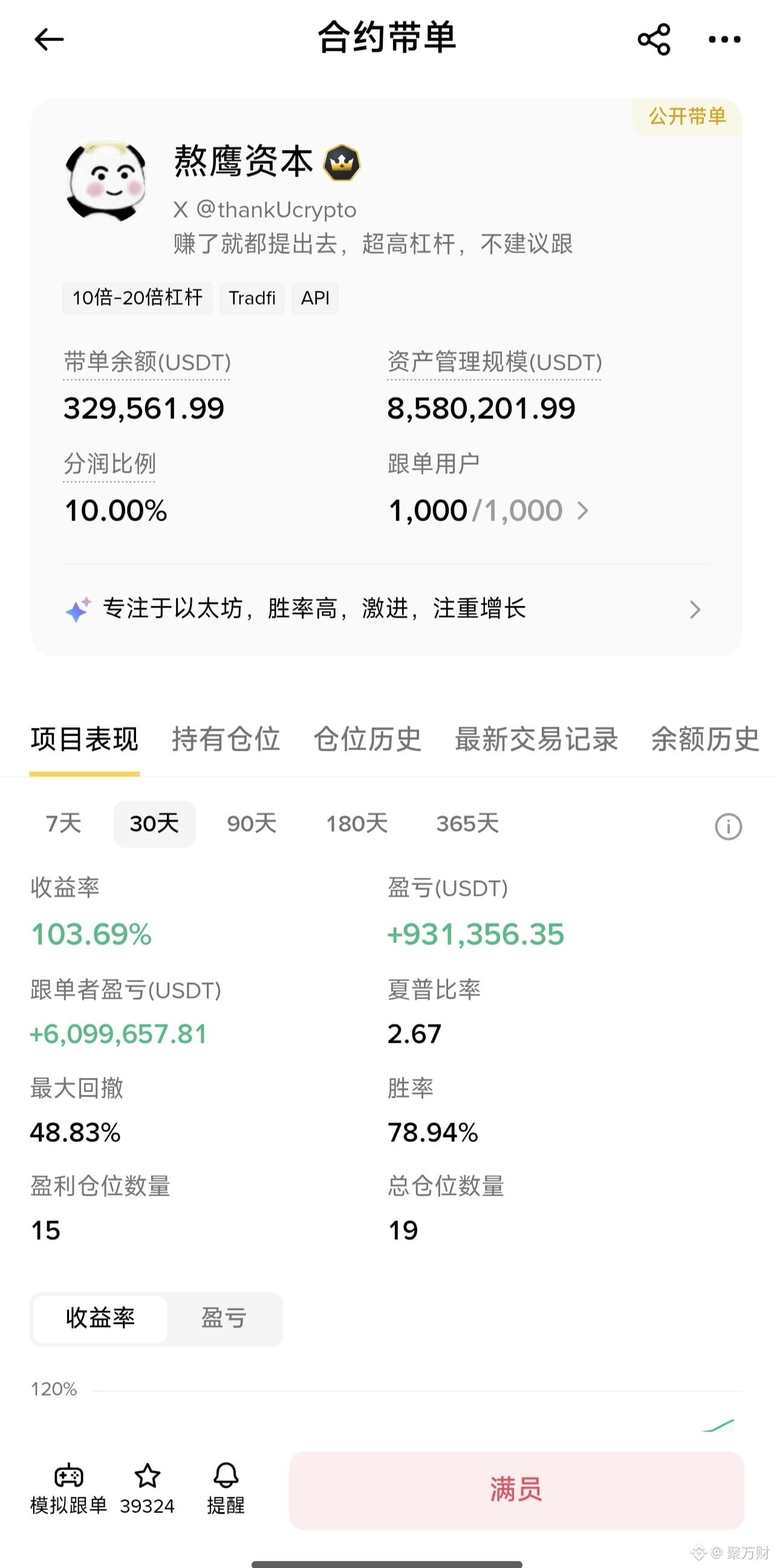
Copying Ao Ying’s trades is just too lucky—you’re riding a wave, and it’d be hard not to get rich. Can I still get in on this in my lifetime? #熬鹰资本
{spot}(BTCUSDT)
Copying Ao Ying’s trades is just too lucky—you’re riding a wave, and it’d be hard not to get rich. Can I still get in on this in my lifetime? #熬鹰资本
3
484
·
--
As records of profitable trades by Aoying Capital spread through the trading community, many market participants have voiced differing opinions. After a winning streak came to light, talk of “making a trading god” resurfaced. The timing of this sudden market surge was particularly subtle: prices shot up and triggered order settlement almost immediately, making the move look as if it had been arranged in advance. The purpose behind the rally has become a hotly debated mystery.
Some credit the string of take-profits to sharp market instincts and a mature trading system, arguing that the trader accurately read market cycles and capital flows and timed the turning point. But skepticism has also been widespread: the sharp short-term spike and rapid closeout of orders seem too deliberate. When there are too many coincidences, it is hard not to suspect coordinated capital activity behind the price action.
Several leading theories have emerged. The first is that major players used the rally to lock in profits, rapidly pushing prices up to sweep away opposing positions and allow their own orders to settle and exit smoothly. The second is that the impressive trading record was used to cultivate an image of a “trading guru,” attracting traffic and followers and eventually creating a wave of copycat trades. The third is a conventional market-manipulation tactic: pushing prices up to trigger stop-loss and take-profit orders, completing a round of position transfers and laying the groundwork for the next period of volatility.
Liquidity in short-term crypto markets fluctuates sharply, and large sums of capital can easily drive sudden price movements in a short time. A rally that appears perfectly timed is not necessarily controlled by a single actor; it may also result from multiple pools of capital moving in the same direction at the same time, creating a resonance that gives the impression it was “all planned.”
The “making a trading god” effect is worth watching out for. Once the myth of a winning streak is repeatedly amplified, large numbers of retail investors may follow suit, while market sentiment can turn at any moment. Many supposedly unbeatable traders have suffered heavy losses when hype peaked. Markets will not always follow one person’s predictions, and no matter how impressive a trade history looks, it cannot guarantee that the next trade will be profitable.#熬鹰资本 $BTC
1
1
2.2k
·
--
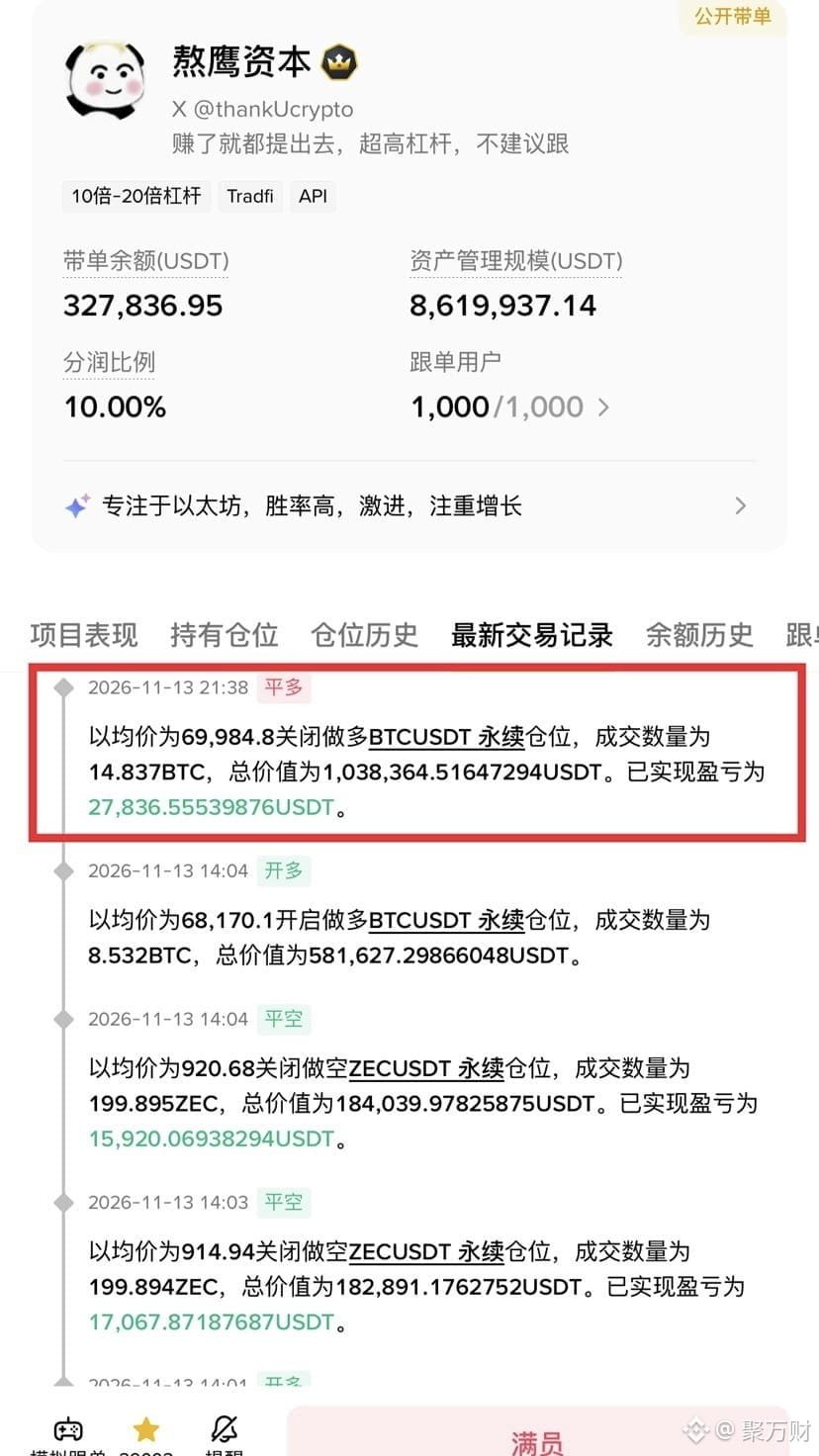
Aoying Capital Scores Another Trading Victory
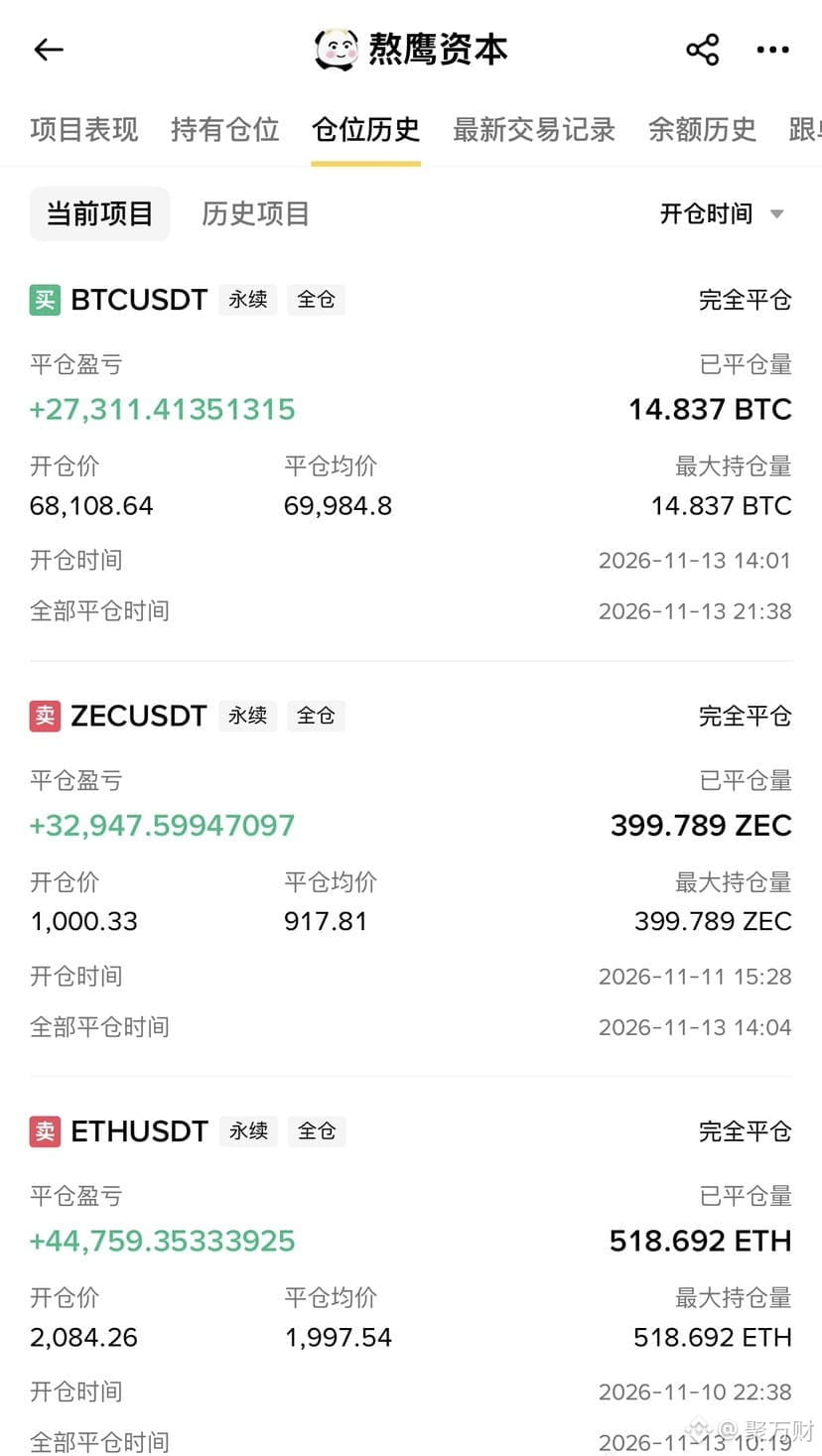
Aoying Capital, a popular trading entity in the community, has once again posted an impressive trading result. The Bitcoin long position entered this afternoon has just successfully hit its take-profit target, earning a total profit of 27,000 U.
Since this market downturn began, Aoying Capital has achieved an impressive nine consecutive wins, successfully closing out multiple trades in a row and drawing the attention of many traders with its strong performance.
A winning streak is certainly impressive, but repeatedly and precisely predicting market movements is largely a matter of chance. Markets change rapidly, and no trading strategy can guarantee profits forever; a winning streak can be broken at any moment by a market reversal. High leverage and short-term trading carry substantial risks, and chasing trades or blindly following others can easily lead to significant losses. Be sure to manage your risk carefully before entering a trade.
Do you think this SPCX short position can help Aoying Capital achieve ten consecutive wins? Share your thoughts in the comments, and follow us to keep up with market updates. #熬鹰资本 $BTC
2
1
2k
·
--
As one of Asia’s most popular digital asset markets, South Korea’s regulatory moves have always attracted close attention. The latest news indicates that the long-awaited Digital Asset Basic Act is expected to be finalized in early January next year, establishing an overarching regulatory framework for the country’s digital asset sector.
Previously, South Korea’s relevant regulatory provisions were fragmented, with no unified foundational law. Once finalized, the bill will set out comprehensive rules covering the definition of digital assets, asset classification, platform licensing, custody and reserves, crisis response, investor protection, and penalties for violations. Stablecoin regulation and emergency risk-control mechanisms for platforms may also be included.
Unified legislation has both advantages and disadvantages. Clear regulations can reduce uncertainty, boost investor confidence, and help South Korea become a digital asset hub in Asia. However, compliance requirements will also rise, potentially accelerating the exit of smaller platforms that lack sufficient resources. Many key provisions are still under negotiation, and how strict the final rules are will directly affect the market’s direction.
Finalization does not mean the law takes effect immediately. It will still need to go through processes such as deliberation and voting in the National Assembly, and supporting rules will continue to be refined. This bill marks an important turning point in the standardization of South Korea’s digital asset sector and will also have a far-reaching impact on Asia’s digital asset market.
What changes do you think the bill’s implementation will bring? Share your thoughts in the comments, and follow us to keep up with the latest developments.#韩国数字资产基本法预计1月初定稿

1
2
721
·
--
Recently, crypto assets and U.S. stocks have weakened in tandem. Tech stocks and crypto-related sectors have both pulled back, while fear continues to spread. After a string of declines, many investors are waiting on the sidelines, wondering what could spark the next rebound.
Several factors have contributed to this widespread pullback. In U.S. stocks, pressure on AI leaders’ valuations, executive reshuffles, and uncertainty around earnings expectations have weighed on bullish sentiment toward tech stocks. The crypto market has followed the broader market lower, with investors seeking safety and risk appetite cooling rapidly. The two markets have dragged each other down, creating a synchronized decline.
The market widely expects the next rebound to depend on several key drivers.
First, signals from macroeconomic and monetary policy. If inflation data cools and raises expectations of looser monetary policy, improved liquidity would benefit both U.S. growth stocks and crypto assets, making it the most direct catalyst for a rebound.
Second, companies delivering on earnings. Better-than-expected results from tech giants and continued surging revenue from AI businesses could restore confidence in high valuations, lift the broader tech sector, and in turn improve sentiment in the crypto market.
Third, positive industry policy developments. For example, clearer regulatory rules and the continued rollout of compliant products—such as asset tokenization and regulated crypto products—could attract substantial traditional investment and bring fresh capital into the market.
Fourth, improving sentiment and returning capital. Once prices have fully absorbed the negative news and selling pressure has run its course, bargain hunters may step in. Combined with catalysts from popular themes, this could trigger a technical rebound.
But a rebound is not guaranteed. The market still faces considerable risks: weaker-than-expected economic performance, tighter regulation, or disappointing earnings could continue to weigh on prices. Whether a rebound can last will depend on whether it is supported by substantial fresh capital and solid fundamentals, rather than just short-term speculation.
What do you think will be the first signal to spark this rebound? Share your thoughts in the comments, follow us, and stay up to date with market developments.#加密美股齐跌,下轮反弹的驱动力在哪?

1
3
1.8k
·
--
Verified
News of a management shake-up at Nvidia broke, and the market reacted swiftly, dragging down U.S. chip stocks and deepening their overall losses.
According to an official announcement, Jensen Huang has resigned as president, CEO, and a member of the board, effective immediately. CFO Colette Kress will serve as interim CEO, and the board will begin the search for a new CEO.
The sudden departure of the key figure who had led Nvidia for more than three decades sent shockwaves through the market. After the news broke, Nvidia shares plunged sharply during trading, falling by more than 14% at their worst and weighing on sentiment across the U.S. chip sector, with several chip stocks also declining.
Market concerns are focused on continuity of strategy. Nvidia’s technology roadmap, capacity expansion plans, and global customer relationships have long reflected Huang’s personal influence. Investors are watching to see whether the interim leadership can maintain the existing pace of research and development and supply. With the Q3 earnings report approaching, multiple uncertainties are compounding and further amplifying volatility across the sector.
Market opinions are sharply divided. Some believe Nvidia has already established a mature technology ecosystem and that its business is unlikely to be easily shaken in the short term. Many institutions, however, worry that a change at the top could alter the company’s long-term strategy and trigger ripple effects across the AI industry supply chain.
As the global leader in AI chips, Nvidia’s management changes are affecting the entire tech sector. What do you think the impact of this leadership change will be? Share your thoughts in the comments, and follow us to keep up with the latest developments. #英伟达突发换帅,美国芯片股跌幅扩大 #黄仁勋辞任CEO,英伟达战略走向受关注

3
1
3
3.9k
·
--
A South Korean exchange that had just received its operating license suddenly suspended deposits and withdrawals.
Online rumors suggest it may have been hit by a hacker attack, prompting the platform to urgently freeze transactions and investigate the risk. Behind this is a new South Korean regulatory rule: if an exchange suspects a hacking risk, it can suspend deposits and withdrawals preemptively without confirming that any assets have been stolen.
The new rule is intended to prevent theft before it happens, requiring platforms to strengthen monitoring and increase their cold-wallet reserves. But it has also sparked controversy, with concerns that a warning could trigger arbitrary suspensions of deposits and withdrawals, leaving users unable to access their funds.
This incident also highlights the significant hacking and security pressures that crypto platforms face over the long term.
What do you think of this new rule? Share your thoughts in the comments, and follow us for ongoing updates. #韩国拟准交易所疑遭黑客停充提 $SPCXB

3
1
1.1k
·
--
News that Jensen Huang is stepping down as CEO of Nvidia has sent shockwaves through the market, quickly drawing intense attention across the tech and capital markets.
As the central figure at Nvidia, Huang has long guided the company’s overall development strategy, helping transform it from a graphics card maker into a global AI chip giant. Over the years, his personal influence has been deeply imprinted on everything from product upgrades and major customer relationships to his assessment of the broader AI industry cycle.
The market’s biggest concern now is whether the company’s strategic direction will change following the leadership transition. Investors are watching to see whether Nvidia will maintain its aggressive capacity expansion, whether its chip supply and pricing strategy will change, and whether it will stick to its established AI technology roadmap. Combined with earlier market concerns about Nvidia’s Q3 earnings, this personnel change has added further uncertainty.
Many investors believe that if the transition goes smoothly, the company will likely continue to carry out its existing development plans. Others, however, point out that a change in core leadership could bring shifts in business strategy and risk appetite, potentially affecting the structure of the entire global AI supply chain.
Executive changes are never just simple personnel reshuffles. As a leader in the AI sector, every move Nvidia makes affects sentiment across the entire industry.
What do you think of this leadership change? Will it alter $Nvidia’s development trajectory going forward? Leave a comment to join the discussion, follow us, and stay tuned for updates.#黄仁勋辞任CEO,英伟达战略走向受关注

2
1
246
·
--
I didn't expect my last post about South Korean exchanges suspending deposits and withdrawals to take off like that.
A lot of people see an exchange suddenly suspend deposits and withdrawals and immediately think: Has it been hacked? Have assets been stolen?
In fact, this is due to new regulations South Korea is pushing forward. Regulators plan to allow exchanges to suspend deposits and withdrawals in advance if they suspect a hacking risk, without having to wait for confirmation that assets have been stolen. It's a form of preventive risk control.
Quite a few platforms have had security issues in the past, from receiving threat emails to having wallets compromised. Once something happens, the losses are very difficult to recover. Regulators introduced this rule to lock down funds ahead of time and prevent hackers from making off with assets. They also want platforms to strengthen monitoring, increase cold wallet reserves, and improve security.
The benefit is that it could stop coin theft before a risk materializes. But there is also considerable controversy: if deposits and withdrawals are suspended whenever a suspicious alert comes in, users could find their funds locked up, which would be a major headache.
The fact that this has sparked so much discussion shows that what everyone cares about most is always the safety of their funds. The risk of hacking has long been an unavoidable challenge for the crypto industry.
Thanks to all the friends who have followed and left comments. Do you think this new rule protects users, or does it increase the risk of funds being frozen arbitrarily? Feel free to keep the discussion going in the comments. Follow for more updates as the story develops.#韩国拟准交易所疑遭黑客停充提 $BTC

1
2
5.1k
·
--
A South Korean exchange that had just received its operating license suddenly suspended deposits and withdrawals.
The most widely circulated explanation is that it may have been hacked. The platform shut down deposits and withdrawals outright, most likely to prevent further problems with funds and urgently lock things down while it investigates the risks.
To be precise, it wasn’t an emergency shutdown in response to an actual incident, but a new regulation: South Korean regulators plan to allow exchanges to suspend deposits and withdrawals preemptively as soon as they suspect a hacking risk, without waiting for confirmation that funds have been stolen. It’s a preventive policy.
Several platforms have suffered security incidents before. Some received threatening emails, while others had their wallets hacked. Once an incident occurs, the losses can be difficult to recover. By loosening the rules this time, regulators are giving platforms an extra layer of protection. They’re also requiring platforms to strengthen their monitoring and keep more assets in cold wallets to build up their security reserves.
The advantage is that funds can be locked down before an incident occurs, preventing hackers from making off with them. But there’s also controversy: if deposits and withdrawals are suspended whenever there’s even the slightest suspicion, users could find their funds stuck, which would be a major inconvenience.
These new rules also show that security remains a major challenge for crypto platforms, and hacking risks are an issue they can’t avoid. #韩国拟准交易所疑遭黑客停充提 $NVDAB

6
10
14.4k
·
--
Nvidia has faced quite a few controversies and negative headlines lately, and market sentiment has clearly turned cautious.
What everyone is most concerned about now is: Is AI demand cooling? Are orders still holding up? Can profits be sustained?
This Q3 earnings report is crucial. If the numbers look good, market concerns will fade and the market can stabilize. But if the results disappoint, all the concerns that have been building will be amplified, and the AI sector will likely remain under pressure.
Put simply, this round of earnings reports will directly determine the strength of market confidence in the short term. #英伟达Q3财报将至:能否化解市场疑虑? #
2
3
516
·
--
Market concerns are now focused on three main questions: Is downstream purchasing slowing? Can high gross margins be sustained? Are future orders sustainable?
This earnings report will be a major test. The key things to watch are revenue, gross margin, and guidance for the next quarter. If the figures meet expectations, market concerns will ease; if they fall short, the pessimism that has built up will quickly be unleashed.
An earnings report is not just a scorecard for one company; it is also a barometer of the overall health of the AI industry chain.
#英伟达Q3财报将至:能否化解市场疑虑?
1
3
325
·
--
Many people think financial luck means chasing hot trends and making a fortune overnight. In reality, true financial opportunity lies in the market’s waiting and strategic maneuvering.
Nvidia has long since become more than just a chipmaker—it’s a barometer for the direction of capital across the entire AI industry. Everyone is wondering: Is demand cooling? Can orders hold steady? Will the various setbacks along the way weigh on results? This earnings report is the answer to all those questions.
If the results beat expectations, doubts will fade, momentum will continue, and money will flow in accordingly. If they fall short, concerns will grow and capital will quickly pull out. Financial fortune is never set in stone; it shifts with every crucial signal. Knowing how to wait and read those signals is how you seize opportunity.
It’s easy to be swayed by the news. Follow me, and I’ll follow you back. Let’s follow the earnings results together, read the market sentiment, seize opportunities, avoid risks, and stay on top of where the money is flowing.#英伟达Q3财报将至:能否化解市场疑虑?
2
257
·
--
People often think financial luck is all about seizing trends and catching the market at the right time. But it’s not just about how you make money—it’s even more important to know whether you can hold on to your wealth.
Nvidia’s meteoric rise wasn’t driven by the AI boom alone. It also depended on the trust investors and the market placed in its leadership. If a key executive becomes embroiled in a major scandal, that trust can waver. Once market confidence collapses, the company’s valuation, funding, and partnerships can all be affected—and the financial gains within reach can easily slip away.
A rising trend can bring opportunity, but that’s only the beginning of financial luck. Character and composure are what truly help you hold on to it. Making money can happen fast; keeping it is harder.
Follow me, and I’ll follow you back. Let’s follow each other and learn to read the signals behind the market—to recognize both opportunities and risks, so we can seize opportunities and protect our financial fortunes.#黄仁勋再被曝与下属婚外情,或遭董事会罢免
5
2
334
Log in to explore more content
Join global crypto users on Binance Square
⚡️ Get latest and useful information about crypto.
💬 Trusted by the world’s largest crypto exchange.
👍 Discover real insights from verified creators.
Email / Phone number
Trending Topics
USPPIMissMayEaseBTCPressure
90,737 views
1,138 Discussing
US PPI Rises 6.5% a Year in October, Slightly Below 6.6% Forecast
Binance News
·18 Likes
·20.3k views
MANTRAPausesUnstakingFor7DaysAfterKeplrSecurityIncident
309 views
12 Discussing
BitcoinCoreDisclosesTorTrafficVulnerability
41,709 views
646 Discussing