

JuneX Crypto
157 Posts

JuneX Crypto
Report
Block User
你不能预测,但你可以准备
Open Trade
Frequent Trader
2.7 Months
82 Following
6 Followers
3 Liked
Posts
Portfolio
·
--
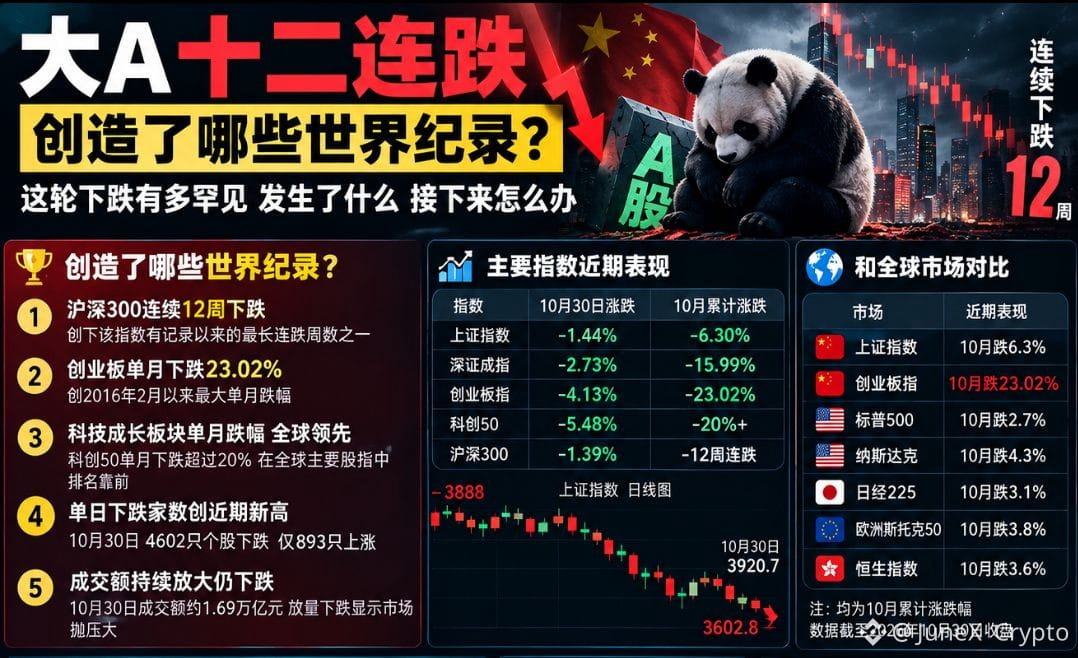
The CSI 300 has fallen for 12 consecutive weeks as A-shares undergo a historically rare correction
As of October 30, the CSI 300 Index had fallen for 12 consecutive weeks, with a cumulative decline of about 14% over that period. Media reports citing Reuters said this was the longest run of consecutive weekly losses in the index’s recorded history. Note that the record is for the CSI 300, not the Shanghai Composite Index; nor can it currently be described as the “longest-ever streak worldwide” for stock markets.
Looking at the final trading day of October: the Shanghai Composite Index closed at 3,599.02, down 1.44%; the Shenzhen Component Index fell 2.73%; the ChiNext Index fell 4.13%; and the STAR 50 Index fell 5.48%. The ChiNext Index dropped 23.02% in October, its largest monthly decline since February 2016. More than 4,600 stocks fell across the market, and trading value totaled about 1.69 trillion yuan.
Why the declines? First, a pullback in U.S. tech stocks, along with concerns over whether the huge capital spending on AI will deliver returns, weighed on sentiment and spilled over into A-share tech stocks. Second, trading in previously popular sectors had become crowded, while earnings failed to keep pace with valuation expectations, prompting investors to reassess prices. Third, risk appetite declined, with investors placing greater emphasis on cash flow and earnings certainty.
#中国股市 #A股暴跌
ASHRETF-0.05%
CNXTETF+0.00%
125
·
--
200 Million USDT Stolen from Binance: Hackers Drain Wallet in 72 Seconds—What Really Happened Behind the 3.3 Billion Incident?
At around 5:42 a.m. Beijing time, a Binance wallet transferred 200 million USDT to an address controlled by hackers. Just 72 seconds later, the funds were gone. The most shocking part isn't just the amount—it was Binance's core hot wallet that was attacked. How could this happen to the fund security system of a major exchange?
The attack involved EIP-7702, a new Ethereum feature that allows regular wallets to delegate execution authority to smart contracts. If that authorization is maliciously exploited, an attacker can transfer assets out of the wallet. On-chain records show that the hackers set up malicious authorizations on Binance 14. There were 50 authorizations in the related transactions, but only one ultimately matched successfully. This suggests the attackers may have prepared a large amount of data in advance. But how did they obtain these authorizations? We can't conclude that private keys were leaked; we have to wait for Binance's official investigation.
What worries me even more is that after the wallet was attacked, Binance's automated consolidation process apparently didn't stop in time. Another 2,199 ETH came in, and 2,198 of it was transferred out. Binance's own Binance 124 wallet also sent another 200 million USDT to the controlled address. Fortunately, Tether has frozen that address, so the funds can't be moved for now. But ETH doesn't have this kind of freeze mechanism, making recovery a very different challenge. In addition, Binance 16 also shows transfers to the attackers—about 28,000 ETH and 55.74 million USDT. If these are confirmed to be related, the issue may go beyond a single compromised wallet and point to deeper problems with signing authorizations and internal security mechanisms.
For ordinary users, be wary of phishing links and messages falsely claiming they can recover your funds over the next few days. Don't connect your wallet or sign unfamiliar authorizations. The most important question raised by this incident isn't how skilled the hackers are, but why an exchange with a massive technical team and security budget could still have this kind of problem. In the age of AI, hackers' methods are evolving, and exchanges must keep their security up to date. Security must never be the weak link.
#Binance #BTC


897
·
--
A global storm is approaching?
A-shares hit a record losing streak! Iran risks rise, $11 billion in BTC options expire—what’s next for global markets?
Global markets have been unsettled lately: A-shares continue to weaken, US-Iran tensions are affecting oil prices, the AI industry is ramping up investment, and BTC is facing a large options expiry. With all four things happening at once, what should we be watching next?
According to a Reuters report on October 24, as of October 23, the CSI 300 had fallen for 11 consecutive weeks, its longest losing streak since 2005, and was down about 19% from its closing high on June 22. For now, I personally don’t recommend investing in A-shares. I’d rather wait and see than rush to buy the dip. On Iran, according to an Associated Press report on October 29, US officials warned some Middle Eastern countries to prepare for possible military action after the November 3 midterm elections and potential Iranian retaliation. However, no final decision has been made, so it cannot be assumed that the US will go to war on November 2. If tensions escalate, pay close attention to changes in oil prices, inflation, and risk assets. As for AI, I remain optimistic about its long-term prospects, but the key question is whether companies’ heavy spending on data centers and chips can ultimately translate into revenue and profits. Don’t focus only on industry buzz—keep an eye on cash flow and valuations too. On BTC, according to a report by The Straits Times on October 29, BTC options with a notional value of about $11 billion on Deribit will expire on October 30. That figure does not mean an equivalent amount of money will be used to buy or sell BTC directly. Options expiry may increase short-term volatility, but it cannot determine the direction of prices. I’m optimistic about BTC in the long term and prefer to buy gradually, manage my position size, and focus on opportunities over the next 5 to 10 years. ETH and SOL require separate risk assessments.
My views are clear: I don’t recommend investing in A-shares for now; judge the Iran situation based on what actually happens, rather than guessing when a war might start; remain optimistic about AI in the long term, but pay attention to profitability and valuations; and remain optimistic about BTC in the long term, without blindly chasing rallies or panic-selling in the short term. These are my personal views and do not constitute investment advice. Invest with caution. $BTC $SOL
If global markets continue to pull back, what would you choose?
A: Hold cash and wait for opportunities
B: Keep dollar-cost averaging into BTC and invest for the next 5 to 10 years
C: Wait for valuations of high-quality AI companies to fall before buying
D: Wait and see for now until the situation becomes clearer. Join the discussion in the comments.
#BTC #宏观经济数据 #加密货币


857
·
--
Verified
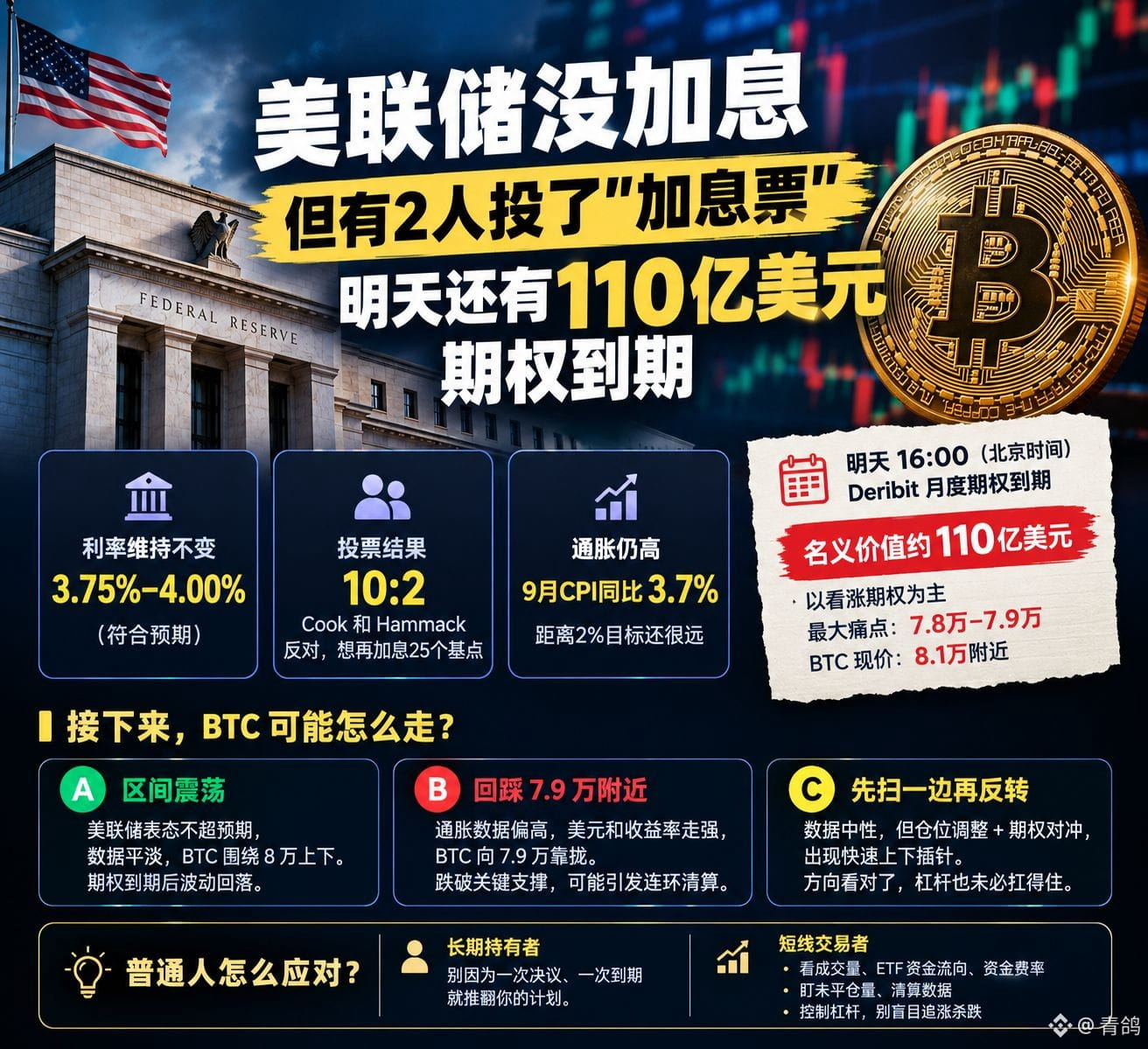
The Fed didn’t raise rates, but two members voted for a hike! $11 billion in BTC options set to expire
Last night, the Fed kept rates at 3.75%–4.00%. That may seem unsurprising, but what’s really worth noting is the 10–2 vote. Two members, Cook and Hammack, wanted to raise rates by another 25 basis points. And with September CPI up 3.7% year over year, inflationary pressure remains a concern. My take: rates are unchanged for now, but that shouldn’t simply be interpreted as bullish. Next, the market will be watching economic data, the dollar, and Treasury yields.
1. Why could the market still come under pressure if rates weren’t raised?
Markets trade not just on outcomes, but also on the gap between outcomes and expectations. If inflation remains elevated, markets may reassess the future path of interest rates. When the dollar and Treasury yields strengthen, risk assets such as BTC may come under pressure.
{spot}(BTCUSDT)
{spot}(SOLUSDT)
{spot}(ETHUSDT)
But keep in mind: a hawkish vote does not mean the Fed will definitely raise rates again.
2. What does the expiration of $11 billion in options mean?
At 16:00 Beijing time on October 30, Deribit will see its monthly options expiration. According to the data currently available, the notional value of BTC options is about $11 billion. The market’s maximum pain point is around $78,000–$79,000, while BTC had previously been trading near $81,000.
3. What might BTC do next?
A: Range-bound trading. If economic data does not significantly exceed expectations, BTC may continue to fluctuate around $80,000.
B: A retest of around $79,000. If inflation is elevated and the dollar and Treasury yields strengthen, BTC may come under pressure. If it falls below key support, liquidations of leveraged longs could further amplify volatility.
C: A quick spike, then a reversal. If the data has limited impact but options hedging and position adjustments happen all at once, the market may rise or fall rapidly before moving in the opposite direction.
My view: The key issue in this event is not simply whether BTC rises or falls, but how short-term volatility may change as macroeconomic data and options positioning interact.
#FOMC会议 #BTC #期权到期
The Fed didn’t raise rates, but two members voted for a hike! $11 billion in BTC options set to expire
Last night, the Fed kept rates at 3.75%–4.00%. That may seem unsurprising, but what’s really worth noting is the 10–2 vote. Two members, Cook and Hammack, wanted to raise rates by another 25 basis points. And with September CPI up 3.7% year over year, inflationary pressure remains a concern. My take: rates are unchanged for now, but that shouldn’t simply be interpreted as bullish. Next, the market will be watching economic data, the dollar, and Treasury yields.
1. Why could the market still come under pressure if rates weren’t raised?
Markets trade not just on outcomes, but also on the gap between outcomes and expectations. If inflation remains elevated, markets may reassess the future path of interest rates. When the dollar and Treasury yields strengthen, risk assets such as BTC may come under pressure.
But keep in mind: a hawkish vote does not mean the Fed will definitely raise rates again.
2. What does the expiration of $11 billion in options mean?
At 16:00 Beijing time on October 30, Deribit will see its monthly options expiration. According to the data currently available, the notional value of BTC options is about $11 billion. The market’s maximum pain point is around $78,000–$79,000, while BTC had previously been trading near $81,000.
3. What might BTC do next?
A: Range-bound trading. If economic data does not significantly exceed expectations, BTC may continue to fluctuate around $80,000.
B: A retest of around $79,000. If inflation is elevated and the dollar and Treasury yields strengthen, BTC may come under pressure. If it falls below key support, liquidations of leveraged longs could further amplify volatility.
C: A quick spike, then a reversal. If the data has limited impact but options hedging and position adjustments happen all at once, the market may rise or fall rapidly before moving in the opposite direction.
My view: The key issue in this event is not simply whether BTC rises or falls, but how short-term volatility may change as macroeconomic data and options positioning interact.
#FOMC会议 #BTC #期权到期
1
807
·
--
🚨 BTC’s riskiest 72 hours this week: the Fed + $11 billion in options expiring at the same time
Most people are betting on whether prices will rise or fall, but the real risk may be: **getting the direction right, but having your position liquidated first.**
📅 Key times (Beijing time)
• Early morning, 10/29: Fed rate decision
• Evening, 10/29: U.S. Q3 GDP advance estimate and September PCE
• 10/30: Around $10.9 billion in BTC options expire on Deribit
Markets expect the Fed to hold rates steady, but **expectations ≠ outcomes, and no rate hike or cut doesn’t necessarily mean prices will rise.**
🔍 Three key factors
1️⃣ The Fed: watch the signals, not the rate
Dovish → rate-cut expectations rise; hawkish → the dollar and Treasury yields strengthen, putting pressure on risk assets.
2️⃣ GDP + PCE: the combination matters more than either figure alone
Strong growth + persistent inflation → expectations for monetary easing cool; easing inflation → risk appetite improves. Markets trade on “the difference versus expectations.”
3️⃣ $10.9 billion in options: don’t let the number scare you
That’s the notional value, not actual money flowing in or out. Closing positions, rolling them over, and adjusting hedges ahead of expiry can amplify short-term volatility, but the direction ultimately still depends on spot-market flows and macro news.
📊 Three scenarios
🟢 A|Mild support: Comments meet or exceed expectations, and spot and ETF flows improve → supportive, but beware of a “sell the news” reaction
🔴 B|Downward pressure: Hawkish signals + hotter-than-expected inflation → if key support breaks, highly leveraged longs could face cascading liquidations
🟡 C|Sharp volatility: Results match expectations, but position adjustments + options hedging + liquidity shifts combine → sharp wicks in both directions and quick reversals
🧠 How to respond?
• Long-term holders: Don’t abandon your long-term plan because of a single event
• Short-term traders: Watch spot trading volume, ETF flows, funding rates, and open interest; manage leverage and don’t chase rallies or sell off in a panic around the news
💡 My view: The more events are packed together, the more you should first ask, “Can my position withstand being wrong?” rather than “Will prices rise or fall?”
👇 Which scenario are you betting on? Leave the letter + your reason in the comments
🅰️ Mild support 🅱️ Downward pressure 🅲 Sharp volatility
#BTC #Bitcoin #FederalReserve #OptionsExpiry #Cryptocurrency
This is a market scenario analysis and does not constitute investment advice.

104
·
--
Bullish
Verified
🚨 From BNB to Nasdaq: Is the crypto industry going mainstream?
Nine years ago, BNB was just getting started. Today, companies associated with BNB Standard Corporation (BNC) have taken the Nasdaq opening bell stage, with CZ there too.
This is more than just a headline—it shows how the ties between the crypto industry and traditional finance are growing stronger.
But let’s look at this rationally: a company ringing the Nasdaq opening bell doesn’t mean BNB is guaranteed to rise.
What’s really worth keeping an eye on over the long term?
🔹 Will the BNB Chain ecosystem and its real user base continue to grow?
🔹 Will traditional investors become more involved in the crypto market?
🔹 Can blockchain deliver real value in payments, tokenized assets, and financial infrastructure?
For long-term investors, short-term buzz is worth noting, but fundamentals, real-world use cases, and long-term value matter most.
Do you see this as an important milestone for the BNB ecosystem, or a new signal that crypto is moving into mainstream finance?
👇 Share your thoughts in the comments!
#BNB #BNC #BNBChain #Crypto #Blockchain

2
1.3k
·
--
$The U.S. is cracking down hard on crypto scams, and the GENIUS Act is now in effect—both are absolutely bullish for crypto!
By eliminating bad actors and establishing clear rules for stablecoins, truly legitimate and compliant projects can grow in a healthier way. This is a long-term positive for the entire industry 🚀
#OCC发布GENIUS法案首个最终规则 $BTC
{spot}(BTCUSDT)
$The U.S. is cracking down hard on crypto scams, and the GENIUS Act is now in effect—both are absolutely bullish for crypto!
By eliminating bad actors and establishing clear rules for stablecoins, truly legitimate and compliant projects can grow in a healthier way. This is a long-term positive for the entire industry 🚀
#OCC发布GENIUS法案首个最终规则 $BTC
By eliminating bad actors and establishing clear rules for stablecoins, truly legitimate and compliant projects can grow in a healthier way. This is a long-term positive for the entire industry 🚀
#OCC发布GENIUS法案首个最终规则 $BTC
164
·
--
Bullish
$BTC $SOL Over the past two days, the crypto market suddenly heated up again.
$BTC has regained the $80,000 area, and $ETH and $SOL have bounced in sync.
But what I care about most right now isn’t:
“Can BTC keep going up?”
Instead, it’s: is this rally a true trend reversal, or just a strong rebound?
$BTC: $80,000 once again becomes a key level
BTC rebounded sharply from around $76K to above $80K in the past few days, and short-term momentum has clearly recovered.
$BTC $SOL Over the past two days, the crypto market suddenly heated up again.
$BTC has regained the $80,000 area, and $ETH and $SOL have bounced in sync.
But what I care about most right now isn’t:
“Can BTC keep going up?”
Instead, it’s: is this rally a true trend reversal, or just a strong rebound?
$BTC : $80,000 once again becomes a key level
BTC rebounded sharply from around $76K to above $80K in the past few days, and short-term momentum has clearly recovered.
816
Log in to explore more content
Join global crypto users on Binance Square
⚡️ Get latest and useful information about crypto.
💬 Trusted by the world’s largest crypto exchange.
👍 Discover real insights from verified creators.
Email / Phone number
Trending Topics
UniswapA16zSeekDeFiExemptionFromIllinoisCryptoTax
37,905 views
891 Discussing
#CryptoTax 🚨 CRYPTO MARKET & REGULATORY UPDATE #HKDollarStablecoinHKDAPToLaunchOnSolana
#uniswapa16zseekdefiexemptionfromillinoiscryptotax UNISWAP, a16z & DeFi Education Fund Challenge Illinois Crypto Tax Rules
October 30, 2026 | Market Volatility & Industry Developments
📊 1. MARKET SNAPSHOT
Crypto markets are showing mixed signals, with selected assets posting sharp gains while several major cryptocurrencies remain under pressure.
📈 Top reported gainers
SOPH: +60.81% — $0.00238
BEAMX: +37.94% — $0.004701
SKDDB: +16.81% — $9.38
📉 Notable reported losers
INTWUSDT: −61.09% — $6.72
AKEUSDT: −31.47% — $0.013989
SNXXUSDT: −30.71% — $6.43
🔎 Major crypto assets under pressure
DOGE: −5.06%
PEPE: −4.91%
SUI: −4.83%
NEAR: −3.28%
XRP: −3.13%
Uniswap Labs, Andreessen Horowitz (a16z), and the DeFi Education Fund (DEF) are pushing for exemptions from Illinois’
#Uniswap #a16z #DeFi #CryptoRegulation #Illinois # #Web3 #BinanceSquare
#HKDollarStablecoinHKDAPToLaunchOnSolana #HKDAP #Stablecoin #CryptoNews #Blockchain #DeFi #DigitalPayments
⚖️ 3. UNISWAP, a16z & ILLINOIS CRYPTO TAX RULES
Uniswap Labs, Andreessen Horowitz (a16z), and the DeFi Education Fund are associated with efforts to seek exemptions proposed Illinois crypto tax requirements.
The debate highlights a key question: How should tax-reporting obligations apply to decentralized that may not operate like traditional financial intermediaries?
The outcome could influence DeFi compliance, developer obligations, and the future regulatory environment.
#BinanceSquare #CryptoNews #HKDAP #Stablecoin #Uniswap #a16z #DeFi #CryptoTax
CHASEPA SULUXù
·2 Likes
·399 views
HKDollarStablecoinHKDAPToLaunchOnSolana
27,329 views
575 Discussing
$1.5BInLeveragedCryptoBetsLiquidated
56,487 views
268 Discussing