

YA ng
1.7k Posts

YA ng
Report
Block User
Open Trade

NIGHT Holder
Frequent Trader
3.7 Years
9 Following
209 Followers
1.7K+ Liked
Posts
Portfolio
All
Quotes
PINNED
·
--

Article
THE FIAT STANDARDBitcoin replaces existing technologies for saving and international money transfer. It is useful to think of the improvements bitcoin brings to the functions of central banking as technological upgrades. A clear picture emerges from the comparison of the full costs and benefits of bitcoin $BTC and #fiat .$SPYB ,$ETH
Fiat is a manual technology, highly vulnerable to human error and exploitation. Bitcoin is a digital and mechanical, predictable technology with very high reliability.An average 14% supply inflation rate of government monies, bitcoin offers you a fixed supply with a predictable declining supply inflation rate.3.Monetary policy run by politicians, bitcoin offers perfect transparency.Financing unaccountable, limitless government spending, bitcoin development of cheap reliable energy resources all over the planet.Shipping heavy lumps of rock across, bitcoin uses proof of work to ensure far less human labor is involved, and far less security risk is incurred.Vicious power struggles domestically, bitcoin resolves the validity of its ledger voluntarily with electric power.Bitcoin allows the redirection of monetary energy to the development of cheap and plentiful energy for humanity.
Only 20% per year, a tenth of what it experienced in the last ten years, it would arrive at the 230 trillion nominal valuation by around 2050.
THE FIAT STANDARD
Bitcoin replaces existing technologies for saving and international money transfer. It is useful to think of the improvements bitcoin brings to the functions of central banking as technological upgrades. A clear picture emerges from the comparison of the full costs and benefits of bitcoin $BTC and #fiat .$SPYB ,$ETH
Fiat is a manual technology, highly vulnerable to human error and exploitation. Bitcoin is a digital and mechanical, predictable technology with very high reliability.An average 14% supply inflation rate of government monies, bitcoin offers you a fixed supply with a predictable declining supply inflation rate.3.Monetary policy run by politicians, bitcoin offers perfect transparency.Financing unaccountable, limitless government spending, bitcoin development of cheap reliable energy resources all over the planet.Shipping heavy lumps of rock across, bitcoin uses proof of work to ensure far less human labor is involved, and far less security risk is incurred.Vicious power struggles domestically, bitcoin resolves the validity of its ledger voluntarily with electric power.Bitcoin allows the redirection of monetary energy to the development of cheap and plentiful energy for humanity.
Only 20% per year, a tenth of what it experienced in the last ten years, it would arrive at the 230 trillion nominal valuation by around 2050.
Fiat is a manual technology, highly vulnerable to human error and exploitation. Bitcoin is a digital and mechanical, predictable technology with very high reliability.An average 14% supply inflation rate of government monies, bitcoin offers you a fixed supply with a predictable declining supply inflation rate.3.Monetary policy run by politicians, bitcoin offers perfect transparency.Financing unaccountable, limitless government spending, bitcoin development of cheap reliable energy resources all over the planet.Shipping heavy lumps of rock across, bitcoin uses proof of work to ensure far less human labor is involved, and far less security risk is incurred.Vicious power struggles domestically, bitcoin resolves the validity of its ledger voluntarily with electric power.Bitcoin allows the redirection of monetary energy to the development of cheap and plentiful energy for humanity.
Only 20% per year, a tenth of what it experienced in the last ten years, it would arrive at the 230 trillion nominal valuation by around 2050.
2
96
·
--
monetization path for stablecoins + blockchain
Agents via x402 and pay with stablecoins could propagate into demand for block space, validation, and settlement, ultimately touching native assets on public chains like $SOL ......
Stablecoins become machines' cash, public chains become machines' settlement layer, Tokenized RWAs $LINK become assets machines can invoke, and compute power might even become the next category of on-chain $ONDO commodities...
monetization path for stablecoins + blockchain
Agents via x402 and pay with stablecoins could propagate into demand for block space, validation, and settlement, ultimately touching native assets on public chains like $SOL ......
Stablecoins become machines' cash, public chains become machines' settlement layer, Tokenized RWAs $LINK become assets machines can invoke, and compute power might even become the next category of on-chain $ONDO commodities...
Agents via x402 and pay with stablecoins could propagate into demand for block space, validation, and settlement, ultimately touching native assets on public chains like $SOL ......
Stablecoins become machines' cash, public chains become machines' settlement layer, Tokenized RWAs $LINK become assets machines can invoke, and compute power might even become the next category of on-chain $ONDO commodities...
158
·
--
The biggest bull $ETH at DAT said in his speech that once he reaches 5%, he’ll stop after buying just 89,000 more coins and won’t continue buying! He’s currently down $4.3 billion overall. Setting aside whether he’ll start selling, I’m more curious: without him, who will take over for Ethereum? How long can the price hold up?
River’s model projects that over the next 3–5 years, if 20%–40% of portfolios start holding $BTC and allocate an average of 2%–4% of their assets to BTC, that could bring in $1.3 trillion–$5.3 trillion in new capital and push Bitcoin’s price to $250K.
The biggest bull $ETH at DAT said in his speech that once he reaches 5%, he’ll stop after buying just 89,000 more coins and won’t continue buying! He’s currently down $4.3 billion overall. Setting aside whether he’ll start selling, I’m more curious: without him, who will take over for Ethereum? How long can the price hold up?
River’s model projects that over the next 3–5 years, if 20%–40% of portfolios start holding $BTC and allocate an average of 2%–4% of their assets to BTC, that could bring in $1.3 trillion–$5.3 trillion in new capital and push Bitcoin’s price to $250K.
River’s model projects that over the next 3–5 years, if 20%–40% of portfolios start holding $BTC and allocate an average of 2%–4% of their assets to BTC, that could bring in $1.3 trillion–$5.3 trillion in new capital and push Bitcoin’s price to $250K.
528
·
--
The three largest and most iconic Meme coins by market capitalization
I. The Big Three Meme Coins
$DOGE No supply cap; approximately 5 billion DOGE are issued each year at a fixed rate. Its enormous market capitalization makes another thousandfold surge unlikely.
$SHIB A large 41% was burned at launch. Its positioning is somewhat awkward: its attempt to pivot toward DeFi/L2 has cost it the advantage of the pure, no-baggage Meme coin narrative.
$PEPE Fixed total supply, with its value entirely dependent on market sentiment. It can suffer steep declines during bear markets or when capital flows out, and early deployers and whale accounts hold a considerable share of the tokens.
II. In-Depth Analysis of Individual Tokens
1. Dogecoin
Core strengths: Founded in 2013, it was the first cryptocurrency to bring internet celebrity culture into crypto. Its brand recognition has spread beyond the crypto world and into the mainstream.
Celebrity and institutional backing: Elon Musk's ongoing public support, expectations of integration with X payments, and SpaceX/Tesla-related narratives give it a unique “top-tier attention anchor.”
PoW network: It has its own underlying PoW network and is merge-mined with Litecoin, giving it strong network security.
2. Shiba Inu
Core strengths: It has launched the decentralized exchange ShibaSwap, the Layer 2 scaling network Shibarium, and plans for the metaverse, in an effort to give the token practical utility.
A powerful, close-knit community: It has one of the most organized and engaged communities in the crypto market, with significant reach among retail investors.
Aggressive burn mechanism: Community activity and Layer 2 network fees continually burn SHIB, reducing the circulating supply.
3. Pepe
Core strengths: No presale, zero tax, and relinquished contract ownership—returning to the purest form of Meme culture and earning strong support from Web3 natives.
Strong sentiment-driven leverage and liquidity: In bull markets, PEPE often becomes the asset of choice for capital seeking greater risk exposure, with extremely high price elasticity and explosive potential.
III. Overall Summary
DOGE: A blue-chip Meme coin. Best suited as a relatively stable Meme asset in a portfolio.
SHIB: An ecosystem-transition Meme coin. Best suited to investors who believe in the community's ecosystem transformation and expect on-chain burn benefits from Shibarium.
PEPE: A high-beta, high-volatility Meme coin. Best suited to traders chasing market trends and bull-market sentiment surges who prefer high risk and high returns.
Which MEME would you choose?
The three largest and most iconic Meme coins by market capitalization
I. The Big Three Meme Coins
$DOGE No supply cap; approximately 5 billion DOGE are issued each year at a fixed rate. Its enormous market capitalization makes another thousandfold surge unlikely.
$SHIB A large 41% was burned at launch. Its positioning is somewhat awkward: its attempt to pivot toward DeFi/L2 has cost it the advantage of the pure, no-baggage Meme coin narrative.
$PEPE Fixed total supply, with its value entirely dependent on market sentiment. It can suffer steep declines during bear markets or when capital flows out, and early deployers and whale accounts hold a considerable share of the tokens.
II. In-Depth Analysis of Individual Tokens
1. Dogecoin
Core strengths: Founded in 2013, it was the first cryptocurrency to bring internet celebrity culture into crypto. Its brand recognition has spread beyond the crypto world and into the mainstream.
Celebrity and institutional backing: Elon Musk's ongoing public support, expectations of integration with X payments, and SpaceX/Tesla-related narratives give it a unique “top-tier attention anchor.”
PoW network: It has its own underlying PoW network and is merge-mined with Litecoin, giving it strong network security.
2. Shiba Inu
Core strengths: It has launched the decentralized exchange ShibaSwap, the Layer 2 scaling network Shibarium, and plans for the metaverse, in an effort to give the token practical utility.
A powerful, close-knit community: It has one of the most organized and engaged communities in the crypto market, with significant reach among retail investors.
Aggressive burn mechanism: Community activity and Layer 2 network fees continually burn SHIB, reducing the circulating supply.
3. Pepe
Core strengths: No presale, zero tax, and relinquished contract ownership—returning to the purest form of Meme culture and earning strong support from Web3 natives.
Strong sentiment-driven leverage and liquidity: In bull markets, PEPE often becomes the asset of choice for capital seeking greater risk exposure, with extremely high price elasticity and explosive potential.
III. Overall Summary
DOGE: A blue-chip Meme coin. Best suited as a relatively stable Meme asset in a portfolio.
SHIB: An ecosystem-transition Meme coin. Best suited to investors who believe in the community's ecosystem transformation and expect on-chain burn benefits from Shibarium.
PEPE: A high-beta, high-volatility Meme coin. Best suited to traders chasing market trends and bull-market sentiment surges who prefer high risk and high returns.
Which MEME would you choose?
I. The Big Three Meme Coins
$DOGE No supply cap; approximately 5 billion DOGE are issued each year at a fixed rate. Its enormous market capitalization makes another thousandfold surge unlikely.
$SHIB A large 41% was burned at launch. Its positioning is somewhat awkward: its attempt to pivot toward DeFi/L2 has cost it the advantage of the pure, no-baggage Meme coin narrative.
$PEPE Fixed total supply, with its value entirely dependent on market sentiment. It can suffer steep declines during bear markets or when capital flows out, and early deployers and whale accounts hold a considerable share of the tokens.
II. In-Depth Analysis of Individual Tokens
1. Dogecoin
Core strengths: Founded in 2013, it was the first cryptocurrency to bring internet celebrity culture into crypto. Its brand recognition has spread beyond the crypto world and into the mainstream.
Celebrity and institutional backing: Elon Musk's ongoing public support, expectations of integration with X payments, and SpaceX/Tesla-related narratives give it a unique “top-tier attention anchor.”
PoW network: It has its own underlying PoW network and is merge-mined with Litecoin, giving it strong network security.
2. Shiba Inu
Core strengths: It has launched the decentralized exchange ShibaSwap, the Layer 2 scaling network Shibarium, and plans for the metaverse, in an effort to give the token practical utility.
A powerful, close-knit community: It has one of the most organized and engaged communities in the crypto market, with significant reach among retail investors.
Aggressive burn mechanism: Community activity and Layer 2 network fees continually burn SHIB, reducing the circulating supply.
3. Pepe
Core strengths: No presale, zero tax, and relinquished contract ownership—returning to the purest form of Meme culture and earning strong support from Web3 natives.
Strong sentiment-driven leverage and liquidity: In bull markets, PEPE often becomes the asset of choice for capital seeking greater risk exposure, with extremely high price elasticity and explosive potential.
III. Overall Summary
DOGE: A blue-chip Meme coin. Best suited as a relatively stable Meme asset in a portfolio.
SHIB: An ecosystem-transition Meme coin. Best suited to investors who believe in the community's ecosystem transformation and expect on-chain burn benefits from Shibarium.
PEPE: A high-beta, high-volatility Meme coin. Best suited to traders chasing market trends and bull-market sentiment surges who prefer high risk and high returns.
Which MEME would you choose?
DOGE
SHIB
PEPE
都不會
15 hr(s) left
1
3k
·
--
Token2049’s conduct is downright ugly. After last year’s event, it was a historic 10/10. To avoid falsely accusing such a [sacred] event, I’ve compiled how altcoins performed in the month after each event from 2022 to 2025: twice they fell by more than 10%, once they rose by 3%, and once the market moved sideways. It really does look like an event for harvesting retail investors.
Token2049’s conduct is downright ugly. After last year’s event, it was a historic 10/10. To avoid falsely accusing such a [sacred] event, I’ve compiled how altcoins performed in the month after each event from 2022 to 2025: twice they fell by more than 10%, once they rose by 3%, and once the market moved sideways. It really does look like an event for harvesting retail investors.
395
·
--
The more pain you can endure, the greater the success you can achieve! At the time, I moved my snek over to night at a loss of -99%. Looking back now, the returns are similar to holding snek—the only difference is that the project went from a meme to privacy.
Some may wonder why I didn’t trade ada for night back then. I was afraid! ada was struggling to stay afloat, falling from 1.2 to 0.15. If prices recovered first, ada would be the one to recover. Looking back today, I would have been in profit much earlier if I’d traded for night. Next time, it could be a life-changing opportunity.
Incident
$NIGHT — On July 21, 2026, a cross-chain bridge operated by Wanchain between Cardano $ADA ↔ $BNB Chain (BSC) was exploited by hackers, who stole approximately 515 million NIGHT tokens from the bridge’s treasury. At the time, they were estimated to be worth around $9–13 million. After the incident, the price of NIGHT briefly fell by 50%, hitting 0.01511.
Key details
The vulnerability was in the bridge’s TreasuryCheck validator: a flaw in the encoding of signed messages allowed signatures to be reused.
The attacker used the signature from a legitimate, small-value authorization transaction on BSC (approximately 3,110 NIGHT), which was reinterpreted on the Cardano side as a large withdrawal (over 200 million NIGHT). The attack was completed in several transactions over just a few minutes, and the stolen tokens were subsequently sold on a DEX.
Aftermath
The Midnight network itself was unaffected (the mainnet, consensus, and native supply remained secure); the issue was limited to the third-party Wanchain bridge.
Wanchain immediately took the bridge offline and began an investigation.
The more pain you can endure, the greater the success you can achieve! At the time, I moved my snek over to night at a loss of -99%. Looking back now, the returns are similar to holding snek—the only difference is that the project went from a meme to privacy.
Some may wonder why I didn’t trade ada for night back then. I was afraid! ada was struggling to stay afloat, falling from 1.2 to 0.15. If prices recovered first, ada would be the one to recover. Looking back today, I would have been in profit much earlier if I’d traded for night. Next time, it could be a life-changing opportunity.
Incident
$NIGHT — On July 21, 2026, a cross-chain bridge operated by Wanchain between Cardano $ADA ↔ $BNB Chain (BSC) was exploited by hackers, who stole approximately 515 million NIGHT tokens from the bridge’s treasury. At the time, they were estimated to be worth around $9–13 million. After the incident, the price of NIGHT briefly fell by 50%, hitting 0.01511.
Key details
The vulnerability was in the bridge’s TreasuryCheck validator: a flaw in the encoding of signed messages allowed signatures to be reused.
The attacker used the signature from a legitimate, small-value authorization transaction on BSC (approximately 3,110 NIGHT), which was reinterpreted on the Cardano side as a large withdrawal (over 200 million NIGHT). The attack was completed in several transactions over just a few minutes, and the stolen tokens were subsequently sold on a DEX.
Aftermath
The Midnight network itself was unaffected (the mainnet, consensus, and native supply remained secure); the issue was limited to the third-party Wanchain bridge.
Wanchain immediately took the bridge offline and began an investigation.
Some may wonder why I didn’t trade ada for night back then. I was afraid! ada was struggling to stay afloat, falling from 1.2 to 0.15. If prices recovered first, ada would be the one to recover. Looking back today, I would have been in profit much earlier if I’d traded for night. Next time, it could be a life-changing opportunity.
Incident
$NIGHT — On July 21, 2026, a cross-chain bridge operated by Wanchain between Cardano $ADA ↔ $BNB Chain (BSC) was exploited by hackers, who stole approximately 515 million NIGHT tokens from the bridge’s treasury. At the time, they were estimated to be worth around $9–13 million. After the incident, the price of NIGHT briefly fell by 50%, hitting 0.01511.
Key details
The vulnerability was in the bridge’s TreasuryCheck validator: a flaw in the encoding of signed messages allowed signatures to be reused.
The attacker used the signature from a legitimate, small-value authorization transaction on BSC (approximately 3,110 NIGHT), which was reinterpreted on the Cardano side as a large withdrawal (over 200 million NIGHT). The attack was completed in several transactions over just a few minutes, and the stolen tokens were subsequently sold on a DEX.
Aftermath
The Midnight network itself was unaffected (the mainnet, consensus, and native supply remained secure); the issue was limited to the third-party Wanchain bridge.
Wanchain immediately took the bridge offline and began an investigation.
388
·
--
Verified
Be careful,TOKEN 2049 coming soon in Singapore! Don't forget October 10, 2025! Today, Binance's Bitcoin reserves have dropped from 704,800 coins to 663,100 coins
private swaps and private DeFi on Solana wallets. win-win-win strategies.🚀🚀🚀
$NIGHT : More Solana users interacting with private DeFi/swaps increases demand to hold NIGHT for DUST generation.
$SOL :Add privacy option on top speed, DeFi liquidity, and cross-ecosystem flows. Reinforces positive narrative and user growth around private use cases.
$ADA : Growth and adoption of Midnight strengthens the broader Cardano ecosystem, and partner-chain.
Be careful,TOKEN 2049 coming soon in Singapore! Don't forget October 10, 2025! Today, Binance's Bitcoin reserves have dropped from 704,800 coins to 663,100 coins
private swaps and private DeFi on Solana wallets. win-win-win strategies.🚀🚀🚀
$NIGHT : More Solana users interacting with private DeFi/swaps increases demand to hold NIGHT for DUST generation.
$SOL :Add privacy option on top speed, DeFi liquidity, and cross-ecosystem flows. Reinforces positive narrative and user growth around private use cases.
$ADA : Growth and adoption of Midnight strengthens the broader Cardano ecosystem, and partner-chain.
private swaps and private DeFi on Solana wallets. win-win-win strategies.🚀🚀🚀
$NIGHT : More Solana users interacting with private DeFi/swaps increases demand to hold NIGHT for DUST generation.
$SOL :Add privacy option on top speed, DeFi liquidity, and cross-ecosystem flows. Reinforces positive narrative and user growth around private use cases.
$ADA : Growth and adoption of Midnight strengthens the broader Cardano ecosystem, and partner-chain.
1
273
·
--
2026/8/6 $ETH Reasonable range: approximately 1,200–1,800
Core data (August 2026)
Circulating/total supply: approximately 120.68M ETH (no hard cap; net issuance is currently slightly inflationary)
Current price: approximately 1,900
Market cap / FDV: approximately 230B
DeFi TVL: approximately 41–42B
Stablecoin supply: approximately 147B+
On-chain fees / revenue: Mainnet revenue often sits in the hundreds of thousands of dollars; staking yield is approximately 2.8–3.3%
Staking ratio: approximately 32–34%
Current low-fee environment + stablecoin/DeFi $AAVE baseline pricing leaves almost no premium for future value flowing back from L2s or an RWA boom.
Benchmarked against mature technology/financial infrastructure at low multiples, with growth assumptions heavily discounted.
Weakened real-world utility and value capture
Activity is high, but much of the value stays on L2s; cash flow from mainnet as the “settlement layer” is thin.
Supply and inflation
No hard cap + current net inflation. A strict model applies an inflation discount and assumes staking lockups cannot fully offset selling pressure.
Macro and relative valuation discount
ETH has underperformed $BTC over the long term. The calculation relies neither on the “ultrasound money” narrative nor on “continued institutional ETF inflows,” and instead uses only a fundamentals-based floor.
Annualized revenue assumptions in a low-fee environment + conservative multiples → market-cap floor of approximately 145B.
Even after adding a stablecoin/DeFi infrastructure premium, the valuation is kept to 217B.
Implied price per token: 145B / 120.68M ≈ 1,200
217B / 120.68M ≈ 1,800
If we further assume that fees continue to compress or that L2s completely cannibalize value, the range could move lower still
2026/8/6 $ETH Reasonable range: approximately 1,200–1,800
Core data (August 2026)
Circulating/total supply: approximately 120.68M ETH (no hard cap; net issuance is currently slightly inflationary)
Current price: approximately 1,900
Market cap / FDV: approximately 230B
DeFi TVL: approximately 41–42B
Stablecoin supply: approximately 147B+
On-chain fees / revenue: Mainnet revenue often sits in the hundreds of thousands of dollars; staking yield is approximately 2.8–3.3%
Staking ratio: approximately 32–34%
Current low-fee environment + stablecoin/DeFi $AAVE baseline pricing leaves almost no premium for future value flowing back from L2s or an RWA boom.
Benchmarked against mature technology/financial infrastructure at low multiples, with growth assumptions heavily discounted.
Weakened real-world utility and value capture
Activity is high, but much of the value stays on L2s; cash flow from mainnet as the “settlement layer” is thin.
Supply and inflation
No hard cap + current net inflation. A strict model applies an inflation discount and assumes staking lockups cannot fully offset selling pressure.
Macro and relative valuation discount
ETH has underperformed $BTC over the long term. The calculation relies neither on the “ultrasound money” narrative nor on “continued institutional ETF inflows,” and instead uses only a fundamentals-based floor.
Annualized revenue assumptions in a low-fee environment + conservative multiples → market-cap floor of approximately 145B.
Even after adding a stablecoin/DeFi infrastructure premium, the valuation is kept to 217B.
Implied price per token: 145B / 120.68M ≈ 1,200
217B / 120.68M ≈ 1,800
If we further assume that fees continue to compress or that L2s completely cannibalize value, the range could move lower still
Core data (August 2026)
Circulating/total supply: approximately 120.68M ETH (no hard cap; net issuance is currently slightly inflationary)
Current price: approximately 1,900
Market cap / FDV: approximately 230B
DeFi TVL: approximately 41–42B
Stablecoin supply: approximately 147B+
On-chain fees / revenue: Mainnet revenue often sits in the hundreds of thousands of dollars; staking yield is approximately 2.8–3.3%
Staking ratio: approximately 32–34%
Current low-fee environment + stablecoin/DeFi $AAVE baseline pricing leaves almost no premium for future value flowing back from L2s or an RWA boom.
Benchmarked against mature technology/financial infrastructure at low multiples, with growth assumptions heavily discounted.
Weakened real-world utility and value capture
Activity is high, but much of the value stays on L2s; cash flow from mainnet as the “settlement layer” is thin.
Supply and inflation
No hard cap + current net inflation. A strict model applies an inflation discount and assumes staking lockups cannot fully offset selling pressure.
Macro and relative valuation discount
ETH has underperformed $BTC over the long term. The calculation relies neither on the “ultrasound money” narrative nor on “continued institutional ETF inflows,” and instead uses only a fundamentals-based floor.
Annualized revenue assumptions in a low-fee environment + conservative multiples → market-cap floor of approximately 145B.
Even after adding a stablecoin/DeFi infrastructure premium, the valuation is kept to 217B.
Implied price per token: 145B / 120.68M ≈ 1,200
217B / 120.68M ≈ 1,800
If we further assume that fees continue to compress or that L2s completely cannibalize value, the range could move lower still
195
·
--
$ADA 10/6 hours 17:15 When I saw the bullish engulfing pattern, I immediately posted a warning. The short-term surge above 0.28 looked more like bait than a genuine breakout. Looking at it today, if you'd been a little more aggressive about shorting yesterday, you'd be up 7% by now~ What did you do when you saw the post yesterday?
$ADA 10/6 hours 17:15 When I saw the bullish engulfing pattern, I immediately posted a warning. The short-term surge above 0.28 looked more like bait than a genuine breakout. Looking at it today, if you'd been a little more aggressive about shorting yesterday, you'd be up 7% by now~ What did you do when you saw the post yesterday?
什麼都不做
做多
做空
7 hr(s) left
739
·
--
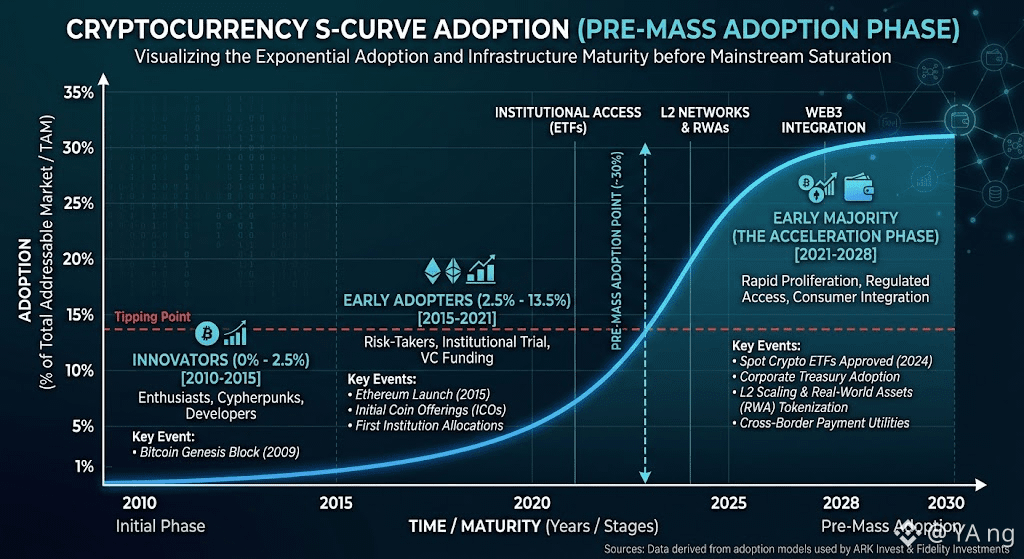
Estimate cryptocurrency market capitalization in 2030 and 2040 by combining macroeconomic models, total addressable market size, penetration rates, and currency substitution effects
I. Institutional Market Cap Growth Estimates for 2030:
ARK Invest: $600,000 in the base case, $1.5 million in the bull case
Fidelity: The $1 million mark, based on a modified S2F model and Metcalfe's law
Currency penetration by 2040: If Bitcoin enters the global reserve currency system, its market cap could challenge $50 trillion or more, depending on global fiat currency inflation and the pace of deglobalization.
II. Institutional Estimates
1. Macroeconomic models and total addressable market
Take ARK's model as an example: it aggregates global traditional assets to calculate the TAM for major asset classes. It divides these into multiple demand pools and sets penetration rates for different years. For example, physical gold has a total market cap of $30T. Estimate how much of gold's store-of-value market share Bitcoin could replace. If we assume it eventually captures 40% of the gold market, this alone could support a cryptocurrency market cap of over $10 trillion.
Institutional asset allocation: As compliant ETFs become available and accounting standards become clearer, global pension funds, sovereign wealth funds, and asset management firms may allocate 1% to 5% of their portfolios to digital assets, translating into several trillion dollars in steady inflows.
2. Currency substitution effects: In countries such as Argentina, Venezuela, and Nigeria, M2 money supply is rapidly flowing into the U.S. dollar or Bitcoin. This generates an increase in market capitalization as demand to preserve the value of monetary reserves in developing economies shifts to crypto assets.
3. Network effects
As L2 scaling, institutional-grade custody, and tokenized assets become more widespread, infrastructure friction will decline, directly accelerating the process of monetization.
III. Core reasons for explosive growth:
Vast room for growth: Capturing just a small share of traditional financial system activities such as "cross-border settlement," "store of value," and "DeFi" could propel total market capitalization from the current $3T to the $20T, $30T, or even higher levels projected by institutions.
Asymmetric risk-reward ratio: The current base is small. Even a tiny allocation from traditional capital—for example, shifting 1% of global asset allocations into crypto markets—could drive a huge price increase across the crypto asset class.
So I use $20T in 2030 to estimate cryptocurrency prices. All of the following are minimum estimates!
$BTC .D 60% -> 570000
$ETH .D 10% -> 16000
$XRP .D 3% -> 6
Estimate cryptocurrency market capitalization in 2030 and 2040 by combining macroeconomic models, total addressable market size, penetration rates, and currency substitution effects
I. Institutional Market Cap Growth Estimates for 2030:
ARK Invest: $600,000 in the base case, $1.5 million in the bull case
Fidelity: The $1 million mark, based on a modified S2F model and Metcalfe's law
Currency penetration by 2040: If Bitcoin enters the global reserve currency system, its market cap could challenge $50 trillion or more, depending on global fiat currency inflation and the pace of deglobalization.
II. Institutional Estimates
1. Macroeconomic models and total addressable market
Take ARK's model as an example: it aggregates global traditional assets to calculate the TAM for major asset classes. It divides these into multiple demand pools and sets penetration rates for different years. For example, physical gold has a total market cap of $30T. Estimate how much of gold's store-of-value market share Bitcoin could replace. If we assume it eventually captures 40% of the gold market, this alone could support a cryptocurrency market cap of over $10 trillion.
Institutional asset allocation: As compliant ETFs become available and accounting standards become clearer, global pension funds, sovereign wealth funds, and asset management firms may allocate 1% to 5% of their portfolios to digital assets, translating into several trillion dollars in steady inflows.
2. Currency substitution effects: In countries such as Argentina, Venezuela, and Nigeria, M2 money supply is rapidly flowing into the U.S. dollar or Bitcoin. This generates an increase in market capitalization as demand to preserve the value of monetary reserves in developing economies shifts to crypto assets.
3. Network effects
As L2 scaling, institutional-grade custody, and tokenized assets become more widespread, infrastructure friction will decline, directly accelerating the process of monetization.
III. Core reasons for explosive growth:
Vast room for growth: Capturing just a small share of traditional financial system activities such as "cross-border settlement," "store of value," and "DeFi" could propel total market capitalization from the current $3T to the $20T, $30T, or even higher levels projected by institutions.
Asymmetric risk-reward ratio: The current base is small. Even a tiny allocation from traditional capital—for example, shifting 1% of global asset allocations into crypto markets—could drive a huge price increase across the crypto asset class.
So I use $20T in 2030 to estimate cryptocurrency prices. All of the following are minimum estimates!
$BTC .D 60% -> 570000
$ETH .D 10% -> 16000
$XRP .D 3% -> 6
I. Institutional Market Cap Growth Estimates for 2030:
ARK Invest: $600,000 in the base case, $1.5 million in the bull case
Fidelity: The $1 million mark, based on a modified S2F model and Metcalfe's law
Currency penetration by 2040: If Bitcoin enters the global reserve currency system, its market cap could challenge $50 trillion or more, depending on global fiat currency inflation and the pace of deglobalization.
II. Institutional Estimates
1. Macroeconomic models and total addressable market
Take ARK's model as an example: it aggregates global traditional assets to calculate the TAM for major asset classes. It divides these into multiple demand pools and sets penetration rates for different years. For example, physical gold has a total market cap of $30T. Estimate how much of gold's store-of-value market share Bitcoin could replace. If we assume it eventually captures 40% of the gold market, this alone could support a cryptocurrency market cap of over $10 trillion.
Institutional asset allocation: As compliant ETFs become available and accounting standards become clearer, global pension funds, sovereign wealth funds, and asset management firms may allocate 1% to 5% of their portfolios to digital assets, translating into several trillion dollars in steady inflows.
2. Currency substitution effects: In countries such as Argentina, Venezuela, and Nigeria, M2 money supply is rapidly flowing into the U.S. dollar or Bitcoin. This generates an increase in market capitalization as demand to preserve the value of monetary reserves in developing economies shifts to crypto assets.
3. Network effects
As L2 scaling, institutional-grade custody, and tokenized assets become more widespread, infrastructure friction will decline, directly accelerating the process of monetization.
III. Core reasons for explosive growth:
Vast room for growth: Capturing just a small share of traditional financial system activities such as "cross-border settlement," "store of value," and "DeFi" could propel total market capitalization from the current $3T to the $20T, $30T, or even higher levels projected by institutions.
Asymmetric risk-reward ratio: The current base is small. Even a tiny allocation from traditional capital—for example, shifting 1% of global asset allocations into crypto markets—could drive a huge price increase across the crypto asset class.
So I use $20T in 2030 to estimate cryptocurrency prices. All of the following are minimum estimates!
$BTC .D 60% -> 570000
$ETH .D 10% -> 16000
$XRP .D 3% -> 6
597
·
--
Top 3 cryptocurrencies not recommended for purchase
1. $ADA : Weak long-term performance, a sharp decline from its relative highs, low DeFi TVL and real-world usage relative to its valuation, ecosystem and governance controversies, and clear advantages held by competitors Solana and Ethereum. Multiple analyses list it as underperforming or advise avoiding it.
2. $AVAX or $DOT : Although AVAX has seen institutional and RWA activity, it faces price pressure and token unlocks; DOT, meanwhile, is said to have persistently insufficient demand and weak correlation.
3. DOGE or other meme coins, such as PEPE: They are highly sentiment-driven, have weak fundamental support, and most analyses recommend avoiding them or note that short-term trading carries high risk.
Which coin would you choose not to invest in?
Top 3 cryptocurrencies not recommended for purchase
1. $ADA : Weak long-term performance, a sharp decline from its relative highs, low DeFi TVL and real-world usage relative to its valuation, ecosystem and governance controversies, and clear advantages held by competitors Solana and Ethereum. Multiple analyses list it as underperforming or advise avoiding it.
2. $AVAX or $DOT : Although AVAX has seen institutional and RWA activity, it faces price pressure and token unlocks; DOT, meanwhile, is said to have persistently insufficient demand and weak correlation.
3. DOGE or other meme coins, such as PEPE: They are highly sentiment-driven, have weak fundamental support, and most analyses recommend avoiding them or note that short-term trading carries high risk.
Which coin would you choose not to invest in?
1. $ADA : Weak long-term performance, a sharp decline from its relative highs, low DeFi TVL and real-world usage relative to its valuation, ecosystem and governance controversies, and clear advantages held by competitors Solana and Ethereum. Multiple analyses list it as underperforming or advise avoiding it.
2. $AVAX or $DOT : Although AVAX has seen institutional and RWA activity, it faces price pressure and token unlocks; DOT, meanwhile, is said to have persistently insufficient demand and weak correlation.
3. DOGE or other meme coins, such as PEPE: They are highly sentiment-driven, have weak fundamental support, and most analyses recommend avoiding them or note that short-term trading carries high risk.
Which coin would you choose not to invest in?
ADA
AVAX
DOT
DOGE
5 hr(s) left
2.2k
·
--
$ADA Yesterday’s poll was overwhelmingly in favor, with 80% thinking it would break above 0.28. I woke up today to 0.26. Sure enough, when it comes to what “most people” think will happen, you just have to bet the other way.
I’ve slightly adjusted the buy prices I was looking at last time. These are the levels where I’d buy again. Until the price reaches them, I won’t do anything:
0.23
0.19
Where would you buy if it pulls back again?
$ADA Yesterday’s poll was overwhelmingly in favor, with 80% thinking it would break above 0.28. I woke up today to 0.26. Sure enough, when it comes to what “most people” think will happen, you just have to bet the other way.
I’ve slightly adjusted the buy prices I was looking at last time. These are the levels where I’d buy again. Until the price reaches them, I won’t do anything:
0.23
0.19
Where would you buy if it pulls back again?
I’ve slightly adjusted the buy prices I was looking at last time. These are the levels where I’d buy again. Until the price reaches them, I won’t do anything:
0.23
0.19
Where would you buy if it pulls back again?
0.23
0.19
0.15
0.13
1 hr(s) left
546
·
--
At this price level, a 10% drop in BTC would trigger 13 billion in liquidations, whereas a 10% rise would result in only 4 billion; therefore, shorting at this position is definitely a sound move?
ETH falling 10% to around 2,440:
Hyperliquid shows cumulative long liquidations of approximately $630 million.
CEX figures are higher, with cumulative long liquidations of approximately $850 million.
ETH rising 10% to around 2,980:
Hyperliquid $HYPE shows cumulative short liquidations of approximately $50–260 million, significantly lower than on the downside. ETH currently has an asymmetric structure overall, with greater liquidation pressure on the downside and lighter liquidation pressure on the upside.
$BNB : Based on leverage and open interest, a 10% drop would liquidate longs worth only a few million dollars (around $1.5M on Hyperliquid); a 10% rise would liquidate even fewer shorts.
$SOL : Hyperliquid data shows that a 10% drop would liquidate around $50 million in longs, while a 10% rise would liquidate around $28 million in shorts. Market-wide figures would be somewhat higher, but still far below ETH.
At this price level, a 10% drop in BTC would trigger 13 billion in liquidations, whereas a 10% rise would result in only 4 billion; therefore, shorting at this position is definitely a sound move?
ETH falling 10% to around 2,440:
Hyperliquid shows cumulative long liquidations of approximately $630 million.
CEX figures are higher, with cumulative long liquidations of approximately $850 million.
ETH rising 10% to around 2,980:
Hyperliquid $HYPE shows cumulative short liquidations of approximately $50–260 million, significantly lower than on the downside. ETH currently has an asymmetric structure overall, with greater liquidation pressure on the downside and lighter liquidation pressure on the upside.
$BNB : Based on leverage and open interest, a 10% drop would liquidate longs worth only a few million dollars (around $1.5M on Hyperliquid); a 10% rise would liquidate even fewer shorts.
$SOL : Hyperliquid data shows that a 10% drop would liquidate around $50 million in longs, while a 10% rise would liquidate around $28 million in shorts. Market-wide figures would be somewhat higher, but still far below ETH.
ETH falling 10% to around 2,440:
Hyperliquid shows cumulative long liquidations of approximately $630 million.
CEX figures are higher, with cumulative long liquidations of approximately $850 million.
ETH rising 10% to around 2,980:
Hyperliquid $HYPE shows cumulative short liquidations of approximately $50–260 million, significantly lower than on the downside. ETH currently has an asymmetric structure overall, with greater liquidation pressure on the downside and lighter liquidation pressure on the upside.
$BNB : Based on leverage and open interest, a 10% drop would liquidate longs worth only a few million dollars (around $1.5M on Hyperliquid); a 10% rise would liquidate even fewer shorts.
$SOL : Hyperliquid data shows that a 10% drop would liquidate around $50 million in longs, while a 10% rise would liquidate around $28 million in shorts. Market-wide figures would be somewhat higher, but still far below ETH.
459
·
--
Partly True
WEDNESDAYU.S. 10Y Treasury Auction + Fed Meeting Minutes
FRIDAY Michigan Consumer Sentiment + Inflation Expectations
Inflation, consumer confidence.
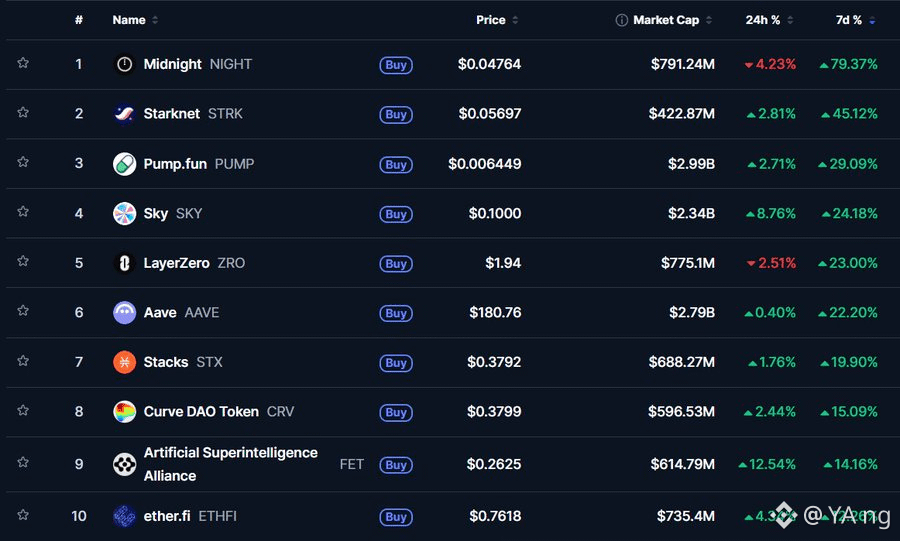
1. $NIGHT is the biggest gainer in the past 7 days +79%
2. $STRK +45%
3.$PUMP +20%
WEDNESDAYU.S. 10Y Treasury Auction + Fed Meeting Minutes
FRIDAY Michigan Consumer Sentiment + Inflation Expectations
Inflation, consumer confidence.
1. $NIGHT is the biggest gainer in the past 7 days +79%
2. $STRK +45%
3.$PUMP +20%
FRIDAY Michigan Consumer Sentiment + Inflation Expectations
Inflation, consumer confidence.
1. $NIGHT is the biggest gainer in the past 7 days +79%
2. $STRK +45%
3.$PUMP +20%
606
·
--
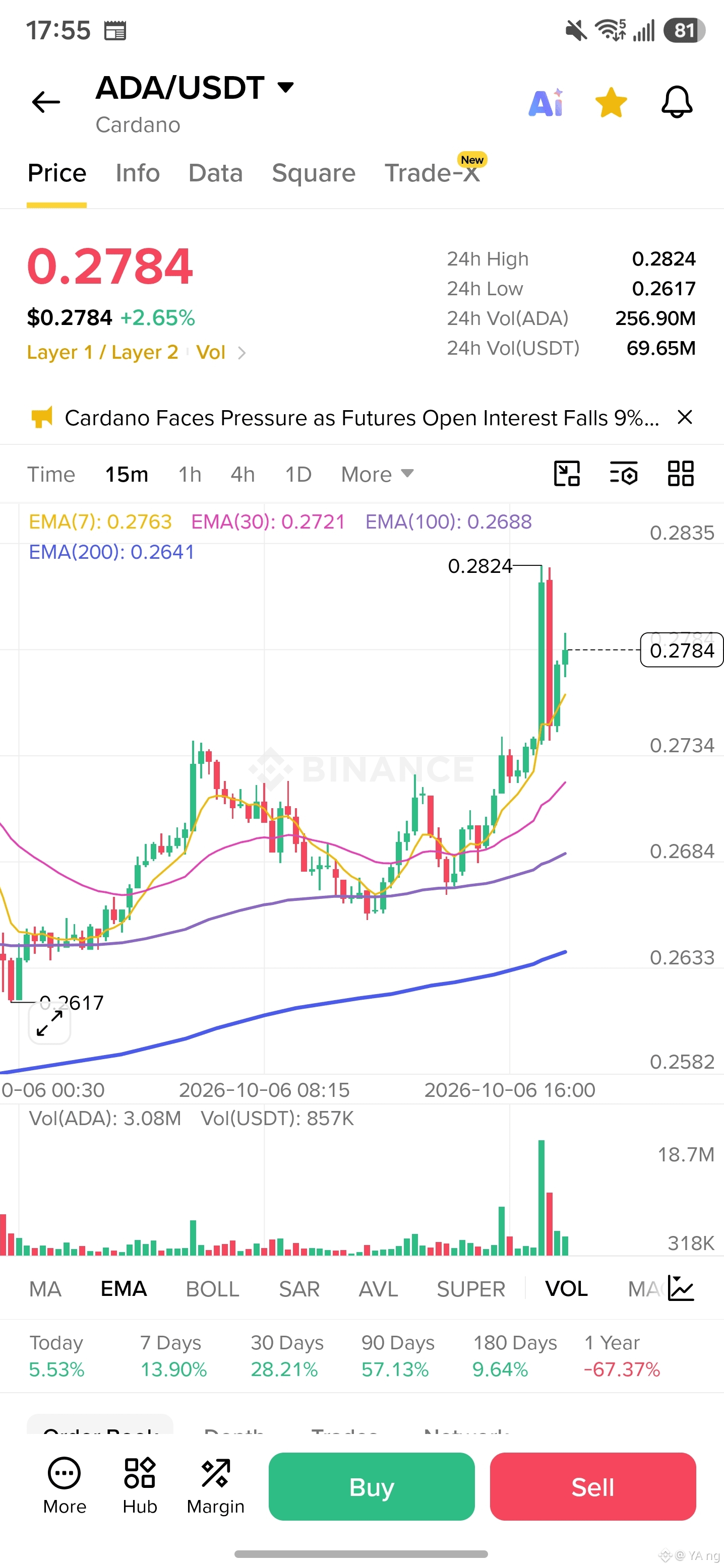
$ADA This way of squeezing people out is quite crude—clearly meant to liquidate some shorts while dangling bait to lure people in. There’s huge selling pressure overhead, especially around 0.3. Although it’s only at 0.27 now, many people will choose to cut their losses and get out quickly. Spot holders may just get their hopes up for nothing, but anyone using high leverage needs to be careful. They’ll use all kinds of tactics to drive everyone out. For example, $ZEC suddenly plunged in a single candle, and $NIGHT did the same, only to surge immediately afterward, leaving many people watching from the sidelines.
$ADA This way of squeezing people out is quite crude—clearly meant to liquidate some shorts while dangling bait to lure people in. There’s huge selling pressure overhead, especially around 0.3. Although it’s only at 0.27 now, many people will choose to cut their losses and get out quickly. Spot holders may just get their hopes up for nothing, but anyone using high leverage needs to be careful. They’ll use all kinds of tactics to drive everyone out. For example, $ZEC suddenly plunged in a single candle, and $NIGHT did the same, only to surge immediately afterward, leaving many people watching from the sidelines.
557
·
--
Reason 11$ADA : A 15-minute bullish engulfing pattern appeared, with the upward and downward moves covering the same distance. Although buying volume was high, the downward candle used only 60% of the upward move’s strength to fall back to the starting point, indicating heavy overhead resistance and that many people are looking to sell.
Reason 2: There’s too much leverage. There are $76.55 million in long positions at $0.22 and $16.81 million in short positions at $0.30. The whales will shake out the market before getting back on the road.
You can also see it in the price action: during the broad consolidation in February, every attempt to rise was suppressed, and each low was lower than the previous one. Lower highs are also forming, so I think breaking above $0.30 will be difficult in the short term, but I believe breaking above $0.33 before the end of the year is inevitable.
$RLC +107%,....$API3 +30%.....。🚀🚀🚀
How will ADA perform today?
Reason 11$ADA : A 15-minute bullish engulfing pattern appeared, with the upward and downward moves covering the same distance. Although buying volume was high, the downward candle used only 60% of the upward move’s strength to fall back to the starting point, indicating heavy overhead resistance and that many people are looking to sell.
Reason 2: There’s too much leverage. There are $76.55 million in long positions at $0.22 and $16.81 million in short positions at $0.30. The whales will shake out the market before getting back on the road.
You can also see it in the price action: during the broad consolidation in February, every attempt to rise was suppressed, and each low was lower than the previous one. Lower highs are also forming, so I think breaking above $0.30 will be difficult in the short term, but I believe breaking above $0.33 before the end of the year is inevitable.
$RLC +107%,....$API3 +30%.....。🚀🚀🚀
How will ADA perform today?
Reason 2: There’s too much leverage. There are $76.55 million in long positions at $0.22 and $16.81 million in short positions at $0.30. The whales will shake out the market before getting back on the road.
You can also see it in the price action: during the broad consolidation in February, every attempt to rise was suppressed, and each low was lower than the previous one. Lower highs are also forming, so I think breaking above $0.30 will be difficult in the short term, but I believe breaking above $0.33 before the end of the year is inevitable.
$RLC +107%,....$API3 +30%.....。🚀🚀🚀
How will ADA perform today?
會突破0.283
74%
不會突破0.28
26%
35 votes • Voting closed
1
1k
·
--
Verified
Bullish on what comes next
$LINK : CCIP 2.0 is live, continuing its evolution into cross-chain infrastructure and compliant settlement for institutions.
$ONDO : Integration with DTCC Fund/SERV, launch of BlackRock model portfolios, and expansion to NEAR bring RWAs ever closer to the back office of traditional finance.
$AAVE : Coinbase tokenized U.S. stocks can now be used as collateral on Aave V4 to borrow USDC. Tokenized stocks are moving beyond “trading” and into “financialization.”
Which one are you most bullish on?
Bullish on what comes next
$LINK : CCIP 2.0 is live, continuing its evolution into cross-chain infrastructure and compliant settlement for institutions.
$ONDO : Integration with DTCC Fund/SERV, launch of BlackRock model portfolios, and expansion to NEAR bring RWAs ever closer to the back office of traditional finance.
$AAVE : Coinbase tokenized U.S. stocks can now be used as collateral on Aave V4 to borrow USDC. Tokenized stocks are moving beyond “trading” and into “financialization.”
Which one are you most bullish on?
$LINK : CCIP 2.0 is live, continuing its evolution into cross-chain infrastructure and compliant settlement for institutions.
$ONDO : Integration with DTCC Fund/SERV, launch of BlackRock model portfolios, and expansion to NEAR bring RWAs ever closer to the back office of traditional finance.
$AAVE : Coinbase tokenized U.S. stocks can now be used as collateral on Aave V4 to borrow USDC. Tokenized stocks are moving beyond “trading” and into “financialization.”
Which one are you most bullish on?
LINK
25%
ONDO
47%
AAVE
28%
108 votes • Voting closed
1
3.7k
·
--
Estimating cryptocurrency prices based on a $20T market cap in 2030. ZEC could still rise 2.5x, and Dogecoin could still rise 5x...,
$ZEC Dominance: 0.5%
Target total market cap: $20T * 0.5% = $100 billion
Estimates based on white paper rules and projected supply: Maximum supply: Same as Bitcoin, capped at 21 million coins.
Halving mechanism: ZEC halves its block rewards every 4 years (the most recent halving occurred in late 2024, and the next is expected in 2028). By 2030, the cumulative mined supply in circulation is estimated to be around 19.5 million to 20 million coins.
19.5M (standard halving model) $5,128.21
19.8M (moderate issuance scenario) $5,050.51
20.0M (conservative upper-bound estimate) $5,000.00, still +280% from current levels
$DOGE Dominance: 0.5%
Target total market cap: $20T * 0.5% = $100 billion
Estimates based on the white paper and economic model:
Inflation model: DOGE has no maximum supply, with 5 billion new coins issued each year.
Circulating supply in 2030: The current circulating supply is around 145 billion to 150 billion coins. An estimated 2.5 billion coins will be issued by 2030, bringing the total circulating supply to around 170 billion to 175 billion coins.
170B (standard fixed-inflation model) $0.59
175B (conservative expansion scenario) $0.57, still +500% from current levels
Would you buy?
Estimating cryptocurrency prices based on a $20T market cap in 2030. ZEC could still rise 2.5x, and Dogecoin could still rise 5x...,
$ZEC Dominance: 0.5%
Target total market cap: $20T * 0.5% = $100 billion
Estimates based on white paper rules and projected supply: Maximum supply: Same as Bitcoin, capped at 21 million coins.
Halving mechanism: ZEC halves its block rewards every 4 years (the most recent halving occurred in late 2024, and the next is expected in 2028). By 2030, the cumulative mined supply in circulation is estimated to be around 19.5 million to 20 million coins.
19.5M (standard halving model) $5,128.21
19.8M (moderate issuance scenario) $5,050.51
20.0M (conservative upper-bound estimate) $5,000.00, still +280% from current levels
$DOGE Dominance: 0.5%
Target total market cap: $20T * 0.5% = $100 billion
Estimates based on the white paper and economic model:
Inflation model: DOGE has no maximum supply, with 5 billion new coins issued each year.
Circulating supply in 2030: The current circulating supply is around 145 billion to 150 billion coins. An estimated 2.5 billion coins will be issued by 2030, bringing the total circulating supply to around 170 billion to 175 billion coins.
170B (standard fixed-inflation model) $0.59
175B (conservative expansion scenario) $0.57, still +500% from current levels
Would you buy?
$ZEC Dominance: 0.5%
Target total market cap: $20T * 0.5% = $100 billion
Estimates based on white paper rules and projected supply: Maximum supply: Same as Bitcoin, capped at 21 million coins.
Halving mechanism: ZEC halves its block rewards every 4 years (the most recent halving occurred in late 2024, and the next is expected in 2028). By 2030, the cumulative mined supply in circulation is estimated to be around 19.5 million to 20 million coins.
19.5M (standard halving model) $5,128.21
19.8M (moderate issuance scenario) $5,050.51
20.0M (conservative upper-bound estimate) $5,000.00, still +280% from current levels
$DOGE Dominance: 0.5%
Target total market cap: $20T * 0.5% = $100 billion
Estimates based on the white paper and economic model:
Inflation model: DOGE has no maximum supply, with 5 billion new coins issued each year.
Circulating supply in 2030: The current circulating supply is around 145 billion to 150 billion coins. An estimated 2.5 billion coins will be issued by 2030, bringing the total circulating supply to around 170 billion to 175 billion coins.
170B (standard fixed-inflation model) $0.59
175B (conservative expansion scenario) $0.57, still +500% from current levels
Would you buy?
ZEC
30%
DOGE
60%
其他
10%
67 votes • Voting closed
1
2.2k
·
--
Verified
$ADA October happen
1.RealFi launched USDrf and yield-bearing stablecoins on Cardano mainnet.
November
1.Amaru’s Rust node targets mainnet block production as an alternative to the Haskell node.
[December]
1.Dijkstra Phase 1 targets mainnet with Linear Leios, nested transactions, and Plutus V4.
2.Linear Leios aims to raise throughput via certified endorser blocks while keeping Praos security.
Holding ADA isn’t simply about wanting price gains; it’s about hoping the project succeeds, admiring the founder’s vision and courage, and appreciating a group of builders who work quietly behind the scenes. My average cost is underwater, but I still have confidence in the project.
Do you still have confidence in ADA, $WMTX , and $NIGHT ?
$ADA October happen
1.RealFi launched USDrf and yield-bearing stablecoins on Cardano mainnet.
November
1.Amaru’s Rust node targets mainnet block production as an alternative to the Haskell node.
[December]
1.Dijkstra Phase 1 targets mainnet with Linear Leios, nested transactions, and Plutus V4.
2.Linear Leios aims to raise throughput via certified endorser blocks while keeping Praos security.
Holding ADA isn’t simply about wanting price gains; it’s about hoping the project succeeds, admiring the founder’s vision and courage, and appreciating a group of builders who work quietly behind the scenes. My average cost is underwater, but I still have confidence in the project.
Do you still have confidence in ADA, $WMTX , and $NIGHT ?
1.RealFi launched USDrf and yield-bearing stablecoins on Cardano mainnet.
November
1.Amaru’s Rust node targets mainnet block production as an alternative to the Haskell node.
[December]
1.Dijkstra Phase 1 targets mainnet with Linear Leios, nested transactions, and Plutus V4.
2.Linear Leios aims to raise throughput via certified endorser blocks while keeping Praos security.
Holding ADA isn’t simply about wanting price gains; it’s about hoping the project succeeds, admiring the founder’s vision and courage, and appreciating a group of builders who work quietly behind the scenes. My average cost is underwater, but I still have confidence in the project.
Do you still have confidence in ADA, $WMTX , and $NIGHT ?
有
81%
沒有
19%
21 votes • Voting closed
1
1.6k
·
--
Hoskinson's speech focused on two main points:
1. The increasing use of blockchain technology to represent traditional assets on-chain.
2. Exponential Growth Can Be Hard to Predict
His point was that technologies can grow much faster than early estimates suggest, especially as adoption and efficiency improve.
The chains most commonly chosen as adoption and efficiency improve:
$ETH : The clear leader, with about 48% share. Institutions favor it most for its security, regulatory compliance, and mature ecosystem.
$BNB Chain: Second place, with about 12%, and especially leading in tokenized stocks.
$SOL : One of the fastest-growing chains, with active trading, many holders, and low fees, making it suitable for high-frequency trading and retail users.
Hoskinson's speech focused on two main points:
1. The increasing use of blockchain technology to represent traditional assets on-chain.
2. Exponential Growth Can Be Hard to Predict
His point was that technologies can grow much faster than early estimates suggest, especially as adoption and efficiency improve.
The chains most commonly chosen as adoption and efficiency improve:
$ETH : The clear leader, with about 48% share. Institutions favor it most for its security, regulatory compliance, and mature ecosystem.
$BNB Chain: Second place, with about 12%, and especially leading in tokenized stocks.
$SOL : One of the fastest-growing chains, with active trading, many holders, and low fees, making it suitable for high-frequency trading and retail users.
1. The increasing use of blockchain technology to represent traditional assets on-chain.
2. Exponential Growth Can Be Hard to Predict
His point was that technologies can grow much faster than early estimates suggest, especially as adoption and efficiency improve.
The chains most commonly chosen as adoption and efficiency improve:
$ETH : The clear leader, with about 48% share. Institutions favor it most for its security, regulatory compliance, and mature ecosystem.
$BNB Chain: Second place, with about 12%, and especially leading in tokenized stocks.
$SOL : One of the fastest-growing chains, with active trading, many holders, and low fees, making it suitable for high-frequency trading and retail users.
281
Log in to explore more content
Join global crypto users on Binance Square
⚡️ Get latest and useful information about crypto.
💬 Trusted by the world’s largest crypto exchange.
👍 Discover real insights from verified creators.
Email / Phone number
Trending Topics
FedMinutesFocusOnOctoberPause
126,803 views
1,163 Discussing
🚨 HIGH ALERT ‼️ PLEASE DON’T TRADE BLINDLY FOR THE NEXT HOUR 🚨
Guys, we have FOMC Minutes coming in less than 1 hour.
And after the kind of volatility we already saw today, I really don’t want anyone opening random high-leverage positions just before this release.
The biggest reaction I’m watching will be in Gold (XAU), Silver (XAG), BTC and ETH. Then coins like SOL and other highly leveraged mid/low-cap alts can exaggerate whatever move BTC makes.
Gold and Silver are especially sensitive tonight because the market is already reacting to the US dollar + Treasury yields, and both metals have been under heavy pressure ahead of the Fed minutes.
Briefly speaking
📉Hawkish Fed Minutes → Dollar/yields can push higher → pressure on BTC, crypto, Gold & silver
📈Dovish Fed Minutes → Dollar/yields can cool → BTC, Gold, Silver and risk assets can bounce hard.
And please remember the first candle can be a trap. We can get a pump, immediate dump, liquidations on both sides, and then the real direction.
So for now, protect your positions, reduce unnecessary leverage and don’t FOMO into the first move.
Tonight I’m watching $XAU , $XAG and $BTC first. These will tell us very quickly how the market is reading the Fed.
I will Update you guys on time
Follow @Panda Traders and Turn on Your notifications right now
#FedMinutesFocusOnOctoberPause
Panda Traders
·18 Likes
·3.5k views
BinanceLaunchesBinanceIntelligence
1.1M views
6,374 Discussing
EvernorthDelaysNasdaqDebutToOct12
8,931 views
244 Discussing