

小木偶ddd
504 Posts

小木偶ddd
Report
Block User
383 Following
13.5K+ Followers
3.1K+ Liked
Posts
All
Quotes
Live
·
--
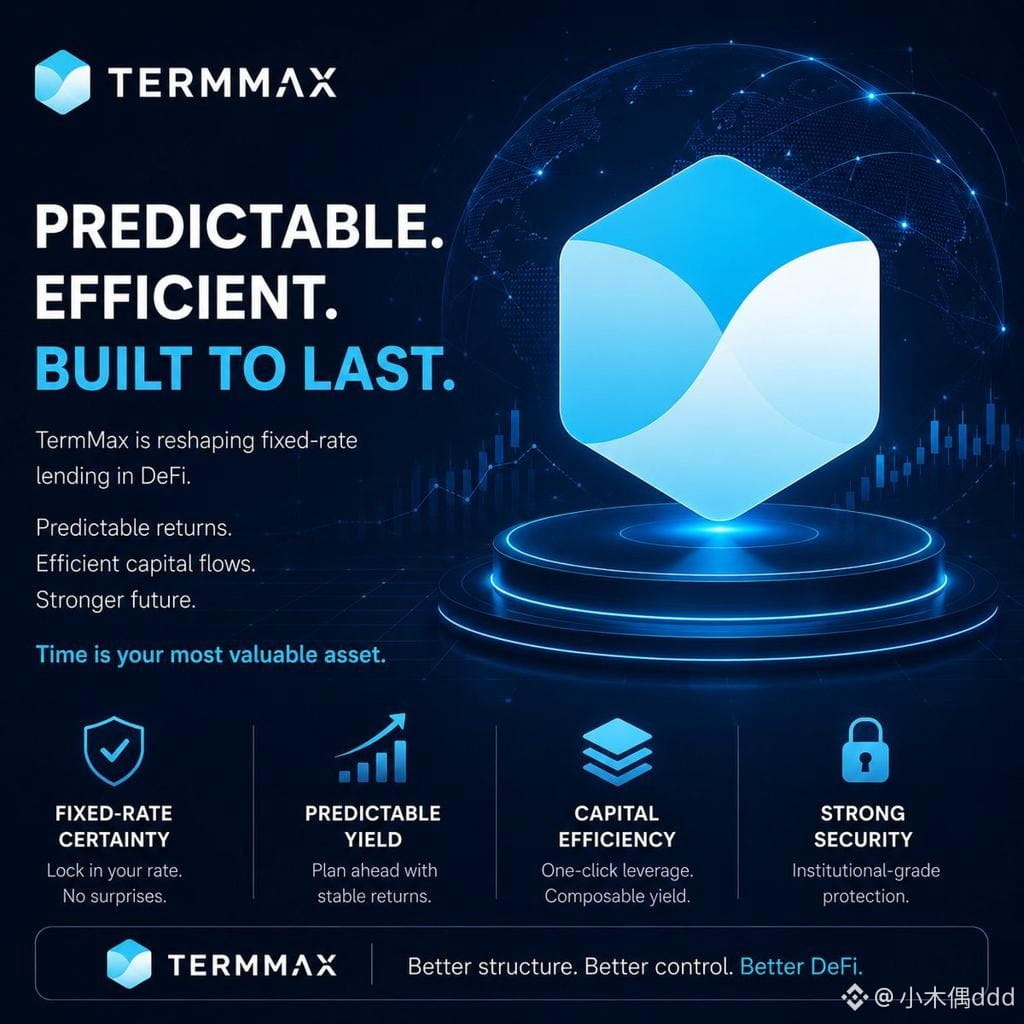
#termmax When I first saw Atomic Orders, what popped into my mind wasn’t “efficiency”—but a very real problem.
The other day, I was organizing my on-chain funds myself, and I ran into something particularly annoying.
I did have some money on hand, but when it came to actually operating, it always felt like the funds were scattered into pieces.
Put some in this pool, place a bit in that order.
In places where there are fills, the funds aren’t enough; in places without fills, the money just sits idle.
In the end, when I opened my wallet, the assets were still substantial—but the amount of capital actually doing work wasn’t as much as I’d imagined.
This time, when I saw TermMax’s Atomic Orders, I suddenly became interested.
One core idea behind Atomic Orders is that before the funds are truly borrowed, the virtual liquidity can be distributed across multiple orders at the same time—avoiding a situation where one particular order locks up the funds early, thereby reducing liquidity fragmentation.
At first glance, this sounds very technical.
With a single pot of money, can it really wait on multiple opportunities at the same time?
In traditional market making, funds are often tied up by a single order.
If that order doesn’t get filled, the money can only wait there.
But Atomic Orders is more like this:
First, I tell the market—
“I'm willing to get filled at all these places.”
But before the actual fills happen, I don’t need to lock all the real capital in advance.
It’s kind of like shopping at a farmers’/street market.
You can tell five different vendors, “I’m considering this price,” but it doesn’t mean you have to pull out all your money right now.
Only when the fill happens do you take out the corresponding funds.
It’s not just about making trades faster.
Why does liquidity keep getting chopped up?
If in the future there are a lot of orders in a TermMax market with different interest rates and different terms, and funds can’t be flexibly distributed, then the larger the scale, the more likely efficiency problems become.
Of course, whether this mechanism can truly improve capital utilization ultimately depends on the actual order depth and market participants.
But at the very least, this design made me see an interesting direction:
In future DeFi market making, it may not be about keeping funds “sitting in a single pool,” but about having funds wait for multiple potential trades at the same time.
You don’t have to decide in advance where the money should go.
Whatever the market brings, the money goes there.
@termmax #TermMax
#termmax When I first saw Atomic Orders, what popped into my mind wasn’t “efficiency”—but a very real problem.
The other day, I was organizing my on-chain funds myself, and I ran into something particularly annoying.
I did have some money on hand, but when it came to actually operating, it always felt like the funds were scattered into pieces.
Put some in this pool, place a bit in that order.
In places where there are fills, the funds aren’t enough; in places without fills, the money just sits idle.
In the end, when I opened my wallet, the assets were still substantial—but the amount of capital actually doing work wasn’t as much as I’d imagined.
This time, when I saw TermMax’s Atomic Orders, I suddenly became interested.
One core idea behind Atomic Orders is that before the funds are truly borrowed, the virtual liquidity can be distributed across multiple orders at the same time—avoiding a situation where one particular order locks up the funds early, thereby reducing liquidity fragmentation.
At first glance, this sounds very technical.
With a single pot of money, can it really wait on multiple opportunities at the same time?
In traditional market making, funds are often tied up by a single order.
If that order doesn’t get filled, the money can only wait there.
But Atomic Orders is more like this:
First, I tell the market—
“I'm willing to get filled at all these places.”
But before the actual fills happen, I don’t need to lock all the real capital in advance.
It’s kind of like shopping at a farmers’/street market.
You can tell five different vendors, “I’m considering this price,” but it doesn’t mean you have to pull out all your money right now.
Only when the fill happens do you take out the corresponding funds.
It’s not just about making trades faster.
Why does liquidity keep getting chopped up?
If in the future there are a lot of orders in a TermMax market with different interest rates and different terms, and funds can’t be flexibly distributed, then the larger the scale, the more likely efficiency problems become.
Of course, whether this mechanism can truly improve capital utilization ultimately depends on the actual order depth and market participants.
But at the very least, this design made me see an interesting direction:
In future DeFi market making, it may not be about keeping funds “sitting in a single pool,” but about having funds wait for multiple potential trades at the same time.
You don’t have to decide in advance where the money should go.
Whatever the market brings, the money goes there.
@TermMax #TermMax
144
·
--
I studied DeFi before #termmax and I have a very consistent habit.
First, I open a protocol. I don’t look at APY or TVL at all—I go straight to checking the permissions.
Once I saw a project claiming “highly decentralized.” But when I scrolled down, I found that almost all the key parameters could be modified directly by an admin. My first reaction was to close the page immediately.
After all, putting money into a smart contract doesn’t mean the risk automatically disappears.
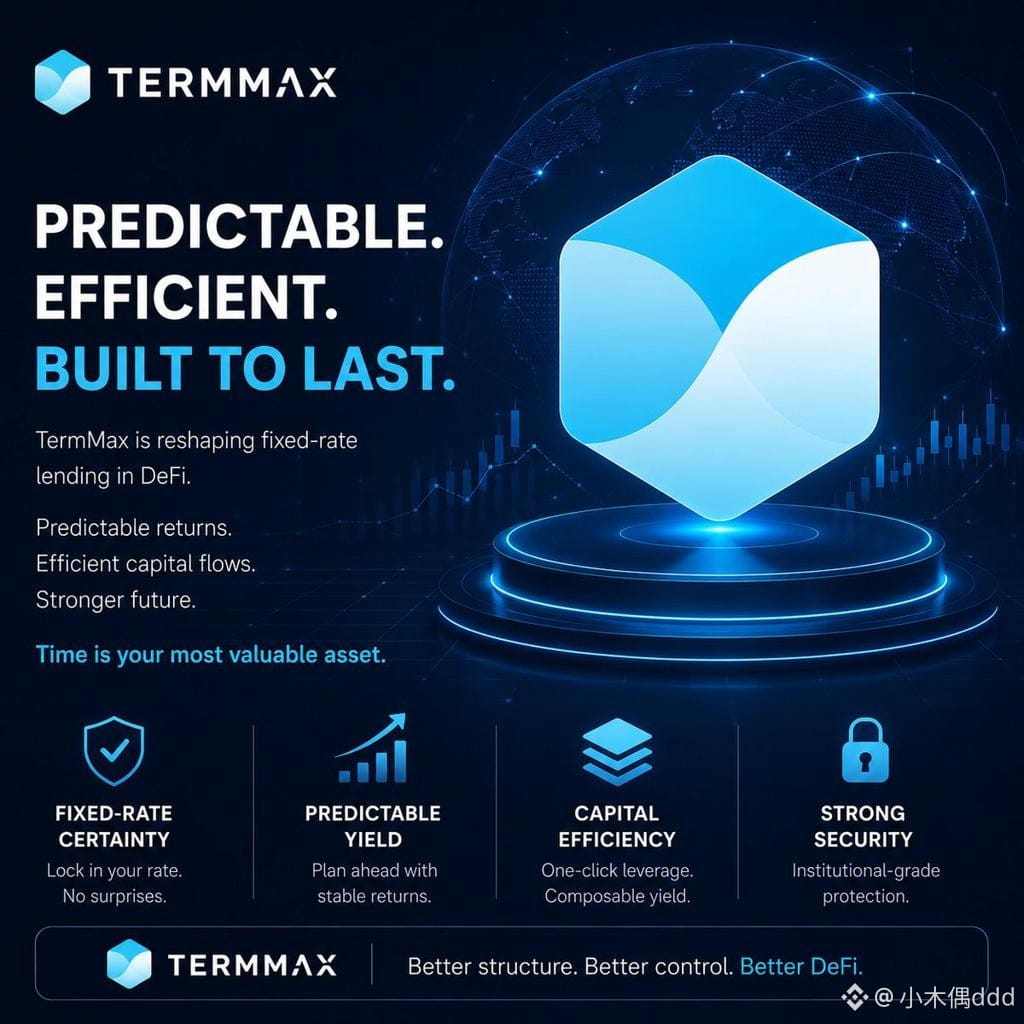
What made me reconsider this recently was TermMax’s Timelock design.
It doesn’t simply say, “Admins can’t change things.” Instead, it adds a waiting period for changes to sensitive parameters.
According to the official mechanism, parameter updates must go through Submit → Wait → Accept: you submit first, then wait, and only afterward can the change be executed. During the waiting period, the Guardian can also revoke it. The default waiting time is 1 day, and the maximum can be configured up to 30 days. What’s even more interesting is that lower-risk operations can be executed faster, while riskier changes require the full waiting period.
Because it’s the same in real-world finance.
The real danger isn’t that “someone has the key.” The real danger is whether, after getting the key, they can open the door immediately.
If a parameter suddenly changes significantly, the market needs at least enough time to understand what happened, assess the impact, adjust positions, or even exit.
So Timelock may look like a mere technical component, but in essence it’s really buying time for the market.
Of course, it isn’t insurance and it can’t eliminate smart contract risk.
But I’ve increasingly come to believe that a mature DeFi protocol shouldn’t just tell users:
“Who can change the rules.”
It should also tell users:
“How much time you have to know before the rules change.”
The former is permission management.
The latter is the real risk management.
@termmax #TermMax
I studied DeFi before #termmax and I have a very consistent habit.
First, I open a protocol. I don’t look at APY or TVL at all—I go straight to checking the permissions.
Once I saw a project claiming “highly decentralized.” But when I scrolled down, I found that almost all the key parameters could be modified directly by an admin. My first reaction was to close the page immediately.
After all, putting money into a smart contract doesn’t mean the risk automatically disappears.
What made me reconsider this recently was TermMax’s Timelock design.
It doesn’t simply say, “Admins can’t change things.” Instead, it adds a waiting period for changes to sensitive parameters.
According to the official mechanism, parameter updates must go through Submit → Wait → Accept: you submit first, then wait, and only afterward can the change be executed. During the waiting period, the Guardian can also revoke it. The default waiting time is 1 day, and the maximum can be configured up to 30 days. What’s even more interesting is that lower-risk operations can be executed faster, while riskier changes require the full waiting period.
Because it’s the same in real-world finance.
The real danger isn’t that “someone has the key.” The real danger is whether, after getting the key, they can open the door immediately.
If a parameter suddenly changes significantly, the market needs at least enough time to understand what happened, assess the impact, adjust positions, or even exit.
So Timelock may look like a mere technical component, but in essence it’s really buying time for the market.
Of course, it isn’t insurance and it can’t eliminate smart contract risk.
But I’ve increasingly come to believe that a mature DeFi protocol shouldn’t just tell users:
“Who can change the rules.”
It should also tell users:
“How much time you have to know before the rules change.”
The former is permission management.
The latter is the real risk management.
@TermMax #TermMax
120
·
--
#termmax The more I look into TermMax, the more I feel the Curator role has been underestimated.
Once, I was chatting with a friend about DeFi, and he said something that really stuck with me:
“Don’t on-chain protocols just run automatically? Why do we still need someone to manage it?”
Haven’t smart contracts already hard-coded the rules?
Automatic execution and professional management are fundamentally not the same thing.
In TermMax’s official whitepaper, there’s a role that I think is especially worth discussing—Curator.
They don’t simply “watch your wallet.”
The Curator will participate in setting pricing curves, risk parameters, and capital allocation.
As listed in the current official whitepaper, the Curators include Keyrock, Hardcoded Lab, Edge Capital, AlphaPing, and Origami Crypto.
This makes me think of a pretty realistic question.
On-chain finance has always emphasized:
“Code is Law.”
But the issue is that code can only execute rules.
It can’t tell you out of thin air:
How much liquidity this market should have right now.
Has the risk of this collateral increased?
Is this term already no longer suitable for further capital expansion?
These things all involve financial judgment.
So I think the emergence of the Curator is quite interesting.
It’s a bit like transplanting the traditional finance role of the “asset manager” into the on-chain market.
But the difference is also very clear.
In traditional fund management, decisions are often made in a black box.
You know what they bought, but you might not know why.
And TermMax’s direction is to ensure that market parameters and capital allocation ultimately fall into on-chain rules—so users can see the market’s structure and parameters. The official website also highlights publicly verifiable fees, parameters, and the on-chain market.
This is really a subtle combination:
Humans handle judgment, while code handles execution.
I think this might be more realistic than “fully automated” systems.
Because in finance, the truly difficult part has never been execution.
It’s judgment.
Of course, having a Curator also brings new governance and operational risks.
Who is qualified to become a Curator?
Who will constrain or oversee them?
What if the risk parameters are set incorrectly?
These are questions that TermMax will have to keep answering going forward.
The endgame of DeFi might not be driving everyone away, but instead putting human professional judgment into a more transparent, more verifiable system.
@termmax #TermMax
#termmax The more I look into TermMax, the more I feel the Curator role has been underestimated.
Once, I was chatting with a friend about DeFi, and he said something that really stuck with me:
“Don’t on-chain protocols just run automatically? Why do we still need someone to manage it?”
Haven’t smart contracts already hard-coded the rules?
Automatic execution and professional management are fundamentally not the same thing.
In TermMax’s official whitepaper, there’s a role that I think is especially worth discussing—Curator.
They don’t simply “watch your wallet.”
The Curator will participate in setting pricing curves, risk parameters, and capital allocation.
As listed in the current official whitepaper, the Curators include Keyrock, Hardcoded Lab, Edge Capital, AlphaPing, and Origami Crypto.
This makes me think of a pretty realistic question.
On-chain finance has always emphasized:
“Code is Law.”
But the issue is that code can only execute rules.
It can’t tell you out of thin air:
How much liquidity this market should have right now.
Has the risk of this collateral increased?
Is this term already no longer suitable for further capital expansion?
These things all involve financial judgment.
So I think the emergence of the Curator is quite interesting.
It’s a bit like transplanting the traditional finance role of the “asset manager” into the on-chain market.
But the difference is also very clear.
In traditional fund management, decisions are often made in a black box.
You know what they bought, but you might not know why.
And TermMax’s direction is to ensure that market parameters and capital allocation ultimately fall into on-chain rules—so users can see the market’s structure and parameters. The official website also highlights publicly verifiable fees, parameters, and the on-chain market.
This is really a subtle combination:
Humans handle judgment, while code handles execution.
I think this might be more realistic than “fully automated” systems.
Because in finance, the truly difficult part has never been execution.
It’s judgment.
Of course, having a Curator also brings new governance and operational risks.
Who is qualified to become a Curator?
Who will constrain or oversee them?
What if the risk parameters are set incorrectly?
These are questions that TermMax will have to keep answering going forward.
The endgame of DeFi might not be driving everyone away, but instead putting human professional judgment into a more transparent, more verifiable system.
@TermMax #TermMax
115
·
--
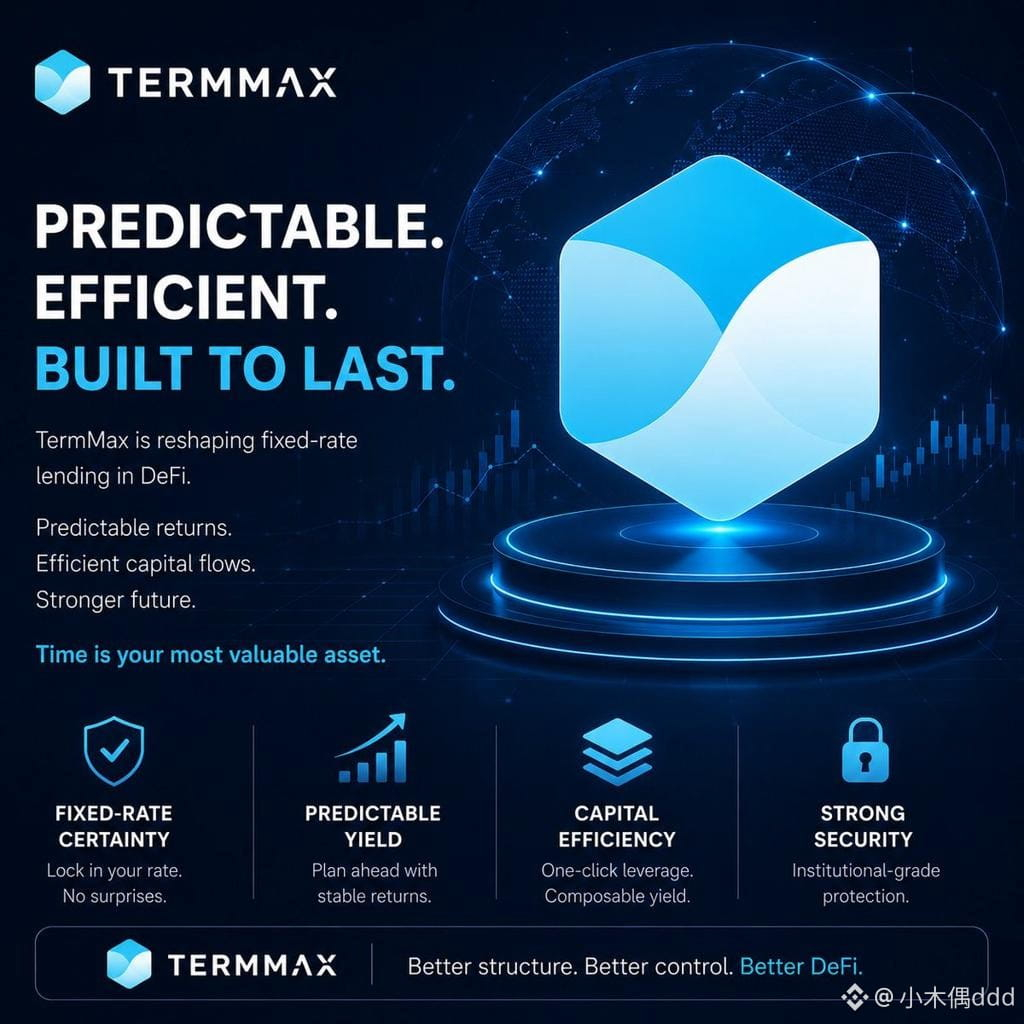
#termmax 《I used to think interest rates were just a number—until I realized they’re actually a language of the market》
Once, I was looking at on-chain lending data, staring at an interest-rate change for quite a while.
It went from 5% to 9%, and then to 11%.
Numbers don’t really feel like anything.
But if you put it differently:
Someone is willing to pay double the financing cost just to get funding right away.
Doesn’t that suddenly feel different?
Later, I increasingly felt that interest rates are not just an APR number.
They’re telling you:
How short of money the market is right now, how expensive capital is, and how risk is being priced.
This is also the part that I became more interested in after studying TermMax.
What’s truly interesting about a fixed-term market isn’t just the two words “fixed,” but the fact that it starts to let market participants form prices around different tenors.
How much does 30 days cost?
How much does 90 days cost?
How much does 180 days cost?
Different time periods correspond to different funding costs.
At that point, it starts to look a bit like the term structure in traditional finance.
In the past, DeFi mostly talked about:
“How much does it cost to borrow right now?”
In the future, more and more people may start discussing:
“For borrowing 30 days vs. borrowing 180 days—why should they be two different prices?”
That’s what I think is interesting about TermMax.
It made me realize again that interest rates themselves are a language of the market.
Price tells you how much an asset is worth.
Interest rates tell you how much money is worth right now.
And the term tells you:
How long this price should last.
Of course, whether this market can ultimately form sufficiently effective pricing can’t rely on product design alone—it also depends on real trading, liquidity, and the scale of participants.
But if on-chain finance continues to go deeper, I think the “interest-rate market” will sooner or later become something you can’t avoid.
By then, people may not just be looking at how much BTC or ETH goes up.
They’ll be asking:
In different time horizons, how much should money be worth?
That question is far more interesting than simply looking at an APY.
@termmax #TermMax
#termmax 《I used to think interest rates were just a number—until I realized they’re actually a language of the market》
Once, I was looking at on-chain lending data, staring at an interest-rate change for quite a while.
It went from 5% to 9%, and then to 11%.
Numbers don’t really feel like anything.
But if you put it differently:
Someone is willing to pay double the financing cost just to get funding right away.
Doesn’t that suddenly feel different?
Later, I increasingly felt that interest rates are not just an APR number.
They’re telling you:
How short of money the market is right now, how expensive capital is, and how risk is being priced.
This is also the part that I became more interested in after studying TermMax.
What’s truly interesting about a fixed-term market isn’t just the two words “fixed,” but the fact that it starts to let market participants form prices around different tenors.
How much does 30 days cost?
How much does 90 days cost?
How much does 180 days cost?
Different time periods correspond to different funding costs.
At that point, it starts to look a bit like the term structure in traditional finance.
In the past, DeFi mostly talked about:
“How much does it cost to borrow right now?”
In the future, more and more people may start discussing:
“For borrowing 30 days vs. borrowing 180 days—why should they be two different prices?”
That’s what I think is interesting about TermMax.
It made me realize again that interest rates themselves are a language of the market.
Price tells you how much an asset is worth.
Interest rates tell you how much money is worth right now.
And the term tells you:
How long this price should last.
Of course, whether this market can ultimately form sufficiently effective pricing can’t rely on product design alone—it also depends on real trading, liquidity, and the scale of participants.
But if on-chain finance continues to go deeper, I think the “interest-rate market” will sooner or later become something you can’t avoid.
By then, people may not just be looking at how much BTC or ETH goes up.
They’ll be asking:
In different time horizons, how much should money be worth?
That question is far more interesting than simply looking at an APY.
@TermMax #TermMax
155
·
--
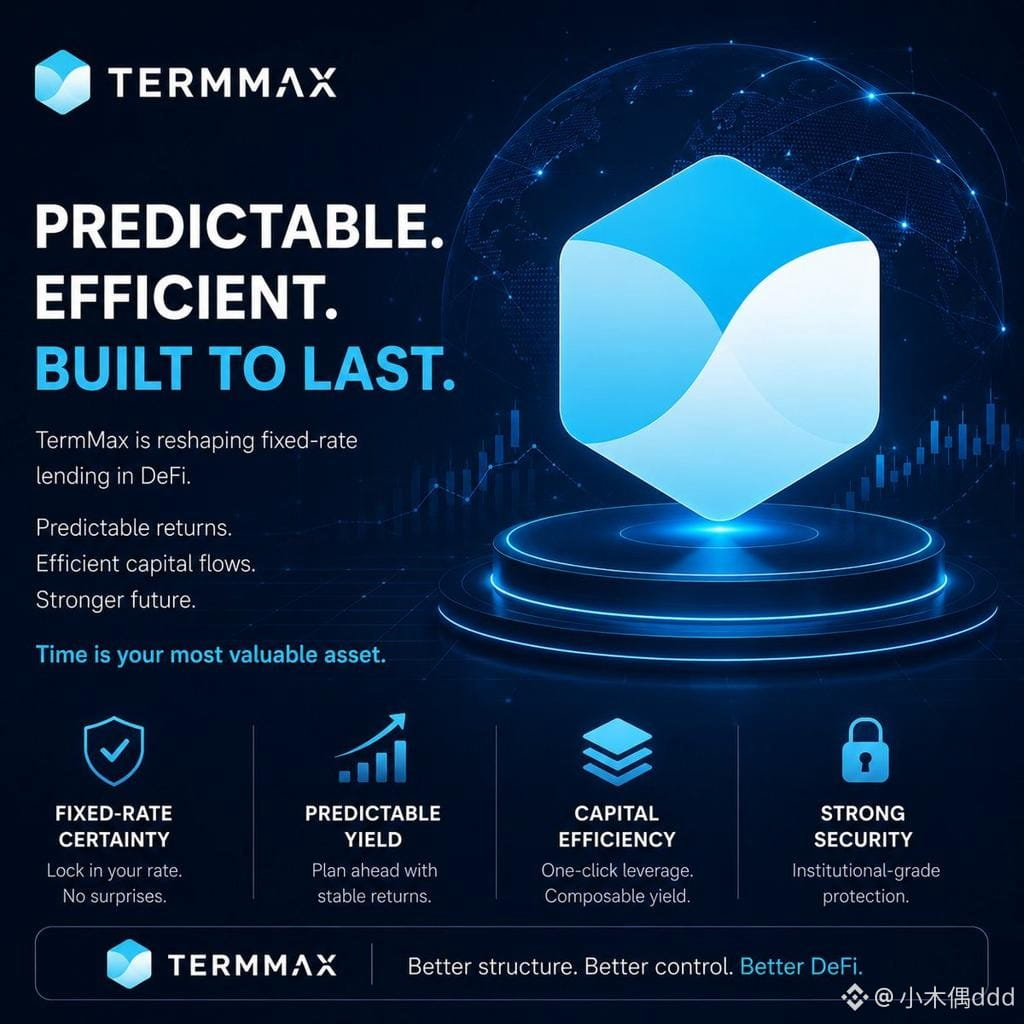
#termmax Why I started paying attention to TermMax: DeFi is moving from “lending and borrowing” toward a “fixed-income market”
When I used to look at DeFi, what I liked most was APY.
Which pool pays the highest returns, where the incentives are greatest, and which protocol can stack even more earnings.
But the longer I watch, the more I feel that:
High returns aren’t that important—certainty is.
Here’s the simplest example.
Suppose today you borrow 100,000 USDC at a 5% interest rate.
That sounds pretty comfortable.
But then the market suddenly goes into a疯狂 rally, demand for capital increases, and borrowing rates climb nonstop.
5% becomes 8%, and 8% becomes 12%.
Only then do you realize the thing that truly affects your strategy’s returns isn’t just whether the asset goes up or down—but also something you didn’t pay much attention to before:
Financing cost.
That’s also why I began seriously researching TermMax.
It doesn’t just try to tell you, “Here’s a higher APY.” Instead, it attempts to make interest rates and tenors themselves into something that can be traded and managed.
Fixed interest rates mean that when the trade happens, you roughly know what your future financing cost will be. Fixed tenors tell you when this capital will mature.
This doesn’t sound as exciting as “1000% APY.”
It’s even a bit boring.
But once financial markets mature, they often end up solving exactly these unexciting problems.
Because retail users can accept checking the market today and switching pools tomorrow.
But if the amount of capital on-chain keeps growing—especially after arbitrageurs, structured strategies, and institutional capital enter—the biggest fear isn’t really earning a few percentage points less. Instead, it’s:
The model was right—then the interest rate suddenly changed.
Of course, fixed interest rates aren’t risk-free.
They simply shift the risk from “rates changing every day” to the term, liquidity, collateral, and maturity management.
So I won’t jump to the conclusion that TermMax is necessarily better just because it uses fixed rates.
But I do think this direction is worth watching.
Because if DeFi truly wants to move from “on-chain borrowing and lending” to a more mature financial market, the next step can’t just be researching:
How to borrow money?
It has to start researching:
At what price, for what tenor, and with what level of risk should this money be deployed?
This step may be even more important than simply increasing APY.
@termmax #TermMax
#termmax Why I started paying attention to TermMax: DeFi is moving from “lending and borrowing” toward a “fixed-income market”
When I used to look at DeFi, what I liked most was APY.
Which pool pays the highest returns, where the incentives are greatest, and which protocol can stack even more earnings.
But the longer I watch, the more I feel that:
High returns aren’t that important—certainty is.
Here’s the simplest example.
Suppose today you borrow 100,000 USDC at a 5% interest rate.
That sounds pretty comfortable.
But then the market suddenly goes into a疯狂 rally, demand for capital increases, and borrowing rates climb nonstop.
5% becomes 8%, and 8% becomes 12%.
Only then do you realize the thing that truly affects your strategy’s returns isn’t just whether the asset goes up or down—but also something you didn’t pay much attention to before:
Financing cost.
That’s also why I began seriously researching TermMax.
It doesn’t just try to tell you, “Here’s a higher APY.” Instead, it attempts to make interest rates and tenors themselves into something that can be traded and managed.
Fixed interest rates mean that when the trade happens, you roughly know what your future financing cost will be. Fixed tenors tell you when this capital will mature.
This doesn’t sound as exciting as “1000% APY.”
It’s even a bit boring.
But once financial markets mature, they often end up solving exactly these unexciting problems.
Because retail users can accept checking the market today and switching pools tomorrow.
But if the amount of capital on-chain keeps growing—especially after arbitrageurs, structured strategies, and institutional capital enter—the biggest fear isn’t really earning a few percentage points less. Instead, it’s:
The model was right—then the interest rate suddenly changed.
Of course, fixed interest rates aren’t risk-free.
They simply shift the risk from “rates changing every day” to the term, liquidity, collateral, and maturity management.
So I won’t jump to the conclusion that TermMax is necessarily better just because it uses fixed rates.
But I do think this direction is worth watching.
Because if DeFi truly wants to move from “on-chain borrowing and lending” to a more mature financial market, the next step can’t just be researching:
How to borrow money?
It has to start researching:
At what price, for what tenor, and with what level of risk should this money be deployed?
This step may be even more important than simply increasing APY.
@TermMax #TermMax
290
·
--
#baby $BABY Recently, when I look at projects, I have a fairly clear feeling.
Many teams are especially fond of showcasing the “front-of-house.”
The homepage is beautiful.
The logo looks high-end.
The ecosystem chart, once you open it, is packed tightly.
All the partner parties are arranged neatly.
It looks especially lively.
But sometimes I ask myself this question:
If people really lived in this building, would the underground water and power utilities be reliable?
(Laughs)
Because buying a home in real life is the same.
You don’t just look at the living room renovation.
After living there for a few years, what truly determines your experience is:
the wiring.
the plumbing.
property management.
those things you usually don’t see.
Blockchain is similar, too.
Many projects like to talk about:
users.
ecosystem.
applications.
But those behind-the-scenes elements that nobody pays attention to are actually what determine whether it can exist long-term.
For example, security.
For example, rules.
For example, what to do if something goes wrong.
The interesting thing about Babylon, in my view, is that it focuses on these “less sexy” aspects.
It’s not building a product that users check every day.
Instead, it solves some basic problems involved in running a chain.
Like how we usually don’t discuss the power grid.
But the moment there’s a blackout for a day, everyone immediately knows how important it is.
Of course, infrastructure projects like this have one problem:
It’s hard in the early stage for ordinary people to feel the value.
Because unlike Meme coins, which can jump tenfold in a day.
And unlike games, which have a beautiful interface.
But many truly important things are just like that.
In the early days of the internet, nobody talked about servers every day.
Only later did people realize: without servers, nothing can run.
So when I look at Babylon, I don’t pay much attention to its short-term hype.
What I’d rather see is:
after more and more chains emerge in the future, will there be real demand for this kind of infrastructure?
Because at the end of industry development, it may not be a matter of who has the loudest voice.
It’s a matter of who can become something others can’t do without.
#Baby $BABY @babylonlabs_io
#baby $BABY Recently, when I look at projects, I have a fairly clear feeling.
Many teams are especially fond of showcasing the “front-of-house.”
The homepage is beautiful.
The logo looks high-end.
The ecosystem chart, once you open it, is packed tightly.
All the partner parties are arranged neatly.
It looks especially lively.
But sometimes I ask myself this question:
If people really lived in this building, would the underground water and power utilities be reliable?
(Laughs)
Because buying a home in real life is the same.
You don’t just look at the living room renovation.
After living there for a few years, what truly determines your experience is:
the wiring.
the plumbing.
property management.
those things you usually don’t see.
Blockchain is similar, too.
Many projects like to talk about:
users.
ecosystem.
applications.
But those behind-the-scenes elements that nobody pays attention to are actually what determine whether it can exist long-term.
For example, security.
For example, rules.
For example, what to do if something goes wrong.
The interesting thing about Babylon, in my view, is that it focuses on these “less sexy” aspects.
It’s not building a product that users check every day.
Instead, it solves some basic problems involved in running a chain.
Like how we usually don’t discuss the power grid.
But the moment there’s a blackout for a day, everyone immediately knows how important it is.
Of course, infrastructure projects like this have one problem:
It’s hard in the early stage for ordinary people to feel the value.
Because unlike Meme coins, which can jump tenfold in a day.
And unlike games, which have a beautiful interface.
But many truly important things are just like that.
In the early days of the internet, nobody talked about servers every day.
Only later did people realize: without servers, nothing can run.
So when I look at Babylon, I don’t pay much attention to its short-term hype.
What I’d rather see is:
after more and more chains emerge in the future, will there be real demand for this kind of infrastructure?
Because at the end of industry development, it may not be a matter of who has the loudest voice.
It’s a matter of who can become something others can’t do without.
#Baby $BABY @BabylonLabs_io
118
·
--
#baby $BABY When I was researching projects before, I had a habit.
I liked watching the hype.
Looking at the community.
Looking at the price.
Looking at whether big money was paying attention.
Later, after going through a few cycles, I slowly realized something pretty brutal.
Many projects fail not because no one is interested.
It’s because people are interested, but they just don’t dare to truly participate.
That made me think of a friend.
Last year, when a new project just launched, he studied it every day.
He read the whitepaper several times.
He chatted in the group every day.
But in the end he said:
“Forget it, I’ll watch for now.”
I asked why.
He said:
“I’m afraid that after I go in, when I come out, the money won’t be mine anymore.”
That sentence is actually pretty real.
The crypto market is like that a lot of the time.
People like innovation.
But when it comes to asset safety, they become very conservative.
So now when I look at projects, I’m paying more and more attention to one question:
Does it solve the problem users are truly afraid of?
What attracted me to Babylon is that it doesn’t just focus on “how to get more BTC involved.”
It focuses on:
How to reduce the trust cost during participation.
Because BTC’s biggest feature is that people trust its rules.
If you introduce a lot of new trust links just to increase its use cases, that actually goes against what many BTC users care about most.
So the direction Babylon is exploring is to let BTC participate in other networks through a staking mechanism, while designing participation rules around security, exit, and slashing.
I think this is a lot like buying insurance.
Most people don’t hope an accident happens.
They just want to know that if something does happen, there’s a solution.
Good infrastructure doesn’t make everyone happy forever.
It makes sure that when problems happen, people don’t panic.
So I think the projects that will truly have value in the future are not necessarily the ones shouting the loudest.
They’re the ones that can solve the question in users’ minds:
“Why don’t I dare to use it?”
#Baby $BABY @babylonlabs_io
#baby $BABY When I was researching projects before, I had a habit.
I liked watching the hype.
Looking at the community.
Looking at the price.
Looking at whether big money was paying attention.
Later, after going through a few cycles, I slowly realized something pretty brutal.
Many projects fail not because no one is interested.
It’s because people are interested, but they just don’t dare to truly participate.
That made me think of a friend.
Last year, when a new project just launched, he studied it every day.
He read the whitepaper several times.
He chatted in the group every day.
But in the end he said:
“Forget it, I’ll watch for now.”
I asked why.
He said:
“I’m afraid that after I go in, when I come out, the money won’t be mine anymore.”
That sentence is actually pretty real.
The crypto market is like that a lot of the time.
People like innovation.
But when it comes to asset safety, they become very conservative.
So now when I look at projects, I’m paying more and more attention to one question:
Does it solve the problem users are truly afraid of?
What attracted me to Babylon is that it doesn’t just focus on “how to get more BTC involved.”
It focuses on:
How to reduce the trust cost during participation.
Because BTC’s biggest feature is that people trust its rules.
If you introduce a lot of new trust links just to increase its use cases, that actually goes against what many BTC users care about most.
So the direction Babylon is exploring is to let BTC participate in other networks through a staking mechanism, while designing participation rules around security, exit, and slashing.
I think this is a lot like buying insurance.
Most people don’t hope an accident happens.
They just want to know that if something does happen, there’s a solution.
Good infrastructure doesn’t make everyone happy forever.
It makes sure that when problems happen, people don’t panic.
So I think the projects that will truly have value in the future are not necessarily the ones shouting the loudest.
They’re the ones that can solve the question in users’ minds:
“Why don’t I dare to use it?”
#Baby $BABY @BabylonLabs_io
124
·
--
I’ve come to feel more and more that the most expensive thing in the crypto industry isn’t the transaction fee—it’s “believing who.”
In the past, when I watched many projects, I usually focused on one question:
How good is the technology?
Is it fast?
Does it have lots of features?
Later, after some market events, I slowly changed my way of thinking.
I found that many issues aren’t actually technological problems.
They’re trust problems.
For example, a protocol.
You need to believe the team won’t do anything reckless.
You need to believe the contract is sound.
You need to believe the bridge won’t have an incident.
You need to believe the custodian won’t introduce risks.
You’ll realize that very often, what really adds cost isn’t the transaction fee.
It’s how much extra you have to trust.
That’s also why I think the Babylon direction is quite special.
It’s not simply adding a BTC application.
It focuses more on:
Can it reduce the things users have to trust additionally?
In the past, many BTC-related solutions have introduced new intermediary layers.
BTC leaves its original environment.
Enters a new system.
Then it relies on new mechanisms to run.
These solutions aren’t without value.
But every time you add a layer, you add another assumption of trust.
What Babylon wants to explore is to keep BTC’s original security logic as much as possible, while participating in more networks through Bitcoin Staking.
Put simply:
It’s not about turning BTC into something else.
It’s about letting BTC itself play a bigger role.
I think this approach actually aligns well with Bitcoin’s original idea.
Because Bitcoin’s biggest feature is reducing intermediaries.
Reducing unnecessary trust.
Of course, I don’t think all problems are solved.
Any new mechanism still needs to be validated over time.
But one point I do agree with is:
As blockchain truly matures in the future, it may not be about whose features are the most.
It’ll be about who makes users have to worry the least.
If a system can achieve:
Trust others a little less.
Trust the rules themselves more.
Then its value may last longer than short-term gains.
#Baby $BABY @babylonlabs_io
I’ve come to feel more and more that the most expensive thing in the crypto industry isn’t the transaction fee—it’s “believing who.”
In the past, when I watched many projects, I usually focused on one question:
How good is the technology?
Is it fast?
Does it have lots of features?
Later, after some market events, I slowly changed my way of thinking.
I found that many issues aren’t actually technological problems.
They’re trust problems.
For example, a protocol.
You need to believe the team won’t do anything reckless.
You need to believe the contract is sound.
You need to believe the bridge won’t have an incident.
You need to believe the custodian won’t introduce risks.
You’ll realize that very often, what really adds cost isn’t the transaction fee.
It’s how much extra you have to trust.
That’s also why I think the Babylon direction is quite special.
It’s not simply adding a BTC application.
It focuses more on:
Can it reduce the things users have to trust additionally?
In the past, many BTC-related solutions have introduced new intermediary layers.
BTC leaves its original environment.
Enters a new system.
Then it relies on new mechanisms to run.
These solutions aren’t without value.
But every time you add a layer, you add another assumption of trust.
What Babylon wants to explore is to keep BTC’s original security logic as much as possible, while participating in more networks through Bitcoin Staking.
Put simply:
It’s not about turning BTC into something else.
It’s about letting BTC itself play a bigger role.
I think this approach actually aligns well with Bitcoin’s original idea.
Because Bitcoin’s biggest feature is reducing intermediaries.
Reducing unnecessary trust.
Of course, I don’t think all problems are solved.
Any new mechanism still needs to be validated over time.
But one point I do agree with is:
As blockchain truly matures in the future, it may not be about whose features are the most.
It’ll be about who makes users have to worry the least.
If a system can achieve:
Trust others a little less.
Trust the rules themselves more.
Then its value may last longer than short-term gains.
#Baby $BABY @BabylonLabs_io
146
·
--
#baby $BABY I used to think the biggest problem with the small chain was that nobody was using it. Later I realized the real issue is that nobody was protecting it.
In the past, when I watched some new projects, sometimes I felt a bit sorry for them.
The technology was solid.
The team also had ideas.
But after they went live, there just wasn’t much buzz.
At the time, I thought the reason was very simple:
No users.
No funding.
No ecosystem.
Later on, I gradually realized there was an even more fundamental problem underneath it all:
Security.
For a newly launched PoS network, security is actually a huge cost.
You need validators.
You need staking.
You need enough capital to build meaningful defense.
But the issue is that a project at the very beginning doesn’t have much intrinsic value.
So it creates a vicious cycle:
No scale → insufficient security → users are cautious → slower development.
To be honest, this is a problem many new chains run into.
It’s not that they aren’t trying.
It’s that security accumulation itself is a long process.
What makes Babylon interesting to me is that it tries to solve this “cold start” problem.
It aims to leverage Bitcoin’s already established economic security so that some PoS networks don’t have to build their security foundation completely from zero.
In simple terms:
A small network doesn’t necessarily have to slowly grow its security by itself over time.
It can also draw on security sources that are already mature.
I think this direction is very similar to entrepreneurship in the real world.
A newly founded small company—if it has to build credibility entirely on its own—it can take many years.
But if it can gain recognition from a mature system, its growth can be much faster.
Of course, blockchain isn’t exactly the same as real-world business.
Shared security involves a lot of economic model design.
Ultimately, it still depends on whether there is real demand.
But I think Babylon is focused on a very practical question:
As more and more blockchains emerge in the future, does every network really need to spend years building security from scratch?
If the answer is no, then shared security resources could become an important direction.
#Baby $BABY @babylonlabs_io
#baby $BABY I used to think the biggest problem with the small chain was that nobody was using it. Later I realized the real issue is that nobody was protecting it.
In the past, when I watched some new projects, sometimes I felt a bit sorry for them.
The technology was solid.
The team also had ideas.
But after they went live, there just wasn’t much buzz.
At the time, I thought the reason was very simple:
No users.
No funding.
No ecosystem.
Later on, I gradually realized there was an even more fundamental problem underneath it all:
Security.
For a newly launched PoS network, security is actually a huge cost.
You need validators.
You need staking.
You need enough capital to build meaningful defense.
But the issue is that a project at the very beginning doesn’t have much intrinsic value.
So it creates a vicious cycle:
No scale → insufficient security → users are cautious → slower development.
To be honest, this is a problem many new chains run into.
It’s not that they aren’t trying.
It’s that security accumulation itself is a long process.
What makes Babylon interesting to me is that it tries to solve this “cold start” problem.
It aims to leverage Bitcoin’s already established economic security so that some PoS networks don’t have to build their security foundation completely from zero.
In simple terms:
A small network doesn’t necessarily have to slowly grow its security by itself over time.
It can also draw on security sources that are already mature.
I think this direction is very similar to entrepreneurship in the real world.
A newly founded small company—if it has to build credibility entirely on its own—it can take many years.
But if it can gain recognition from a mature system, its growth can be much faster.
Of course, blockchain isn’t exactly the same as real-world business.
Shared security involves a lot of economic model design.
Ultimately, it still depends on whether there is real demand.
But I think Babylon is focused on a very practical question:
As more and more blockchains emerge in the future, does every network really need to spend years building security from scratch?
If the answer is no, then shared security resources could become an important direction.
#Baby $BABY @BabylonLabs_io
171
·
--
#baby $BABY I found that many people are not unwilling to participate in the BTC ecosystem, but they just don’t dare to press the confirm button.
When I studied the BTC ecosystem, I noticed a rather strange phenomenon.
In the market, there are actually many people who want their BTC to generate more impact.
But the number of people truly willing to get involved isn’t as large as you might imagine.
Why?
Later, I chatted with a few friends, and found that everyone’s concerns were basically the same.
It’s not that they can’t operate.
And it’s not that they don’t understand the returns.
What they’re afraid of is this one question:
“If something goes wrong, can I still get my BTC back?”
Honestly, that mindset is very real.
Because BTC is different from other assets.
Many people holding BTC don’t look at short-term gains, but rather a sense of long-term security.
So for any new gameplay that requires locking funds, staking, or participating, the first reaction is:
“The returns look good.”
But what about the risks?
That’s actually a question many BTC financial solutions have trouble getting around.
Later, while researching Babylon, I thought it has a design worth paying attention to:
A fast unbinding mechanism.
In simple terms, when designing BTC staking, it doesn’t only consider how to make the asset participate in security services—it also considers how normal users can exit.
Because a good financial system shouldn’t just encourage you to come in.
It should also help you know:
When you can leave.
I think this point is easy to overlook.
Many projects like to talk about return rates, scale, and growth.
But for truly mature infrastructure, they often focus on very detailed issues.
For example:
What do users worry about?
When will they panic?
How do you lower the cost of exiting?
Babylon’s approach, at its core, is to lower the psychological barrier for BTC holders to participate in a new ecosystem.
Of course, this doesn’t mean the risk doesn’t exist.
Any staking mechanism needs long-term validation.
But what I find interesting is that it doesn’t just focus on “how to attract BTC in.”
It focuses on:
How to make BTC holders dare to participate with confidence.
A lot of the time, what drives the development of a new market isn’t higher returns.
It’s stronger security.
#Baby $BABY @babylonlabs_io
#baby $BABY I found that many people are not unwilling to participate in the BTC ecosystem, but they just don’t dare to press the confirm button.
When I studied the BTC ecosystem, I noticed a rather strange phenomenon.
In the market, there are actually many people who want their BTC to generate more impact.
But the number of people truly willing to get involved isn’t as large as you might imagine.
Why?
Later, I chatted with a few friends, and found that everyone’s concerns were basically the same.
It’s not that they can’t operate.
And it’s not that they don’t understand the returns.
What they’re afraid of is this one question:
“If something goes wrong, can I still get my BTC back?”
Honestly, that mindset is very real.
Because BTC is different from other assets.
Many people holding BTC don’t look at short-term gains, but rather a sense of long-term security.
So for any new gameplay that requires locking funds, staking, or participating, the first reaction is:
“The returns look good.”
But what about the risks?
That’s actually a question many BTC financial solutions have trouble getting around.
Later, while researching Babylon, I thought it has a design worth paying attention to:
A fast unbinding mechanism.
In simple terms, when designing BTC staking, it doesn’t only consider how to make the asset participate in security services—it also considers how normal users can exit.
Because a good financial system shouldn’t just encourage you to come in.
It should also help you know:
When you can leave.
I think this point is easy to overlook.
Many projects like to talk about return rates, scale, and growth.
But for truly mature infrastructure, they often focus on very detailed issues.
For example:
What do users worry about?
When will they panic?
How do you lower the cost of exiting?
Babylon’s approach, at its core, is to lower the psychological barrier for BTC holders to participate in a new ecosystem.
Of course, this doesn’t mean the risk doesn’t exist.
Any staking mechanism needs long-term validation.
But what I find interesting is that it doesn’t just focus on “how to attract BTC in.”
It focuses on:
How to make BTC holders dare to participate with confidence.
A lot of the time, what drives the development of a new market isn’t higher returns.
It’s stronger security.
#Baby $BABY @BabylonLabs_io
210
·
--
#baby $BABY Before many people discussed Bitcoin, the focus was mostly on the price.
How high will it go? Can it reach new highs again? Will institutions keep buying?
But I think the real question worth paying attention to is actually something else:
In addition to being an asset, can Bitcoin become the security foundation—the trust layer—of the entire blockchain world?
This is the direction where Babylon feels particularly interesting.
To be honest, when I first saw the concept of BTC staking, I was a bit hesitant. Over the past few years, the market has seen many “BTC appreciation” schemes, and many of them ultimately ran into the same problem: users need to move their BTC out, handing it over to a new protocol, a new bridge, or a new custody arrangement.
Yes, the returns increase—but so does the cost of trust.
What Babylon wants to explore is a different path.
It aims to leverage Bitcoin’s own security capabilities, enabling BTC holders to participate in securing other blockchain networks. Through the native BTC staking mechanism, Bitcoin’s value can be extended into more application scenarios.
I think the most important change here isn’t simply that “BTC can earn yield.”
Rather, it’s that the security model between future blockchains may change.
Previously, when a new chain launched, it needed to build its own validator set and attract capital and nodes to participate. But if it could draw on a security layer like Bitcoin—a globally recognized asset with shared consensus—many development barriers could be lowered.
Of course, any new model has to be validated.
As BTC, the largest crypto asset globally, enters more complex financial and security systems, risk control, economic models, and long-term sustainability will all be challenges.
But looking at the trend, I believe Babylon is focusing on a very key issue:
In the future, competition in the crypto industry won’t be only about speed and features—it will be about who can provide a more reliable foundation of trust.
Bitcoin has proven its security over the past decade.
And what Babylon wants to do is to generate more value from that security.
Truly meaningful innovation doesn’t always mean creating something new. Sometimes, it’s reconnecting existing value to the world again.
#Baby $BABY @babylonlabs_io
#baby $BABY Before many people discussed Bitcoin, the focus was mostly on the price.
How high will it go? Can it reach new highs again? Will institutions keep buying?
But I think the real question worth paying attention to is actually something else:
In addition to being an asset, can Bitcoin become the security foundation—the trust layer—of the entire blockchain world?
This is the direction where Babylon feels particularly interesting.
To be honest, when I first saw the concept of BTC staking, I was a bit hesitant. Over the past few years, the market has seen many “BTC appreciation” schemes, and many of them ultimately ran into the same problem: users need to move their BTC out, handing it over to a new protocol, a new bridge, or a new custody arrangement.
Yes, the returns increase—but so does the cost of trust.
What Babylon wants to explore is a different path.
It aims to leverage Bitcoin’s own security capabilities, enabling BTC holders to participate in securing other blockchain networks. Through the native BTC staking mechanism, Bitcoin’s value can be extended into more application scenarios.
I think the most important change here isn’t simply that “BTC can earn yield.”
Rather, it’s that the security model between future blockchains may change.
Previously, when a new chain launched, it needed to build its own validator set and attract capital and nodes to participate. But if it could draw on a security layer like Bitcoin—a globally recognized asset with shared consensus—many development barriers could be lowered.
Of course, any new model has to be validated.
As BTC, the largest crypto asset globally, enters more complex financial and security systems, risk control, economic models, and long-term sustainability will all be challenges.
But looking at the trend, I believe Babylon is focusing on a very key issue:
In the future, competition in the crypto industry won’t be only about speed and features—it will be about who can provide a more reliable foundation of trust.
Bitcoin has proven its security over the past decade.
And what Babylon wants to do is to generate more value from that security.
Truly meaningful innovation doesn’t always mean creating something new. Sometimes, it’s reconnecting existing value to the world again.
#Baby $BABY @BabylonLabs_io
229
·
--

Article
I used to think the biggest advantage of the on-chain world was freedom, but later I found that the real difficulty is how to manage that freedomWhen I first started getting into blockchain, I really loved one thing about it: “You don’t need anyone’s approval.”
To make a transfer, you don’t need bank approval.
If you want to participate in financial protocols, you don’t need to fill out a bunch of paperwork.
If you want to use an app, just connect your wallet and you can get started.
Back then, I thought this was the most fascinating part of blockchain.
It removes many of the restrictions found in traditional finance, making the movement of assets more free-flowing.
But over these past few years, I’ve slowly realized a problem.
Freedom is indeed very important, but when freedom faces a complex world, it also creates new challenges.
I used to think the biggest advantage of the on-chain world was freedom, but later I found that the real difficulty is how to manage that freedom
When I first started getting into blockchain, I really loved one thing about it: “You don’t need anyone’s approval.”
To make a transfer, you don’t need bank approval.
If you want to participate in financial protocols, you don’t need to fill out a bunch of paperwork.
If you want to use an app, just connect your wallet and you can get started.
Back then, I thought this was the most fascinating part of blockchain.
It removes many of the restrictions found in traditional finance, making the movement of assets more free-flowing.
But over these past few years, I’ve slowly realized a problem.
Freedom is indeed very important, but when freedom faces a complex world, it also creates new challenges.
1
1
118
·
--
#newt $NEWT The real infrastructure has never been what users see every day.
A few days ago, my home broadband suddenly went down for half an hour, and I discovered something quite interesting.
Normally, nobody praises how stable the network is, and nobody discusses undersea fiber cables, DNS, or servers every day. But once the internet is down for ten minutes, everyone suddenly realizes: the things that are invisible in everyday life are actually the true infrastructure that keeps the whole system running.
Later, when I looked into the AI Agent track, I had a similar feeling.
Right now, the market loves to debate which Agent is smarter, which model has stronger reasoning, and which application has flashier interactions. But those are like high-rises built above ground. What ultimately determines how high the building can go is actually the foundation layer underground—something very few people pay attention to.
If, in the future, AI really starts managing wallets, calling protocols, and executing transactions, then the most important question may no longer be “can it complete the task,” but whether it has a reliable set of operating rules.
Because the biggest difference between a financial system and a chatbot is this: if a chatbot answers incorrectly, you can redo it—but once assets on-chain have been executed, many actions have no way back.
That’s also why I’m paying attention to Newton Protocol.
It doesn’t focus on building the smartest Agent; instead, it builds the infrastructure behind Agents. Capabilities like permission management, policy constraints, and execution verification allow developers to establish a stable operating framework for Agents, rather than handing all decisions over to the model to improvise in the moment.
I’ve always thought that in a mature ecosystem, what truly matters isn’t how many flashy applications there are, but whether the underlying layer can still reliably carry them as more and more applications emerge.
The same is true for the development of the internet, and for the development of finance.
Truly excellent infrastructure is hardly discussed when everything is fine; but when it’s absent, everyone quickly realizes how important it is.
Maybe what people will remember in the future won’t be how many features Newton built, but rather that as more and more on-chain Agents are able to run reliably, people will finally notice that behind it all there’s been a set of quietly working infrastructure all along.
@NewtonProtocol
$NEWT #Newt
120
·
--
#grvt I discovered that what GRVT truly wants to change isn’t trading speed, but the trading account itself.
Over the past few days I’ve been reading through GRVT’s documentation, and the more I look, the more I feel that its focus isn’t simply building a faster exchange. Instead, it’s redefining what a “trading account” means.
Before, when I traded on different platforms, the role of the account was fairly one-dimensional.
You put money in, then you wait to open a position. When you’re not opening a position, the funds are basically idle. If you want to earn some yield, you have to withdraw and place it into another protocol. If you want to buy RWA, you have to switch to yet another platform. Assets keep moving back and forth between different protocols, which is very inefficient.
What surprised me about GRVT is that it wants to put all these things back into the same account to be completed.
The unified margin system the team is planning isn’t just about putting assets on a single page. It’s about enabling the same pool of capital to support trading, yield, and more asset-allocation scenarios. Combined with Aave’s yield capabilities and the RWA direction, the account gradually evolves from a “trading tool” into a “capital management tool.”
I think this is a major shift in thinking.
A truly mature financial account shouldn’t only have trading functions. It should allow assets to flow naturally across different scenarios—rather than forcing users to keep moving things around manually.
Of course, this path won’t be easy.
Unified margin means more complex risk calculations. How yield-bearing assets are valued, how margin safety is maintained during extreme market conditions, and how risk is isolated across different assets—these are all problems the market will have to test after Mainnet.
So when I pay attention to GRVT now, it’s not just about what features it launches. I’m more interested in whether it can truly make the unified account system work end-to-end.
If this model is ultimately validated by the market, I believe that in the future, the competition among on-chain trading platforms won’t be about who lists more coins, but about whose accounts are more valuable.
The most valuable thing in the future may not be the trading functionality itself, but the account itself.
@grvt_io
202
·
--

Article
《The day institutional capital truly enters the chain—what may be missing is not liquidity, but a set of verifiable rules》Previously, when many people discussed institutional entry into the crypto market, their focus was basically concentrated in a few areas.
Is there a market large enough?
Is there sufficiently deep liquidity?
Is there regulatory licensing?
Are there any traditional financial giants involved?
These are, of course, important.
But later I realized that the real thing limiting institutions from entering the chain at scale might not be capital or technology, but a more fundamental issue:
Does an organization dare to hand over its assets to a system whose execution process cannot be explained?
That’s also why many on-chain protocols look very strong and have many users, yet there’s still a gap before they can truly accommodate large-scale institutional capital.
《The day institutional capital truly enters the chain—what may be missing is not liquidity, but a set of verifiable rules》
Previously, when many people discussed institutional entry into the crypto market, their focus was basically concentrated in a few areas.
Is there a market large enough?
Is there sufficiently deep liquidity?
Is there regulatory licensing?
Are there any traditional financial giants involved?
These are, of course, important.
But later I realized that the real thing limiting institutions from entering the chain at scale might not be capital or technology, but a more fundamental issue:
Does an organization dare to hand over its assets to a system whose execution process cannot be explained?
That’s also why many on-chain protocols look very strong and have many users, yet there’s still a gap before they can truly accommodate large-scale institutional capital.
4
2
98
·
--
#grvt Sometimes I feel that the biggest problem in the crypto industry isn’t a lack of innovation—it’s that people get too easily lured in by the words “innovation.”
Every so often, new concepts, new technologies, and new narratives appear.
But the projects that truly endure ultimately come back to a very simple question:
Does it solve a real users’ problem?
When I look back at GRVT, my biggest impression is that it feels more like redesigning a financial product than simply showcasing technical capabilities.
What was the biggest contradiction in on-chain trading in the past?
On one side, blockchain brings transparency and openness; on the other, traditional finance users are used to efficiency and experience.
Many products can only choose one side.
Either it’s transparent enough, but complicated to use and not efficient;
or the experience is close to traditional platforms, but trust still depends on centralized institutions.
What GRVT wants to explore is another path.
Hand the efficiency required for high-frequency trading over to the off-chain system, put asset verification and final settlement back on-chain, and let different components take on different responsibilities.
This isn’t just a matter of stacking technologies—it’s a product trade-off.
Of course, I also believe the market won’t deliver the answer just because of one design philosophy.
Financial products ultimately have to be tested by real users and real capital.
If liquidity is insufficient, no matter how good the experience is, it will be hard to achieve scale;
and if risk control isn’t done well, the more features there are, the more complexity may increase.
So what GRVT truly needs to build in the future isn’t only technical advantages, but a complete set of market-level trust.
Why do users choose it?
Why do institutions stay?
Why does the ecosystem develop around it?
These questions are more important than any technical parameter.
I’ve always believed that the next stage of the blockchain industry won’t belong to the projects that are best at telling stories, but to the teams that can turn complex technologies into stable financial services.
If GRVT can continue to prove itself, then its value may not be just a trading platform, but a layer of infrastructure that connects the on-chain world with real-world financial needs.
@grvt_io
130
·
--
#newt $NEWT Over the past period of time, as I’ve watched the development of AI Agents, I’ve increasingly felt that a trend is taking shape:
In the future, the market won’t lack AI that can think. What will be truly scarce is AI that can run reliably and stably over the long term.
Why?
Because there’s a huge gulf between chatbots and on-chain Agents.
Chat only needs to output an answer.
But on-chain execution means taking responsibility for the outcome.
If an Agent helps a user analyze the market and it’s wrong, it’s “just” a flawed recommendation.
But if it manages assets, calls protocols, and executes strategies, then every decision it makes affects real value.
So for AI Agents to enter the finance sector in the future, they must have a dependable execution environment.
That’s also the part that makes Newton Protocol interesting to me.
It isn’t focused on making Agents look more human. Instead, it aims to make Agents become truly usable on-chain infrastructure.
Because an economic system never needs the occasional brilliant participant—it needs a long-term, stable executor.
For example, a future AI fund management Agent might analyze market changes every day and automatically rebalance an asset portfolio.
But the real question institutions care about isn’t:
“How much did it make today?”
Instead, it’s:
“Can it run according to strategy continuously?”
“Do the decisions each time match expectations?”
“Can the entire process be tracked?”
This is what determines whether AI Agents can move from the experimental stage into production.
Newton’s value lies in trying to fill this layer of infrastructure—building a more reliable connection between intelligent decision-making and on-chain execution.
I feel that the development of AI + Crypto won’t be a short-term explosion. It’ll be more like a reconstruction of foundational infrastructure.
Models provide capabilities, while protocols provide order.
In the future, truly valuable projects won’t necessarily be the ones that tell the best stories, but the ones that quietly solve real problems and make it possible for the entire ecosystem to operate.
The market likes to focus on what AI creates.
But in the long run, what matters more is:
Who can ensure that the value created by AI is realized safely and stably.
That’s also why Newton Protocol is worth continued observation.
@NewtonProtocol
$NEWT
#Newt
105
·
--

Article
《The Next Stage of DeFi: It’s Not Who Trades Faster, but Who Can Make Complex Operations More Reliable》When I first entered DeFi, the one thing I cared most about was efficiency.
Which protocol has higher returns.
Which has faster trading speed.
Which chain has lower transaction fees.
At that time, the industry’s competition logic was very simple:
Faster.
Cheaper.
More opportunities.
But as the industry develops, I gradually realize a change.
The real problem changed.
Back then, the biggest on-chain demand was to let more people participate in finance.
So openness is extremely important.
But as the size of capital keeps growing, another issue starts to emerge:
How can complex operations be kept secure?
《The Next Stage of DeFi: It’s Not Who Trades Faster, but Who Can Make Complex Operations More Reliable》
When I first entered DeFi, the one thing I cared most about was efficiency.
Which protocol has higher returns.
Which has faster trading speed.
Which chain has lower transaction fees.
At that time, the industry’s competition logic was very simple:
Faster.
Cheaper.
More opportunities.
But as the industry develops, I gradually realize a change.
The real problem changed.
Back then, the biggest on-chain demand was to let more people participate in finance.
So openness is extremely important.
But as the size of capital keeps growing, another issue starts to emerge:
How can complex operations be kept secure?
2
1
105
·
--
#newt $NEWT In the past few years, blockchain has consistently emphasized one idea: decentralization, openness, and permissionlessness.
But with the continuous development of DeFi, RWA, and stablecoins, I’ve noticed another emerging need in the market: after opening up, how do we maintain order?
Because when truly large-scale capital comes on-chain, it’s impossible to rely solely on “code running automatically.”
Institutions need to know where the risks are, users need to know where the boundaries of permissions lie, and protocols need to know which transactions should be allowed and which behaviors should be blocked.
Many problems in today’s on-chain systems aren’t that there are no rules—they’re that there’s a gap between the rules and their enforcement.
You can see the restrictions in the documentation, and you can read the notices on the page. But if the rules aren’t genuinely verified when a transaction is executed, then those rules are very likely just statements.
That’s exactly the execution-layer problem that Newton Protocol solves.
It’s more like an authorization infrastructure on-chain. Before a transaction truly happens, it determines whether to allow execution based on policy conditions. The official positioning for Newton is also “onchain transaction authorization layer.” Through a policy engine, it embeds identity verification, risk rules, quota limits, and other conditions into the smart contract execution flow.
Here’s a simple example.
An RWA protocol issues an on-chain asset and needs to restrict participation by users from different regions, while also adjusting transaction permissions based on risk levels.
Previously, these tasks might have relied on back-office review. But an on-chain environment requires a more automated approach. Newton can combine external data and risk information to complete verification before a transaction is executed. RedStone provides price and market data, Credora provides risk assessments, and then the policy system integrates everything to decide whether to allow it.
I believe that in the future, blockchain won’t only be about who can process transactions faster.
What truly matters is: as capital scales up and automation becomes more widespread, who can ensure that rules are actually enforced.
Because rules without enforcement capability are just a document.
Only rules that can affect transaction outcomes are the real infrastructure.
@NewtonProtocol
$NEWT
#Newt

3
1
123
Log in to explore more content
Join global crypto users on Binance Square
⚡️ Get latest and useful information about crypto.
💬 Trusted by the world’s largest crypto exchange.
👍 Discover real insights from verified creators.
Email / Phone number