
King_Monarch
1.7k Posts

King_Monarch
Frequent Trader
2 Years
144 Following
5.6K+ Followers
1.0K+ Liked
Posts
All
Quotes
Videos
Live
#dusk $DUSK
@Dusk At first I thought the NPEX and Dusk partnership was simply about putting regulated securities onchain. But then I looked closer at what each side actually brings. NPEX provides the regulated venue for bonds and share certificates while Dusk provides the infrastructure for tokenization access controls selective disclosure and settlement. The EU DLT Pilot Regime makes this more interesting because Dusk is not just adding blockchain to an existing asset and calling it innovation. The idea is to connect issuance trading and settlement while keeping the controls that regulated securities already depend on. That changes how I look at Dusk because the bigger opportunity may not be replacing traditional markets but making their existing structure work with blockchain underneath. The counterintuitive part is that if this works well users might barely notice the technology at all while @Dusk quietly becomes part of the infrastructure moving regulated assets. Maybe Dusk is building the rails rather than trying to be the destination or maybe the real value is simply making regulated markets compatible with onchain settlement. I am not sure whether this is just a useful experiment or an early template for something
@Dusk At first I thought the NPEX and Dusk partnership was simply about putting regulated securities onchain. But then I looked closer at what each side actually brings. NPEX provides the regulated venue for bonds and share certificates while Dusk provides the infrastructure for tokenization access controls selective disclosure and settlement. The EU DLT Pilot Regime makes this more interesting because Dusk is not just adding blockchain to an existing asset and calling it innovation. The idea is to connect issuance trading and settlement while keeping the controls that regulated securities already depend on. That changes how I look at Dusk because the bigger opportunity may not be replacing traditional markets but making their existing structure work with blockchain underneath. The counterintuitive part is that if this works well users might barely notice the technology at all while @Dusk quietly becomes part of the infrastructure moving regulated assets. Maybe Dusk is building the rails rather than trying to be the destination or maybe the real value is simply making regulated markets compatible with onchain settlement. I am not sure whether this is just a useful experiment or an early template for something
#dusk $DUSK @Dusk Dusk, EU Regulations, and the Future of Privacy in Crypto
On my way home tonight, watching the evening city pulse with its usual rhythm, I found myself lost in thought about something that's been lingering in my mind. The contrast between that bustling public life and the private thoughts we all carry felt oddly fitting for where crypto privacy is heading.
When I got to my desk, I couldn't shake the comparison: Dusk's roadmap against the tightening EU regulations on mixers and anonymous wallets.
Here's what struck me: while everyone's panicking about regulators "destroying privacy, we might be looking at it wrong.
Europe's MiCA framework is effectively ending the era of projects that promise total anonymity. And yes, people are already writing Dusk's obituary because of this. But I think they're missing the fundamental point.
Dusk isn't built for tax evasion. It's built for something far more interesting.
Their Citadel protocol does something genuinely clever: it gives regulators exactly what they need (proof that checks have been passed, wallets are clean) while keeping commercial secrets completely shielded from competitors and hackers on the public ledger.
It's like building armored offices within the system, not trying to exist outside it.
While others fight the system, Dusk seems to be saying: "Okay, what if we work with it instead?" They recognized that future privacy isn't anarchy—it's a regulated compliance framework with strong protections built in.
But I keep coming back to the same question:
Is the crypto community ready for this?
For so many, crypto represents absolute freedom. No oversight. No permission. The whole "be your own bank" ethos.
If Dusk goes all-in on regulatory approval, will they lose the retail investors who create the initial hype and liquidity? The ones who showed up for rebellion, not regulation?
I'm genuinely torn.
On one hand, hybrid privacy under surveillance feels inevitable if we want mainstream adoption. On the other, losing that uncompromising edge feels like losing what made
On my way home tonight, watching the evening city pulse with its usual rhythm, I found myself lost in thought about something that's been lingering in my mind. The contrast between that bustling public life and the private thoughts we all carry felt oddly fitting for where crypto privacy is heading.
When I got to my desk, I couldn't shake the comparison: Dusk's roadmap against the tightening EU regulations on mixers and anonymous wallets.
Here's what struck me: while everyone's panicking about regulators "destroying privacy, we might be looking at it wrong.
Europe's MiCA framework is effectively ending the era of projects that promise total anonymity. And yes, people are already writing Dusk's obituary because of this. But I think they're missing the fundamental point.
Dusk isn't built for tax evasion. It's built for something far more interesting.
Their Citadel protocol does something genuinely clever: it gives regulators exactly what they need (proof that checks have been passed, wallets are clean) while keeping commercial secrets completely shielded from competitors and hackers on the public ledger.
It's like building armored offices within the system, not trying to exist outside it.
While others fight the system, Dusk seems to be saying: "Okay, what if we work with it instead?" They recognized that future privacy isn't anarchy—it's a regulated compliance framework with strong protections built in.
But I keep coming back to the same question:
Is the crypto community ready for this?
For so many, crypto represents absolute freedom. No oversight. No permission. The whole "be your own bank" ethos.
If Dusk goes all-in on regulatory approval, will they lose the retail investors who create the initial hype and liquidity? The ones who showed up for rebellion, not regulation?
I'm genuinely torn.
On one hand, hybrid privacy under surveillance feels inevitable if we want mainstream adoption. On the other, losing that uncompromising edge feels like losing what made
onlo legal Zk-KYC
67%
This will kill the cropt
0%
compliance is inevitable
0%
the market is ada ptang
33%
3 votes • Voting closed
Verified
I’ve been looking at Dusk again, and I think the more interesting question isn’t simply whether privacy works.
The real question is what you can actually build with it.
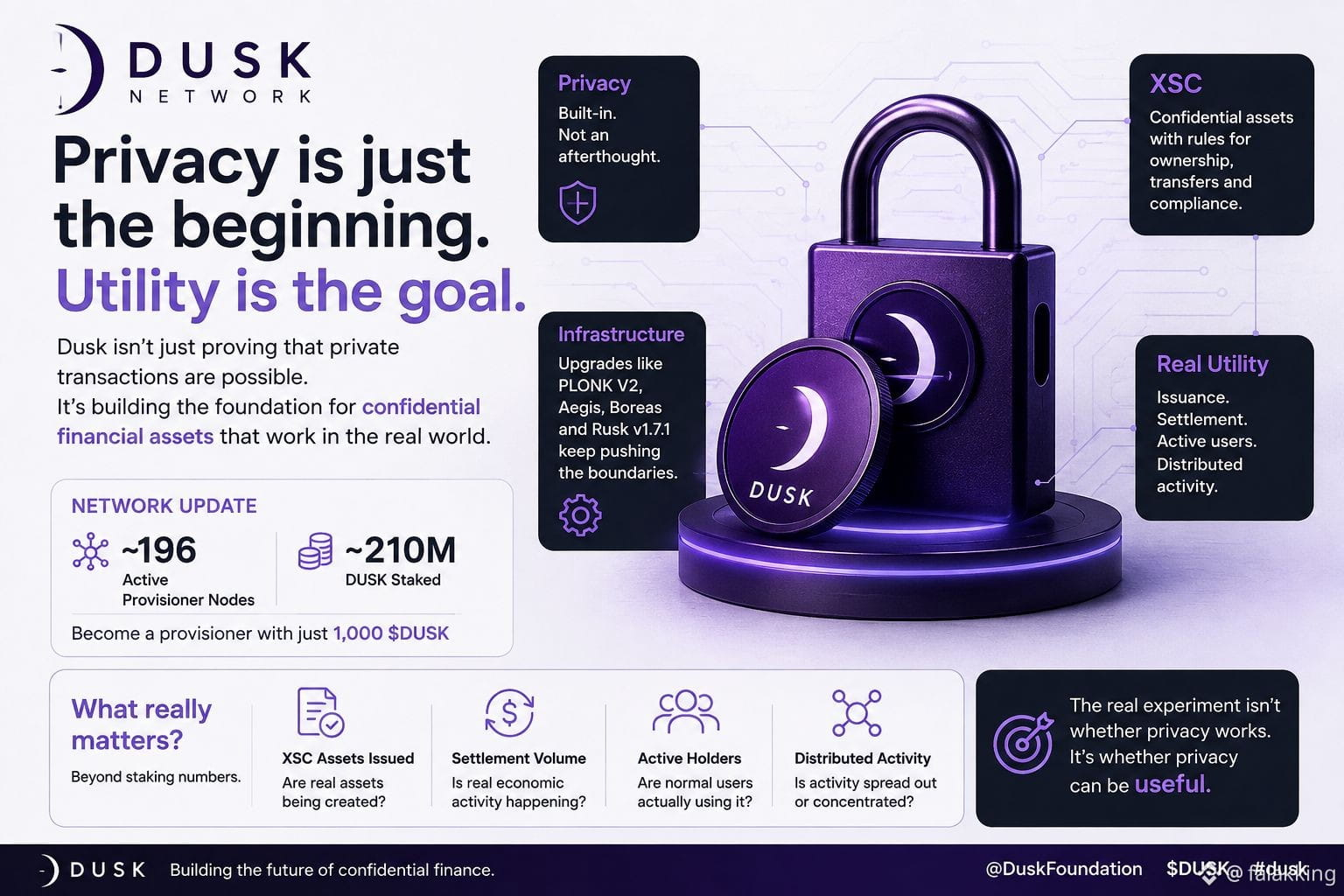
That’s why the recent network development caught my attention. Since mainnet launched, Dusk has continued pushing upgrades around its privacy and execution stack, including PLONK V2, Aegis, Boreas and the Rusk releases.
But infrastructure alone doesn’t prove the thesis.
What I’m more interested in now is XSC and whether confidential financial assets can operate with real rules around ownership, transfers and compliance without exposing everything publicly.
That’s a much harder problem than simply hiding a transaction.
So I’m less interested in staking numbers by themselves.
I’d rather see how many XSC assets are actually issued, how much real settlement happens, how many independent users hold them, and whether activity remains distributed or becomes concentrated among a small group.
If those numbers start moving, that would tell us far more about Dusk than another headline about privacy.
For me, that’s the experiment worth watching.
@Dusk #Foundation $DUSK #dusk
$DUSK #dusk
The real question is what you can actually build with it.
That’s why the recent network development caught my attention. Since mainnet launched, Dusk has continued pushing upgrades around its privacy and execution stack, including PLONK V2, Aegis, Boreas and the Rusk releases.
But infrastructure alone doesn’t prove the thesis.
What I’m more interested in now is XSC and whether confidential financial assets can operate with real rules around ownership, transfers and compliance without exposing everything publicly.
That’s a much harder problem than simply hiding a transaction.
So I’m less interested in staking numbers by themselves.
I’d rather see how many XSC assets are actually issued, how much real settlement happens, how many independent users hold them, and whether activity remains distributed or becomes concentrated among a small group.
If those numbers start moving, that would tell us far more about Dusk than another headline about privacy.
For me, that’s the experiment worth watching.
@Dusk #Foundation $DUSK #dusk
$DUSK #dusk
I’M ANALYSING TODAY’S LEADERS!
$ZRO
LayerZero, one of the older projects, hadn’t appeared on the charts for a long time, and its volume had dropped just as much. Since it’s re-entered the charts after such a long time, it might continue to gain momentum.
$UAI
I Frankly, this is one of those “pump-and-dump” coins, so my interest in it is quite low. I don’t plan on opening a trade.
$MORPHO
It ranks as the 40th-largest project by market cap, with a current market cap of nearly $2 billion. If it breaks above these levels, the rally could continue.
THESE ARE MY PERSONAL OPINIONS
$ZRO
LayerZero, one of the older projects, hadn’t appeared on the charts for a long time, and its volume had dropped just as much. Since it’s re-entered the charts after such a long time, it might continue to gain momentum.
$UAI
I Frankly, this is one of those “pump-and-dump” coins, so my interest in it is quite low. I don’t plan on opening a trade.
$MORPHO
It ranks as the 40th-largest project by market cap, with a current market cap of nearly $2 billion. If it breaks above these levels, the rally could continue.
THESE ARE MY PERSONAL OPINIONS
$TUT
is one of those tokens where the 24H chart tells only half the story.
Right now, TUT is around $0.063, with roughly $91M in spot volume and more than $834M in futures volume over the last 24 hours. That huge gap matters because it shows how much of the current activity is coming from leveraged markets rather than simple spot demand.
The interesting part is the contrast: TUT is down around 8% over 24H, but still up more than 80% over the past week.
For me, the next 24 hours are less about chasing the move and more about watching whether spot volume can support the momentum while futures open interest cools down.
TUT has attention. The real question is whether it can turn that attention into sustainable demand.
is one of those tokens where the 24H chart tells only half the story.
Right now, TUT is around $0.063, with roughly $91M in spot volume and more than $834M in futures volume over the last 24 hours. That huge gap matters because it shows how much of the current activity is coming from leveraged markets rather than simple spot demand.
The interesting part is the contrast: TUT is down around 8% over 24H, but still up more than 80% over the past week.
For me, the next 24 hours are less about chasing the move and more about watching whether spot volume can support the momentum while futures open interest cools down.
TUT has attention. The real question is whether it can turn that attention into sustainable demand.
I’m staying defensive here. $GRVT
is in a clear short-term bearish structure, trading near $0.2305 after a sharp drop. I’d only consider SHORT after rejection below $0.2347.
Entry: $0.2305–$0.2345
TP1: $0.2250
TP2: $0.2222
TP3: $0.2150
SL: $0.2400
Invalidation: reclaim above $0.2472
No clean rejection, no trade. Capital first. #GRVT #Futures #Trading $GRVT
is in a clear short-term bearish structure, trading near $0.2305 after a sharp drop. I’d only consider SHORT after rejection below $0.2347.
Entry: $0.2305–$0.2345
TP1: $0.2250
TP2: $0.2222
TP3: $0.2150
SL: $0.2400
Invalidation: reclaim above $0.2472
No clean rejection, no trade. Capital first. #GRVT #Futures #Trading $GRVT
This is why the zone mattered. $BMT
Short: TP2 hit. Position already paid. Congrats if you were in from the original call.
If you missed this one, do not chase the receipt. The move is done. The only mistake left is entering late.
Focus shifts to the next setup. Wait for the signal.
Short: TP2 hit. Position already paid. Congrats if you were in from the original call.
If you missed this one, do not chase the receipt. The move is done. The only mistake left is entering late.
Focus shifts to the next setup. Wait for the signal.
#dusk
$DUSK @Dusk Spent the @DuskFoundation Creatorpad task digging deeper into Hedger and the whole idea of “privacy without opacity.”
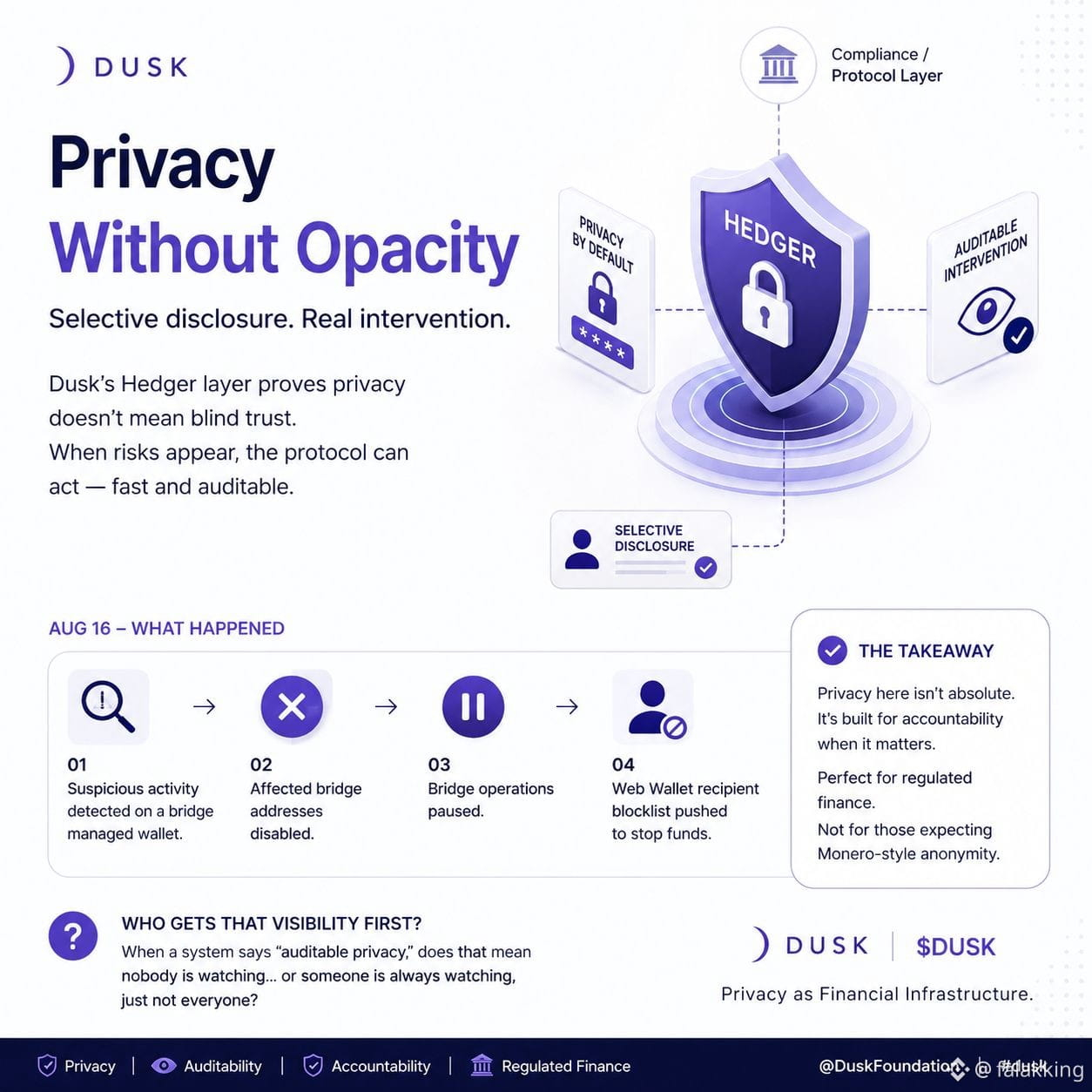
At first, I honestly thought it was just another ZK/privacy narrative. But then I looked at what happened on Aug 16, when suspicious activity was detected around a bridge-managed wallet.
The team disabled the affected bridge addresses, paused bridge operations, and pushed a Web Wallet recipient blocklist for flagged addresses.
That detail changed how I look at Dusk’s privacy model.
Because this clearly isn't absolute anonymity. It feels more like selective privacy, where confidentiality is preserved for normal activity, while the protocol or compliance layer can still intervene when something goes wrong.
And if Dusk is serious about regulated finance, that actually makes sense.
Financial institutions probably don't want everything exposed publicly, but they also can't operate in a system where intervention is impossible.
So the interesting part isn't simply “privacy.”
It's the balance between privacy, compliance, and accountability.
But one question keeps bothering me:
Who gets that visibility first?
And when a system calls itself “auditable privacy,” does that mean nobody is watching, or someone is always watching… just not everyone?
$DUSK #dusk @Dusk
$DUSK @Dusk Spent the @DuskFoundation Creatorpad task digging deeper into Hedger and the whole idea of “privacy without opacity.”
At first, I honestly thought it was just another ZK/privacy narrative. But then I looked at what happened on Aug 16, when suspicious activity was detected around a bridge-managed wallet.
The team disabled the affected bridge addresses, paused bridge operations, and pushed a Web Wallet recipient blocklist for flagged addresses.
That detail changed how I look at Dusk’s privacy model.
Because this clearly isn't absolute anonymity. It feels more like selective privacy, where confidentiality is preserved for normal activity, while the protocol or compliance layer can still intervene when something goes wrong.
And if Dusk is serious about regulated finance, that actually makes sense.
Financial institutions probably don't want everything exposed publicly, but they also can't operate in a system where intervention is impossible.
So the interesting part isn't simply “privacy.”
It's the balance between privacy, compliance, and accountability.
But one question keeps bothering me:
Who gets that visibility first?
And when a system calls itself “auditable privacy,” does that mean nobody is watching, or someone is always watching… just not everyone?
$DUSK #dusk @Dusk
High$POPCAT
— 24H Update 📊
Current price: around $0.043–$0.054 depending on exchange/data feed.
Bybit is showing roughly $0.0538, with a 24H high of $0.0607 and low of $0.0517.
24H volume: around $16M+, so short-term volatility remains high.
Key resistance: $0.060–$0.061
Support: $0.051–$0.052
If $0.061 breaks with strong volume, momentum could improve; losing $0.051 would make the setup weaker.
Short-term view: POPCAT is highly volatile, so confirmation above resistance is preferable rather than chasing a sudden move.
— 24H Update 📊
Current price: around $0.043–$0.054 depending on exchange/data feed.
Bybit is showing roughly $0.0538, with a 24H high of $0.0607 and low of $0.0517.
24H volume: around $16M+, so short-term volatility remains high.
Key resistance: $0.060–$0.061
Support: $0.051–$0.052
If $0.061 breaks with strong volume, momentum could improve; losing $0.051 would make the setup weaker.
Short-term view: POPCAT is highly volatile, so confirmation above resistance is preferable rather than chasing a sudden move.
$ETH
If you are talking about Akash Network ($AKT), then according to the latest 24H data the price is approximately $0.544. In 24 hours it moved around -6.7%, with the 24H high near $0.612 and the low near $0.539.
You can create a post on this.For Binance Square: 24H update + price + support/resistance + next target
If you are talking about Akash Network ($AKT), then according to the latest 24H data the price is approximately $0.544. In 24 hours it moved around -6.7%, with the 24H high near $0.612 and the low near $0.539.
You can create a post on this.For Binance Square: 24H update + price + support/resistance + next target
$BTC
24H UPDATE 🚨
Bitcoin is currently consolidating around the ~$77K–$78K zone. After strong buying in the past few sessions, the market is now looking a bit like it’s cooling off.
📌 BTC: ~$77.3K
📈 24H range: ~$76.5K – $78.8K
📊 7D performance: around +22%
⚡ Key zone: A sustained move above $78K can strengthen bullish momentum, while weakness could increase below $76.5K.
In the next 24 hours, I’ll closely watch the $78K breakout or the $76.5K support reaction. Volatility is high, so FOMO trades without confirmation can be risky.
#BTC #Bitcoin #Crypto #BTCUpdate
24H UPDATE 🚨
Bitcoin is currently consolidating around the ~$77K–$78K zone. After strong buying in the past few sessions, the market is now looking a bit like it’s cooling off.
📌 BTC: ~$77.3K
📈 24H range: ~$76.5K – $78.8K
📊 7D performance: around +22%
⚡ Key zone: A sustained move above $78K can strengthen bullish momentum, while weakness could increase below $76.5K.
In the next 24 hours, I’ll closely watch the $78K breakout or the $76.5K support reaction. Volatility is high, so FOMO trades without confirmation can be risky.
#BTC #Bitcoin #Crypto #BTCUpdate
📊 $SOL
L — 24H Market Update
After showing recent strength, Solana is now trading around the $93–$94 zone. In the last 24H, the price tested a range of roughly $91.28–$101.75, so volatility remains strong.
🔹 Support: $91–$93
🔹 Resistance: $100–$102
🔹 A breakout above $102 = further upside possible
🔹 Weakness below $91 = risk of a deeper pullback
For me, the key level right now is $100–$102. Without sustainable breakout confirmation above this zone, chasing it can be risky.
⚠️ Crypto is highly volatile. Make sure to use proper risk management before trading.
#SOL #Solana #Crypto #trading
L — 24H Market Update
After showing recent strength, Solana is now trading around the $93–$94 zone. In the last 24H, the price tested a range of roughly $91.28–$101.75, so volatility remains strong.
🔹 Support: $91–$93
🔹 Resistance: $100–$102
🔹 A breakout above $102 = further upside possible
🔹 Weakness below $91 = risk of a deeper pullback
For me, the key level right now is $100–$102. Without sustainable breakout confirmation above this zone, chasing it can be risky.
⚠️ Crypto is highly volatile. Make sure to use proper risk management before trading.
#SOL #Solana #Crypto #trading
📉 $PUMP
is showing an interesting setup after the recent move higher.
Price is around $0.00493, with RSI near 65 and strong volume. The key zone to watch is $0.00494–$0.00499. If this area gets rejected, downside targets could come into focus around $0.00449, $0.00418, and $0.00377.
Invalidation sits near $0.00524.
Not financial advice—manage risk and wait for confirmation before entering. 👀
#PUMP #Crypto #trading
is showing an interesting setup after the recent move higher.
Price is around $0.00493, with RSI near 65 and strong volume. The key zone to watch is $0.00494–$0.00499. If this area gets rejected, downside targets could come into focus around $0.00449, $0.00418, and $0.00377.
Invalidation sits near $0.00524.
Not financial advice—manage risk and wait for confirmation before entering. 👀
#PUMP #Crypto #trading
Yes, while keeping your original style intact—personal incident + Dusk governance insight + a natural analytical wrap-up—your post will flow better:
#dusk $DUSK @Dusk almost turned my entire portfolio into dust 😭
I was doing a Dusk trading task and accidentally opened a much larger position than I intended. Luckily, I noticed it in time and closed it before liquidation.
That experience actually made me think about something else: when a proposed change to @Dusk actually becomes part of the protocol, what is the exact process?
Apparently, writing a convincing DIP is only the beginning.
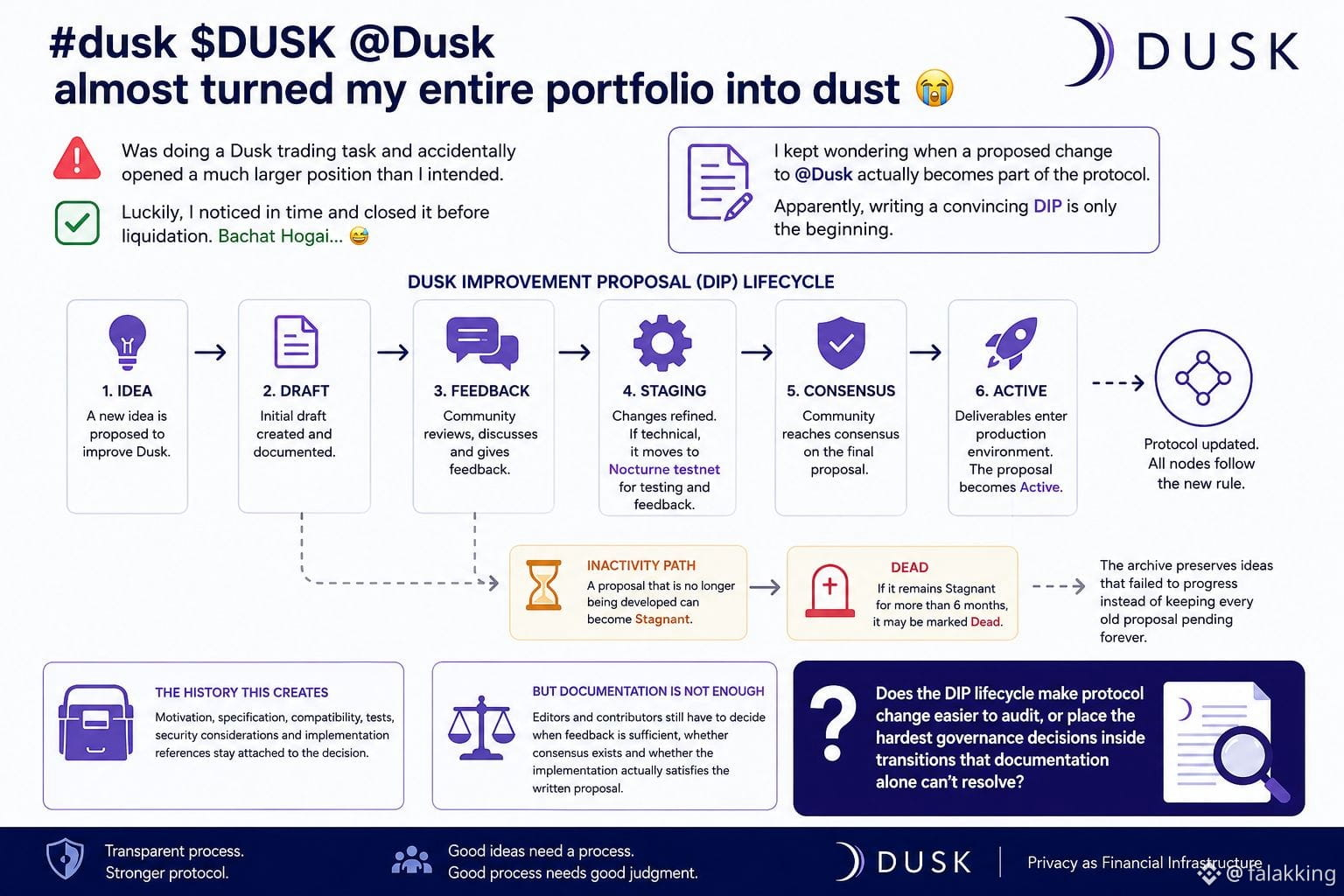
A Dusk Improvement Proposal moves through Idea, Draft and Feedback before reaching Staging. If it requires technical implementation, the staging phase puts it on the Nocturne testnet for another round of testing and feedback.
Only after consensus is reached and the deliverables enter the production environment does the proposal become Active.
That separation is important.
A merged document can preserve the specification, reasoning and discussion behind a change, but that doesn’t automatically mean every node is already following the new rule on mainnet.
Proposal maturity and production activation are two different things.
There is also an inactivity path. A proposal that is no longer being developed can become Stagnant, and if it stays there for more than six months, it can eventually be marked Dead.
I actually like the history this creates. Motivation, specifications, compatibility, testing, security considerations and implementation references remain connected to the decision instead of disappearing into scattered discussions.
But documentation alone doesn’t remove the hardest governance questions.
Someone still has to decide when feedback is sufficient, whether consensus really exists, and whether the final implementation actually matches what was proposed.
Does the DIP lifecycle make Dusk protocol changes easier to audit, or does it simply move the hardest governance decisions into transitions that documentation cannot
#dusk $DUSK @Dusk almost turned my entire portfolio into dust 😭
I was doing a Dusk trading task and accidentally opened a much larger position than I intended. Luckily, I noticed it in time and closed it before liquidation.
That experience actually made me think about something else: when a proposed change to @Dusk actually becomes part of the protocol, what is the exact process?
Apparently, writing a convincing DIP is only the beginning.
A Dusk Improvement Proposal moves through Idea, Draft and Feedback before reaching Staging. If it requires technical implementation, the staging phase puts it on the Nocturne testnet for another round of testing and feedback.
Only after consensus is reached and the deliverables enter the production environment does the proposal become Active.
That separation is important.
A merged document can preserve the specification, reasoning and discussion behind a change, but that doesn’t automatically mean every node is already following the new rule on mainnet.
Proposal maturity and production activation are two different things.
There is also an inactivity path. A proposal that is no longer being developed can become Stagnant, and if it stays there for more than six months, it can eventually be marked Dead.
I actually like the history this creates. Motivation, specifications, compatibility, testing, security considerations and implementation references remain connected to the decision instead of disappearing into scattered discussions.
But documentation alone doesn’t remove the hardest governance questions.
Someone still has to decide when feedback is sufficient, whether consensus really exists, and whether the final implementation actually matches what was proposed.
Does the DIP lifecycle make Dusk protocol changes easier to audit, or does it simply move the hardest governance decisions into transitions that documentation cannot
$BB
I’m that physics teacher of the 10u-30000u
BB🙏 Let me make some money for a pork knuckle rice meal
I’m that physics teacher of the 10u-30000u
BB🙏 Let me make some money for a pork knuckle rice meal
Warning ⚠️ Brothers !!!!
Binance Announced it's Delisting Several coins in few days. but as you know these will randomly pump & dump after it .
$ICX
X
$STORJ
$SCRT
Binance Announced it's Delisting Several coins in few days. but as you know these will randomly pump & dump after it .
$ICX
X
$STORJ
$SCRT
Binance Wallet announced on X that Binance Alpha's third wave of ChainOpera AI ($COAI
I) airdrop rewards is now available. Users with at least 242 Binance Alpha Points can claim 105 COAI tokens on a first-come, first-served basis. If the reward pool is not fully distributed, the score threshold will automatically decrease by 5 points every 5 minutes. Claiming the airdrop will consume 15 Binance Alpha Points. Users must confirm their claim on the Alpha Events page within 24 hours, or it will be treated as a forfeiture of the airdrop claim.
I) airdrop rewards is now available. Users with at least 242 Binance Alpha Points can claim 105 COAI tokens on a first-come, first-served basis. If the reward pool is not fully distributed, the score threshold will automatically decrease by 5 points every 5 minutes. Claiming the airdrop will consume 15 Binance Alpha Points. Users must confirm their claim on the Alpha Events page within 24 hours, or it will be treated as a forfeiture of the airdrop claim.
Yes, $BTC
hour update ka setup looks strongly bullish.
In the screenshot, BTC is at $76,335, with a 24h high of $76,916.95 and a low of $69,778.01.
The current price is well above the daily Bollinger Upper of $72,180—momentum is strong, but there’s also a risk of short-term overheating.
EMA 7 ≈ $69,496 and Supertrend ≈ $68,610, so the immediate trend is bullish.
In the recent move, BTC decisively reclaimed the $69K–$70K zone; the current rally is also supported by Treasury/liquidity developments and positive crypto-regulation sentiment.
Next 24 hours key levels
Resistance:
$76,900 → $78,000 → $80,000
Support:
$75,000 → $72,200 → $69,800
My scenario:
If BTC holds above $75K and breaks $76,900, then the next target could be $78K–$80K.
If $75K is lost, then a $72.2K retest is possible. If $72K also breaks, momentum will weaken considerably.
⚠️ Right now, the price is already elevated after a strong pump, so in the market it’s better to wait for pullback confirmation rather than chase entries. Volatility may stay high in the next 24h—recent data shows BTC made roughly 5%+ moves in a single session.
If you want, on the basis of **this same chart**, I’ll set up an exact LONG trade for BTC—with Entry, Stop Loss, TP1, TP2, and TP3
hour update ka setup looks strongly bullish.
In the screenshot, BTC is at $76,335, with a 24h high of $76,916.95 and a low of $69,778.01.
The current price is well above the daily Bollinger Upper of $72,180—momentum is strong, but there’s also a risk of short-term overheating.
EMA 7 ≈ $69,496 and Supertrend ≈ $68,610, so the immediate trend is bullish.
In the recent move, BTC decisively reclaimed the $69K–$70K zone; the current rally is also supported by Treasury/liquidity developments and positive crypto-regulation sentiment.
Next 24 hours key levels
Resistance:
$76,900 → $78,000 → $80,000
Support:
$75,000 → $72,200 → $69,800
My scenario:
If BTC holds above $75K and breaks $76,900, then the next target could be $78K–$80K.
If $75K is lost, then a $72.2K retest is possible. If $72K also breaks, momentum will weaken considerably.
⚠️ Right now, the price is already elevated after a strong pump, so in the market it’s better to wait for pullback confirmation rather than chase entries. Volatility may stay high in the next 24h—recent data shows BTC made roughly 5%+ moves in a single session.
If you want, on the basis of **this same chart**, I’ll set up an exact LONG trade for BTC—with Entry, Stop Loss, TP1, TP2, and TP3
Yes, based on this chart the BNB/USDT setup looks bullish, but the price has already extended quite a lot in the short term. Binance’s live page is showing $BNB
around $671.25, whereas in your screenshot it was $669.58, with a 24h high of $673.73 and a low of $630.35.
📈 BNB/USDT — 24H Trade Setup
Current: ~$671
24H High: $673.73
24H Low: $630.35
Bias: 🟢 Bullish
Preferred LONG entry: $655–$662 on a pullback
Stop Loss: $642
TP1: $674
TP2: $685
TP3: $700
Breakout setup: If BNB closes on 1D/4H above $674–$675 with strong volume, then a breakout long can be considered, with $665 invalidation.
On the chart, EMA(7) is ~633.7, EMA(25) is ~607.9, and Supertrend is ~616.1, meaning the trend structure is bullish. But the price is also above the Bollinger upper band (~649), so waiting for a pullback instead of entering out of FOMO at the current price offers comparatively better risk/reward.
BNB has shown strong momentum in recent sessions; daily gains were also recorded on Aug 19 and Aug 20.
24-hour view:
Bullish above $650 → $674 breakout → $685–700 possible.
If $650 is lost, momentum may cool down, and the $640–630 zone could be retested.
⚠️ Risk: keep leverage low and risk only a small portion of your per-trade capital. This is a technical setup, not a guaranteed signal.
around $671.25, whereas in your screenshot it was $669.58, with a 24h high of $673.73 and a low of $630.35.
📈 BNB/USDT — 24H Trade Setup
Current: ~$671
24H High: $673.73
24H Low: $630.35
Bias: 🟢 Bullish
Preferred LONG entry: $655–$662 on a pullback
Stop Loss: $642
TP1: $674
TP2: $685
TP3: $700
Breakout setup: If BNB closes on 1D/4H above $674–$675 with strong volume, then a breakout long can be considered, with $665 invalidation.
On the chart, EMA(7) is ~633.7, EMA(25) is ~607.9, and Supertrend is ~616.1, meaning the trend structure is bullish. But the price is also above the Bollinger upper band (~649), so waiting for a pullback instead of entering out of FOMO at the current price offers comparatively better risk/reward.
BNB has shown strong momentum in recent sessions; daily gains were also recorded on Aug 19 and Aug 20.
24-hour view:
Bullish above $650 → $674 breakout → $685–700 possible.
If $650 is lost, momentum may cool down, and the $640–630 zone could be retested.
⚠️ Risk: keep leverage low and risk only a small portion of your per-trade capital. This is a technical setup, not a guaranteed signal.
Log in to explore more content