
zshm
111 Posts

zshm
无
20 Following
36 Followers
213 Liked
Posts
All
Quotes
$VAULT Slow and steady accumulation—I believe the Robin Chain has just started, and memes have just started too
$VAULT pons生态系统ponsvault
$VAULT Next, what will happen in the pons vault?
$PONS Who Can Trigger It
This section is worth understanding because it explains why PonsVault will help you complete the launch, rather than giving you a vault after the fact.
Charging fees and collecting fees are two different permissions for the pons locker. Payments will follow fee redirection, but calls that remove fees from the locker can only be accepted from the token chain or the pons protocol fee recipient. Even if the funds do exist on the forwarding target, they are not authorized. deployer
So the vault can collect fees, but it can never settle on its own. PonsVault fills this gap through its own launcher contract, which makes Pons Vault the deployer. The launcher exposes an open scanning function, allowing the whole cycle to run without any privileged operator.
In practice, you do not need to press any buttons. PonsVault runs a bot that checks all active vaults every few minutes, and once the accumulated fees exceed the minimum fee and the value exceeds gas, it triggers a run. This is a convenience, not a dependency: it has no special permissions, and if it stops tomorrow, any holder can continue running the vault through the button on your token page.
Attach the vault to an existing token
This section is worth understanding because it explains why PonsVault will help you complete the launch, rather than giving you a vault after the fact.
Charging fees and collecting fees are two different permissions for the pons locker. Payments will follow fee redirection, but calls that remove fees from the locker can only be accepted from the token chain or the pons protocol fee recipient. Even if the funds do exist on the forwarding target, they are not authorized. deployer
So the vault can collect fees, but it can never settle on its own. PonsVault fills this gap through its own launcher contract, which makes Pons Vault the deployer. The launcher exposes an open scanning function, allowing the whole cycle to run without any privileged operator.
In practice, you do not need to press any buttons. PonsVault runs a bot that checks all active vaults every few minutes, and once the accumulated fees exceed the minimum fee and the value exceeds gas, it triggers a run. This is a convenience, not a dependency: it has no special permissions, and if it stops tomorrow, any holder can continue running the vault through the button on your token page.
Attach the vault to an existing token
$VAULT Who can trigger it
This section is worth understanding because it explains why PonsVault will help you with the launch, rather than giving you a vault afterward.
Collecting fees and collecting fees are two different permissions for the Pons locker. Payment will follow fee redirection, but the call that removes fees from the locker can only be accepted by the token on-chain or the Pons protocol fee recipient. Even if the funds do end up on the redirect target, it is not authorized. deployer
So the vault can collect fees, but it can never liquidate on its own. PonsVault fills this gap through its own launcher contract, making Pons Vault the deployer. The launcher exposes an open scanning function, which allows the entire cycle to run without any privileged operator.
In practice, you do not need to press any button. PonsVault runs a bot that checks all active vaults every few minutes, and when accumulated fees exceed the minimum fee and the value exceeds gas, it triggers a run. This is a convenience, not a dependency: it has no special permissions, and if it stops tomorrow, any holder can continue running the vault using the button on your token page.
This section is worth understanding because it explains why PonsVault will help you with the launch, rather than giving you a vault afterward.
Collecting fees and collecting fees are two different permissions for the Pons locker. Payment will follow fee redirection, but the call that removes fees from the locker can only be accepted by the token on-chain or the Pons protocol fee recipient. Even if the funds do end up on the redirect target, it is not authorized. deployer
So the vault can collect fees, but it can never liquidate on its own. PonsVault fills this gap through its own launcher contract, making Pons Vault the deployer. The launcher exposes an open scanning function, which allows the entire cycle to run without any privileged operator.
In practice, you do not need to press any button. PonsVault runs a bot that checks all active vaults every few minutes, and when accumulated fees exceed the minimum fee and the value exceeds gas, it triggers a run. This is a convenience, not a dependency: it has no special permissions, and if it stops tomorrow, any holder can continue running the vault using the button on your token page.
$PONS How the Treasury Makes Money
Every time a PON is launched, its liquidity position is held by the locker contract. The locker tracks each token address and, after deducting the PONS protocol share, pays the creator their share of the collected fees. feeRedirect
Adding a vault means setting the redirect to the vault’s address. From then on, the collected fees flow into the vault in WETH form — this is a regular ERC-20 transfer, not native ETH. When fees also accumulate on the token side of the pool, the vault receives a portion of those tokens as well.
Every template is the same. What happens next is the part you choose. Buyback and Burn are one of the two templates currently available, running this cycle:
Every time a PON is launched, its liquidity position is held by the locker contract. The locker tracks each token address and, after deducting the PONS protocol share, pays the creator their share of the collected fees. feeRedirect
Adding a vault means setting the redirect to the vault’s address. From then on, the collected fees flow into the vault in WETH form — this is a regular ERC-20 transfer, not native ETH. When fees also accumulate on the token side of the pool, the vault receives a portion of those tokens as well.
Every template is the same. What happens next is the part you choose. Buyback and Burn are one of the two templates currently available, running this cycle:
$VAULT
Every time a PON is launched, its liquidity position is held by the locker contract. The locker tracks each token address and, after deducting the pons protocol’s share, pays the creator their share of the collected fees.
Adding a vault means setting the redirect to the vault’s address. From that point on, collected fees go into the vault as WETH — a standard ERC-20 transfer, not native ETH. When fees also accumulate on the pool’s token side, the vault receives a share of those tokens as well.
Each template is the same. What happens next is the part you choose. Buyback and Burn is one of the two templates currently available, running this cycle:
Every time a PON is launched, its liquidity position is held by the locker contract. The locker tracks each token address and, after deducting the pons protocol’s share, pays the creator their share of the collected fees.
Adding a vault means setting the redirect to the vault’s address. From that point on, collected fees go into the vault as WETH — a standard ERC-20 transfer, not native ETH. When fees also accumulate on the pool’s token side, the vault receives a share of those tokens as well.
Each template is the same. What happens next is the part you choose. Buyback and Burn is one of the two templates currently available, running this cycle:
$PONS What problem does ponsvault solve
When the pons token launches, the trading fees earned by its liquidity position go to the creator. This is good for the creator, and at best neutral for everyone else: once the token is claimed, its value disappears from that moment on.
The vault changes the destination. The fees are not paid to a wallet, but to a contract—the one you chose when you first started. This could be buying back tokens and then burning them, funding a bonus pool, or paying stakers who lock their tokens. As a result, the way the game is launched is that the rules are enforced by code rather than by the founder's word.
When the pons token launches, the trading fees earned by its liquidity position go to the creator. This is good for the creator, and at best neutral for everyone else: once the token is claimed, its value disappears from that moment on.
The vault changes the destination. The fees are not paid to a wallet, but to a contract—the one you chose when you first started. This could be buying back tokens and then burning them, funding a bonus pool, or paying stakers who lock their tokens. As a result, the way the game is launched is that the rules are enforced by code rather than by the founder's word.
$VAULT What problem does this solve
When the pons token launches, the trading fees earned by its liquidity position go to the creator. That is good for the creator and, at best, neutral for everyone else: once the token is claimed, its value disappears from that moment on.
The vault changes the destination. Fees are not paid to a wallet, but to a contract—the one you chose for the job when you started. This could be buying back tokens and then burning them, funding a prize pool, or paying stakers who have locked tokens. As a result, the way the game is launched is that the rules are enforced by code rather than by the founder's word.
When the pons token launches, the trading fees earned by its liquidity position go to the creator. That is good for the creator and, at best, neutral for everyone else: once the token is claimed, its value disappears from that moment on.
The vault changes the destination. Fees are not paid to a wallet, but to a contract—the one you chose for the job when you started. This could be buying back tokens and then burning them, funding a prize pool, or paying stakers who have locked tokens. As a result, the way the game is launched is that the rules are enforced by code rather than by the founder's word.
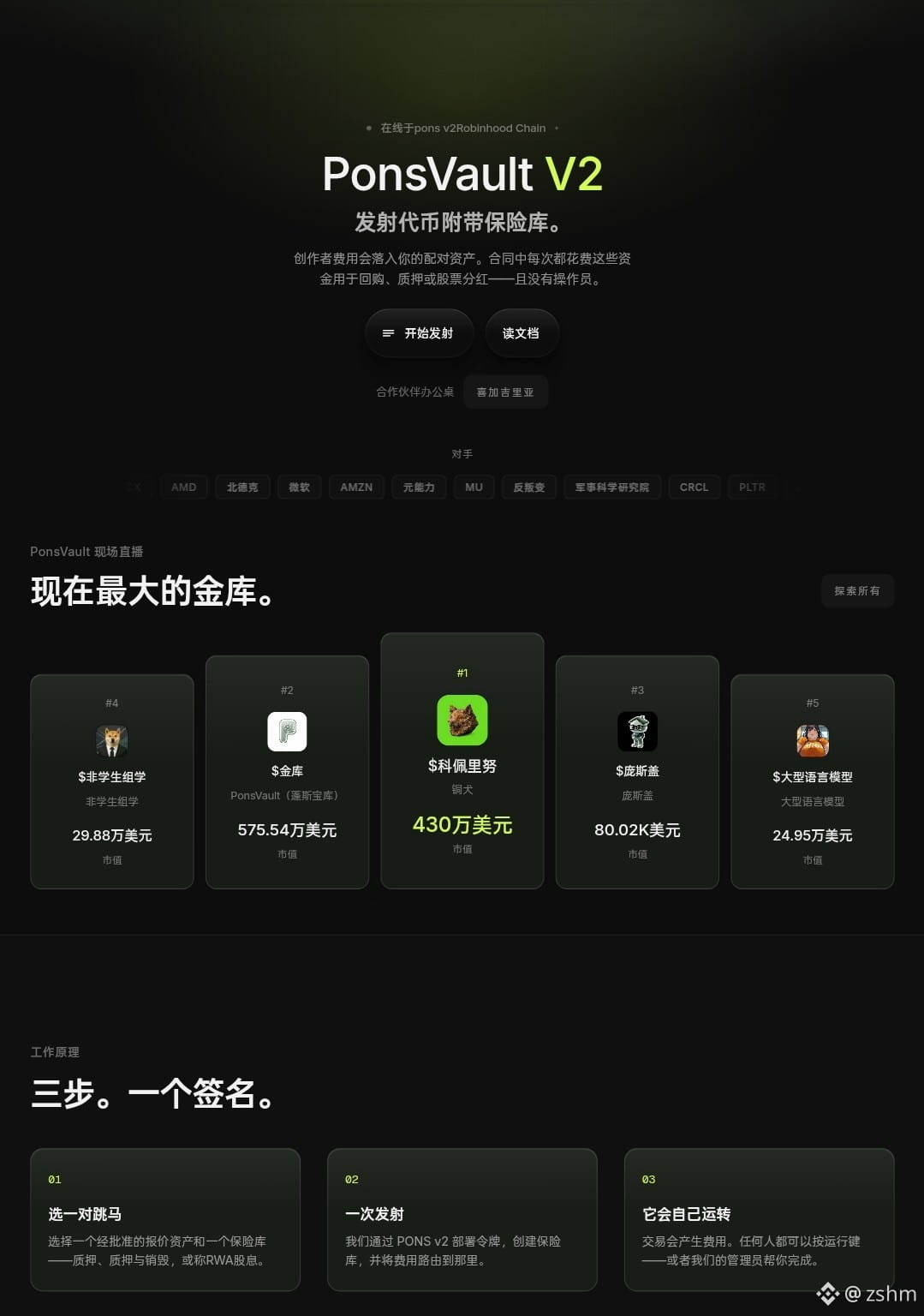
$PONS https://www.ponsvault.com/
Join the PONS ecosystem and usher in a new era of token issuance
Join the PONS ecosystem and usher in a new era of token issuance
$VAULT https://www.ponsvault.com/
Join the Pons ecosystem
Join the Pons ecosystem
$VAULT Several upcoming updates to be released$VAULT :
We will announce a new fee structure for $VAULT buybacks.
Multiple pairings are live, pairing
$SPCX
with
$TSLA
, with up to 3 stocks supported per pair.
The lottery vault also supports RWA payouts and can be used in combination with multiple stocks.
More content will be released soon.
We will announce a new fee structure for $VAULT buybacks.
Multiple pairings are live, pairing
$SPCX
with
$TSLA
, with up to 3 stocks supported per pair.
The lottery vault also supports RWA payouts and can be used in combination with multiple stocks.
More content will be released soon.
$VAULT Pons Vault new content: Lottery is live.
Creator fees will accumulate into an ETH prize pool. Token holders use that token to buy lottery tickets; all tickets are burned, and one ticket wins the entire pool.
The creator sets the ticket price, number of rounds, and minimum prize pool size at launch.
More lotteries = better odds.
More tickets = burn more material.
The above content is all from Twitter
Creator fees will accumulate into an ETH prize pool. Token holders use that token to buy lottery tickets; all tickets are burned, and one ticket wins the entire pool.
The creator sets the ticket price, number of rounds, and minimum prize pool size at launch.
More lotteries = better odds.
More tickets = burn more material.
The above content is all from Twitter
$PONS is more optimistic about Robinhood Chain's follow-through afterward. I think everyone should pay more attention to the big juicy piece of the launchpad business. There are tens of thousands of tokens every day. Get in early on the launchpad.
$ZZZ
Log in to explore more content