
SAIIFY
2.5k Posts

SAIIFY
Nothing To Show
Frequent Trader
1.4 Years
737 Following
23.2K+ Followers
5.0K+ Liked
Posts
All
Quotes
Live
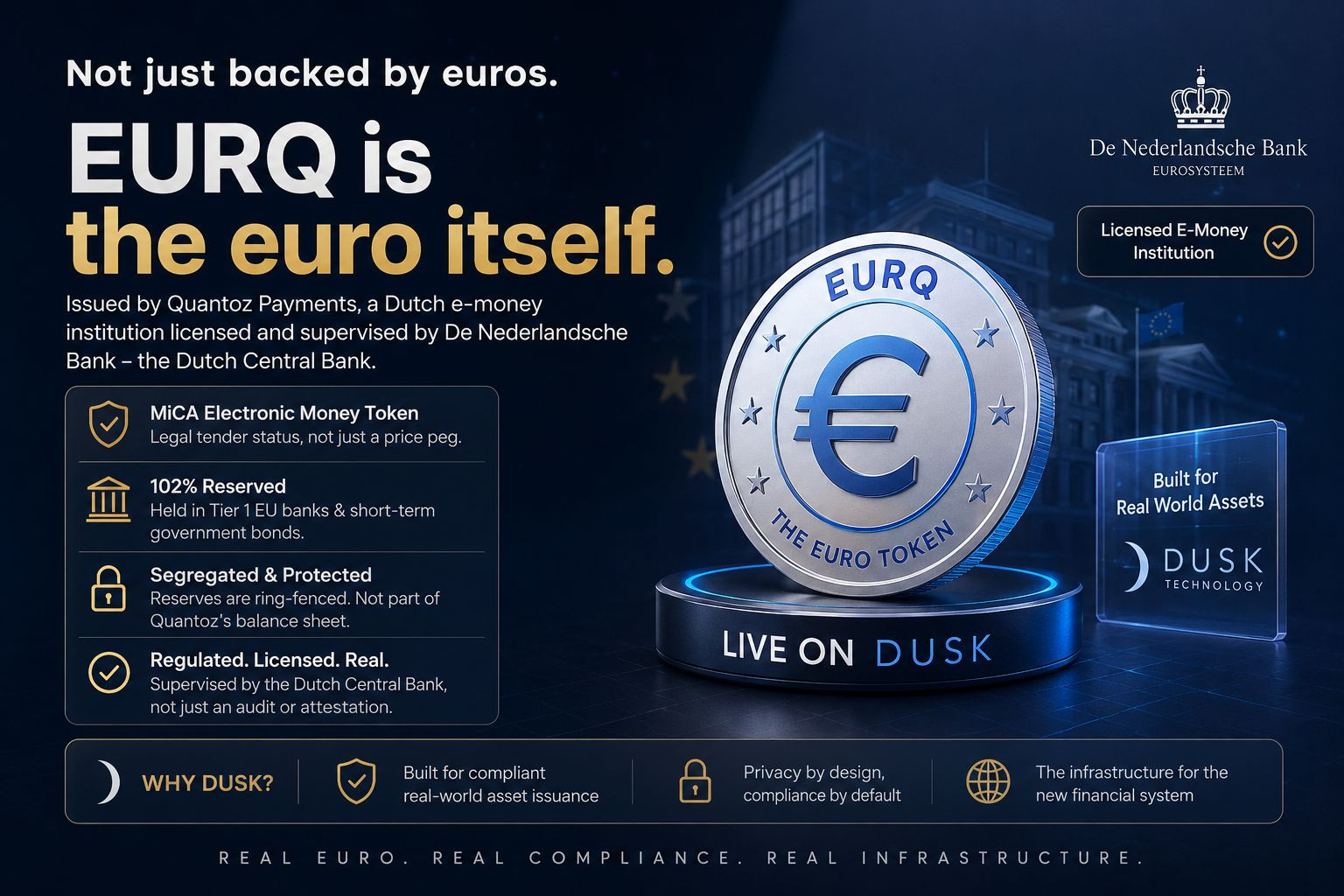
Most stablecoins are a companys promise. EURQ is legally the euro itself. Thats a bigger difference than it sounds.
I have read a lot of stablecoin pitches. Almost all of them use the same language, backed 1:1, fully reserved, audited regularly. EURQ, the euro token now live on @Dusk , makes a different and much stronger claim, and I wanted to check whether it actually holds up.
EURQ is issued by Quantoz Payments, a Dutch electronic money institution licensed and supervised directly by De Nederlandsche Bank, the actual Dutch central bank. Thats not a self-attested audit or a third party attestation firm signing off after the fact. Thats a banking regulator granting an E-Money license the same category used for real digital cash, not a crypto side project wearing compliance language.
Heres the part that actually separates it from something like USDT or even USDC. Under MiCA, EURQ is classified as an Electronic Money Token, legal tender status, not just a price-pegged crypto asset. Reserves sit in Tier 1 European banks and short term government bonds, segregated from Quantozs own balance sheet, held at 102 percent to cover redemption even under stress. If Quantoz ran into trouble tomorrow, those reserves are not Quantozs money to touch.
Now the #dusk specific part. Dusk is not just one more chain EURQ happens to support. Out of the handful of blockchains carrying it, $DUSK is the one actually built for native real world asset issuance with compliance baked into the protocol itself, not bolted on after. Thats why NPEX picked it too, a real Euro token is the missing piece for an actual on-chain stock exchange to settle trades in something regulators recognize as genuine currency, not a synthetic stand-in for one.
I still think people should read the fine print on any stablecoin before trusting it. But EURQs fine print is a banking license, not a whitepaper. Thats a meaningfully different foundation than most of what circulates in this space.
I have read a lot of stablecoin pitches. Almost all of them use the same language, backed 1:1, fully reserved, audited regularly. EURQ, the euro token now live on @Dusk , makes a different and much stronger claim, and I wanted to check whether it actually holds up.
EURQ is issued by Quantoz Payments, a Dutch electronic money institution licensed and supervised directly by De Nederlandsche Bank, the actual Dutch central bank. Thats not a self-attested audit or a third party attestation firm signing off after the fact. Thats a banking regulator granting an E-Money license the same category used for real digital cash, not a crypto side project wearing compliance language.
Heres the part that actually separates it from something like USDT or even USDC. Under MiCA, EURQ is classified as an Electronic Money Token, legal tender status, not just a price-pegged crypto asset. Reserves sit in Tier 1 European banks and short term government bonds, segregated from Quantozs own balance sheet, held at 102 percent to cover redemption even under stress. If Quantoz ran into trouble tomorrow, those reserves are not Quantozs money to touch.
Now the #dusk specific part. Dusk is not just one more chain EURQ happens to support. Out of the handful of blockchains carrying it, $DUSK is the one actually built for native real world asset issuance with compliance baked into the protocol itself, not bolted on after. Thats why NPEX picked it too, a real Euro token is the missing piece for an actual on-chain stock exchange to settle trades in something regulators recognize as genuine currency, not a synthetic stand-in for one.
I still think people should read the fine print on any stablecoin before trusting it. But EURQs fine print is a banking license, not a whitepaper. Thats a meaningfully different foundation than most of what circulates in this space.
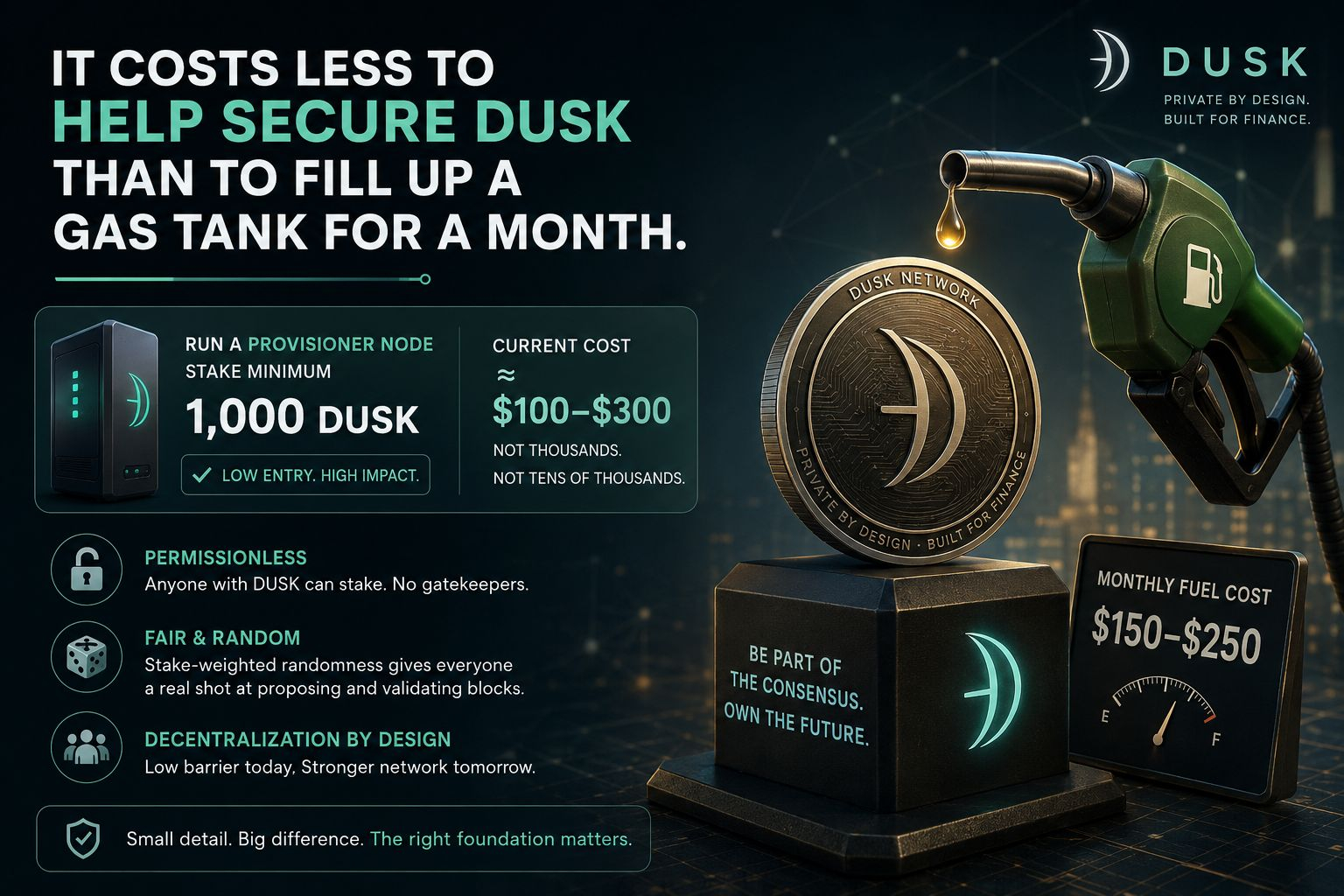
It costs less to help secure @Dusk than it costs to fill up a gas tank for a month. That number stopped me.
I have been picking apart a lot of the rough edges in these threads, so let me flip it for a second and talk about something #dusk actually got right, because I think it gets buried under everything else.
To run a validator node on Dusk, a Provisioner, the minimum stake is 1,000 $DUSK . At current prices thats somewhere in the low hundreds of dollars, not thousands, not tens of thousands. Compare that to what it takes to run an actual validator on a lot of major proof of stake chains, where the entry ticket runs well into 5 or 6 figures once you account for the minimum stake requirement. Dusk deliberately kept that door low.
And its not just cheap, its genuinely permissionless. Anyone holding DUSK can stake and become part of the consensus set, no application, no approval, no gatekeeper deciding whos allowed to help secure the network. Selection happens through stake weighted randomness, so smaller stakers still get real, recurring chances to propose and validate blocks, not just watch from the sidelines while a handful of whales run everything.
I want to be careful not to oversell this. Low cost of entry does not automatically mean the validator set stays spread out over time, concentration can still creep in as bigger holders accumulate more influence, that risk exists on every proof of stake chain regardless of the starting minimum. But a low floor is still the right foundation to build decentralization on top of. You cant get broad participation if the entry price locks most people out before they even try, and Dusk clearly chose not to do that.
Small detail, easy to scroll past. Probably should not be.
I have been picking apart a lot of the rough edges in these threads, so let me flip it for a second and talk about something #dusk actually got right, because I think it gets buried under everything else.
To run a validator node on Dusk, a Provisioner, the minimum stake is 1,000 $DUSK . At current prices thats somewhere in the low hundreds of dollars, not thousands, not tens of thousands. Compare that to what it takes to run an actual validator on a lot of major proof of stake chains, where the entry ticket runs well into 5 or 6 figures once you account for the minimum stake requirement. Dusk deliberately kept that door low.
And its not just cheap, its genuinely permissionless. Anyone holding DUSK can stake and become part of the consensus set, no application, no approval, no gatekeeper deciding whos allowed to help secure the network. Selection happens through stake weighted randomness, so smaller stakers still get real, recurring chances to propose and validate blocks, not just watch from the sidelines while a handful of whales run everything.
I want to be careful not to oversell this. Low cost of entry does not automatically mean the validator set stays spread out over time, concentration can still creep in as bigger holders accumulate more influence, that risk exists on every proof of stake chain regardless of the starting minimum. But a low floor is still the right foundation to build decentralization on top of. You cant get broad participation if the entry price locks most people out before they even try, and Dusk clearly chose not to do that.
Small detail, easy to scroll past. Probably should not be.
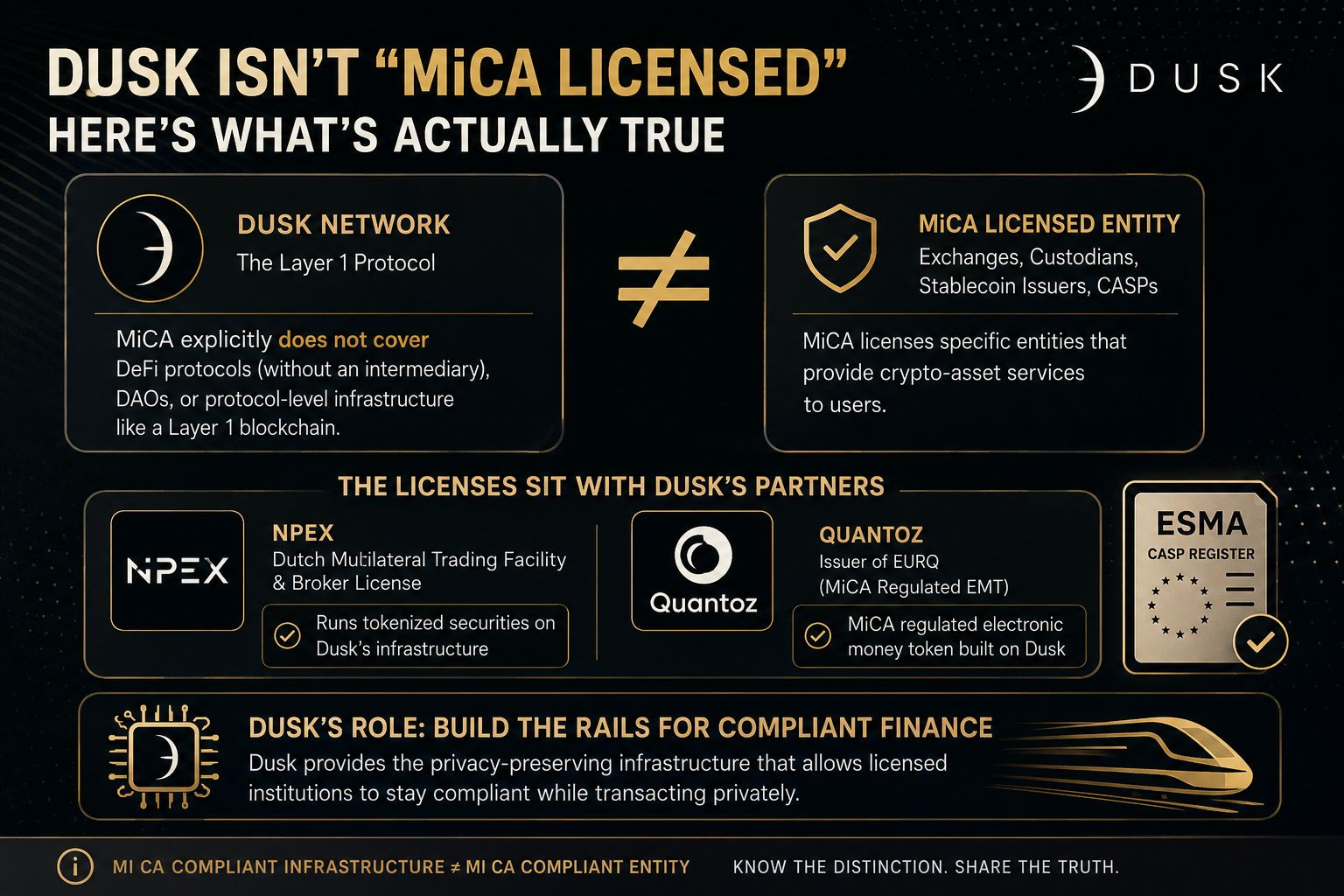
"MiCA Compliant" gets said about @Dusk constantly. Dusk itself does not actually hold a MiCA license. I had to read that twice.
I went looking for confirmation that #dusk itself is MiCA authorized, expecting a straightforward yes. What I found was more nuanced, and honestly more interesting than a simple yes would have been.
MiCA, the EUs crypto regulation framework, licenses specific things. Exchanges, custodians, stablecoin issuers, entities that are Crypto-Asset Service Providers. By Dusks own words in their own writeup, MiCA explicitly does not cover DeFi protocols without an intermediary, DAOs, or plain protocol-level infrastructure like a Layer 1 blockchain itself. So Dusk the network is not the thing getting licensed. Its the rails underneath licensed entities.
The actual licenses sit with Dusks partners. NPEX holds a Dutch Multilateral Trading Facility and broker license and runs its tokenized securities on $DUSK infrastructure. Quantoz issues EURQ, a MiCA regulated electronic money token, also built on Dusk. Both of those are real, verifiable, sitting in the ESMA CASP register. Dusk built the technology that lets licensed institutions stay compliant while transacting privately. Thats genuinely valuable. Its just a different claim than "Dusk is MiCA Compliant" as a blanket statement.
I dont think this is Dusk being dishonest, their own blog post actually spells out the distinction pretty clearly if you read past the headline. I think its more that "MiCA Compliant Infrastructure" gets shortened to "MiCA Compliant" in casual conversation and social posts, and that shortening quietly changes what's being claimed. One version says we enable compliance. The other implies we are compliant. Those are not the same sentence.
Worth knowing which one is actually true before repeating it as a selling point.
I went looking for confirmation that #dusk itself is MiCA authorized, expecting a straightforward yes. What I found was more nuanced, and honestly more interesting than a simple yes would have been.
MiCA, the EUs crypto regulation framework, licenses specific things. Exchanges, custodians, stablecoin issuers, entities that are Crypto-Asset Service Providers. By Dusks own words in their own writeup, MiCA explicitly does not cover DeFi protocols without an intermediary, DAOs, or plain protocol-level infrastructure like a Layer 1 blockchain itself. So Dusk the network is not the thing getting licensed. Its the rails underneath licensed entities.
The actual licenses sit with Dusks partners. NPEX holds a Dutch Multilateral Trading Facility and broker license and runs its tokenized securities on $DUSK infrastructure. Quantoz issues EURQ, a MiCA regulated electronic money token, also built on Dusk. Both of those are real, verifiable, sitting in the ESMA CASP register. Dusk built the technology that lets licensed institutions stay compliant while transacting privately. Thats genuinely valuable. Its just a different claim than "Dusk is MiCA Compliant" as a blanket statement.
I dont think this is Dusk being dishonest, their own blog post actually spells out the distinction pretty clearly if you read past the headline. I think its more that "MiCA Compliant Infrastructure" gets shortened to "MiCA Compliant" in casual conversation and social posts, and that shortening quietly changes what's being claimed. One version says we enable compliance. The other implies we are compliant. Those are not the same sentence.
Worth knowing which one is actually true before repeating it as a selling point.
🚀 Crypto Market Blast: Bitcoin Just Shook the Market! 🚀
Bitcoin is on an incredible run this week. It closed with a 22% weekly gain, ending near $77,000, up from about $62,800 at the start of the week. That's its strongest weekly run since 2024, and Bitcoin even broke past the $78,000 level!
What's driving the rally?
📈 Treasury Secretary Bessent's bond market intervention pushed yields down
📈 Trump has been pushing Congress to pass the Clarity Act, which would bring clarity to crypto regulation
📈 This triggered a massive short squeeze, with roughly $2.7 billion in crypto short positions liquidated
It's not just Bitcoin. Ethereum jumped 8.12% to $2,515, and XRP surged 14.61% to $1.4538, showing the rally is broad rather than a single-token move. Bitcoin Cash gained 31% in 24 hours, and Ethena rose 27%. Altcoins are joining the party too! 🎉
⚠️ Reminder: crypto is highly volatile. Do your own research and only invest what you can afford to lose.
#Bitcoin #CryptoMarket #BTC #CryptoNews #Ethereum
Bitcoin is on an incredible run this week. It closed with a 22% weekly gain, ending near $77,000, up from about $62,800 at the start of the week. That's its strongest weekly run since 2024, and Bitcoin even broke past the $78,000 level!
What's driving the rally?
📈 Treasury Secretary Bessent's bond market intervention pushed yields down
📈 Trump has been pushing Congress to pass the Clarity Act, which would bring clarity to crypto regulation
📈 This triggered a massive short squeeze, with roughly $2.7 billion in crypto short positions liquidated
It's not just Bitcoin. Ethereum jumped 8.12% to $2,515, and XRP surged 14.61% to $1.4538, showing the rally is broad rather than a single-token move. Bitcoin Cash gained 31% in 24 hours, and Ethena rose 27%. Altcoins are joining the party too! 🎉
⚠️ Reminder: crypto is highly volatile. Do your own research and only invest what you can afford to lose.
#Bitcoin #CryptoMarket #BTC #CryptoNews #Ethereum
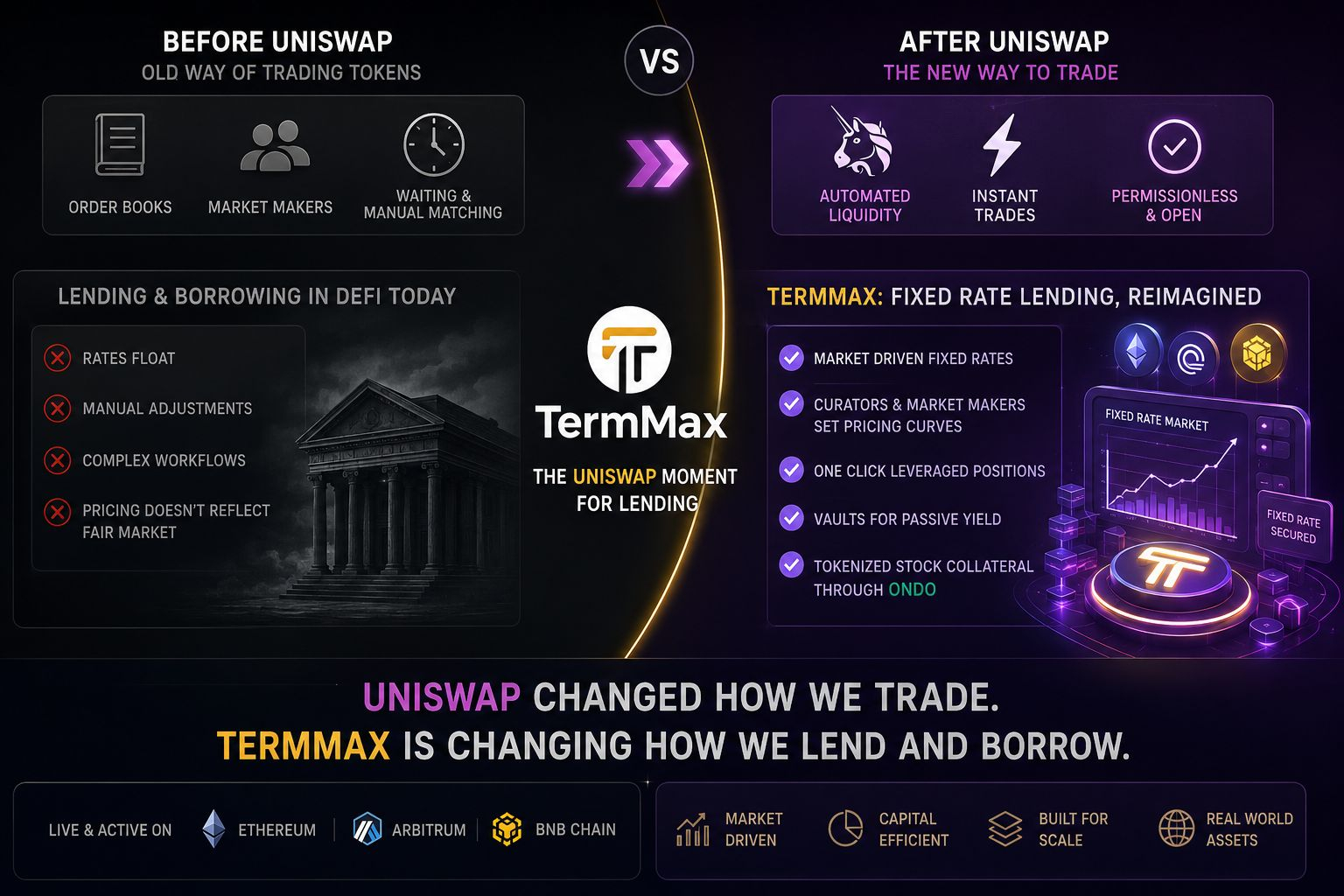
Uniswap changed how people trade tokens. @TermMax is trying to do the same thing for how people borrow and lend.
Before Uniswap, trading meant order books, market makers, and waiting for someone to match your price. Uniswap made it instant and automated. Lending and borrowing in DeFi still feels a lot like the old system. Rates float, positions need constant attention, and pricing rarely reflects what's actually fair for both sides.
#TermMax brings that same automated, market driven approach to fixed rate lending. Borrowers and lenders settle on rates through actual market mechanics, not a single algorithm trying to guess the right number for everyone. Curators and market makers set their own pricing curves through range orders, so the market adjusts itself instead of you adjusting to it.
A few reasons this is worth a closer look.
Live and active on Ethereum, Arbitrum, and BNB Chain, not just an announcement.
One click leveraged positions, so you are not stitching together five transactions across different platforms.
Vaults for people who want yield without actively managing a strategy every day.
A tokenized stock collateral market through Ondo, opening fixed rate borrowing to real world assets.
The comparison is not about hype. Its about the shift from manual, unpredictable systems to ones that just work the way markets are supposed to. Thats usually where the real growth happens.
Which part of DeFi do you think still needs its "Uniswap Moment"?
Before Uniswap, trading meant order books, market makers, and waiting for someone to match your price. Uniswap made it instant and automated. Lending and borrowing in DeFi still feels a lot like the old system. Rates float, positions need constant attention, and pricing rarely reflects what's actually fair for both sides.
#TermMax brings that same automated, market driven approach to fixed rate lending. Borrowers and lenders settle on rates through actual market mechanics, not a single algorithm trying to guess the right number for everyone. Curators and market makers set their own pricing curves through range orders, so the market adjusts itself instead of you adjusting to it.
A few reasons this is worth a closer look.
Live and active on Ethereum, Arbitrum, and BNB Chain, not just an announcement.
One click leveraged positions, so you are not stitching together five transactions across different platforms.
Vaults for people who want yield without actively managing a strategy every day.
A tokenized stock collateral market through Ondo, opening fixed rate borrowing to real world assets.
The comparison is not about hype. Its about the shift from manual, unpredictable systems to ones that just work the way markets are supposed to. Thats usually where the real growth happens.
Which part of DeFi do you think still needs its "Uniswap Moment"?
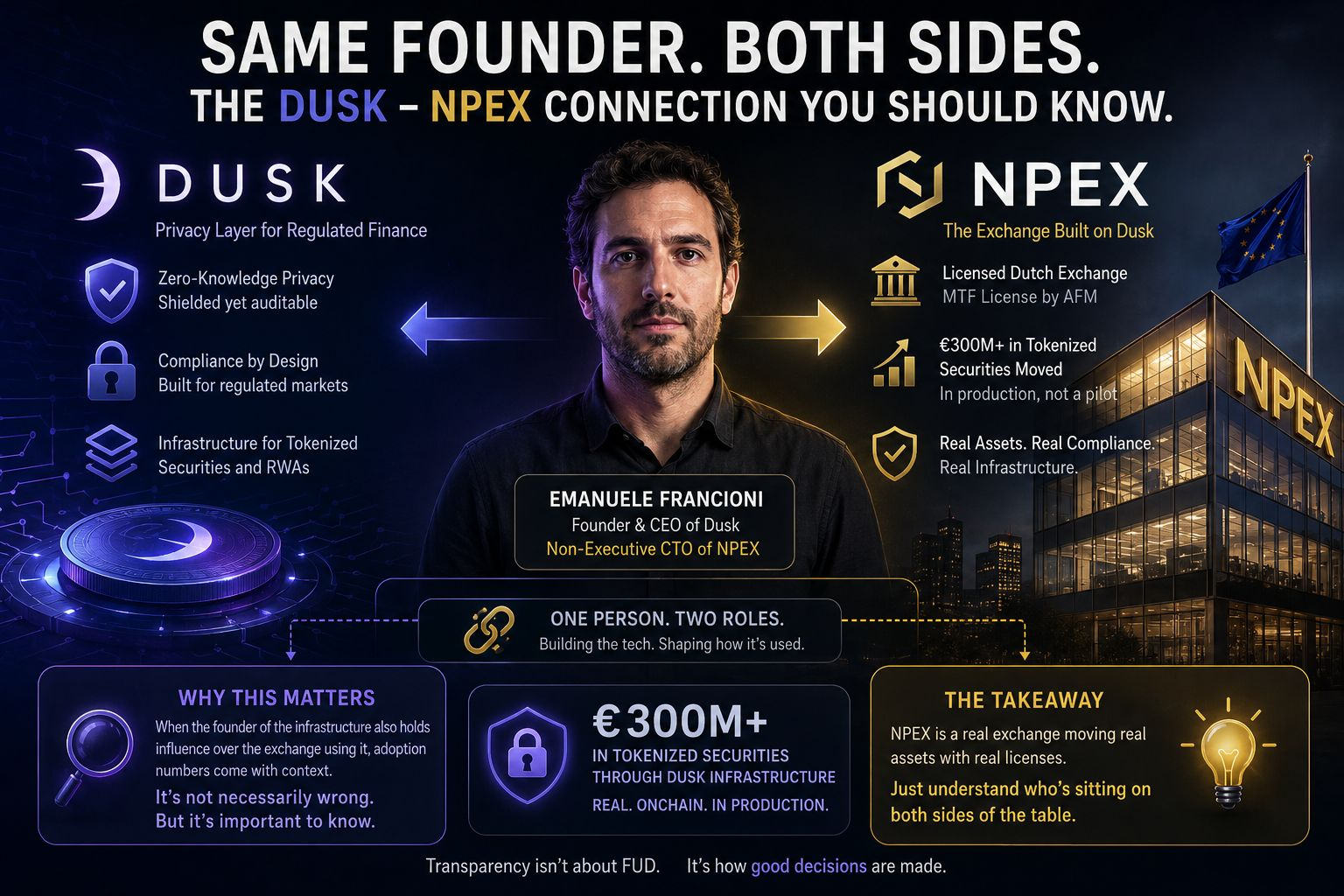
Dusks founder is also the CTO of the exchange that runs on Dusks own technology. Nobody flagged this to me until I checked myself.
I was reading through #dusk partnership news and noticed a line that made me stop. Emanuele Francioni, founder and CEO of @Dusk , was appointed as Non-Executive CTO of NPEX, the licensed Dutch exchange that's tokenizing hundreds of millions in securities using Dusks infrastructure. Same person, sitting on both sides of whats supposed to be a partnership between two separate entities.
I want to be fair about this before jumping to conclusions. Non-Executive roles are common in this industry, Advisors sit on boards all the time, and having the actual architect of the underlying tech helping the exchange implement it correctly is not inherently sketchy. If anything, you could argue its the opposite, who better understands how to securely deploy $DUSK privacy and compliance layer than the person who built it.
But step back for a second. NPEX using Dusk is not just two companies doing business together anymore. Its a licensed exchange whose technical direction is partly steered by the same person whose company benefits directly from that Exchanges continued use of Dusk. Every reference to NPEX as proof of institutional adoption, the 300 million plus in tokenized assets, all of it carries this detail sitting quietly underneath, not hidden exactly, just rarely mentioned next to the headline number.
I dont think this makes the NPEX partnership fake or the numbers inflated. Real securities are genuinely moving through real infrastructure. I just think when a founder holds influence on both sides of a flagship adoption story, thats worth knowing before you treat it as fully independent validation, not after.
I was reading through #dusk partnership news and noticed a line that made me stop. Emanuele Francioni, founder and CEO of @Dusk , was appointed as Non-Executive CTO of NPEX, the licensed Dutch exchange that's tokenizing hundreds of millions in securities using Dusks infrastructure. Same person, sitting on both sides of whats supposed to be a partnership between two separate entities.
I want to be fair about this before jumping to conclusions. Non-Executive roles are common in this industry, Advisors sit on boards all the time, and having the actual architect of the underlying tech helping the exchange implement it correctly is not inherently sketchy. If anything, you could argue its the opposite, who better understands how to securely deploy $DUSK privacy and compliance layer than the person who built it.
But step back for a second. NPEX using Dusk is not just two companies doing business together anymore. Its a licensed exchange whose technical direction is partly steered by the same person whose company benefits directly from that Exchanges continued use of Dusk. Every reference to NPEX as proof of institutional adoption, the 300 million plus in tokenized assets, all of it carries this detail sitting quietly underneath, not hidden exactly, just rarely mentioned next to the headline number.
I dont think this makes the NPEX partnership fake or the numbers inflated. Real securities are genuinely moving through real infrastructure. I just think when a founder holds influence on both sides of a flagship adoption story, thats worth knowing before you treat it as fully independent validation, not after.
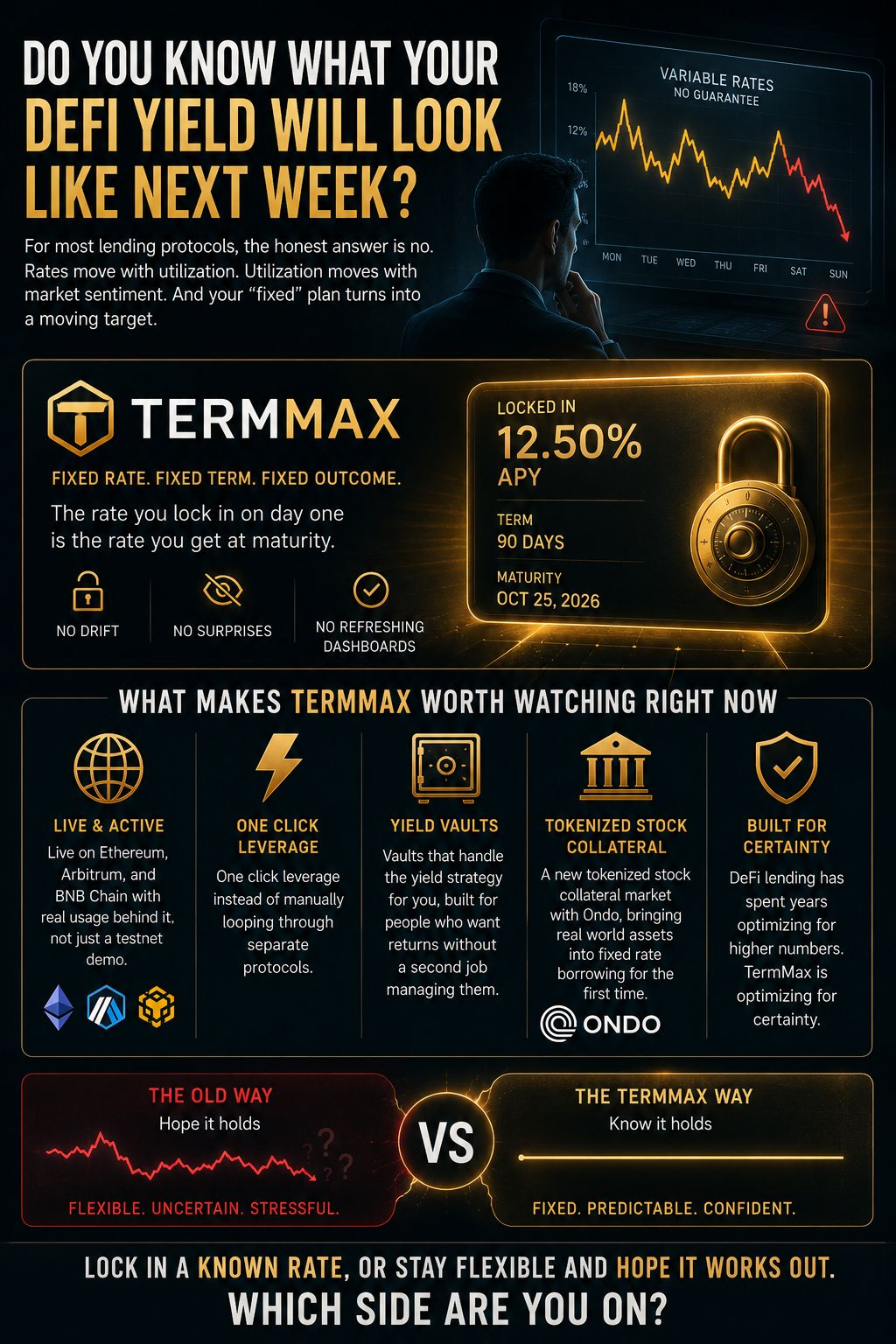
Quick question. Do you actually know what your DeFi yield will look like next week?
For most lending protocols, the honest answer is no. Rates move with utilization, utilization moves with market sentiment, and your "Fixed" plan turns into a moving target.
@TermMax skips that problem entirely. Its a Fixed Rate, Fixed Term Protocol, so the rate you lock in on day one is the rate you get at maturity. No drift, no surprises, no refreshing your dashboard to see what changed overnight.
What makes it worth watching right now.
Live on Ethereum, Arbitrum, and BNB Chain with real usage behind it, not just a testnet demo.
One click leverage instead of manually looping through separate protocols.
Vaults that handle the yield strategy for you, built for people who want returns without a second job managing them.
A new tokenized stock collateral market with Ondo, which brings real world assets into fixed rate borrowing for the first time.
DeFi lending has spent years optimizing for higher numbers. #TermMax is optimizing for certainty instead, and that might matter more once serious capital starts looking for a reason to come on chain.
Locking in a known rate, or staying flexible and hoping it works out. Which side are you on?
For most lending protocols, the honest answer is no. Rates move with utilization, utilization moves with market sentiment, and your "Fixed" plan turns into a moving target.
@TermMax skips that problem entirely. Its a Fixed Rate, Fixed Term Protocol, so the rate you lock in on day one is the rate you get at maturity. No drift, no surprises, no refreshing your dashboard to see what changed overnight.
What makes it worth watching right now.
Live on Ethereum, Arbitrum, and BNB Chain with real usage behind it, not just a testnet demo.
One click leverage instead of manually looping through separate protocols.
Vaults that handle the yield strategy for you, built for people who want returns without a second job managing them.
A new tokenized stock collateral market with Ondo, which brings real world assets into fixed rate borrowing for the first time.
DeFi lending has spent years optimizing for higher numbers. #TermMax is optimizing for certainty instead, and that might matter more once serious capital starts looking for a reason to come on chain.
Locking in a known rate, or staying flexible and hoping it works out. Which side are you on?
Verified
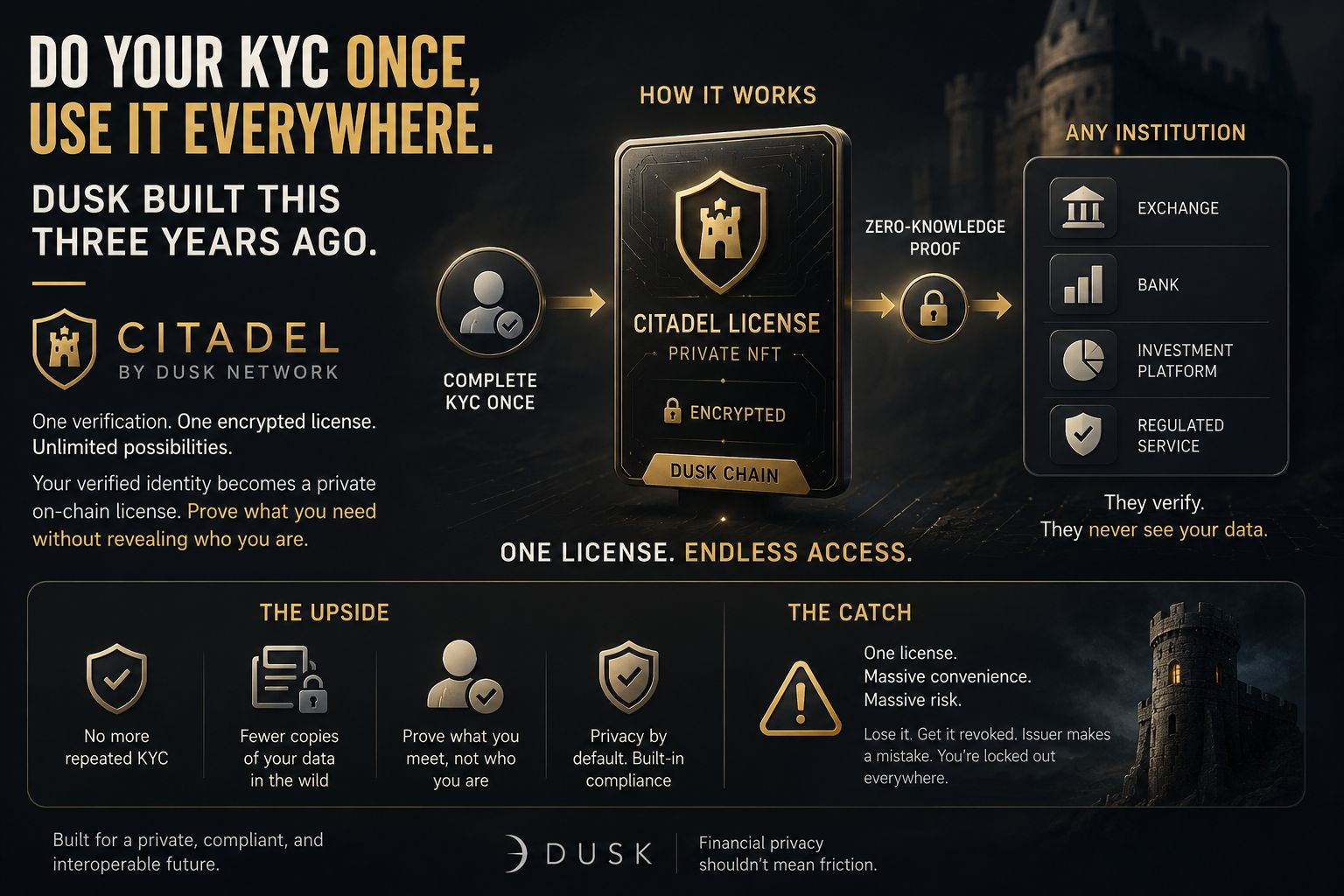
Do your KYC once, use it everywhere. @Dusk built this three years ago and almost nobody talks about it anymore.
Everyones excited about DuskEVM and the price action lately, fair enough. But scrolling back through #dusk history, I found something older I think matters more than anything shipping right now. Its called Citadel. You complete KYC once, and every institution that needs to verify you afterward just checks a license instead of making you go through the whole process again.
Here is how it works. Your verified identity becomes something like a private NFT, a license, sitting on the Dusk chain, encrypted. When a platform needs to confirm you meet their requirements, accredited investor status, minimum balance, whatever it is, you don't hand over documents again. You generate a zero-knowledge proof that you hold a valid license meeting their exact requirement. Thats all they see. Not your name, not your bank statement, just a verified yes.
I like this for an obvious reason. KYC today is genuinely miserable, the same documents, the same selfie holding your ID, over and over, for every exchange and platform you touch, each one storing a fresh copy of your data somewhere. Citadel collapses all of that into one verification that gets reused, meaning one less pile of your personal documents sitting in some database waiting to leak.
Here is what gives me pause though. If your entire compliance identity boils down to one on-chain license, that license becomes an extremely valuable target. Lose control of it, or have the issuing party make a mistake, and you are not locked out of one platform, potentially all of them. Centralizing convenience and centralizing risk tend to be the same move wearing different clothes.
Three years old and I still dont see it get much attention. Might be the most underrated piece of what Dusk's actually built. $DUSK
Everyones excited about DuskEVM and the price action lately, fair enough. But scrolling back through #dusk history, I found something older I think matters more than anything shipping right now. Its called Citadel. You complete KYC once, and every institution that needs to verify you afterward just checks a license instead of making you go through the whole process again.
Here is how it works. Your verified identity becomes something like a private NFT, a license, sitting on the Dusk chain, encrypted. When a platform needs to confirm you meet their requirements, accredited investor status, minimum balance, whatever it is, you don't hand over documents again. You generate a zero-knowledge proof that you hold a valid license meeting their exact requirement. Thats all they see. Not your name, not your bank statement, just a verified yes.
I like this for an obvious reason. KYC today is genuinely miserable, the same documents, the same selfie holding your ID, over and over, for every exchange and platform you touch, each one storing a fresh copy of your data somewhere. Citadel collapses all of that into one verification that gets reused, meaning one less pile of your personal documents sitting in some database waiting to leak.
Here is what gives me pause though. If your entire compliance identity boils down to one on-chain license, that license becomes an extremely valuable target. Lose control of it, or have the issuing party make a mistake, and you are not locked out of one platform, potentially all of them. Centralizing convenience and centralizing risk tend to be the same move wearing different clothes.
Three years old and I still dont see it get much attention. Might be the most underrated piece of what Dusk's actually built. $DUSK
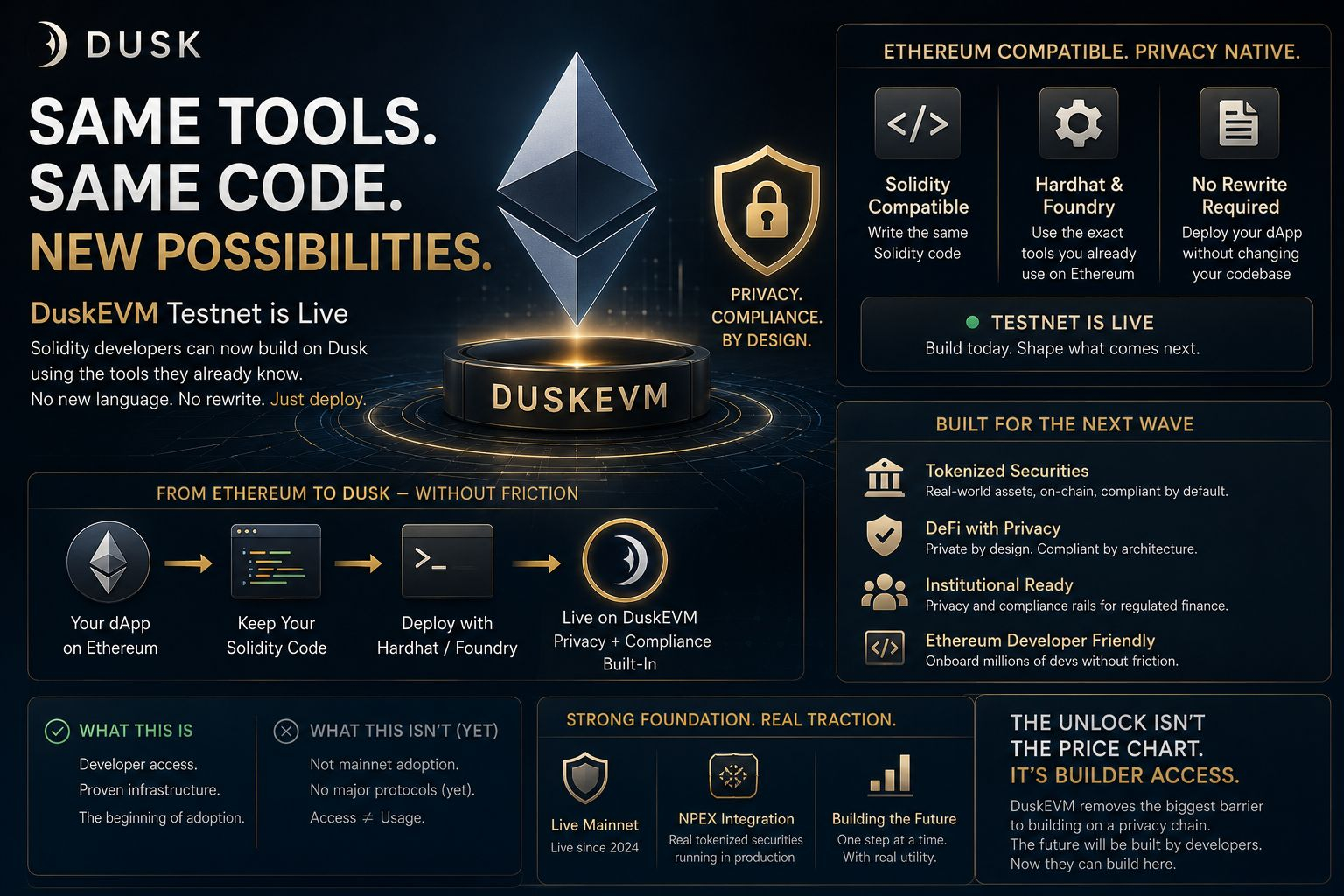
$DUSK just made it possible for any Ethereum Developer to build here without Learning anything new. I think this is the actual Unlock, not the price Chart.
Small headline, big implication. DuskEVM testnet went live earlier this month. What that actually means: Developers can now deploy Solidity contracts on @Dusk using Hardhat and Foundry, the exact tools they already use on Ethereum. No new language, no rewriting a codebase from scratch, no learning #dusk Native Rust Environment just to try it out.
Why that matters more than it sounds. Privacy chains have historically had a chicken and egg problem. The tech is genuinely impressive, but almost nobody builds on it because it demands developers abandon everything familiar and start over. Dusk just removed that excuse. An existing Ethereum DeFi app can now target DuskEVM directly, keep its Solidity code, and inherit Dusks privacy and compliance layer underneath without a rewrite.
I want to be honest about what this is and is not, because the hype cycle tends to skip this part. This is a testnet. It establishes developer access, it does not prove adoption yet. Nobodys shipped a major protocol on it, no TVL has moved because of it. Access is not the same as usage, and I have watched enough testnets get treated like finished products to know the difference matters.
Still, paired with everything else stacking up, real tokenized securities running through NPEX, a live Mainnet a year old now, this is the piece that turns "Interesting Privacy Chain" into "A Chain Ethereum Builders can actually enter without Friction". Thats a bigger deal long term than another green candle.
Watching this closely, not calling it proven yet. The testnet is real. The adoption is still an open question.
Small headline, big implication. DuskEVM testnet went live earlier this month. What that actually means: Developers can now deploy Solidity contracts on @Dusk using Hardhat and Foundry, the exact tools they already use on Ethereum. No new language, no rewriting a codebase from scratch, no learning #dusk Native Rust Environment just to try it out.
Why that matters more than it sounds. Privacy chains have historically had a chicken and egg problem. The tech is genuinely impressive, but almost nobody builds on it because it demands developers abandon everything familiar and start over. Dusk just removed that excuse. An existing Ethereum DeFi app can now target DuskEVM directly, keep its Solidity code, and inherit Dusks privacy and compliance layer underneath without a rewrite.
I want to be honest about what this is and is not, because the hype cycle tends to skip this part. This is a testnet. It establishes developer access, it does not prove adoption yet. Nobodys shipped a major protocol on it, no TVL has moved because of it. Access is not the same as usage, and I have watched enough testnets get treated like finished products to know the difference matters.
Still, paired with everything else stacking up, real tokenized securities running through NPEX, a live Mainnet a year old now, this is the piece that turns "Interesting Privacy Chain" into "A Chain Ethereum Builders can actually enter without Friction". Thats a bigger deal long term than another green candle.
Watching this closely, not calling it proven yet. The testnet is real. The adoption is still an open question.
I used to think Fixed rates in DeFi were a nice idea that would never actually work.
Too much Liquidity Fragmentation, too many edge cases, too hard to price. Turns out I was wrong, or at least early in writing it off.
@TermMax has been running fixed rate, fixed term Lending and Borrowing since April 2025, and its now sitting on close to $50M in TVL across Ethereum, Arbitrum, and BNB Chain, with over 17K daily active users and more than 100 markets live. Thats not hype numbers. Thats actual usage from people who got tired of watching their yield drift around.
Here is what changed my mind.
Instead of forcing everyone into one floating Rate curve, #TermMax lets Lenders and Borrowers agree on rates through an actual market mechanism. Curators and market makers set their own pricing and manage risk with range orders. You get real price discovery instead of a single formula trying to fit everyone.
Then they added one click leverage, so you are not chaining five transactions across different apps just to loop a position. And now they have pushed into tokenized stock collateral through Ondo, which means fixed rate borrowing against real world assets is no longer a theory, its live.
The bigger picture is simple. Fixed income is the largest asset class in traditional finance for a reason. People want to know what they are getting before they commit capital. DeFi is finally catching up to that expectation instead of asking everyone to tolerate constant rate volatility.
Still early days for the sector, but this is what Infrastructure actually being built looks like...
Too much Liquidity Fragmentation, too many edge cases, too hard to price. Turns out I was wrong, or at least early in writing it off.
@TermMax has been running fixed rate, fixed term Lending and Borrowing since April 2025, and its now sitting on close to $50M in TVL across Ethereum, Arbitrum, and BNB Chain, with over 17K daily active users and more than 100 markets live. Thats not hype numbers. Thats actual usage from people who got tired of watching their yield drift around.
Here is what changed my mind.
Instead of forcing everyone into one floating Rate curve, #TermMax lets Lenders and Borrowers agree on rates through an actual market mechanism. Curators and market makers set their own pricing and manage risk with range orders. You get real price discovery instead of a single formula trying to fit everyone.
Then they added one click leverage, so you are not chaining five transactions across different apps just to loop a position. And now they have pushed into tokenized stock collateral through Ondo, which means fixed rate borrowing against real world assets is no longer a theory, its live.
The bigger picture is simple. Fixed income is the largest asset class in traditional finance for a reason. People want to know what they are getting before they commit capital. DeFi is finally catching up to that expectation instead of asking everyone to tolerate constant rate volatility.
Still early days for the sector, but this is what Infrastructure actually being built looks like...
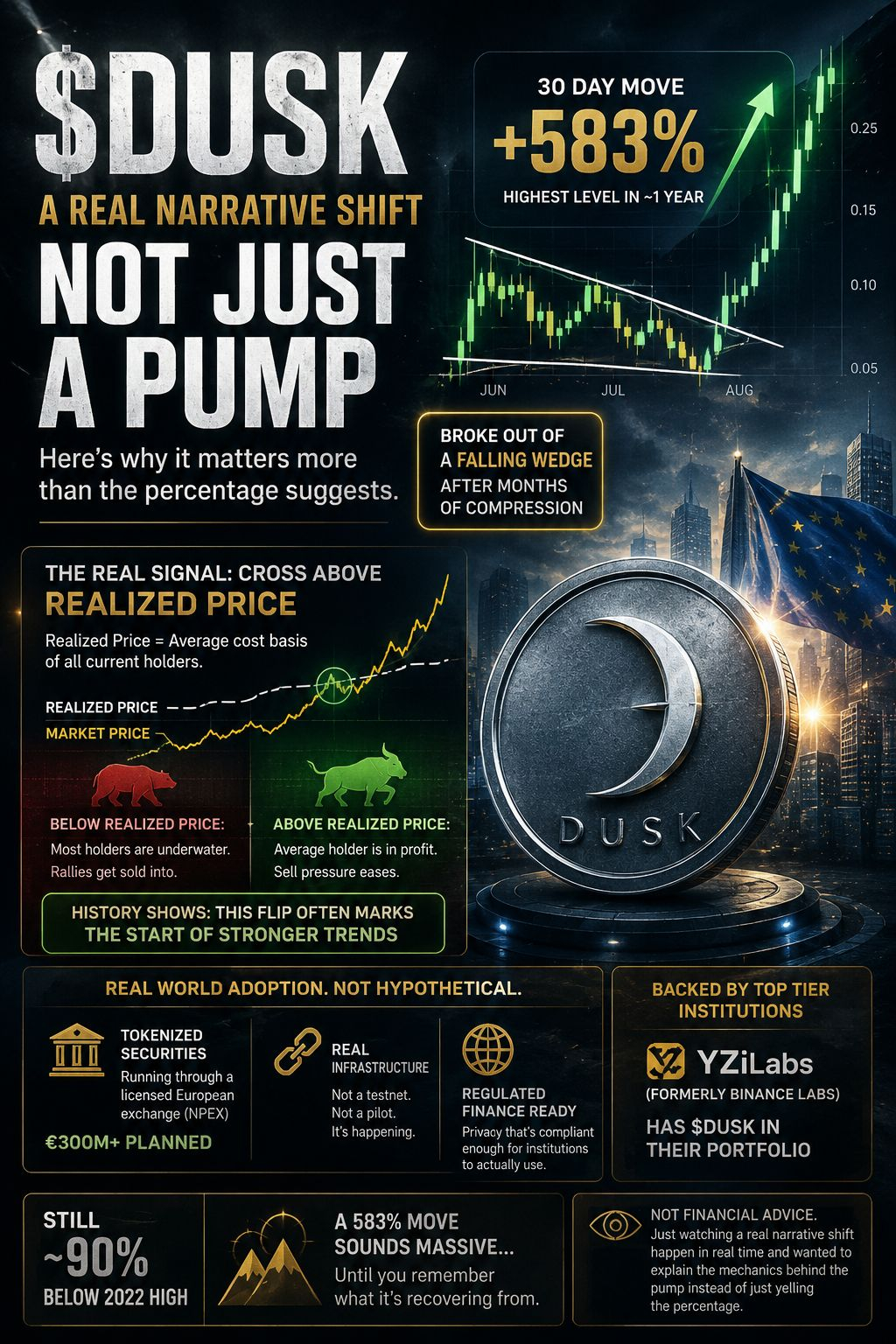
$DUSK just did something most Privacy Coins have not managed in Years. I want to explain why it matters more than the Percentage suggests.
Everyone chases the number first. Fine, lets start there. @Dusk ran nearly 583% in 30 days, Breaking out of a falling wedge it had been stuck in for months, hitting its Highest level in about a Year. Loud number. But loud numbers happen every week in this market and most of them mean nothing six weeks later.
Here is the part that actually made me Pay attention. On-chain data shows #dusk Crossed above its realized price, basically the average cost basis of everyone currently holding it. That flip matters more than people give it Credit for. Below that line, most holders are underwater and rallies get sold into as people rush to break even. Above it, the average holder is finally in profit, and historically that's when sell pressure eases instead of capping every bounce. It's the difference between a pump getting sold, and a trend that has room to actually continue.
And this is not happening in a vacuum. DUSK is one of the few privacy tokens actually shipping Real-World Asset (RWA) integration, Tokenized securities running through a licensed European exchange, north of 300 million Euros planned, not hypothetical.
Y Zi Labs, the fund formerly known as BINANCE Labs, has DUSK in its own portfolio. Thats not retail hype carrying this, thats a narrative Institutions are actually positioning around, privacy thats compliant enough for regulated finance to touch.
I will say the boring part too because it matters. This token is still sitting something like 90 percent below its 2022 high. A 583% move sounds massive until you remember what it's recovering from. Respect the move, dont romanticize it into something it is not yet.
Not financial Advice. Just watching a real narrative shift happen in real time and wanted to explain the mechanics behind the pump instead of just yelling the Percentage.
Everyone chases the number first. Fine, lets start there. @Dusk ran nearly 583% in 30 days, Breaking out of a falling wedge it had been stuck in for months, hitting its Highest level in about a Year. Loud number. But loud numbers happen every week in this market and most of them mean nothing six weeks later.
Here is the part that actually made me Pay attention. On-chain data shows #dusk Crossed above its realized price, basically the average cost basis of everyone currently holding it. That flip matters more than people give it Credit for. Below that line, most holders are underwater and rallies get sold into as people rush to break even. Above it, the average holder is finally in profit, and historically that's when sell pressure eases instead of capping every bounce. It's the difference between a pump getting sold, and a trend that has room to actually continue.
And this is not happening in a vacuum. DUSK is one of the few privacy tokens actually shipping Real-World Asset (RWA) integration, Tokenized securities running through a licensed European exchange, north of 300 million Euros planned, not hypothetical.
Y Zi Labs, the fund formerly known as BINANCE Labs, has DUSK in its own portfolio. Thats not retail hype carrying this, thats a narrative Institutions are actually positioning around, privacy thats compliant enough for regulated finance to touch.
I will say the boring part too because it matters. This token is still sitting something like 90 percent below its 2022 high. A 583% move sounds massive until you remember what it's recovering from. Respect the move, dont romanticize it into something it is not yet.
Not financial Advice. Just watching a real narrative shift happen in real time and wanted to explain the mechanics behind the pump instead of just yelling the Percentage.
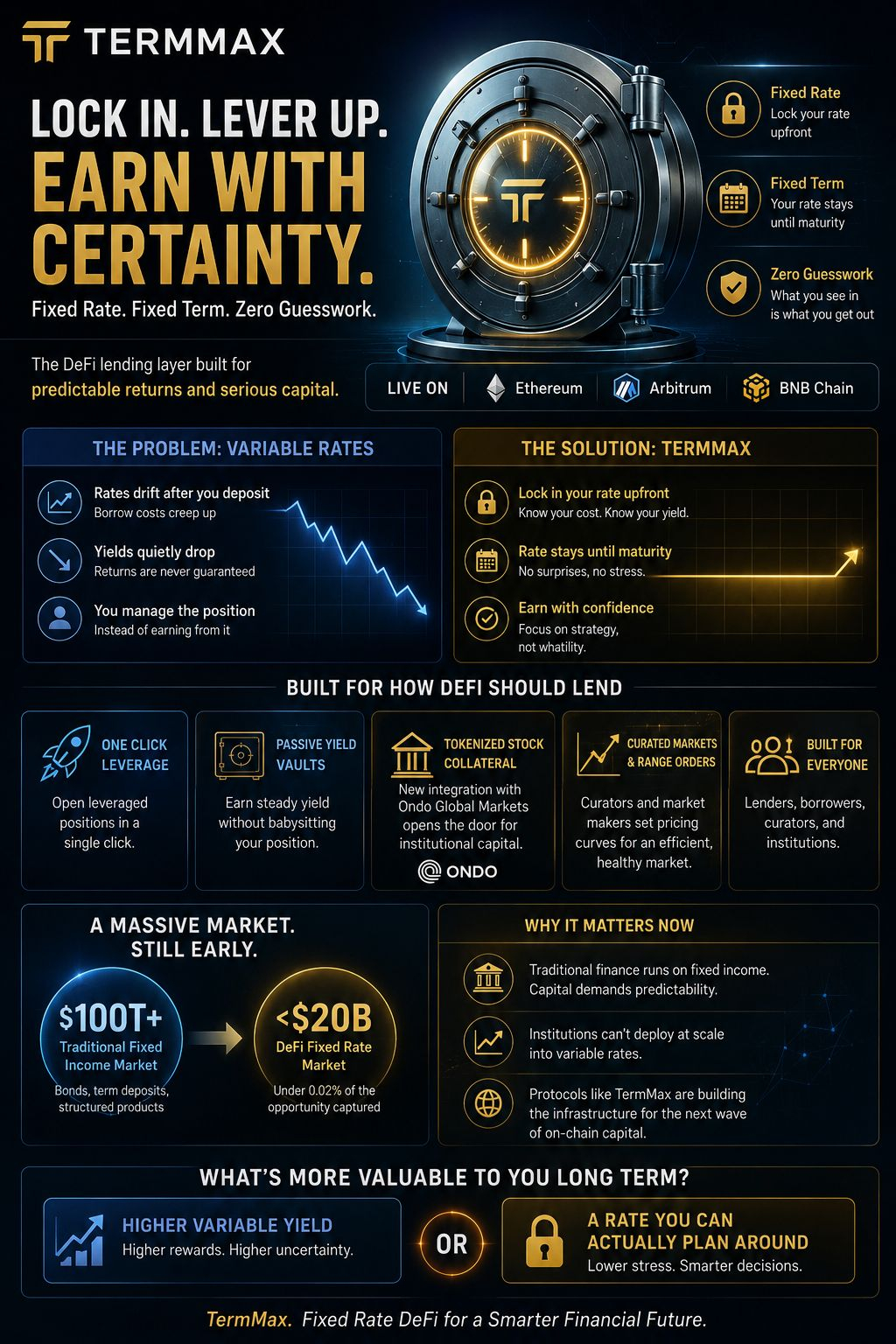
Most people dont realize how much they Are overpaying for uncertainty in DeFi.
You Deposit into a lending pool, the Rate looks great on day one, and then it Drifts. Borrow costs creep up. Yield quietly drops. You end up managing a position instead of actually earning from it.
@TermMax takes a different approach. Its a fixed rate, fixed term lending and borrowing protocol, live on Ethereum, Arbitrum, and BNB Chain. You lock in your rate upfront and it stays that way until maturity. What you see going in is what you get coming out.
A few reasons this stands out right now.
It supports one click leveraged positions without routing through multiple protocols.
Vaults let you earn passive yield without babysitting your position every day.
It recently added tokenized stock collateral through Ondo Global Markets, which is a real step toward bringing institutional capital on chain.
Curators and market makers can set their own pricing curves through range orders, so the market stays efficient instead of relying on a single formula.
Traditional finance runs on fixed income. Bonds, term deposits, structured products. Its a market worth well over $100T. DeFis fixed rate segment is still under $20B. Thats not a weakness in the space. Its early innings.
If DeFi wants to attract capital that cant tolerate unpredictable returns, protocols like this are the ones building the actual infrastructure for it.
Whats more valuable to you long term, higher variable yield or a rate you can actually plan around? #termmax
You Deposit into a lending pool, the Rate looks great on day one, and then it Drifts. Borrow costs creep up. Yield quietly drops. You end up managing a position instead of actually earning from it.
@TermMax takes a different approach. Its a fixed rate, fixed term lending and borrowing protocol, live on Ethereum, Arbitrum, and BNB Chain. You lock in your rate upfront and it stays that way until maturity. What you see going in is what you get coming out.
A few reasons this stands out right now.
It supports one click leveraged positions without routing through multiple protocols.
Vaults let you earn passive yield without babysitting your position every day.
It recently added tokenized stock collateral through Ondo Global Markets, which is a real step toward bringing institutional capital on chain.
Curators and market makers can set their own pricing curves through range orders, so the market stays efficient instead of relying on a single formula.
Traditional finance runs on fixed income. Bonds, term deposits, structured products. Its a market worth well over $100T. DeFis fixed rate segment is still under $20B. Thats not a weakness in the space. Its early innings.
If DeFi wants to attract capital that cant tolerate unpredictable returns, protocols like this are the ones building the actual infrastructure for it.
Whats more valuable to you long term, higher variable yield or a rate you can actually plan around? #termmax
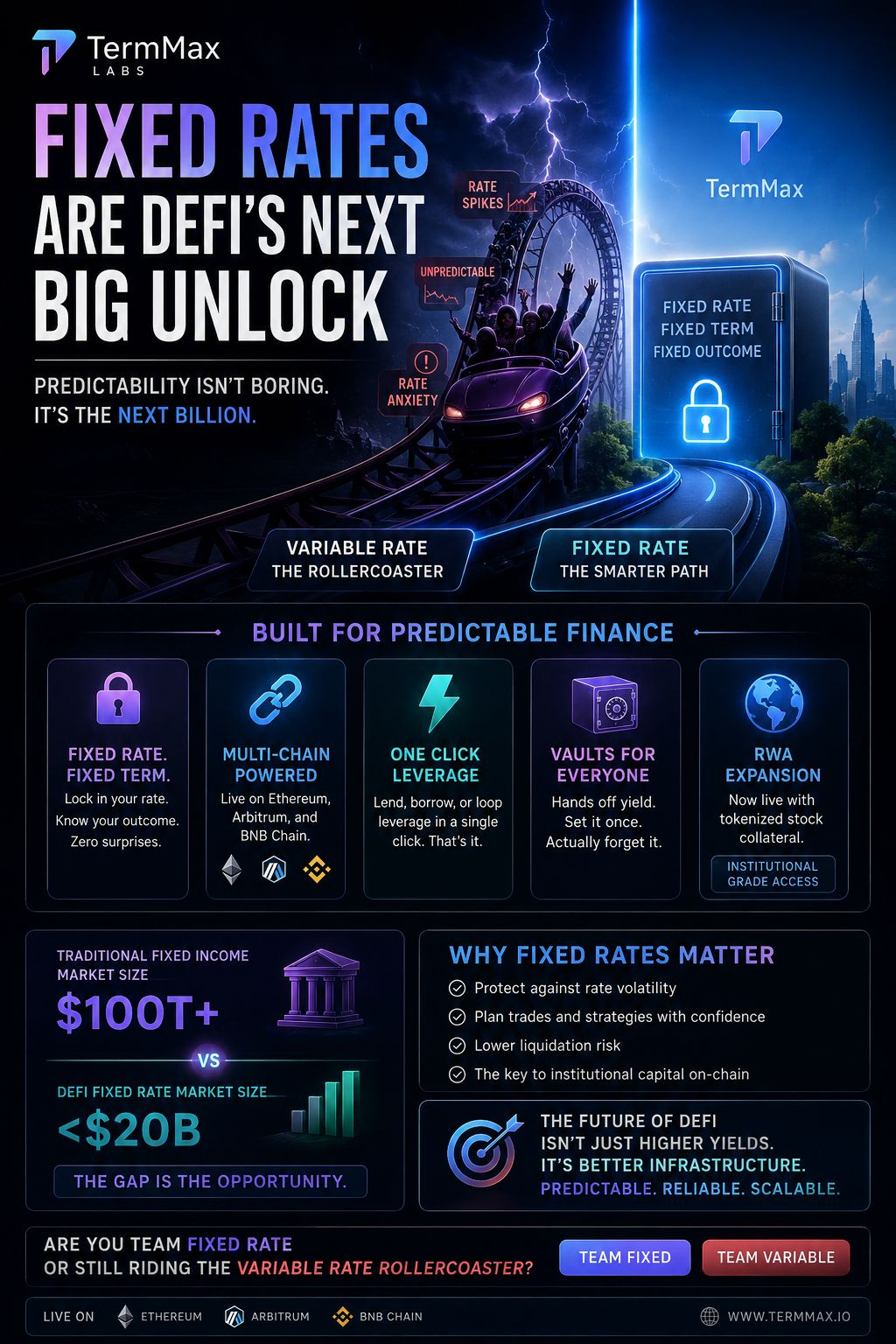
Fixed rates are quietly becoming DeFi's next big unlock...
Everyones chasing APY screenshots, but the real problem in DeFi lending has never been the yield. Its the uncertainty. Rates swing overnight, borrowing costs spike out of nowhere, and "Passive income" often means checking your dashboard five times a day...
Thats the gap @TermMax is quietly closing.
Instead of the usual floating rate roulette, #TermMax lets you lock in a fixed rate for a fixed term. Lend, borrow, or loop leverage with a single click, and actually know your numbers going in. No guessing games. No rate anxiety.
A few things worth paying attention to:
Fixed rate and fixed maturity lending/borrowing, live on Ethereum, Arbitrum, and BNB Chain.
One click leverage without hopping across five different protocols.
Vaults for hands off yield. Set it and actually forget it.
Recently expanded into tokenized stock collateral, opening the door for RWAs and institutional grade capital.
Zoom out for a second. Traditional fixed income markets are worth over $100T. DeFi's version of that market is still under $20B. That gap isn't a flaw. Its the opportunity.
Predictability is not the exciting part of crypto, but it might be the part that finally brings serious capital on chain.
Are you team fixed rate or still riding the variable rate rollercoaster?
Everyones chasing APY screenshots, but the real problem in DeFi lending has never been the yield. Its the uncertainty. Rates swing overnight, borrowing costs spike out of nowhere, and "Passive income" often means checking your dashboard five times a day...
Thats the gap @TermMax is quietly closing.
Instead of the usual floating rate roulette, #TermMax lets you lock in a fixed rate for a fixed term. Lend, borrow, or loop leverage with a single click, and actually know your numbers going in. No guessing games. No rate anxiety.
A few things worth paying attention to:
Fixed rate and fixed maturity lending/borrowing, live on Ethereum, Arbitrum, and BNB Chain.
One click leverage without hopping across five different protocols.
Vaults for hands off yield. Set it and actually forget it.
Recently expanded into tokenized stock collateral, opening the door for RWAs and institutional grade capital.
Zoom out for a second. Traditional fixed income markets are worth over $100T. DeFi's version of that market is still under $20B. That gap isn't a flaw. Its the opportunity.
Predictability is not the exciting part of crypto, but it might be the part that finally brings serious capital on chain.
Are you team fixed rate or still riding the variable rate rollercoaster?
Verified
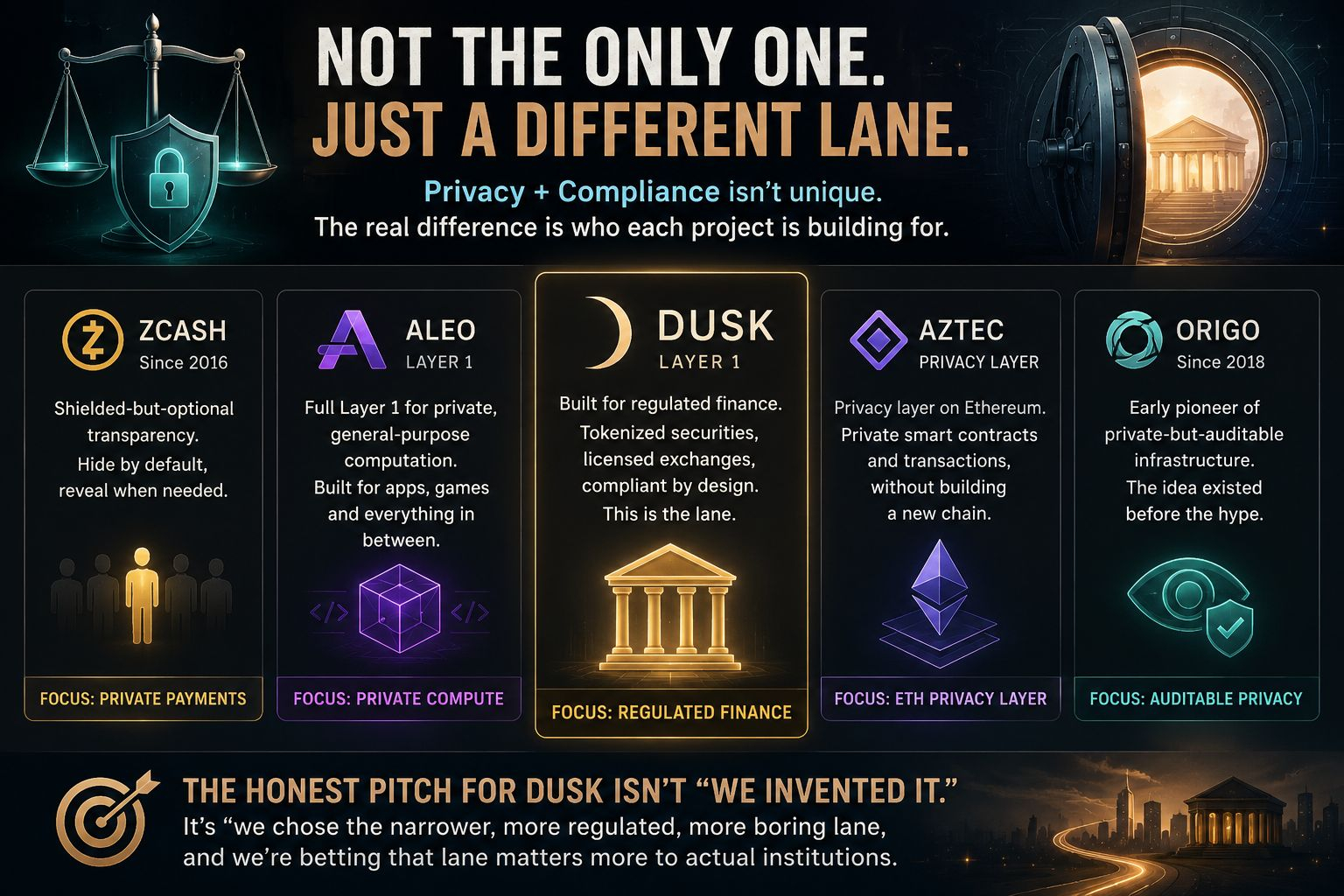
@Dusk keeps getting called "unique" for combining privacy and compliance. It is not, not really.
I kept seeing the same line repeated in #dusk write-ups. Privacy and regulatory compliance, together, first of its kind. So I went and checked who else is actually working on that exact problem, and its a more crowded room than the marketing lets on.
Zcash has been doing shielded-but-optional transparency since 2016, thats basically the same tension, hide by default, reveal when needed. Aleo is building a full Layer 1 around private, general-purpose computation, not just payments. Aztec is doing something similar but as a privacy layer sitting on top of Ethereum instead of its own chain. Even Origo, a much smaller, less talked about project, was pitching private-but-auditable infrastructure back in 2018, years before Dusk had a working mainnet.
What actually is different, and I want to be fair here, is who each of these is building for. Aleo and Aztec both lean toward general private computation, apps, games, arbitrary logic that happens to also be private. $DUSK narrows in specifically on regulated finance, tokenized securities, licensed exchanges, the NPEX kind of real-world deal. Thats a real distinction, not nothing. Its not a unique idea though, its a different target market for a shared idea a handful of teams have been chasing for years.
I think the honest version of Dusks pitch is not "We invented private compliant finance". Its "We picked a narrower, more boring, more regulated lane than Aleo or Aztec did, and we are betting that lane matters more to actual institutions." Thats a smaller claim. It also happens to be the one I find more believable.
I kept seeing the same line repeated in #dusk write-ups. Privacy and regulatory compliance, together, first of its kind. So I went and checked who else is actually working on that exact problem, and its a more crowded room than the marketing lets on.
Zcash has been doing shielded-but-optional transparency since 2016, thats basically the same tension, hide by default, reveal when needed. Aleo is building a full Layer 1 around private, general-purpose computation, not just payments. Aztec is doing something similar but as a privacy layer sitting on top of Ethereum instead of its own chain. Even Origo, a much smaller, less talked about project, was pitching private-but-auditable infrastructure back in 2018, years before Dusk had a working mainnet.
What actually is different, and I want to be fair here, is who each of these is building for. Aleo and Aztec both lean toward general private computation, apps, games, arbitrary logic that happens to also be private. $DUSK narrows in specifically on regulated finance, tokenized securities, licensed exchanges, the NPEX kind of real-world deal. Thats a real distinction, not nothing. Its not a unique idea though, its a different target market for a shared idea a handful of teams have been chasing for years.
I think the honest version of Dusks pitch is not "We invented private compliant finance". Its "We picked a narrower, more boring, more regulated lane than Aleo or Aztec did, and we are betting that lane matters more to actual institutions." Thats a smaller claim. It also happens to be the one I find more believable.
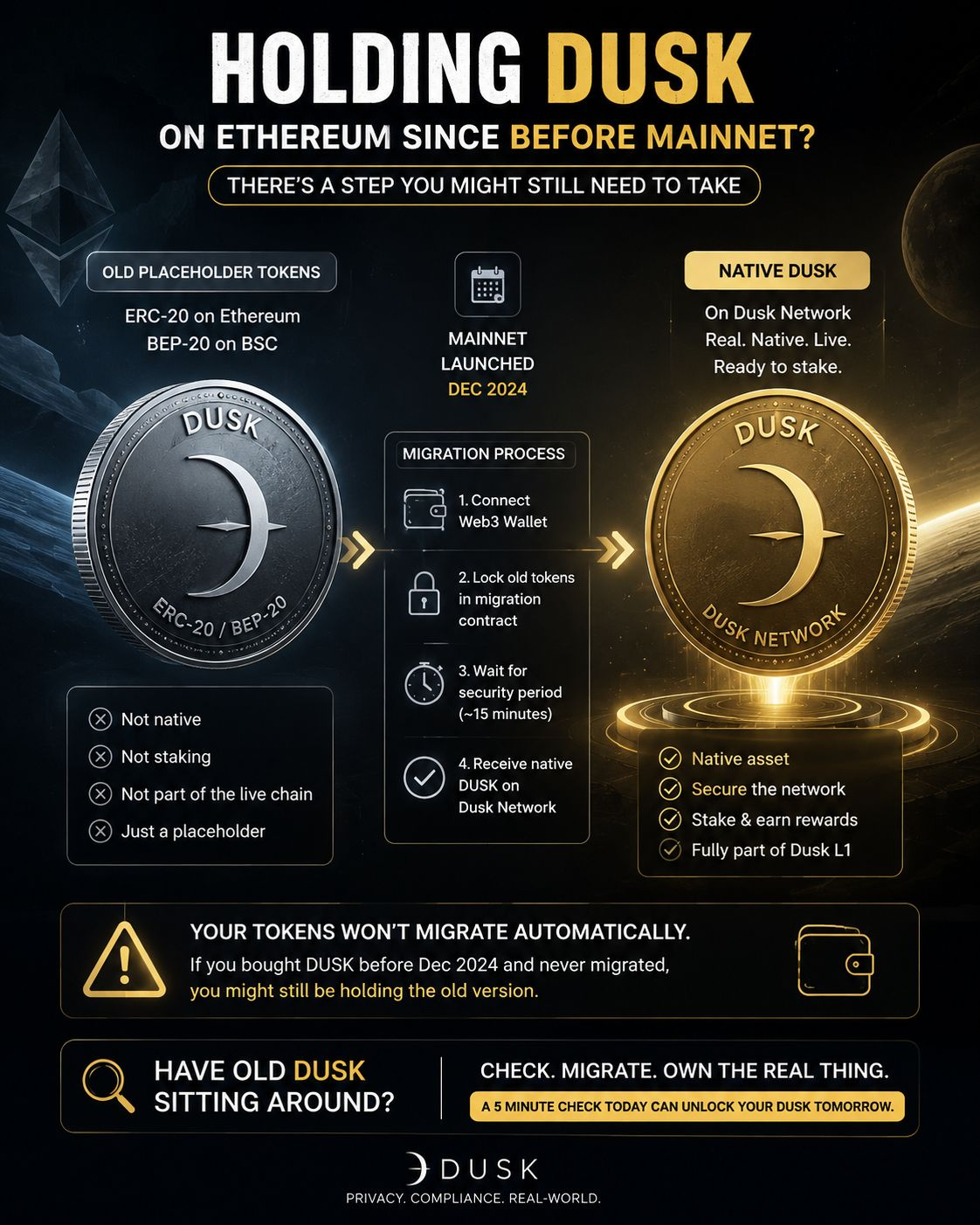
If you have been holding $DUSK on Ethereum since before mainnet, theres a step you might not know you still need to take...
I was reading through #dusk migration docs and realized something that seems easy to miss if you bought in early and just... never checked back.
@Dusk originally launched as a placeholder token, ERC-20 on Ethereum, BEP-20 on BSC, because the actual mainnet was not ready yet. Thats normal, plenty of projects do this. Whats less normal is what happens after mainnet actually launches. Those placeholder tokens dont automatically become the real thing. You have to manually migrate them, connect a Web3 wallet, lock the old tokens in a migration contract, and wait for native DUSK to get issued on the other end. Its not instant either, the contract itself imposes a wait, roughly fifteen minutes, built in for security.
Mainnet went live back in December 2024. That means anyone who bought ERC-20 or BEP-20 DUSK before then and just left it sitting in an exchange wallet or a Web3 wallet they forgot about is holding a placeholder token, not the actual native asset securing the network today. It still has value, its still swappable, but its not staking, not earning anything, not actually part of the live chain until someone manually moves it over.
I dont think this is some kind of trap, the process is documented, its not hidden. But migrations like this quietly strand tokens all the time, not through malice, just through people buying something years ago and forgetting to check back when the underlying project actually shipped.
If you have got old DUSK sitting somewhere and have not touched it since 2023 or 2024, thats worth a five minute check before you assume its already the current version.
I was reading through #dusk migration docs and realized something that seems easy to miss if you bought in early and just... never checked back.
@Dusk originally launched as a placeholder token, ERC-20 on Ethereum, BEP-20 on BSC, because the actual mainnet was not ready yet. Thats normal, plenty of projects do this. Whats less normal is what happens after mainnet actually launches. Those placeholder tokens dont automatically become the real thing. You have to manually migrate them, connect a Web3 wallet, lock the old tokens in a migration contract, and wait for native DUSK to get issued on the other end. Its not instant either, the contract itself imposes a wait, roughly fifteen minutes, built in for security.
Mainnet went live back in December 2024. That means anyone who bought ERC-20 or BEP-20 DUSK before then and just left it sitting in an exchange wallet or a Web3 wallet they forgot about is holding a placeholder token, not the actual native asset securing the network today. It still has value, its still swappable, but its not staking, not earning anything, not actually part of the live chain until someone manually moves it over.
I dont think this is some kind of trap, the process is documented, its not hidden. But migrations like this quietly strand tokens all the time, not through malice, just through people buying something years ago and forgetting to check back when the underlying project actually shipped.
If you have got old DUSK sitting somewhere and have not touched it since 2023 or 2024, thats worth a five minute check before you assume its already the current version.
Verified
"Includes BlackRock" started as a tweet from an account with 2,000 followers. Now its part of the whole bull case.
I was reading through recent #dusk news roundups, and one line kept getting repeated across multiple sources: hints of BlackRock integration fueling institutional optimism. That phrase alone made me want to trace it back to the source instead of just repeating it.
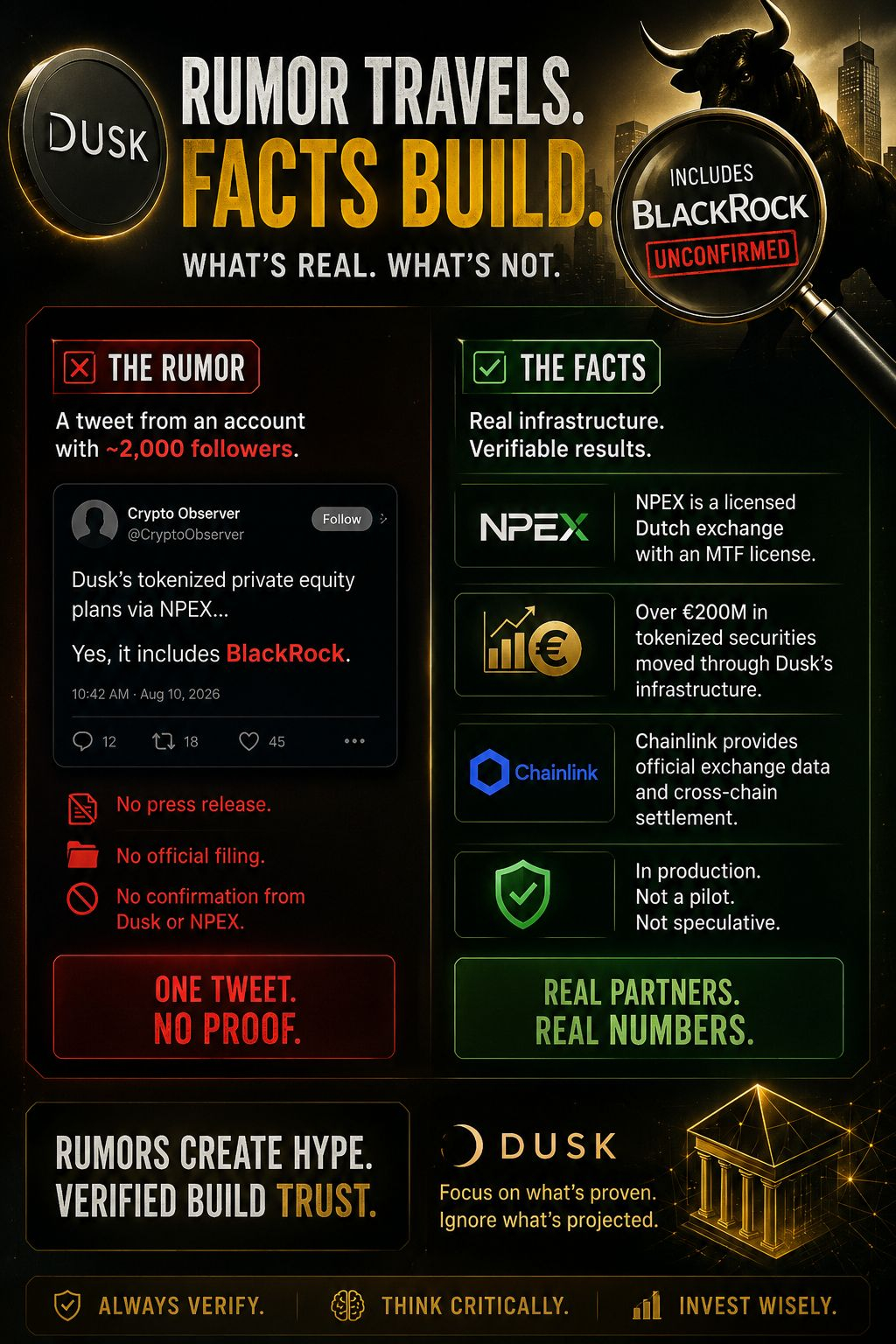
Traced it back. Its a tweet. From an account with roughly 2,000 followers, commenting on @Dusk tokenized private equity plans through their NPEX partnership, adding "Yes, it includes BlackRock." Thats it. Thats the origin. Not a press release, not an official filing, not anything from Dusk or NPEX themselves confirming it. One persons aside, now circulating in market roundups as a genuine catalyst.
What actually is confirmed is a lot less flashy but honestly more solid. NPEX is a real, licensed Dutch exchange holding an MTF license, and they have moved over 200 million euros in tokenized securities through Dusks infrastructure, in production, not a pilot. Chainlinks involved now too, handling official exchange data and cross-chain settlement for the tokenized assets. Thats genuine institutional plumbing, verifiable, not speculative.
I get why the BlackRock line spreads faster than the NPEX numbers. One is a globally recognized name attached to a rumor. The other is a real but unfamiliar Dutch exchange attached to a confirmed number. Rumors travel lighter than facts, they always have.
Im not saying BlackRock definitely is not involved somehow, somewhere down the chain. Im saying nobodys actually shown that yet, and its already being treated like settled news in places that should know better. $DUSK
I was reading through recent #dusk news roundups, and one line kept getting repeated across multiple sources: hints of BlackRock integration fueling institutional optimism. That phrase alone made me want to trace it back to the source instead of just repeating it.
Traced it back. Its a tweet. From an account with roughly 2,000 followers, commenting on @Dusk tokenized private equity plans through their NPEX partnership, adding "Yes, it includes BlackRock." Thats it. Thats the origin. Not a press release, not an official filing, not anything from Dusk or NPEX themselves confirming it. One persons aside, now circulating in market roundups as a genuine catalyst.
What actually is confirmed is a lot less flashy but honestly more solid. NPEX is a real, licensed Dutch exchange holding an MTF license, and they have moved over 200 million euros in tokenized securities through Dusks infrastructure, in production, not a pilot. Chainlinks involved now too, handling official exchange data and cross-chain settlement for the tokenized assets. Thats genuine institutional plumbing, verifiable, not speculative.
I get why the BlackRock line spreads faster than the NPEX numbers. One is a globally recognized name attached to a rumor. The other is a real but unfamiliar Dutch exchange attached to a confirmed number. Rumors travel lighter than facts, they always have.
Im not saying BlackRock definitely is not involved somehow, somewhere down the chain. Im saying nobodys actually shown that yet, and its already being treated like settled news in places that should know better. $DUSK
@Dusk is advertising 27% staking APR. The math behind it made me want to slow down.
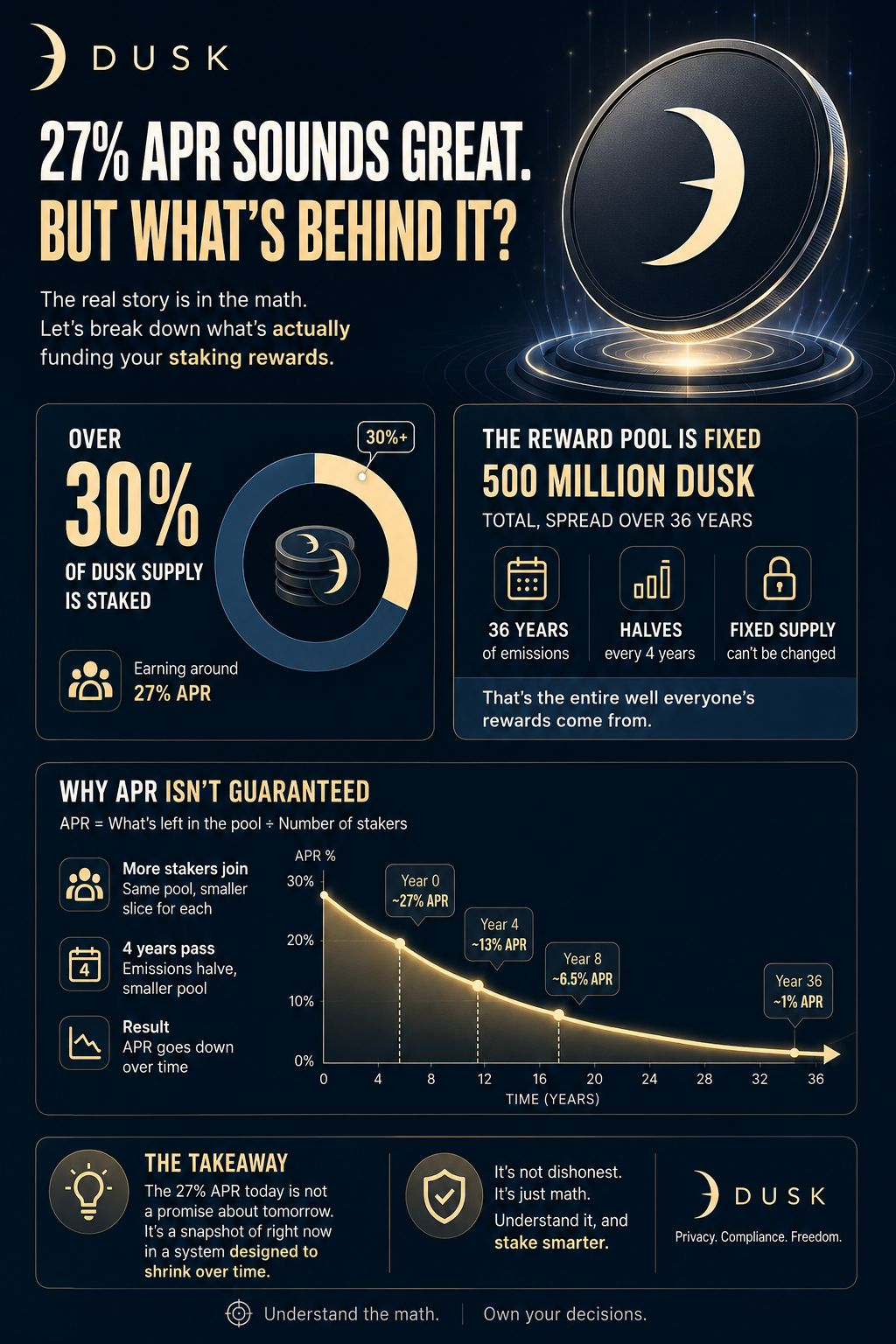
Saw the number on their own account: over 30% of $DUSK supply staked, earning around 27% APR. Sounds great on its own. Then I checked what's actually funding that reward.
The whole staking reward pool is fixed. 500 million DUSK, total, spread out over 36 years, cut in half every four years by design. Thats it. Thats the entire well everyones rewards come from, forever shrinking on a schedule that was set in advance.
So here is the thing nobody says out loud next to that 27% figure. Its not a fixed rate. Its whatever is left in a shrinking pool, split across however many people happen to be staking at that moment. More stakers join, same pool, smaller slice each. Four years pass, the emission halves, smaller pool too. The 27% today is not a promise about tomorrow, its a snapshot of right now.
I dont think thats dishonest exactly, this is how most staking systems work once you look under the hood. I just think leading with a big APR number, without the decay curve sitting right next to it, sets people up to expect something thats mathematically built to shrink. #dusk
Saw the number on their own account: over 30% of $DUSK supply staked, earning around 27% APR. Sounds great on its own. Then I checked what's actually funding that reward.
The whole staking reward pool is fixed. 500 million DUSK, total, spread out over 36 years, cut in half every four years by design. Thats it. Thats the entire well everyones rewards come from, forever shrinking on a schedule that was set in advance.
So here is the thing nobody says out loud next to that 27% figure. Its not a fixed rate. Its whatever is left in a shrinking pool, split across however many people happen to be staking at that moment. More stakers join, same pool, smaller slice each. Four years pass, the emission halves, smaller pool too. The 27% today is not a promise about tomorrow, its a snapshot of right now.
I dont think thats dishonest exactly, this is how most staking systems work once you look under the hood. I just think leading with a big APR number, without the decay curve sitting right next to it, sets people up to expect something thats mathematically built to shrink. #dusk
A blockchain trying to be private and fully auditable at once. Did not think that was possible until I looked closer.
Privacy and compliance usually dont mix in crypto. Either transactions are hidden and regulators hate it, or everythings public and you have rebuilt a transparent ledger nobody with real money wants. @Dusk is building the thing in between.
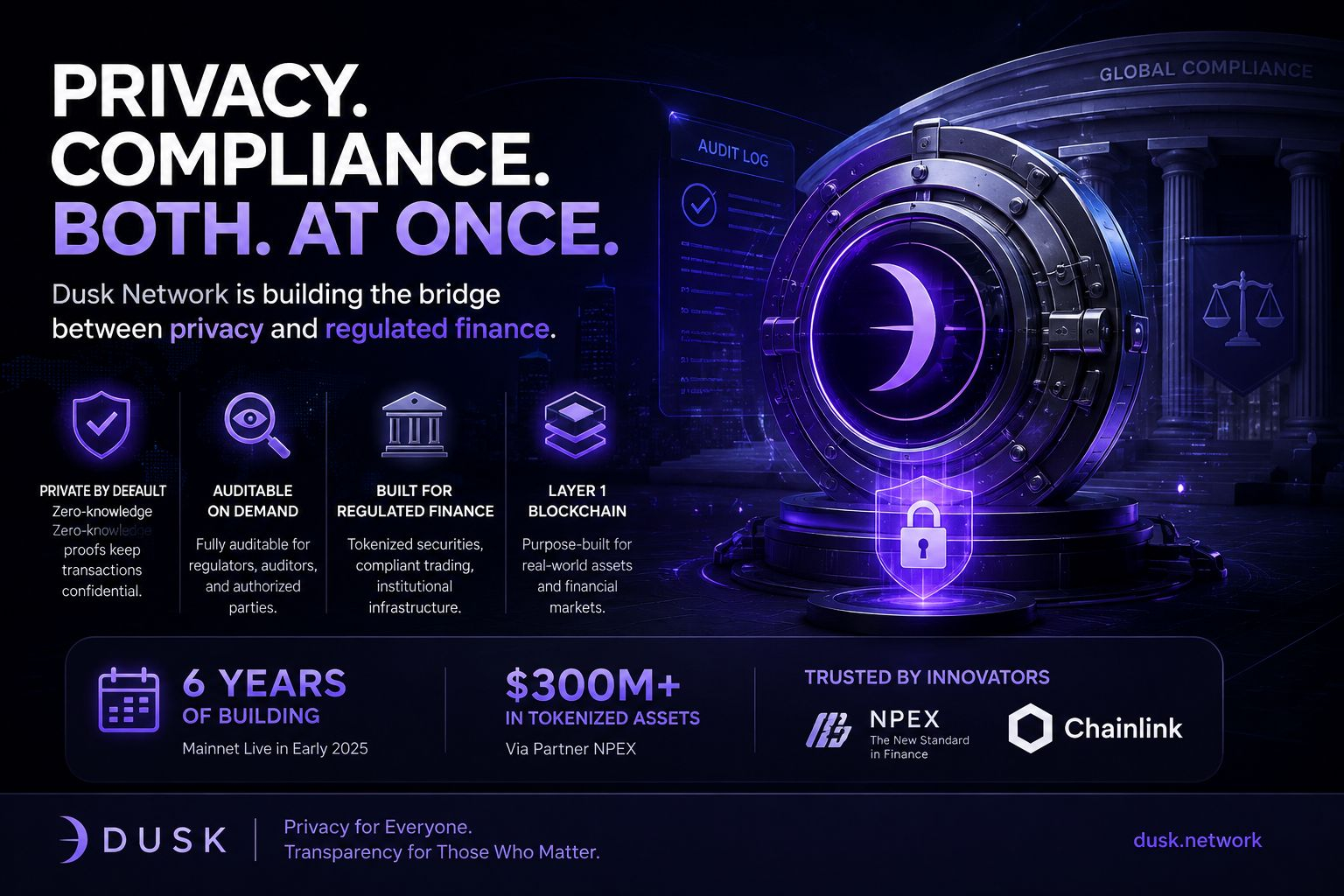
It's a Layer 1 for regulated finance, tokenized securities, compliant trading, not degen DeFi. It uses zero-knowledge proofs so transactions stay shielded from public view while still being fully auditable to whoevers legally allowed to check them. Confidential to everyone else, transparent to the one party who is supposed to see it. Thats a genuinely hard problem, not a slogan.
What caught my attention is the timeline. Mainnet went live in early 2025, six years after the project started. Six years is unusual patience in an industry that ships a whitepaper and a token in six months. Paired with real partners like NPEX tokenizing over 300 million dollars in assets, it reads less like stalling and more like someone waiting for the hard part to actually work.
The price chart tells a rougher story. DUSK still sits around 80 percent below its 2021 high, even after real rallies tied to actual news. That gap between "The Tech is Advancing" and "The Token has not Recovered" is common with infrastructure plays. The market does not wait for six year roadmaps to prove themselves.
I dont know yet if regulated finance actually wants this, or if institutions stay comfortable running real securities through a token this volatile. But privacy that does not have to fight compliance feels like one of the few genuinely new ideas I have run into lately. #dusk $DUSK
Privacy and compliance usually dont mix in crypto. Either transactions are hidden and regulators hate it, or everythings public and you have rebuilt a transparent ledger nobody with real money wants. @Dusk is building the thing in between.
It's a Layer 1 for regulated finance, tokenized securities, compliant trading, not degen DeFi. It uses zero-knowledge proofs so transactions stay shielded from public view while still being fully auditable to whoevers legally allowed to check them. Confidential to everyone else, transparent to the one party who is supposed to see it. Thats a genuinely hard problem, not a slogan.
What caught my attention is the timeline. Mainnet went live in early 2025, six years after the project started. Six years is unusual patience in an industry that ships a whitepaper and a token in six months. Paired with real partners like NPEX tokenizing over 300 million dollars in assets, it reads less like stalling and more like someone waiting for the hard part to actually work.
The price chart tells a rougher story. DUSK still sits around 80 percent below its 2021 high, even after real rallies tied to actual news. That gap between "The Tech is Advancing" and "The Token has not Recovered" is common with infrastructure plays. The market does not wait for six year roadmaps to prove themselves.
I dont know yet if regulated finance actually wants this, or if institutions stay comfortable running real securities through a token this volatile. But privacy that does not have to fight compliance feels like one of the few genuinely new ideas I have run into lately. #dusk $DUSK
The crypto market feels like it’s entering a phase where patience matters more than hype.
We’re seeing money rotate, narratives change fast, and strong projects separate themselves from the noise. BTC remains the market’s anchor, while liquidity is gradually searching for the next areas of growth across DeFi, AI, RWA and infrastructure.
The big question isn’t just “Will crypto go higher?”
It’s “Which sectors and projects will still matter when the next wave of liquidity arrives?”
Markets rarely move in a straight line. There will be pullbacks, fakeouts and sudden rotations.
For me, this is the phase to watch the fundamentals, follow liquidity and stay prepared rather than chase every green candle.
The next big move may already be forming quietly. 👀
$NBISB $PROM
#crypto #BTC #Altcoins #DeFi #CryptoMarket
We’re seeing money rotate, narratives change fast, and strong projects separate themselves from the noise. BTC remains the market’s anchor, while liquidity is gradually searching for the next areas of growth across DeFi, AI, RWA and infrastructure.
The big question isn’t just “Will crypto go higher?”
It’s “Which sectors and projects will still matter when the next wave of liquidity arrives?”
Markets rarely move in a straight line. There will be pullbacks, fakeouts and sudden rotations.
For me, this is the phase to watch the fundamentals, follow liquidity and stay prepared rather than chase every green candle.
The next big move may already be forming quietly. 👀
$NBISB $PROM
#crypto #BTC #Altcoins #DeFi #CryptoMarket
@BabylonLabs_io own paperwork says #baby is not an investment. Their staking page disagrees with that.
I was reading through Babylon's tokenomics docs, mostly checking numbers, and ran into a disclaimer I was not expecting. Buried in the legal boilerplate, it says plainly that BABY's primary purpose is paying fees, securing consensus and enabling governance, and that it is not intended to serve as an investment. Fine, standard lawyer language, every project has some version of this.
Except I do just come from the staking page, where the whole pitch is APY numbers, reward projections and language about earning yield on your Bitcoin. Those two things are sitting on the same website contradicting each other, and I dont think thats an accident, I think its the exact tension every token project is currently navigating.
The SEC actually weighed in on this general question earlier this year and their framing stuck with me. What matters is not the label a project puts on its own token. What matters is economic reality, how the thing actually behaves in practice, regardless of what the disclaimer calls it. If something functions like an investment, generates yield, gets marketed around returns, the paperwork saying otherwise does not necessarily settle anything.
Im not a lawyer and Im not accusing Babylon of doing anything uniquely wrong here, honestly almost every token project has this same gap between its legal disclaimers and its actual marketing copy. But reading both pages back to back made the gap feel bigger than usual. One page says this is not an investment. The other page is entirely built around convincing you its worth investing in.
I dont know how that gets resolved, and I dont think Babylon does either yet, nobody in crypto fully does. I just think its worth noticing when a projects legal language and its marketing language are quietly telling you two different stories.
$BABY $ON
I was reading through Babylon's tokenomics docs, mostly checking numbers, and ran into a disclaimer I was not expecting. Buried in the legal boilerplate, it says plainly that BABY's primary purpose is paying fees, securing consensus and enabling governance, and that it is not intended to serve as an investment. Fine, standard lawyer language, every project has some version of this.
Except I do just come from the staking page, where the whole pitch is APY numbers, reward projections and language about earning yield on your Bitcoin. Those two things are sitting on the same website contradicting each other, and I dont think thats an accident, I think its the exact tension every token project is currently navigating.
The SEC actually weighed in on this general question earlier this year and their framing stuck with me. What matters is not the label a project puts on its own token. What matters is economic reality, how the thing actually behaves in practice, regardless of what the disclaimer calls it. If something functions like an investment, generates yield, gets marketed around returns, the paperwork saying otherwise does not necessarily settle anything.
Im not a lawyer and Im not accusing Babylon of doing anything uniquely wrong here, honestly almost every token project has this same gap between its legal disclaimers and its actual marketing copy. But reading both pages back to back made the gap feel bigger than usual. One page says this is not an investment. The other page is entirely built around convincing you its worth investing in.
I dont know how that gets resolved, and I dont think Babylon does either yet, nobody in crypto fully does. I just think its worth noticing when a projects legal language and its marketing language are quietly telling you two different stories.
$BABY $ON
Log in to explore more content