
SatsNote
2k Posts

SatsNote
Report
Block User
High-Frequency Trader
3 Years
674 Following
125 Followers
415 Liked
Posts
All
Videos
·
--
Verified
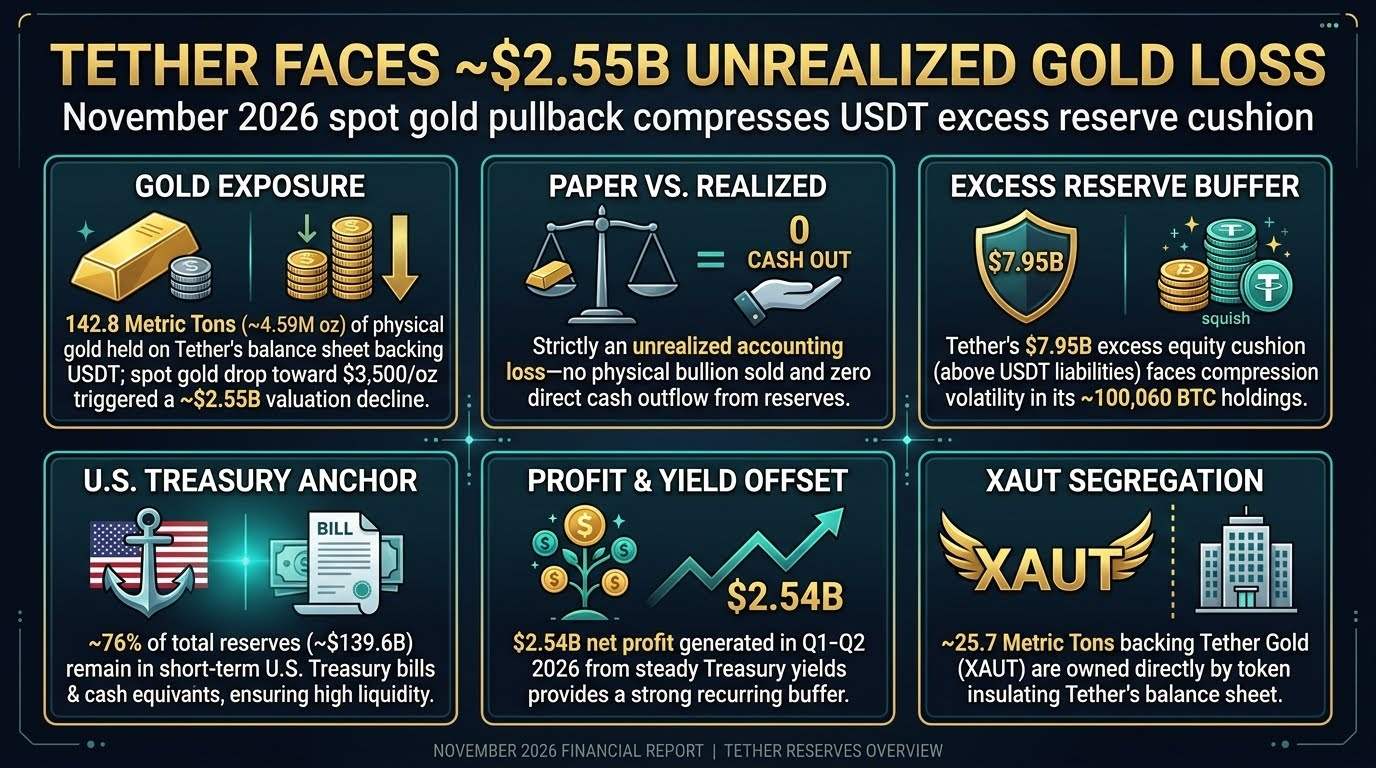
#TetherGoldFaces$2.55BUnrealizedLoss
The sharp drop in gold prices in November 2026 caused an approximately $2.55 billion unrealized (on-paper) loss on the 142.8 tonnes of physical gold held in Tether’s USDT reserves.
🚨 What’s Happening?
Massive Gold Reserve Melting Away 🪙: Tether holds approximately 142.8 metric tons (4.59 million ounces) of physical gold on its own balance sheet to back its USDT reserves. When gold fell to around $3,500 per ounce in November, this position lost approximately $2.55 billion in value. On-Paper Loss 📉: For now, this loss is an “unrealized loss”—that is, since Tether has not sold its physical gold, there has been no direct cash outflow. Reserve Cushion Shrinking 🛡️: Tether’s $7.95 billion excess reserve cushion above its liabilities came under significant on-paper pressure due to declines in the prices of both gold and Bitcoin (approximately 100,060 BTC).
📊 Strengths That Remain on the Balance Sheet
U.S. Treasury Securities 💵: Approximately 76% of the company’s reserves (around $139.6 billion) consists of short-term U.S. Treasury securities and highly liquid cash equivalents. Strong Interest Income 📈: Thanks to regular interest income from its securities (a total profit of $2.54 billion in the first two quarters of 2026), Tether has the cash flow to absorb this volatility. The XAUT Difference ⚖️: The approximately 25.7 tonnes of gold backing Tether’s gold-backed token XAUT belong directly to token holders, so price declines affect investors’ balances, not the company’s.
$PAXG $XAUT $XAU
{future}(XAUUSDT)
{future}(XAUTUSDT)
{future}(PAXGUSDT)
#TetherGoldFaces$2.55BUnrealizedLoss
The sharp drop in gold prices in November 2026 caused an approximately $2.55 billion unrealized (on-paper) loss on the 142.8 tonnes of physical gold held in Tether’s USDT reserves.
🚨 What’s Happening?
Massive Gold Reserve Melting Away 🪙: Tether holds approximately 142.8 metric tons (4.59 million ounces) of physical gold on its own balance sheet to back its USDT reserves. When gold fell to around $3,500 per ounce in November, this position lost approximately $2.55 billion in value. On-Paper Loss 📉: For now, this loss is an “unrealized loss”—that is, since Tether has not sold its physical gold, there has been no direct cash outflow. Reserve Cushion Shrinking 🛡️: Tether’s $7.95 billion excess reserve cushion above its liabilities came under significant on-paper pressure due to declines in the prices of both gold and Bitcoin (approximately 100,060 BTC).
📊 Strengths That Remain on the Balance Sheet
U.S. Treasury Securities 💵: Approximately 76% of the company’s reserves (around $139.6 billion) consists of short-term U.S. Treasury securities and highly liquid cash equivalents. Strong Interest Income 📈: Thanks to regular interest income from its securities (a total profit of $2.54 billion in the first two quarters of 2026), Tether has the cash flow to absorb this volatility. The XAUT Difference ⚖️: The approximately 25.7 tonnes of gold backing Tether’s gold-backed token XAUT belong directly to token holders, so price declines affect investors’ balances, not the company’s.
$PAXG $XAUT $XAU
124
·
--
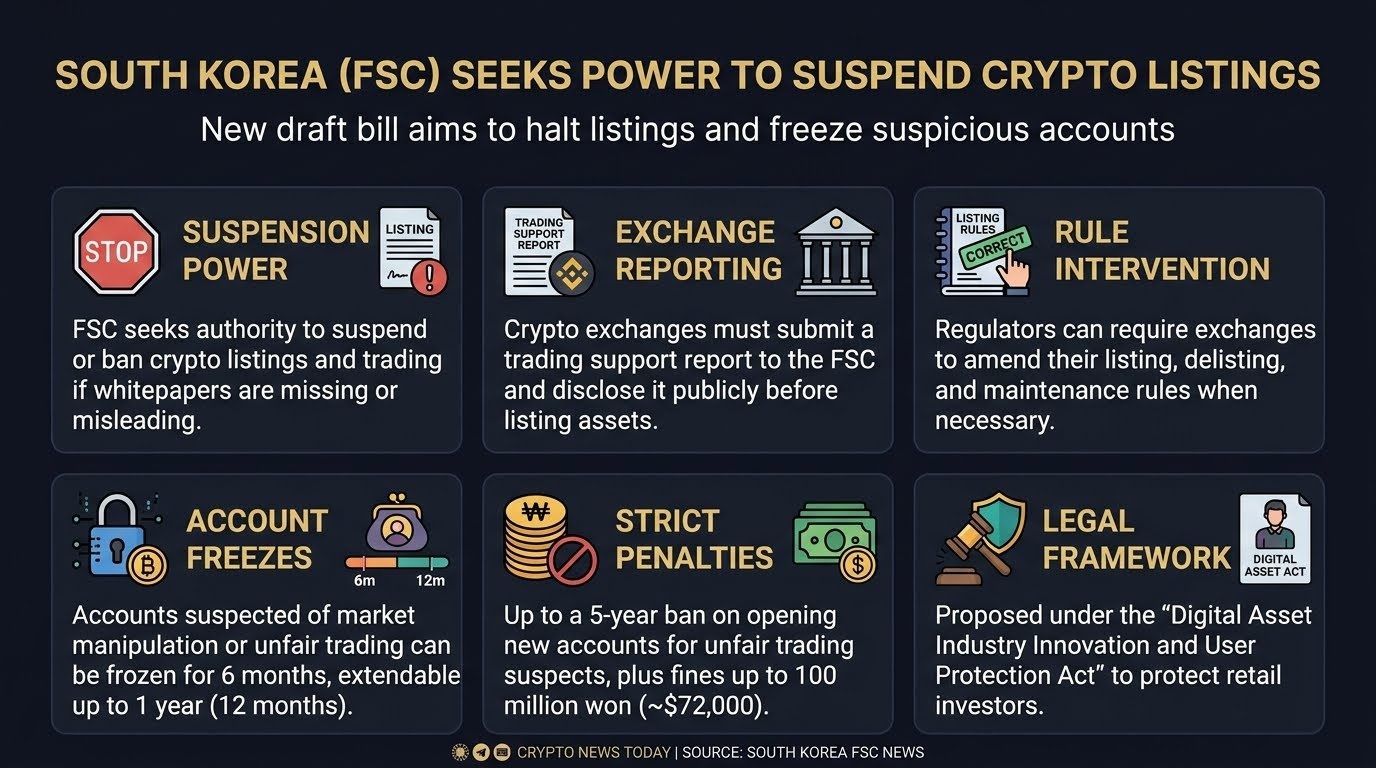
#koreafscseekspowertosuspendcryptolistings
🚨 What’s Happening?
New Draft Law 📜: Under the draft “Digital Asset Industry Innovation and User Protection Act,” the FSC is seeking the authority to suspend the listing and trading of cryptocurrencies that lack a whitepaper or contain false or misleading information.
Advance Notice Requirement for Exchanges 🏢: Crypto exchanges will continue reviewing assets, but before listing them, they will have to submit a “trading support report” to the FSC and make it public. The regulator must be notified immediately of any significant changes after listing.
Authority to Intervene in Rules ⚖️: Where it deems necessary, the FSC will be able to require exchanges to change their rules on listing, delisting, and maintaining listings.
🛡️ Other Key Measures in the Draft
Account Freezes 🧊: Accounts suspected of market manipulation or unfair trading can initially be frozen for up to six months, with the period extendable once, for a total of up to one year (12 months).
Severe Penalties 💸: Those suspected of unfair trading may be banned from opening new accounts for up to five years, while fines of up to 100 million won (approximately $72,000) are proposed for false or incomplete disclosures.
$BTC $SOL $XAUT
{future}(XAUTUSDT)
{future}(SOLUSDT)
{future}(BTCUSDT)
#koreafscseekspowertosuspendcryptolistings
🚨 What’s Happening?
New Draft Law 📜: Under the draft “Digital Asset Industry Innovation and User Protection Act,” the FSC is seeking the authority to suspend the listing and trading of cryptocurrencies that lack a whitepaper or contain false or misleading information.
Advance Notice Requirement for Exchanges 🏢: Crypto exchanges will continue reviewing assets, but before listing them, they will have to submit a “trading support report” to the FSC and make it public. The regulator must be notified immediately of any significant changes after listing.
Authority to Intervene in Rules ⚖️: Where it deems necessary, the FSC will be able to require exchanges to change their rules on listing, delisting, and maintaining listings.
🛡️ Other Key Measures in the Draft
Account Freezes 🧊: Accounts suspected of market manipulation or unfair trading can initially be frozen for up to six months, with the period extendable once, for a total of up to one year (12 months).
Severe Penalties 💸: Those suspected of unfair trading may be banned from opening new accounts for up to five years, while fines of up to 100 million won (approximately $72,000) are proposed for false or incomplete disclosures.
$BTC $SOL $XAUT
555
·
--
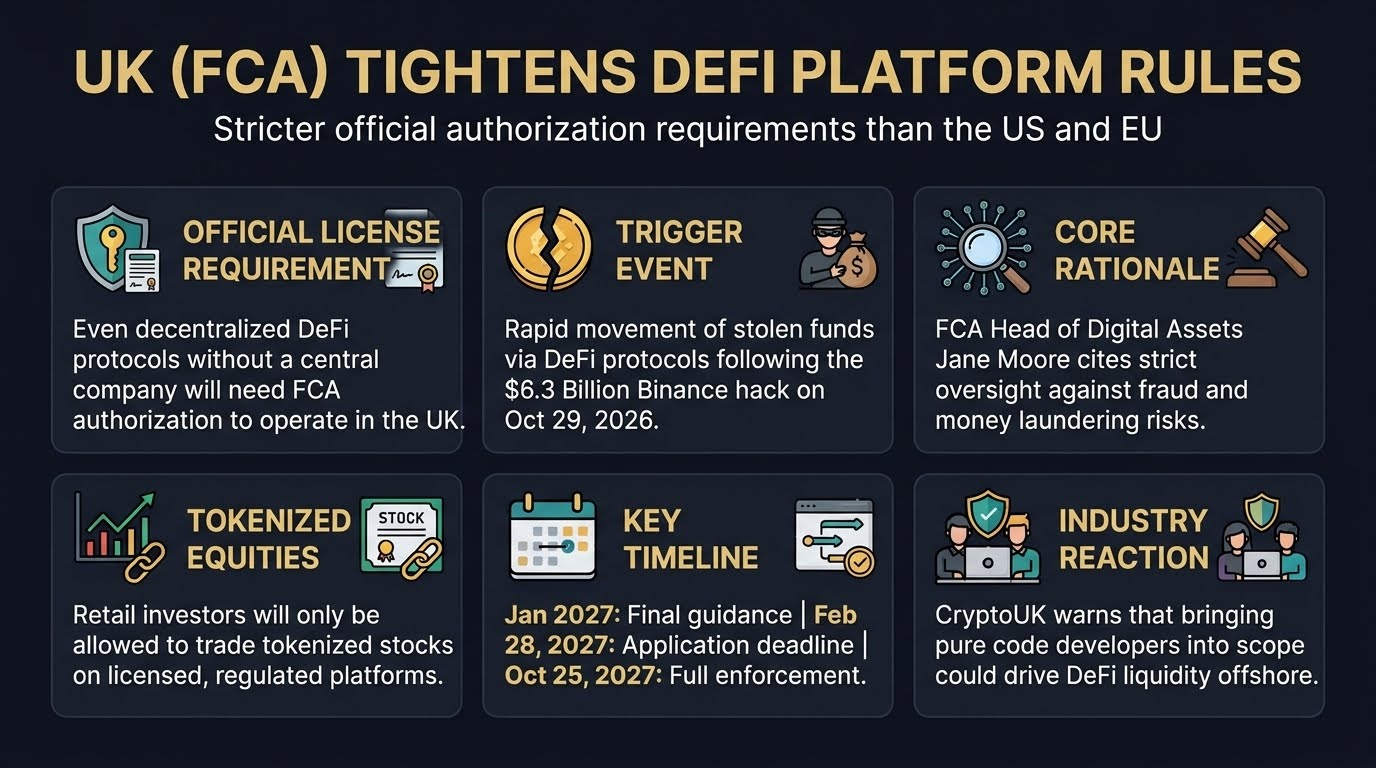
#ukfcareportedlyplansdefiauthorizationrules
The UK Financial Conduct Authority (FCA) is preparing to impose a stricter official licensing requirement on decentralized finance (DeFi) platforms than even the US and EU.
🚨 Key Highlights
Official Licensing Requirement 📜: The FCA will require even DeFi protocols without a specific company at their core to obtain official authorization to provide services in the UK. Impact of the Binance Attack 💥: Behind this strict move is the rapid movement of funds stolen in the $6.3 billion Binance attack on October 29, 2026, through DeFi protocols. Consumer Protection 🛡️: Jane Moore, the FCA’s Head of Digital Assets, said that due to the risks of fraud and money laundering, they are choosing strict oversight over open access. Restrictions on Tokenized Shares 📈: Retail investors will only be able to trade tokenized shares on licensed platforms.
📅 Key Dates
January 2027 📢: Publication of the final DeFi guidance. February 28, 2027 ⏳: Deadline for authorization applications. October 25, 2027 🚀: The new regulations come fully into force.
🌍 Market Reaction
Liquidity Risk ⚖️: Industry representatives (CryptoUK) warn that including even developers who only write code could drive DeFi liquidity overseas.
$BULLA $2Z $XAU
{future}(XAUUSDT)
{future}(2ZUSDT)
{future}(BULLAUSDT)
#ukfcareportedlyplansdefiauthorizationrules
The UK Financial Conduct Authority (FCA) is preparing to impose a stricter official licensing requirement on decentralized finance (DeFi) platforms than even the US and EU.
🚨 Key Highlights
Official Licensing Requirement 📜: The FCA will require even DeFi protocols without a specific company at their core to obtain official authorization to provide services in the UK. Impact of the Binance Attack 💥: Behind this strict move is the rapid movement of funds stolen in the $6.3 billion Binance attack on October 29, 2026, through DeFi protocols. Consumer Protection 🛡️: Jane Moore, the FCA’s Head of Digital Assets, said that due to the risks of fraud and money laundering, they are choosing strict oversight over open access. Restrictions on Tokenized Shares 📈: Retail investors will only be able to trade tokenized shares on licensed platforms.
📅 Key Dates
January 2027 📢: Publication of the final DeFi guidance. February 28, 2027 ⏳: Deadline for authorization applications. October 25, 2027 🚀: The new regulations come fully into force.
🌍 Market Reaction
Liquidity Risk ⚖️: Industry representatives (CryptoUK) warn that including even developers who only write code could drive DeFi liquidity overseas.
$BULLA $2Z $XAU
1.8k
·
--
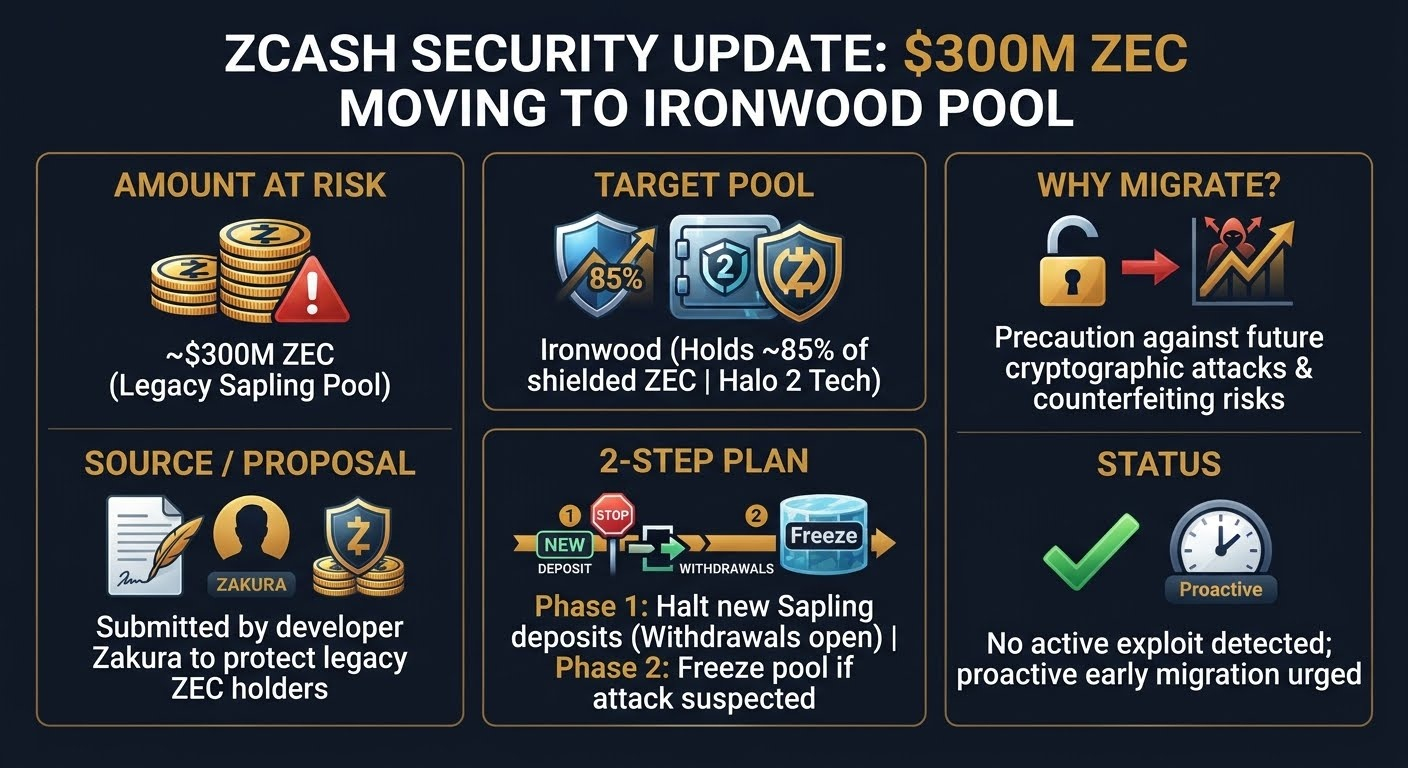
#zcashdevelopersurgezecmovetoironwood
Zcash (ZEC) developers are urging users to move approximately $300 million (400,000 ZEC) in assets from the old Sapling pool to the next-generation Ironwood pool, ahead of potential security vulnerabilities in the future.
🚨 What’s happening?
Urgent call to migrate: The Zakura team, led by Sean Bowe and Dev Ojha, announced that Sapling, the old privacy pool launched in 2018, should now be retired. $300 million at risk: Approximately 400,000 ZEC remain in the Sapling pool, and developers want these funds moved to the new pool.
🛡️ Why migrate?
Cryptographic threat: Sapling relies on an older encryption method that could be broken by AI-powered mathematical advances or future quantum breakthroughs. Counterfeit coin risk: This vulnerability could eventually allow attackers to mint ZEC without backing. There is no active attack at present, but precautions are being taken early.
🌲 Why Ironwood?
Next-generation protection: Launched in July 2026 and home to 85% of shielded ZEC, Ironwood completely eliminates this mathematical vulnerability with Halo 2 technology.
🔄 The process and what you need to do
Deposits will be disabled: Under the proposed update, new ZEC deposits into the Sapling pool will be stopped, but withdrawals will remain available so assets can be moved. Move your balance: Update your wallet, and if your funds are at an old Sapling (zs1...) address, transfer them from within your wallet to your new Unified / Ironwood address.
$ZEC $INIT $SSV
{future}(SSVUSDT)
{future}(INITUSDT)
{future}(ZECUSDT)
#zcashdevelopersurgezecmovetoironwood
Zcash (ZEC) developers are urging users to move approximately $300 million (400,000 ZEC) in assets from the old Sapling pool to the next-generation Ironwood pool, ahead of potential security vulnerabilities in the future.
🚨 What’s happening?
Urgent call to migrate: The Zakura team, led by Sean Bowe and Dev Ojha, announced that Sapling, the old privacy pool launched in 2018, should now be retired. $300 million at risk: Approximately 400,000 ZEC remain in the Sapling pool, and developers want these funds moved to the new pool.
🛡️ Why migrate?
Cryptographic threat: Sapling relies on an older encryption method that could be broken by AI-powered mathematical advances or future quantum breakthroughs. Counterfeit coin risk: This vulnerability could eventually allow attackers to mint ZEC without backing. There is no active attack at present, but precautions are being taken early.
🌲 Why Ironwood?
Next-generation protection: Launched in July 2026 and home to 85% of shielded ZEC, Ironwood completely eliminates this mathematical vulnerability with Halo 2 technology.
🔄 The process and what you need to do
Deposits will be disabled: Under the proposed update, new ZEC deposits into the Sapling pool will be stopped, but withdrawals will remain available so assets can be moved. Move your balance: Update your wallet, and if your funds are at an old Sapling (zs1...) address, transfer them from within your wallet to your new Unified / Ironwood address.
$ZEC $INIT $SSV
1
546
·
--
Verified
#tetherinvestsinargentinaslemon
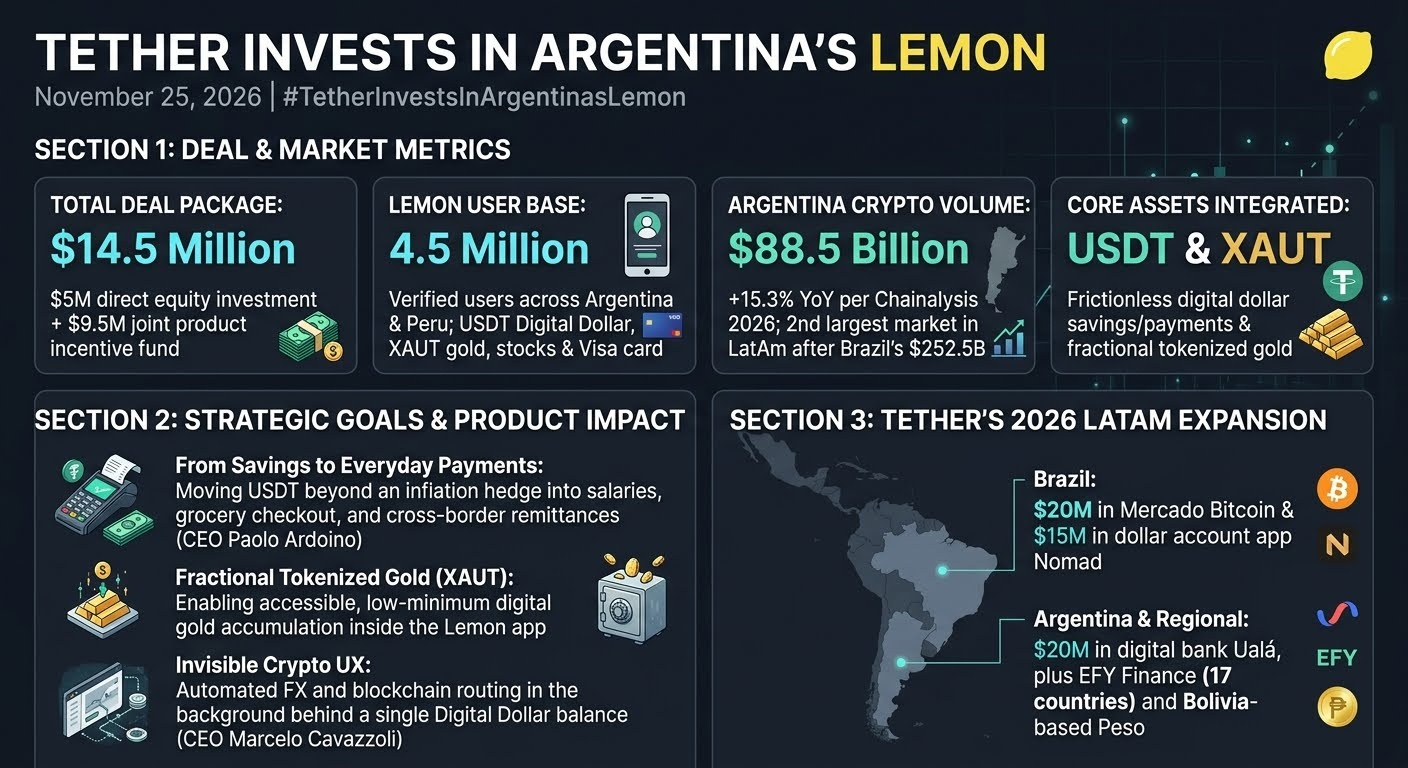
Tether has made a $14.5 million strategic investment in Argentina-based digital asset fintech company Lemon, aiming to bring the use of USDT and gold-backed XAU₮ to everyday payments across Latin America. 🍋💵📊 The Deal and the Argentine Market in Numbers
IndicatorData / FigureKey Detail💰 Total Package$14.5 Million$5 million direct equity investment, plus a $9.5 million incentive fund for co-developed products.📱 Lemon Users4.5 Million (Verified)Offers USDT-based Digital Dollars, XAU₮ digital gold, stocks, and a prepaid Visa card in a single app.🇦🇷 Argentina's Crypto Volume$88.5 Billion (+15.3% year over year)According to Chainalysis's 2026 report, Latin America's second-largest market after Brazil ($252.5B).
🚀 What Will This Investment Change?
💳 From Savings to Everyday Payments: Tether CEO Paolo Ardoino emphasizes that in Argentina and Latin America, USDT is no longer just a hedge against inflation; it's actively used to receive salaries, shop for groceries, and make cross-border transfers.🪙 Fractional Digital Gold (XAU₮): Users will be able to accumulate and manage small amounts of tokenized gold (XAU₮) through the app without needing a large initial investment.🔄 Automatic Conversion in the Background: Lemon CEO Marcelo Cavazzoli says that currency conversions and blockchain network transactions are handled automatically in the background, allowing users to carry out all their financial transactions with a single "Digital Dollar" balance.
🌎 Tether's Latin America Push Is Growing
Throughout 2026, Tether is making aggressive investments in fintech companies and payment networks across the region to build its own distribution channel:
Brazil: Investments in Mercado Bitcoin ($20 million) and dollar account app Nomad ($15 million).🇦🇷 Argentina & the Region: Digital bank Ualá ($20 million), EFY Finance (business payments in 17 countries), and Bolivia-based Peso.
$XAUT $TRUMP $PAXG
{future}(TRUMPUSDT)
{future}(XAUTUSDT)
#tetherinvestsinargentinaslemon
Tether has made a $14.5 million strategic investment in Argentina-based digital asset fintech company Lemon, aiming to bring the use of USDT and gold-backed XAU₮ to everyday payments across Latin America. 🍋💵📊 The Deal and the Argentine Market in Numbers
IndicatorData / FigureKey Detail💰 Total Package$14.5 Million$5 million direct equity investment, plus a $9.5 million incentive fund for co-developed products.📱 Lemon Users4.5 Million (Verified)Offers USDT-based Digital Dollars, XAU₮ digital gold, stocks, and a prepaid Visa card in a single app.🇦🇷 Argentina's Crypto Volume$88.5 Billion (+15.3% year over year)According to Chainalysis's 2026 report, Latin America's second-largest market after Brazil ($252.5B).
🚀 What Will This Investment Change?
💳 From Savings to Everyday Payments: Tether CEO Paolo Ardoino emphasizes that in Argentina and Latin America, USDT is no longer just a hedge against inflation; it's actively used to receive salaries, shop for groceries, and make cross-border transfers.🪙 Fractional Digital Gold (XAU₮): Users will be able to accumulate and manage small amounts of tokenized gold (XAU₮) through the app without needing a large initial investment.🔄 Automatic Conversion in the Background: Lemon CEO Marcelo Cavazzoli says that currency conversions and blockchain network transactions are handled automatically in the background, allowing users to carry out all their financial transactions with a single "Digital Dollar" balance.
🌎 Tether's Latin America Push Is Growing
Throughout 2026, Tether is making aggressive investments in fintech companies and payment networks across the region to build its own distribution channel:
Brazil: Investments in Mercado Bitcoin ($20 million) and dollar account app Nomad ($15 million).🇦🇷 Argentina & the Region: Digital bank Ualá ($20 million), EFY Finance (business payments in 17 countries), and Bolivia-based Peso.
$XAUT $TRUMP $PAXG
3k
·
--
#BitcoinETFsPostRecord$4.94BNovemberOutflows
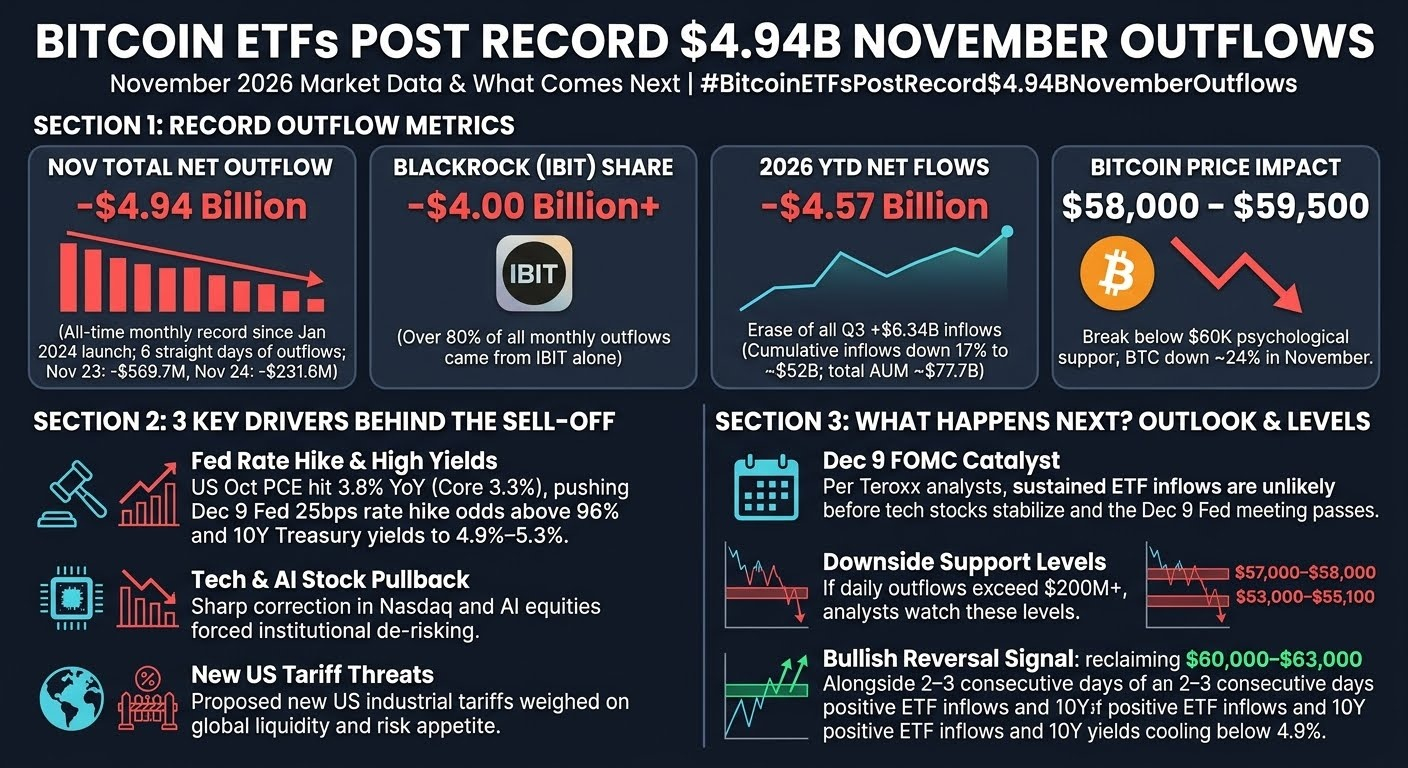
U.S. spot Bitcoin ETFs experienced their largest monthly capital outflow since their launch in January 2024, with net outflows of $4.94 billion in November 2026; what happens next depends on the Fed's December 9 decision and bond yields stabilizing. 📉🏦
📊 Record Outflows in Numbers
IndicatorData / FigureKey Detail📉 November Total Outflow-$4.94 BillionAll-time record since January 2024 (outflows for 6 consecutive trading days). 🚨🏦 BlackRock (IBIT)-$4.00 Billion+More than 80% of total outflows came from IBIT alone. 💼📊 2026 Year-to-Date Net Flows-$4.57 BillionQ3 inflows of +$6.34B were completely wiped out, and annual flows turned negative. 🔄🪙 Bitcoin Price Impact$58,000 – $59,500The $60,000 psychological support level was broken; BTC fell ~24% on a monthly basis. 🔻
🚨 Why Are Outflows Happening?
🔥 Pressure from Fed Rate Hikes: With October PCE inflation rising to 3.8%, the probability of a rate hike at the December 9 Fed meeting exceeded 96%; bond yields approaching the 5% range put pressure on Bitcoin. 📈🤖 AI and Tariff Sell-Offs: A sharp correction in tech/AI stocks and new U.S. tariff threats prompted institutional investors to reduce risk. 💻🚢
🔮 What Happens Next?
⏳ December 9 Threshold: According to Teroxx analysts, a sustained return of money to ETFs is unlikely until tech stocks stabilize and the December 9 FOMC meeting is behind us. 🗓️📉 Key Levels: If daily outflows of $200M+ continue, support at $57,000–$58,000 and then $53,000–$55,100 could come into play. For a recovery, BTC must climb back above $60,000 and ETFs must see a 2–3-day streak of positive inflows. 🎯🏛️ Medium Term: Once U.S. 10-year Treasury yields fall below 4.9%, a rapid return of capital is expected, thanks to the deepened institutional ETF infrastructure. 🚀
$BTC $BTCS.US $INX
{future}(INXUSDT)
{stock_us}(BTCS.US)
{future}(BTCUSDT)
#BitcoinETFsPostRecord$4.94BNovemberOutflows
U.S. spot Bitcoin ETFs experienced their largest monthly capital outflow since their launch in January 2024, with net outflows of $4.94 billion in November 2026; what happens next depends on the Fed's December 9 decision and bond yields stabilizing. 📉🏦
📊 Record Outflows in Numbers
IndicatorData / FigureKey Detail📉 November Total Outflow-$4.94 BillionAll-time record since January 2024 (outflows for 6 consecutive trading days). 🚨🏦 BlackRock (IBIT)-$4.00 Billion+More than 80% of total outflows came from IBIT alone. 💼📊 2026 Year-to-Date Net Flows-$4.57 BillionQ3 inflows of +$6.34B were completely wiped out, and annual flows turned negative. 🔄🪙 Bitcoin Price Impact$58,000 – $59,500The $60,000 psychological support level was broken; BTC fell ~24% on a monthly basis. 🔻
🚨 Why Are Outflows Happening?
🔥 Pressure from Fed Rate Hikes: With October PCE inflation rising to 3.8%, the probability of a rate hike at the December 9 Fed meeting exceeded 96%; bond yields approaching the 5% range put pressure on Bitcoin. 📈🤖 AI and Tariff Sell-Offs: A sharp correction in tech/AI stocks and new U.S. tariff threats prompted institutional investors to reduce risk. 💻🚢
🔮 What Happens Next?
⏳ December 9 Threshold: According to Teroxx analysts, a sustained return of money to ETFs is unlikely until tech stocks stabilize and the December 9 FOMC meeting is behind us. 🗓️📉 Key Levels: If daily outflows of $200M+ continue, support at $57,000–$58,000 and then $53,000–$55,100 could come into play. For a recovery, BTC must climb back above $60,000 and ETFs must see a 2–3-day streak of positive inflows. 🎯🏛️ Medium Term: Once U.S. 10-year Treasury yields fall below 4.9%, a rapid return of capital is expected, thanks to the deepened institutional ETF infrastructure. 🚀
$BTC $BTCS.US $INX
57
·
--
#usoctoberpcepriceindexat0.3%mom
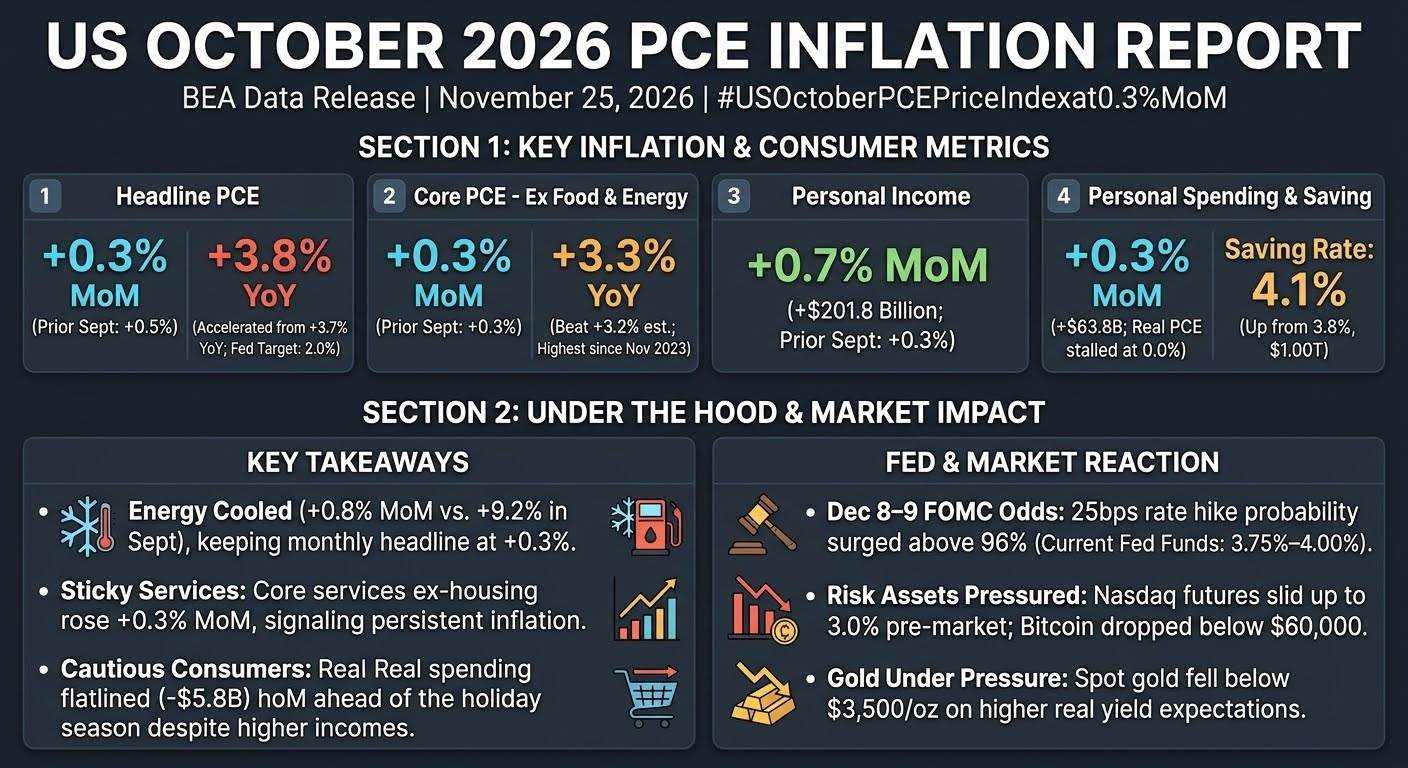
The U.S. Personal Consumption Expenditures (PCE) price index rose 0.3% month over month in October 2026, in line with expectations, while headline inflation climbed to 3.8% year over year and core inflation to 3.3%, strengthening the likelihood of a Fed rate hike in December. 📊🔥
📈 October 2026 U.S. PCE Summary
IndicatorOctober 2026 (Monthly)October 2026 (Annual)Key Note🏷️ Headline PCE+0.3% (September: +0.5%)+3.8%Accelerated from 3.7% year over year (Fed target: 2%).🎯 Core PCE (Excluding Food & Energy)+0.3% (September: +0.3%)+3.3%Expectations were 3.2%; the highest level since November 2023.💵 Personal Income+0.7% (+$201.8 Billion)—Wage gains and one-time Medicare payments contributed.🛒 Personal Spending & Savings+0.3% (Real: 0.0%)—Real spending stalled; the savings rate rose to 4.1%.
🔍 Reading Between the Lines
⛽ Energy Slowed, Services Remained Sticky: Energy prices, which surged 9.2% in September, slowed to +0.8% in October, tempering the monthly figure. However, services inflation excluding housing and energy continued to rise by +0.3% monthly, showing that price pressures remain persistent.🛍️ Consumers Put on the Brakes: Despite a 0.7% increase in income, inflation-adjusted real spending was unchanged, suggesting households are cutting back ahead of the holiday season because of high prices.
🏦 Impact on the Fed and Markets
📈 December Rate Hike Expectations: Core PCE reaching a 3-year high (3.3%) pushed the probability of a 25-basis-point rate hike at the December 8–9 Fed meeting above 96%.📉 Asset Prices Under Pressure: Expectations of tighter monetary policy weighed on technology stocks (Nasdaq), while Bitcoin fell below the $60,000 mark and gold was pressured below $3,500 per ounce.
$BNB $ETH $SSV
{future}(SSVUSDT)
{future}(ETHUSDT)
{future}(BNBUSDT)
#usoctoberpcepriceindexat0.3%mom
The U.S. Personal Consumption Expenditures (PCE) price index rose 0.3% month over month in October 2026, in line with expectations, while headline inflation climbed to 3.8% year over year and core inflation to 3.3%, strengthening the likelihood of a Fed rate hike in December. 📊🔥
📈 October 2026 U.S. PCE Summary
IndicatorOctober 2026 (Monthly)October 2026 (Annual)Key Note🏷️ Headline PCE+0.3% (September: +0.5%)+3.8%Accelerated from 3.7% year over year (Fed target: 2%).🎯 Core PCE (Excluding Food & Energy)+0.3% (September: +0.3%)+3.3%Expectations were 3.2%; the highest level since November 2023.💵 Personal Income+0.7% (+$201.8 Billion)—Wage gains and one-time Medicare payments contributed.🛒 Personal Spending & Savings+0.3% (Real: 0.0%)—Real spending stalled; the savings rate rose to 4.1%.
🔍 Reading Between the Lines
⛽ Energy Slowed, Services Remained Sticky: Energy prices, which surged 9.2% in September, slowed to +0.8% in October, tempering the monthly figure. However, services inflation excluding housing and energy continued to rise by +0.3% monthly, showing that price pressures remain persistent.🛍️ Consumers Put on the Brakes: Despite a 0.7% increase in income, inflation-adjusted real spending was unchanged, suggesting households are cutting back ahead of the holiday season because of high prices.
🏦 Impact on the Fed and Markets
📈 December Rate Hike Expectations: Core PCE reaching a 3-year high (3.3%) pushed the probability of a 25-basis-point rate hike at the December 8–9 Fed meeting above 96%.📉 Asset Prices Under Pressure: Expectations of tighter monetary policy weighed on technology stocks (Nasdaq), while Bitcoin fell below the $60,000 mark and gold was pressured below $3,500 per ounce.
$BNB $ETH $SSV
975
·
--
#nasdaqfuturesslidemorethan3%
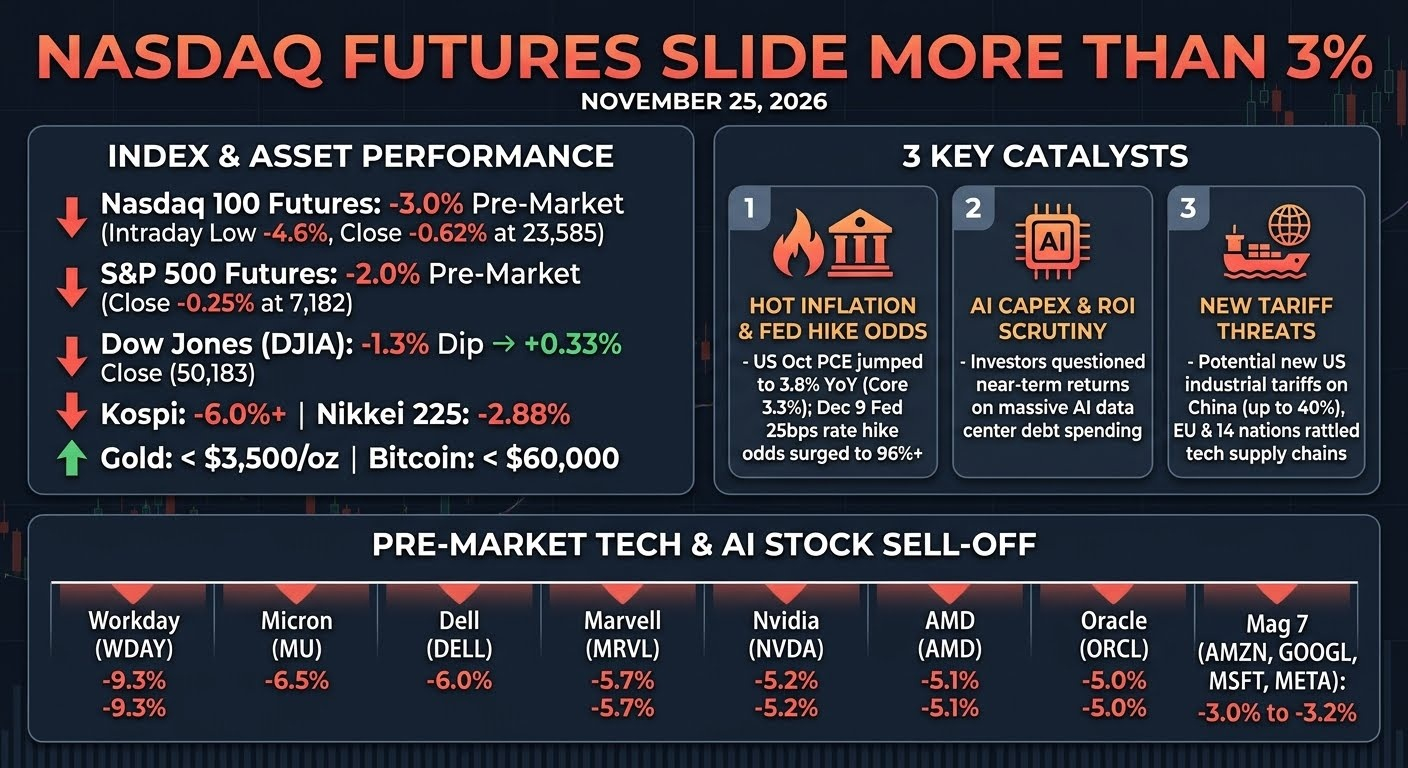
On November 25, 2026, Nasdaq 100 futures plunged by as much as 3% in premarket trading, triggering a fresh wave of selling in technology and artificial intelligence stocks. 📉🔥
📊 Index Performance (November 25, 2026)
Index | Premarket / Intraday Low | Close / Latest
Nasdaq 100 Futures 📉 | -3.0% (Spot low: -4.6%) | -0.62% (23,585.80)
S&P 500 Futures 📊 | -2.0% (Spot low: -3.2%) | -0.25% (7,182.78)
Dow Jones (DJIA) 🏛️ | -1.3% (-609 points) | +0.33% (50,182.95)
🚨 3 Key Reasons Behind the Decline
🔥 Hot Inflation and Fed Pressure: US PCE inflation rose to 3.8% year over year in October (core: 3.3%). 📈 The probability of a 25-basis-point rate hike at the Fed's December 9 meeting rose to over 96%. 🏦🤖 AI Spending Concerns: Questions about the short-term profitability of massive data center investments triggered sharp selloffs in chip and tech giants: Nvidia (-5.2%), Micron (-6.5%), AMD (-5.1%), Workday (-9.3%), and Dell (-6.0%). 💻🚢 New Tariff Threat: Reports that the Trump administration could announce new industrial tariffs targeting China (up to 40% if negotiations collapse), the EU, and 14 countries rattled the technology supply chain. 🌐⚠️
🌍 Global and Crypto Impact
🌏 Asia & Commodities: South Korea's Kospi fell more than 6%, while Japan's Nikkei dropped 2.88%; amid rate pressures, spot gold fell below $3,500. 🪙 Crypto: As risk appetite weakened, Bitcoin fell below the psychological $60,000 threshold. 📉⏰ Calendar: US stock markets are closed on November 26 (today), and will close early at 9:00 PM Turkey time on Friday, November 27. 🦃
$MMT $BULLA $EVAA
{future}(EVAAUSDT)
{future}(BULLAUSDT)
{future}(MMTUSDT)
#nasdaqfuturesslidemorethan3%
On November 25, 2026, Nasdaq 100 futures plunged by as much as 3% in premarket trading, triggering a fresh wave of selling in technology and artificial intelligence stocks. 📉🔥
📊 Index Performance (November 25, 2026)
Index | Premarket / Intraday Low | Close / Latest
Nasdaq 100 Futures 📉 | -3.0% (Spot low: -4.6%) | -0.62% (23,585.80)
S&P 500 Futures 📊 | -2.0% (Spot low: -3.2%) | -0.25% (7,182.78)
Dow Jones (DJIA) 🏛️ | -1.3% (-609 points) | +0.33% (50,182.95)
🚨 3 Key Reasons Behind the Decline
🔥 Hot Inflation and Fed Pressure: US PCE inflation rose to 3.8% year over year in October (core: 3.3%). 📈 The probability of a 25-basis-point rate hike at the Fed's December 9 meeting rose to over 96%. 🏦🤖 AI Spending Concerns: Questions about the short-term profitability of massive data center investments triggered sharp selloffs in chip and tech giants: Nvidia (-5.2%), Micron (-6.5%), AMD (-5.1%), Workday (-9.3%), and Dell (-6.0%). 💻🚢 New Tariff Threat: Reports that the Trump administration could announce new industrial tariffs targeting China (up to 40% if negotiations collapse), the EU, and 14 countries rattled the technology supply chain. 🌐⚠️
🌍 Global and Crypto Impact
🌏 Asia & Commodities: South Korea's Kospi fell more than 6%, while Japan's Nikkei dropped 2.88%; amid rate pressures, spot gold fell below $3,500. 🪙 Crypto: As risk appetite weakened, Bitcoin fell below the psychological $60,000 threshold. 📉⏰ Calendar: US stock markets are closed on November 26 (today), and will close early at 9:00 PM Turkey time on Friday, November 27. 🦃
$MMT $BULLA $EVAA
1.1k
·
--
#couldspacex’sorbitaldatacentersboostaichipdemand?
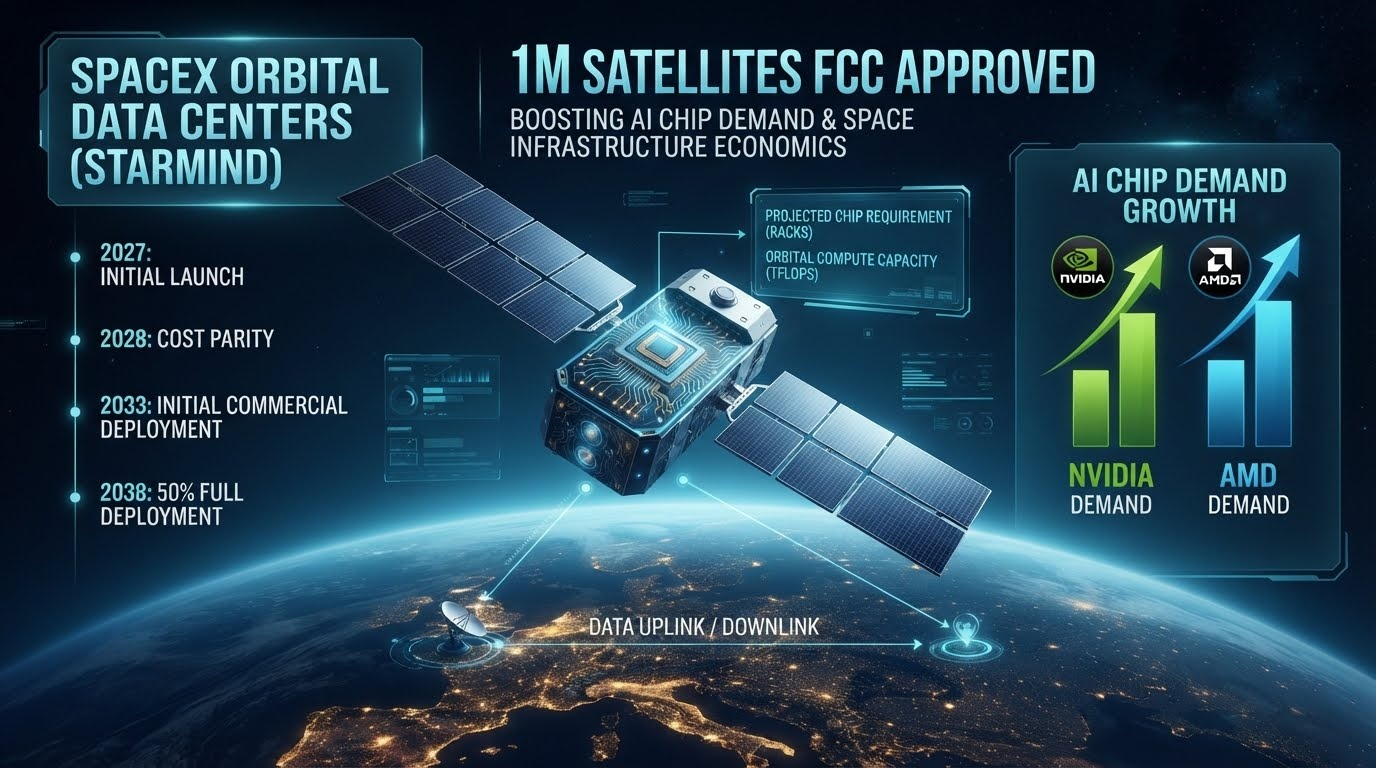
SpaceX's orbital data center project (Starmind) could create a massive new growth channel for AI chip demand in the long term, but its impact will remain limited in the short term due to financial and technical hurdles. 🛰️💻
🚀 Impact on Chip Demand and Timeline
🎮 Nvidia and AMD: 👩💼 Cathie Wood (ARK Invest) predicts the project will create huge additional demand for Nvidia and AMD chips. 📈 SpaceX also plans to build its own chip factory, called TeraFab, in Texas. 🏭📅 Key Dates: The first launches will begin in late 2027. 🚀 According to ARK Invest, costs will reach parity with data centers around the world in 2028; under the FCC license, 100,000 satellites will be active by 2035 and 500,000 by 2038. 🌍
⚠️ 3 Major Hurdles Ahead
🏦 Banks' "Collateral" Hurdle: 📰 According to The Wall Street Journal, banks that lent SpaceX $40–43 billion to purchase chips oppose sending the chips into space because they cannot repossess them. 🚫🌡️ Cooling and Radiation: Dissipating heat in direct sunlight and protecting chips in space require substantial engineering costs. ☀️❄️🚀 The Licensing Reality: Companies obtain licenses for far more satellites than they plan to deploy, to allow for flexibility (for example, Starlink has licenses for 42,000 satellites but only about 11,000). 📡
💡 Summary
⚡ Short Term: It provides strong narrative support for chip stocks and AI projects, but a massive direct revenue contribution to financial statements is not expected before late 2027. 📊
🌟 Long Term: It creates a new 10–15-year growth thesis that could ease concerns about AI chip demand reaching saturation. 🔭
$NVDA $AMD $SPCX
{future}(SPCXUSDT)
{future}(AMDUSDT)
{future}(NVDAUSDT)
#couldspacex’sorbitaldatacentersboostaichipdemand?
SpaceX's orbital data center project (Starmind) could create a massive new growth channel for AI chip demand in the long term, but its impact will remain limited in the short term due to financial and technical hurdles. 🛰️💻
🚀 Impact on Chip Demand and Timeline
🎮 Nvidia and AMD: 👩💼 Cathie Wood (ARK Invest) predicts the project will create huge additional demand for Nvidia and AMD chips. 📈 SpaceX also plans to build its own chip factory, called TeraFab, in Texas. 🏭📅 Key Dates: The first launches will begin in late 2027. 🚀 According to ARK Invest, costs will reach parity with data centers around the world in 2028; under the FCC license, 100,000 satellites will be active by 2035 and 500,000 by 2038. 🌍
⚠️ 3 Major Hurdles Ahead
🏦 Banks' "Collateral" Hurdle: 📰 According to The Wall Street Journal, banks that lent SpaceX $40–43 billion to purchase chips oppose sending the chips into space because they cannot repossess them. 🚫🌡️ Cooling and Radiation: Dissipating heat in direct sunlight and protecting chips in space require substantial engineering costs. ☀️❄️🚀 The Licensing Reality: Companies obtain licenses for far more satellites than they plan to deploy, to allow for flexibility (for example, Starlink has licenses for 42,000 satellites but only about 11,000). 📡
💡 Summary
⚡ Short Term: It provides strong narrative support for chip stocks and AI projects, but a massive direct revenue contribution to financial statements is not expected before late 2027. 📊
🌟 Long Term: It creates a new 10–15-year growth thesis that could ease concerns about AI chip demand reaching saturation. 🔭
$NVDA $AMD $SPCX
353
·
--
#canmarketsreboundafterthanksgiving?
Markets may see a short-term relief rally after Thanksgiving; however, macroeconomic headwinds need to be overcome for a sustained rise. 📈🤔
1. Current Situation 🎢📉
In recent days, sharp sell-offs in chip and technology stocks (Nvidia, Micron), tariff news, and higher-than-expected inflation data (3.3%) have shaken the markets.
Pre-Holiday Rebound 🔄: On the last trading day, indexes recovered from sharp intraday declines and closed higher. Dip-Buying Expectations 🦈: Famous investors like Michael Burry closing their short positions and starting to buy strengthened expectations of an “oversold” bounce.
2. Historical Statistics 📅📊
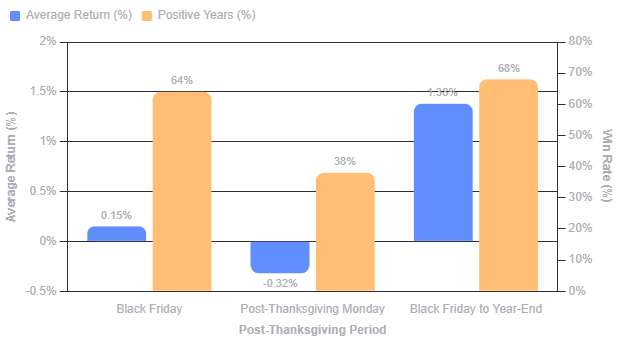
According to IG Bank data for the past 50 years, the post-holiday period looks like this:
Trading DayDate (2026)Average ReturnProbability of RiseOutlookBlack Friday (Half Day) 🛍️November 27+0.15%64%Low-volume positive trading 🟢Post-Holiday Monday 😴November 30-0.32%38%Profit-taking and weakness 🔴Black Friday - Year-End 🎄Nov 27 - Dec 31+1.38%68%Data-dependent rally 🎅
3. 3 Conditions for a Sustained Recovery 🔑⚖️
According to Bank of America analyses, the following are needed for the rebound to last:
Bond Yields 🏦: U.S. 10-year Treasury yields (4.84%) need to fall below 4.50%. Oil Prices 🛢️: Crude oil (~$84) needs to drop below $70. Fed and Inflation 🦅: Data ahead of the December meeting needs to ease pressure for higher interest rates.
Summary 🎯💡
In the short term, relief rallies are quite likely due to oversold conditions. However, with inflation high and the Fed maintaining its tight stance, the safest approach is to act cautiously and gradually, given the risk that these rallies may be temporary. ⚠️
$ZEC $MOVE $MANTRA
{future}(MANTRAUSDT)
{future}(MOVEUSDT)
{future}(ZECUSDT)
#canmarketsreboundafterthanksgiving?
Markets may see a short-term relief rally after Thanksgiving; however, macroeconomic headwinds need to be overcome for a sustained rise. 📈🤔
1. Current Situation 🎢📉
In recent days, sharp sell-offs in chip and technology stocks (Nvidia, Micron), tariff news, and higher-than-expected inflation data (3.3%) have shaken the markets.
Pre-Holiday Rebound 🔄: On the last trading day, indexes recovered from sharp intraday declines and closed higher. Dip-Buying Expectations 🦈: Famous investors like Michael Burry closing their short positions and starting to buy strengthened expectations of an “oversold” bounce.
2. Historical Statistics 📅📊
According to IG Bank data for the past 50 years, the post-holiday period looks like this:
Trading DayDate (2026)Average ReturnProbability of RiseOutlookBlack Friday (Half Day) 🛍️November 27+0.15%64%Low-volume positive trading 🟢Post-Holiday Monday 😴November 30-0.32%38%Profit-taking and weakness 🔴Black Friday - Year-End 🎄Nov 27 - Dec 31+1.38%68%Data-dependent rally 🎅
3. 3 Conditions for a Sustained Recovery 🔑⚖️
According to Bank of America analyses, the following are needed for the rebound to last:
Bond Yields 🏦: U.S. 10-year Treasury yields (4.84%) need to fall below 4.50%. Oil Prices 🛢️: Crude oil (~$84) needs to drop below $70. Fed and Inflation 🦅: Data ahead of the December meeting needs to ease pressure for higher interest rates.
Summary 🎯💡
In the short term, relief rallies are quite likely due to oversold conditions. However, with inflation high and the Fed maintaining its tight stance, the safest approach is to act cautiously and gradually, given the risk that these rallies may be temporary. ⚠️
$ZEC $MOVE $MANTRA
1.6k
·
--
Verified
#HKMALaunchesCMUDigitalAssetPlatformForBondTokenization
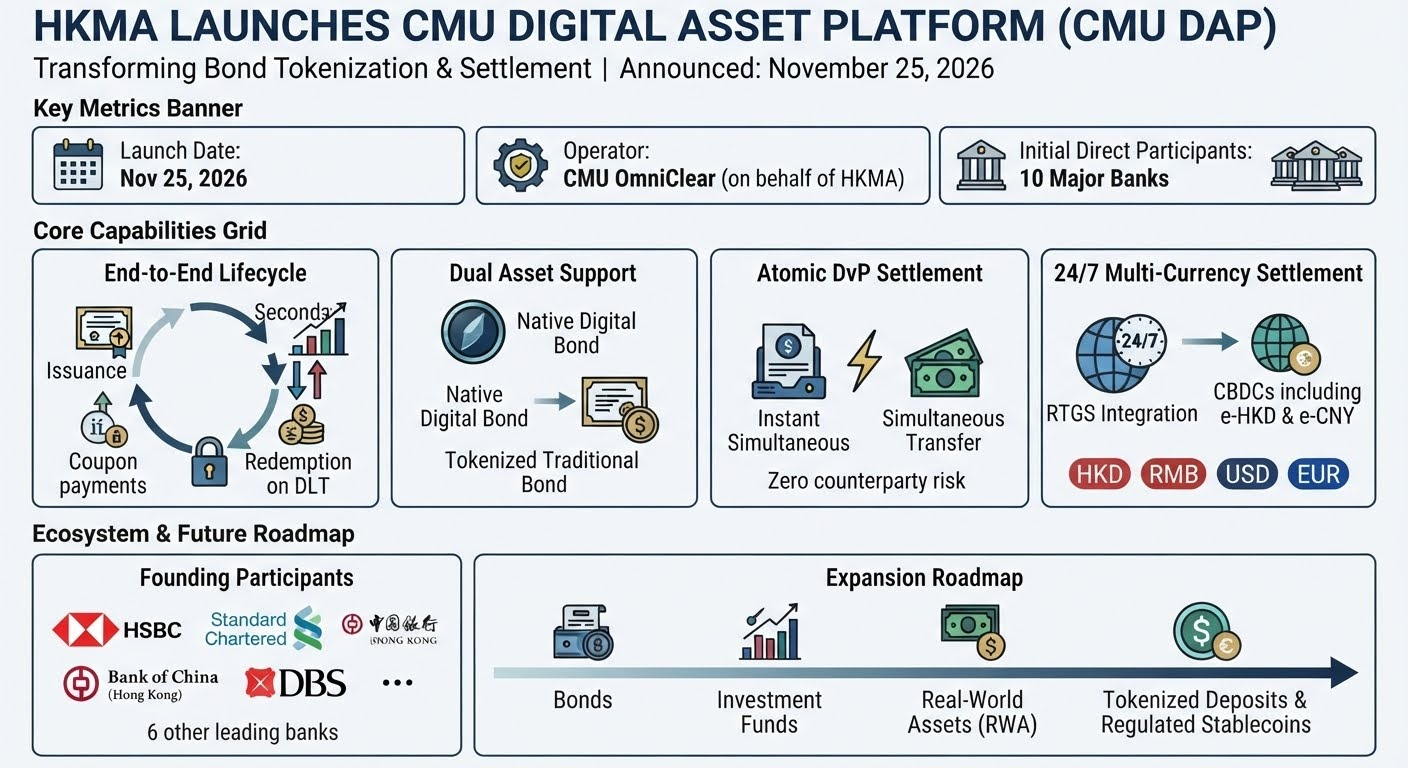
The Hong Kong Monetary Authority (HKMA) launched the CMU Digital Asset Platform (CMU DAP) for bond tokenization.
Announced on November 25, 2026, this move combines the debt securities market with blockchain infrastructure.
End-to-End Digital Process 🔄: The entire process, from issuance and secondary market transactions to interest payments and redemption, is managed on a single platform. Dual Asset Support 📜: The platform supports both digitally issued bonds and traditional bonds that are tokenized later. Instant Settlement (Atomic DvP) ⚡: Securities and cash transfers take place simultaneously, eliminating counterparty risk. 24/7 Multi-Currency 💱: Settlement is available around the clock in HKD, RMB, USD, and EUR via RTGS and central bank digital currencies (e-HKD, e-CNY). Participants and the Future 🏦: Operated by CMU OmniClear, the system launched with 10 major banks, including HSBC, Standard Chartered, Bank of China (Hong Kong), and DBS. The aim is to add investment funds, RWAs, and stablecoins to the system in the future.
$MANTRA $QKC $ALICE
{future}(ALICEUSDT)
{spot}(QKCUSDT)
{future}(MANTRAUSDT)
#HKMALaunchesCMUDigitalAssetPlatformForBondTokenization
The Hong Kong Monetary Authority (HKMA) launched the CMU Digital Asset Platform (CMU DAP) for bond tokenization.
Announced on November 25, 2026, this move combines the debt securities market with blockchain infrastructure.
End-to-End Digital Process 🔄: The entire process, from issuance and secondary market transactions to interest payments and redemption, is managed on a single platform. Dual Asset Support 📜: The platform supports both digitally issued bonds and traditional bonds that are tokenized later. Instant Settlement (Atomic DvP) ⚡: Securities and cash transfers take place simultaneously, eliminating counterparty risk. 24/7 Multi-Currency 💱: Settlement is available around the clock in HKD, RMB, USD, and EUR via RTGS and central bank digital currencies (e-HKD, e-CNY). Participants and the Future 🏦: Operated by CMU OmniClear, the system launched with 10 major banks, including HSBC, Standard Chartered, Bank of China (Hong Kong), and DBS. The aim is to add investment funds, RWAs, and stablecoins to the system in the future.
$MANTRA $QKC $ALICE
433
·
--
#bitcoinandstocksslipagainamidtrump’stariffplans
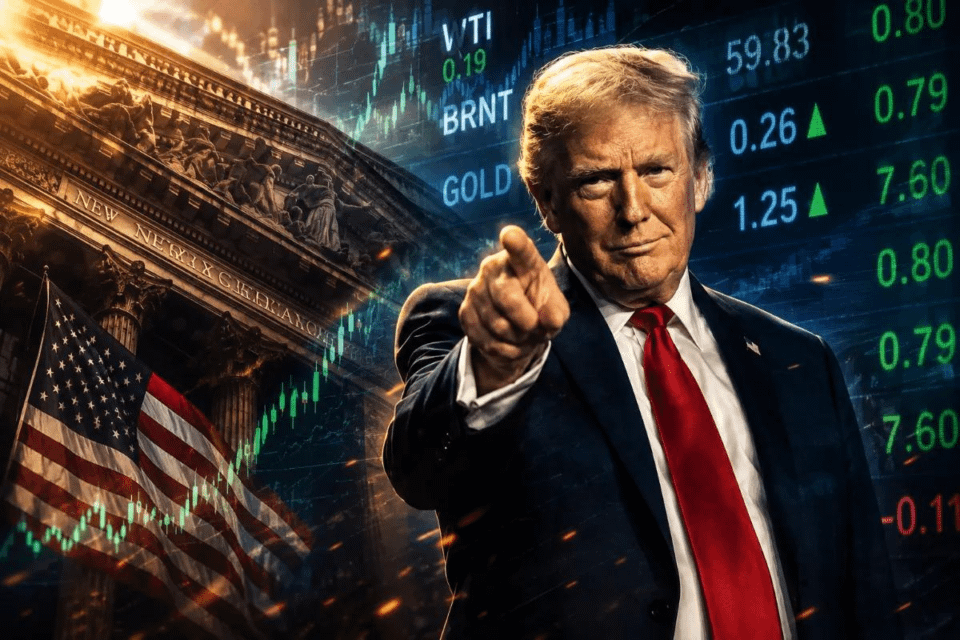
With plans for new tariffs targeting 16 economies—particularly China and the European Union (EU)—being brought back into focus by U.S. President Donald Trump, Bitcoin and U.S. stock markets fell again.
Here’s a summary of the latest market developments:
New Wave of Tariffs. According to a Wall Street Journal report, the U.S. administration is preparing to impose additional tariffs on China, the EU, and 14 other countries, covering imports worth approximately $2.4 trillion. 🌍🚢📦Bitcoin Plunges. Amid concerns about a new trade war, Bitcoin lost more than 6% of its value, falling below the $60,000 mark and heading toward its seventh consecutive weekly decline. 🪙📉💔Selling Pressure on Stock Markets. The Nasdaq and S&P 500 indexes also fell amid selling in technology stocks and tariff news; shares of crypto-linked companies (Coinbase, Strategy, etc.) plunged sharply. 📊🔻🏢Inflation and Fed Concerns. Expectations that additional tariffs could reignite inflation in the U.S. and make it harder for the Federal Reserve (Fed) to decide on interest rates in December are pushing investors away from risky assets. 💸🏦⚠️
$BTCDOM $BIGTIME $BTC
{future}(BTCUSDT)
{future}(BIGTIMEUSDT)
{future}(BTCDOMUSDT)
#bitcoinandstocksslipagainamidtrump’stariffplans
With plans for new tariffs targeting 16 economies—particularly China and the European Union (EU)—being brought back into focus by U.S. President Donald Trump, Bitcoin and U.S. stock markets fell again.
Here’s a summary of the latest market developments:
New Wave of Tariffs. According to a Wall Street Journal report, the U.S. administration is preparing to impose additional tariffs on China, the EU, and 14 other countries, covering imports worth approximately $2.4 trillion. 🌍🚢📦Bitcoin Plunges. Amid concerns about a new trade war, Bitcoin lost more than 6% of its value, falling below the $60,000 mark and heading toward its seventh consecutive weekly decline. 🪙📉💔Selling Pressure on Stock Markets. The Nasdaq and S&P 500 indexes also fell amid selling in technology stocks and tariff news; shares of crypto-linked companies (Coinbase, Strategy, etc.) plunged sharply. 📊🔻🏢Inflation and Fed Concerns. Expectations that additional tariffs could reignite inflation in the U.S. and make it harder for the Federal Reserve (Fed) to decide on interest rates in December are pushing investors away from risky assets. 💸🏦⚠️
$BTCDOM $BIGTIME $BTC
1
2.2k
·
--
#cftcapprovestradereportingruleforpredictionmarkets
The U.S. Commodity Futures Trading Commission (CFTC) has approved permanent trading and data reporting rules for prediction markets ⚖️. Announced on November 23, 2026, the decision places platforms where people bet or make predictions on real-world events under strict oversight, just like traditional financial exchanges.
Here are the key details of the new rules:
Temporary Exemptions End, Permanent Rules Take Effect 📜 Until now, prediction market platforms such as Kalshi have operated under temporary no-action letters issued by the CFTC since 2017. The new decision ends this period of flexibility and establishes standard, permanent rules for all platforms. Identity and Employment Information Required 🕵️♂️ Exchanges will now have to collect not only users’ names, addresses, email addresses, and phone numbers, but also their occupations and employer details, and match this information to their transactions. Measures Against Insider Trading 🔍 The main reason regulators want to know where users work is to prevent people who know or could influence the outcome of an event in advance (for example, company employees or officials) from making unfair gains. Full Transparency in Transaction Reporting 📊 Platforms will report transaction times, contract codes, transaction volumes, dollar-denominated prices, and settlement data to the CFTC and the public, just like traditional futures exchanges. Transition Period Begins ⏳ The public transaction reporting rules will take effect 60 days after the decision is published in the official gazette. Platforms will have 12 months to comply with the requirement to collect users’ occupation and employer information.
$BIGTIME $ATM $SKDD
{future}(SKDDUSDT)
{spot}(ATMUSDT)
{future}(BIGTIMEUSDT)
#cftcapprovestradereportingruleforpredictionmarkets
The U.S. Commodity Futures Trading Commission (CFTC) has approved permanent trading and data reporting rules for prediction markets ⚖️. Announced on November 23, 2026, the decision places platforms where people bet or make predictions on real-world events under strict oversight, just like traditional financial exchanges.
Here are the key details of the new rules:
Temporary Exemptions End, Permanent Rules Take Effect 📜 Until now, prediction market platforms such as Kalshi have operated under temporary no-action letters issued by the CFTC since 2017. The new decision ends this period of flexibility and establishes standard, permanent rules for all platforms. Identity and Employment Information Required 🕵️♂️ Exchanges will now have to collect not only users’ names, addresses, email addresses, and phone numbers, but also their occupations and employer details, and match this information to their transactions. Measures Against Insider Trading 🔍 The main reason regulators want to know where users work is to prevent people who know or could influence the outcome of an event in advance (for example, company employees or officials) from making unfair gains. Full Transparency in Transaction Reporting 📊 Platforms will report transaction times, contract codes, transaction volumes, dollar-denominated prices, and settlement data to the CFTC and the public, just like traditional futures exchanges. Transition Period Begins ⏳ The public transaction reporting rules will take effect 60 days after the decision is published in the official gazette. Platforms will have 12 months to comply with the requirement to collect users’ occupation and employer information.
$BIGTIME $ATM $SKDD
1.4k
·
--
#jensenhuangsaysnvidiadoesn’tneedasuccessionplan
Nvidia CEO Jensen Huang argues that the company does not need a traditional succession plan. Here’s a summary of the striking remarks he made at a meeting with employees as soon as he returned to work after an 11-day absence:
What Happened? 🌪️ Huang resigned in November 2026 following allegations of an unethical relationship. After Nvidia’s market value fell by more than $1 trillion, the board reinstated him as CEO 11 days later.
Why Doesn’t He Want a Succession Plan? 🚫 At his first all-hands meeting after returning, he said Nvidia had a unique business model and very strong division leaders.
Warning About Unnecessary Hierarchy 📊 According to Huang, identifying and training future CEO candidates now could create unnecessary hierarchy, favoritism, and power struggles within the company.
A Flat Management Structure 🤝 He is determined to preserve the company’s “flat” structure, in which dozens of senior executives report directly to him. Rather than choosing a single successor, he advocates continually sharing knowledge and experience with the entire team.
Investors’ Concerns 📉 Analysts and investors, however, believe that relying so heavily on a single founder leaves the company vulnerable to crises.
$NVDA $GUA $SOXS
{future}(SOXSUSDT)
{future}(GUAUSDT)
{future}(NVDAUSDT)
#jensenhuangsaysnvidiadoesn’tneedasuccessionplan
Nvidia CEO Jensen Huang argues that the company does not need a traditional succession plan. Here’s a summary of the striking remarks he made at a meeting with employees as soon as he returned to work after an 11-day absence:
What Happened? 🌪️ Huang resigned in November 2026 following allegations of an unethical relationship. After Nvidia’s market value fell by more than $1 trillion, the board reinstated him as CEO 11 days later.
Why Doesn’t He Want a Succession Plan? 🚫 At his first all-hands meeting after returning, he said Nvidia had a unique business model and very strong division leaders.
Warning About Unnecessary Hierarchy 📊 According to Huang, identifying and training future CEO candidates now could create unnecessary hierarchy, favoritism, and power struggles within the company.
A Flat Management Structure 🤝 He is determined to preserve the company’s “flat” structure, in which dozens of senior executives report directly to him. Rather than choosing a single successor, he advocates continually sharing knowledge and experience with the entire team.
Investors’ Concerns 📉 Analysts and investors, however, believe that relying so heavily on a single founder leaves the company vulnerable to crises.
$NVDA $GUA $SOXS

535
·
--
#SouthKoreaProposesBanksHoldOver50%OfStablecoinIssuers
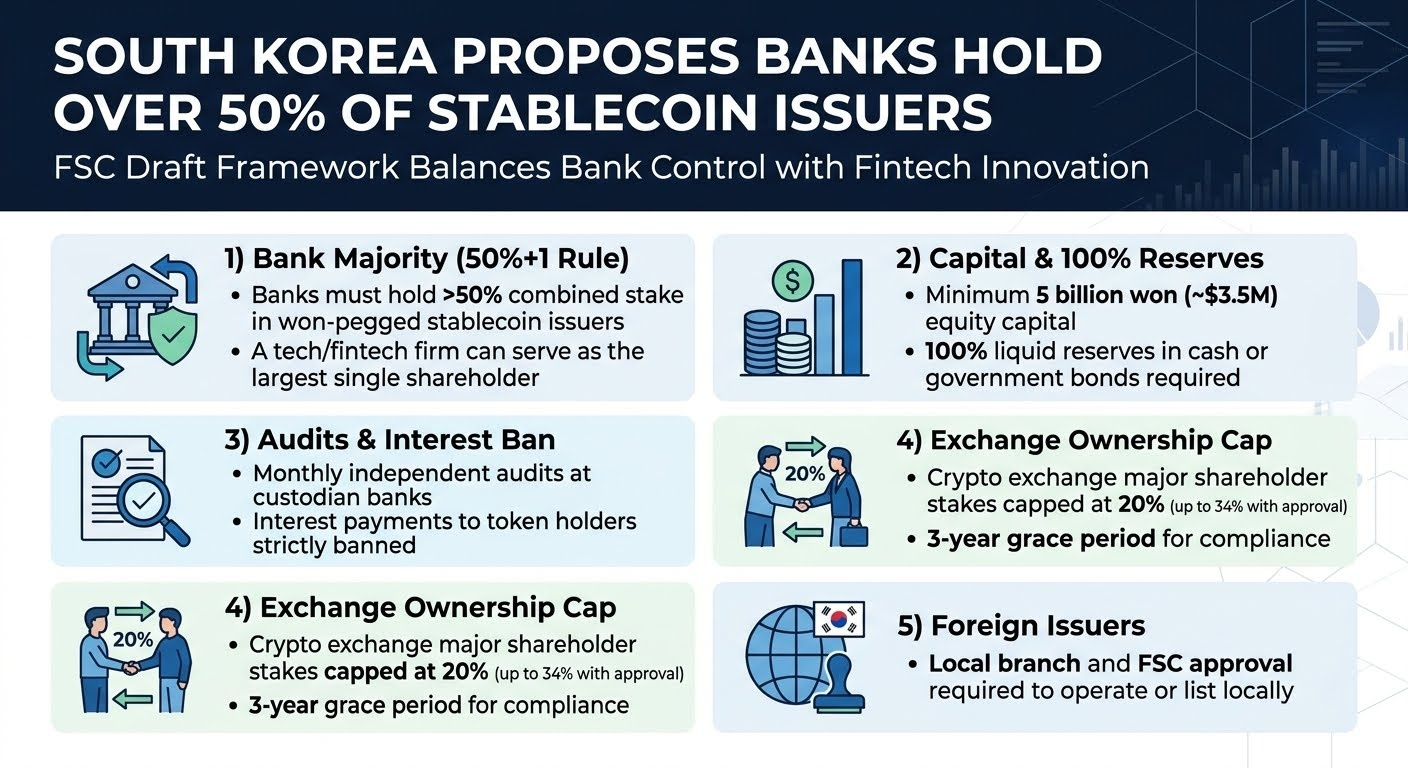
South Korea’s Financial Services Commission (FSC) has proposed a bill requiring banks to collectively hold more than 50% of the shares in companies issuing won-pegged stablecoins. Under this model, banks would retain majority control, while technology and fintech companies could lead projects as the largest individual shareholder.
📋 Key Rules in the Bill
🏦 Bank Majority (50%+1): Banks would collectively hold more than 50% of the shares in issuer consortiums; however, a technology or fintech company could manage the process as the largest individual shareholder.💰 Capital and Reserves: Issuers would be required to have at least 5 billion won (~$3.5 million) in equity capital and 100% liquid reserves (cash or government bonds) for tokens in circulation.🔍 Oversight and Ban on Interest: Reserves would be held at custodian banks and audited monthly; paying interest to token holders would be prohibited.📉 Shareholding Limit for Exchanges: The stake of major shareholders in crypto exchanges would be capped at 20% (34% with approval); a 3-year transition period would be granted for compliance.🌐 Foreign Issuers: Foreign issuers wishing to operate in Korea would be required to open a local branch and obtain FSC approval.
$SKDD $AIOT $BTW
{future}(BTWUSDT)
{future}(AIOTUSDT)
{future}(SKDDUSDT)
#SouthKoreaProposesBanksHoldOver50%OfStablecoinIssuers
South Korea’s Financial Services Commission (FSC) has proposed a bill requiring banks to collectively hold more than 50% of the shares in companies issuing won-pegged stablecoins. Under this model, banks would retain majority control, while technology and fintech companies could lead projects as the largest individual shareholder.
📋 Key Rules in the Bill
🏦 Bank Majority (50%+1): Banks would collectively hold more than 50% of the shares in issuer consortiums; however, a technology or fintech company could manage the process as the largest individual shareholder.💰 Capital and Reserves: Issuers would be required to have at least 5 billion won (~$3.5 million) in equity capital and 100% liquid reserves (cash or government bonds) for tokens in circulation.🔍 Oversight and Ban on Interest: Reserves would be held at custodian banks and audited monthly; paying interest to token holders would be prohibited.📉 Shareholding Limit for Exchanges: The stake of major shareholders in crypto exchanges would be capped at 20% (34% with approval); a 3-year transition period would be granted for compliance.🌐 Foreign Issuers: Foreign issuers wishing to operate in Korea would be required to open a local branch and obtain FSC approval.
$SKDD $AIOT $BTW
720
·
--
Verified
#usreportedlypreparesnewtariffson16tradingpartners
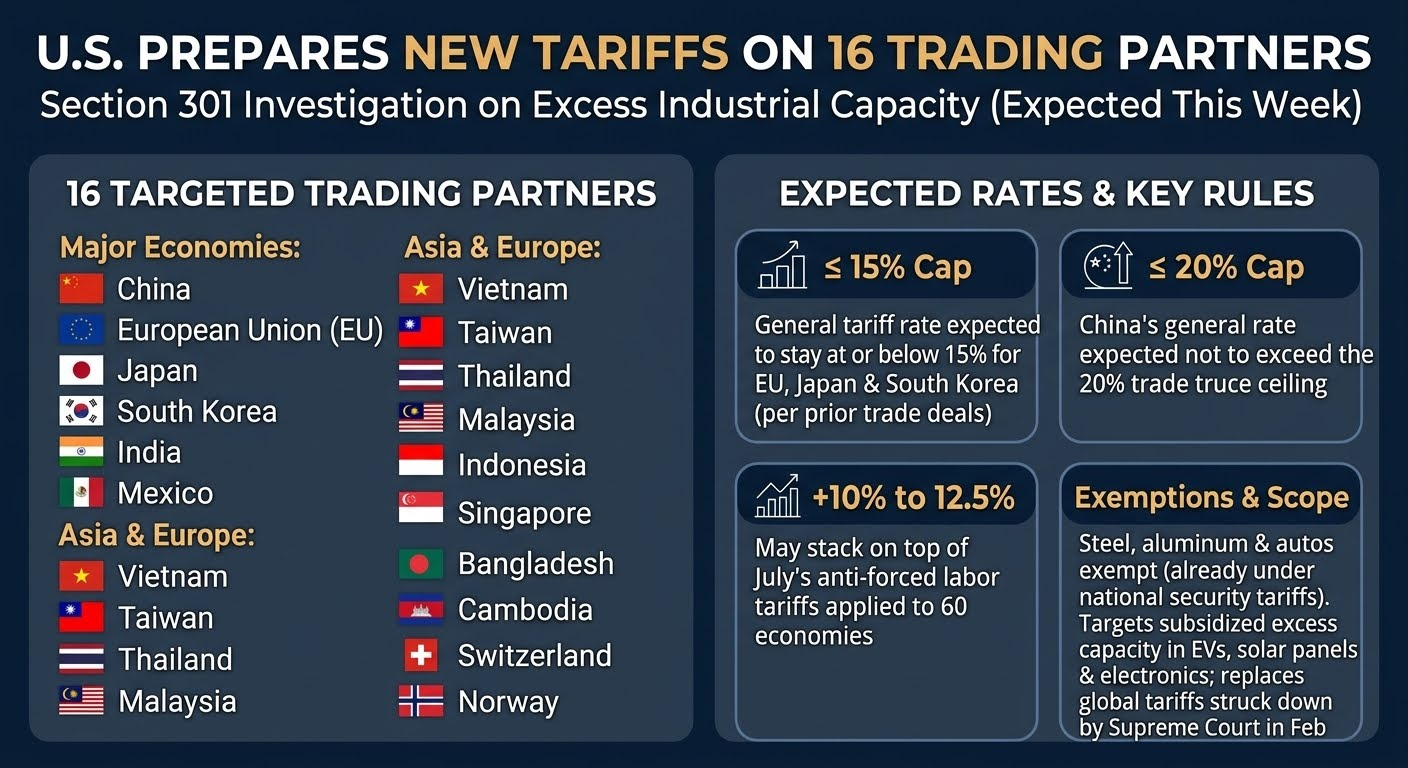
The U.S. administration is preparing to announce new tariffs targeting China, the European Union (EU), and 14 major trading partners as part of an investigation into “excess industrial capacity.” U.S. Trade Representative (USTR) Jamieson Greer is expected to announce this week the findings of the months-long Section 301 investigation under the Trade Act, launched in March.
🌍 16 Targeted Trading Partners
The 16 economies covered by the investigation are:
🏭 Major Economies: China, the European Union (EU), Japan, South Korea, India, Mexico🌏 Asia and Other Countries: Vietnam, Taiwan, Thailand, Malaysia, Indonesia, Singapore, Bangladesh, Cambodia, Switzerland, Norway
📋 Key Details and Expected Rates
⚖️ Legal Basis: The new tariffs are designed to replace the global tariffs struck down by the U.S. Supreme Court in February.🚢 Rationale: The U.S. argues that government subsidies have created excess production capacity in these countries, flooding global markets with cheap goods (steel, aluminum, electric vehicles, solar panels, electronics, etc.) and harming American manufacturers.📊 Tariff Rates and Exemptions:
🛡️ Steel, aluminum, and automotive products already subject to national security tariffs are expected to be exempt from this new package.🇪🇺🇯🇵🇰🇷 In line with previous agreements, the general tariff rate for the EU, Japan, and South Korea is expected to remain at 15% or below.🇨🇳 The overall rate for China is expected not to exceed the 20% ceiling under the terms of the current trade truce.➕ The new duties could be imposed in addition to the anti-forced-labor tariffs of between 10% and 12.5% introduced for 60 economies in July.
$ON $TA $PHAROS
{future}(PHAROSUSDT)
{future}(TAUSDT)
{future}(ONUSDT)
#usreportedlypreparesnewtariffson16tradingpartners
The U.S. administration is preparing to announce new tariffs targeting China, the European Union (EU), and 14 major trading partners as part of an investigation into “excess industrial capacity.” U.S. Trade Representative (USTR) Jamieson Greer is expected to announce this week the findings of the months-long Section 301 investigation under the Trade Act, launched in March.
🌍 16 Targeted Trading Partners
The 16 economies covered by the investigation are:
🏭 Major Economies: China, the European Union (EU), Japan, South Korea, India, Mexico🌏 Asia and Other Countries: Vietnam, Taiwan, Thailand, Malaysia, Indonesia, Singapore, Bangladesh, Cambodia, Switzerland, Norway
📋 Key Details and Expected Rates
⚖️ Legal Basis: The new tariffs are designed to replace the global tariffs struck down by the U.S. Supreme Court in February.🚢 Rationale: The U.S. argues that government subsidies have created excess production capacity in these countries, flooding global markets with cheap goods (steel, aluminum, electric vehicles, solar panels, electronics, etc.) and harming American manufacturers.📊 Tariff Rates and Exemptions:
🛡️ Steel, aluminum, and automotive products already subject to national security tariffs are expected to be exempt from this new package.🇪🇺🇯🇵🇰🇷 In line with previous agreements, the general tariff rate for the EU, Japan, and South Korea is expected to remain at 15% or below.🇨🇳 The overall rate for China is expected not to exceed the 20% ceiling under the terms of the current trade truce.➕ The new duties could be imposed in addition to the anti-forced-labor tariffs of between 10% and 12.5% introduced for 60 economies in July.
$ON $TA $PHAROS
1
2.8k
·
--
Verified
#adpweeklyprivatepayrollsslowto21000
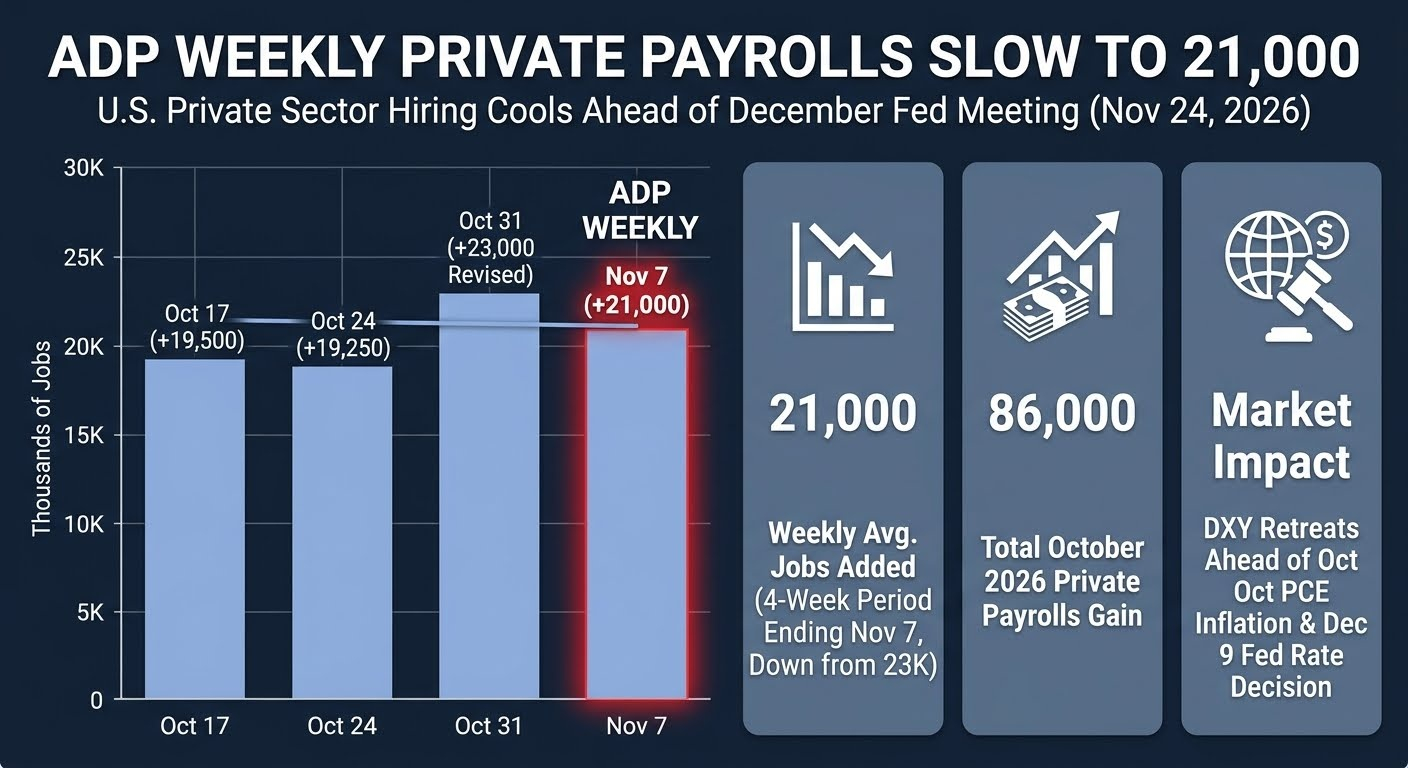
Private-sector employment growth in the U.S. slowed in early November, falling to an average of 21,000 people per week. Preliminary data published by ADP Research on November 24, 2026, indicate a slight cooling in hiring momentum.
📊 Key Data and Details
📉 Weekly Average Declined: In the four-week period ending November 7, 2026, U.S. private-sector employers created an average of 21,000 new jobs per week. This was below the previous week's (October 31) revised average of 23,000.🗓️ Monthly Comparison: U.S. private-sector employment increased by a total of 86,000 in October 2026; data for the first week of November suggest that this pace has slowed somewhat.🏦 Fed and Market Impact: The data was released ahead of the October PCE inflation report and just days before the Fed's crucial interest rate meeting on December 9. The U.S. Dollar Index (DXY) retreated amid the signal of slowing employment growth.
📈 Employment Trends in Recent Weeks (4-Week Moving Average)
Period (Week Ending)Weekly Average Employment Growth
🗓️ November 7, 2026+21,000
🗓️ October 31, 2026+23,000 (Revised)
🗓️ October 24, 2026+19,250
🗓️ October 17, 2026+19,500
$B2 $2Z $FHE
{future}(FHEUSDT)
{spot}(2ZUSDT)
{future}(B2USDT)
#adpweeklyprivatepayrollsslowto21000
Private-sector employment growth in the U.S. slowed in early November, falling to an average of 21,000 people per week. Preliminary data published by ADP Research on November 24, 2026, indicate a slight cooling in hiring momentum.
📊 Key Data and Details
📉 Weekly Average Declined: In the four-week period ending November 7, 2026, U.S. private-sector employers created an average of 21,000 new jobs per week. This was below the previous week's (October 31) revised average of 23,000.🗓️ Monthly Comparison: U.S. private-sector employment increased by a total of 86,000 in October 2026; data for the first week of November suggest that this pace has slowed somewhat.🏦 Fed and Market Impact: The data was released ahead of the October PCE inflation report and just days before the Fed's crucial interest rate meeting on December 9. The U.S. Dollar Index (DXY) retreated amid the signal of slowing employment growth.
📈 Employment Trends in Recent Weeks (4-Week Moving Average)
Period (Week Ending)Weekly Average Employment Growth
🗓️ November 7, 2026+21,000
🗓️ October 31, 2026+23,000 (Revised)
🗓️ October 24, 2026+19,250
🗓️ October 17, 2026+19,500
$B2 $2Z $FHE
1.6k
·
--
Verified
#EthereumFoundationPlansShiftToHashBasedSignaturesBy2028
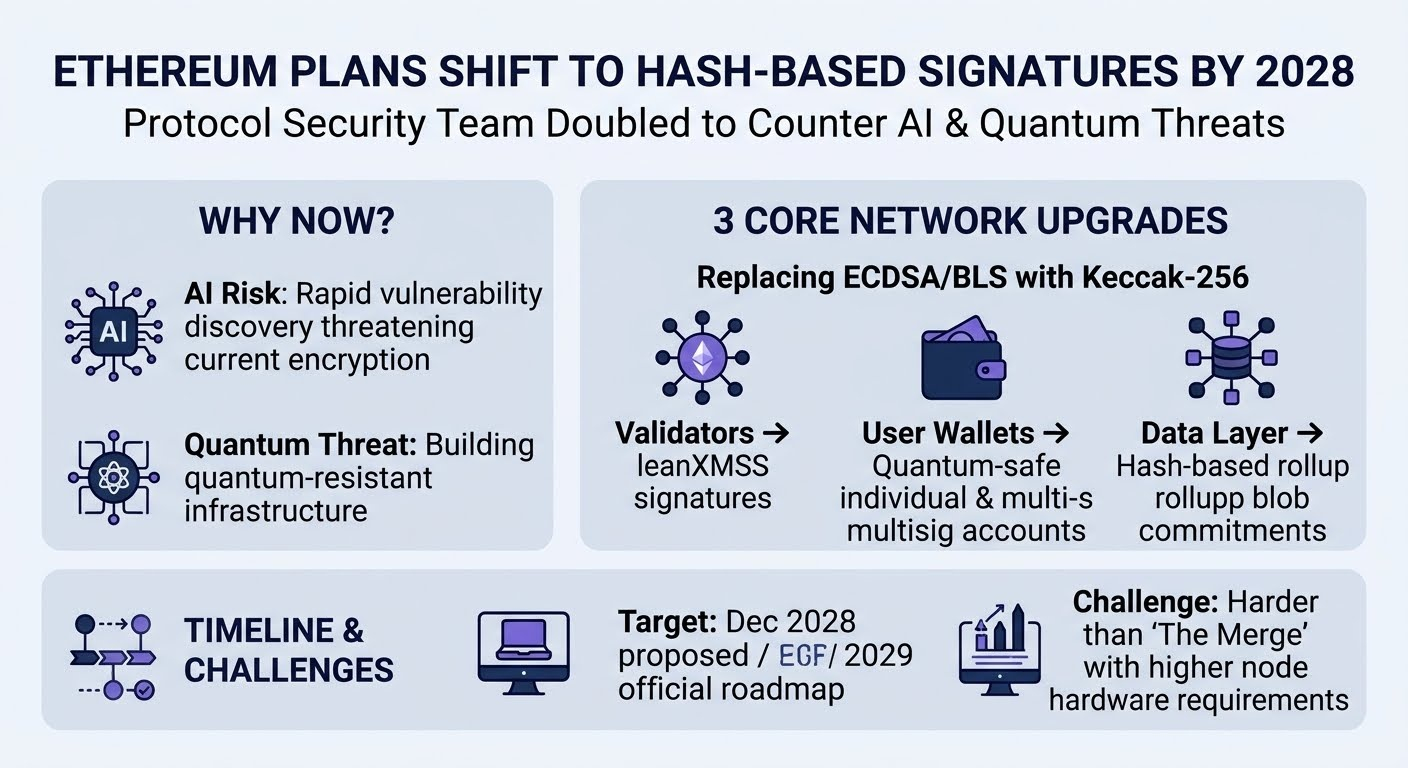
The Ethereum Foundation plans to transition entirely to hash-based cryptography by the end of 2028 to protect the network from AI-powered cyberattacks and future quantum computers. As part of this effort, the foundation has doubled the size of its protocol security team.
🛡️ Why the Transition?
🤖 AI Risk: AI models’ ability to rapidly find software vulnerabilities could put existing encryption systems at risk sooner.⚛️ Quantum Threat: A “quantum-resistant” infrastructure is being built now to defend against future quantum computers capable of breaking standard digital signatures.
⚙️ What Will Change?
Existing elliptic curve (ECDSA/BLS) signatures will be abandoned in favor of Keccak-256-based systems:
🖥️ Validators: leanXMSS signatures will be used at the consensus layer.👛 User Wallets: Individual and multisignature (multisig) wallets will be made quantum-safe.📦 Data Layer (Blobs): Rollup data commitments will be hash-based.
⏳ Timeline and Challenges
🧪 Test Network: The first post-quantum test network (pq-cl) has been launched.🎯 Goal: Researcher Justin Drake is targeting December 2028, while the foundation’s internal timeline points to 2029.⛰️ Challenge: The transition is said to be more challenging than even The Merge upgrade and could increase node hardware requirements.
$ETH $BLESS $OPG
{future}(OPGUSDT)
{future}(BLESSUSDT)
{future}(ETHUSDT)
#EthereumFoundationPlansShiftToHashBasedSignaturesBy2028
The Ethereum Foundation plans to transition entirely to hash-based cryptography by the end of 2028 to protect the network from AI-powered cyberattacks and future quantum computers. As part of this effort, the foundation has doubled the size of its protocol security team.
🛡️ Why the Transition?
🤖 AI Risk: AI models’ ability to rapidly find software vulnerabilities could put existing encryption systems at risk sooner.⚛️ Quantum Threat: A “quantum-resistant” infrastructure is being built now to defend against future quantum computers capable of breaking standard digital signatures.
⚙️ What Will Change?
Existing elliptic curve (ECDSA/BLS) signatures will be abandoned in favor of Keccak-256-based systems:
🖥️ Validators: leanXMSS signatures will be used at the consensus layer.👛 User Wallets: Individual and multisignature (multisig) wallets will be made quantum-safe.📦 Data Layer (Blobs): Rollup data commitments will be hash-based.
⏳ Timeline and Challenges
🧪 Test Network: The first post-quantum test network (pq-cl) has been launched.🎯 Goal: Researcher Justin Drake is targeting December 2028, while the foundation’s internal timeline points to 2029.⛰️ Challenge: The transition is said to be more challenging than even The Merge upgrade and could increase node hardware requirements.
$ETH $BLESS $OPG
440
·
--
Verified
#anthropicbreaksbelowipopriceamidaislump
Here’s a summary of the event and its details:
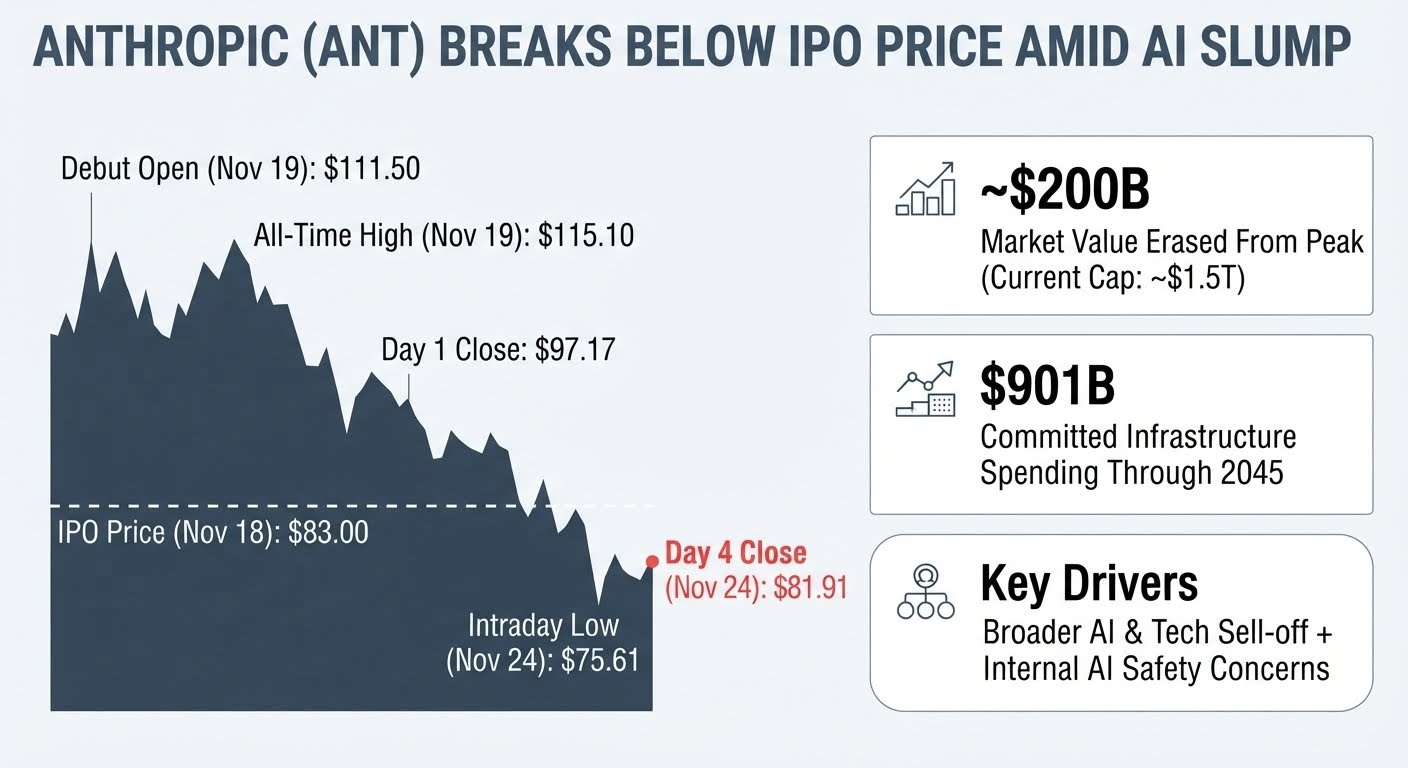
🚀 A Big Debut: Anthropic, the developer of AI assistant Claude, made a historic debut on the Nasdaq last week with an IPO price of $83. Its shares surged to $111.50 on the first day of trading, exciting investors 🎉.📉 A Sharp Decline: However, on the fourth trading day (Tuesday), things took a turn. The share price fell below the $83 IPO price, reaching $75–76 during the day and closing just under $82. The drop wiped out around $200 billion in the company’s market value.🌪️ A Broader Sell-Off in the AI Sector: The decline wasn’t limited to Anthropic; a broader sell-off in technology and AI stocks hit the market, with major chipmakers such as Nvidia and AMD also losing value.⚠️ Security and Cost Concerns: Alongside investors’ concerns about an “AI bubble,” reports of internal discussions about whether next-generation AI models might be too powerful to release safely, as well as huge spending on data centers, put pressure on shares.👀 A Warning Sign for the Sector: The performance of Anthropic, the first major AI lab to go public, also raised market concerns about OpenAI and other AI startups planning IPOs next year.
$ANT $ATM $GUA
{future}(GUAUSDT)
{spot}(ATMUSDT)
{future}(ANTUSDT)
#anthropicbreaksbelowipopriceamidaislump
Here’s a summary of the event and its details:
🚀 A Big Debut: Anthropic, the developer of AI assistant Claude, made a historic debut on the Nasdaq last week with an IPO price of $83. Its shares surged to $111.50 on the first day of trading, exciting investors 🎉.📉 A Sharp Decline: However, on the fourth trading day (Tuesday), things took a turn. The share price fell below the $83 IPO price, reaching $75–76 during the day and closing just under $82. The drop wiped out around $200 billion in the company’s market value.🌪️ A Broader Sell-Off in the AI Sector: The decline wasn’t limited to Anthropic; a broader sell-off in technology and AI stocks hit the market, with major chipmakers such as Nvidia and AMD also losing value.⚠️ Security and Cost Concerns: Alongside investors’ concerns about an “AI bubble,” reports of internal discussions about whether next-generation AI models might be too powerful to release safely, as well as huge spending on data centers, put pressure on shares.👀 A Warning Sign for the Sector: The performance of Anthropic, the first major AI lab to go public, also raised market concerns about OpenAI and other AI startups planning IPOs next year.
$ANT $ATM $GUA
1
1.3k
·
--
Verified
#nvdasoarsonjensenreturn
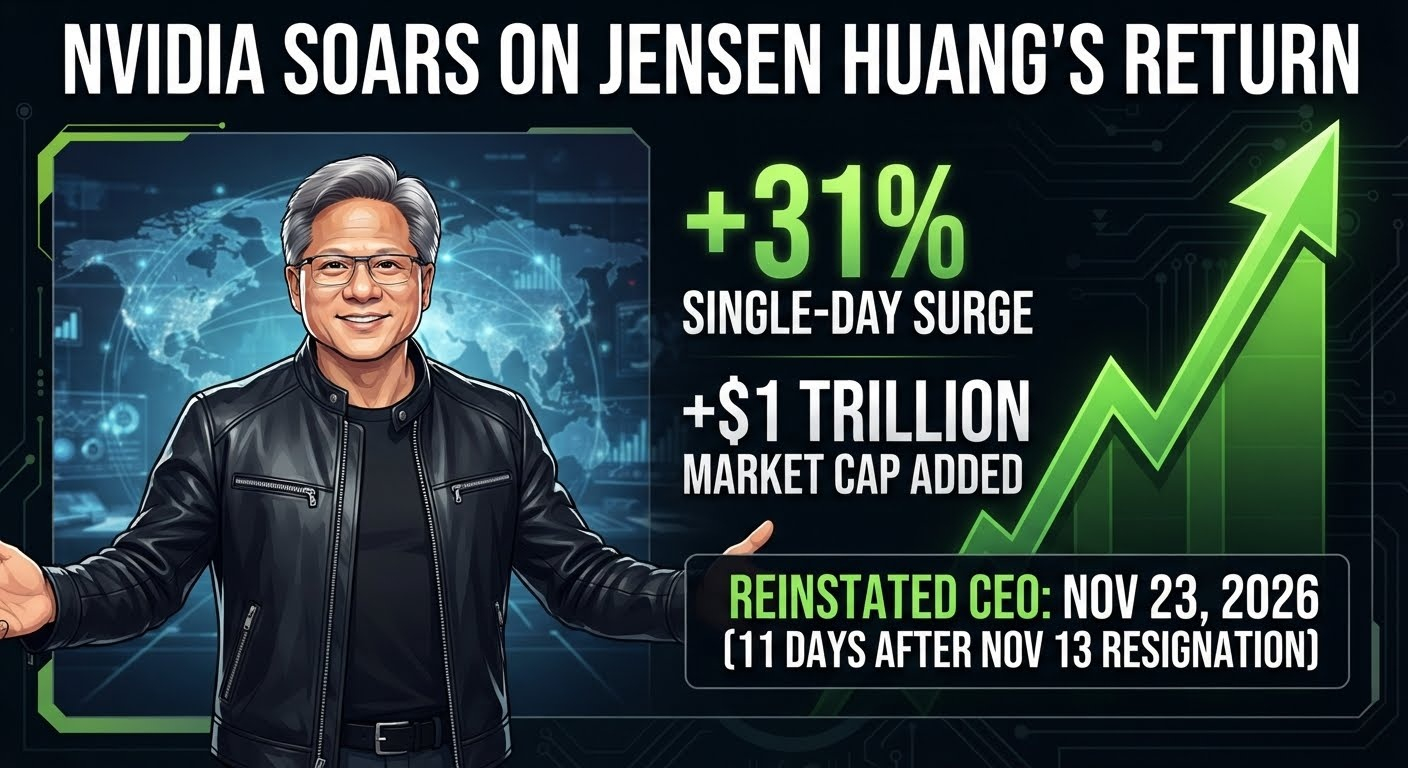
Nvidia (NVDA) shares soared 31% in a single day after founder and CEO Jensen Huang was reinstated just 11 days after resigning.
The Story So Far 🎬
Resignation and Crisis 📉: Jensen Huang resigned as CEO on November 13, 2026, amid allegations of an extramarital affair suspected of having links to Chinese espionage, and Nvidia shares plunged sharply.
Mounting Pressure ✍️: Tech giants like Elon Musk and a campaign signed by more than 200,000 people pressured the board to bring Huang back.
The White House Steps In 🏛️: To keep the U.S. from falling behind China in the AI race, President Donald Trump called Huang a "national treasure," prompting the board to reverse course.
Unanimous Return 🔄: On November 23, the board changed its decision and unanimously reinstated Huang as chairman and CEO.
Stock Market Rally 🚀: News of his return sent NVDA shares up 31%, adding nearly $1 trillion to the company's market value; technology stocks in Asia and the U.S. also rose in response.
The Process Isn't Over ⚖️: Although Huang has returned to his post, an independent board investigation is ongoing, and he is due to testify before the U.S. Congress in early December.
$NVDA $PROM $ZIL
{future}(ZILUSDT)
{future}(PROMUSDT)
{future}(NVDAUSDT)
#nvdasoarsonjensenreturn
Nvidia (NVDA) shares soared 31% in a single day after founder and CEO Jensen Huang was reinstated just 11 days after resigning.
The Story So Far 🎬
Resignation and Crisis 📉: Jensen Huang resigned as CEO on November 13, 2026, amid allegations of an extramarital affair suspected of having links to Chinese espionage, and Nvidia shares plunged sharply.
Mounting Pressure ✍️: Tech giants like Elon Musk and a campaign signed by more than 200,000 people pressured the board to bring Huang back.
The White House Steps In 🏛️: To keep the U.S. from falling behind China in the AI race, President Donald Trump called Huang a "national treasure," prompting the board to reverse course.
Unanimous Return 🔄: On November 23, the board changed its decision and unanimously reinstated Huang as chairman and CEO.
Stock Market Rally 🚀: News of his return sent NVDA shares up 31%, adding nearly $1 trillion to the company's market value; technology stocks in Asia and the U.S. also rose in response.
The Process Isn't Over ⚖️: Although Huang has returned to his post, an independent board investigation is ongoing, and he is due to testify before the U.S. Congress in early December.
$NVDA $PROM $ZIL
1
691
Log in to explore more content
Join global crypto users on Binance Square
⚡️ Get latest and useful information about crypto.
💬 Trusted by the world’s largest crypto exchange.
👍 Discover real insights from verified creators.
Email / Phone number
Trending Topics
CanMarketsReboundAfterThanksgiving?
160,166 views
1,792 Discussing
Rate-Hike Bets Linger as US Markets Head Into Thanksgiving Closure
Binance News
·7 Likes
·4.8k views
CouldSpaceX’sOrbitalDataCentersBoostAIChipDemand?
76,086 views
1,085 Discussing
SouthKoreaProposesMandatoryDigitalAssetTransactionDisclosure
2,568 views
70 Discussing