
Elez Bedh
17k Posts

Elez Bedh
 Square Verified+
Crypto Enthusiast, Investor, KOL & Gem Holder Long term Holder of Memecoin
24 Following
39.0K+ Followers
24.1K+ Liked
Posts
All
Quotes
Live
I've been burned by this before. Watched an infrastructure token rack up transactions for months, convinced the market was just slow to notice. Turns out I was counting the wrong activity.
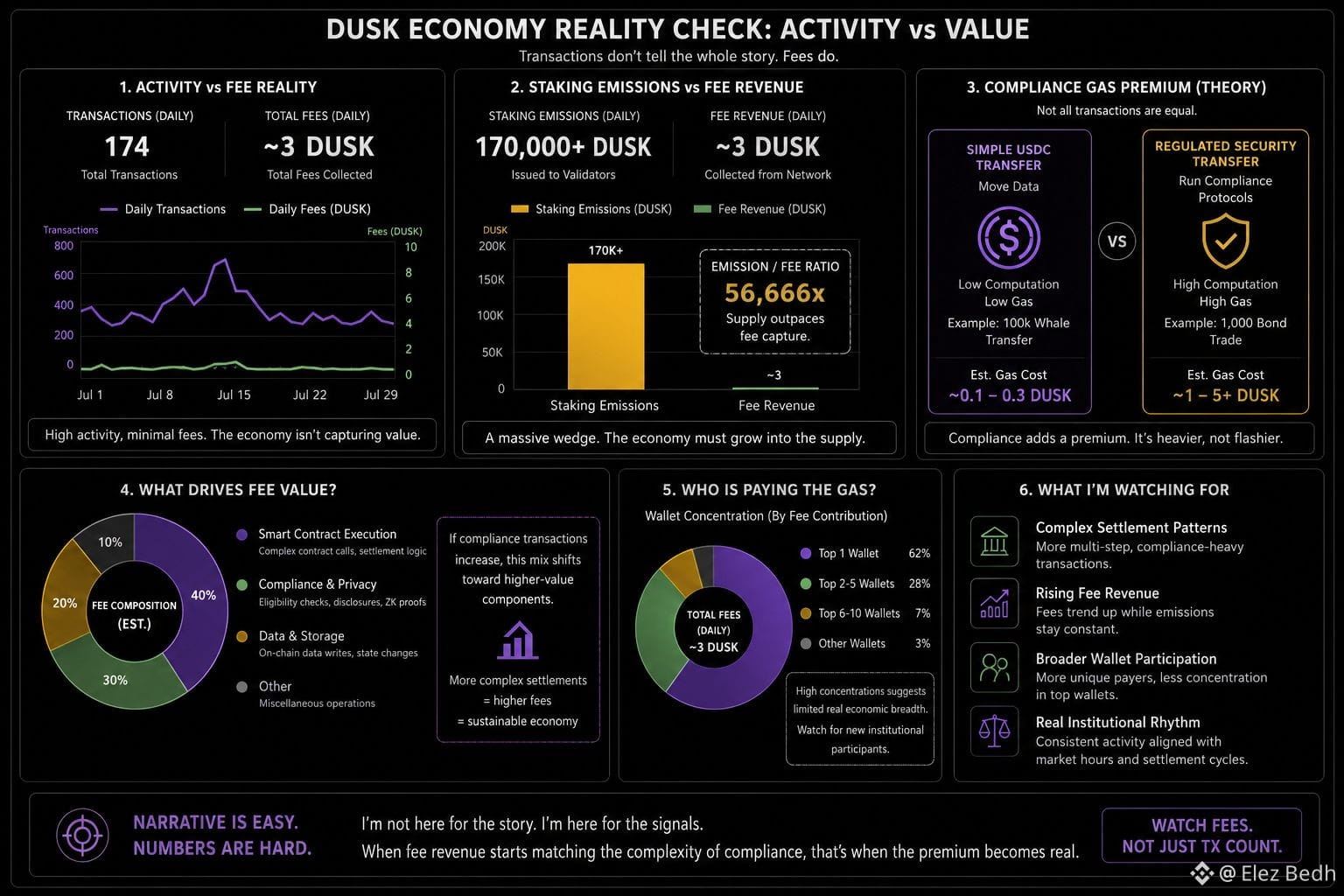
That bias followed me when I looked at $DUSK . A simple USDC transfer and a regulated security transfer might look identical in a block explorer, but on Dusk they aren't even playing the same game. One is moving data. The other runs eligibility checks, compliance filters, and selective disclosure protocols around a single trade. It's computationally heavier. I started calling it a "Compliance Gas Premium" in my head—a boring 1,000 bond trade could consume more gas than a flashy 100k whale transfer.
But then I pulled the scanner data. Oof. One recent day showed roughly 174 transactions total. Total fees? Maybe 3 DUSK. Meanwhile, staking issuance spits out over 170k tokens daily just to validators. That's an uncomfortable wedge between what could be and what currently is.
NPEX is a legit anchor—they've tokenized hundreds of millions in securities—and they're live on DuskEVM. But one heavyweight partner doesn't equal a bustling economy. The app layer is thin. Liquidity is shallow.
What I actually watch now isn't the narrative around "tokenizing the world." It's the ugly, boring stuff: what are the fees actually composed of? Is it the same wallet doing tiny test transactions, or are we starting to see complex settlement patterns that look like real institutional rhythm?
Transaction count gives a warm, fuzzy feeling. Knowing who is paying the gas, and what they're executing, is the only thing that tells me whether the economy is keeping pace with the token supply. If fee revenue stays flat while emissions run, the premium is just a clever theory. If it starts climbing with actual complex settlements, that's when I'll stop lurking and actually start paying attention.
@Dusk #dusk #DUSK $DUSK
That bias followed me when I looked at $DUSK . A simple USDC transfer and a regulated security transfer might look identical in a block explorer, but on Dusk they aren't even playing the same game. One is moving data. The other runs eligibility checks, compliance filters, and selective disclosure protocols around a single trade. It's computationally heavier. I started calling it a "Compliance Gas Premium" in my head—a boring 1,000 bond trade could consume more gas than a flashy 100k whale transfer.
But then I pulled the scanner data. Oof. One recent day showed roughly 174 transactions total. Total fees? Maybe 3 DUSK. Meanwhile, staking issuance spits out over 170k tokens daily just to validators. That's an uncomfortable wedge between what could be and what currently is.
NPEX is a legit anchor—they've tokenized hundreds of millions in securities—and they're live on DuskEVM. But one heavyweight partner doesn't equal a bustling economy. The app layer is thin. Liquidity is shallow.
What I actually watch now isn't the narrative around "tokenizing the world." It's the ugly, boring stuff: what are the fees actually composed of? Is it the same wallet doing tiny test transactions, or are we starting to see complex settlement patterns that look like real institutional rhythm?
Transaction count gives a warm, fuzzy feeling. Knowing who is paying the gas, and what they're executing, is the only thing that tells me whether the economy is keeping pace with the token supply. If fee revenue stays flat while emissions run, the premium is just a clever theory. If it starts climbing with actual complex settlements, that's when I'll stop lurking and actually start paying attention.
@Dusk #dusk #DUSK $DUSK
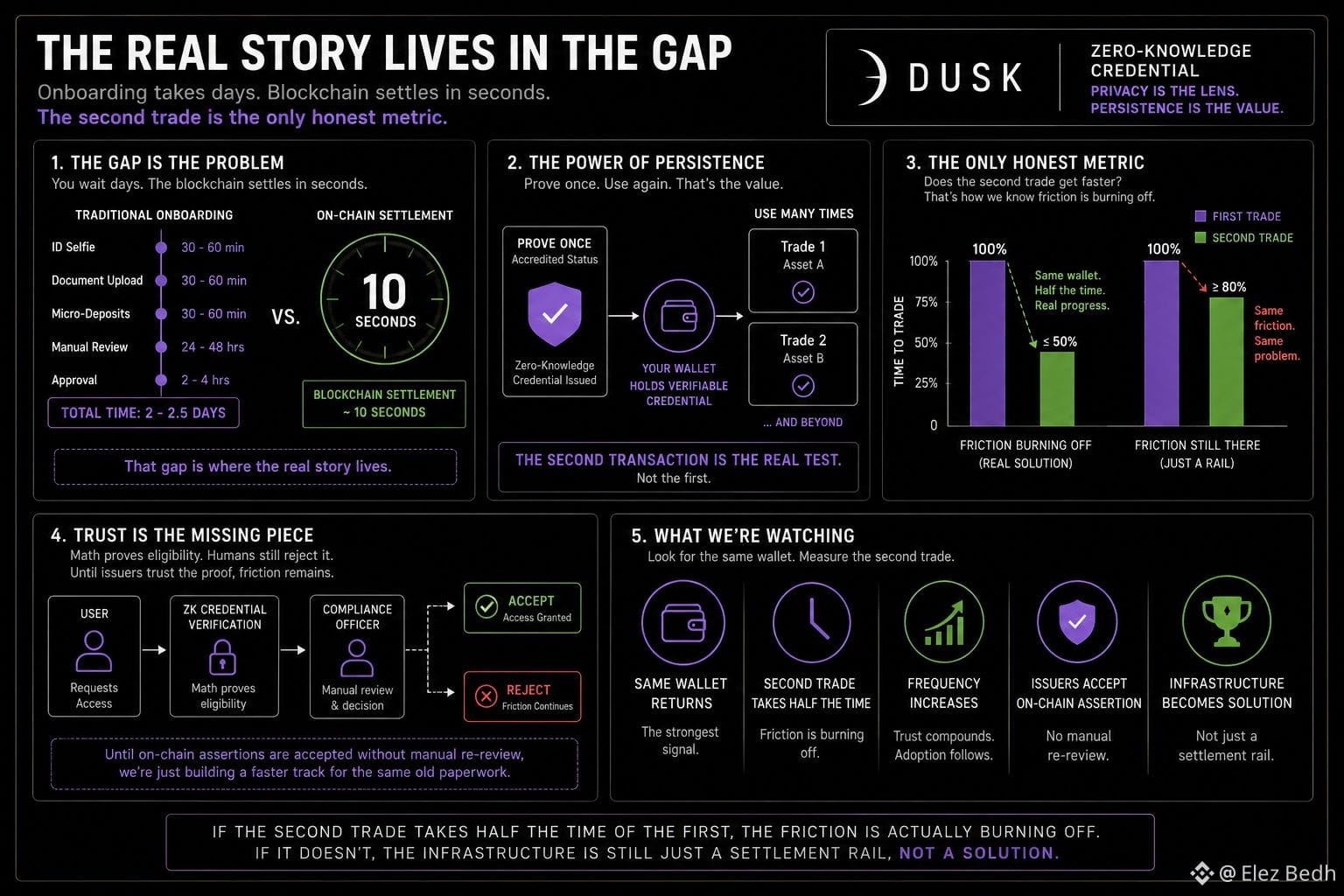
I spent four hours last week proving I was me—ID selfies, micro-deposits, the whole routine—only to watch the market move while I waited. The blockchain could have settled my trade in ten seconds. My onboarding took two days. That gap is where the real story lives.
For Dusk, the Zero-Knowledge credential is often framed as privacy. I think that's the wrong lens. The real value is persistence. If I prove my accredited status once and receive a verifiable credential, the question isn't whether the first trade happens fast. The question is whether that same credential works when I return for a second, completely different asset. That second transaction is the only honest metric. The first one is just a measure of my patience and document-scanning quality.
But $DUSK cannot win this alone. The math can prove eligibility perfectly, yet a human compliance officer can still reject it out of distrust. Until issuers accept that on-chain assertion without manual re-review, we are just building a faster track for the same old paperwork. I am watching for the same wallet to reappear. If the second trade takes half the time of the first, the friction is actually burning off. If it doesn't, the infrastructure is still just a settlement rail, not a solution.
@Dusk #dusk #DUSK $DUSK
For Dusk, the Zero-Knowledge credential is often framed as privacy. I think that's the wrong lens. The real value is persistence. If I prove my accredited status once and receive a verifiable credential, the question isn't whether the first trade happens fast. The question is whether that same credential works when I return for a second, completely different asset. That second transaction is the only honest metric. The first one is just a measure of my patience and document-scanning quality.
But $DUSK cannot win this alone. The math can prove eligibility perfectly, yet a human compliance officer can still reject it out of distrust. Until issuers accept that on-chain assertion without manual re-review, we are just building a faster track for the same old paperwork. I am watching for the same wallet to reappear. If the second trade takes half the time of the first, the friction is actually burning off. If it doesn't, the infrastructure is still just a settlement rail, not a solution.
@Dusk #dusk #DUSK $DUSK
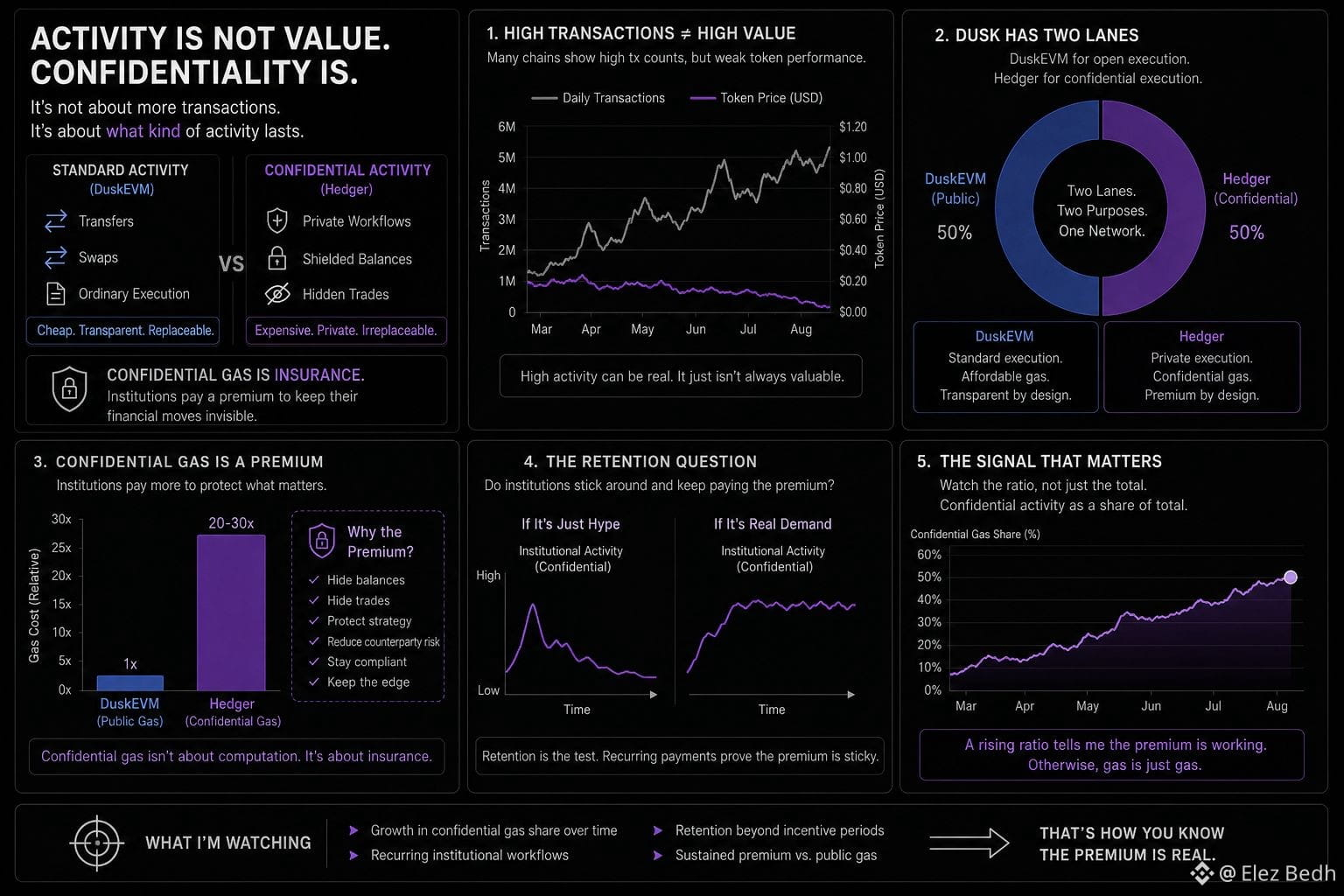
I used to think rising transaction counts were enough. More activity, more value. Simple.
Then I watched a few infrastructure projects prove me wrong. Block explorers were screaming with transactions, but the token barely budged. The activity looked real. It just wasn't valuable.
That's why $DUSK keeps pulling at my attention. Not for the total transaction numbers—those can be gamed or subsidized. I care about what kind of activity is happening.
With DuskEVM, you get the standard stuff. Transfers. Swaps. Ordinary execution. Cheap and transparent. But Hedger opens up something else: the ability to run private workflows where sensitive financial data can't sit exposed on a public ledger.
Here's the angle that doesn't get discussed enough. Confidential gas isn't really about computation. It's about insurance. When an institution hides a trade or shields a balance, they're paying to keep their hand invisible. That carries a premium. A significant one.
The retention question eats at me though. Incentives fade. Hype passes. Do the institutions actually stick around and keep paying the higher fee? Or was it just early experimentation dressed up as demand?
I'd become genuinely constructive if confidential gas starts growing as a share of recurring activity. Not absolute numbers, but the ratio of private to public execution. That would tell me the premium is sticky, not temporary.
Right now, I'm watching. Not convinced yet, but the signal is there if the ratio moves.
@Dusk #dusk #DUSK $DUSK
Then I watched a few infrastructure projects prove me wrong. Block explorers were screaming with transactions, but the token barely budged. The activity looked real. It just wasn't valuable.
That's why $DUSK keeps pulling at my attention. Not for the total transaction numbers—those can be gamed or subsidized. I care about what kind of activity is happening.
With DuskEVM, you get the standard stuff. Transfers. Swaps. Ordinary execution. Cheap and transparent. But Hedger opens up something else: the ability to run private workflows where sensitive financial data can't sit exposed on a public ledger.
Here's the angle that doesn't get discussed enough. Confidential gas isn't really about computation. It's about insurance. When an institution hides a trade or shields a balance, they're paying to keep their hand invisible. That carries a premium. A significant one.
The retention question eats at me though. Incentives fade. Hype passes. Do the institutions actually stick around and keep paying the higher fee? Or was it just early experimentation dressed up as demand?
I'd become genuinely constructive if confidential gas starts growing as a share of recurring activity. Not absolute numbers, but the ratio of private to public execution. That would tell me the premium is sticky, not temporary.
Right now, I'm watching. Not convinced yet, but the signal is there if the ratio moves.
@Dusk #dusk #DUSK $DUSK
Partly True
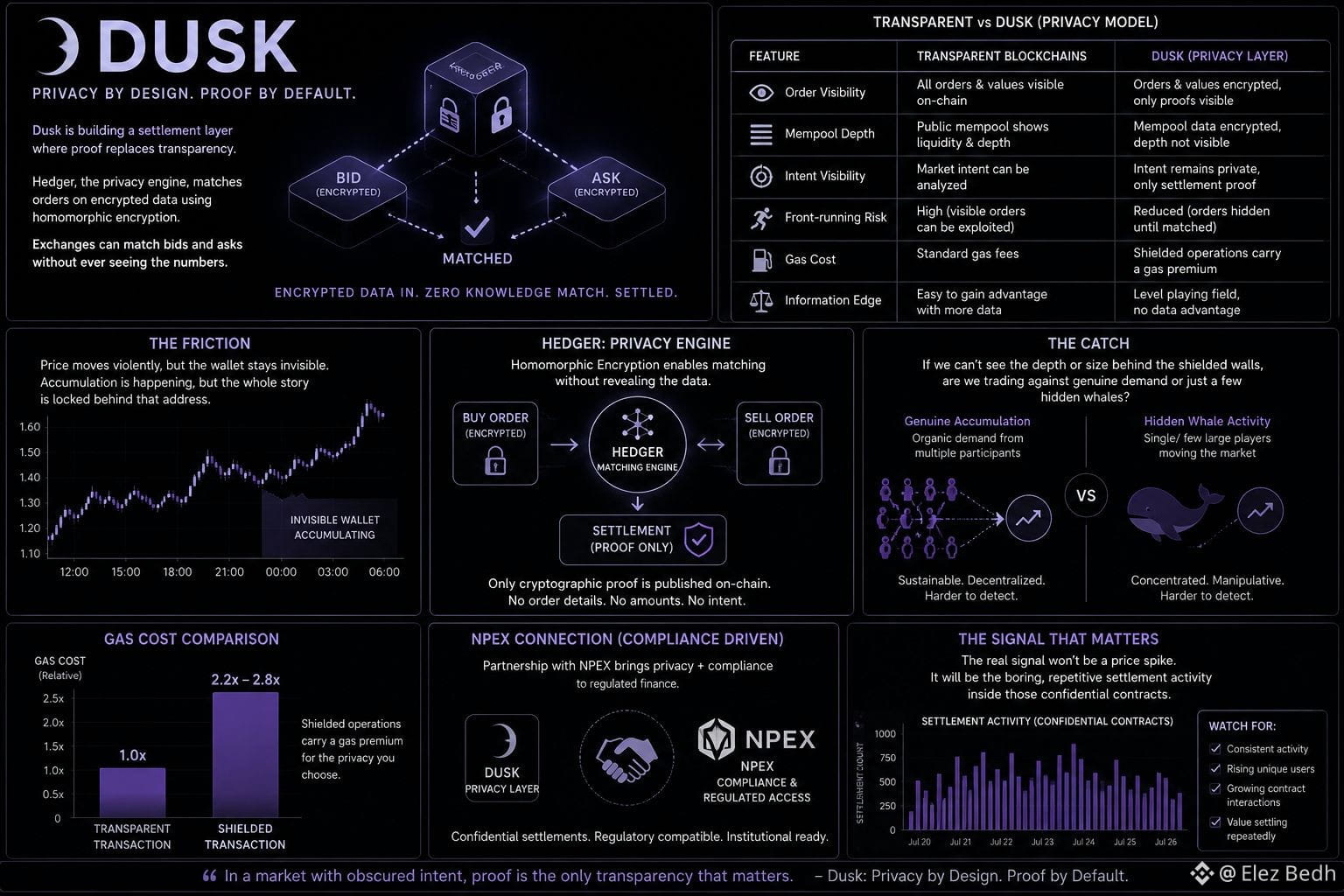
That thin market memory keeps bothering me. Price moved violently, but the wallet stayed invisible. I could see someone was accumulating, but the whole story was locked behind that address.
$DUSK takes this friction and bakes it into the infrastructure. It isn't just building a privacy coin; it is building a settlement layer where proof replaces transparency. Hedger, their privacy engine, actually matches orders on encrypted data using homomorphic encryption. The exchange can match a bid and ask without ever seeing the actual numbers. It feels like a genuine technical shift.
But here is the catch I keep circling back to. If I cannot see the mempool depth or the size behind the shielded walls, am I trading against genuine organic demand or just a few hidden whales playing games? A rising price under this model could mean accumulation, or it could just mean a single concentrated buyer executing silently. The cost of this privacy is also tangible—shielded operations carry a gas premium that transparent transactions avoid.
The NPEX connection suggests a specific, compliance-driven user base. The real signal for me won't be a price spike. It will be the boring, repetitive settlement activity happening inside those confidential contracts. I am still uncertain whether a market with obscured intent can produce a price signal that remains trustworthy. I think that uncertainty is exactly what makes watching this experiment worthwhile.
@Dusk #dusk #DUSK $DUSK
$DUSK takes this friction and bakes it into the infrastructure. It isn't just building a privacy coin; it is building a settlement layer where proof replaces transparency. Hedger, their privacy engine, actually matches orders on encrypted data using homomorphic encryption. The exchange can match a bid and ask without ever seeing the actual numbers. It feels like a genuine technical shift.
But here is the catch I keep circling back to. If I cannot see the mempool depth or the size behind the shielded walls, am I trading against genuine organic demand or just a few hidden whales playing games? A rising price under this model could mean accumulation, or it could just mean a single concentrated buyer executing silently. The cost of this privacy is also tangible—shielded operations carry a gas premium that transparent transactions avoid.
The NPEX connection suggests a specific, compliance-driven user base. The real signal for me won't be a price spike. It will be the boring, repetitive settlement activity happening inside those confidential contracts. I am still uncertain whether a market with obscured intent can produce a price signal that remains trustworthy. I think that uncertainty is exactly what makes watching this experiment worthwhile.
@Dusk #dusk #DUSK $DUSK
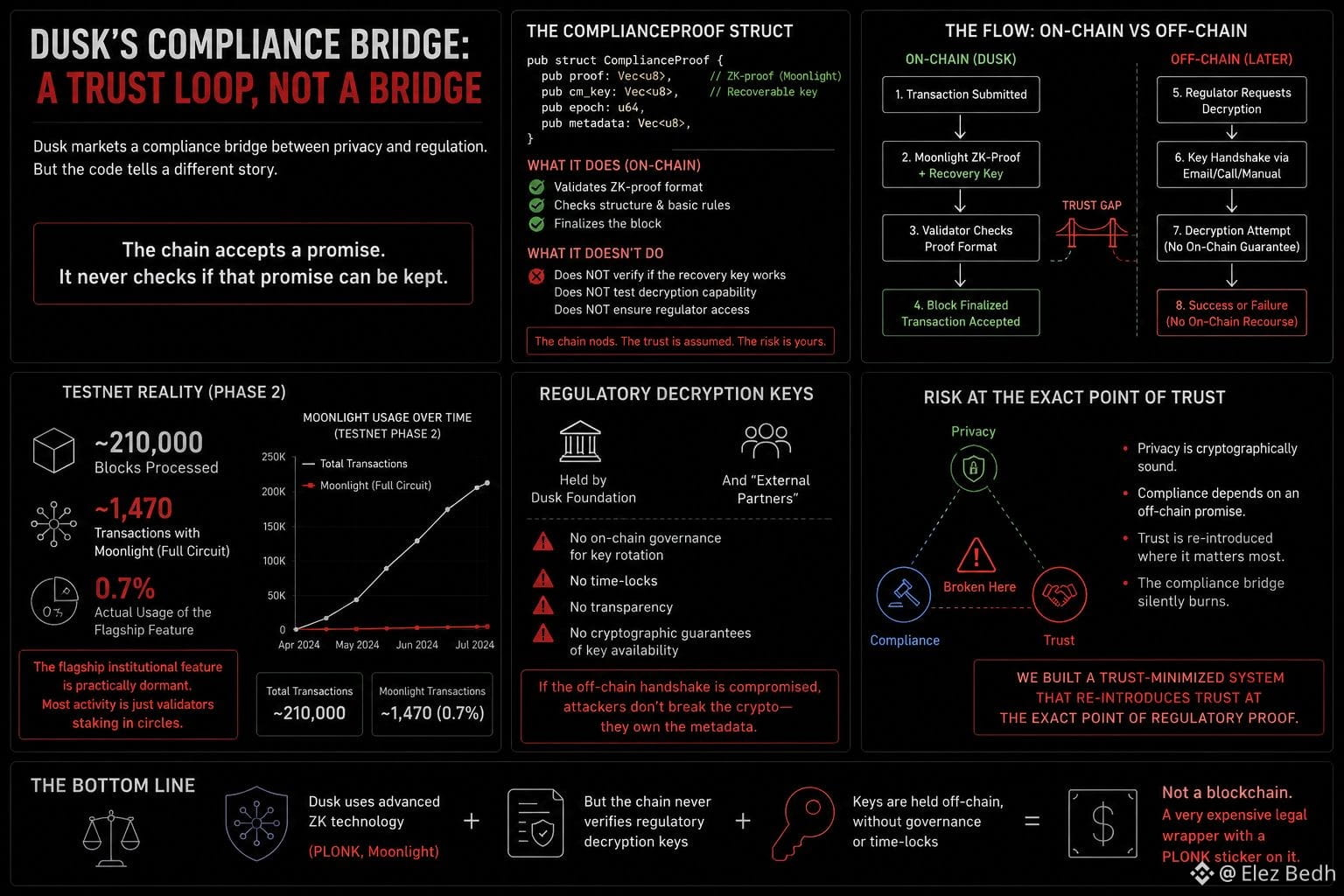
Late night digging through Dusk's Rust code, I stumbled on a struct called ComplianceProof. Thought it was the "bridge" they market. Then I read what it actually does—or rather, what it doesn't.
Moonlight generates a ZK-proof for privacy, plus a recoverable key for regulators. The validator checks the proof format, nods, and finalizes the block. That's it. It never verifies if that recovery key actually works. The decryption handshake happens off-chain—email, phone call, carrier pigeon—after the transaction is already cemented. A malicious actor could feed a junk key, the chain accepts it, and the regulator later gets gibberish with zero on-chain recourse. The privacy stays intact, the compliance bridge silently burns.
I checked the testnet data myself—Phase 2, current. ~210,000 blocks processed, but only ~1,470 transactions triggered the full Moonlight circuit. That's 0.7%. The flagship institutional feature is practically dormant. Most activity is just validators staking in circles.
And the Regulatory Decryption Keys? Held by the foundation and vaguely named "external partners." No on-chain governance for rotation, no time-lock. If that off-chain key handshake gets compromised, the attacker doesn't break the cryptography—they just own the metadata.
So $DUSK built a trust-minimized privacy layer that re-introduces a trust assumption at the exact point of regulatory proof. If the compliance feature barely runs and the keys rely on human goodwill, are we really buying a blockchain—or a very expensive legal wrapper with a PLONK sticker on it?
@Dusk #dusk #DUSK $DUSK
Moonlight generates a ZK-proof for privacy, plus a recoverable key for regulators. The validator checks the proof format, nods, and finalizes the block. That's it. It never verifies if that recovery key actually works. The decryption handshake happens off-chain—email, phone call, carrier pigeon—after the transaction is already cemented. A malicious actor could feed a junk key, the chain accepts it, and the regulator later gets gibberish with zero on-chain recourse. The privacy stays intact, the compliance bridge silently burns.
I checked the testnet data myself—Phase 2, current. ~210,000 blocks processed, but only ~1,470 transactions triggered the full Moonlight circuit. That's 0.7%. The flagship institutional feature is practically dormant. Most activity is just validators staking in circles.
And the Regulatory Decryption Keys? Held by the foundation and vaguely named "external partners." No on-chain governance for rotation, no time-lock. If that off-chain key handshake gets compromised, the attacker doesn't break the cryptography—they just own the metadata.
So $DUSK built a trust-minimized privacy layer that re-introduces a trust assumption at the exact point of regulatory proof. If the compliance feature barely runs and the keys rely on human goodwill, are we really buying a blockchain—or a very expensive legal wrapper with a PLONK sticker on it?
@Dusk #dusk #DUSK $DUSK
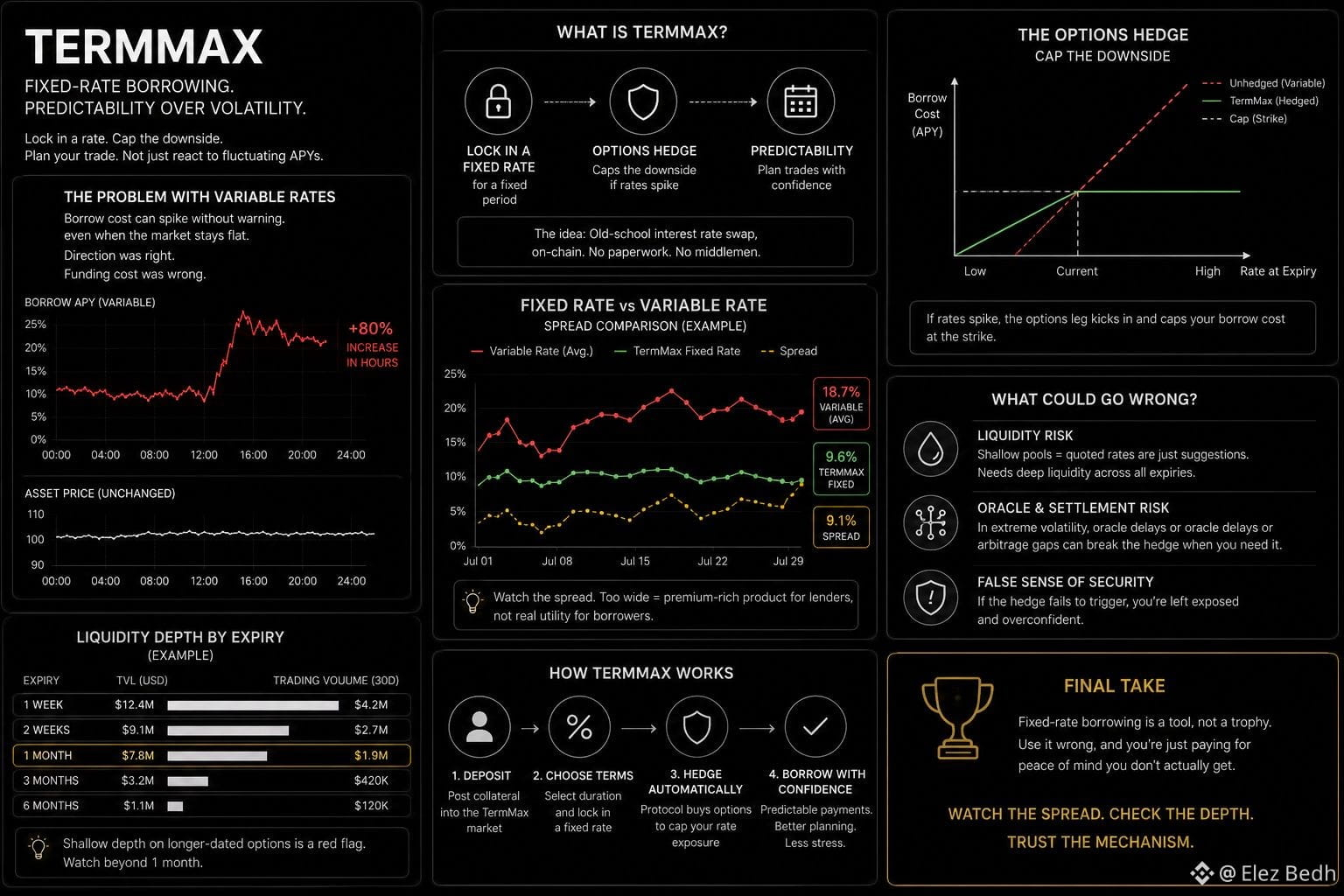
I remember the exact moment I stopped trusting variable rates. It wasn't a market crash. It was a quiet Tuesday where my borrow cost silently crept up 80% over a few hours while the asset price stayed flat. I wasn't wrong about the direction; I was wrong about the funding cost. That is the kind of loss that sticks with you.
So TermMax catches my attention because it finally tries to bring some predictability to the lending side. The idea is simple: lock in a rate for a fixed period and use options to cap the downside if things go wild. It reminds me of an old-school interest rate swap, just without the paperwork and the middlemen. Theoretically, it gives you breathing room to actually plan a trade instead of just reacting to fluctuating APYs.
But honestly, I'm skeptical. The critical flaw I see is liquidity. A fixed-rate market needs trading volume across different expiry dates to function properly. If the pool is shallow, that quoted rate is just a suggestion. More importantly, the options leg is only as good as the settlement mechanism. In the heat of a real volatility event, if the oracle feed slips or the arbitrageurs get scared off, the hedge you paid for might not trigger when you need it most. It becomes a false sense of security, which is more dangerous than no hedge at all.
For now, I'm watching the gap between their fixed rate and the average variable rate on the major money markets. If that spread is too wide, it's just a premium-rich product for lenders, not a utility for borrowers. Also, the trading depth on the longer-dated options—anything beyond a month—will tell me if this has legs or if it's just a novelty.
Fixed-rate borrowing is a tool, not a trophy. Use it wrong, and you are just paying for peace of mind you don't actually get.
@TermMax #TermMax
So TermMax catches my attention because it finally tries to bring some predictability to the lending side. The idea is simple: lock in a rate for a fixed period and use options to cap the downside if things go wild. It reminds me of an old-school interest rate swap, just without the paperwork and the middlemen. Theoretically, it gives you breathing room to actually plan a trade instead of just reacting to fluctuating APYs.
But honestly, I'm skeptical. The critical flaw I see is liquidity. A fixed-rate market needs trading volume across different expiry dates to function properly. If the pool is shallow, that quoted rate is just a suggestion. More importantly, the options leg is only as good as the settlement mechanism. In the heat of a real volatility event, if the oracle feed slips or the arbitrageurs get scared off, the hedge you paid for might not trigger when you need it most. It becomes a false sense of security, which is more dangerous than no hedge at all.
For now, I'm watching the gap between their fixed rate and the average variable rate on the major money markets. If that spread is too wide, it's just a premium-rich product for lenders, not a utility for borrowers. Also, the trading depth on the longer-dated options—anything beyond a month—will tell me if this has legs or if it's just a novelty.
Fixed-rate borrowing is a tool, not a trophy. Use it wrong, and you are just paying for peace of mind you don't actually get.
@TermMax #TermMax
I was wrong about Dusk.
The empty block explorer wasn't failure—it was privacy working.
What changed my mind? Validators don't just process blocks; they hold decryption keys and must vote collectively to reveal data if regulators ask. It's a jury of network infrastructure—un-crypto, but brutally logical for regulated finance.
The real risk isn't tech; it's geopolitical. What happens when EU and US regulators demand the same data under conflicting rules? Validators can't lawyer their way out.
Now I watch who runs nodes—custodians, settlement firms, independent operators from diverse jurisdictions. That mix determines if the privacy backdoor stays decentralized.
$DUSK may be the most honest attempt to bridge privacy and compliance. But honesty doesn't guarantee adoption. Regulators could stall, or tokenization might fizzle.
I don't know the ending. But I no longer see an empty chain. I see a vault waiting for the right key holder—and that's the question I can't yet answer.
@Dusk #dusk #DUSK $DUSK
The empty block explorer wasn't failure—it was privacy working.
What changed my mind? Validators don't just process blocks; they hold decryption keys and must vote collectively to reveal data if regulators ask. It's a jury of network infrastructure—un-crypto, but brutally logical for regulated finance.
The real risk isn't tech; it's geopolitical. What happens when EU and US regulators demand the same data under conflicting rules? Validators can't lawyer their way out.
Now I watch who runs nodes—custodians, settlement firms, independent operators from diverse jurisdictions. That mix determines if the privacy backdoor stays decentralized.
$DUSK may be the most honest attempt to bridge privacy and compliance. But honesty doesn't guarantee adoption. Regulators could stall, or tokenization might fizzle.
I don't know the ending. But I no longer see an empty chain. I see a vault waiting for the right key holder—and that's the question I can't yet answer.
@Dusk #dusk #DUSK $DUSK
Yes ✅
50%
No 🚫
25%
Maybe 🤷
25%
4 votes • Voting closed
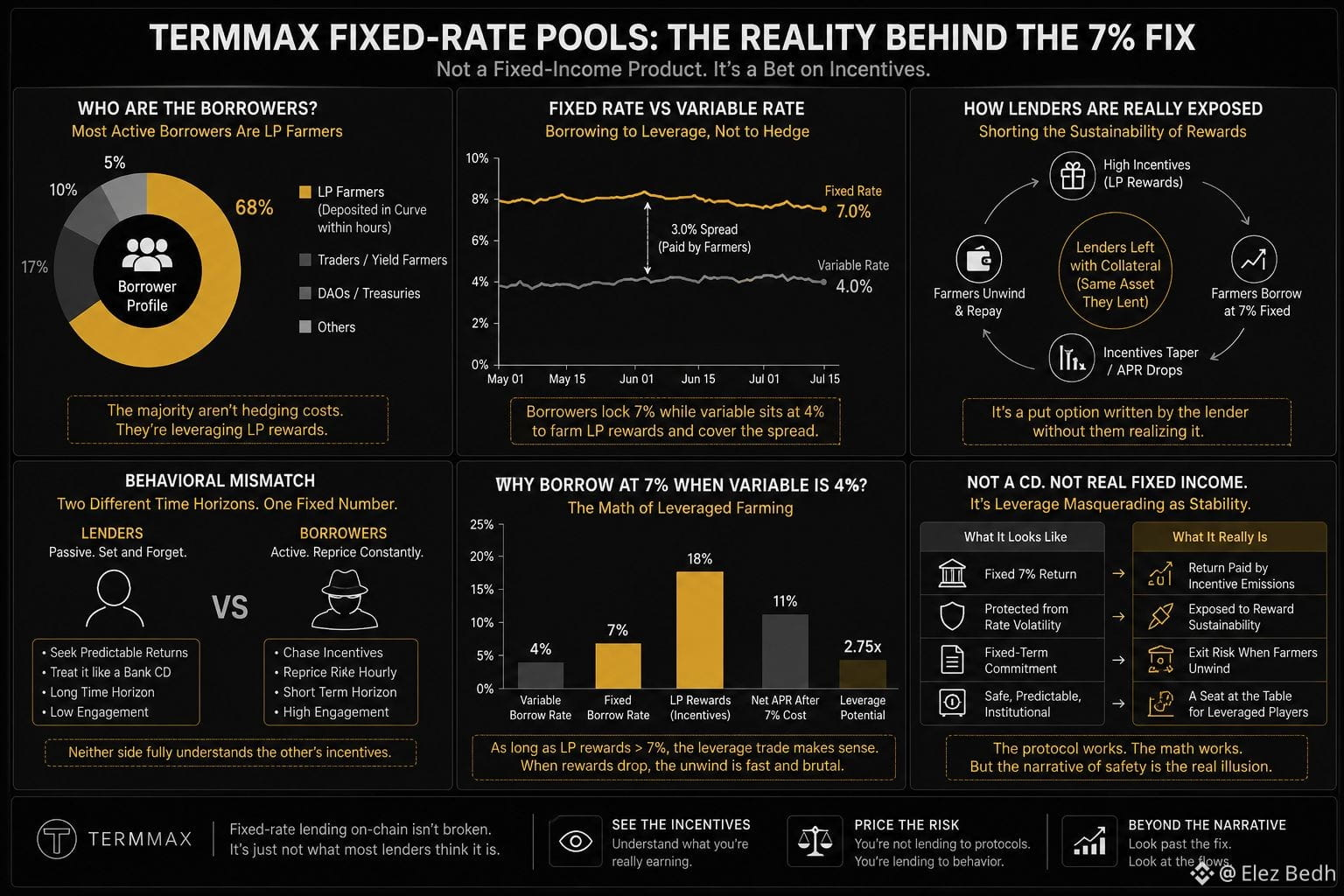
I spent an hour looking through TermMax’s fixed-rate pools yesterday, and the borrower profiles caught me off guard.
I expected treasury managers or cautious DAOs seeking budget predictability. Instead, the most active borrowers were wallets that had deposited the same asset into a Curve pool just hours prior. They weren't hedging operational costs. They were borrowing at a 7% fixed rate while the variable rate sat at 4%, purely to lever up their LP rewards. The fixed rate isn't a discovery of time preference—it’s a tax on emissions, paid by farmers who expect incentive tokens to cover the spread.
This flips the lender’s position entirely. On the surface, locking a 7% return feels like a safe bet against market volatility. In reality, the lender is shorting the sustainability of those Curve rewards. When the incentive program tapers or the APR crashes, the borrower unwinds, and the lender is left holding collateral—usually the same asset they lent out. That’s not a fixed-income product; it’s a put option written by the lender without them realizing it, and the options layer on TermMax doesn't eliminate this asymmetry—it just dresses it up.
What bothers me most is the behavioral mismatch. The lenders on these pools are mostly passive. They deposit and walk away, treating it like a bank CD. The borrowers are the opposite—hyper-active, repricing their risk hourly. You have two completely different time horizons settling on a single number, and neither side fully understands the other's incentives. The protocol works perfectly mathematically, but the adoption data suggests we're still far from institutional maturity. For now, fixed-rate lending seems less about stability and more about offering passive believers a seat at a table that active players are using for leverage. That's not a failure, but it's also not the safety narrative we keep telling ourselves.
@TermMax #TermMax
I expected treasury managers or cautious DAOs seeking budget predictability. Instead, the most active borrowers were wallets that had deposited the same asset into a Curve pool just hours prior. They weren't hedging operational costs. They were borrowing at a 7% fixed rate while the variable rate sat at 4%, purely to lever up their LP rewards. The fixed rate isn't a discovery of time preference—it’s a tax on emissions, paid by farmers who expect incentive tokens to cover the spread.
This flips the lender’s position entirely. On the surface, locking a 7% return feels like a safe bet against market volatility. In reality, the lender is shorting the sustainability of those Curve rewards. When the incentive program tapers or the APR crashes, the borrower unwinds, and the lender is left holding collateral—usually the same asset they lent out. That’s not a fixed-income product; it’s a put option written by the lender without them realizing it, and the options layer on TermMax doesn't eliminate this asymmetry—it just dresses it up.
What bothers me most is the behavioral mismatch. The lenders on these pools are mostly passive. They deposit and walk away, treating it like a bank CD. The borrowers are the opposite—hyper-active, repricing their risk hourly. You have two completely different time horizons settling on a single number, and neither side fully understands the other's incentives. The protocol works perfectly mathematically, but the adoption data suggests we're still far from institutional maturity. For now, fixed-rate lending seems less about stability and more about offering passive believers a seat at a table that active players are using for leverage. That's not a failure, but it's also not the safety narrative we keep telling ourselves.
@TermMax #TermMax
Partly True
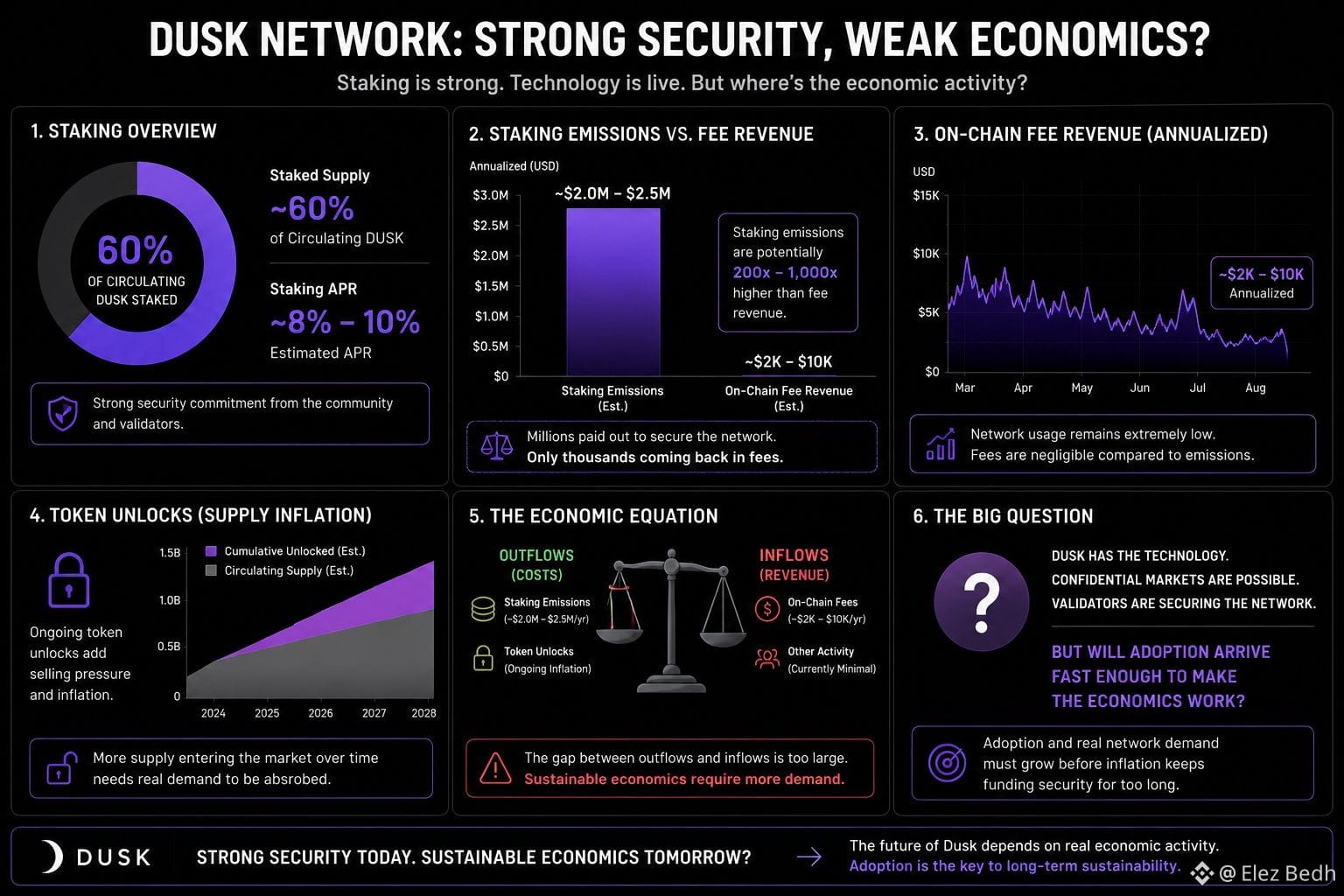
Dusk’s staking numbers look strong—roughly 60% of circulating $DUSK staked with ~8–10% APR.
But the other side of the equation is harder to ignore: on-chain fee revenue appears tiny compared with the millions potentially being paid annually in staking emissions.
The technology is live. Confidential assets are possible. Validators are securing the network.
But where’s the economic activity?
Add ongoing token unlocks and staking rewards, and Dusk faces a simple challenge: real network demand needs to grow before inflation keeps funding security for too long.
The biggest question for Dusk may not be whether confidential markets can work.
@Dusk #dusk #DUSK $DUSK
But the other side of the equation is harder to ignore: on-chain fee revenue appears tiny compared with the millions potentially being paid annually in staking emissions.
The technology is live. Confidential assets are possible. Validators are securing the network.
But where’s the economic activity?
Add ongoing token unlocks and staking rewards, and Dusk faces a simple challenge: real network demand needs to grow before inflation keeps funding security for too long.
The biggest question for Dusk may not be whether confidential markets can work.
@Dusk #dusk #DUSK $DUSK
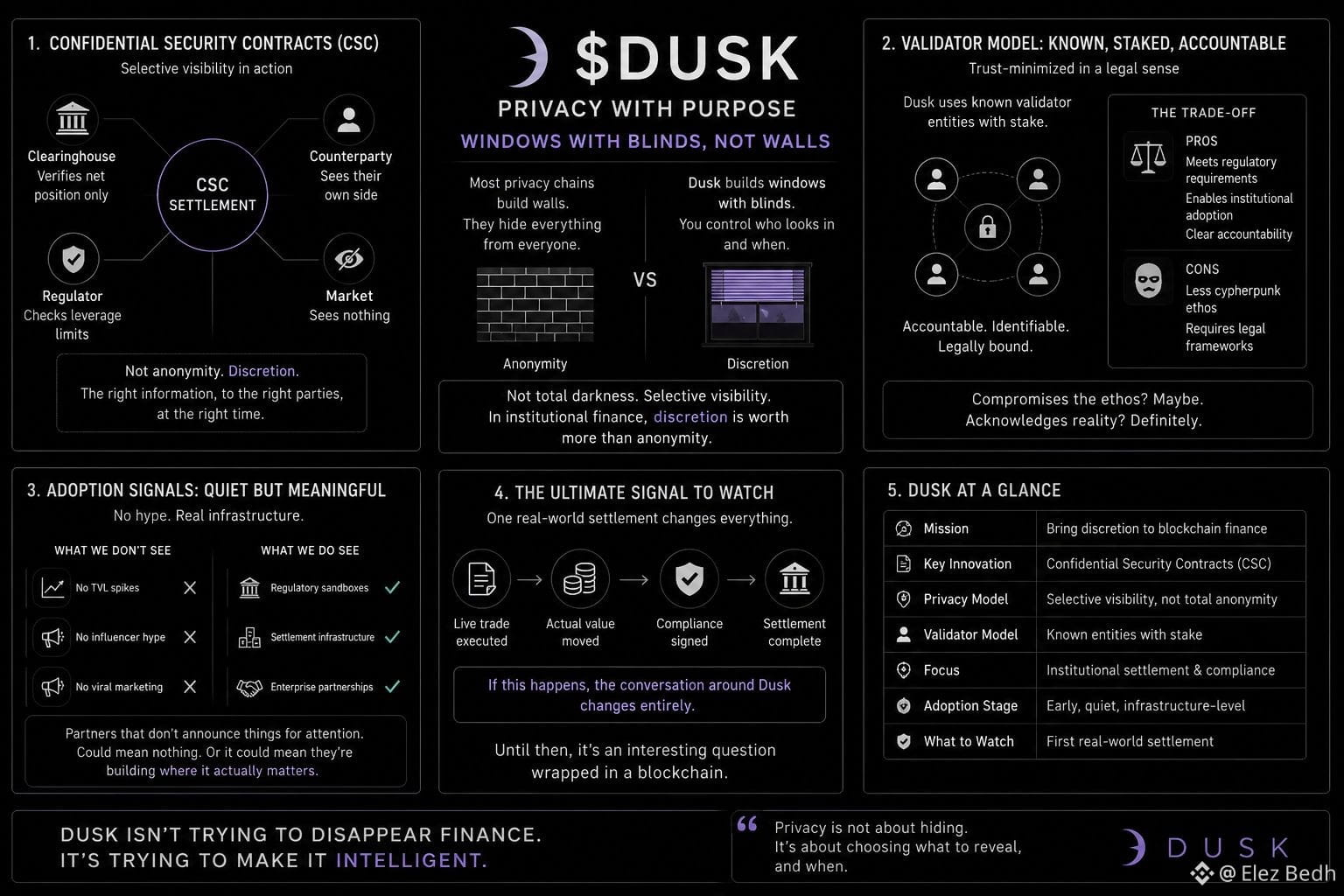
I keep coming back to $DUSK because it doesn't fit the privacy narrative I'm used to.
Most privacy chains feel like they're building walls. Dusk feels like it's building windows with blinds. You control who looks in and when. That's a subtle but massive difference.
Their Confidential Security Contracts let you settle a trade where the clearinghouse can verify the net position, the counterparty sees their side, the regulator checks leverage limits—but the broader market sees nothing. Not total darkness, just selective visibility. That's not anonymity. That's discretion. And in institutional finance, discretion is worth more than anonymity.
What gives me pause is the validator model. They're known entities with stake—not anonymous miners. It's trust-minimized in a legal sense, not a cypherpunk one. I don't know if that compromises the ethos or just acknowledges reality. Probably both.
The adoption signals are quiet. No TVL spikes, no influencer hype. But the partnerships that exist are with regulatory sandboxes and settlement infrastructure—places that don't announce things for attention. That could mean nothing. Or it could mean they're building where it actually matters.
I'm watching for a single real-world settlement. A live trade, compliance-signed, moving actual value. If that happens, the conversation around Dusk changes entirely. Until then, it's an interesting question wrapped in a blockchain.
@Dusk #dusk #DUSK $DUSK
Most privacy chains feel like they're building walls. Dusk feels like it's building windows with blinds. You control who looks in and when. That's a subtle but massive difference.
Their Confidential Security Contracts let you settle a trade where the clearinghouse can verify the net position, the counterparty sees their side, the regulator checks leverage limits—but the broader market sees nothing. Not total darkness, just selective visibility. That's not anonymity. That's discretion. And in institutional finance, discretion is worth more than anonymity.
What gives me pause is the validator model. They're known entities with stake—not anonymous miners. It's trust-minimized in a legal sense, not a cypherpunk one. I don't know if that compromises the ethos or just acknowledges reality. Probably both.
The adoption signals are quiet. No TVL spikes, no influencer hype. But the partnerships that exist are with regulatory sandboxes and settlement infrastructure—places that don't announce things for attention. That could mean nothing. Or it could mean they're building where it actually matters.
I'm watching for a single real-world settlement. A live trade, compliance-signed, moving actual value. If that happens, the conversation around Dusk changes entirely. Until then, it's an interesting question wrapped in a blockchain.
@Dusk #dusk #DUSK $DUSK
Verified
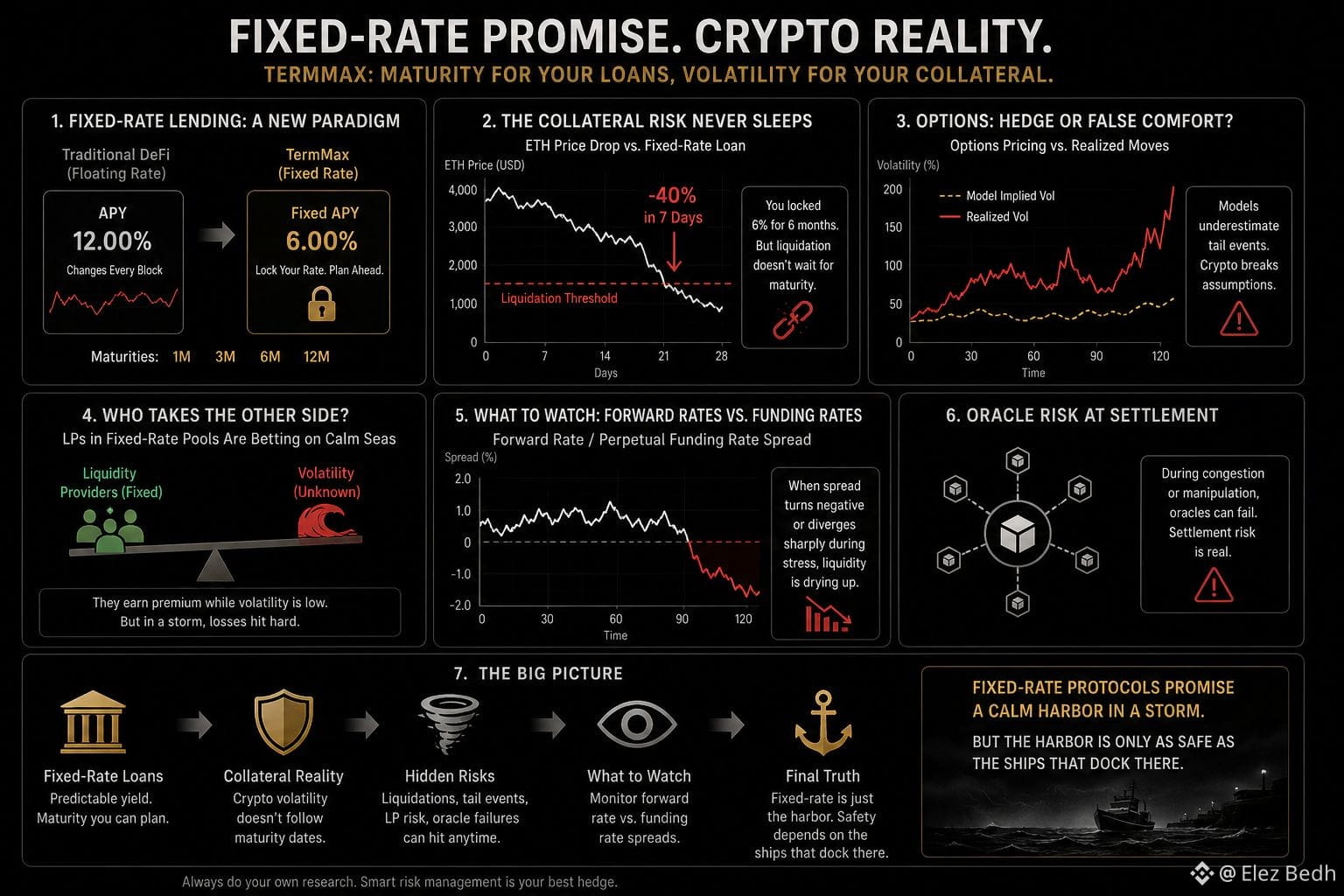
I've been burned by floating rates more times than I care to admit. You look at that 12% APY on the dashboard, think you're set, and then the funding rate flips overnight and you're left scrambling to roll your position at a loss. That's why the idea of fixed-rate lending actually caught my attention—it feels like DeFi is finally growing up and admitting that not everyone wants to gamble on yield every single block.
TermMax tries to build an actual bond market on-chain, with different maturities so you can plan ahead. Sounds mature, right? But here's the thing that keeps me up at night: the collateral backing these loans is still crypto, and crypto doesn't care about your maturity schedule. If ETH drops 40% in a week, that fixed 6% rate you locked in becomes irrelevant—you're getting liquidated at the spot price long before the loan term ends. The protocol also offers options, which is clever, but options pricing models tend to underestimate how ugly tail events can get in this space. And the liquidity providers on the fixed side? They're essentially betting that volatility stays calm, which feels like standing in front of a train and hoping it slows down.
What I'm actually watching is the spread between TermMax's forward rates and perpetual swap funding rates. If that relationship starts looking weird during a market shock, it's a signal that liquidity is drying up, not that rates are changing rationally. Also, oracles are involved at settlement, and we all know how that can go sideways during congestion.
Fixed-rate protocols promise a calm harbor in a storm. But the harbor is only as safe as the ships that dock there.
@TermMax #TermMax
TermMax tries to build an actual bond market on-chain, with different maturities so you can plan ahead. Sounds mature, right? But here's the thing that keeps me up at night: the collateral backing these loans is still crypto, and crypto doesn't care about your maturity schedule. If ETH drops 40% in a week, that fixed 6% rate you locked in becomes irrelevant—you're getting liquidated at the spot price long before the loan term ends. The protocol also offers options, which is clever, but options pricing models tend to underestimate how ugly tail events can get in this space. And the liquidity providers on the fixed side? They're essentially betting that volatility stays calm, which feels like standing in front of a train and hoping it slows down.
What I'm actually watching is the spread between TermMax's forward rates and perpetual swap funding rates. If that relationship starts looking weird during a market shock, it's a signal that liquidity is drying up, not that rates are changing rationally. Also, oracles are involved at settlement, and we all know how that can go sideways during congestion.
Fixed-rate protocols promise a calm harbor in a storm. But the harbor is only as safe as the ships that dock there.
@TermMax #TermMax
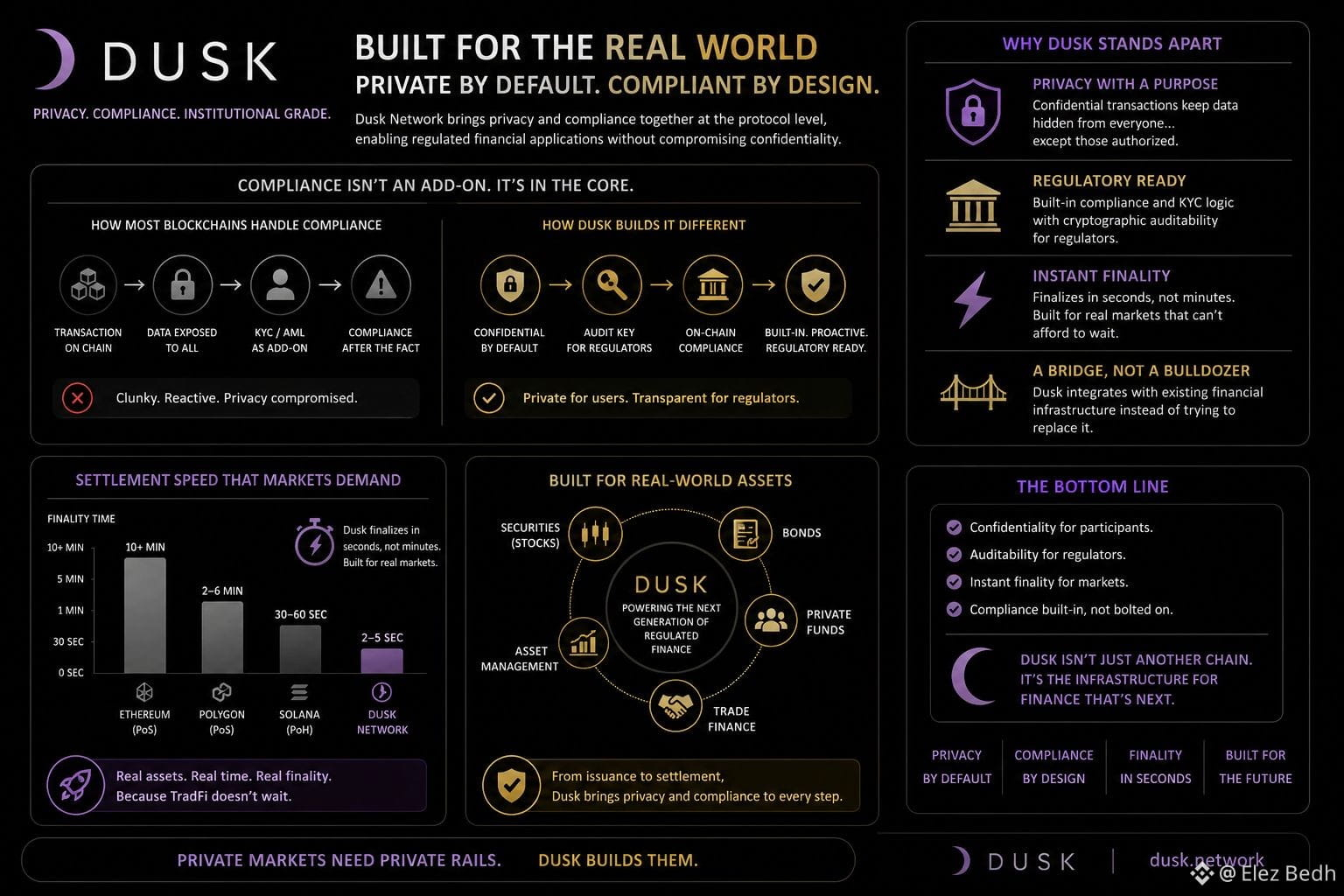
What really sets Dusk apart, at least to me, is how it handles the regulatory elephant in the room. Most chains treat KYC and compliance as a clunky add-on, but $DUSK builds it right into the core logic. You get private, confidential transfers, yet the network leaves a cryptographic backdoor for auditors—so a securities trade stays hidden from competitors but visible to the SEC if needed.
The other practical detail that stands out is settlement speed. For trading actual stocks or bonds, waiting around for probabilistic finality over 10 minutes just doesn't cut it. Dusk finalizes in seconds, which actually respects how traditional markets operate. Honestly, it’s one of the few projects that feels like it’s building a bridge to the existing financial system, rather than just trying to bulldoze it.
@Dusk #dusk #DUSK $DUSK
The other practical detail that stands out is settlement speed. For trading actual stocks or bonds, waiting around for probabilistic finality over 10 minutes just doesn't cut it. Dusk finalizes in seconds, which actually respects how traditional markets operate. Honestly, it’s one of the few projects that feels like it’s building a bridge to the existing financial system, rather than just trying to bulldoze it.
@Dusk #dusk #DUSK $DUSK
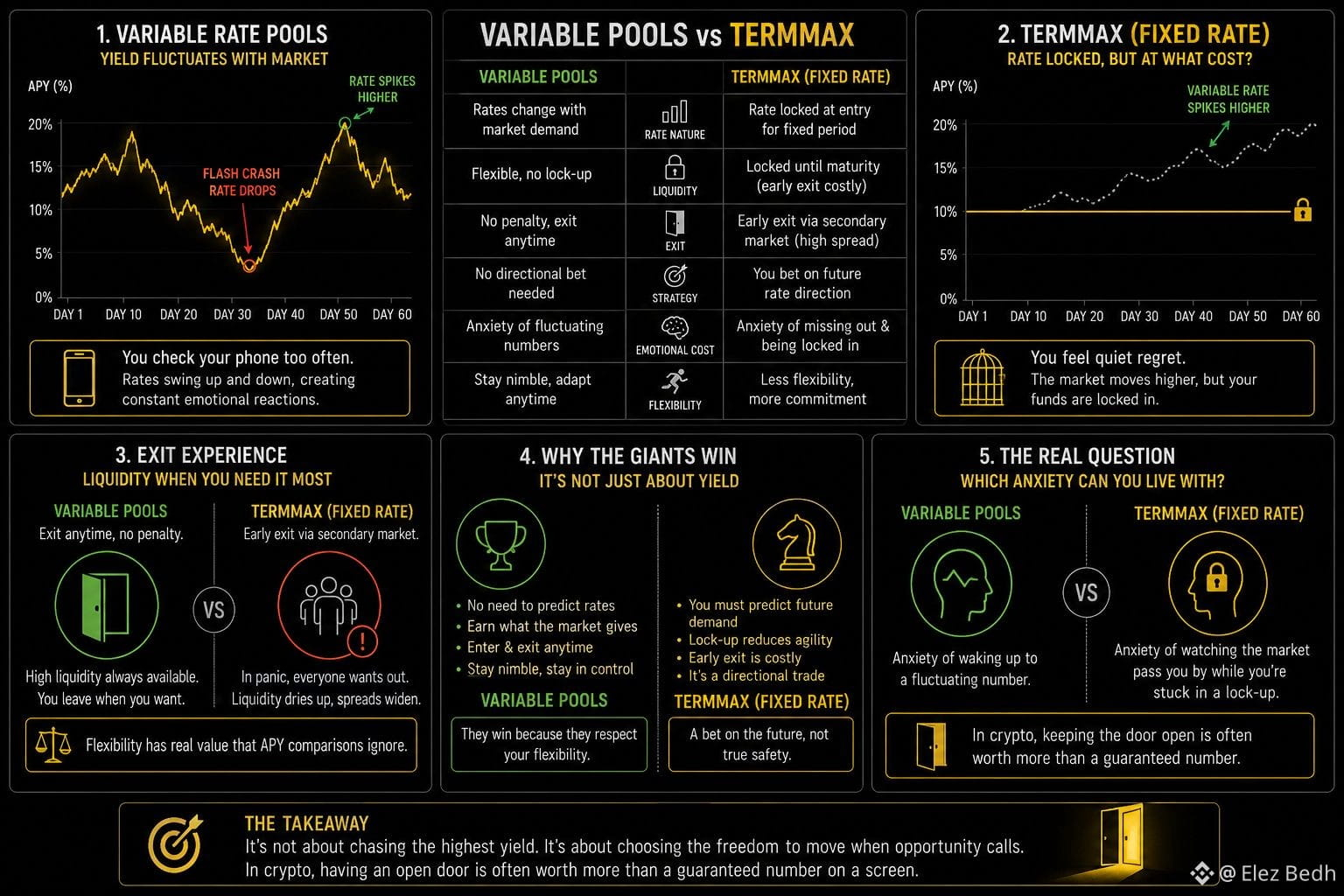
I’ve been running a small experiment with both, splitting some capital just to feel the difference rather than just theorize about it. The variable pools make me check my phone too often. A flash crash sends the rate down, and I feel that pang of irritation. But TermMax makes me feel something worse: a quiet, creeping regret when the variable rate spikes past my locked number. I thought I was buying peace of mind, but I ended up buying a cage.
What surprised me most was the exit. I tried to pull from TermMax early just to test the waters, and the spread was painful. It turns out that fixed rate only holds if nobody else wants out at the same time. In a panic, that secondary market dries up fast. Variable pools don't have that problem. You leave when you want, no questions asked, no penalty. The flexibility itself has a real, tangible value that doesn't show up in the APY comparison.
I’ve started to see the giants differently. They don't win because they offer better yields; they win because they never ask you to predict where rates are going. You just show up, earn what the market gives you, and stay nimble. TermMax, on the other hand, asks you to make a bet on the future direction of borrowing demand. That's not safety. That's a directional trade dressed up in the language of certainty.
The real question isn't which yields higher. It's which anxiety you can actually live with. The anxiety of waking up to a fluctuating number, or the anxiety of watching the market pass you by while you're stuck in a lock-up. I'm starting to think that most people choose the former simply because it leaves the door open. And in crypto, having an open door is often worth more than a guaranteed number on a screen.
@TermMax #TermMax
What surprised me most was the exit. I tried to pull from TermMax early just to test the waters, and the spread was painful. It turns out that fixed rate only holds if nobody else wants out at the same time. In a panic, that secondary market dries up fast. Variable pools don't have that problem. You leave when you want, no questions asked, no penalty. The flexibility itself has a real, tangible value that doesn't show up in the APY comparison.
I’ve started to see the giants differently. They don't win because they offer better yields; they win because they never ask you to predict where rates are going. You just show up, earn what the market gives you, and stay nimble. TermMax, on the other hand, asks you to make a bet on the future direction of borrowing demand. That's not safety. That's a directional trade dressed up in the language of certainty.
The real question isn't which yields higher. It's which anxiety you can actually live with. The anxiety of waking up to a fluctuating number, or the anxiety of watching the market pass you by while you're stuck in a lock-up. I'm starting to think that most people choose the former simply because it leaves the door open. And in crypto, having an open door is often worth more than a guaranteed number on a screen.
@TermMax #TermMax
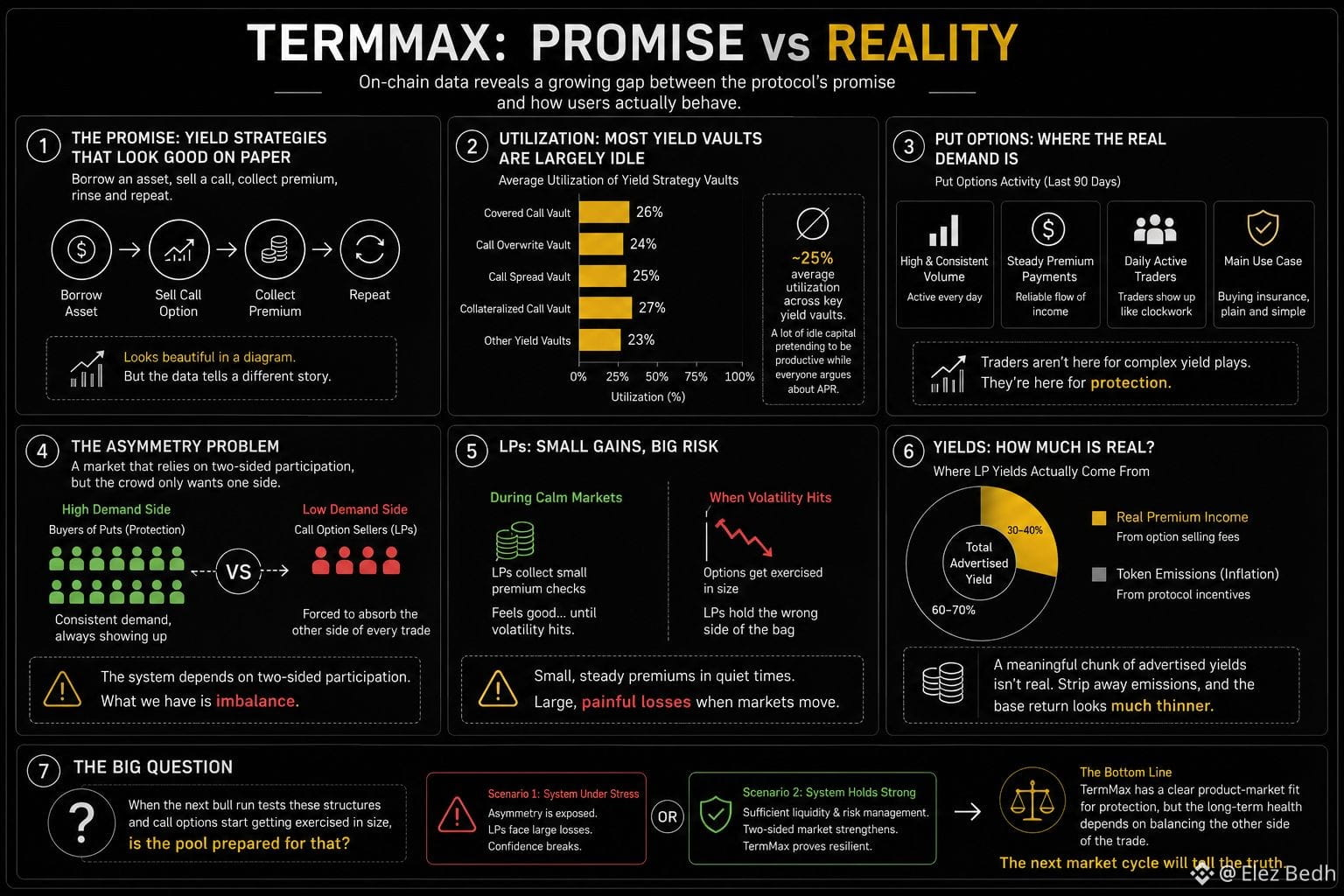
I was poking around TermMax's on-chain data this week, and one thing kept nagging at me. The gap between what the protocol promises and how people actually use it is pretty stark.
Everyone talks about the yield strategies—borrow an asset, sell a call, collect premium, rinse and repeat. It's the kind of thing that looks beautiful in a diagram. But when I checked the utilization on those specific vaults, most were hovering around 25%. That's not a bustling marketplace. That's a lot of idle capital pretending to be productive while everyone argues about APR.
Flip to the put options, though, and suddenly it's a different world. Consistent volume, steady premium payments, traders showing up every single day like clockwork. They're not here for complex yield plays. They're buying insurance. Plain and simple.
This creates a dynamic that makes me uneasy. The whole system depends on two-sided participation—people willing to take both sides of the risk. But what we actually have is a crowd that only wants protection and a pool of LPs forced to absorb the other side of every single trade. Those LPs collect small premium checks during quiet markets, but when volatility finally hits, they're the ones holding the wrong side of the bag.
Here's the thing I keep circling back to. A meaningful chunk of those advertised yields for LPs isn't even real premium income. It's token emissions. Strip away the inflationary rewards, and the base return on that idle capital starts looking thinner than the marketing suggests.
The real question that's going to bug me until we see a proper market cycle play out is this. When the next bull run actually tests these structures, and those call options start getting exercised in size, is the pool prepared for that? Or is it just a matter of time before the asymmetry in user behavior exposes a flaw that nobody's talking about yet?
@TermMax #TermMax
Everyone talks about the yield strategies—borrow an asset, sell a call, collect premium, rinse and repeat. It's the kind of thing that looks beautiful in a diagram. But when I checked the utilization on those specific vaults, most were hovering around 25%. That's not a bustling marketplace. That's a lot of idle capital pretending to be productive while everyone argues about APR.
Flip to the put options, though, and suddenly it's a different world. Consistent volume, steady premium payments, traders showing up every single day like clockwork. They're not here for complex yield plays. They're buying insurance. Plain and simple.
This creates a dynamic that makes me uneasy. The whole system depends on two-sided participation—people willing to take both sides of the risk. But what we actually have is a crowd that only wants protection and a pool of LPs forced to absorb the other side of every single trade. Those LPs collect small premium checks during quiet markets, but when volatility finally hits, they're the ones holding the wrong side of the bag.
Here's the thing I keep circling back to. A meaningful chunk of those advertised yields for LPs isn't even real premium income. It's token emissions. Strip away the inflationary rewards, and the base return on that idle capital starts looking thinner than the marketing suggests.
The real question that's going to bug me until we see a proper market cycle play out is this. When the next bull run actually tests these structures, and those call options start getting exercised in size, is the pool prepared for that? Or is it just a matter of time before the asymmetry in user behavior exposes a flaw that nobody's talking about yet?
@TermMax #TermMax
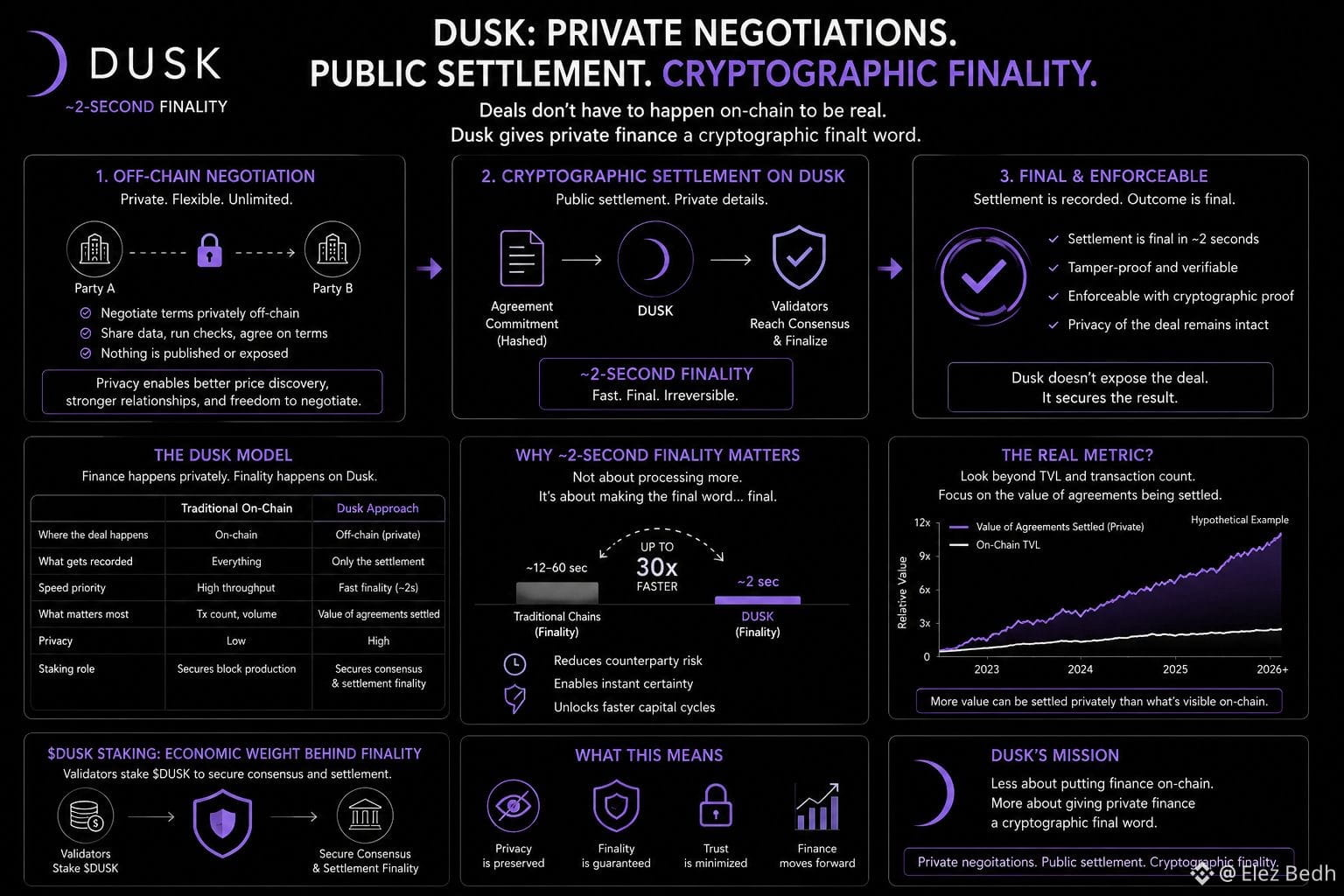
Dusk’s ~2-second finality makes more sense when you realize the chain may not be where the actual deal happens.
Parties can negotiate privately off-chain, then use Dusk to cryptographically settle the agreement. In that model, speed isn’t mainly about processing huge trading volume—it’s about making an agreed settlement final quickly.
That also gives $DUSK staking a deeper role. Validators stake value to secure consensus and settlement, putting economic weight behind the network’s finality.
So maybe TVL and transaction count don’t tell the full Dusk story. If meaningful financial activity happens privately before reaching the chain, the more interesting metric could eventually be the value of agreements being settled and secured.
Dusk may be less about putting finance on-chain—and more about giving private finance a cryptographic final word.
@Dusk #dusk $DUSK #DUSK
Parties can negotiate privately off-chain, then use Dusk to cryptographically settle the agreement. In that model, speed isn’t mainly about processing huge trading volume—it’s about making an agreed settlement final quickly.
That also gives $DUSK staking a deeper role. Validators stake value to secure consensus and settlement, putting economic weight behind the network’s finality.
So maybe TVL and transaction count don’t tell the full Dusk story. If meaningful financial activity happens privately before reaching the chain, the more interesting metric could eventually be the value of agreements being settled and secured.
Dusk may be less about putting finance on-chain—and more about giving private finance a cryptographic final word.
@Dusk #dusk $DUSK #DUSK
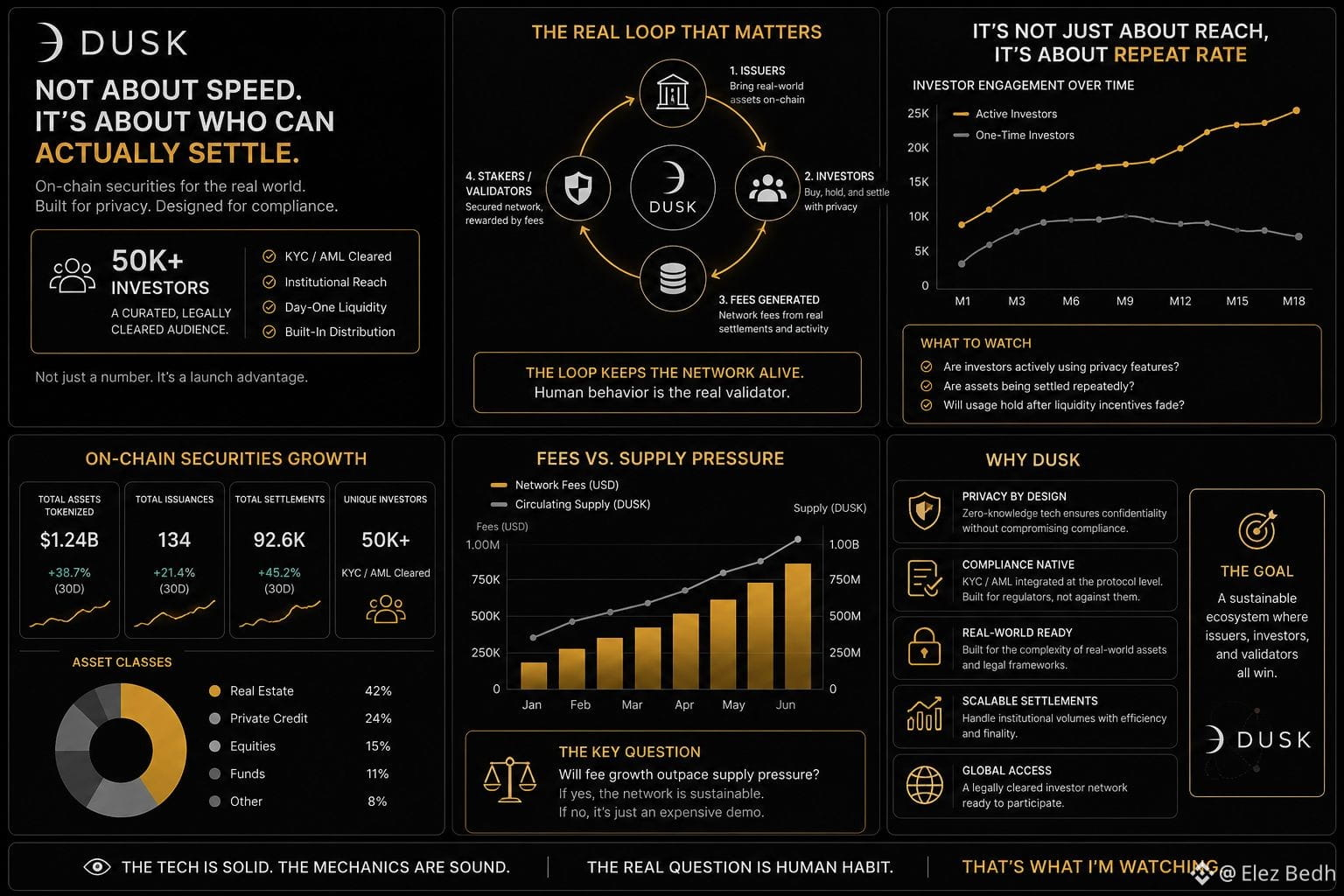
I'll admit, I usually glaze over when projects pitch "institutional-grade" anything. But digging into Dusk, I realized I was looking at the wrong metric. It’s not about how fast it settles—it’s about who can actually settle at all.
That 50k+ investor pool isn't just a vanity number to slap on a pitch deck. It feels more like a curated guest list. If you're a fund looking to tokenize a real estate asset, knowing you already have a large, legally cleared audience capable of buying on day one actually changes your entire launch strategy. You're not crossing your fingers, hoping market makers show up to save the day.
Still, my trader brain kicks in here. I've seen "reach" turn into "ghost traffic" way too many times to take the headline at face value. I care less about the initial count and more about the repeat rate. Are these investors actually using the privacy features to trade these assets, or are they just sitting on them? And more importantly, when the liquidity incentives inevitably fade, do the network fees from these real-world settlements actually keep the validators happy?
If fee growth doesn't keep pace with the circulating supply pressure, it's just an elaborate compliance demo.$DUSK The tech for on-chain securities is actually solid here. But that behavioral loop—issuers bringing assets, investors settling them repeatedly, and fees rewarding stakers—is the only thing I'm actually watching. The mechanics are sound; the human habits are the real question mark.
@Dusk #dusk #DUSK $DUSK
That 50k+ investor pool isn't just a vanity number to slap on a pitch deck. It feels more like a curated guest list. If you're a fund looking to tokenize a real estate asset, knowing you already have a large, legally cleared audience capable of buying on day one actually changes your entire launch strategy. You're not crossing your fingers, hoping market makers show up to save the day.
Still, my trader brain kicks in here. I've seen "reach" turn into "ghost traffic" way too many times to take the headline at face value. I care less about the initial count and more about the repeat rate. Are these investors actually using the privacy features to trade these assets, or are they just sitting on them? And more importantly, when the liquidity incentives inevitably fade, do the network fees from these real-world settlements actually keep the validators happy?
If fee growth doesn't keep pace with the circulating supply pressure, it's just an elaborate compliance demo.$DUSK The tech for on-chain securities is actually solid here. But that behavioral loop—issuers bringing assets, investors settling them repeatedly, and fees rewarding stakers—is the only thing I'm actually watching. The mechanics are sound; the human habits are the real question mark.
@Dusk #dusk #DUSK $DUSK
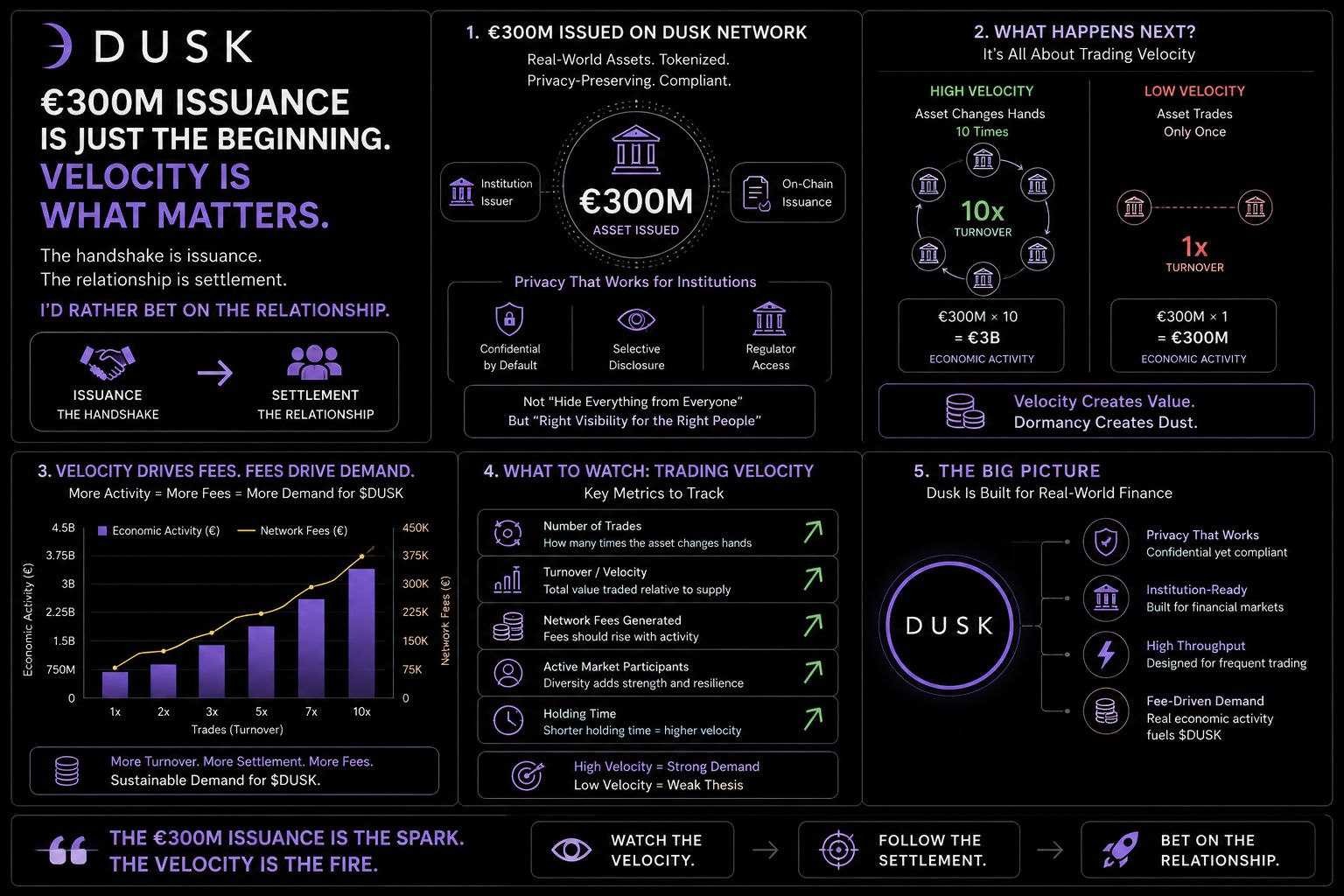
When I look at Dusk, I don't get excited about the €300M issuance number anymore. I've been burned before by big headlines that don't move the needle. What actually makes me lean in is what happens after that asset gets issued. Does it just sit there looking pretty on-chain, or does it start moving?
Here's what Dusk gets right: they built privacy that actually works for institutions—not the "hide everything from everyone" kind, but the kind where you can keep your trades confidential while still letting regulators peek in if they need to. That's the boring but critical stuff that makes financial firms feel safe enough to trade frequently.
And frequency is everything. If that €300M changes hands ten times, you've got €3B in economic activity flowing through the network. That's where fees start piling up, and that's what gives $DUSK real demand beyond staking rewards. But if it trades once and goes dormant? Then it's just a vanity metric.
So honestly, I'd watch the trading velocity like a hawk. The issuance is the handshake. The settlement is the relationship. I'd rather bet on the relationship.
@Dusk #dusk #DUSK $DUSK
Here's what Dusk gets right: they built privacy that actually works for institutions—not the "hide everything from everyone" kind, but the kind where you can keep your trades confidential while still letting regulators peek in if they need to. That's the boring but critical stuff that makes financial firms feel safe enough to trade frequently.
And frequency is everything. If that €300M changes hands ten times, you've got €3B in economic activity flowing through the network. That's where fees start piling up, and that's what gives $DUSK real demand beyond staking rewards. But if it trades once and goes dormant? Then it's just a vanity metric.
So honestly, I'd watch the trading velocity like a hawk. The issuance is the handshake. The settlement is the relationship. I'd rather bet on the relationship.
@Dusk #dusk #DUSK $DUSK
I noticed something weird about $DUSK last night while poking around their block explorer.
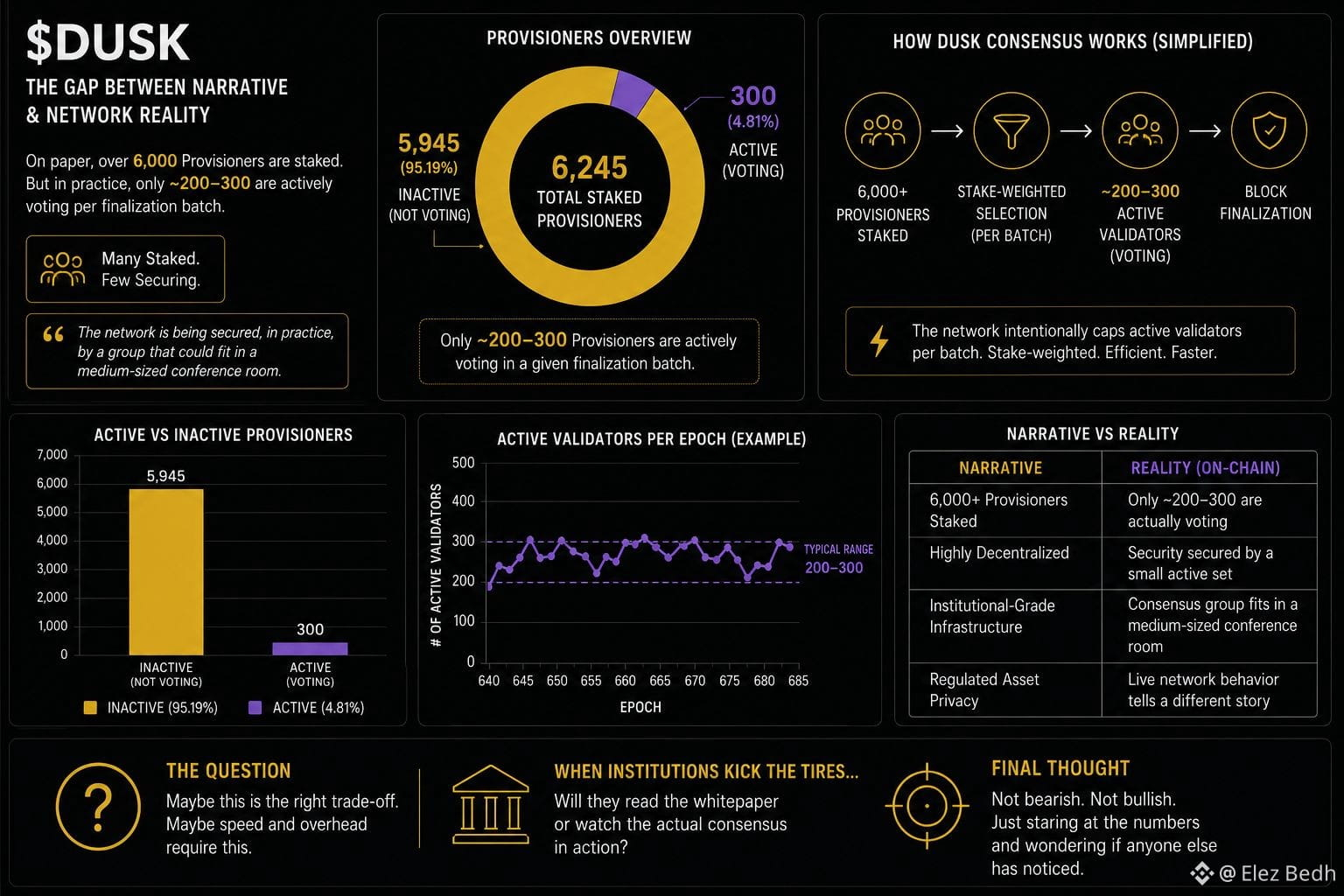
On paper, there are over 6,000 Provisioners staked. That's a solid number. Decentralized. Healthy. Exactly what you'd want to see.
Then I started watching the actual block finalization on a given epoch.
Only about 200 to 300 of those nodes are actively voting.
I refreshed the page a few times thinking my browser was glitching. Nope. The network intentionally caps active validators per batch. Stake-weighted. Efficient. Probably makes the whole thing faster.
But let's sit with that for a moment.
The network is being secured, in practice, by a group that could fit in a medium-sized conference room. Meanwhile, the narrative keeps pushing "institutional-grade infrastructure" and "regulated asset privacy." Those are big promises. And I'm not saying they're empty. I'm just saying there's a gap between the story and the live network.
Maybe it's the right trade-off. Maybe speed and overhead require this. But when institutions finally kick the tires, are they going to read the whitepaper or watch the actual consensus in action?
Because right now, those two things don't perfectly align.
I'm not bearish. I'm not bullish. I'm just staring at the numbers and wondering if anyone else has noticed.
@Dusk #dusk #DUSK $DUSK
On paper, there are over 6,000 Provisioners staked. That's a solid number. Decentralized. Healthy. Exactly what you'd want to see.
Then I started watching the actual block finalization on a given epoch.
Only about 200 to 300 of those nodes are actively voting.
I refreshed the page a few times thinking my browser was glitching. Nope. The network intentionally caps active validators per batch. Stake-weighted. Efficient. Probably makes the whole thing faster.
But let's sit with that for a moment.
The network is being secured, in practice, by a group that could fit in a medium-sized conference room. Meanwhile, the narrative keeps pushing "institutional-grade infrastructure" and "regulated asset privacy." Those are big promises. And I'm not saying they're empty. I'm just saying there's a gap between the story and the live network.
Maybe it's the right trade-off. Maybe speed and overhead require this. But when institutions finally kick the tires, are they going to read the whitepaper or watch the actual consensus in action?
Because right now, those two things don't perfectly align.
I'm not bearish. I'm not bullish. I'm just staring at the numbers and wondering if anyone else has noticed.
@Dusk #dusk #DUSK $DUSK
I keep circling back to Dusk, and I genuinely struggle to care about the TPS number.
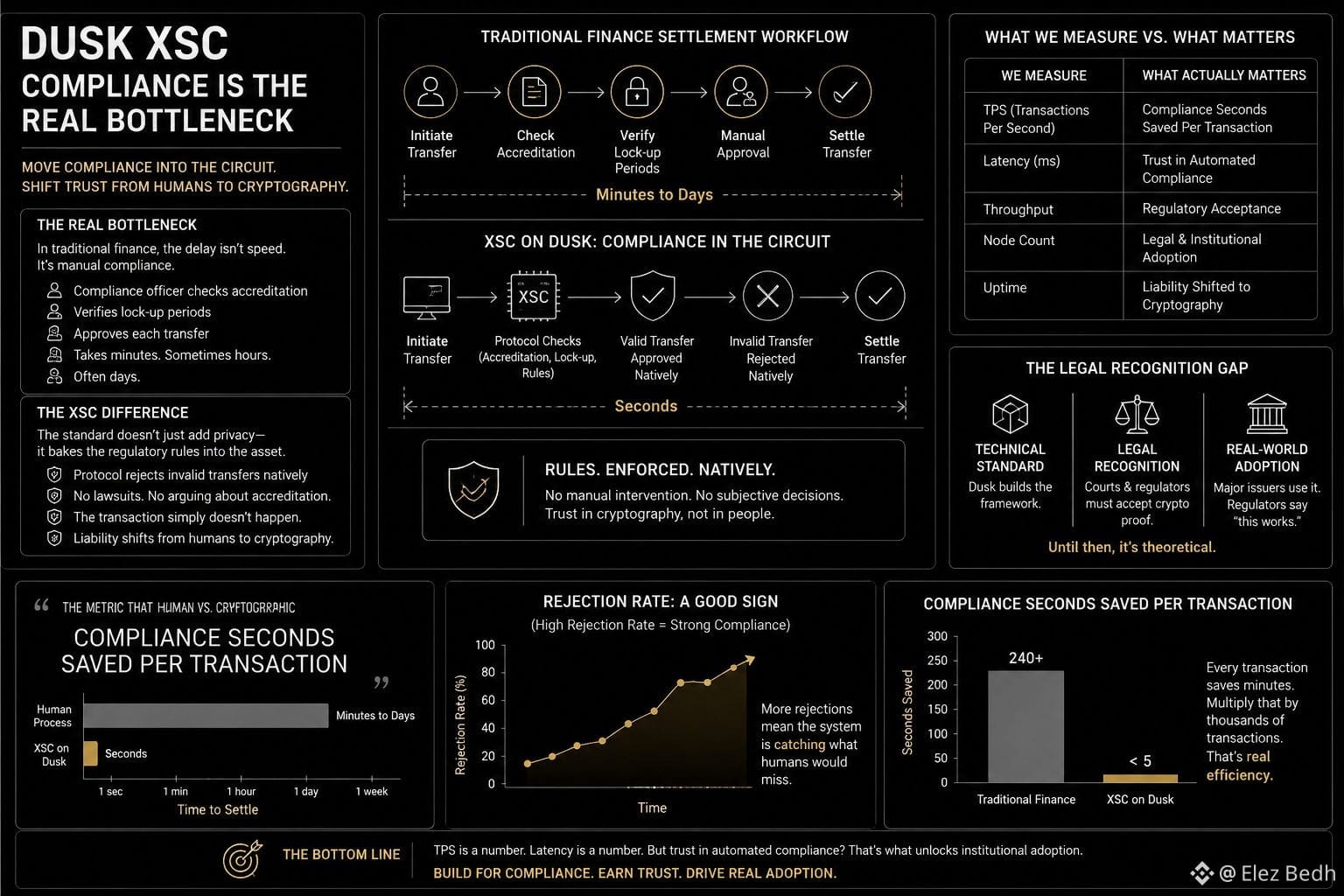
The real bottleneck isn't speed. If you've ever watched a security trade settle in traditional finance, you know the holdup isn't database latency. It's the compliance officer manually checking accreditation against a PDF, verifying lock-up periods, and approving each transfer. That takes minutes. Sometimes hours. Often days.
XSC moves compliance into the circuit. The standard doesn't just add privacy—it bakes the regulatory rules into the asset itself. The protocol rejects invalid transfers natively. No lawsuits. No arguing about accreditation. The transaction simply doesn't happen. That shifts the entire liability model off humans and onto cryptography.
We measure what's easy, not what matters. TPS is a number. Latency is a number. But trust in automated compliance? That's squishy and hard to benchmark. Yet that's exactly what determines whether a regulated institution will actually use the chain.
Here's where I get uneasy. A technical standard is useless if the legal system doesn't recognize the cryptographic proof as sufficient. Dusk can build the most elegant framework, but until a major issuer uses it and a regulator says "this works," it's theoretical.
Two signals I'm actually watching. First, whether law firms are willing to opine on XSC—that's real adoption, not node count. Second, the rejection rate. Counterintuitively, a high number of failed transfers is a good sign. It means the system catches what humans would otherwise handle manually.
Maybe the real metric isn't transactions per second. It's compliance seconds saved per transaction.
@Dusk #dusk #DUSK $DUSK
The real bottleneck isn't speed. If you've ever watched a security trade settle in traditional finance, you know the holdup isn't database latency. It's the compliance officer manually checking accreditation against a PDF, verifying lock-up periods, and approving each transfer. That takes minutes. Sometimes hours. Often days.
XSC moves compliance into the circuit. The standard doesn't just add privacy—it bakes the regulatory rules into the asset itself. The protocol rejects invalid transfers natively. No lawsuits. No arguing about accreditation. The transaction simply doesn't happen. That shifts the entire liability model off humans and onto cryptography.
We measure what's easy, not what matters. TPS is a number. Latency is a number. But trust in automated compliance? That's squishy and hard to benchmark. Yet that's exactly what determines whether a regulated institution will actually use the chain.
Here's where I get uneasy. A technical standard is useless if the legal system doesn't recognize the cryptographic proof as sufficient. Dusk can build the most elegant framework, but until a major issuer uses it and a regulator says "this works," it's theoretical.
Two signals I'm actually watching. First, whether law firms are willing to opine on XSC—that's real adoption, not node count. Second, the rejection rate. Counterintuitively, a high number of failed transfers is a good sign. It means the system catches what humans would otherwise handle manually.
Maybe the real metric isn't transactions per second. It's compliance seconds saved per transaction.
@Dusk #dusk #DUSK $DUSK
$INX is exploding with +35% momentum and buyers are still pushing hard! A clean continuation could trigger another leg higher. 🚀
EP: 0.0108 – 0.0112
TP: 0.0125 / 0.0138 / 0.0150 🎯
SL: 0.0102 🛑
$COOKIE is up +28% in your snapshot. If buyers defend the breakout zone, the rally could stretch further.
EP: 0.0147 – 0.0152
TP: 0.0165 / 0.0178 / 0.0190 🎯
SL: 0.0139 🛑
$CYS is ripping higher near fresh highs, with current market data also showing strong 24H momentum.
EP: 1.40 – 1.46
TP: 1.55 / 1.68 / 1.82 🎯
SL: 1.32 🛑
EP: 0.0108 – 0.0112
TP: 0.0125 / 0.0138 / 0.0150 🎯
SL: 0.0102 🛑
$COOKIE is up +28% in your snapshot. If buyers defend the breakout zone, the rally could stretch further.
EP: 0.0147 – 0.0152
TP: 0.0165 / 0.0178 / 0.0190 🎯
SL: 0.0139 🛑
$CYS is ripping higher near fresh highs, with current market data also showing strong 24H momentum.
EP: 1.40 – 1.46
TP: 1.55 / 1.68 / 1.82 🎯
SL: 1.32 🛑
Long
51%
Short
49%
83 votes • Voting closed
Log in to explore more content