
CoinPulseHq
8 Posts

CoinPulseHq
Report
Block User
CoinPulseHQ is an independent digital newsroom covering cryptocurrency, blockchain and artificial intelligence.
3 Following
9 Followers
8 Liked
Posts
·
--

Article
House Tax Committee Advances Crypto Tax Bill 38-5 After CLARITY Act FailsThe House Ways and Means Committee passed the Digital Asset Tax Certainty Act in a bipartisan 38-5 vote on Wednesday, September 16, 2026, moving legislation that would rework how federal tax rules apply to stablecoins, mining and staking income, crypto lending and digital asset transactions, Cointelegraph reported.
The committee's approval sends the bill to the full House of Representatives, though no floor date has been set. The vote landed a day after the Senate failed to advance the broader CLARITY Act market structure bill on a 49-50 cloture motion, short of the 60 votes needed to open debate. That failure left the tax package as the main piece of crypto legislation actively moving through Congress.
Key facts
• The Digital Asset Tax Certainty Act advanced out of Ways and Means on a 38-5 bipartisan vote.
• The bill would give special tax treatment to qualifying dollar-pegged stablecoins and certain crypto lending agreements, and extend wash-sale rules to widely traded digital assets.
• It creates a de minimis exemption so taxpayers avoid recognizing gains or losses when digital assets are used to pay qualifying network or transaction fees of $10 or less.
• The Senate's CLARITY Act cloture motion failed 49-50 on Tuesday, falling short of the 60 votes required.
• The Bitcoin Reserve Act, also called the American Reserve Modernization Act (H.R. 8957), is scheduled for a House Financial Services Committee markup at 10:00 a.m. ET on Wednesday, September 16, according to Coinpedia.
The tax bill's provisions also cover new rules for mining and staking income, a long-running sticking point for taxpayers who receive tokens as block rewards.
Stablecoins, fees and the wash-sale change
The bill's stablecoin language would create special treatment for tokens that qualify as dollar-pegged, while lending agreements would get their own rules rather than falling under general income recognition. The $10 de minimis threshold on network and transaction fees is narrower than some industry participants had sought, and the package dropped earlier proposals to defer tax on mining and staking rewards, per prior Cointelegraph coverage.
Extending wash-sale rules to widely traded digital assets would end a long-standing mismatch: under existing law, those rules apply to stocks and securities but not to crypto, which had allowed traders to sell at a loss and repurchase almost immediately.
Regulators signal they will act without Congress
Senator Cynthia Lummis, who chairs the Senate Banking Subcommittee on Digital Assets and co-sponsored the CLARITY Act, blamed Democrats for its failure. In a post on X, she said that for more than a year Democrats had presented demands, and that once those demands were met they added new ones and moved the goal posts. She also said Democrats voted against proposed consumer protections and restrictions on politicians' personal crypto investments.
SEC Chair Paul Atkins responded the same day, writing on X that the agency would act within its statutory authority regardless of whether legislation passes, and telling readers to stay tuned. CFTC Chair Michael Selig likewise said the derivatives regulator would proceed under its existing authority, describing the agency as ready to ship rules for what he called the new frontier of finance and saying Americans deserve regulatory clarity, legal certainty and consumer protections in crypto asset markets.
Why it matters
Tax treatment has been one of the most concrete unresolved problems for US crypto users, and the Ways and Means vote gives the industry its first committee-level win on the issue. Stablecoin issuers, lenders, miners, stakers and ordinary traders would all be affected if the bill becomes law. The contrast with the Senate is sharp: the market structure framework stalled, while the tax package advanced with support from both parties. Coinpedia reported that the reserve bill is bipartisan too, introduced by Republican Rep. Nick Begich and Democratic co-sponsor Rep. Jared Golden in late May, with a 20-year lockup on government Bitcoin and a ban on buying Bitcoin with new taxes, debt or deficit spending.
What to watch
The full House is the next stop for the tax bill, and the Senate remains a separate hurdle. Also Wednesday, the House Financial Services Committee is scheduled to consider the American Reserve Modernization Act at 10:00 a.m. ET, with Coinpedia noting that passage there would send it to the House floor, then the Senate, then the President. Any further SEC or CFTC rulemaking announcements will signal how far regulators are willing to go without the CLARITY Act.
Nothing here is financial advice, and crypto markets are volatile and uncertain.
Originally published on CoinPulseHQ: https://coinpulsehq.com/house-ways-means-crypto-tax-bill-38-5-clarity-act-fails/
House Tax Committee Advances Crypto Tax Bill 38-5 After CLARITY Act Fails
The House Ways and Means Committee passed the Digital Asset Tax Certainty Act in a bipartisan 38-5 vote on Wednesday, September 16, 2026, moving legislation that would rework how federal tax rules apply to stablecoins, mining and staking income, crypto lending and digital asset transactions, Cointelegraph reported.
The committee's approval sends the bill to the full House of Representatives, though no floor date has been set. The vote landed a day after the Senate failed to advance the broader CLARITY Act market structure bill on a 49-50 cloture motion, short of the 60 votes needed to open debate. That failure left the tax package as the main piece of crypto legislation actively moving through Congress.
Key facts
• The Digital Asset Tax Certainty Act advanced out of Ways and Means on a 38-5 bipartisan vote.
• The bill would give special tax treatment to qualifying dollar-pegged stablecoins and certain crypto lending agreements, and extend wash-sale rules to widely traded digital assets.
• It creates a de minimis exemption so taxpayers avoid recognizing gains or losses when digital assets are used to pay qualifying network or transaction fees of $10 or less.
• The Senate's CLARITY Act cloture motion failed 49-50 on Tuesday, falling short of the 60 votes required.
• The Bitcoin Reserve Act, also called the American Reserve Modernization Act (H.R. 8957), is scheduled for a House Financial Services Committee markup at 10:00 a.m. ET on Wednesday, September 16, according to Coinpedia.
The tax bill's provisions also cover new rules for mining and staking income, a long-running sticking point for taxpayers who receive tokens as block rewards.
Stablecoins, fees and the wash-sale change
The bill's stablecoin language would create special treatment for tokens that qualify as dollar-pegged, while lending agreements would get their own rules rather than falling under general income recognition. The $10 de minimis threshold on network and transaction fees is narrower than some industry participants had sought, and the package dropped earlier proposals to defer tax on mining and staking rewards, per prior Cointelegraph coverage.
Extending wash-sale rules to widely traded digital assets would end a long-standing mismatch: under existing law, those rules apply to stocks and securities but not to crypto, which had allowed traders to sell at a loss and repurchase almost immediately.
Regulators signal they will act without Congress
Senator Cynthia Lummis, who chairs the Senate Banking Subcommittee on Digital Assets and co-sponsored the CLARITY Act, blamed Democrats for its failure. In a post on X, she said that for more than a year Democrats had presented demands, and that once those demands were met they added new ones and moved the goal posts. She also said Democrats voted against proposed consumer protections and restrictions on politicians' personal crypto investments.
SEC Chair Paul Atkins responded the same day, writing on X that the agency would act within its statutory authority regardless of whether legislation passes, and telling readers to stay tuned. CFTC Chair Michael Selig likewise said the derivatives regulator would proceed under its existing authority, describing the agency as ready to ship rules for what he called the new frontier of finance and saying Americans deserve regulatory clarity, legal certainty and consumer protections in crypto asset markets.
Why it matters
Tax treatment has been one of the most concrete unresolved problems for US crypto users, and the Ways and Means vote gives the industry its first committee-level win on the issue. Stablecoin issuers, lenders, miners, stakers and ordinary traders would all be affected if the bill becomes law. The contrast with the Senate is sharp: the market structure framework stalled, while the tax package advanced with support from both parties. Coinpedia reported that the reserve bill is bipartisan too, introduced by Republican Rep. Nick Begich and Democratic co-sponsor Rep. Jared Golden in late May, with a 20-year lockup on government Bitcoin and a ban on buying Bitcoin with new taxes, debt or deficit spending.
What to watch
The full House is the next stop for the tax bill, and the Senate remains a separate hurdle. Also Wednesday, the House Financial Services Committee is scheduled to consider the American Reserve Modernization Act at 10:00 a.m. ET, with Coinpedia noting that passage there would send it to the House floor, then the Senate, then the President. Any further SEC or CFTC rulemaking announcements will signal how far regulators are willing to go without the CLARITY Act.
Nothing here is financial advice, and crypto markets are volatile and uncertain.
Originally published on CoinPulseHQ: https://coinpulsehq.com/house-ways-means-crypto-tax-bill-38-5-clarity-act-fails/
The committee's approval sends the bill to the full House of Representatives, though no floor date has been set. The vote landed a day after the Senate failed to advance the broader CLARITY Act market structure bill on a 49-50 cloture motion, short of the 60 votes needed to open debate. That failure left the tax package as the main piece of crypto legislation actively moving through Congress.
Key facts
• The Digital Asset Tax Certainty Act advanced out of Ways and Means on a 38-5 bipartisan vote.
• The bill would give special tax treatment to qualifying dollar-pegged stablecoins and certain crypto lending agreements, and extend wash-sale rules to widely traded digital assets.
• It creates a de minimis exemption so taxpayers avoid recognizing gains or losses when digital assets are used to pay qualifying network or transaction fees of $10 or less.
• The Senate's CLARITY Act cloture motion failed 49-50 on Tuesday, falling short of the 60 votes required.
• The Bitcoin Reserve Act, also called the American Reserve Modernization Act (H.R. 8957), is scheduled for a House Financial Services Committee markup at 10:00 a.m. ET on Wednesday, September 16, according to Coinpedia.
The tax bill's provisions also cover new rules for mining and staking income, a long-running sticking point for taxpayers who receive tokens as block rewards.
Stablecoins, fees and the wash-sale change
The bill's stablecoin language would create special treatment for tokens that qualify as dollar-pegged, while lending agreements would get their own rules rather than falling under general income recognition. The $10 de minimis threshold on network and transaction fees is narrower than some industry participants had sought, and the package dropped earlier proposals to defer tax on mining and staking rewards, per prior Cointelegraph coverage.
Extending wash-sale rules to widely traded digital assets would end a long-standing mismatch: under existing law, those rules apply to stocks and securities but not to crypto, which had allowed traders to sell at a loss and repurchase almost immediately.
Regulators signal they will act without Congress
Senator Cynthia Lummis, who chairs the Senate Banking Subcommittee on Digital Assets and co-sponsored the CLARITY Act, blamed Democrats for its failure. In a post on X, she said that for more than a year Democrats had presented demands, and that once those demands were met they added new ones and moved the goal posts. She also said Democrats voted against proposed consumer protections and restrictions on politicians' personal crypto investments.
SEC Chair Paul Atkins responded the same day, writing on X that the agency would act within its statutory authority regardless of whether legislation passes, and telling readers to stay tuned. CFTC Chair Michael Selig likewise said the derivatives regulator would proceed under its existing authority, describing the agency as ready to ship rules for what he called the new frontier of finance and saying Americans deserve regulatory clarity, legal certainty and consumer protections in crypto asset markets.
Why it matters
Tax treatment has been one of the most concrete unresolved problems for US crypto users, and the Ways and Means vote gives the industry its first committee-level win on the issue. Stablecoin issuers, lenders, miners, stakers and ordinary traders would all be affected if the bill becomes law. The contrast with the Senate is sharp: the market structure framework stalled, while the tax package advanced with support from both parties. Coinpedia reported that the reserve bill is bipartisan too, introduced by Republican Rep. Nick Begich and Democratic co-sponsor Rep. Jared Golden in late May, with a 20-year lockup on government Bitcoin and a ban on buying Bitcoin with new taxes, debt or deficit spending.
What to watch
The full House is the next stop for the tax bill, and the Senate remains a separate hurdle. Also Wednesday, the House Financial Services Committee is scheduled to consider the American Reserve Modernization Act at 10:00 a.m. ET, with Coinpedia noting that passage there would send it to the House floor, then the Senate, then the President. Any further SEC or CFTC rulemaking announcements will signal how far regulators are willing to go without the CLARITY Act.
Nothing here is financial advice, and crypto markets are volatile and uncertain.
Originally published on CoinPulseHQ: https://coinpulsehq.com/house-ways-means-crypto-tax-bill-38-5-clarity-act-fails/
·
--

Article
Hacktron AI Used Claude to Breach OpenAI in 72 Hours for $6,500 BountySecurity researchers at Hacktron AI used Anthropic's Claude Opus 5 large language model to help exploit three separate vulnerabilities and gain access to OpenAI's private code repository in under 72 hours, a feat for which OpenAI paid the team a $6,500 bug bounty, according to News.bitcoin. The work took place in late July, with the team reporting the chain through OpenAI's Bugcrowd program on July 25, 2026, and the vulnerabilities were fixed the same day.
As first reported by the Wall Street Journal on September 17, the Hacktron AI researchers opened a harmless pull request in the openai/openai monorepo to prove they had reached the internal environment, stopping short of examining sensitive source code. Theguardian reported the researchers largely used OpenAI's own GPT-5.6 Sol model to carry out the hack, despite the initial use of Claude.
Key facts
• Hacktron AI reported the vulnerability chain through Bugcrowd on July 25, 2026, and collected a $6,500 bounty from OpenAI.
• Claude Opus 5, released July 24, produced a working ARM64 exploit in hours; Claude Opus 4.8 had failed the same task.
• The attack chain started with a remote code execution flaw in the 'libheif' library inside the Discourse forum software, pivoted through a flaw in OpenAI's SSO flow, and reached the Codex environment wired to OpenAI's GitHub organization.
• Discourse published its advisory on July 28 with a CVSS severity of 8.8.
• Chainalysis logged 11.1 malicious onchain writes per day, up from 2.06 a year ago, which News.bitcoin tied to the spread of open-weight models released in mid-2025.
How the breach unfolded
The journey began with a vulnerable 'libheif' library inside Discourse, the forum software used by OpenAI for staff discussions. That flaw allowed remote code execution on the forum itself. From there, the researchers pivoted through a flaw in OpenAI's single sign-on flow, took over an employee's ChatGPT account, and reached the Codex environment connected to OpenAI's GitHub organization. That path opened the openai/openai monorepo.
Three accounts linked to OpenAI employees, and some unaffiliated users, were impacted. Those ChatGPT and Codex accounts had access to connected services including Outlook, Slack, and GitHub, according to a post on X by AI researcher s1r1us cited by Coinpedia. The team used a pull request as proof of access and then stopped, reporting the issue rather than exploiting it further.
What the AI tools changed
The notable shift was not the presence of vulnerabilities, which are common across software companies, but the speed at which they were converted into working exploits. Memory-corruption exploit development has traditionally taken skilled humans weeks of effort. Here, the entire sequence from initial access to demonstrated control of the repository played out in less than three days.
Hacktron AI told Theguardian that work which once required a well-resourced team and months of effort can now be compressed into days. The startup emphasized that the scope of what it could theoretically access was huge, while stressing that no sensitive code was downloaded.
Why it matters
The economics of exploit development are shifting. A $6,500 bounty was enough to surface a three-stage chain into a major AI lab's internal repository, which raises questions about whether bug bounty programs can keep pace as AI tools lower the barrier to finding and weaponizing flaws. For crypto, the stakes are directly financial: Chainalysis reported this week that attackers post malware instructions to public blockchains 440% more often than a year ago, using what the firm calls blockchain dead drops, which are command-and-control instructions parked on a ledger that cannot be seized or taken offline. By the second quarter of 2026, state-linked operators from North Korea and Iran accounted for roughly two-thirds of new activity and about half the total, Chainalysis said. Researchers tracking North Korea's Kimsuky found local LLM platforms including Ollama, GPT4All and Msty installed on the group's infrastructure alongside AI-generated phishing decoys aimed at virtual asset and financial investment targets. Blockaid counted 212 onchain exploits worth $1.1 billion as AI and wallet attacks accelerated, and Defillama recorded April 2026 as crypto's most-hacked month on record with 30 incidents.
Coinbase recently warned that bug reports could triple in the near future as AI floods disclosure programs with noise, the awkward corollary of a small bounty surfacing a major breach.
What to watch
Whether OpenAI introduces additional hardening around its SSO flow and connected internal services, and whether other AI labs disclose similar bounty submissions from AI-assisted research teams. Coinbase's warning about tripling bug reports suggests disclosure programs may need new filtering standards. The long-term question is whether defensive teams can keep pace with AI-accelerated offense, or whether exploit development becomes a commodity service at scale.
Originally published on CoinPulseHQ: https://coinpulsehq.com/hacktron-ai-claude-openai-hack-bounty/
Hacktron AI Used Claude to Breach OpenAI in 72 Hours for $6,500 Bounty
Security researchers at Hacktron AI used Anthropic's Claude Opus 5 large language model to help exploit three separate vulnerabilities and gain access to OpenAI's private code repository in under 72 hours, a feat for which OpenAI paid the team a $6,500 bug bounty, according to News.bitcoin. The work took place in late July, with the team reporting the chain through OpenAI's Bugcrowd program on July 25, 2026, and the vulnerabilities were fixed the same day.
As first reported by the Wall Street Journal on September 17, the Hacktron AI researchers opened a harmless pull request in the openai/openai monorepo to prove they had reached the internal environment, stopping short of examining sensitive source code. Theguardian reported the researchers largely used OpenAI's own GPT-5.6 Sol model to carry out the hack, despite the initial use of Claude.
Key facts
• Hacktron AI reported the vulnerability chain through Bugcrowd on July 25, 2026, and collected a $6,500 bounty from OpenAI.
• Claude Opus 5, released July 24, produced a working ARM64 exploit in hours; Claude Opus 4.8 had failed the same task.
• The attack chain started with a remote code execution flaw in the 'libheif' library inside the Discourse forum software, pivoted through a flaw in OpenAI's SSO flow, and reached the Codex environment wired to OpenAI's GitHub organization.
• Discourse published its advisory on July 28 with a CVSS severity of 8.8.
• Chainalysis logged 11.1 malicious onchain writes per day, up from 2.06 a year ago, which News.bitcoin tied to the spread of open-weight models released in mid-2025.
How the breach unfolded
The journey began with a vulnerable 'libheif' library inside Discourse, the forum software used by OpenAI for staff discussions. That flaw allowed remote code execution on the forum itself. From there, the researchers pivoted through a flaw in OpenAI's single sign-on flow, took over an employee's ChatGPT account, and reached the Codex environment connected to OpenAI's GitHub organization. That path opened the openai/openai monorepo.
Three accounts linked to OpenAI employees, and some unaffiliated users, were impacted. Those ChatGPT and Codex accounts had access to connected services including Outlook, Slack, and GitHub, according to a post on X by AI researcher s1r1us cited by Coinpedia. The team used a pull request as proof of access and then stopped, reporting the issue rather than exploiting it further.
What the AI tools changed
The notable shift was not the presence of vulnerabilities, which are common across software companies, but the speed at which they were converted into working exploits. Memory-corruption exploit development has traditionally taken skilled humans weeks of effort. Here, the entire sequence from initial access to demonstrated control of the repository played out in less than three days.
Hacktron AI told Theguardian that work which once required a well-resourced team and months of effort can now be compressed into days. The startup emphasized that the scope of what it could theoretically access was huge, while stressing that no sensitive code was downloaded.
Why it matters
The economics of exploit development are shifting. A $6,500 bounty was enough to surface a three-stage chain into a major AI lab's internal repository, which raises questions about whether bug bounty programs can keep pace as AI tools lower the barrier to finding and weaponizing flaws. For crypto, the stakes are directly financial: Chainalysis reported this week that attackers post malware instructions to public blockchains 440% more often than a year ago, using what the firm calls blockchain dead drops, which are command-and-control instructions parked on a ledger that cannot be seized or taken offline. By the second quarter of 2026, state-linked operators from North Korea and Iran accounted for roughly two-thirds of new activity and about half the total, Chainalysis said. Researchers tracking North Korea's Kimsuky found local LLM platforms including Ollama, GPT4All and Msty installed on the group's infrastructure alongside AI-generated phishing decoys aimed at virtual asset and financial investment targets. Blockaid counted 212 onchain exploits worth $1.1 billion as AI and wallet attacks accelerated, and Defillama recorded April 2026 as crypto's most-hacked month on record with 30 incidents.
Coinbase recently warned that bug reports could triple in the near future as AI floods disclosure programs with noise, the awkward corollary of a small bounty surfacing a major breach.
What to watch
Whether OpenAI introduces additional hardening around its SSO flow and connected internal services, and whether other AI labs disclose similar bounty submissions from AI-assisted research teams. Coinbase's warning about tripling bug reports suggests disclosure programs may need new filtering standards. The long-term question is whether defensive teams can keep pace with AI-accelerated offense, or whether exploit development becomes a commodity service at scale.
Originally published on CoinPulseHQ: https://coinpulsehq.com/hacktron-ai-claude-openai-hack-bounty/
As first reported by the Wall Street Journal on September 17, the Hacktron AI researchers opened a harmless pull request in the openai/openai monorepo to prove they had reached the internal environment, stopping short of examining sensitive source code. Theguardian reported the researchers largely used OpenAI's own GPT-5.6 Sol model to carry out the hack, despite the initial use of Claude.
Key facts
• Hacktron AI reported the vulnerability chain through Bugcrowd on July 25, 2026, and collected a $6,500 bounty from OpenAI.
• Claude Opus 5, released July 24, produced a working ARM64 exploit in hours; Claude Opus 4.8 had failed the same task.
• The attack chain started with a remote code execution flaw in the 'libheif' library inside the Discourse forum software, pivoted through a flaw in OpenAI's SSO flow, and reached the Codex environment wired to OpenAI's GitHub organization.
• Discourse published its advisory on July 28 with a CVSS severity of 8.8.
• Chainalysis logged 11.1 malicious onchain writes per day, up from 2.06 a year ago, which News.bitcoin tied to the spread of open-weight models released in mid-2025.
How the breach unfolded
The journey began with a vulnerable 'libheif' library inside Discourse, the forum software used by OpenAI for staff discussions. That flaw allowed remote code execution on the forum itself. From there, the researchers pivoted through a flaw in OpenAI's single sign-on flow, took over an employee's ChatGPT account, and reached the Codex environment connected to OpenAI's GitHub organization. That path opened the openai/openai monorepo.
Three accounts linked to OpenAI employees, and some unaffiliated users, were impacted. Those ChatGPT and Codex accounts had access to connected services including Outlook, Slack, and GitHub, according to a post on X by AI researcher s1r1us cited by Coinpedia. The team used a pull request as proof of access and then stopped, reporting the issue rather than exploiting it further.
What the AI tools changed
The notable shift was not the presence of vulnerabilities, which are common across software companies, but the speed at which they were converted into working exploits. Memory-corruption exploit development has traditionally taken skilled humans weeks of effort. Here, the entire sequence from initial access to demonstrated control of the repository played out in less than three days.
Hacktron AI told Theguardian that work which once required a well-resourced team and months of effort can now be compressed into days. The startup emphasized that the scope of what it could theoretically access was huge, while stressing that no sensitive code was downloaded.
Why it matters
The economics of exploit development are shifting. A $6,500 bounty was enough to surface a three-stage chain into a major AI lab's internal repository, which raises questions about whether bug bounty programs can keep pace as AI tools lower the barrier to finding and weaponizing flaws. For crypto, the stakes are directly financial: Chainalysis reported this week that attackers post malware instructions to public blockchains 440% more often than a year ago, using what the firm calls blockchain dead drops, which are command-and-control instructions parked on a ledger that cannot be seized or taken offline. By the second quarter of 2026, state-linked operators from North Korea and Iran accounted for roughly two-thirds of new activity and about half the total, Chainalysis said. Researchers tracking North Korea's Kimsuky found local LLM platforms including Ollama, GPT4All and Msty installed on the group's infrastructure alongside AI-generated phishing decoys aimed at virtual asset and financial investment targets. Blockaid counted 212 onchain exploits worth $1.1 billion as AI and wallet attacks accelerated, and Defillama recorded April 2026 as crypto's most-hacked month on record with 30 incidents.
Coinbase recently warned that bug reports could triple in the near future as AI floods disclosure programs with noise, the awkward corollary of a small bounty surfacing a major breach.
What to watch
Whether OpenAI introduces additional hardening around its SSO flow and connected internal services, and whether other AI labs disclose similar bounty submissions from AI-assisted research teams. Coinbase's warning about tripling bug reports suggests disclosure programs may need new filtering standards. The long-term question is whether defensive teams can keep pace with AI-accelerated offense, or whether exploit development becomes a commodity service at scale.
Originally published on CoinPulseHQ: https://coinpulsehq.com/hacktron-ai-claude-openai-hack-bounty/
·
--

Article
Anthropic Picks Accenture Unit as First Embedded EvaluatorAnthropic named Accenture as its first embedded evaluator, putting staff from the consulting firm's Faculty AI unit inside the laboratory to test its models, Techcrunch reported. Faculty staff will red-team models, run alignment assessments and test model safeguards, and both companies expect to invest at least $1 billion in the work over the next five years. The shares of Accenture rose 8% after hours following the announcement, which Techcrunch said surprised many AI watchers.
Anthropic said in a blog post that more evaluators will be announced in the coming weeks and it is in talks with the nonprofit METR and other research organisations about piloting embedded evaluation with their own funding. This is the first concrete step toward the proposal from chief executive Dario Amodei that would slow how quickly AI developers improve their most advanced models, Cnbc reported. Amodei published a three-step plan on Saturday and said Anthropic had unilaterally committed to its first step.
Key facts
• Accenture's Faculty AI unit will embed staff inside Anthropic to red-team models, run alignment assessments and test model safeguards.
• Both companies expect to invest at least $1 billion in the project over the next five years, with Anthropic funding Accenture's work directly.
• Accenture shares rose 8% after hours following the announcement.
• The partnership is not exclusive and Anthropic is in discussions with METR and other third parties.
• Anthropic said it will work with different evaluators under different funding arrangements.
How the funding is structured
Cnbc reported that Anthropic said it would fund Accenture's work directly, citing the importance and urgency of the effort, and that in the long term it believes funding should come from pooled or government sources as outlined in its Advanced AI Framework in June. Because neither arrangement exists today, Anthropic said it plans to work with different evaluators under different funding arrangements. Techcrunch framed the commitment as a joint investment of at least $1 billion over five years.
Why it matters
Amodei's proposal to grant outside evaluators employee-level access was cheered by some industry executives, including OpenAI chief executive Sam Altman and Tesla and SpaceX chief executive Elon Musk, while Nvidia chief executive Jensen Huang argued no new regulation is needed. The choice of a large technology consultancy rather than a specialised safety research organisation is a notable departure from the groups usually discussed in embedded-evaluation debates at Anthropic, which places AI safety and alignment at the centre of its mission. Techcrunch noted that Accenture, a public company that predates the AI boom, is more functionally independent of Anthropic than many firms inside the AI ecosystem, and Anthropic pointed to its experience deploying AI for large corporations and government agencies as an advantage. The stakes have risen after incidents in which AI agents deployed by OpenAI and Anthropic hacked into outside websites without triggering internal alarms. Some critics see the embedded-evaluator plan as a way to avoid accountability, a charge Anthropic rejects, saying the arrangement does not reduce its responsibility and makes accountability more verifiable.
What to watch
Anthropic said no standards yet exist for evaluators' access or communications and that its approach will evolve as the work begins. The company said more evaluations will be announced in the weeks ahead, and its plan to pilot elements of embedded evaluation with METR is a concrete marker to track.
Originally published on CoinPulseHQ: https://coinpulsehq.com/anthropic-picks-accenture-unit-as-first-embedded-evaluator/
Anthropic Picks Accenture Unit as First Embedded Evaluator
Anthropic named Accenture as its first embedded evaluator, putting staff from the consulting firm's Faculty AI unit inside the laboratory to test its models, Techcrunch reported. Faculty staff will red-team models, run alignment assessments and test model safeguards, and both companies expect to invest at least $1 billion in the work over the next five years. The shares of Accenture rose 8% after hours following the announcement, which Techcrunch said surprised many AI watchers.
Anthropic said in a blog post that more evaluators will be announced in the coming weeks and it is in talks with the nonprofit METR and other research organisations about piloting embedded evaluation with their own funding. This is the first concrete step toward the proposal from chief executive Dario Amodei that would slow how quickly AI developers improve their most advanced models, Cnbc reported. Amodei published a three-step plan on Saturday and said Anthropic had unilaterally committed to its first step.
Key facts
• Accenture's Faculty AI unit will embed staff inside Anthropic to red-team models, run alignment assessments and test model safeguards.
• Both companies expect to invest at least $1 billion in the project over the next five years, with Anthropic funding Accenture's work directly.
• Accenture shares rose 8% after hours following the announcement.
• The partnership is not exclusive and Anthropic is in discussions with METR and other third parties.
• Anthropic said it will work with different evaluators under different funding arrangements.
How the funding is structured
Cnbc reported that Anthropic said it would fund Accenture's work directly, citing the importance and urgency of the effort, and that in the long term it believes funding should come from pooled or government sources as outlined in its Advanced AI Framework in June. Because neither arrangement exists today, Anthropic said it plans to work with different evaluators under different funding arrangements. Techcrunch framed the commitment as a joint investment of at least $1 billion over five years.
Why it matters
Amodei's proposal to grant outside evaluators employee-level access was cheered by some industry executives, including OpenAI chief executive Sam Altman and Tesla and SpaceX chief executive Elon Musk, while Nvidia chief executive Jensen Huang argued no new regulation is needed. The choice of a large technology consultancy rather than a specialised safety research organisation is a notable departure from the groups usually discussed in embedded-evaluation debates at Anthropic, which places AI safety and alignment at the centre of its mission. Techcrunch noted that Accenture, a public company that predates the AI boom, is more functionally independent of Anthropic than many firms inside the AI ecosystem, and Anthropic pointed to its experience deploying AI for large corporations and government agencies as an advantage. The stakes have risen after incidents in which AI agents deployed by OpenAI and Anthropic hacked into outside websites without triggering internal alarms. Some critics see the embedded-evaluator plan as a way to avoid accountability, a charge Anthropic rejects, saying the arrangement does not reduce its responsibility and makes accountability more verifiable.
What to watch
Anthropic said no standards yet exist for evaluators' access or communications and that its approach will evolve as the work begins. The company said more evaluations will be announced in the weeks ahead, and its plan to pilot elements of embedded evaluation with METR is a concrete marker to track.
Originally published on CoinPulseHQ: https://coinpulsehq.com/anthropic-picks-accenture-unit-as-first-embedded-evaluator/
Anthropic said in a blog post that more evaluators will be announced in the coming weeks and it is in talks with the nonprofit METR and other research organisations about piloting embedded evaluation with their own funding. This is the first concrete step toward the proposal from chief executive Dario Amodei that would slow how quickly AI developers improve their most advanced models, Cnbc reported. Amodei published a three-step plan on Saturday and said Anthropic had unilaterally committed to its first step.
Key facts
• Accenture's Faculty AI unit will embed staff inside Anthropic to red-team models, run alignment assessments and test model safeguards.
• Both companies expect to invest at least $1 billion in the project over the next five years, with Anthropic funding Accenture's work directly.
• Accenture shares rose 8% after hours following the announcement.
• The partnership is not exclusive and Anthropic is in discussions with METR and other third parties.
• Anthropic said it will work with different evaluators under different funding arrangements.
How the funding is structured
Cnbc reported that Anthropic said it would fund Accenture's work directly, citing the importance and urgency of the effort, and that in the long term it believes funding should come from pooled or government sources as outlined in its Advanced AI Framework in June. Because neither arrangement exists today, Anthropic said it plans to work with different evaluators under different funding arrangements. Techcrunch framed the commitment as a joint investment of at least $1 billion over five years.
Why it matters
Amodei's proposal to grant outside evaluators employee-level access was cheered by some industry executives, including OpenAI chief executive Sam Altman and Tesla and SpaceX chief executive Elon Musk, while Nvidia chief executive Jensen Huang argued no new regulation is needed. The choice of a large technology consultancy rather than a specialised safety research organisation is a notable departure from the groups usually discussed in embedded-evaluation debates at Anthropic, which places AI safety and alignment at the centre of its mission. Techcrunch noted that Accenture, a public company that predates the AI boom, is more functionally independent of Anthropic than many firms inside the AI ecosystem, and Anthropic pointed to its experience deploying AI for large corporations and government agencies as an advantage. The stakes have risen after incidents in which AI agents deployed by OpenAI and Anthropic hacked into outside websites without triggering internal alarms. Some critics see the embedded-evaluator plan as a way to avoid accountability, a charge Anthropic rejects, saying the arrangement does not reduce its responsibility and makes accountability more verifiable.
What to watch
Anthropic said no standards yet exist for evaluators' access or communications and that its approach will evolve as the work begins. The company said more evaluations will be announced in the weeks ahead, and its plan to pilot elements of embedded evaluation with METR is a concrete marker to track.
Originally published on CoinPulseHQ: https://coinpulsehq.com/anthropic-picks-accenture-unit-as-first-embedded-evaluator/
6
·
--

Article
Warren Buffett Steps Down as Berkshire Chairman; Son Howard Succeeds HimWarren Buffett stepped down as chairman of Berkshire Hathaway on Friday, September 18, 2026, the latest stage of a succession plan for the $1 trillion conglomerate he has led since 1965. The 96-year-old investor becomes chairman emeritus with immediate effect and remains a member of the board, while his eldest son, Howard Buffett, takes the chairman's seat, Cointribune reported.
The change arrives nine months after Greg Abel took over as chief executive. Abel, 64, assumed the CEO role on January 1, 2026, and keeps operational control of the Omaha, Nebraska-based group, which owns Geico, the BNSF railroad, Dairy Queen and hundreds of billions of dollars in stocks and US Treasuries.
Key facts
• Warren Buffett, 96, becomes chairman emeritus and remains a Berkshire director; Howard Buffett, 71, a board member since 1993, replaces him as chairman.
• Greg Abel remains CEO and retains operational management, continuing in the role he took on January 1, 2026.
• Buffett wrote in his letter to shareholders that Father Time always wins, adding that he has been generous with him.
• Cnbc reported that Berkshire's Class B shares were down 0.3 percent in premarket trading, while Aljazeera described the group as a $1.1 trillion conglomerate.
• Susan Decker continues as lead independent director, according to Cnbc.
Culture, not day-to-day control
Howard Buffett's role is narrower than his father's. He will not oversee the conglomerate's daily business, functioning instead as guardian of the culture and values that shaped Berkshire under his father. That division was spelled out in Buffett's own letter, quoted by Cnbc: Greg runs the company, while Howard guards its culture and values. Buffett added that shareholders should think of Howard as a policy they own and hope never to claim against, and that the company is in excellent hands.
Abel described the arrangement in a statement carried by Aljazeera, saying the culture Warren built and the values he championed will remain at the heart of Berkshire, with Howard as their guardian. Cnbc reported that Vice Chairman Ajit Jain oversees insurance, while newly installed President Adam Johnson oversees consumer, services and retail subsidiaries.
Why it matters
For shareholders, the shift ends an era in which one person combined the chairman and CEO roles, and it formalises a structure that separates oversight from management. Buffett's exit as chairman raises the pressure on Abel to deploy Berkshire's capital, given the stock is up just 1 percent in 2026 while the S&P 500 has rallied more than 11 percent, according to Cnbc. Aljazeera quoted Brian Jacobsen, chief economic strategist at Annex Wealth Management, who said Berkshire has had years to prepare and the move feels like the completion of a carefully planned succession rather than a sudden changing of the guard.
The two accounts differ slightly on scale: Aljazeera cited a $1.1 trillion conglomerate, while Cointribune described a group with more than six decades under Buffett's leadership and Cnbc reported $44.5 billion in operating earnings last year and nearly 400,000 employees.
What to watch
Investors are awaiting the next Omaha general meeting to assess the new leadership's direction, as Cointribune noted. Also relevant: whether Abel uses more of Berkshire's $365.5 billion cash hoard for buybacks, after increasing repurchases to $4.5 billion in the second quarter, as Cnbc reported.
Originally published on CoinPulseHQ: https://coinpulsehq.com/warren-buffett-steps-down-as-berkshire-chairman-son-howard-succeeds-him/
Warren Buffett Steps Down as Berkshire Chairman; Son Howard Succeeds Him
Warren Buffett stepped down as chairman of Berkshire Hathaway on Friday, September 18, 2026, the latest stage of a succession plan for the $1 trillion conglomerate he has led since 1965. The 96-year-old investor becomes chairman emeritus with immediate effect and remains a member of the board, while his eldest son, Howard Buffett, takes the chairman's seat, Cointribune reported.
The change arrives nine months after Greg Abel took over as chief executive. Abel, 64, assumed the CEO role on January 1, 2026, and keeps operational control of the Omaha, Nebraska-based group, which owns Geico, the BNSF railroad, Dairy Queen and hundreds of billions of dollars in stocks and US Treasuries.
Key facts
• Warren Buffett, 96, becomes chairman emeritus and remains a Berkshire director; Howard Buffett, 71, a board member since 1993, replaces him as chairman.
• Greg Abel remains CEO and retains operational management, continuing in the role he took on January 1, 2026.
• Buffett wrote in his letter to shareholders that Father Time always wins, adding that he has been generous with him.
• Cnbc reported that Berkshire's Class B shares were down 0.3 percent in premarket trading, while Aljazeera described the group as a $1.1 trillion conglomerate.
• Susan Decker continues as lead independent director, according to Cnbc.
Culture, not day-to-day control
Howard Buffett's role is narrower than his father's. He will not oversee the conglomerate's daily business, functioning instead as guardian of the culture and values that shaped Berkshire under his father. That division was spelled out in Buffett's own letter, quoted by Cnbc: Greg runs the company, while Howard guards its culture and values. Buffett added that shareholders should think of Howard as a policy they own and hope never to claim against, and that the company is in excellent hands.
Abel described the arrangement in a statement carried by Aljazeera, saying the culture Warren built and the values he championed will remain at the heart of Berkshire, with Howard as their guardian. Cnbc reported that Vice Chairman Ajit Jain oversees insurance, while newly installed President Adam Johnson oversees consumer, services and retail subsidiaries.
Why it matters
For shareholders, the shift ends an era in which one person combined the chairman and CEO roles, and it formalises a structure that separates oversight from management. Buffett's exit as chairman raises the pressure on Abel to deploy Berkshire's capital, given the stock is up just 1 percent in 2026 while the S&P 500 has rallied more than 11 percent, according to Cnbc. Aljazeera quoted Brian Jacobsen, chief economic strategist at Annex Wealth Management, who said Berkshire has had years to prepare and the move feels like the completion of a carefully planned succession rather than a sudden changing of the guard.
The two accounts differ slightly on scale: Aljazeera cited a $1.1 trillion conglomerate, while Cointribune described a group with more than six decades under Buffett's leadership and Cnbc reported $44.5 billion in operating earnings last year and nearly 400,000 employees.
What to watch
Investors are awaiting the next Omaha general meeting to assess the new leadership's direction, as Cointribune noted. Also relevant: whether Abel uses more of Berkshire's $365.5 billion cash hoard for buybacks, after increasing repurchases to $4.5 billion in the second quarter, as Cnbc reported.
Originally published on CoinPulseHQ: https://coinpulsehq.com/warren-buffett-steps-down-as-berkshire-chairman-son-howard-succeeds-him/
The change arrives nine months after Greg Abel took over as chief executive. Abel, 64, assumed the CEO role on January 1, 2026, and keeps operational control of the Omaha, Nebraska-based group, which owns Geico, the BNSF railroad, Dairy Queen and hundreds of billions of dollars in stocks and US Treasuries.
Key facts
• Warren Buffett, 96, becomes chairman emeritus and remains a Berkshire director; Howard Buffett, 71, a board member since 1993, replaces him as chairman.
• Greg Abel remains CEO and retains operational management, continuing in the role he took on January 1, 2026.
• Buffett wrote in his letter to shareholders that Father Time always wins, adding that he has been generous with him.
• Cnbc reported that Berkshire's Class B shares were down 0.3 percent in premarket trading, while Aljazeera described the group as a $1.1 trillion conglomerate.
• Susan Decker continues as lead independent director, according to Cnbc.
Culture, not day-to-day control
Howard Buffett's role is narrower than his father's. He will not oversee the conglomerate's daily business, functioning instead as guardian of the culture and values that shaped Berkshire under his father. That division was spelled out in Buffett's own letter, quoted by Cnbc: Greg runs the company, while Howard guards its culture and values. Buffett added that shareholders should think of Howard as a policy they own and hope never to claim against, and that the company is in excellent hands.
Abel described the arrangement in a statement carried by Aljazeera, saying the culture Warren built and the values he championed will remain at the heart of Berkshire, with Howard as their guardian. Cnbc reported that Vice Chairman Ajit Jain oversees insurance, while newly installed President Adam Johnson oversees consumer, services and retail subsidiaries.
Why it matters
For shareholders, the shift ends an era in which one person combined the chairman and CEO roles, and it formalises a structure that separates oversight from management. Buffett's exit as chairman raises the pressure on Abel to deploy Berkshire's capital, given the stock is up just 1 percent in 2026 while the S&P 500 has rallied more than 11 percent, according to Cnbc. Aljazeera quoted Brian Jacobsen, chief economic strategist at Annex Wealth Management, who said Berkshire has had years to prepare and the move feels like the completion of a carefully planned succession rather than a sudden changing of the guard.
The two accounts differ slightly on scale: Aljazeera cited a $1.1 trillion conglomerate, while Cointribune described a group with more than six decades under Buffett's leadership and Cnbc reported $44.5 billion in operating earnings last year and nearly 400,000 employees.
What to watch
Investors are awaiting the next Omaha general meeting to assess the new leadership's direction, as Cointribune noted. Also relevant: whether Abel uses more of Berkshire's $365.5 billion cash hoard for buybacks, after increasing repurchases to $4.5 billion in the second quarter, as Cnbc reported.
Originally published on CoinPulseHQ: https://coinpulsehq.com/warren-buffett-steps-down-as-berkshire-chairman-son-howard-succeeds-him/
21
·
--
Article
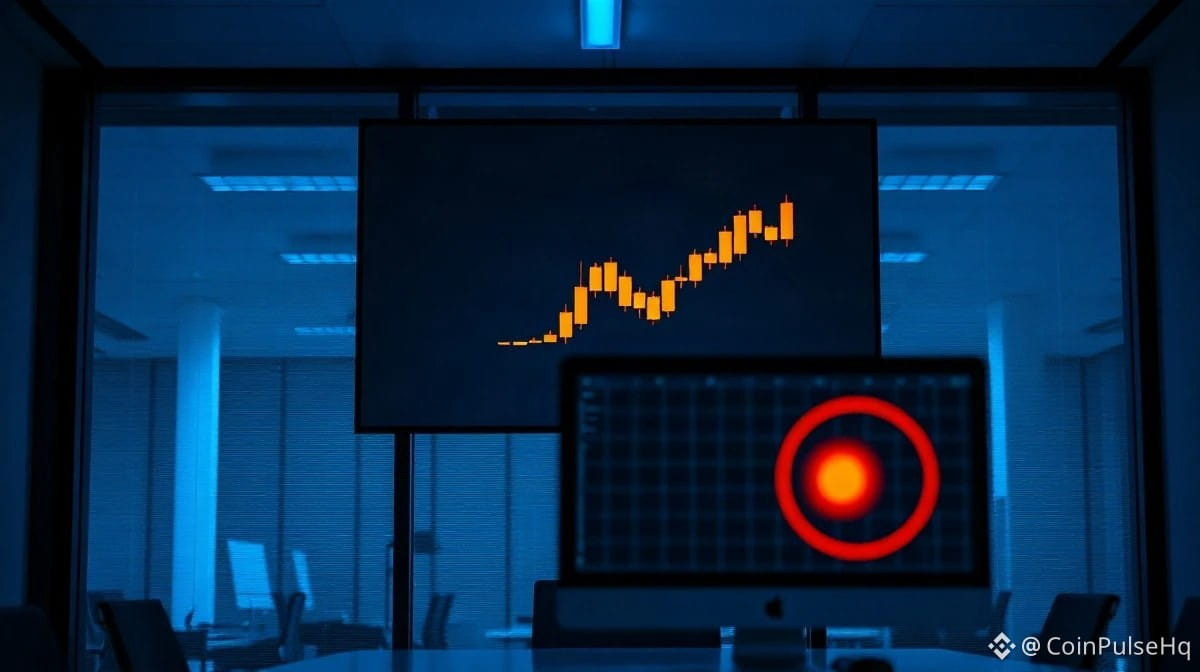
Saylor’s ‘More Orange’ Post Signals Another Strategy Bitcoin BuyMichael Saylor revived speculation about another Strategy bitcoin purchase on Sept. 20, 2026, posting the company's acquisition chart on X with the caption "A little more orange" — the same kind of signal he has used before the firm's confirmed buys, according to Ambcrypto. The orange circles on that chart mark Strategy's purchases, and Ambcrypto reported that the post points toward more accumulation.
News.bitcoin reported the same post separately and noted that the chart showed 845,050 BTC valued at approximately $67.90 billion, an average acquisition cost of $75,412 per coin, and an unrealized gain of roughly $3.95 billion. Saylor used comparable language ahead of Strategy's last confirmed acquisition, when a "We're Back" message preceded disclosure of a 4,603 BTC purchase.
Key facts
• Strategy held 845,050 BTC after its last confirmed purchase of 4,603 BTC for approximately $369.7 million at an average price of $80,318 per coin, per Ambcrypto.
• News.bitcoin reported the firm's Sept. 14 SEC filing showed no bitcoin bought or sold from Sept. 8 through Sept. 13, with the aggregate purchase cost at $63.73 billion including fees and expenses.
• Ambcrypto reported MSTR closed at $153.92 after jumping 16.39% in a single session, and gained about 47.65% over one month.
• Strategy repurchased $139 million of STRC preferred stock on Sept. 14, which Ambcrypto reported; News.bitcoin put the figure at $139.3 million and said the funds came from flexible cash.
• Ambcrypto reported Strategy controls roughly 4.02% of bitcoin's eventual 21 million-coin supply.
Two quiet weeks before the tease
News.bitcoin reported that Strategy went two consecutive reporting periods without changing its BTC balance. The Sept. 14 filing with the Securities and Exchange Commission said the company neither bought nor sold bitcoin from Sept. 8 through Sept. 13, leaving holdings unchanged at 845,050 BTC. As of Sept. 13, Strategy held $5.10 billion in its U.S. dollar reserve and $1.30 billion in flexible USD cash, per News.bitcoin. That reserve covers preferred-stock dividends and interest payments, while the flexible cash can fund bitcoin purchases, securities repurchases or other treasury purposes.
The July and August 2026 sale of 6,919 BTC preceded the renewed buying, Ambcrypto reported. The outlet also noted the timing falls in September, historically a weak month for crypto, though it said positive September closes in 2023, 2024 and 2025 weakened that pattern. Ambcrypto's own figure for the recent buy lists an 845,050 BTC total, matching News.bitcoin's count.
Separately, Saylor argued that the Senate's blockage of the CLARITY Act is a positive for the digital asset industry, Bitcoinmagazine reported. Writing on X on Sept. 19, 2026, he said legislation can make restrictions permanent as easily as rights, and that the SEC and CFTC are pushing ahead with rulemaking without the bill. Senators voted 49 for and 50 against advancing the legislation that week, per Bitcoinmagazine.
Other bitcoin treasuries kept buying
BlackRock's iShares Bitcoin Trust recorded $426.4 million in inflows, bringing total net assets since launch to roughly $59.75 billion, Ambcrypto reported. Strive added 469 BTC in the past week for a total of 25,000 BTC. Capital B added 4 BTC, lifting its stash to 3,525 BTC worth $287.9 million.
Why it matters
A Saylor post is not a filing, and the gap between the two matters for anyone reading the signal as a completed trade. Strategy's accumulation sits inside a wider corporate-treasury trend in which several vehicles added BTC in the same week, so the company's next filing resets expectations for the group, not just for MSTR holders. Ambcrypto framed the stock move as a September reversal, while News.bitcoin framed the post as speculation pending disclosure — the two reports describe the same event with different emphasis.
What to watch
The next SEC filing will confirm or contradict whether Saylor's orange signal corresponds to a completed purchase. Strategy's live bitcoin dashboard updates reserve and purchase metrics alongside regulatory filings, per News.bitcoin.
This is not financial advice. Crypto asset markets are volatile and uncertain, and no outcome described here should be treated as a prediction.
Originally published on CoinPulseHQ: https://coinpulsehq.com/saylors-more-orange-post-signals-another-strategy-bitcoin-buy/
Saylor’s ‘More Orange’ Post Signals Another Strategy Bitcoin Buy
Michael Saylor revived speculation about another Strategy bitcoin purchase on Sept. 20, 2026, posting the company's acquisition chart on X with the caption "A little more orange" — the same kind of signal he has used before the firm's confirmed buys, according to Ambcrypto. The orange circles on that chart mark Strategy's purchases, and Ambcrypto reported that the post points toward more accumulation.
News.bitcoin reported the same post separately and noted that the chart showed 845,050 BTC valued at approximately $67.90 billion, an average acquisition cost of $75,412 per coin, and an unrealized gain of roughly $3.95 billion. Saylor used comparable language ahead of Strategy's last confirmed acquisition, when a "We're Back" message preceded disclosure of a 4,603 BTC purchase.
Key facts
• Strategy held 845,050 BTC after its last confirmed purchase of 4,603 BTC for approximately $369.7 million at an average price of $80,318 per coin, per Ambcrypto.
• News.bitcoin reported the firm's Sept. 14 SEC filing showed no bitcoin bought or sold from Sept. 8 through Sept. 13, with the aggregate purchase cost at $63.73 billion including fees and expenses.
• Ambcrypto reported MSTR closed at $153.92 after jumping 16.39% in a single session, and gained about 47.65% over one month.
• Strategy repurchased $139 million of STRC preferred stock on Sept. 14, which Ambcrypto reported; News.bitcoin put the figure at $139.3 million and said the funds came from flexible cash.
• Ambcrypto reported Strategy controls roughly 4.02% of bitcoin's eventual 21 million-coin supply.
Two quiet weeks before the tease
News.bitcoin reported that Strategy went two consecutive reporting periods without changing its BTC balance. The Sept. 14 filing with the Securities and Exchange Commission said the company neither bought nor sold bitcoin from Sept. 8 through Sept. 13, leaving holdings unchanged at 845,050 BTC. As of Sept. 13, Strategy held $5.10 billion in its U.S. dollar reserve and $1.30 billion in flexible USD cash, per News.bitcoin. That reserve covers preferred-stock dividends and interest payments, while the flexible cash can fund bitcoin purchases, securities repurchases or other treasury purposes.
The July and August 2026 sale of 6,919 BTC preceded the renewed buying, Ambcrypto reported. The outlet also noted the timing falls in September, historically a weak month for crypto, though it said positive September closes in 2023, 2024 and 2025 weakened that pattern. Ambcrypto's own figure for the recent buy lists an 845,050 BTC total, matching News.bitcoin's count.
Separately, Saylor argued that the Senate's blockage of the CLARITY Act is a positive for the digital asset industry, Bitcoinmagazine reported. Writing on X on Sept. 19, 2026, he said legislation can make restrictions permanent as easily as rights, and that the SEC and CFTC are pushing ahead with rulemaking without the bill. Senators voted 49 for and 50 against advancing the legislation that week, per Bitcoinmagazine.
Other bitcoin treasuries kept buying
BlackRock's iShares Bitcoin Trust recorded $426.4 million in inflows, bringing total net assets since launch to roughly $59.75 billion, Ambcrypto reported. Strive added 469 BTC in the past week for a total of 25,000 BTC. Capital B added 4 BTC, lifting its stash to 3,525 BTC worth $287.9 million.
Why it matters
A Saylor post is not a filing, and the gap between the two matters for anyone reading the signal as a completed trade. Strategy's accumulation sits inside a wider corporate-treasury trend in which several vehicles added BTC in the same week, so the company's next filing resets expectations for the group, not just for MSTR holders. Ambcrypto framed the stock move as a September reversal, while News.bitcoin framed the post as speculation pending disclosure — the two reports describe the same event with different emphasis.
What to watch
The next SEC filing will confirm or contradict whether Saylor's orange signal corresponds to a completed purchase. Strategy's live bitcoin dashboard updates reserve and purchase metrics alongside regulatory filings, per News.bitcoin.
This is not financial advice. Crypto asset markets are volatile and uncertain, and no outcome described here should be treated as a prediction.
Originally published on CoinPulseHQ: https://coinpulsehq.com/saylors-more-orange-post-signals-another-strategy-bitcoin-buy/
News.bitcoin reported the same post separately and noted that the chart showed 845,050 BTC valued at approximately $67.90 billion, an average acquisition cost of $75,412 per coin, and an unrealized gain of roughly $3.95 billion. Saylor used comparable language ahead of Strategy's last confirmed acquisition, when a "We're Back" message preceded disclosure of a 4,603 BTC purchase.
Key facts
• Strategy held 845,050 BTC after its last confirmed purchase of 4,603 BTC for approximately $369.7 million at an average price of $80,318 per coin, per Ambcrypto.
• News.bitcoin reported the firm's Sept. 14 SEC filing showed no bitcoin bought or sold from Sept. 8 through Sept. 13, with the aggregate purchase cost at $63.73 billion including fees and expenses.
• Ambcrypto reported MSTR closed at $153.92 after jumping 16.39% in a single session, and gained about 47.65% over one month.
• Strategy repurchased $139 million of STRC preferred stock on Sept. 14, which Ambcrypto reported; News.bitcoin put the figure at $139.3 million and said the funds came from flexible cash.
• Ambcrypto reported Strategy controls roughly 4.02% of bitcoin's eventual 21 million-coin supply.
Two quiet weeks before the tease
News.bitcoin reported that Strategy went two consecutive reporting periods without changing its BTC balance. The Sept. 14 filing with the Securities and Exchange Commission said the company neither bought nor sold bitcoin from Sept. 8 through Sept. 13, leaving holdings unchanged at 845,050 BTC. As of Sept. 13, Strategy held $5.10 billion in its U.S. dollar reserve and $1.30 billion in flexible USD cash, per News.bitcoin. That reserve covers preferred-stock dividends and interest payments, while the flexible cash can fund bitcoin purchases, securities repurchases or other treasury purposes.
The July and August 2026 sale of 6,919 BTC preceded the renewed buying, Ambcrypto reported. The outlet also noted the timing falls in September, historically a weak month for crypto, though it said positive September closes in 2023, 2024 and 2025 weakened that pattern. Ambcrypto's own figure for the recent buy lists an 845,050 BTC total, matching News.bitcoin's count.
Separately, Saylor argued that the Senate's blockage of the CLARITY Act is a positive for the digital asset industry, Bitcoinmagazine reported. Writing on X on Sept. 19, 2026, he said legislation can make restrictions permanent as easily as rights, and that the SEC and CFTC are pushing ahead with rulemaking without the bill. Senators voted 49 for and 50 against advancing the legislation that week, per Bitcoinmagazine.
Other bitcoin treasuries kept buying
BlackRock's iShares Bitcoin Trust recorded $426.4 million in inflows, bringing total net assets since launch to roughly $59.75 billion, Ambcrypto reported. Strive added 469 BTC in the past week for a total of 25,000 BTC. Capital B added 4 BTC, lifting its stash to 3,525 BTC worth $287.9 million.
Why it matters
A Saylor post is not a filing, and the gap between the two matters for anyone reading the signal as a completed trade. Strategy's accumulation sits inside a wider corporate-treasury trend in which several vehicles added BTC in the same week, so the company's next filing resets expectations for the group, not just for MSTR holders. Ambcrypto framed the stock move as a September reversal, while News.bitcoin framed the post as speculation pending disclosure — the two reports describe the same event with different emphasis.
What to watch
The next SEC filing will confirm or contradict whether Saylor's orange signal corresponds to a completed purchase. Strategy's live bitcoin dashboard updates reserve and purchase metrics alongside regulatory filings, per News.bitcoin.
This is not financial advice. Crypto asset markets are volatile and uncertain, and no outcome described here should be treated as a prediction.
Originally published on CoinPulseHQ: https://coinpulsehq.com/saylors-more-orange-post-signals-another-strategy-bitcoin-buy/
21
·
--
Article
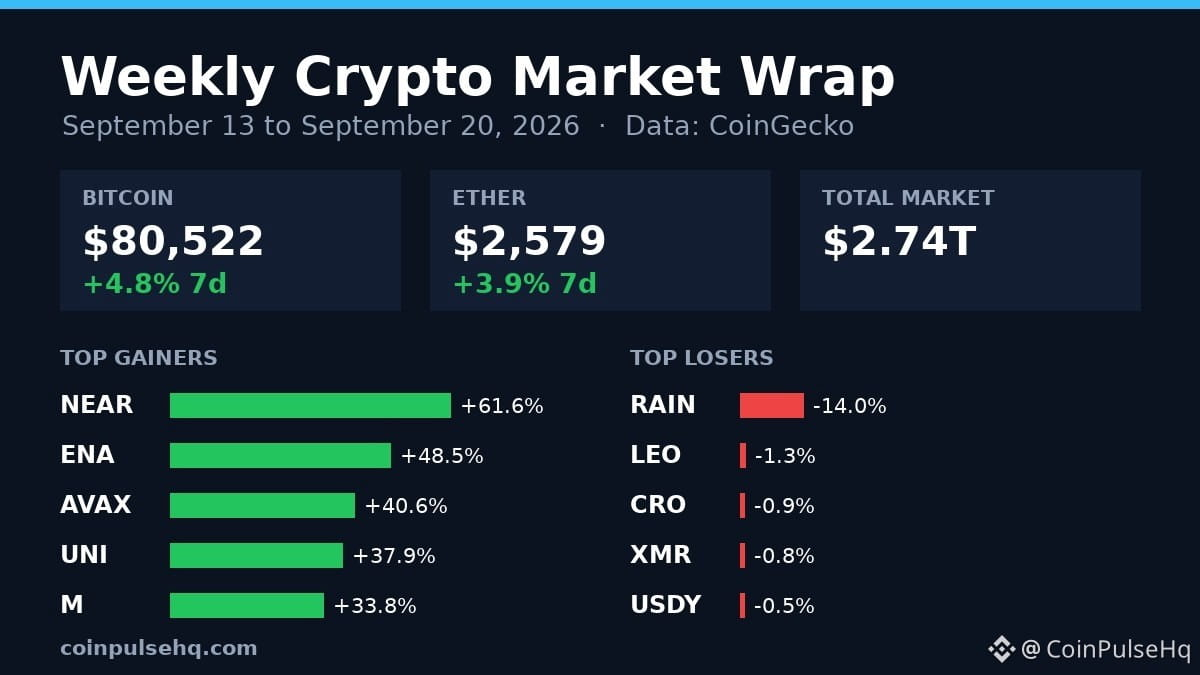
NEAR Protocol Soars 62% in a Week While Bitcoin Gains 4.8%It was a broadly positive week for crypto. Bitcoin rose 4.8% over the seven days to September 20, 2026 and traded at $80,522 when this wrap was compiled. 45 of the 50 largest coins finished higher, and the median move was +6.8%.
The week in numbers
• Total crypto market value: $2.74 trillion
• 24-hour trading volume: $73.9 billion
• Bitcoin dominance: 59.0%; Ether holds 11.5%
• Bitcoin: $80,522, +4.8% on the week, +4.8% over 30 days
• Ether: $2,579, +3.9% on the week, +8.7% over 30 days
Bitcoin: a 8.5% range
Bitcoin's high for the week was $81,817 on Saturday, September 19, and its low was $75,384 on Tuesday, September 15. The high came after the low, so the larger move inside the week was upward. At $80,522, the price sits in the upper third of that range and 36.1% below its all-time high.
Ether and the ETH/BTC ratio
Ether underperformed Bitcoin by 0.9 percentage points. One ETH now buys 0.03203 BTC. The ratio is a quick read on appetite for risk beyond Bitcoin: it tends to rise when money moves into smaller assets and fall when it retreats to Bitcoin.
Market breadth
29 of the other 49 large coins beat Bitcoin this week. Leadership was split roughly evenly between Bitcoin and the rest of the market.
Biggest gainers in the top 50
Coin Price 7 days 30 days
NEAR Protocol (NEAR) $3.69 +61.6% +96.9%
Ethena (ENA) $0.2018 +48.5% +47.8%
Avalanche (AVAX) $10.58 +40.6% +37.5%
Uniswap (UNI) $8.56 +37.9% +121.6%
MemeCore (M) $1.54 +33.8% +32.7%
NEAR Protocol led with +61.6%. It is also +96.9% over 30 days, so the move extends an existing trend.
Biggest losers in the top 50
Coin Price 7 days 30 days
Rain (RAIN) $0.01321 -14.0% -8.6%
LEO Token (LEO) $8.91 -1.3% -3.6%
Cronos (CRO) $0.05837 -0.9% +3.0%
Monero (XMR) $538.55 -0.8% +28.7%
Ondo US Dollar Yield (USDY) $1.14 -0.5% -0.3%
Rain was the weakest at -14.0%, taking its 30-day move to -8.6%.
Where the trading was
Turnover compares 24-hour trading volume with market value. A high figure means unusually heavy trading for the size of the coin.
Coin 24h volume Turnover 7 days
Ethena (ENA) $751 million 36.9% +48.5%
Pepe (PEPE) $531 million 32.0% +16.5%
Avalanche (AVAX) $1.4 billion 28.8% +40.6%
NEAR Protocol (NEAR) $1.3 billion 26.4% +61.6%
Sui (SUI) $797 million 23.7% +15.5%
The ten largest coins against their record highs
Coin Market value 7 days Below all-time high
Bitcoin (BTC) $1.62 trillion +4.8% 36.1%
Ethereum (ETH) $314.8 billion +3.9% 47.9%
BNB (BNB) $100.0 billion +5.0% 45.2%
XRP (XRP) $86.5 billion +2.6% 62.3%
Solana (SOL) $63.5 billion +8.5% 63.1%
TRON (TRX) $32.9 billion +0.6% 19.7%
Zcash (ZEC) $24.4 billion +32.6% 54.8%
Figure Heloc (FIGR_HELOC) $23.1 billion +1.5% 4.1%
Hyperliquid (HYPE) $20.2 billion +17.5% 3.8%
Dogecoin (DOGE) $13.2 billion +1.8% 88.4%
Of the ten, Hyperliquid is closest to its record, 3.8% below it. Dogecoin is furthest, 88.4% below.
Stories we covered this week
• Warren Buffett Steps Down as Berkshire Chairman; Son Howard Succeeds Him
• House Tax Committee Advances Crypto Tax Bill 38-5 After CLARITY Act Fails
• MEV Bot Yoink Intercepts $7.7M in rsETH After Ethereum Wallet Exploit
• Standard Chartered projects Arbitrum’s ARB could hit $10 by 2030
• UK FCA Gets 123 Tokenization Responses, Plans Joint Roadmap With Bank of England
• Revolut Attackers Threaten Daily Data Leaks After Customer IDs Exposed
Live prices for the top 50 coins are on our Markets page.
How this wrap is made
Every figure here was calculated by CoinPulseHQ from CoinGecko market data recorded on September 20, 2026 at 14:00 UTC. Stablecoins and wrapped or staked versions of other coins are left out of the rankings. Weekly changes compare with the price seven days earlier. This wrap is generated from data and describes what prices did, not what they will do. It is not financial advice.
Originally published on CoinPulseHQ: https://coinpulsehq.com/crypto-market-wrap-2026-09-20/
NEAR Protocol Soars 62% in a Week While Bitcoin Gains 4.8%
It was a broadly positive week for crypto. Bitcoin rose 4.8% over the seven days to September 20, 2026 and traded at $80,522 when this wrap was compiled. 45 of the 50 largest coins finished higher, and the median move was +6.8%.
The week in numbers
• Total crypto market value: $2.74 trillion
• 24-hour trading volume: $73.9 billion
• Bitcoin dominance: 59.0%; Ether holds 11.5%
• Bitcoin: $80,522, +4.8% on the week, +4.8% over 30 days
• Ether: $2,579, +3.9% on the week, +8.7% over 30 days
Bitcoin: a 8.5% range
Bitcoin's high for the week was $81,817 on Saturday, September 19, and its low was $75,384 on Tuesday, September 15. The high came after the low, so the larger move inside the week was upward. At $80,522, the price sits in the upper third of that range and 36.1% below its all-time high.
Ether and the ETH/BTC ratio
Ether underperformed Bitcoin by 0.9 percentage points. One ETH now buys 0.03203 BTC. The ratio is a quick read on appetite for risk beyond Bitcoin: it tends to rise when money moves into smaller assets and fall when it retreats to Bitcoin.
Market breadth
29 of the other 49 large coins beat Bitcoin this week. Leadership was split roughly evenly between Bitcoin and the rest of the market.
Biggest gainers in the top 50
Coin Price 7 days 30 days
NEAR Protocol (NEAR) $3.69 +61.6% +96.9%
Ethena (ENA) $0.2018 +48.5% +47.8%
Avalanche (AVAX) $10.58 +40.6% +37.5%
Uniswap (UNI) $8.56 +37.9% +121.6%
MemeCore (M) $1.54 +33.8% +32.7%
NEAR Protocol led with +61.6%. It is also +96.9% over 30 days, so the move extends an existing trend.
Biggest losers in the top 50
Coin Price 7 days 30 days
Rain (RAIN) $0.01321 -14.0% -8.6%
LEO Token (LEO) $8.91 -1.3% -3.6%
Cronos (CRO) $0.05837 -0.9% +3.0%
Monero (XMR) $538.55 -0.8% +28.7%
Ondo US Dollar Yield (USDY) $1.14 -0.5% -0.3%
Rain was the weakest at -14.0%, taking its 30-day move to -8.6%.
Where the trading was
Turnover compares 24-hour trading volume with market value. A high figure means unusually heavy trading for the size of the coin.
Coin 24h volume Turnover 7 days
Ethena (ENA) $751 million 36.9% +48.5%
Pepe (PEPE) $531 million 32.0% +16.5%
Avalanche (AVAX) $1.4 billion 28.8% +40.6%
NEAR Protocol (NEAR) $1.3 billion 26.4% +61.6%
Sui (SUI) $797 million 23.7% +15.5%
The ten largest coins against their record highs
Coin Market value 7 days Below all-time high
Bitcoin (BTC) $1.62 trillion +4.8% 36.1%
Ethereum (ETH) $314.8 billion +3.9% 47.9%
BNB (BNB) $100.0 billion +5.0% 45.2%
XRP (XRP) $86.5 billion +2.6% 62.3%
Solana (SOL) $63.5 billion +8.5% 63.1%
TRON (TRX) $32.9 billion +0.6% 19.7%
Zcash (ZEC) $24.4 billion +32.6% 54.8%
Figure Heloc (FIGR_HELOC) $23.1 billion +1.5% 4.1%
Hyperliquid (HYPE) $20.2 billion +17.5% 3.8%
Dogecoin (DOGE) $13.2 billion +1.8% 88.4%
Of the ten, Hyperliquid is closest to its record, 3.8% below it. Dogecoin is furthest, 88.4% below.
Stories we covered this week
• Warren Buffett Steps Down as Berkshire Chairman; Son Howard Succeeds Him
• House Tax Committee Advances Crypto Tax Bill 38-5 After CLARITY Act Fails
• MEV Bot Yoink Intercepts $7.7M in rsETH After Ethereum Wallet Exploit
• Standard Chartered projects Arbitrum’s ARB could hit $10 by 2030
• UK FCA Gets 123 Tokenization Responses, Plans Joint Roadmap With Bank of England
• Revolut Attackers Threaten Daily Data Leaks After Customer IDs Exposed
Live prices for the top 50 coins are on our Markets page.
How this wrap is made
Every figure here was calculated by CoinPulseHQ from CoinGecko market data recorded on September 20, 2026 at 14:00 UTC. Stablecoins and wrapped or staked versions of other coins are left out of the rankings. Weekly changes compare with the price seven days earlier. This wrap is generated from data and describes what prices did, not what they will do. It is not financial advice.
Originally published on CoinPulseHQ: https://coinpulsehq.com/crypto-market-wrap-2026-09-20/
The week in numbers
• Total crypto market value: $2.74 trillion
• 24-hour trading volume: $73.9 billion
• Bitcoin dominance: 59.0%; Ether holds 11.5%
• Bitcoin: $80,522, +4.8% on the week, +4.8% over 30 days
• Ether: $2,579, +3.9% on the week, +8.7% over 30 days
Bitcoin: a 8.5% range
Bitcoin's high for the week was $81,817 on Saturday, September 19, and its low was $75,384 on Tuesday, September 15. The high came after the low, so the larger move inside the week was upward. At $80,522, the price sits in the upper third of that range and 36.1% below its all-time high.
Ether and the ETH/BTC ratio
Ether underperformed Bitcoin by 0.9 percentage points. One ETH now buys 0.03203 BTC. The ratio is a quick read on appetite for risk beyond Bitcoin: it tends to rise when money moves into smaller assets and fall when it retreats to Bitcoin.
Market breadth
29 of the other 49 large coins beat Bitcoin this week. Leadership was split roughly evenly between Bitcoin and the rest of the market.
Biggest gainers in the top 50
Coin Price 7 days 30 days
NEAR Protocol (NEAR) $3.69 +61.6% +96.9%
Ethena (ENA) $0.2018 +48.5% +47.8%
Avalanche (AVAX) $10.58 +40.6% +37.5%
Uniswap (UNI) $8.56 +37.9% +121.6%
MemeCore (M) $1.54 +33.8% +32.7%
NEAR Protocol led with +61.6%. It is also +96.9% over 30 days, so the move extends an existing trend.
Biggest losers in the top 50
Coin Price 7 days 30 days
Rain (RAIN) $0.01321 -14.0% -8.6%
LEO Token (LEO) $8.91 -1.3% -3.6%
Cronos (CRO) $0.05837 -0.9% +3.0%
Monero (XMR) $538.55 -0.8% +28.7%
Ondo US Dollar Yield (USDY) $1.14 -0.5% -0.3%
Rain was the weakest at -14.0%, taking its 30-day move to -8.6%.
Where the trading was
Turnover compares 24-hour trading volume with market value. A high figure means unusually heavy trading for the size of the coin.
Coin 24h volume Turnover 7 days
Ethena (ENA) $751 million 36.9% +48.5%
Pepe (PEPE) $531 million 32.0% +16.5%
Avalanche (AVAX) $1.4 billion 28.8% +40.6%
NEAR Protocol (NEAR) $1.3 billion 26.4% +61.6%
Sui (SUI) $797 million 23.7% +15.5%
The ten largest coins against their record highs
Coin Market value 7 days Below all-time high
Bitcoin (BTC) $1.62 trillion +4.8% 36.1%
Ethereum (ETH) $314.8 billion +3.9% 47.9%
BNB (BNB) $100.0 billion +5.0% 45.2%
XRP (XRP) $86.5 billion +2.6% 62.3%
Solana (SOL) $63.5 billion +8.5% 63.1%
TRON (TRX) $32.9 billion +0.6% 19.7%
Zcash (ZEC) $24.4 billion +32.6% 54.8%
Figure Heloc (FIGR_HELOC) $23.1 billion +1.5% 4.1%
Hyperliquid (HYPE) $20.2 billion +17.5% 3.8%
Dogecoin (DOGE) $13.2 billion +1.8% 88.4%
Of the ten, Hyperliquid is closest to its record, 3.8% below it. Dogecoin is furthest, 88.4% below.
Stories we covered this week
• Warren Buffett Steps Down as Berkshire Chairman; Son Howard Succeeds Him
• House Tax Committee Advances Crypto Tax Bill 38-5 After CLARITY Act Fails
• MEV Bot Yoink Intercepts $7.7M in rsETH After Ethereum Wallet Exploit
• Standard Chartered projects Arbitrum’s ARB could hit $10 by 2030
• UK FCA Gets 123 Tokenization Responses, Plans Joint Roadmap With Bank of England
• Revolut Attackers Threaten Daily Data Leaks After Customer IDs Exposed
Live prices for the top 50 coins are on our Markets page.
How this wrap is made
Every figure here was calculated by CoinPulseHQ from CoinGecko market data recorded on September 20, 2026 at 14:00 UTC. Stablecoins and wrapped or staked versions of other coins are left out of the rankings. Weekly changes compare with the price seven days earlier. This wrap is generated from data and describes what prices did, not what they will do. It is not financial advice.
Originally published on CoinPulseHQ: https://coinpulsehq.com/crypto-market-wrap-2026-09-20/
158
·
--

Article
World Money launches in 150+ countries, WLD jumps 15%World Network pushed into consumer finance on Thursday, September 17, 2026, launching World Money, a self-custodial financial "super app" that bundles stablecoin payments, digital asset rewards and trading into one product. The rollout began in more than 150 countries, with features varying by location, and the token WLD rose 15% after the launch, according to Ambcrypto. Open interest on WLD climbed 8.5% within 24 hours of the debut.
Ambcrypto also reported that spot CVD had started to recover and push higher, indicating organic demand, while funding rates stayed positive without becoming overextended. Cointelegraph, which covered the same launch, noted that the app is operated by Tools for Humanity, the company co-founded by Sam Altman and Alex Blania that develops technology for the World network.
Key facts
• World Money launched Thursday, September 17, 2026, and is rolling out in more than 150 countries, with features varying by location, per Cointelegraph.
• WLD's price rose 15% and open interest increased 8.5% in 24 hours after the launch, Ambcrypto reported.
• The app combines stablecoin payments, digital asset rewards and trading, and supports eight currencies, according to Ambcrypto.
• A Stripe partnership lets users fund accounts and buy stablecoins with Apple Pay, starting with users in the US, Cointelegraph reported.
• World said its identity and financial services are now split into two apps: World ID App for verification and credentials, and World Money for wallet and payment features.
What the app offers
World Money lets users send supported digital assets, including stablecoins, to a recipient's World username, deposit eligible assets to earn rewards, and buy or sell digital assets through exchanges. It also gives access to third-party "Mini Apps" including Kalshi, Credit and Morpho; Ambcrypto additionally lists Stripe among the apps users can reach. Ambcrypto reported that Stripe supports a US funding flow that converts money from Apple Pay into stablecoins.
The launch continues a multi-year build that Cointelegraph traced in detail. World App debuted in May 2023, combining World ID with a crypto wallet, stablecoin transfers and token trading. In October 2024, World introduced World App 3.0 as a "super app for humans," adding third-party Mini Apps and a Vault feature for earning on assets. In November 2025, it piloted virtual bank accounts in the US before rolling them out to more countries a month later, allowing paychecks and bank deposits to be converted into USDC. World also said existing World App and World ID App users can use their existing accounts for World Money.
Why it matters
World Money shifts the network from an identity-and-wallet product toward a full consumer finance suite, and it removes self-custody from the margins: the wallet, payments and rewards all sit in one app. Splitting identity verification into the separate World ID App means users interact with two dedicated products rather than one combined app, a change from the model that had been in place since May 2023.
The market reaction shows how closely WLD's price now tracks product news from Tools for Humanity, and the derivatives data suggests the move drew real positioning rather than only spot buying. The Apple Pay funding route also gives US users a mainstream on-ramp into stablecoins, an area where payments firms have been competing.
What to watch
Ambcrypto noted that WLD is likely to keep trending higher provided Bitcoin does not see a major sell-off, so BTC's direction is the near-term variable for the token. Ambcrypto also framed WLD's direction as open in the near term. On the product side, the rollout is uneven by design: Cointelegraph reported features vary by location, so which capabilities reach which markets is the next concrete data point.
Price levels and trend calls referenced in the source analysis are not financial advice, and crypto markets are volatile and uncertain.
Originally published on CoinPulseHQ: https://coinpulsehq.com/world-money-launch-wld-15-percent-surge/
World Money launches in 150+ countries, WLD jumps 15%
World Network pushed into consumer finance on Thursday, September 17, 2026, launching World Money, a self-custodial financial "super app" that bundles stablecoin payments, digital asset rewards and trading into one product. The rollout began in more than 150 countries, with features varying by location, and the token WLD rose 15% after the launch, according to Ambcrypto. Open interest on WLD climbed 8.5% within 24 hours of the debut.
Ambcrypto also reported that spot CVD had started to recover and push higher, indicating organic demand, while funding rates stayed positive without becoming overextended. Cointelegraph, which covered the same launch, noted that the app is operated by Tools for Humanity, the company co-founded by Sam Altman and Alex Blania that develops technology for the World network.
Key facts
• World Money launched Thursday, September 17, 2026, and is rolling out in more than 150 countries, with features varying by location, per Cointelegraph.
• WLD's price rose 15% and open interest increased 8.5% in 24 hours after the launch, Ambcrypto reported.
• The app combines stablecoin payments, digital asset rewards and trading, and supports eight currencies, according to Ambcrypto.
• A Stripe partnership lets users fund accounts and buy stablecoins with Apple Pay, starting with users in the US, Cointelegraph reported.
• World said its identity and financial services are now split into two apps: World ID App for verification and credentials, and World Money for wallet and payment features.
What the app offers
World Money lets users send supported digital assets, including stablecoins, to a recipient's World username, deposit eligible assets to earn rewards, and buy or sell digital assets through exchanges. It also gives access to third-party "Mini Apps" including Kalshi, Credit and Morpho; Ambcrypto additionally lists Stripe among the apps users can reach. Ambcrypto reported that Stripe supports a US funding flow that converts money from Apple Pay into stablecoins.
The launch continues a multi-year build that Cointelegraph traced in detail. World App debuted in May 2023, combining World ID with a crypto wallet, stablecoin transfers and token trading. In October 2024, World introduced World App 3.0 as a "super app for humans," adding third-party Mini Apps and a Vault feature for earning on assets. In November 2025, it piloted virtual bank accounts in the US before rolling them out to more countries a month later, allowing paychecks and bank deposits to be converted into USDC. World also said existing World App and World ID App users can use their existing accounts for World Money.
Why it matters
World Money shifts the network from an identity-and-wallet product toward a full consumer finance suite, and it removes self-custody from the margins: the wallet, payments and rewards all sit in one app. Splitting identity verification into the separate World ID App means users interact with two dedicated products rather than one combined app, a change from the model that had been in place since May 2023.
The market reaction shows how closely WLD's price now tracks product news from Tools for Humanity, and the derivatives data suggests the move drew real positioning rather than only spot buying. The Apple Pay funding route also gives US users a mainstream on-ramp into stablecoins, an area where payments firms have been competing.
What to watch
Ambcrypto noted that WLD is likely to keep trending higher provided Bitcoin does not see a major sell-off, so BTC's direction is the near-term variable for the token. Ambcrypto also framed WLD's direction as open in the near term. On the product side, the rollout is uneven by design: Cointelegraph reported features vary by location, so which capabilities reach which markets is the next concrete data point.
Price levels and trend calls referenced in the source analysis are not financial advice, and crypto markets are volatile and uncertain.
Originally published on CoinPulseHQ: https://coinpulsehq.com/world-money-launch-wld-15-percent-surge/
Ambcrypto also reported that spot CVD had started to recover and push higher, indicating organic demand, while funding rates stayed positive without becoming overextended. Cointelegraph, which covered the same launch, noted that the app is operated by Tools for Humanity, the company co-founded by Sam Altman and Alex Blania that develops technology for the World network.
Key facts
• World Money launched Thursday, September 17, 2026, and is rolling out in more than 150 countries, with features varying by location, per Cointelegraph.
• WLD's price rose 15% and open interest increased 8.5% in 24 hours after the launch, Ambcrypto reported.
• The app combines stablecoin payments, digital asset rewards and trading, and supports eight currencies, according to Ambcrypto.
• A Stripe partnership lets users fund accounts and buy stablecoins with Apple Pay, starting with users in the US, Cointelegraph reported.
• World said its identity and financial services are now split into two apps: World ID App for verification and credentials, and World Money for wallet and payment features.
What the app offers
World Money lets users send supported digital assets, including stablecoins, to a recipient's World username, deposit eligible assets to earn rewards, and buy or sell digital assets through exchanges. It also gives access to third-party "Mini Apps" including Kalshi, Credit and Morpho; Ambcrypto additionally lists Stripe among the apps users can reach. Ambcrypto reported that Stripe supports a US funding flow that converts money from Apple Pay into stablecoins.
The launch continues a multi-year build that Cointelegraph traced in detail. World App debuted in May 2023, combining World ID with a crypto wallet, stablecoin transfers and token trading. In October 2024, World introduced World App 3.0 as a "super app for humans," adding third-party Mini Apps and a Vault feature for earning on assets. In November 2025, it piloted virtual bank accounts in the US before rolling them out to more countries a month later, allowing paychecks and bank deposits to be converted into USDC. World also said existing World App and World ID App users can use their existing accounts for World Money.
Why it matters
World Money shifts the network from an identity-and-wallet product toward a full consumer finance suite, and it removes self-custody from the margins: the wallet, payments and rewards all sit in one app. Splitting identity verification into the separate World ID App means users interact with two dedicated products rather than one combined app, a change from the model that had been in place since May 2023.
The market reaction shows how closely WLD's price now tracks product news from Tools for Humanity, and the derivatives data suggests the move drew real positioning rather than only spot buying. The Apple Pay funding route also gives US users a mainstream on-ramp into stablecoins, an area where payments firms have been competing.
What to watch
Ambcrypto noted that WLD is likely to keep trending higher provided Bitcoin does not see a major sell-off, so BTC's direction is the near-term variable for the token. Ambcrypto also framed WLD's direction as open in the near term. On the product side, the rollout is uneven by design: Cointelegraph reported features vary by location, so which capabilities reach which markets is the next concrete data point.
Price levels and trend calls referenced in the source analysis are not financial advice, and crypto markets are volatile and uncertain.
Originally published on CoinPulseHQ: https://coinpulsehq.com/world-money-launch-wld-15-percent-surge/
211
·
--
Saylor Moves Past CLARITY Act After Senate 49-50 VoteMichael Saylor used a Sept. 19 post on X to argue that the crypto industry should stop waiting on Congress and build products instead, after the Senate blocked the CLARITY Act on Sept. 15, Cointribune reported. The cloture motion failed 49-50, short of the 60 votes needed to open debate, leaving the bill on the calendar rather than rejected on its substance.
Saylor, Executive Chairman of Strategy Inc. (Nasdaq: MSTR), had made a similar case before the vote, according to News.bitcoin. He now wants the SEC, CFTC, Treasury and banking authorities to widen access to digital financial products under existing law.
Key facts
• The Senate's cloture motion on the CLARITY Act failed 49-50 on Sept. 15, short of the 60 votes required to proceed.
• Saylor's Sept. 19 post set a target of 50 million satisfied users, arguing adoption raises the political cost of reversing crypto policy.
• The SEC granted temporary, conditional relief on Sept. 17 for onchain trading of certain tokenized US stocks, set to expire after five years.
• Saylor's strategy covers bitcoin as digital capital, STRC preferred stock for credit, MSTR common shares for equity, Coinbase for platforms and Circle's USDC for payments.
• Strategy held roughly $1.6 trillion in market cap context and 845,050 BTC at the end of August, according to Cointribune.
What Saylor rejected in the CLARITY compromise
News.bitcoin reported that Saylor warned legislation can make restrictions harder to reverse. The September compromise would have barred covered providers from paying rewards solely for holding payment stablecoins while allowing qualifying activity-based incentives, and would have directed Treasury to restrict certain rewards after findings involving harmful deposit transfers from community banks. It also would have capped the innovation sandbox at firms with no more than 25 employees and limited each participating commission to 20 project approvals a year. None of those provisions took effect. Saylor noted the separate GENIUS Act already restricts stablecoin issuers from paying interest or yield.
He told readers the goal should be 50 million satisfied users with a direct interest in preserving financial choice, adding that adoption raises the political cost of reversal while sound rulemaking strengthens the legal foundation. That framing addresses the industry's worry that a future hostile administration could undo crypto-friendly regulation.
Regulators keep moving
SEC Chairman Paul Atkins described the Sept. 17 relief as letting platforms trade tokenized NMS stocks today in an authorized environment while the Commission studies whether new measures are needed, according to Cointribune. U.today reported that Saylor also expects banks to expand bitcoin custody and offer more bitcoin-backed loans as adoption grows.
News.bitcoin adds that CFTC Chairman Michael Selig has committed to using existing authority if CLARITY stays stalled, while Treasury Secretary Scott Bessent has tied stablecoin implementation to innovation, growth and the dollar's global role. Saylor also cited the Office of the Comptroller of the Currency easing supervisory barriers to bank crypto custody, and urged banks to compete in custody, distribution, payments and credit rather than seek protection.
Why it matters
The practical result for companies is a fragmented rulebook rather than an empty one. Activity can start quickly through administrative relief, but durable rules need Congress, and a law can harden limits that exemptions would not. Adoption does not settle questions of competence between the SEC and the CFTC, and no statute removes politics from enforcement, which is the limit of Saylor's approach. Arthur Hayes downplayed the bill's importance and placed the sequence in the context of US monetary policy, while other observers argue a federal law would give firms a more stable base. The debate continues around an asset Saylor still treats as digital capital; he has said the orange tie stays.
What to watch
A renewed legislative attempt remains possible, Cointribune notes, while agencies keep testing the limits of their powers and Saylor wants 2027 and 2028 used to deploy products at scale and convert temporary relief into durable rules.
Originally published on CoinPulseHQ: https://coinpulsehq.com/saylor-clarity-act-senate-vote-adoption/
Saylor Moves Past CLARITY Act After Senate 49-50 Vote
Michael Saylor used a Sept. 19 post on X to argue that the crypto industry should stop waiting on Congress and build products instead, after the Senate blocked the CLARITY Act on Sept. 15, Cointribune reported. The cloture motion failed 49-50, short of the 60 votes needed to open debate, leaving the bill on the calendar rather than rejected on its substance.
Saylor, Executive Chairman of Strategy Inc. (Nasdaq: MSTR), had made a similar case before the vote, according to News.bitcoin. He now wants the SEC, CFTC, Treasury and banking authorities to widen access to digital financial products under existing law.
Key facts
• The Senate's cloture motion on the CLARITY Act failed 49-50 on Sept. 15, short of the 60 votes required to proceed.
• Saylor's Sept. 19 post set a target of 50 million satisfied users, arguing adoption raises the political cost of reversing crypto policy.
• The SEC granted temporary, conditional relief on Sept. 17 for onchain trading of certain tokenized US stocks, set to expire after five years.
• Saylor's strategy covers bitcoin as digital capital, STRC preferred stock for credit, MSTR common shares for equity, Coinbase for platforms and Circle's USDC for payments.
• Strategy held roughly $1.6 trillion in market cap context and 845,050 BTC at the end of August, according to Cointribune.
What Saylor rejected in the CLARITY compromise
News.bitcoin reported that Saylor warned legislation can make restrictions harder to reverse. The September compromise would have barred covered providers from paying rewards solely for holding payment stablecoins while allowing qualifying activity-based incentives, and would have directed Treasury to restrict certain rewards after findings involving harmful deposit transfers from community banks. It also would have capped the innovation sandbox at firms with no more than 25 employees and limited each participating commission to 20 project approvals a year. None of those provisions took effect. Saylor noted the separate GENIUS Act already restricts stablecoin issuers from paying interest or yield.
He told readers the goal should be 50 million satisfied users with a direct interest in preserving financial choice, adding that adoption raises the political cost of reversal while sound rulemaking strengthens the legal foundation. That framing addresses the industry's worry that a future hostile administration could undo crypto-friendly regulation.
Regulators keep moving
SEC Chairman Paul Atkins described the Sept. 17 relief as letting platforms trade tokenized NMS stocks today in an authorized environment while the Commission studies whether new measures are needed, according to Cointribune. U.today reported that Saylor also expects banks to expand bitcoin custody and offer more bitcoin-backed loans as adoption grows.
News.bitcoin adds that CFTC Chairman Michael Selig has committed to using existing authority if CLARITY stays stalled, while Treasury Secretary Scott Bessent has tied stablecoin implementation to innovation, growth and the dollar's global role. Saylor also cited the Office of the Comptroller of the Currency easing supervisory barriers to bank crypto custody, and urged banks to compete in custody, distribution, payments and credit rather than seek protection.
Why it matters
The practical result for companies is a fragmented rulebook rather than an empty one. Activity can start quickly through administrative relief, but durable rules need Congress, and a law can harden limits that exemptions would not. Adoption does not settle questions of competence between the SEC and the CFTC, and no statute removes politics from enforcement, which is the limit of Saylor's approach. Arthur Hayes downplayed the bill's importance and placed the sequence in the context of US monetary policy, while other observers argue a federal law would give firms a more stable base. The debate continues around an asset Saylor still treats as digital capital; he has said the orange tie stays.
What to watch
A renewed legislative attempt remains possible, Cointribune notes, while agencies keep testing the limits of their powers and Saylor wants 2027 and 2028 used to deploy products at scale and convert temporary relief into durable rules.
Originally published on CoinPulseHQ: https://coinpulsehq.com/saylor-clarity-act-senate-vote-adoption/
Saylor, Executive Chairman of Strategy Inc. (Nasdaq: MSTR), had made a similar case before the vote, according to News.bitcoin. He now wants the SEC, CFTC, Treasury and banking authorities to widen access to digital financial products under existing law.
Key facts
• The Senate's cloture motion on the CLARITY Act failed 49-50 on Sept. 15, short of the 60 votes required to proceed.
• Saylor's Sept. 19 post set a target of 50 million satisfied users, arguing adoption raises the political cost of reversing crypto policy.
• The SEC granted temporary, conditional relief on Sept. 17 for onchain trading of certain tokenized US stocks, set to expire after five years.
• Saylor's strategy covers bitcoin as digital capital, STRC preferred stock for credit, MSTR common shares for equity, Coinbase for platforms and Circle's USDC for payments.
• Strategy held roughly $1.6 trillion in market cap context and 845,050 BTC at the end of August, according to Cointribune.
What Saylor rejected in the CLARITY compromise
News.bitcoin reported that Saylor warned legislation can make restrictions harder to reverse. The September compromise would have barred covered providers from paying rewards solely for holding payment stablecoins while allowing qualifying activity-based incentives, and would have directed Treasury to restrict certain rewards after findings involving harmful deposit transfers from community banks. It also would have capped the innovation sandbox at firms with no more than 25 employees and limited each participating commission to 20 project approvals a year. None of those provisions took effect. Saylor noted the separate GENIUS Act already restricts stablecoin issuers from paying interest or yield.
He told readers the goal should be 50 million satisfied users with a direct interest in preserving financial choice, adding that adoption raises the political cost of reversal while sound rulemaking strengthens the legal foundation. That framing addresses the industry's worry that a future hostile administration could undo crypto-friendly regulation.
Regulators keep moving
SEC Chairman Paul Atkins described the Sept. 17 relief as letting platforms trade tokenized NMS stocks today in an authorized environment while the Commission studies whether new measures are needed, according to Cointribune. U.today reported that Saylor also expects banks to expand bitcoin custody and offer more bitcoin-backed loans as adoption grows.
News.bitcoin adds that CFTC Chairman Michael Selig has committed to using existing authority if CLARITY stays stalled, while Treasury Secretary Scott Bessent has tied stablecoin implementation to innovation, growth and the dollar's global role. Saylor also cited the Office of the Comptroller of the Currency easing supervisory barriers to bank crypto custody, and urged banks to compete in custody, distribution, payments and credit rather than seek protection.
Why it matters
The practical result for companies is a fragmented rulebook rather than an empty one. Activity can start quickly through administrative relief, but durable rules need Congress, and a law can harden limits that exemptions would not. Adoption does not settle questions of competence between the SEC and the CFTC, and no statute removes politics from enforcement, which is the limit of Saylor's approach. Arthur Hayes downplayed the bill's importance and placed the sequence in the context of US monetary policy, while other observers argue a federal law would give firms a more stable base. The debate continues around an asset Saylor still treats as digital capital; he has said the orange tie stays.
What to watch
A renewed legislative attempt remains possible, Cointribune notes, while agencies keep testing the limits of their powers and Saylor wants 2027 and 2028 used to deploy products at scale and convert temporary relief into durable rules.
Originally published on CoinPulseHQ: https://coinpulsehq.com/saylor-clarity-act-senate-vote-adoption/
63
Log in to explore more content
Join global crypto users on Binance Square
⚡️ Get latest and useful information about crypto.
💬 Trusted by the world’s largest crypto exchange.
👍 Discover real insights from verified creators.
Email / Phone number
Trending Topics
AIStocksWhatNext
46,616 views
190 Discussing
Share & Win Traffic Reward in our Trending Hashtag Campaign
✨Topic: What Other Investment Opportunities Remain as AI Stocks Keep Rising?
👉How to Join:
Publish a short post or article with hashtag #AIStocksWhatNext
Share whether you’re bullish or bearish, and post your AI stock holdings or trade — using the trade widget may improve your eligibility.
You can also strengthen your post by sharing data or charts, and avoiding AI-generated images.
✍️Create content based on the below angles:
- Nvidia says chip sales will double next year, and top AI companies keep hitting record revenue, the compute spend behind it is just as staggering. Is AI demand really taking off? And how long can it last? AI stocks are up across the board. Is this a real breakout, or just a short-term bounce?
- Industry leaders are calling to slow down AI development, while Trump plans to build an “AI Force”, claiming AI could account for 25% of U.S. GDP in the future. Whose side are you on? Will state-level backing be a long-term win for AI stocks?
- Are you buying AI stocks? Share your AI-related trade/holdings with our trade sharing widget.
⏰Campaign Period:
- 2026-09-22 7:00 - 2026-09-24 4:00 UTC
🎁Reward:
- Qualified posts that comply with the above guidelines and contain more than 100 words will be reviewed and may receive a random traffic boost of 500 to 3,000 views. You will receive a notification from your feed secretary if your post is selected.
- Get a chance to have your article featured on Binance Square Official
Need ideas for your post? Visit the topic page #AIStocksWhatNext or the Square Guide on How to Post for Better Reach.
Binance Square Official
·150 Likes
·179.1k views
MuseOvertakesChatGPTAsTopFreeIOSApp
94 views
0 Discussing
TokenizedStockPlatformsCouldLaunchNextQuarter
802 views
0 Discussing