Author: Kun Yuan
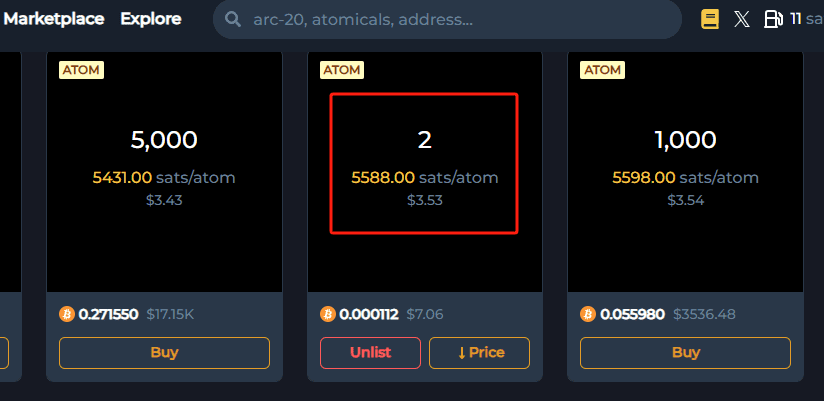
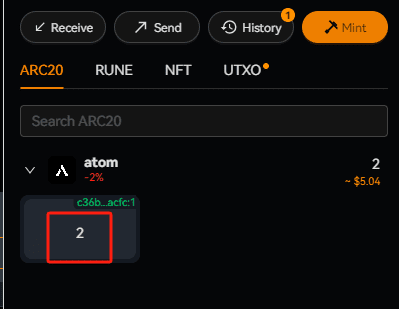
The#ARC20partial coloring of the#Atomicalsprotocol has been upgraded in Bitcoin block #848484, and now it is possible to transfer as little as 1 $ATOM token. I just put 2 $ATOMs on the Bitatom exchange for testing, and it worked.
I see that most people haven’t taken action yet, so I’d like to start a reward-based forwarding campaign, calling on everyone to put their scattered $ATOM orders together to facilitate more retail investors to enter the market and build a broader community consensus.
1. I call on more people to split $atom and list it on the trading market, and then spread this news widely, so that more small-capital retail investors can enter the market, and more people can truly feel the charm of#ARC20tokens.
In fact, there is an arbitrage idea that you can try. For example, we first buy 1,000 $ATOMs at the floor price, and then split it into 30 parts, each with about 30, worth about 100u, and then add 20% to the price and put it on the market. I believe that this 100u order will be easier to trade, and everyone can make some arbitrage from it. Our goal is to get more retail investors to enter the market and become fans and believers of the#Atomicalsprotocol together.
2. Let me briefly explain the splitting principle of#ARC20and popularize the basic knowledge to everyone.
The#Atomicalsprotocol initially implemented a full coloring scheme for #UTXO, i.e. a UTXO must be fully colored no matter how many satoshis it contains. However, UTXO is constantly split and reorganized. If you are not careful, if you split the utxo, the colored coins will be burned. This is why so many ARC20 tokens were burned when the early infrastructure was not perfect.
The partial dyeing scheme of#ARC20effectively solves this problem. The dyeing is no longer done on the entire utxo, but on the individual satoshis contained inside. This effectively avoids destruction. So what is the specific implementation principle?
For example, if I own an $ATOM token, which contains 1000 satoshis, i.e. 1000 $ATOM tokens, how can I transfer 1 $ATOM token to another wallet?
Because the Bitcoin mainnet is designed to prevent dust attacks, each Bitcoin mainnet transaction must have a minimum of 546 or 330 satoshis.
Here we take 546 Satoshi as an example. When we transfer 1 $ATOM token, the Bitcoin wallet will split 1 ATOM token, and then take out 545 ordinary Satoshi from ordinary Bitcoin, that is, uncolored white Satoshi, and then combine the two into a new UTXO.
When the transaction is completed, a brand new UTXO is born. It is still composed of 546 satoshis, but these 546 satoshis are composed of two parts, one is 1 dyed $ATOM token, and the other is 545 ordinary undyed white satoshis. Yes, the#Atomicalsprotocol is so magical that it makes the impossible possible.
3. So why is the#Atomicalsprotocol so magical? Because it is perfectly integrated with the Bitcoin mainnet. The principle of colored coins itself is a function that comes naturally with the Bitcoin mainnet, and it is part of Bitcoin's "self-sufficiency".
This is why I have always emphasized that the#Atomicalsprotocol is the most orthodox Bitcoin native expansion solution. The next 15 years will definitely be the 15 years in which we use the#Atomicalsprotocol to color Bitcoin, and the 15 years belonging to the#Atomicalsprotocol and the vast sea of stars!