
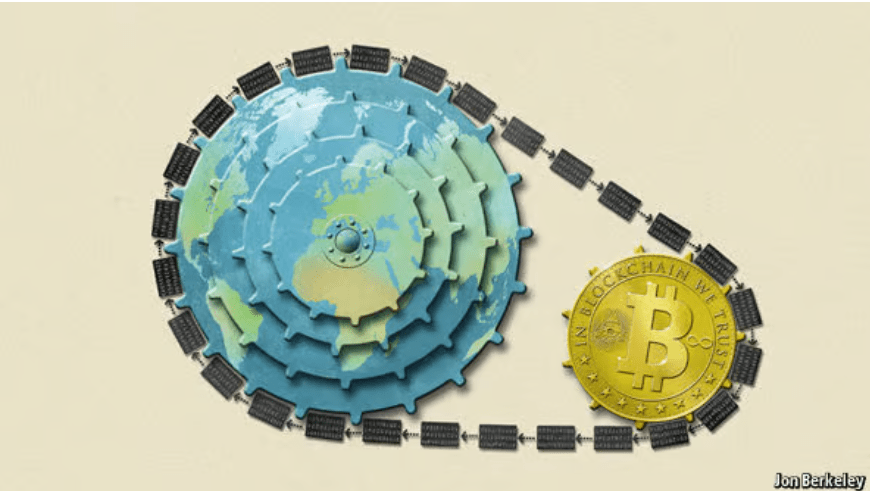

Gary Gensler once said that the current crypto world is the "Wild West", but we don't need to ignore the pioneering spirit brought by the "Westward Movement" to that era, and the independence, adventure and innovation of the cowboys who just set foot on this hot land because of the many outlaws in the West. Just like Bitcoin, which appeared in 2008, it is bringing various changes to this society and the world.
The following is a compilation of an article about Bitcoin from The Economist in 2015 - The Trust Machine, to compare the status of the Bitcoin/blockchain industry in two 7-year time spans. This will make us realize that although we are in the crypto winter now, the original belief, freedom and love remain.
Below, enjoy:
The technology behind Bitcoin will change the way the economy works.
The technology behind bitcoin could transform how the economy works.
Oct 31st 2015
BITCOIN has a bad reputation. The decentralised digital cryptocurrency, powered by a vast computer network, is notorious for the wild fluctuations in its value, the zeal of its supporters and its degenerate uses, such as extortion, buying drugs and hiring hitmen in the online bazaars of the “dark net”.
Bitcoin has always been notorious to the outside world. This decentralized digital cryptocurrency, powered by the computing power of a large network of computers, is known for its wild fluctuations in value, the fanaticism of its believers, and its depraved and illegal uses, such as buying drugs and hiring assassins on the "dark web" online market.
This is unfair. The value of a bitcoin has been pretty stable, at around $250, for most of this year. Among regulators and financial institutions, scepticism has given way to enthusiasm (the European Union recently recognised it as a currency). But most unfair of all is that bitcoin’s shady image causes people to overlook the extraordinary potential of the “blockchain”, the technology that underpins it. This innovation carries a significance stretching far beyond cryptocurrency. The blockchain lets people who have no particular confidence in each other collaborate without having to go through a neutral central authority. Simply put, it is a machine for creating trust.
This is unfair. Bitcoin’s value has remained fairly stable at around $250 for much of 2015. For regulators and financial institutions, skepticism has been replaced by acceptance (the European Union has already recognized it as a currency). But most unfairly, Bitcoin’s shady image has led to a lack of awareness of the extraordinary potential of “blockchain,” the technology that underpins Bitcoin. The significance of this innovation goes far beyond cryptocurrency itself. Blockchain allows people who don’t have a trusting foundation to collaborate without having to go through a neutral central trust endorsement. In short, it is a machine for creating trust.
The origin of blockchain (The blockchain food chain)
To understand the power of blockchain systems, and the things they can do, it is important to distinguish between three things that are commonly muddled up, namely the bitcoin currency, the specific blockchain that underpins it and the idea of blockchains in general. A helpful analogy is with Napster, the pioneering but illegal “peer-to-peer” file-sharing service that went on line in 1999, providing free access to millions of music tracks. Napster itself was swiftly shut down, but it inspired a host of other peer-to-peer services. Many of these were also used for pirating music and films. Yet despite its dubious origins, peer-to-peer technology found legitimate uses, powering internet startups such as Skype (for telephony) and Spotify (for music streaming)—and also, as it happens, bitcoin.
In order to understand the function of blockchain, and to comprehend the capabilities that blockchain can enable, it is necessary to distinguish three concepts that are often confused, namely the Bitcoin currency itself, the blockchain technology that underpins the Bitcoin network, and the concept of blockchain in general. A useful analogy is Napster, a pioneering but illegal "peer-to-peer" file-sharing service network launched in 1999, providing free access to millions of music tracks. Napster itself was quickly shut down, but it inspired many other peer-to-peer service networks, many of which were also used to pirate music and movies.
While the original intentions of the aforementioned peer-to-peer service network are questionable, the technology has since found legitimate uses, powering and directing internet startups like Skype for phone calls and Spotify for music streaming, and the same can be said for Bitcoin.
The blockchain is an even more potent technology. In essence it is a shared, trusted, public ledger that everyone can inspect, but which no single user controls. The participants in a blockchain system collectively keep the ledger up to date: it can be amended only according to strict rules and by general agreement. Bitcoin’s blockchain ledger prevents double-spending and keeps track of transactions continuously. It is what makes possible a currency without a central bank.
Blockchain is a powerful technology. Essentially, it is a shared, trusted, public ledger that can be inspected by anyone, but no single user can control it. Participants in a blockchain system jointly maintain updates to the ledger: it can only be modified according to strict rules. Bitcoin's blockchain network prevents double spending of transactions and keeps track of the ledger. This is the key to achieving a currency without the control of a central bank.
Blockchains are also the latest example of the unexpected fruits of cryptography. Mathematical scrambling is used to boil down an original piece of information into a code, known as a hash. Any attempt to tamper with any part of the blockchain is apparent immediately—because the new hash will not match the old ones. In this way a science that keeps information secret (vital for encrypting messages and online shopping and banking) is, paradoxically, also a tool for open dealing.
Blockchain is also the latest example of an unexpected outcome in the field of cryptography, where mathematical obfuscation is used to compress raw information into a code called a hash. Any attempt to tamper with a blockchain will be immediately apparent because the new hash will not match the old one. Paradoxically, a science that keeps information private - a vital component of encrypted messaging and online shopping and banking - is also a tool for public transactions.
Bitcoin itself may never be more than a curiosity. However blockchains have a host of other uses because they meet the need for a trustworthy record, something vital for transactions of every sort. Dozens of startups now hope to capitalise on the blockchain technology, either by doing clever things with the bitcoin blockchain or by creating new blockchains of their own (see article).
Bitcoin itself may be based on curiosity alone. However, blockchain has many other uses because it meets the need for a trusted record that is essential for all kinds of transactions. There are now dozens of startups looking to capitalize on blockchain technology, either by building on the Bitcoin blockchain or creating new blockchains of their own.
One idea, for example, is to make cheap, tamper-proof public databases—land registries, say, (Honduras and Greece are interested); or registers of the ownership of luxury goods or works of art. Documents can be notarised by embedding information about them into a public blockchain—and you will no longer need a notary to vouch for them. Financial-services firms are contemplating using blockchains as a record of who owns what instead of having a series of internal ledgers. A trusted private ledger removes the need for reconciling each transaction with a counterparty, it is fast and it minimises errors. Santander reckons that it could save banks up to $20 billion a year by 2022. Twenty-five banks have just joined a blockchain startup, called R3 CEV, to develop common standards, and NASDAQ is about to start using the technology to record trading in securities of private companies.
For example, one idea is to create low-cost, tamper-proof public databases, such as land registries (Honduras and Greece are interested), or registers of ownership of luxury goods and works of art. These ideas can be used as notarized documents by embedding information about the subject matter on a public blockchain, so that a notary no longer needs to witness them. Financial services companies are considering using blockchains as a record of who owns what, rather than having a series of internal ledgers.
Trusted private distributed copies eliminate the need to reconcile every trade with a counterparty, and are efficient and error-free. Santander Bank believes it could save banks up to $20 billion in costs by 2022. 25 banks just joined a blockchain startup called R3 CEV to develop common standards, and Nasdaq is about to start using the technology to record trades in private company securities.
These new blockchains need not work in exactly the way that bitcoin’s does. Many of them could tweak its model by, for example, finding alternatives to its energy-intensive “mining” process, which pays participants newly minted bitcoins in return for providing the computing power needed to maintain the ledger. A group of vetted participants within an industry might instead agree to join a private blockchain, say, that needs less security. Blockchains can also implement business rules, such as transactions that take place only if two or more parties endorse them, or if another transaction has been completed first. As with Napster and peer-to-peer technology, a clever idea is being modified and improved. In the process, it is fast throwing off its reputation for shadiness.
These new blockchains don’t need to work based on the same mechanisms as Bitcoin; many of them could tweak their models by finding alternatives to its energy-intensive “mining” process, as well as replacing the Bitcoin network’s method of minting new bitcoins as a reward for participants maintaining the ledger.
A group of permissioned players in an industry can also mutually agree to join a private blockchain. New blockchains also create and enforce business rules, such as transactions only occur when two or more parties approve them. As with Napster and peer-to-peer technology, innovations based on this are being/have been born. In the process, blockchain is quickly shedding its bad reputation.
The spread of blockchains is bad for anyone in the “trust business”—the centralised institutions and bureaucracies, such as banks, clearing houses and government authorities that are deemed sufficiently trustworthy to handle transactions. Even as some banks and governments explore the use of this new technology, others will surely fight it. But given the decline in trust in governments and banks in recent years, a way to create more scrutiny and transparency could be no bad thing.
The popularity of blockchain is bad for any "trusted intermediary business" - those centralized institutions and bureaucracies that are considered reliable enough to process transactions, such as banks, clearing houses, and government authorities. While some banks and governments are exploring the use of this new technology, others are sure to oppose it. But considering the decline in trust in governments and banks in recent years, creating more oversight and transparency may not be a bad thing.
Drawing up regulations for blockchains at this early stage would be a mistake: the history of peer-to-peer technology suggests that it is likely to be several years before the technology’s full potential becomes clear. In the meantime regulators should stay their hands, or find ways to accommodate new approaches within existing frameworks, rather than risk stifling a fast-evolving idea with overly prescriptive rules.
It would be a mistake to create rules for blockchain at this early stage: the history of peer-to-peer technology suggests that more time may be needed before the technology’s potential is fully realized. In the meantime, regulators should exercise restraint or find ways to accommodate innovation within existing frameworks rather than stifle an emerging innovation through excessive regulation.
The notion of shared public ledgers may not sound revolutionary or sexy. Neither did double-entry book-keeping or joint-stock companies. Yet, like them, the blockchain is an apparently mundane process that has the potential to transform how people and businesses co-operate. Bitcoin fanatics are enthralled by the libertarian ideal of a pure, digital currency beyond the reach of any central bank. The real innovation is not the digital coins themselves, but the trust machine that mints them—and which promises much more besides.
The idea of a distributed ledger may not sound revolutionary or appealing, but then again, neither did double-entry accounting and the joint-stock company. Yet, like those great innovations, the blockchain, a seemingly mundane technology or process improvement, has the potential to change the way people and businesses work together. Bitcoiners are fascinated by this libertarian ideal - a purely digital currency that transcends any central bank. But the real innovation is not the digital currency itself, but the trust machine that creates it, and the many more changes it can bring.
Original article address: https://www.economist.com/leaders/2015/10/31/the-trust-machine
This article is for learning and reference only. We hope it is helpful to you. It does not constitute any legal or investment advice. Not your lawyer, DYOR.