


Disturbing trend or progress? Lightning Network channels keep growing, but capacity keeps falling.
The Lightning Network is a second-layer solution that aims to solve the scalability and speed issues of Bitcoin transactions. It creates off-chain payment channels that allow users to transact almost instantly and at a fraction of the cost of traditional on-chain methods.
By allowing multiple transactions to take place off-chain and recording only the final balance on the main blockchain, it could ease congestion and reduce fees, making microtransactions more feasible and improving the overall efficiency of the Bitcoin network.
The growth of the Lightning Network suggests that more people are using Bitcoin for everyday transactions, a sign of wider cryptocurrency adoption. Changes in the Lightning Network can also reflect shifts in market sentiment — as more users seek fast, cheap Bitcoin transactions, a sudden increase in capacity could indicate bullish sentiment, and vice versa.
Lightning Network capacity refers to the total amount of Bitcoin being transacted within the network at any given time. A reduction in capacity could hinder the network’s ability to process many transactions. According to data from Glassnode, Lightning Network capacity dropped significantly between July and August, falling by nearly 13% over the past 30 days.
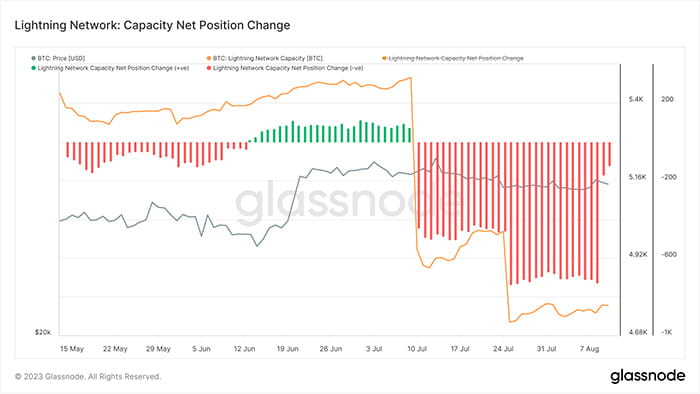 Chart showing changes in Lightning Network capacity net positions from May 14 to August 10, 2023 (Source: Glassnode)
This decline brings capacity back to levels recorded in December 2022.
Chart showing Lightning Network capacity from May 14 to August 10, 2023 (Source: Glassnode)
The number of channels on the Lightning Network grew by 3% over the same period.
Channels are the fundamental building blocks of the Lightning Network. They are private off-chain paths that enable two parties to transact without broadcasting to the blockchain. The increase in channels means more avenues for transactions, potentially increasing the efficiency of the network. This growth means expanding the network infrastructure, allowing more users to participate.
Chart showing the number of Lightning Network channels from May 30 to August 10, 2023 (Source: Glassnode)
One potential reason for these conflicting trends could be the creation of more channels holding smaller amounts of Bitcoin. This could indicate a more decentralized network, with users more willing to open their own channels rather than rely on larger centralized channels. While this could be seen as a step towards decentralization, the reduction in capacity could also indicate that larger players are withdrawing Bitcoin from the network, perhaps due to market uncertainty or a shift in investment strategy. #闪电网络 #比特币