


Original source: Open Access Supercomputing Foundation
Translated by: PANews Editorial Department
On June 14, the decentralized computing network AO launched by the sustainable storage protocol Arweave announced token economics.
8 Key Facts and Dates for AO Token
AO is a 100% fair issuance token that follows the Bitcoin economic model.
AO tokens will be used to secure messaging within its network.
The minting mechanism operates retroactively starting at 13:00 ET on February 27, 2024 (block 1372724). 100% of AO tokens minted during this period have been vested to Arweave token holders based on their respective balances held every 5 minutes. If you hold AR on an exchange or custodian, you should ask the exchange how to receive the tokens.
Going forward, one third (33.3%) of AO tokens will be minted to AR token holders based on their ownership every 5 minutes. In the future, two-thirds (66.6%) of AO tokens will be minted to transfer assets into AO to strongly stimulate economic growth.
The first phase of the bridge contract goes live today. During this pre-bridging phase, users’ tokens will remain securely on their native network while AO tokens will be earned. Once the second phase of the bridge goes live, users will be able to deposit assets into the new bridge contract and use them on AO - while earning rewards. Here users can deposit staked Ethereum (stETH) tokens into an audited pre-bridge contract.
Transition rewards will begin on June 18, 2024 at 11:00 AM ET.
Users can withdraw tokens from the pre-bridge at any time, but will only start earning AO once rewards begin on June 18. Rewards are distributed every 24 hours.
AO tokens will remain locked until approximately 15% of the supply is minted. This will happen around February 8, 2025.
Overview: 21 million coins in total, 100% fair issuance
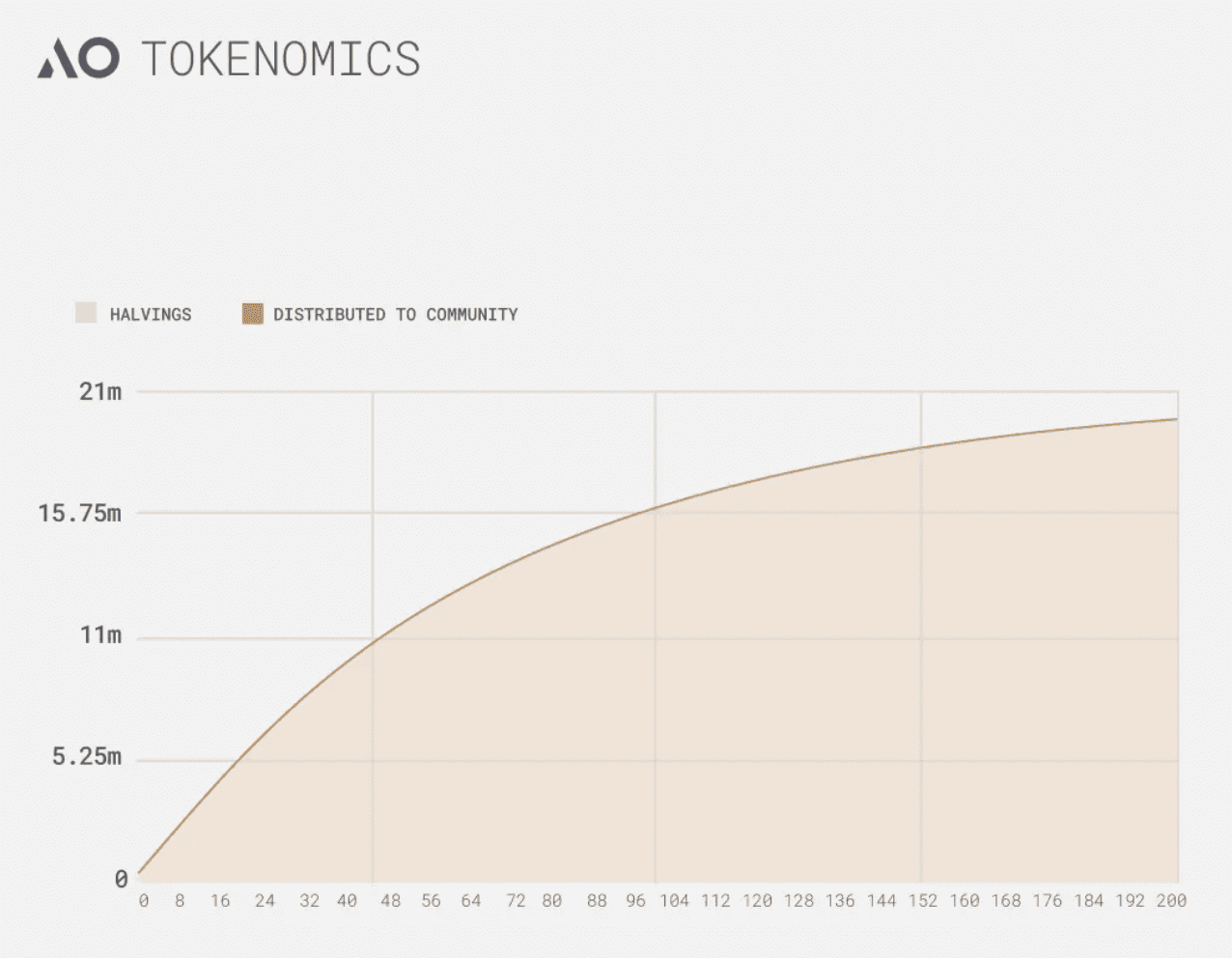
AO is a 100% fair issuance token modeled after Bitcoin.
Like Bitcoin, AO has a total supply of 21 million tokens and a 4-year halving cycle. AO is distributed every 5 minutes and the monthly distribution is 1.425% of the remaining supply. As of June 13, the inventory of AO was 1.0387 million. This makes them extremely scarce. By comparison, Ethereum has 120 million, Solana has 461 million, and Ripple has 55 billion.
AO's minting mechanism means that although the number of newly minted tokens will be halved every 4 years, there will not be a sudden "halving event". Instead, the number of new tokens will decrease slightly each month, resulting in a smooth issuance schedule.
While most token distribution models favor insiders over the community, AO’s model adheres to the principles of fairness and equal access that are at the heart of the crypto revolution. There is no pre-sale or pre-allocation. Instead, the AO token reward mechanism incentivizes two key aspects of a successful ecosystem: economic growth and base layer security.
Here’s how it works:
~36% (100% in the first 4 months + 33.3% thereafter) of AO tokens are minted over time by Arweave token holders, whose tokens incentivize the AO base layer – Arweave’s security sex.
Approximately 64% of AO tokens are minted over time to provide external benefits and bring assets into AO to incentivize its economic growth. This creates an extremely powerful incentive to increase liquidity in the ecosystem, creating an economic flywheel.
At the same time, without any token sales, the network funds the development of its own ecosystem in two ways:
Permissionless ecosystem financing
After the bridge goes live, developers who attract users to deposit eligible assets in their applications will be rewarded with corresponding AO tokens. This provides developers with a long-term, permissionless revenue stream without having to apply for grants, outside investment, or even tokenize their projects. If they wish, these developers can also choose to share part of their AO rewards with users, allowing users to continue to earn AO tokens when using apps in the ecosystem.
Permaweb Ecosystem Development Association
In addition, some dedicated ecosystem development organizations and builders will also share in the native revenue from the assets stored in the bridge. These organizations and builders work on AO's core protocols, marketing operations, and critical infrastructure development. These funds will gradually decrease over time, in line with the decay rate of the network's minting - allowing the network to bootstrap, but retaining it as a neutral sharing protocol.
How to calculate the AO balance of AR existing holders
Mining of AO tokens for Arweave token holders has been applied retroactively from the launch of the AO testnet on February 27, 2024 at 12:00 UTC. Minting AO tokens since testnet launch will ensure that the tokens have sufficient circulation before circulation, with the goal of reaching approximately 15% of the total supply (3.15 million) around February 8, 2025.
If you had been holding $AR in the months since the launch of the testnet, you would have accumulated approximately 0.016 AO tokens per AR as of June 13, 2024. Keep in mind that the current supply of AO is 1/65 of AR.
Major exchanges are currently studying whether and how to transfer $AO to users. Please contact the exchange or custodian to find out how they manage this process.
If users have been self-storing $AR tokens, they can check their balance by visiting ao.arweave.dev. Click on the Arweave tab and connect a self-custody wallet (such as ArConnect).
Holding AR in the future will earn AO
New AO tokens are minted every 5 minutes. Prior to the launch of the pre-bridge on June 18, 100% of all AO tokens were minted by AR token holders. Following the launch of the pre-bridge, 33% of AO tokens will be distributed proportionally to AR holders, accounting for an average of approximately 36% of the total AO supply minted by AR token holders. This process happens automatically.
The list below shows approximately how many AOs you can expect to accumulate over the next 12 months for a given AR balance:
1 AR:0.016 AO
10 AR:0.16 AO
50 AR :0.8 AO
100 AR:1.6 AO
500 AR:8.0 AO
1000 AR:16.0 AO
The amount of newly minted $AO will decrease over time until all AO tokens have been minted. AO tokens will become transferable on or about February 8, 2025.
Pre-bridge stETH to exchange earnings for AO
Note: AO Transition Awards are not available to U.S. citizens
During this initial phase, stETH (ETH staked using Lido) can be deposited to accumulate token rewards in AO. As AO begins to open up to more ecosystems, other proof-of-stake assets will become eligible.
During this initial phase, pre-bridge assets will not be available in applications on the AO network. Once the second phase of the bridge goes live, you will be able to use stETH in the AO application while still receiving AO token rewards.
When a user's stETH is pre-bridged to AO, their original stETH deposit will remain in the audit contract on the Ethereum network, while the native earnings will be distributed between dedicated ecosystem development organizations and builders of the AO ecosystem to Promote growth. At launch, these organizations include the Open Access Supercomputing Foundation, Forward Research, Autonomous Finance, Warp Contracts, Longview Labs, and ao/acc. As the ecosystem grows, more organizations will be added.
Users can withdraw their initial stETH deposit at any time.
New AO tokens will be minted every 5 minutes after 11am ET on June 18, 2024, which is exactly 16 weeks after the launch of the AO testnet. Once rewards begin, 66% of newly minted $AO will be distributed proportionally to wallets pre-bridged to AO. This process happens automatically.
The exact number of AO tokens a yield provider receives depends on the proportion of their deposited assets into the contract relative to their total deposited assets. As AO opens up to more of the ecosystem and can offer multiple proof-of-stake assets, the number of AO tokens received depends not only on the proportion of assets offered, but also on the yield generated by each asset.
The following list shows how many AO tokens you can expect to accumulate over the next 12 months by holding a certain percentage of the total yield asset pool (assuming the only asset offered is stETH):
0.01%:210 AO
0.1%:2,105 AO
0.5%:10,524 AO
1%:21,049 AO
5%:105,243 AO
AO tokens will become transferable on approximately February 8, 2025.
How to deposit stETH to get AO
Note: AO Transition Awards are not available to U.S. citizens
Users can start depositing stETH into the pre-bridge today. Rewards will begin accruing on June 18, 2024 at 11am ET. Rewards are distributed once a day, so users may have to wait up to 24 hours to receive their first reward.
Please follow the simple instructions below to exchange users’ stETH earnings for AO tokens:
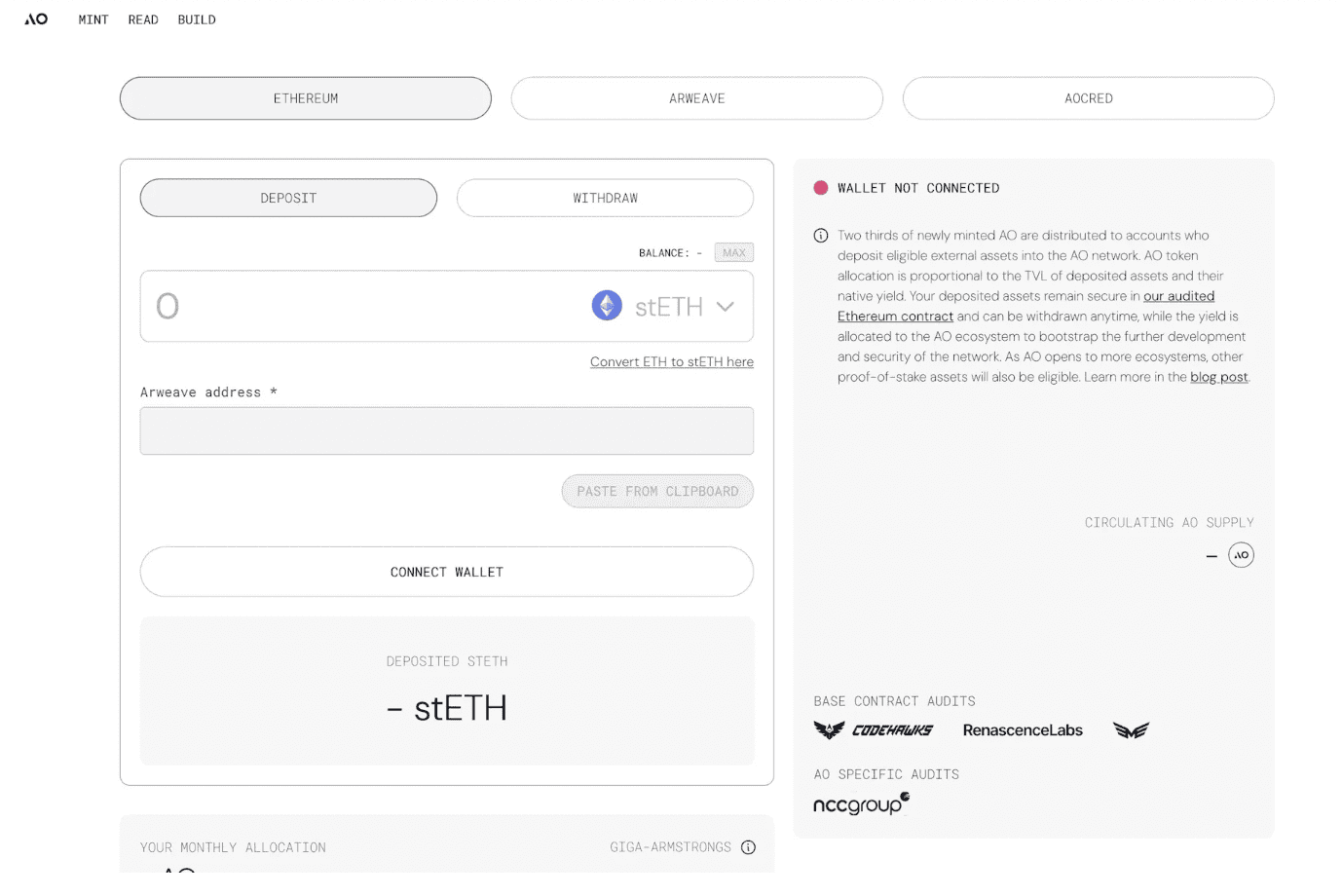
Go to the Minting page on the AO website.
Click on the Ethereum tab and connect your Ethereum wallet (Metamask or Rabby).
Enter the Arweave wallet address where you would like to receive AO tokens.
Deposit stETH into the audit contract by entering the amount you wish to provide. These tokens will remain in trustless contracts on Ethereum and can be withdrawn at any time. If you don't have stETH in your wallet, you'll need to exchange other tokens to get some stETH before depositing.
Sign the transaction in your ETH wallet to deposit stETH into the contract.
You will receive AO tokens directly deposited into your designated Arweave wallet.
Smart contract security
The pre-bridge contract is extensively audited and trustless: no one but you can access your tokens. The only perk is that the Open Access Supercomputing Foundation (the organization coordinating the launch of the AO token with the Arweave Ecosystem Organization) is able to withdraw the token from the contract in the event of a security incident - returning it to its original owner. This feature provides an additional layer of security without placing pre-bridge assets under the control of any centralized entity.
The contracts themselves are minor modifications of the MorpheusAI deposit contracts. These contracts are used to provide a battle-tested foundation, thereby mitigating any security risks.
in conclusion
The AO token minting process introduces a completely different model that rewards users and developers based on the principles of fairness and equal access. The diverse team behind the initiative drew inspiration from Bitcoin’s groundbreaking innovation and the fundamental principles established by Satoshi Nakamoto.
The crypto industry has experienced tremendous growth over the past fifteen years. However, this expansion has not always been consistent with wider social interests. To truly advance the mission of creating a permissionless, decentralized web that safeguards user rights, it becomes critical to rethink how value and incentives are integrated to achieve these goals.
(The above content is excerpted and reprinted with the authorization of our partner PANews, original text link)
Statement: The article only represents the author's personal views and opinions, and does not represent the objective views and positions of the blockchain. All contents and opinions are for reference only and do not constitute investment advice. Investors should make their own decisions and transactions, and the author and Blockchain Client will not be held responsible for any direct or indirect losses caused by investors' transactions.
〈A quick look at decentralized supercomputer AO token economics, how to earn 100% fairly distributed tokens? 〉This article was first published in "Block Guest".