

Disclaimer:
1. Browsing articles is a personal behavior, and investing is also a personal behavior. There is no mandatory requirement to refer to my own ideas. I am what you criticize me for. I am not afraid of low-quality trolls, and black fans are also fans.
2. If you think I am trash, then I am trash. My articles have remained of poor quality for several years. Those who like to read are welcome to read them, and those who don’t like to read them can cross them out.
3. I don’t use fake pictures or those so-called simulated account screenshots. If you want to take profits every day, I suggest you look at the profit screenshots of other people’s articles.
Hot topics of Master Chat:
Last night, the US financial market was quite exciting, and several Fed officials spoke. The speeches by Williams and Bullard were scheduled last week, but Brainard's speech was a bit special. It was an article published on the Fed's official website. Most of the content of this article was actually a speech made at a closed-door meeting of the Bank for International Settlements this summer.
I just made some additions and updates last night. Also, Meister's speech was arranged temporarily, and there was no preparation or planning in advance. Let's see what they said, and then analyze the macroeconomic situation next year based on their speech.
New York Fed President Williams said (at an event hosted by the Economic Club of New York) that the Fed will do more to curb inflation, which remains "too high" despite recent easing of supply chain challenges. Inflation is expected to slow to 5%-5.5% by the end of this year and fall further to 3%-3.5% next year. The US unemployment rate may rise to 4.5%-5% by the end of next year from the current 3.7% (both of his estimates are higher than the median forecast released by the Fed in September).
Williams told reporters after his speech that he sees a slightly higher path for rates than he had forecast in September. St. Louis Fed President James Bullard said (in a webcast interview with MarketWatch and Barron's) that financial markets are underestimating the likelihood that policymakers will raise rates more aggressively next year. (Reiterated) The Fed needs to raise rates at least to the bottom of the 5%-7% range to achieve its goal of limiting economic growth and, therefore, inflation.
Cleveland Fed President Loretta Mester said (in an interview with the Financial Times) that the Fed is not close to pausing its rate hikes. Given that we are starting to move into restrictive territory, we have an opportunity to slow the pace of rate hikes and assess the impact. We have a good October CPI report.
I need to see more data like this, more data showing a further slowdown in price pressures, or even lower prices in the core services sector. It's easy to notice the good news, but we can't let wishful thinking replace convincing evidence that stopping interest rate hikes early would be costly.
Fed Vice Chairman Lael Brainard said in a speech delivered at the Fed that the market underestimated the possibility of a sharp rate hike by the Fed next year. At a time when inflation is more volatile than in decades past, the Fed must guard against the risk of inflation expectations exceeding 2%.
In the face of protracted supply shocks and high inflation, it is important that monetary policy aims to manage risks and avoid inflation expectations rising above target. The cumulative effect of waves of negative supply-side shocks that have led to prolonged constraints on potential output may require tighter monetary policy to restore balance between supply and demand.
Overall, the ideas expressed by the four officials are very clear, that is, everyone feels that there is still a long way to go to fight inflation. The cycle of interest rate hikes is far from over, and I think this expectation is similar to the market's expectations.
Although there is speculation in the market about a rate cut, everyone knows that once the rate hike train starts moving, it will not brake so quickly. There must be a transition process, from aggressive rate hikes to moderate rate hikes, and from moderate rate hikes to stopping. Therefore, the Fed will not easily stop raising interest rates next year, but the pace of rate hikes will slow down.
Greg Abbott, the governor of Texas, said that he is open to Bitcoin and hopes to make the state a "core of Bitcoin innovation and encourage Bitcoin-related entities to settle in Texas. Greg Abbott revealed that Texas has set up a working group to focus on improving existing laws.
Making the state "more attractive" to ensure the success of Bitcoin, Texas will "provide a platform for people involved in blockchain, people involved in Bitcoin." According to a recent study by SmartAsset on crypto-friendly regions in the United States, Texas tied with New Jersey for fourth place, behind only Nevada, Florida and California.
Master looks at the trend:
Rebound is not the bottom, it is the bottom without rebound. Bitcoin is currently more like a long-term bottoming trend. After a sharp drop, it will rebound after a long period of bottoming. If the rebound action comes, it will be a violent rebound, generally with a magnitude of about 1 times, so we patiently wait for the market to adjust.
At the 4-hour level, Bitcoin had support near 16,000 last night, but this support did not have an obvious increase in volume, and it remains to be seen. If the 4-hour level can effectively stabilize near 17,000, then there is a high probability that an effective rebound trend will begin.
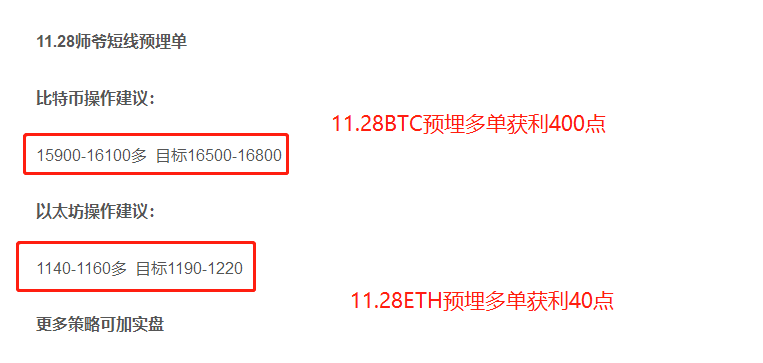
11.29 Master's short-term pre-buried order
Bitcoin:
16300-16500 empty defense 300 target 16000-15700
Ethereum:
1190-1210 empty defense 30 target 1160-1130