
1. Concept of hedging
Hedging, also known as hedge trading, refers to the establishment of futures trading contracts of equal quantity when buying and selling actual goods. The main purpose of hedging is to reduce risks and loss of profits, which can be simply understood as buying insurance for the physical price.
The essence is to lock in the buying and selling prices in advance to avoid the risks brought by future price fluctuations. Therefore, hedging itself is a business that locks in the risk of spot price fluctuations. There is no difference between profit and loss, only between doing and not doing.
For cryptocurrency miners, the most important hedging businesses are: first, hedging of raw materials. For example, hedging of electricity futures contracts to prevent future surges in electricity prices and increase costs. Second, hedging of output products. For example, hedging of BTC contracts to prevent future sharp drops in currency prices and reduce profits.
2. Two business categories
Buying hedging (long hedging): Processors: lock in the cost of raw materials. Refers to buying futures contracts in the futures market, which is equal to the spot value to be purchased.
For example, suppose there is a mining machine contract. I plan to buy a batch of mining machines in half a year, but I am afraid that the price of mining machines will increase in half a year. Then I can buy the mining machine contract that expires in half a year at the current price. After half a year, no matter whether the price of mining machines rises or falls, I will buy the mining machines according to the contract price six months ago.
Selling hedging (short hedging): Producers: lock in output costs. Refers to selling futures contracts in the futures market, which is equal to the spot value to be sold.
For example: a mining machine will produce 100 ETH in the next year. The future price is uncertain, but if you think it is appropriate to sell it at the current price of 4,000, you can establish an equal amount of short contracts. In the future, no matter whether the price is higher than 4,000 or lower than 4,000, the ETH produced will be locked in at 4,000 for sale.
3. Settlement Method
Physical delivery: refers to the physical delivery of goods by both parties according to the contract value after the contract expires. It is generally used in medium and large manufacturing enterprises.
Cash settlement: refers to the ability to close a position at any time before the contract expires, with real-time profit and loss settlement. Currently, hedging in perpetual/delivery contracts in the cryptocurrency world is basically cash settled.
4. Key Points
1) Margin system
1. Because the contract has a margin system, the amount of capital occupied can be greatly reduced.
2. Contract leverage: Domestic futures contracts are 5-10 times, and cryptocurrency contracts can be up to 100 times.
2) Principle of equal value
1. Equivalence principle: the contract value of the position is equal to the value of the spot
2. You can also do partial hedging based on your preferences
3) Principle of close contract delivery months
1. Delivery contract: When choosing a delivery contract, you should generally choose a contract whose delivery date is greater than the date of spot trading. Otherwise, after the contract expires, you will need to switch to the next contract, which may cause slippage and premiums and discounts due to the time difference.
2. Perpetual contract: There is no problem of transferring positions, but there is a rule that the funding rate is charged every 8 hours
5. Notes
1) Risk of contract liquidation
Because of the margin system of the contract, if the price fluctuates in the opposite direction, it will cause insufficient margin and need to be supplemented.
2) Overall profit and loss
Do not separate the profit and loss of the contract, because the profit of the contract = the difference between the loss of buying and selling the spot in the future, and the loss of the contract = the difference between the profit of buying and selling the spot in the future
6. Case
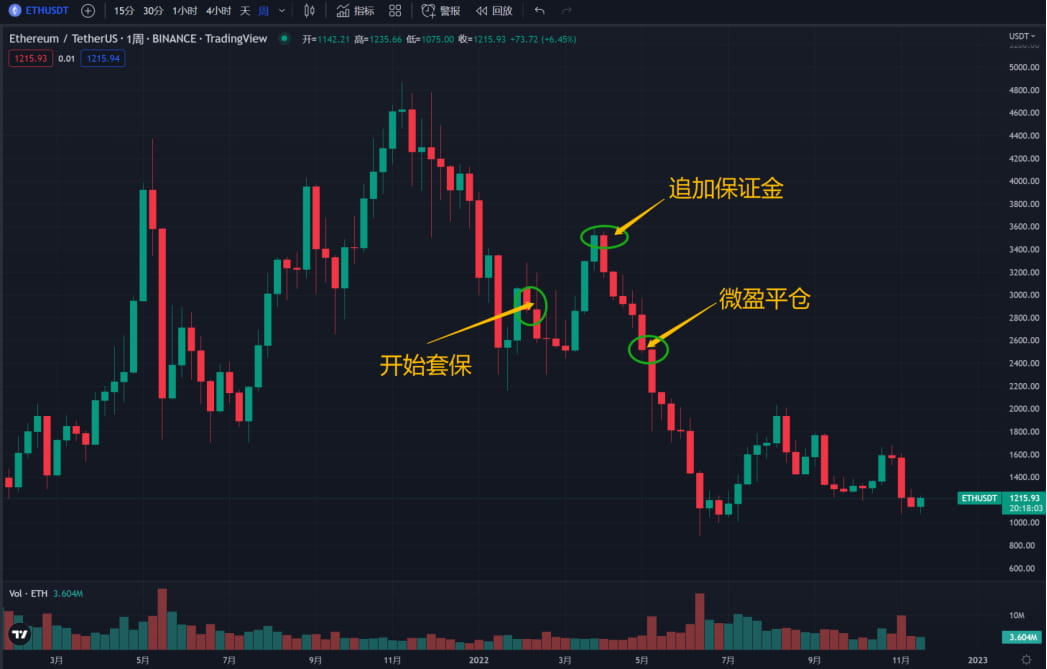
Case 1: A friend of mine hedged ETH at around 2800 in February 2022, and added margin when the price hit 3500 at the end of March. Then, when the price fell to around 2600 in April and made a little profit, he closed all his positions, thinking that he had made a little profit from the contract. Later, the price of the currency continued to fall, and the mined ETH could only be sold at a low price.
Problem: Look at the whole picture. My friend always feels that it is not pleasant to see a contract lose money, and cannot bear to see the contract lose money. In fact, when the contract loses money, the ETH produced by the mining machine is sold at a high price. The profit of the part of ETH sold at a price higher than the original price = the profit of the contract loss. Therefore, the profit and loss of the contract and the profit and loss of the spot are integrated.
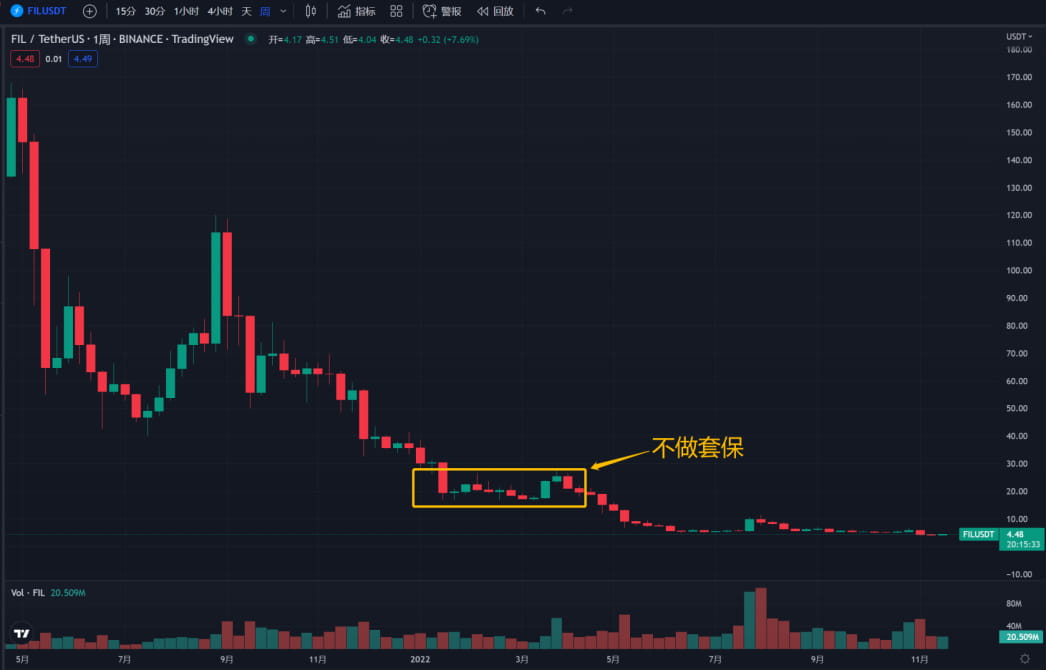
Case 2: Another friend of mine never hedged his FIL. When the price dropped to 20, he thought about hedging. After a night's sleep, he thought that the price had dropped so much, and the mining machine had already recovered its investment, so he simply stopped hedging. Then, the price of the currency dropped from 20 in March to 4.5 now. Future income has been greatly reduced.
Problem: Weakening the changes in currency prices and focusing only on one's own costs and future profits.
7. Personal views and hedging techniques
1) In a bull market, try to buy multiple units of output for the next few years at a high price, or hedge at different price batches
2) Don’t guess the top and bottom of hedging subjectively. In essence, you should hedge at the corresponding price based on your own costs and payback period.
3) You can have a psychological price according to your own costs. Above the psychological price, you can choose to hedge selectively, opportunistically, and partially; below the psychological price, you can hedge fully.
4) Hedging should be operated as a business, not speculation. Hedging itself is a business. If you do it with a speculative mindset, it is not hedging.
5) Large mining companies need to hedge electricity futures. For example, the European energy crisis has pushed up electricity prices, which has greatly increased the costs of mining companies.
6) Four futures exchanges have launched electricity futures: New York Mercantile Exchange (NYMEX), London International Petroleum Exchange (IPE), Chicago Board of Trade (CBOT), and Australian Stock Exchange (ASX)