

Author: Ignas, DeFi researcher; Translation: Golden Finance xiaozou
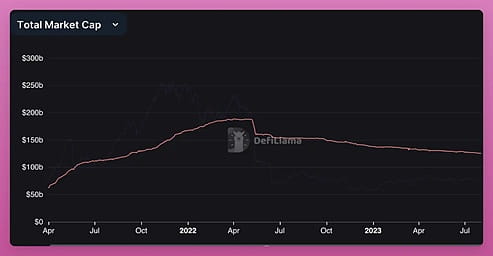
Is the golden age of decentralized stablecoins coming? Don’t be misled by the drop in the total market value of stablecoins from more than $180 billion to $125 billion (DeFi stablecoins account for only 9%). Let’s take a look at the exciting changes in DeFi stablecoins to welcome the future bull market!
Safety first! Non-profit organization Bluechip has released an economic security rating for major stablecoins. Which ones have the highest ratings? BUSD, PAXG, GUSD and the safest DeFi stablecoin LUSD. Safer than USDC. During the USDC decoupling incident in March, LUSD acted as a safe haven.
DeFi stablecoins like DAI and RAI received a B+, while USDD and Tron USDD received an F. These ratings are important as the ratings will focus on experimental DeFi stablecoins. Whether you are a DeFi miner or risk-averse, there is a stablecoin for everyone.
Lybra
Let's look at Lybra eUSD, a competitor to LUSD. As a fork of Liquity, it differs from Liquity in that it accepts stETH as collateral. This allows eUSD holders to earn an APY of about 7.2%. However, the distribution of eUSD's earnings is done through a rebase mechanism, which leads to adoption issues within DeFi.
To address this and other issues, Lybra v2 introduces a new stablecoin, peUSD. The upgrade also includes full-chain functionality, can be minted using a variety of collateral, and is easier to integrate with DeFi protocols. v2 is currently running on the Arbitrum testnet.
Simple liquidity at zero interest, one-time borrowing fees, and censorship resistance are cool. But to keep up with the competition, Liquid launched v2, which aims to solve the “stablecoin trilemma” of decentralization, stability, and scalability.
Liquity v2 introduces principal protection leverage and secondary markets to ensure stability in case of ETH price declines, thanks to a reserve-backed delta-neutral model. It is complex but provides leverage, yield, and trading opportunities. Release is scheduled for 2024.
Synthetix
Why is the SNX founder bullish on decentralized stablecoins? I guess it’s because of Synthetix v3! Although sUSD’s market cap has dropped to $94 million, the launch of v3 could change that trend. It heralds an exciting change in the Synthetix ecosystem.
The main improvements of sUSD are:
Multi-collateral collateralization: v3 supports different collaterals to support synthetic assets. No longer only supports SNX. sUSD liquidity is expected to increase.
Synthetix Lending: mint sUSD with no debt pool risk and no issuance fees.
MakerDAO
Additionally, Maker is thriving:
MKR is up 26% in a month.
DAI will soon earn 8% through the DSR.
Spark Protocol — a DAI-focused Aave fork — reached $57M TVL.
Maker reduced its reliance on USDC from 65% to 17%.
It is now the third largest revenue generator, surpassing Lido.
FRAX
Let’s look at FRAX: it has a D (Unsafe) rating in the Blue Chip category. The relevant issues are FXS’s partial collateralization and heavy reliance on centralized assets, but with the release of v3, things may change soon.
Although the details have not yet been fully announced, Frax is currently voting to work with FinresPBC to jointly hold and manage low-risk cash equivalent assets. It will enable on-chain access to off-chain traditional assets and bring benefits to the Frax protocol while reducing dependence on USDC.
Ghost
Meanwhile, Aave recently launched its stablecoin GHO, which is off to a solid start with a market cap of $11 million. The potential of GHO goes beyond Aave: being a facilitator of GHO minting using real-world assets, treasuries, or partial algorithms like the FRAX model.
The key things to know about GHO are as follows:
· Overcollateralized, minted/destroyed only by approved Facilitators.
The accrued interest is set by Aave governance (currently 1.5%).
Cannot supply to the Aave Ethereum market.
· stkAave holders are provided with a lending discount model.
Curve
The release of crvUSC by Curve has proven to be crucial to the platform. After the hack, crvUSD played a key role in providing liquidity to the Fraxlend CRV/FRAX lending pools as well as CRV on the TriCypto pool, while maintaining the peg. This is a very timely release.
The lending and liquidation AMM algorithm based on the soft liquidation mechanism makes crvUSD stand out. Through the gradual conversion between collateral and crvUSD - selling collateral when the price drops and buying back collateral when the price rises - the liquidation problem is solved and more trading volume is brought.
The collapse of UST and the decoupling of USDC have taught us good lessons about what we need to improve. What works today may not work tomorrow, and what seems impossible now may become the norm in the near future. DeFi stablecoins are forging ahead amidst these lessons.