


Current core inflation trend
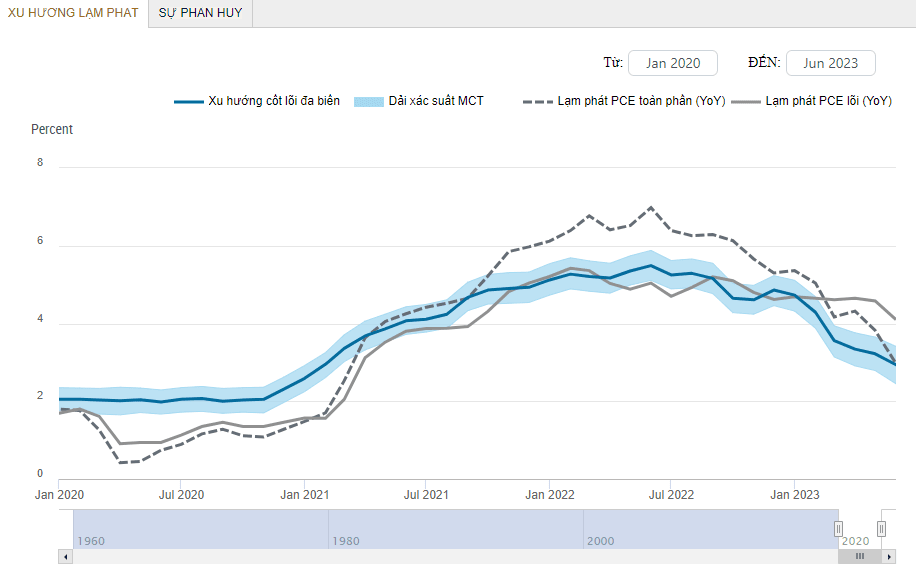
The correction trend is gradually reducing inflation in 2023 with some information as follows before I provide analytical information on Inflation
Housing inflation accounted for 0.44 percentage points (ppt) of the MCT estimate, while moving services accounted for 0.40 ppt.
Core goods had a lower contribution of 0.22 ppt.
The persistence in both housing and non-housing services inflation is driven by the industry-specific component of the trend.
What is inflation ?
Inflation and vice versa, deflation both have an impact on Bitcoin price. A general increase in inflation tends to boost Bitcoin prices. And when the inflation rate turns negative, deflation tends to drag Bitcoin prices down.
As the COVID-19 pandemic led to an economic crisis, central banks around the world have tried to boost the economy by printing more money. The world economy is in a cycle where central banks are reluctant to take money out of the economy and end up having to put more in. As a result, the money printing cycle has had an impact on Bitcoin prices.
Basic Concepts of Inflation and Deflation
In economics, inflation is the general increase in prices in an economy over time. Deflation, on the other hand, is the opposite - specifically, a general decline in an economy's prices over time.
When you buy a loaf of bread, you'll pay about $1.37 per pound. About 70 years ago, that bread cost $0.14 per pound. Prices have increased nearly tenfold in the past 70 years. That price increase is due to inflation.
A little inflation in prices in an economy is positive. A slight increase in the price of goods and services indicates that there is an inherent demand for those products. On the other hand, when an economy experiences deflation, prices adjust lower and businesses lay off employees or go bankrupt, creating a negative feedback loop.
Sometimes, the topic of inflation and deflation can confuse people. The reality is that anything can be inflated or deflated - whether it's bicycle tires or prices in the economy. Therefore, it is important to understand what is being referenced when the topics of inflation and deflation are introduced.
Fiat Money Inflation: Supply and Credit
Most media outlets are referring to a general increase or decrease in prices when they discuss inflation.
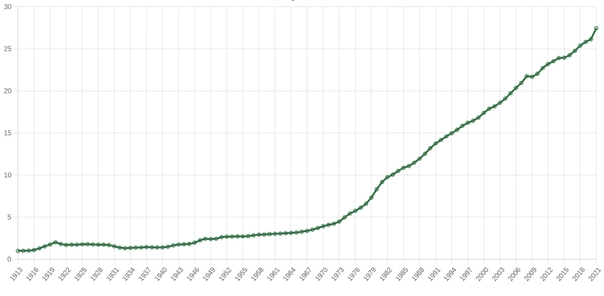
For example, the chart above illustrates how prices have increased over the past 100 years.
When prices rise, the purchasing power of each dollar is reduced.
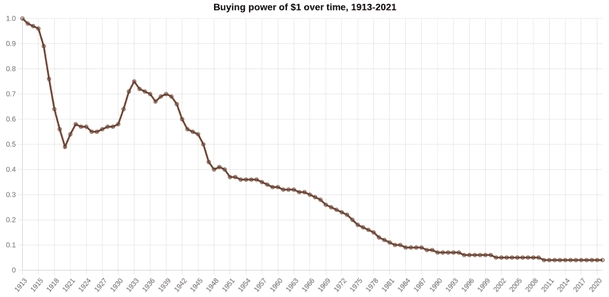
In the chart above, we can see a continuous decline in purchasing power over the past 100 years. $10 in 1913 is not the same as $10 in 2021, because what you can buy with that $10 has changed dramatically. With that same $10, you cannot buy as many goods and services today as you did nearly a century ago.
Inflation and Deflation: Causes and Effects
Could it be that changes in consumer prices are an effect of inflation rather than the cause? If so, what are the causes of inflation and deflation?
A better way to look at inflation is as the expansion of money in the economy. Let's simplify an example: bicycles. Suppose the demand for new bicycles is steady from year to year and a new bicycle costs an average of $500.
If the amount of currency in the system increases by 10%, the cost of the bike eventually needs to increase as well - because it takes more money to buy the same amount of bike. The amount of money spent on purchasing equipment and supplies has increased, so more money is needed to buy the same product.
On the other hand, if the amount of money in the economy decreases and there is less money, people will not be able to pay as much to buy bicycles. In this case, the manufacturer would have difficulty selling their bike at the $500 level and would need to reduce the price - or risk being placed in unsaleable stock.
In the bicycle example above, note that the demand for bicycles remained constant, but people's willingness to buy changed, depending on the amount of currency available in the economic system.
Therefore, we can define inflation and deflation as follows:
Inflation = Monetary expansion in the economy
Deflation = The contraction of money in the economy
What Is Healthy Deflation?
Deflation in an economy is often considered undesirable - and largely it is. During the 1930s, the United States experienced economic deflation and the effects lasted for a decade.
In 2007–08, the world economy deflated as the banking system went into overdrive, freezing money flows around the world.
However, deflation in consumer prices is not always a bad thing, as it can imply a more productive economy.
For example, technology is deflationary in nature. The cost of a computer has decreased significantly over the past 25 years while the processing power of computers has increased.
In essence, you get a better computer for less today than you did 25 years ago, which is deflationary. Those cheaper computers allow us to work more efficiently - and invest in other innovations.
How Do Inflation and Deflation Work?
There are many factors to consider when determining whether an economy is experiencing inflation or deflation. For example, we mentioned the productivity of an economy. A highly developed economy using computers is quite economically productive compared to a village in a rural part of the world without advanced technology.
Long-term population demographics are also an important issue. An aging population means less productive workers, while a young and growing population has plenty of future workers and pent-up demand. Part of the reason for the massive price inflation of the past 70 years is the baby boom. The population exploded, maturing and becoming productive workers, creating more demand.
Credit availability also plays a part in the inflation versus deflation story. Inflation and deflation cycles tend to be guided by banks' willingness to lend money. The time has come for society to over-consume and the economy to over-produce. This creates pressure on the ability to repay loans, and banks will withdraw the amount of credit they provide. As do credit contracts, so does the economy, which leads to price deflation.
Supply Inflation and the Bitcoin Protocol
We mentioned earlier that anything can be inflated, from currencies in the economy to bicycle tires. Bitcoin was created to be a currency and store of value, and its inflation rate is pre-programmed into its code.
As you probably already know this, Bitcoin is the fuel to maintain and secure the Bitcoin blockchain. Approximately every 10 minutes, new transactions are confirmed with the next block of the Bitcoin chain. Miners who confirm those blocks receive new Bitcoins, which are created as rewards for doing their work. Therefore, every 10 minutes, a new Bitcoin is added to the economy and becomes available for spending.
To restrain and limit the number of bitcoins that would be created, Satoshi Nakamoto programmed a halving cycle into the code. Approximately every four years, the reward a miner receives is halved. New Bitcoins continue to be created but at a slower rate.
On the chart above, the slope of the curve is decreasing, signaling a corresponding decrease in the amount of new Bitcoins created each year. The next halving cycle is expected to take place around 2024, and the pace of new Bitcoin will be even slower at that time.
In the end, the reward will be less than 1 Satoshi and no more Bitcoins will be created. At that point, there will be 21 million bitcoins available. However, that won't happen for many generations, as it's expected to happen around 2140.
One of the biggest reasons people invest in Bitcoin is the scarcity of supply. There is a limit to the number of bitcoins available, and the inflation rate can be calculated mathematically at any time.
What Happens to BTC Price During Currency Inflation?
Now that we know the supply of Bitcoin is fixed, the other main factors that will influence its price will be the demand for Bitcoin and the supply of the currency in the economy.
Demand for Bitcoin will increase and decrease based on many different factors. It could be argued that Bitcoin is still in the early stages of adopting new technology. A recent survey found that 14% of Americans have invested in Bitcoin. In general, it can be argued that demand is likely to increase for Bitcoin, which could push prices higher.
Let's put demand aside for a moment, assuming that it will stay the same or increase slightly. How might inflation or deflation of fiat currencies in economies around the world affect Bitcoin prices?
The world's major developed economies are increasing their currency supplies. As we have a worldwide economy with more money and a fixed number of bitcoins, the cost of Bitcoin priced in fiat currency will increase.
The chart above shows the size of the Federal Reserve's assets. The Fed is the central bank of the United States, and the size of its assets is a broad measure of how much money it allows to print.
Before 2007, the Fed's total assets were nearly $1 trillion. In 2021, this number has increased to more than $8 trillion. It is therefore no surprise that Bitcoin prices are trending higher, as more money is printed by developed economies.
What Happens to BTC Price During Monetary Deflation?
On the other hand, there are times when currencies are destroyed or credit collapses, which creates a deflationary environment. Generally, when deflation prevails, we often see the price of Bitcoin collapse as well.
The chart above shows the price of Bitcoin during the COVID-19 pandemic. When people are forced to stay in their homes, they spend less, but businesses have inventory and expenses to pay. As a result, during the pandemic, businesses laid off workers, and revenue declined.
Bitcoin prices also collapsed during this time. Some people may need to convert the value of Bitcoin to their local fiat currency. For others, the price collapse may have been expected, as the pandemic began to drag prices lower with no end in sight.
The important point to remember is that Bitcoin prices generally follow the printing of currency. If the money supply is increasing significantly, then the price of Bitcoin will likely increase. If the currency supply is decreasing, then the price of Bitcoin will likely decrease. However, these trends do not correspond directly and should be considered in general terms, because the demand for Bitcoin also has an impact on price.
Inflation and Deflation: Where Are We?
In response to the COVID-19 pandemic, central banks across the globe have printed a lot of money.
Source: Federalreserve.gov - red circle shows when the COVID-19 pandemic hit the United States
For example, the Federal Reserve printed nearly $4 trillion between March 2020 and July 21. This is a staggering 100% increase in the amount of available currency in the US economy.
Since the vaccine became available, businesses have reopened and commerce is reopening in many sectors. However, the effects of the pandemic are still being seen in high unemployment rates. In the chart above, compared to the time just before the pandemic began, the US unemployment rate has decreased but is still higher than before.
One way to measure the impact of inflation or deflation is to look at the consumer price index (CPI).
The CPI includes complex calculations to determine whether the cost of certain goods and services is increasing. When the CPI increases, it shows that the impact of inflation is being felt in the economy. With better employment and increased currency printing, the CPI edged higher towards the end of the year. Therefore, the current inflationary environment will support the price of Bitcoin.
If there comes a time when central banks start to keep printing money or shrink the money supply, it is likely that the price of Bitcoin will drop lower.
Can Bitcoin Be an Effective Hedge Against Inflation?
Fiat currency inflation occurs when the amount of currency in an economic system grows significantly, causing the prices of goods and services to increase. Citizens will therefore want to invest in instruments that can store the purchasing power of their assets and act as a hedge against inflation. This could be investing in another economy or in companies that tend to do well in high inflation environments.
However, if your investments or inflation hedges do not keep up with the rate of inflation, you will lose purchasing power and your assets will evaporate. Since Bitcoin has a fixed supply that can never increase, it is believed to be a store of value that can maintain the purchasing power of fiat money.
In the image above, you can see that as money expands (blue line moves higher), Bitcoin tends to perform well and move higher as well (orange line). However, as the blue line moves lower, deflation is at hand and Bitcoin tends to underperform.
Should You HODL Your Bitcoin Or Spend It?
Currently, there is an interesting cycle going on that is positively impacting the price of Bitcoin. First, when the economy declines, central banks and politicians quickly introduce promotional measures. That boost is the result of printing more currency, and that causes inflation. When inflation increases, central banks consider cutting back on the promotion process - which causes deflation of the money supply. Then the economy started to decline and more acceleration was lined up.
Bitcoin has responded positively to such a chain of events and is therefore also deflationary. The standard response is that deflation leads to spurts... which leads to inflation...which leads to higher Bitcoin prices. Therefore, if you have the courage to endure the waiting process, HODL (HOLD) is a sound investment strategy to earn more Bitcoin at a cheaper rate.
Conclude
Inflation greatly affects the Crypto and Bitcoin markets
Central banks closely monitor inflation rates in their economies. A healthy economy will experience a small amount of inflation. If the inflation rate turns negative, the economy experiences deflation, which could wreak havoc on efforts to restart the economy.
Since the COVID-19 pandemic began, the Federal Reserve has printed $4 trillion in fiat money, driving inflation rates higher. As a result, Bitcoin prices have increased as people look to it as a store of value.
If central banks clamp down on printing their currency or reduce the amount of currency in the economy, Bitcoin prices could fall in response to the tighter money supply.