
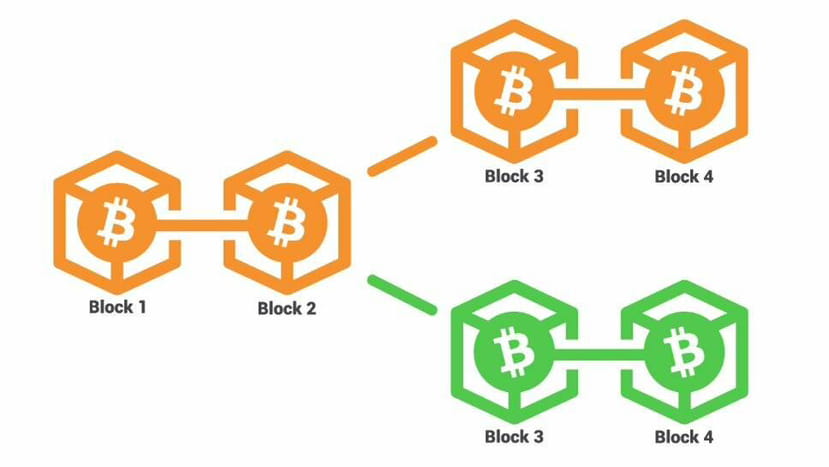
A fork occurs in a blockchain when significant changes are made to its source code. The process is designed to tailor network capabilities to community preferences or align them with specific technology requirements. As a result of a hard fork, a new one with changed characteristics may emerge from an existing blockchain network. Such well-known blockchains as Bitcoin and Ethereum have repeatedly been subject to forks, as a result of which new independent cryptocurrencies emerged. There are also soft forks that provide a reversible change to the blockchain when minor updates are made to the existing network.

What is a cryptocurrency fork?
One of the most notable examples of a cryptocurrency fork is the controversy in the early Bitcoin community, which led to the creation of two famous digital assets: Bitcoin Satoshi's Vision (BSV) and Bitcoin Cash (BCH).
Some characteristics remained unchanged, such as total supply, circulating supply, and treatment of assets held in individual accounts. This means that each Bitcoin owner received BSV and BCH in an amount equal to the number of coins he owned. Simply put, if a user had 1 BTC, then he would receive one BSV and one BCH.
A fork is a process of creating new cryptocurrencies that occurs by changing the source code of the blockchain. It can be caused by various reasons and can be carried out in two ways: hard fork or soft fork.
Why do forks happen and why are they needed?
Centralized systems are easy to improve through direct updates, while upgrading a blockchain application or network requires a more thorough approach, and community consensus plays a large role in updating such projects.
The blockchain is maintained by participants who ensure its security and stability. Any proposed changes to the network must be approved by a majority of the community. This step is not required in centralized systems, but is key when forking cryptocurrencies. Community members are miners in blockchains with the Proof-of-Work (PoW) algorithm or validators in Proof-of-Stake (PoS).
When changes are made to the network, a new blockchain is created. If new adjustments are accepted by miners and validators of the network, then they update their nodes to the new version of the blockchain and continue to support it. In cases where a community cannot reach a consensus, one of its factions may decide to continue supporting the old network while the rest of the members move to the new one. This leads to the splitting of the network and the emergence of a new blockchain, which contains the history of the parent network, but works slightly differently.
Thus, forks can occur for the following reasons:
Making changes to the blockchain source code. Some established rules, such as node requirements, community suggestions, and tokenomics, can be changed by a fork. In this case, the technology has not changed, but the rules by which community management functions have changed.
Technological improvements or optimization. As the blockchain evolves, it may be necessary to make changes to the underlying code base or the code that powers certain infrastructures. This will improve work efficiency or meet user requirements.
Creation of a new independent blockchain. The network can be forked as a result of a deliberate attempt to create a new blockchain that operates independently of its parent. This can be done by part of the blockchain community or by independent developers who want to improve on the technology or rules of the parent network without creating a new blockchain from scratch.

Types of forks: soft fork and hard fork
Considering the method and result of the fork, the process can be divided into the following categories:
Soft forks are minor updates to the network. They are simple improvements to the blockchain code or rules that ensure the project retains its basic look and feel and can be easily merged with the original version.
In this case, new changes made to the blockchain software are compatible with the records and system that existed before the update and are called reversible. Once network participants agree to these changes, the updated version is integrated into the old network and a new one comes into being.
Hard forks. Changes in the blockchain with such a fork are not reversible. That is, the blockchain software changes so much that it cannot be integrated with existing records and system. Moreover, if the decision to upgrade was unanimous, then miners or validators in the network will update the software to the new version and maintain a single network without creating new ones.

How to make money on a fork
Forks of crypto projects not only improve their functionality, but also provide an opportunity to make a profit. To figure out how to do this, it's helpful to look at past forks.
For example, the BTC network initially processed transactions instantly, but as its popularity grew, it began to suffer from congestion, causing delays. In the summer of 2017, many users waited several days or even weeks for transactions to be confirmed.
To solve this problem, a group of developers led by Amaury Secheta proposed increasing the block size from 1 to 8 MB. They believed that this would help increase network capacity. They launched a hard fork in August 2017, but many miners refused to support it, and most of the network remained with the old settings.
As a result, a forced fork occurred, and the network was divided into two parallel blockchains: traditional Bitcoin (BTC) and the new cryptocurrency Bitcoin Cash (BCH). Those who had Bitcoin at the time of the hard fork automatically received the same amount of Bitcoin Cash.
In August 2017, BTC was trading at around $3,000 and BCH started trading at around $700. This meant that each Bitcoin holder received about 20% of their deposit thanks to the hard fork. At the end of 2017, the BCH rate rose to $3900, and the amount of the automatic increase increased by 5.5 times.
At the end of August 2017, the Segregated Witness (SegWit) soft fork was activated on the Bitcoin main network, which allowed transaction signatures to be moved outside the main block. This resulted in the following benefits: increasing the number of transactions per block, reducing fees, increasing speed, improving scalability, and solving the problem of “transaction plasticity.”
Hard forks and soft forks have a significant impact on the price of a cryptocurrency. For example, if a community reaches consensus and expects a fork to occur, the price of the coin will often increase before the fork occurs. If the fork successfully solves significant problems of the project, it can lead to a significant increase in the value of the currency in the long term.
However, the opposite effect is also possible. If a hard fork does not go as planned or the idea itself causes controversy in the community, investors may begin to doubt the future prospects of the cryptocurrency. As a result, its value may decrease.
Contrary to popular belief, forks are not simply copies of old networks, they often represent the embodiment of technological innovation or political views. For example, forks of the Ethereum PoW blockchain represent the latter. Thus, the purpose of forks is to support and promote blockchain technology.
How to determine the reliability of a fork
Fork developers should be active and also answer questions from the community. It is also important to evaluate the amount of work and the quality of the code that was produced by the team, as well as read reviews from other users and pay attention to their recommendations. In addition, it is necessary to analyze the financial component of the project, such as the budget, opportunities for growth and profit prospects. All these factors will help you make an informed choice and increase the likelihood of successful earnings on forks.
A fork hunter is a person who seeks to find promising cryptocurrency fork projects. Its main task is to analyze the development team and study their portfolio. This allows us to draw conclusions about the success of the project. For example, the team that wanted to carry out the Segwit2X Bitcoin hard fork was small, which aroused suspicion in the crypto community. As a result, this fork never took place.
It is also important to consider the cost of new tokens. If the price is too high, the risk of losing significant profits can be significant. Therefore, the user needs to be careful to make the right decision. An important aspect is monitoring and analyzing the database to search for forks in cryptocurrency. Particular attention should be paid to which crypto exchanges the coin will be listed on. If the world's major platforms have listed a cryptocurrency, then the risk of losing investments becomes minimal.
However, it is worth considering that a soft fork or hard fork may not bring profit. The reasons may be different: lack of original ideas, insufficient user support and lack of specific goals. Choosing promising forks is the way to make money.$BTC $ETH $BNB