
On Thursday (July 27), US presidential candidate Robert F. Kennedy Jr. personally confirmed on Twitter that he holds Bitcoin assets and has purchased 2 Bitcoins for each of his 7 children. He emphasized that Bitcoin is an inflation-resistant currency, which gives retail investors freedom instead of holding legal tender that is dominated by the system. He explained that cryptocurrencies have the potential to lift the poor out of poverty and proposed a policy commitment that Bitcoin will become a reserve of the US dollar and exempt Bitcoin from capital gains tax.
Kennedy Jr. listed an investment account on the financial report submitted at the end of June, indicating that the account held Bitcoin worth $100,000 to $250,000. He supported Bitcoin in a speech in Miami in May and announced on the spot that he would accept Bitcoin as a campaign donation. To avoid conflicts of interest, his campaign team explained that although Kennedy Jr. did hold Bitcoin investments, this was after the speech, and he did not hold any cryptocurrency at the time of the Bitcoin speech.
In a Twitter Space live broadcast hosted by crypto opinion leader Scott Melker, Kennedy Jr. once again confirmed the fact that he holds Bitcoin and said that he bought 2 Bitcoins for each of his 7 children. He explained: "After the Bitcoin conference on May 18-20, I decided to keep my word and buy 2 Bitcoins for each of my 7 children."
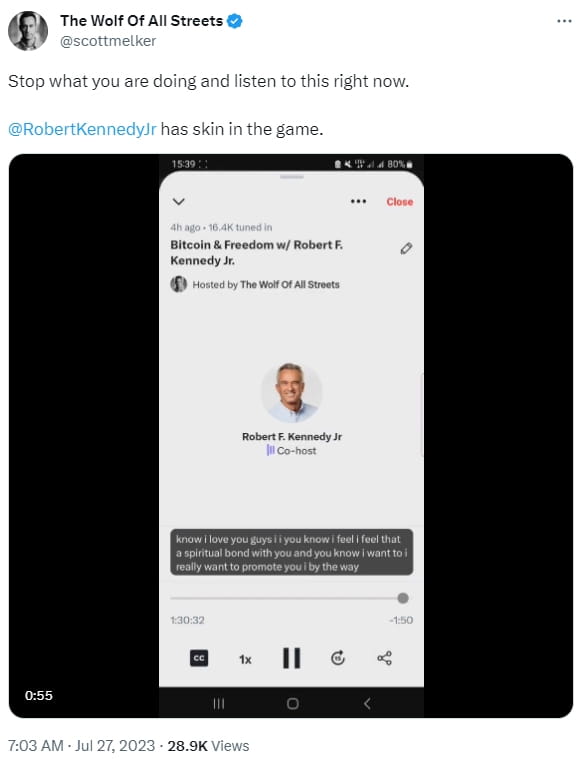
Kennedy Jr. stressed that Bitcoin allows small investors to actually own an inflation-resistant currency, which gives them freedom, rather than holding fiat currencies that are at the mercy of the system. He explained that cryptocurrency market investments have the potential to lift the poor out of poverty.
As a US presidential candidate, Kennedy Jr. will face the re-election challenge of the current President Biden. Faced with the current government's inability to provide a clear regulatory framework for Bitcoin and the continued ambiguity in the corporate sector, Kennedy Jr. introduced all his political views related to Bitcoin at the Heal-the-Divide Political Action Committee last week. The first point was to gradually use Bitcoin as a reserve for the US dollar.
He explained that this is a gradual process and the plan will start on a very small scale, perhaps only 1% of the national debt will be backed by hard currency, gold, silver, platinum or Bitcoin.
Kennedy Jr. later announced at the meeting that if he is successfully elected as the US president, he will exempt the capital gains tax on the conversion of Bitcoin into US dollars. He pointed out that this will bring many benefits to the United States, including promoting innovation and stimulating investment, ensuring the privacy of citizens, and encouraging companies and technology jobs to stay in the United States instead of Singapore, Switzerland, Germany and Portugal.
CoinDesk mentioned in a recent analysis article that Bitcoin has become an important issue that cannot be ignored in the 2024 US presidential election. The analysis stated: "Since taking office in January 2021, the Biden administration has maintained a tough policy stance on cryptocurrencies, and both the White House Office of Science and Technology Policy (OSTP) and the Council of Economic Advisers have issued reports that are unfavorable to Bitcoin."
For example, the US OSTP report decried the environmental impact of Bitcoin data centers without making an apples-to-apples comparison with other major industries or analyzing the data center market as a whole. The OSTP report also attributed nearly 20% of its citations, more than any other source to date, to a controversial researcher, Digiconomist, whose methods have been largely debunked by various technical analysts. In addition, the President’s budget proposed a 30% Digital Asset Mining Energy (DAME) tax on Bitcoin data centers without applying the same standard to any other type of data center.
Pursuing specific policies against Bitcoin mining could also have a negative impact on candidates in the 2024 elections. Many Bitcoin data centers are operating in Rust Belt counties, such as those in Pennsylvania and Ohio, which represent key swing votes in federal elections. Bitcoin mining companies are employing thousands of voters, increasing local tax revenues, and revitalizing areas that have been neglected and underserved for generations.
It remains to be seen whether the 2024 Biden campaign will soften its stance toward the industry as it shifts into campaign mode in these areas.
The report concludes: “A growing number of pro-crypto Democrats, independents, and Republicans remain distrustful of anti-innovation policies and are willing to become single-issue voters if they feel their livelihoods, investments, and ideological beliefs are threatened.”