

Written by Paul Veradittakit, Partner at Pantera Capital
Compiled by: Cosmos Chinese Technology Community
Traditional blockchain systems are facing significant challenges that hinder their widespread adoption and scalability. One of these challenges is the lack of interoperability between different blockchain networks, which makes communication and data transfer complex and inefficient. In addition, scalability has also been a major obstacle because blockchain design choices focus on security rather than scalability, resulting in slower communication and increased costs when the network is congested.
By introducing an interconnected blockchain paradigm, Cosmos has become the recognized blockchain scalability solution. Cosmos utilizes the IBC cross-chain communication protocol to achieve seamless communication and secure asset transfer between different chains. With a standardized framework for cross-chain interoperability, Cosmos promotes efficient cross-chain interactions, expanding the possibilities and practicality of blockchain technology. Additionally, Cosmos solves scalability issues through its modular architecture and consensus algorithm. Developers can use the Cosmos SDK to create application-specific blockchains. These application chains can adopt different consensus mechanisms, thus providing the possibility for horizontal expansion and performance optimization. Cosmos significantly improves network processing capabilities and scalability by supporting parallel processing of cross-chain transactions for multiple applications; not only that, Cosmos also uses the CometBFT consensus algorithm to provide fast block confirmation time and stronger Security and resistance to malicious attacks. The CometBFT consensus algorithm combines efficiency, finality and robustness, and is a reliable foundation for the interconnected chain network.
Core technology stack: Cosmos SDK, IBC and CometBFT
The Cosmos SDK provides developers with the ability to create custom blockchains or application chains that meet specific needs and goals. Leveraging the interoperability features of Cosmos, these custom application chains expand the boundaries of cross-chain interactions. The CometBFT consensus algorithm further enhances this feature, ensuring that the Cosmos network operates securely and efficiently. In addition, the IBC protocol also supports seamless communication between different cross-chains.
Why does Cosmos have a bright future?
Interoperability: The advantage of Cosmos lies in its guarantee of interoperability, which enables independent blockchains in the Cosmos network to easily interconnect. This interoperability promotes breakthroughs in cross-chain applications and collaboration, drives innovation and enhances the practicality of decentralized systems.
Scalability and performance: To address scalability challenges, Cosmos allows developers to create independent blockchains or application chains, and allows these chains to customize consensus mechanisms and scalability as needed. This approach provides the possibility of horizontal expansion while digesting the increased transaction volume by integrating additional application chains. As a result, the Cosmos ecosystem has excellent performance and scalability.
Sovereignty: The Cosmos ecosystem provides an ideal platform for creating chains that value independent sovereignty. Through the infrastructure provided by Cosmos, such as the Cosmos SDK, IBC, and Comet BFT consensus algorithms, developers can flexibly customize the technology stack to enhance the performance, throughput, security, and other key features of the chain. For example, EVM chains such as Evmos are built using existing technology stacks. In addition, by developing a dedicated application layer to support specific virtual machines (VMs), Cosmos also allows developers to build chains that run on different virtual machines, such as Move or SVM.
Developer-friendly environment: Cosmos provides a friendly environment for developers who want to enter the blockchain space. The Cosmos SDK is a feature-rich platform for building dApps. The SDK's modular framework allows developers to create their own unique blockchains and simplify the development process. This simplified approach allows developers to create custom chains that extend from the Cosmos SDK, thereby promoting technological adoption and growth in the blockchain ecosystem.
Cosmos Application Chain
Application chains are an integral part of the Cosmos innovation ecosystem, representing specialized and application-specific blockchains that meet different use cases. Unlike traditional monolithic blockchains, Cosmos offers modularity through the Cosmos SDK, enabling developers to customize consensus, storage, and network mechanisms to the specific requirements of their dApps. This gives application chains a degree of autonomy, giving developers greater control over their applications and enhancing their ability to shape the user experience. In addition, the Cosmos application chain model offers attractive revenue opportunities, allowing dApp creators to explore unique revenue strategies and promote sustainable growth of the chain.
In addition, the flexibility of the Cosmos application chain is also reflected in MEV processing. By providing developers with tools to design MEV strategies that suit their needs, Cosmos incentivizes fair and transparent MEV extraction and promotes a fairer and more efficient ecosystem. In addition, the interconnectivity feature achieved through the IBC protocol is a key advantage of the Cosmos application chain model. IBC supports seamless communication and asset transfer between different application chains, as well as the development of advanced cross-chain applications, and provides developers and users with broader possibilities. In short, the application chain of the Cosmos ecosystem provides a promising path for dApps development, as well as sovereignty, revenue opportunities, MEV flexibility, and seamless interoperability, thereby fostering a vibrant and thriving blockchain ecosystem.
Cross-chain security
Interchain Security is a breakthrough technology developed by the Informal Systems team. It allows other Cosmos chains to share the security of the Cosmos Hub, thereby significantly lowering the threshold for new chains to start and operate safely. Cross-chain security enables Cosmos Hub’s minimalist design, ushering in a new era of secure, connected dApps.
Cosmos SDK
The Cosmos SDK is highly modular, creating an ecosystem with a large number of replaceable modules. This technology frees developers from the previous task of "building complex functions from scratch". Instead, developers can seamlessly integrate pre-built modules into their applications, simplifying the application chain creation process. The Cosmos SDK provides high flexibility in module customization, allowing developers to precisely customize these modules according to their application needs, opening up broad possibilities for on-chain application optimization and adjustment. As Cosmos develops, the module ecosystem of the Cosmos SDK will also develop with it, providing developers with ever-expanding choices and capabilities. In this dynamic environment, complex and highly specialized blockchain applications can be cultivated, promoting innovation and driving the development of the Cosmos ecosystem. In addition, the Cosmos SDK establishes clear boundaries for different modules through the concept of capability-based security, mitigates risks arising from malicious or unexpected interactions, and adheres to uncompromising security measures.
IBC cross-chain communication protocol
The IBC cross-chain communication protocol is a universal interoperability protocol for the Cosmos ecosystem. It is designed to promote secure and decentralized cross-chain communication between blocks and is known as the "gold standard in the cross-chain field". As a bridge, IBC facilitates data transmission across the entire Cosmos network. By using cryptographic proofs and consensus algorithms, IBC is able to promote the integrity and credibility of cross-chain transactions, maintain data confidentiality, and prevent tampering or unauthorized access. The IBC protocol not only enhances cross-chain interoperability, but also promotes collaboration and innovation by allowing project-based systems to be utilized on the network. IBC gives Cosmos the potential to usher in a new era of blockchain Internet, providing new possibilities for the creation of dApps, cross-chain asset transfers, and blockchain Internet.
Cosmos Environment
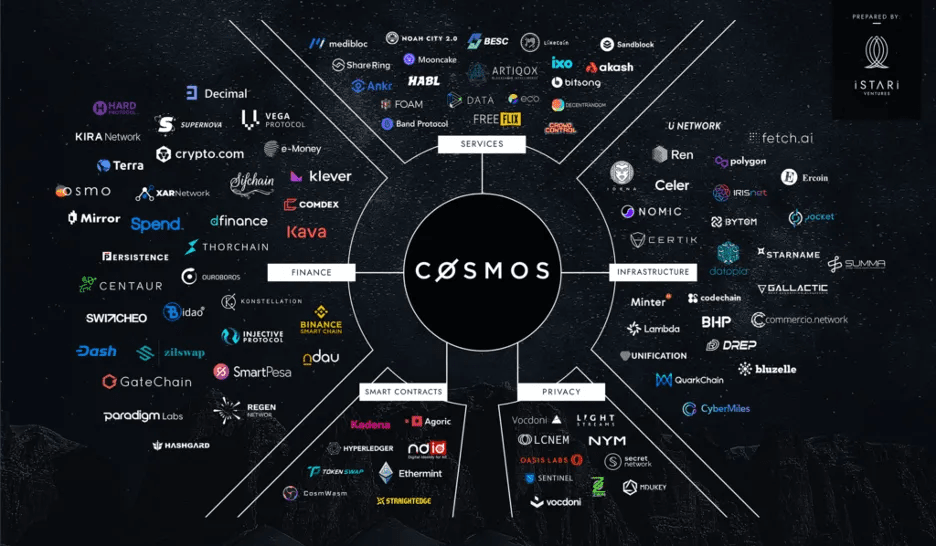
The vibrant Cosmos ecosystem is thriving, attracting a wide variety of projects to build on and establishing many influential partnerships. By using the powerful infrastructure provided by Cosmos, these projects gain access to a vast field of interoperability, hopefully unleashing powerful network effects. This seamless collaboration and integration greatly enhances the entire ecosystem, drives innovation, and promotes wider adoption of Cosmos as an exceptional blockchain solution.
Here are some well-known projects in the Cosmos ecosystem (some are supplemented by the editor):
IRISHUB
Project homepage: https://www.irisnet.org/
IRISHUB (also known as IRISnet) is a cross-chain NFT hub tailored for the next generation of decentralized applications (dApps). It is built on the Cosmos SDK and supports NFTs, cross-chain computing services, and interoperability between heterogeneous systems on and off the chain. As a pioneer of many innovative technologies, IRISHUB is the first network to establish an IBC connection with the Cosmos Hub, implement NFT technology in the Cosmos ecosystem, and manage NFT assets through cross-chain accounts. Its core development team, Bianjie Intelligence, is a long-term open source contributor to Cosmos and has made important contributions to the establishment of the ICS721 cross-chain NFT protocol. In addition, the fourth important developer event in the history of Cosmos, Game of NFTs, initiated by Bianjie Intelligence, has received strong support from the Cosmos Cross-Chain Foundation ICF, Cosmos Hub, Stargaze, Juno, OmniFlix, Uptick, and many ecological teams and developers, which has greatly promoted the innovation and adoption of cross-chain NFT technology.
IRISHUB supports EVM and has integrated AVATA Global cross-chain services, providing secure, powerful and convenient technical support for building the next generation of distributed business applications.
Osmosis
Project homepage: https://app.osmosis.zone/
Osmosis is an innovative project in the Cosmos ecosystem that provides a platform to facilitate liquidity provision. Powered by the IBC protocol, Osmosis enables seamless interaction between different chains in the Cosmos ecosystem. This unique feature provides users with an efficient and secure transaction experience. With the interoperability and scalability of Cosmos, Osmosis creates an inclusive and interconnected ecosystem that enhances liquidity and enables cross-chain collaboration. With a user-centric focus and a focus on optimizing liquidity management, Osmosis opens up new opportunities for participants to explore a wider world of assets and maximize the potential of on-chain transactions.
dYdX
Project homepage: https://dydx.exchange/
dYdX is a decentralized transaction platform that stands out for its user-centric approach to cross-chain transactions. While giving users full control, dYdX eliminates reliance on centralized institutions and promotes a more secure and transparent transaction experience. dYdX runs on the Cosmos chain and utilizes the Cosmos SDK to facilitate fast and efficient transaction processing, as well as seamless interoperability with other Cosmos applications. With strong security, dYdX, built on the Cosmos ecosystem, has a bright future, revolutionizing the way users participate in the ecosystem interaction, while promoting the growth of the IBC ecosystem.
Akash Network
Project homepage: https://akash.network/
Akash Network is a centralized cloud computing marketplace. By leveraging the security of Cosmos, Akash Network provides a secure platform where users can transfer data to each other and develop. The project runs on a PoS (Proof of Stake) consensus mechanism, which improves the security of on-chain transactions. Through integration with Cosmos, Akash Network benefits from the interoperability and scalability of the larger network, enabling seamless communication with other blockchain platforms. As a result, Akash Network enables developers and organizations to access affordable and decentralized cloud computing resources.
Six Networks
Project homepage: https://www.sei.io/
Sei Network is a high-performance L1 network built with Cosmos SDK. Sei uses its proprietary PoS consensus algorithm to provide secure transaction confirmation through staking and ownership verification. The platform's three-layer architecture includes the client layer, service layer, and chain platform layer, supporting high throughput and processing up to 20,000 transactions per second. With built-in support for smart contracts in Rust and Solidity programming languages, developers can easily build customized projects and applications on Sei. In addition, Sei's integration with Cosmos gives it interoperability and scalability, allowing seamless communication with other blockchain platforms and providing support for wider adoption and easier access to decentralized services. Ultimately, Sei Network will become an affordable and powerful blockchain platform that supports the development of cutting-edge applications in all areas of blockchain.
Neutron
Project homepage: https://neutron.org/
Neutron is a decentralized platform in the Cosmos ecosystem that introduces a revolution in cross-chain communication. Positioned to be the first consumer chain on Cosmos, Neutron adopts an open strategy, fully supports IBC capabilities, and promotes seamless interaction between different blockchain networks. This revolutionary approach allows smart contracts to be written in multiple programming languages through CosmWasm, providing a high degree of flexibility and scalability. Its interoperability enables developers to access the feature sets of other blockchains, opening up a new realm of possibilities and unleashing the true potential of blockchain technology. By adopting the Replicated Security of the Cosmos Hub, Neutron promotes a secure and reliable infrastructure, laying the foundation for the formation of a mutually beneficial atmosphere within the AEZ (Atom Economic Zone (AEZ). Neutron's characteristics and strategic positioning herald the arrival of an era of ecological change in the Cosmos ecosystem and have a profound impact on the future of cross-chain cooperation.
Celestia
Project homepage: https://celestia.org/
Celestia is a project of the Cosmos ecosystem that can provide consensus and security on demand. Celestia aims to advance blockchain deployments by eliminating the need to bootstrap a new consensus network, thereby significantly reducing overhead. Unlike traditional blockchains, Celestia’s throughput scales with the number of users due to the unique properties of data availability sampling. What is unique is that the Celestia chain does not rely on the Honest Majority Assumption to ensure state validity, thus ensuring the highest security standards. Additionally, Celestia's flexible design allows developers to define their own execution environments, giving them freedom and creativity. By supporting various types of Rollups and focusing on EVM and Cosmos SDK, Celestia provides solutions for building a secure and scalable blockchain internet.
Stride
Project homepage: https://www.stride.zone/
Stride is a decentralized platform built on the Cosmos blockchain, dedicated to releasing Cosmos ecosystem liquidity and bringing users more abundant liquidity contribution returns. At the same time, Stride has emphasized security after multiple audits. This mechanism that combines security and flexibility has activated ecosystem users and promoted the further development and prosperity of the ecosystem.
Leap Wallet
Project homepage: https://www.leapwallet.io/
Leap Wallet has launched an innovative mobile browser extension and application dedicated to optimizing Web3 interactions on the basis of simplicity and security. Leap emphasizes user autonomy, ensures that all digital assets are under user control, and adheres to the concept of decentralization. Fast and low-cost asset exchange provides users with more diverse choices and facilitates the exploration of fields such as NFT. Leap's extensive network of partnerships with dApps, aggregators, and Marketplace creates a high-quality Web3 experience. The strictly audited platform creates a safe environment for users and cultivates widespread trust and confidence. Leap Wallet provides multi-platform support across multiple devices, enabling individuals to easily explore the unlimited potential of Web3.
in conclusion
Cosmos is a flexible framework that supports the secure transfer of data between different chains, unleashing the full potential of blockchain technology. Projects such as Terra, Polygon, and Cronos have been very successful on early versions of Cosmos, highlighting the versatility of Cosmos in supporting a diverse ecosystem. The recent collaboration between Noble and Circle and Tether and Kava further strengthens Cosmos' multi-chain layout. In addition, projects such as Cosmso Hub, Stargaze, and IRISHUB are playing a key role in the rapidly developing cross-chain NFT ecosystem - all of which herald a vibrant and interconnected future for the entire cross-chain community.