

Main
In this series of articles, we provide a brief overview of our team's research, with a more complete description provided in their reports.
This article provides a preview of Binance Research's April 2023 report, which covers the latest developments surrounding Bitcoin, down to the introduction of ordinals and inscriptions.
Although Bitcoin has long been the most famous blockchain network, there have been ongoing concerns about its long-term sustainability.
Recent innovations, as demonstrated by Bitcoin's on-chain metrics, can address these issues to some extent.
Binance Research offers industry analysis of the processes shaping the Web3 world. We bring current knowledge from the field of crypto research to our community. If you want to dive deeper into this topic, check out the full reports on Binance Research.

Although BTC still ranks number one among cryptocurrencies by market capitalization, the sustainability of the Bitcoin ecosystem has long been a major concern. The block reward is halved every four years, and the reduction in the benefit to miners from maintaining the network could negatively impact its security model. Bitcoin still maintains its leadership, but what awaits us in the future?
The appearance of ordinals and inscriptions in early 2023 may indicate the prospect of resolving these issues. We are not only seeing a rise in the popularity of so-called Bitcoin NFTs, but also a revival throughout the Bitcoin ecosystem, although not everyone is on board with these innovations. As activity increases and new use cases for Bitcoin emerge, it is important to monitor the impact of innovation.
Today we will look at this stage of Bitcoin's evolution. We will discuss the current state of the Bitcoin ecosystem, including on-chain metrics and technical updates, as well as ordinals and labels. Please note that this article is based on a Binance Research report published on April 1, 2023. Therefore, it does not cover indicators and data for a more recent period.
Bitcoin Popularity
As smart contract platforms like Ethereum and BNB Chain continue to gain attention, Bitcoin continues to be the clear leader in market capitalization. Although BTC's dominance has decreased from 60-70% in 2020 and 2021, the former cryptocurrency still accounts for the majority of the market.
Bitcoin accounts for more than 50% of the total market capitalization of cryptocurrencies

This suggests that holders have faith in Bitcoin, despite its relative disadvantage of lacking smart contracts on the Level 1 (L1) blockchain. This could also mean that Bitcoin is held more for the purposes for which it was created—as hard money—and non-monetary uses are not as interesting to owners due to the relative lack of appropriate infrastructure.
While there is some innovation in the Bitcoin ecosystem, it is much less than in smart contract giants Ethereum and BNB Chain. This is largely due to the slow and cautious nature of the Bitcoin network, which is an advantage for those who prefer this cryptocurrency as a form of “hard money”. However, at the same time, this raises doubts about the sustainability of Bitcoin's security model.
The Bitcoin network incentivizes miners to keep the network running through two economic resources: block rewards and transaction fees. The block reward is halved approximately every four years and will eventually be reduced to zero. Thus, in the end, the only reward for miners, i.e. the budget for the operation of the L1 blockchain, will be transaction fees. However, given Bitcoin's limited use cases (the network is primarily used for asset transfers), these payments have historically represented only a small share of miner revenue, which is a concern over the long term. Annual Bitcoin Network Operating Budget (Block Reward + Fee) per transaction) currently consists primarily of block rewards, which are halved every four years and will eventually reach zero.

Source: Dune Analytics, Binance Research (data as of March 30, 2023)
The Ordinals protocol was introduced in January of this year. It allows you to add arbitrary data (images, videos, text, etc.) to the Bitcoin blockchain, creating so-called inscriptions - digital artifacts similar to NFTs.
By July 6, 2023, nearly 15 million captions had been created and the number is growing rapidly. These changes have led to increased activity on the Bitcoin network and increased attention to projects based on it. Not only have the mempool, transaction fees, and block sizes changed, there has also been a cultural shift in how Bitcoin is perceived differently. Existing projects are attracting more attention, and new ones have flooded the ecosystem. Thus, there was suddenly an organic demand for Bitcoin blocks.
Latest developments on the Bitcoin network
Let's take a quick look at two key areas: on-chain metrics and technical updates. Although we will only discuss them in general terms, it will help us better understand the evolution of Bitcoin.
On-chain metrics
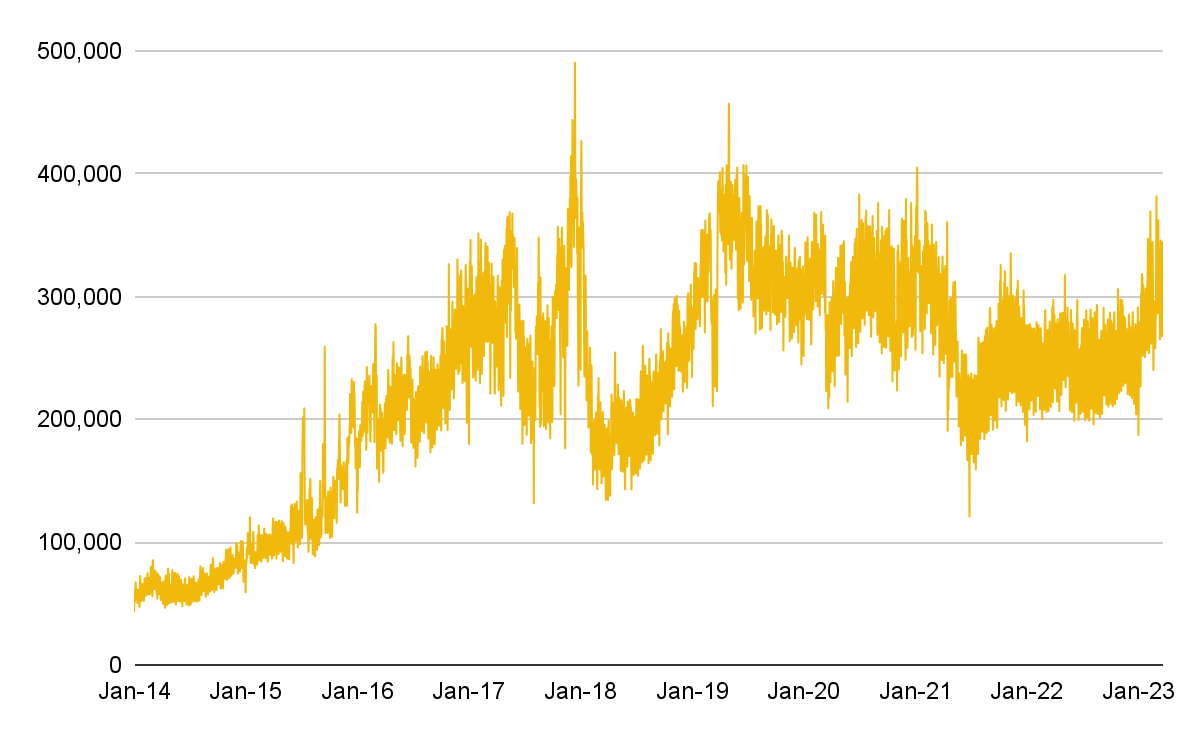
2021 saw a significant increase in activity, exceeding 300 thousand transactions per day. In turn, in 2022, activity was more moderate and remained at the level of 250 thousand transactions for most of the year. This trend reversed in 2023, with the number of daily transactions rising again to more than 300K.
In 2023, the number of Bitcoin transactions per day began to increase from the stable levels of 2022.
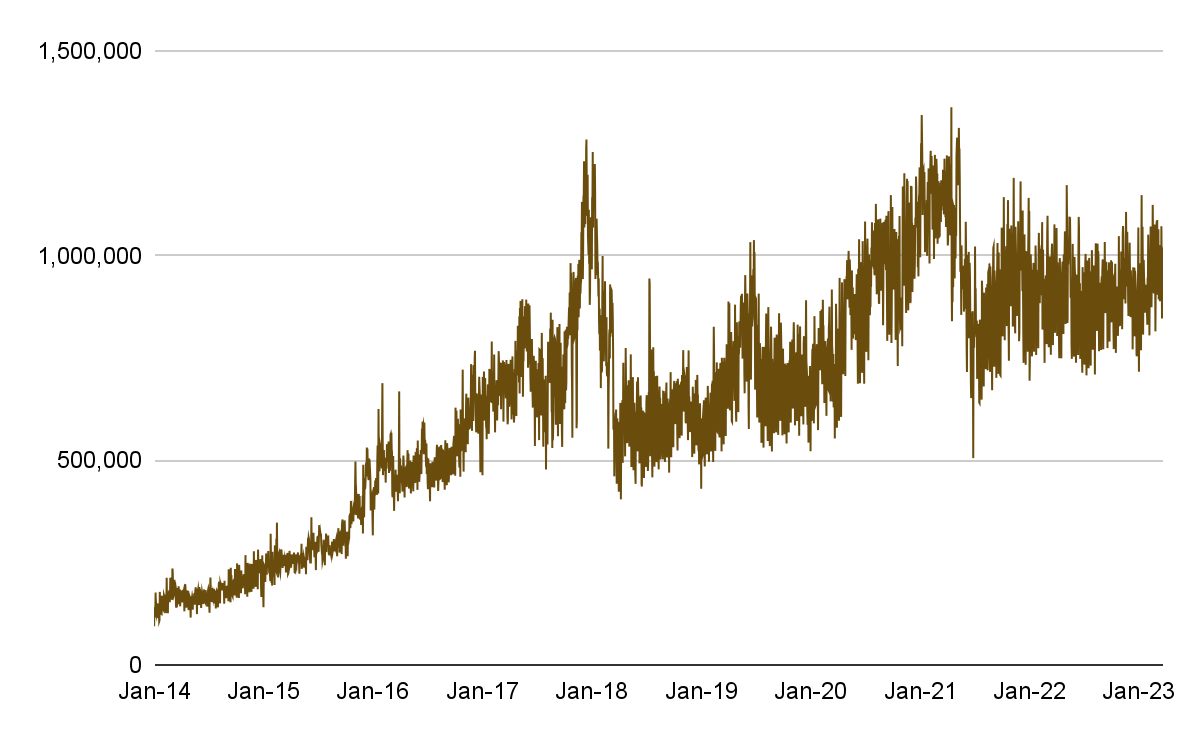
Like the previous indicator, the number of active addresses per day has dropped significantly compared to the values of 2021, when at its peak it reached about 1.2 million. In 2022, this number fluctuated around the 900 thousand mark and increased slightly in 2023, amounting to approximately 1 million per day.
Number of active Bitcoin addresses
Source: Glassnode, Binance Research (data as of March 22, 2023)
These graphs show that in 2022, which was quite a challenging year economically, activity on the Bitcoin network was stable. It is worth noting that the number of transactions per day remained virtually unchanged and remained at the 2017 level. At the same time, the number of transactions and active addresses per day has increased since January 2023.
Technical updates
Over the past six years, Bitcoin has experienced two major technical upgrades: Segregated Witness (SegWit) in 2017 and Taproot in 2021.
SegWit was a soft fork of Bitcoin in 2017. He divided the transaction structure into two parts: the transaction data itself and the Witness data (from the English witness - “witness”), while the weight of the Witness data is only 25% of the weight of the transaction data. This means that storing data in this new section of the transaction (the Witness segment) has become easier and cheaper. In fact, the SegWit update has significantly increased the maximum block size of Bitcoin.
Taproot is a soft fork in 2021 that included three Bitcoin Improvement Proposals (BIPs): BIP 340, BIP 341, and BIP 342. They increased the privacy, scalability, and interoperability of the blockchain. The Taproot update allowed the use of advanced scripts in the Witness section of the block and removed the data size limit between the transaction and Witness sections.
Taproot adoption started off slowly, but then ordinal technology allowed for significant leaps forward.

Source: Glassnode, Binance Research (data as of March 22, 2023)
Ordinals and inscriptions
ORD is open source software that can run on any full Bitcoin node and allows you to track individual satoshis based on something called ordinal theory (founded by Casey Rodarmore). A satoshi (sat) is the smallest unit on the Bitcoin network. 1 BTC consists of 100 million sats.
Within the framework of ordinal theory, each Satoshi in the Bitcoin network receives a unique identifier. In addition, you can add inscriptions to each Satoshi with any content, such as text, images and videos. These are Bitcoin-native digital artifacts that are similar to NFTs. The first inscription was created on December 14, 2022, and the total number of inscriptions has since exceeded 12 million.
The first inscription on Bitcoin: Inscription 0

Source: ordinals.com
Thus, the SegWit update made it possible to add cheaper data to the Witness section of the transaction, which increased the block size, and thanks to Taproot, it became possible to use advanced scripts in the Witness section. These two updates played an important role for inscriptions, because now more arbitrary data can be stored in the Witness part of any Bitcoin block.
Inscriptions and NFTs
Although ordinal-based inscriptions are often called Bitcoin NFTs, there are a number of important differences between them and the smart contract-based NFTs we are familiar with.
Storage is completely on-chain: inscriptions are stored directly in the Bitcoin L1 blockchain. A popular complaint about some popular varieties of NFTs is based on the fact that their metadata is stored off-chain. The functioning of such off-chain storage depends on external factors. Inscriptions, in turn, are much more stable: in fact, they will exist as long as Bitcoin exists.
Immutability: Since inscriptions are stored on-chain, they are guaranteed to be immutable. Many NFTs have this same property, but there are also some that the owner of the contract can change or delete. This is impossible to do with inscriptions.
Ordinal numbers: each inscription is tied to a separate satoshi, which has a serial number according to the theory of ordinals. There is an inscription with the number 500, 9999, etc. Most of the existing types of NFTs have this unique characteristic. It gives them additional rarity and attracts collectors.
Limited supply: Thanks to the combination of SegWit and Taproot, Bitcoin blocks can store significantly more data. However, it also effectively set an upper limit on both the size and number of inscriptions that could be created on the Bitcoin network as a whole. There is no such upper limit for most regular smart contract-based NFTs: in theory, there can be an unlimited number of them.
Impact on Bitcoin metrics
As mentioned earlier, the Taproot update started gaining popularity earlier this year due to the hype around ordinals and captions.
Average block size
Ordinals and inscriptions caused a new increase in demand for Bitcoin blocks. This can be seen in the image below by the sharp jump in average block size around the beginning of February 2023.
Bitcoin's average block size has increased sharply since February 2023

Source: Blockchain.com, Binance Research (data as of March 22, 2023)
Mempool growth
A similar picture can be observed for the Bitcoin mempool, which is essentially a queue of unconfirmed transactions. At the beginning of 2023, the total number of unconfirmed Bitcoin transactions and the corresponding number of transactions in the mempool were growing.
With the exception of two peaks last year, the average number of transactions in the mempool in 2022 remained at 5 thousand. During February and March, this number rose steadily.
The total number of unconfirmed transactions in the Bitcoin mempool is growing

Source: Blockchain.com, Binance Research (data as of March 22, 2023)
Transaction fees
Bitcoin's relatively low transaction fees are a source of long-term concern due to the decline in block rewards that occurs approximately every four years. Ordinals and inscriptions have increased Bitcoin transaction fees. As you can see in the image below, ordinal-related fees have steadily increased throughout the year, along with overall transaction fees.
There are many in the Bitcoin community who are proponents of Bitcoin's original "sound money" scenario, and they don't like this increase in transaction fees. However, this could create sustained demand for Bitcoin blocks and reduce miners' dependence on block rewards.
Ordinal fees have bolstered miners' earnings since the start of the year

Source: Dune Analytics, Binance Research (data as of March 26, 2023)
Owners of full nodes
To track individual satoshis based on ordinal theory, ORD software is required. Despite the emergence of appropriate solutions (for example, marketplaces) for ordinary users, a full Bitcoin node is required to implement inscriptions. This has been a significant factor behind the recent surge in the number of Bitcoin nodes available.
The more active full nodes, the more decentralized the network becomes. While this spike may be a one-off, overall the increase in this number is positive for the Bitcoin network as a whole.
The total number of available Bitcoin nodes is growing throughout 2023

Source: bitnodes.io, Binance Research (data as of March 22, 2023)
Ecosystem Innovation
The pace of innovation and improvement of DApps in the Bitcoin infrastructure since the advent of ordinals has been significant. Bitcoin wallets quickly added support for ordinals, and we saw the emergence of many products related to this technology.
While many are opposed to the hype surrounding ordinals due to the increase in transaction fees, there are those who view the technology as a positive development for the long-term sustainability of Bitcoin. As transaction fees increase, miners may have more incentive to keep the Bitcoin network running.
Regardless of these cultural shifts in the Bitcoin community, it is important to continue to monitor changes in the space.
Binance Research
The Binance Research team offers objective, independent, and comprehensive analysis of the cryptocurrency world. Our experts publish in-depth content on topics related to Web3, the cryptocurrency ecosystem, blockchain applications, the latest market developments, and many other topics.
This article is just a sneak peek of the full report, which contains more detailed analysis of on-chain metrics and also looks at ordinals, layer-2 (L2) decisions, and the future of Bitcoin. This comprehensive and exclusive content is definitely worth the time you take to read it.
You can read the full version of the report here. Other in-depth reports covering the world of Web3 are available in the Insights & Insights section of Binance Research. Don't miss the opportunity to gain up-to-date knowledge in the field of cryptocurrencies!
Additional Information
Binance Research: exploring the rise in popularity of BRC-20
Binance Research: Top Cryptocurrency Trends - June 2023
What are ordinals? Bitcoin NFT Review
General disclaimer. This material was prepared by Binance Research and is not intended to be a forecast or used as investment advice, and is not a recommendation, offer or solicitation to buy or sell any security, cryptocurrency or engage in any investment strategy. The terms used and information provided are intended to promote awareness and responsible development of the sector and should not be interpreted as the definitive views of Binance. The opinions expressed are as of the date stated, are the personal opinions of the author, and are subject to change as conditions change in the future. The information and opinions in this material are obtained from our own and third-party sources that Binance Research believes to be reliable. The data provided is not necessarily all-inclusive and is not guaranteed to be accurate. Binance makes no guarantees of accuracy or reliability and assumes no liability for errors or omissions (including liability to any person due to negligence). This material may contain forward-looking information that is not necessarily based on historical data and may include, but is not limited to, projections and predictions. There is no guarantee that any of these predictions will come true. Reliance on the information provided in this material is solely at your own discretion. This material is provided for informational purposes and does not constitute investment advice, an offer or solicitation to buy or sell any securities, cryptocurrencies or the use of any investment strategy, and is not intended to offer or promote any securities or cryptocurrencies to any person in any manner. jurisdiction in which the offer, solicitation, purchase or sale would be unlawful under the laws of that jurisdiction. Investments involve risks.