

Main
We will be publishing a summary of our reports in a new series of articles, and the full text of the research can be found on Binance Research.
This article provides a brief overview of a recent Binance Research report examining BRC-20, an experimental token standard that allows fungible tokens to be used on the Bitcoin blockchain.
The introduction of BRC-20 received mixed reactions from the community. This standard has only recently come into use, and it is too early to judge whether it will remain in demand in the long term.
Binance Research offers industry analysis of the processes shaping the Web3 world. We bring current knowledge from the field of crypto research to our community. If you want to dive deeper into this topic, check out the full reports on Binance Research.

In 2023, many innovations were introduced into the Bitcoin ecosystem related to the development of so-called ordinals. The Ordinals protocol launched at the beginning of the year and introduced users to the phenomenon of “inscriptions,” also known in the crypto community as “Bitcoin NFTs.”
BRC-20 tokens are the latest innovation in the ordinal space and have been the subject of heated debate in recent months. Many users are excited about the possibilities of this innovation, while others oppose the changes and see them as a deviation from the original goals of Bitcoin.
In this article we will talk about the emergence of the BRC-20, study its history and the reaction of the community. In addition, we will discuss the current risks and issues associated with BRC-20 tokens, as well as offer some recommendations for the future.
History
BRC-20 is an experimental token standard whose concept was first proposed in March 2023. It enables the deployment, mining and transfer of fungible tokens on the Bitcoin blockchain. The arrival of this innovation based on the Ordinals protocol means that the Bitcoin ecosystem now includes both fungible and non-fungible tokens (NFTs).
It should be noted that BRC-20 tokens are associated with risks and are still at an early stage of development. The creators themselves openly stated this, citing the experimental nature of the technology. Please keep this aspect in mind as you read the article, and also remember that the material presented is written for educational purposes and does not constitute advice.
Ordinals and inscriptions
The Ordinals protocol allows tracking of individual satoshis (SATS) based on “ordinals theory,” as Casey Rodarmore called it. SATS is the smallest unit of Bitcoin, and 1 BTC is equal to 100,000,000 SATS. Within the framework of ordinal theory, each Satoshi in the Bitcoin network receives a unique identifier.
Any content such as text, image or video can then be “written” onto these SATS, resulting in a “caption”. In general, this is the entire process of creating NFTs on the Bitcoin blockchain. Check out the Binance Academy article What are Ordinals from Ordinals? Bitcoin NFT Review to learn more about ordinals, inscriptions, and NFTs on the Bitcoin blockchain.
Application of BRC-20 tokens
The inscription technology that enabled the introduction of NFTs into the Bitcoin network has continued to evolve to include fungible tokens. At this point, the BRC-20 standard was introduced. If inscriptions are used to create non-fungible tokens using the ordinal system, then BRC-20 is the analogue for fungible assets.
On March 9, an anonymous Twitter user named @domo published a post in which he described a method called BRC-20, which allows creating fungible tokens based on the Ordinals protocol.
The method was to add a text “inscription” to the Satoshi, creating a fungible token. According to the original plan, only three possible operations were allowed: deployment, creation and transfer of tokens.
The birth of BRC-20 tokens (the first post by @domo on this topic)

Source: Twitter (@domodata)
Three initially valid operations with BRC-20 tokens

Source: https://domo-2.gitbook.io/brc-20-experiment/, Binance Research
The first token contract was deployed for the $ORDI token with a limit of 1000 tokens per creation and a maximum supply of 21 million (a reference to Bitcoin's maximum supply). All 21 million $ORDI tokens were created in less than 24 hours, and other tokens soon began to appear. The total market capitalization of BRC-20 tokens at that time exceeded $1 billion, but then it decreased and is now about $300 million.
Community reaction
The appearance of ordinals and inscriptions has already caused heated debate in the Bitcoin community. The most active discussion was about the increase in transaction fees due to the spread of ordinals. The introduction of BRC-20 has taken this discussion to a new level.
On the one hand, there are supporters of increasing transaction fees who believe this is necessary to ensure the longevity of Bitcoin. In contrast to them are advocates of low fees, who are more critical of increasing transaction costs and believe that this is contrary to the values and objectives of the system.
Arguments for increasing commissions
Many community members were primarily concerned with the sustainability of Bitcoin's security model. The Bitcoin block reward halves every 210,000 blocks (roughly every four years).
Reward for successful Bitcoin block
Period | Block reward (BTC) |
December 2008 - November 2012 | 50 |
December 2012 – July 2016 | 25 |
July 2016 – May 2020 | 12,5 |
June 2020 - present | 6,25 |
May 2024 (expected) | 3,125 |
Source: Bitcoin Visuals, Binance Research
Miners who ensure the security of the system should be rewarded for their work. Given the complexity of Bitcoin transactions, the fees for them should be higher. Therefore, many in the community, especially miners, were pleasantly surprised by the excitement surrounding the introduction of ordinals and BRC-20. They are positive about the changes this technology will have on the relatively muted Bitcoin fee market.
Although the price of Bitcoin has risen significantly since the days when the block reward was 50 BTC, the problem itself illustrates the flaws in the business model of BTC miners. Considering the possibility of popularization of the blockchain space in the future, the situation may change in a positive direction for miners, which will potentially attract new network participants.
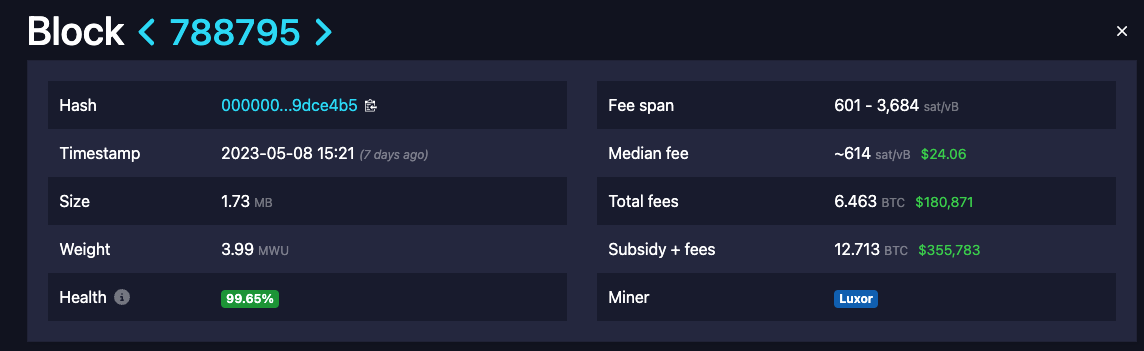
It is noteworthy that in early May, Bitcoin blocks even appeared with transaction fees exceeding the block reward of 6.25 BTC. The amount is significant given that fees averaged just 1-2% of miners' income for most of 2022 and little more in the early years. This indicates a growing demand for block space, driven in particular by the introduction of ordinals and BRC-20.
The total fees for block 788795 were 6.46 BTC, while the reward was 6.25 BTC.
Arguments against increasing fees
While some are excited about the increased activity around the Bitcoin ecosystem and are encouraged by the increase in fees that will make the system more sustainable, others are more skeptical.
Proponents of low fees argue that Bitcoin's true purpose is to serve as a hard, non-fiat currency and be used only for peer-to-peer transactions. They believe that transactions involving ordinals require large amounts of data, overload the Bitcoin network and increase fees, which ultimately prevents peer-to-peer transactions.
In their opinion, an increase in fees will lead to an outflow of users in countries where Bitcoin is used on a par with the local fiat system. Some even take more radical views and consider ordinals and BRC-20 a threat to the Bitcoin blockchain.
Risks and difficulties
As discussed above, ordinals, inscriptions and BRC-20 tokens are recent innovations that come with some risk at this stage. They are now at the forefront of the cryptocurrency industry. Accordingly, there are several risks that every user should be aware of.
1. Limited or no infrastructure
BRC-20 tokens are just a concept that originated from an experimental token standard created by an anonymous Twitter user. While the innovation and potential of this idea cannot be denied, it is important to understand that this technology has not yet stood the test of time and there is not enough infrastructure for it yet.
The token standard has been around for a few months now, but has only seen a stir in the last few weeks. And although developers strive to create the necessary infrastructure as quickly as possible, there is not yet enough of it. We're seeing the beginnings of future marketplaces and DEXs, but most trading is still done over-the-counter (OTC) via Discord servers. Without proper infrastructure, tracking tokens and their owners will be difficult.
There is another problem related to the lack of methodological consensus. These tools are not native to the Bitcoin blockchain. They come from the theory of ordinals, which gives Satoshi certain characteristics. In the absence of public consensus on this method, some parties may not recognize certain ordinals, and with them certain BRC-20 tokens.
Developers will need to do a lot of work before there are several thousand more token holders on the market. Despite optimism about the emergence of new BRC-20 tokens and the associated benefits, the infrastructure has yet to be developed.
2. Lack of real application
The majority of BRC-20 tokens in circulation are meme coins. As the name suggests, these tokens offer no real-world use and rely heavily on social media and community sentiment. While they attract attention and create excitement, the lack of real-world application and therefore the lack of a serious owner base means that these tokens can suddenly become worthless.
Every reader should remember this risk. If you find a new token with potential use cases, research the information available and make sure it's not a marketing ploy.
3. High risk of fraud
Please remember that this experimental token is a recent development and therefore carries a high risk of fraud. For example, over-the-counter trading of tokens on Discord servers is quite risky and often leads to people becoming victims of fraud and losing their money.
Projects creating infrastructure for ordinals or BRC-20s may also pose a potential security risk at such an early stage. We are not trying to scare off readers at all. However, given that these tokens have only recently been introduced into the cryptocurrency space, the risk of fraud is extremely high and should be taken seriously.
Conclusion
Ordinals, inscriptions and BRC-20 tokens have demonstrated that there is significant demand for the Bitcoin blockchain beyond traditional peer-to-peer payments. Users want to see the same features on Bitcoin that are available on Ethereum and BNB Chain.
The key problem that Bitcoin proponents recognized was the inability to generate income for miners from transaction fees. However, a recent surge in activity has demonstrated the possibilities that exist. Recent developments are encouraging and provide insight into how to ensure Bitcoin's long-term sustainability.
Cryptocurrency growth often occurs exponentially. So, after creating the first inscription on December 14, 2022, it took more than a month to reach the 100 inscription mark. However, between February 2 and February 15, the number of inscriptions increased from 1,000 to 100,000. By April, we reached the 1 million mark, and now this figure exceeds 7 million.
While it is impossible to predict how large this market will become, we expect the number of captions to continue to grow. In other words, we need to continue to monitor the development of this space.
Exponential growth of inscriptions at the moment
Date | Number of inscriptions |
December 14, 2022 | 1 |
January 26, 2023 | 100 |
February 2, 2023 | 1000 |
February 7, 2023 | 10 000 |
February 15, 2023 | 100 000 |
April 8, 2023 | 1 000 000 |
May 9, 2023 | 5 000 000 |
May 16, 2023 | 7 196 570 |
Source: Dune Analytics (@dgtl_assets), Binance Research (May 16, 2023)
Binance Research
The Binance Research team offers objective, independent, and comprehensive analysis of the cryptocurrency world. Our experts publish in-depth materials on topics related to Web3, the crypto ecosystem, blockchain and the latest market trends.
This article is just an excerpt of the full report, which contains additional data and detailed analysis of the most important indicators of the BRC-20 market. It also discusses second-tier solutions and industry prospects. This comprehensive and exclusive material is definitely worth your time to read.
Read the full report here. More research on current events in the Web3 world is available in the analytics and analysis section of the Binance Research website. Don't miss the opportunity to learn something new through exploring the world of cryptocurrencies!
Additional Information
Binance Research 2.0
Binance Research: Top Trends in the Cryptocurrency World - May 2023
Binance Research: AI use cases and opportunities in cryptocurrencies
General Disclosure: This material has been prepared by Binance Research and is not intended to make predictions or be used as investment advice, and is not a recommendation, offer or solicitation to buy or sell any security, cryptocurrency or engage in any investment strategy. The terms used and information provided are intended to promote awareness and responsible development of the sector and should not be interpreted as the definitive views of Binance. The views expressed are as of the date stated, are the personal opinions of the author and are subject to change as conditions subsequently change. The information and opinions in this material are obtained from our own and third-party sources that Binance Research believes to be reliable. The data provided is not necessarily all-inclusive and is not guaranteed to be accurate. Binance makes no guarantees of accuracy or reliability and assumes no liability for errors or omissions (including liability to any person due to negligence). This material may contain “forward-looking” information that is not necessarily based on historical data and may include, but is not limited to, projections and predictions. There is no guarantee that any of these predictions will come true. Reliance on the information provided in this material is solely at your own discretion. This material is provided for informational purposes and does not constitute investment advice, an offer or solicitation to buy or sell any securities, cryptocurrencies or to engage in any investment strategy, and does not offer or promote any securities or cryptocurrencies to any person in any jurisdiction in which offer, solicitation, purchase or sale would be unlawful under the laws of this jurisdiction. Investments involve risks.