Bitcoin celebrated an epic milestone today with the mining of block 800,000, marking a significant moment in the history of the first cryptocurrency. James Check (aka Checkmate), lead on-chain analyst at Glassnode, took to Twitter to share some interesting insights into the Bitcoin network’s progress so far.
In a series of tweets, Checkmate delved into various aspects of Bitcoin's journey, painting a fascinating picture of Bitcoin's growth and achievements. According to Checkmate's analysis, as of the 800,000th block, a total of 19,437,000 BTC were created, and miners received 268,700 BTC in fees. Historically, miners have earned as much as $52.593 billion, most of which comes from block subsidies (94.5%) and a small portion from fees (5.5%).
From Bitcoin Genesis to Block 800,000
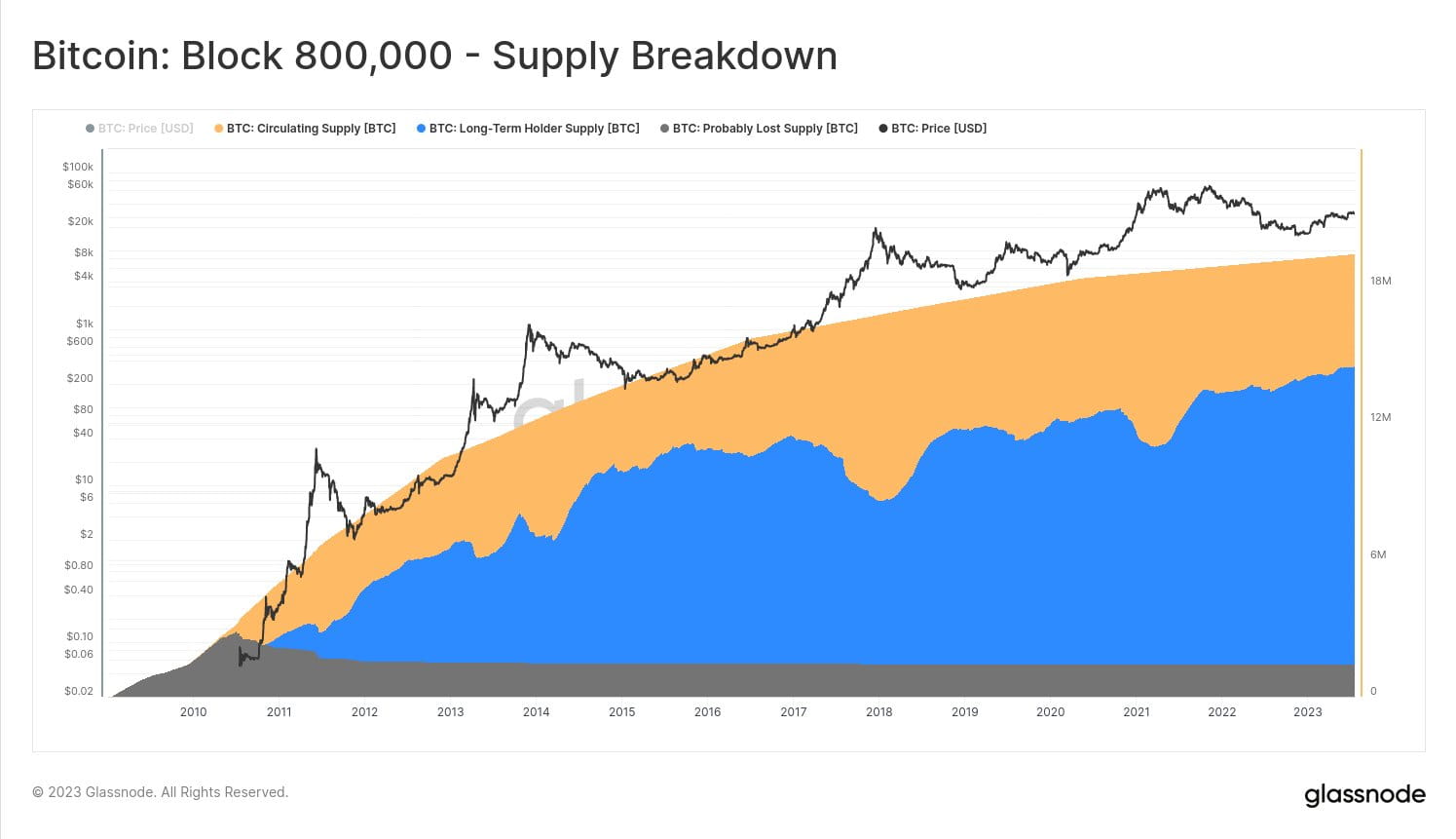
The longevity of the Bitcoin blockchain allows for some interesting observations. Of the 19.4 million BTC mined since it first traded on exchanges in July 2010, approximately 7.5% remain unspent, suggesting that these coins may be lost forever to early miners.
Additionally, 74.6% of BTC is held outside of exchanges by long-term holders, highlighting the significant commitment to BTC by a significant portion of the user base. Only 2.68 million BTC are held by short-term holders, and 2.25 million BTC are on exchanges.
A key metric revealed by Checkmate is the unspent transaction output (UTXO). Currently, the Bitcoin UTXO set contains 163.6 million UTXOs, of which 2.275 billion have been spent and destroyed.
As UTXOs are created and destroyed, the amount of BTC being transferred results in an impressive 8.378 billion BTC being transferred over 800,000 blocks. Each block costs an average of about 10,473 BTC, resulting in a whopping $109 trillion in value settled on the Bitcoin network (or $137 million per block when denominated in USD).
Checkmate also took a closer look at the concept of "Coindays" and provided valuable insights into BTC holding behavior. Coindays represent the accumulation of holding time per unit of BTC. Coindays are destroyed when BTC is spent. Checkmate noted that of the 70.2 billion Coindays created, approximately 37.8 billion Coindays have been destroyed (activity = 0.538), which shows the extent of BTC movement and spending.
On the other hand, Bitcoin Stratum market analyst Joe Consorti expressed his thoughts on this milestone. Consorti said that with the mining of block 800,00, there are only 40,000 blocks (about 9 months) left until the fourth halving of BTC supply.
The halving process is a defining feature of Bitcoin’s monetary policy, with the issuance rate automatically reduced by about 50% at predetermined intervals, ultimately resulting in a fixed supply. Consolti added, “Absolute scarcity in a monetary order, whose ultimate purpose is to disincentivize finance by inflating away debt burdens. You might want to look into that.”
Indeed, what Bitcoin has accomplished in the past 14.5 years is remarkable. With 867 million transactions confirmed, an average of 1,084 transactions per block, and all of that data fitting into a compact 497 GB blockchain, BTC has proven its resilience and value as a pioneering cryptocurrency.
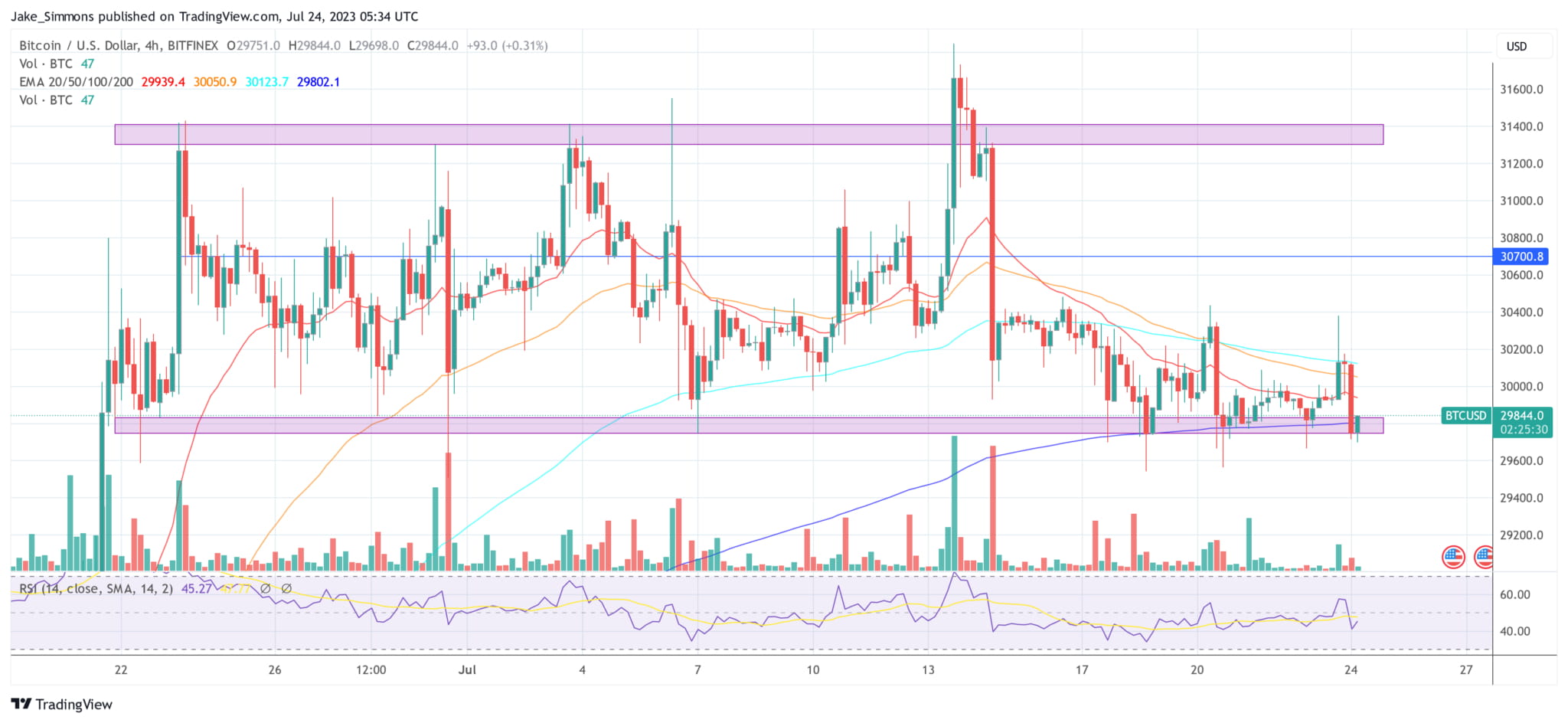
At press time, BTC is trading at $29,844.