

Ripple achieved a partial victory in the SEC case, proving that XRP cannot be considered a security when sold on exchanges. This was a huge success for Ripple. As a result of the lawsuit that has been ongoing since 2020, XRP skyrocketed, causing investor enthusiasm.
So what is this Ripple and how is XRP different from other altcoins? In this article, we will analyze how Ripple works, what XRP investors should expect and why this asset is needed.
What is Ripple?
Ripple is the American technology company behind the RippleNet payment system and the XRP cryptocurrency. The company was founded in 2012 by Chris Larsen, Arthur Britto and Jed McCaleb with the aim of creating a better alternative or complement to SWIFT based on distributed ledger technology (DLT).
Like many other developers, McAleb and Britto were inspired by Bitcoin, but they initially sought to create a product that would interact with, not compete with, the traditional financial system. Currently the company's website indicates the existence of 3 main areas of activity:
Solutions for international payments;
Liquidity hub for the crypto market;
Infrastructure for CBDC (Central Bank Digital Currency).
As a settlement infrastructure provider, Ripple has partnered with hundreds of banks and companies in dozens of different jurisdictions, with countries like Montenegro and Bhutan using Ripple's CBDC solutions. Therefore, ripple price depends somewhat on the projects carried out by this company.
History of Ripple
2004: Canadian programmer Ryan Fouger launched a public peer-to-peer settlement network called RipplePay. It has nothing to do with DLT or cryptocurrency.
2012: Jed Macaleb and Chris Larsen revive the Fuger project. Inspired by the launch of Bitcoin, they are building a new payment network based on the distributed ledger XRP Ledger (originally known as Ripple Consensus Ledger). The name of the developer company was OpenCoin.
With the launch of the network, 100 billion XRP has been pre-mined as a native currency for payments on the XRP Ledger. Ripple now directly owns about 6% of that amount, according to Forbes.
2013: OpenCoin changes its name to Ripple Labs and begins expanding into the banking industry. The company's first partner is Fidor Bank in Munich. By 2018, hundreds of partners in various parts of the world used Ripple infrastructure: Saudi National Bank from Earthport and American Express among them.
September 2018: Ripple closed 55 billion XRP in escrow account and launched xRapid solution to limit supply and ensure predictability for market participants.
December 2020: The SEC filed a lawsuit against Ripple and its senior management, accusing the company of illegally selling securities and manipulating the XRP market. Most US exchanges have gradually delisted the asset.
September 2021: Bhutan became the first country to use Ripple's infrastructure to launch a CBDC.
November 2021: The company announced Ripple Liquidity Hub, a cryptocurrency exchange liquidity solution for institutional and market makers.
October 2022: Peersyst Technology announced testing of the first EVM-compatible sidechain for XPR Ledger. A full launch took place in March 2023.
May 2023: The company is launching a CBDC platform and is in talks with governments in 20 countries. Montenegro announced that it is working together with Ripple on CBDC.
July 2023: Ripple partially wins the lawsuit against the SEC. XRP sales to retail investors through exchanges are no longer considered securities offerings. Coinbase, Gemini and other exchanges added XRP back to their lists and opened it for trading.

Ripple Network
The RippleNET payment network is built on the distributed ledger XRP Ledger, which was first introduced by Jed McAleb and Arthur Britto in 2011.
XRP Ledger does not use miners to verify transactions, relying on a list of 35 trusted nodes (Unique Node List (UNL)). Nodes from UNL reach an agreement to change the state of the registry and update it every 3-5 seconds. There are no usual blocks, PoW or PoS, but the network can handle up to 1,500 TPS due to the rejection of resource-intensive solutions.
Formally, any node that meets a set of requirements can be a validator (there are currently 117). XRP Ledger, however, was created taking into account the recommendations of UNL, Ripple, the XRP Ledger Foundation and the Coil organization associated with Ripple. For this reason, the cryptocurrency community criticizes the XRP Ledger as a centralized network influenced by Ripple.
However, the XRP Ledger allows verifiable mutual agreements on a publicly accessible network, and the main Ripple products are built on the basis of this ledger:
On-Demand Liquidity (ODL): Formerly known as xRapid, it is a liquidity hub for more stable payment using XRP as an intermediary asset. It is now a comprehensive solution module for cross-border payments.
If banks in Japan and the United States agree among themselves using ODL and each processes the payment in the local currency, at the time of payment the dollars sent from the US bank are converted into XRP, and the XRP is then converted into yen, which the bank in Japan receives.
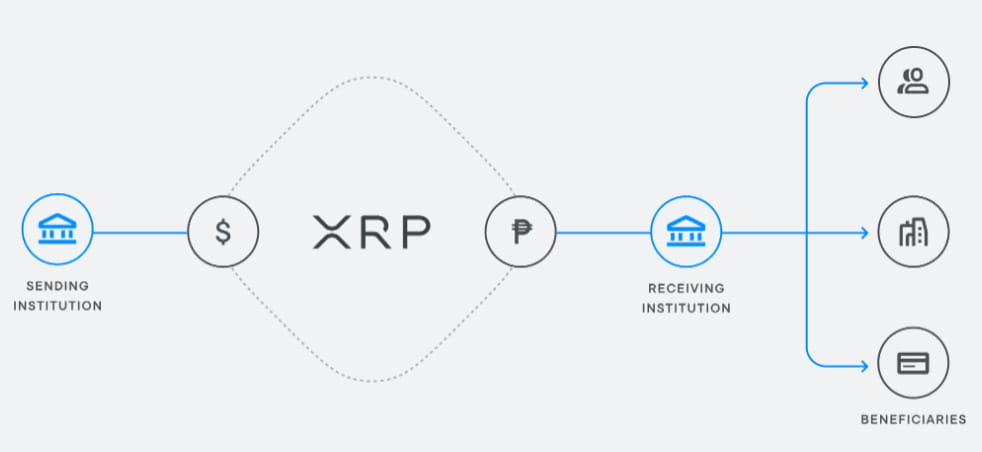
Various liquidity sources (gateways) are connected to the ODL solution and users are provided with fiat or cryptocurrencies required for settlements.
xCurrent: It is software based on the Interledger Protocol (ILP), introduced in 2015. It allows counterparties to make mutual reconciliation even if their accounts are in different banks or platforms:
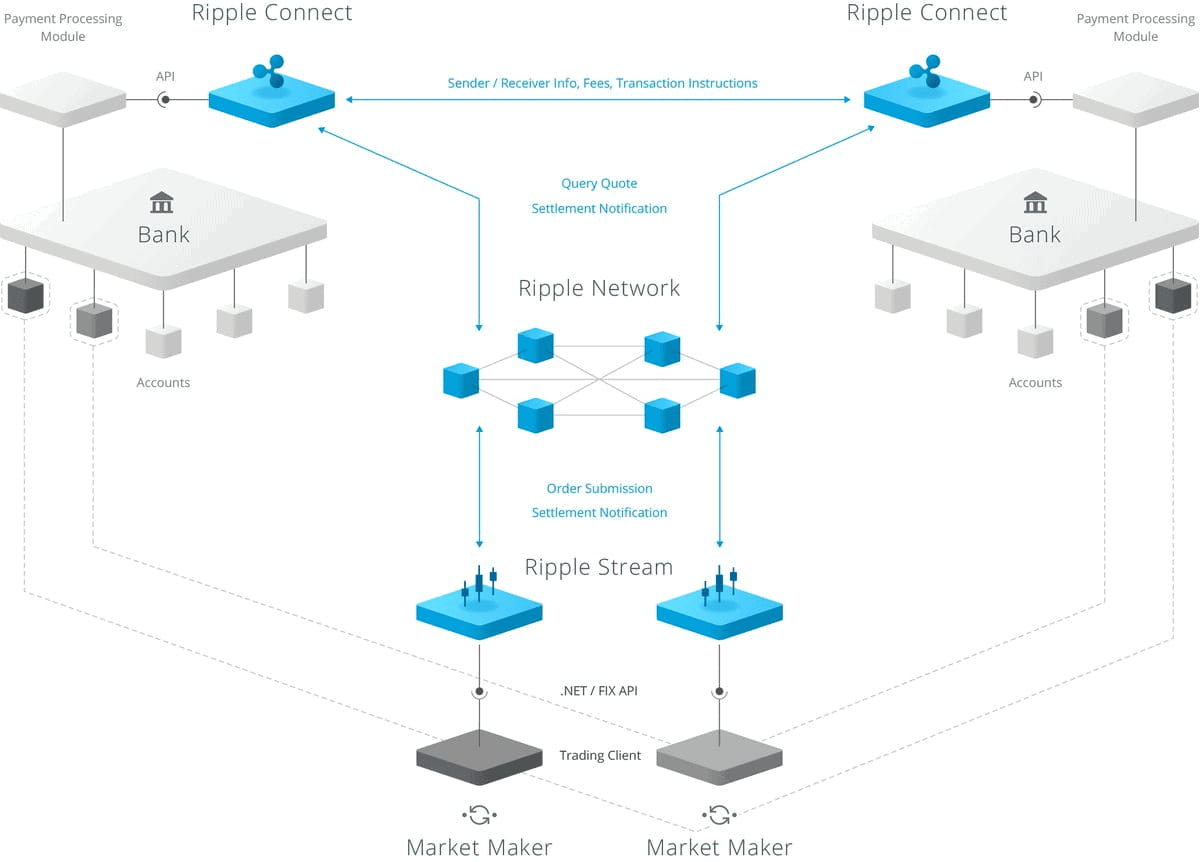
xVia: Payment interface for agreements between users of the Ripple network.
The last two products in 2019 were combined into a single solution under the RippleNet brand, which allows banks, payment operators and providers to integrate settlements into their software using the ODL and XRP Ledger network. At the same time, RippleNet uses the RTXP protocol, which creates a single transaction standard for all network users.
The CBDC infrastructure includes more advanced solutions based on the XRP Ledger, which provides central banks with a complete set of modules for digital currency management.
Let's redefine these terms:
Ripple: XRP Ledger development company. Originally known as OneCoin, it was renamed RippleLabs in 2013 and changed to just Ripple in 2015. It provides solutions based on the XRP Ledger and influences the selection of validators on the network.
XRP Ledger: A decentralized settlement network developed by the founders of Ripple. XRP Ledger is a decentralized ledger, not a blockchain.
RippleNet: A solution for integrating standardized payments between Ripple partners. Comprehensive payment network focusing on banks and international trade.
ODL: A solution to provide liquidity to network users using XRP as an intermediary currency. It is part of the international payments infrastructure.
There is no separate entry for XRP in this list, because the token's role in the Ripple ecosystem is quite specific and different from the classical purpose of cryptocurrencies, which we will discuss below.
XRP Ledger Advantages and Disadvantages
Advantages
High Bandwidth: The claimed throughput of XRP Ledger is up to 1500 TPS and it takes 3-5 seconds to finalize a transaction. It is one of the best indicators on the market, especially among first-generation networks.
Low commissions: Transactions on XRP Ledger cost between 0.001 and 0.0002 XRP, which is an order of magnitude lower than most popular blockchain networks.
Traditional finance integration: XRP Ledger is used by banks, market makers, and some governments for cross-border payments, CBDC management, and other purposes. An advanced international financial infrastructure has been created on a network basis.
Independence from any asset: The XRP token is launched on the XRP Ledger, but it is not as critical to Bitcoin as BTC. Even if all existing XRP were destroyed, XRP Ledger validators would still be able to operate and keep records of transactions using other assets.
Disadvantages
Centralization: XRP Ledger has more than 100 validator nodes, out of which only 35 nodes from the UNL list are involved in transaction processing. To this we can add the relatively small number of nodes in general and the lack of a decentralized management mechanism.
Dependency on Ripple and its founders: It should be noted that apart from a small number of nodes, Ripple and related organizations can influence validators. This was illustrated by the example of Bitstamp node, which in 2015, at the request of Ripple, froze 96 million XRP in Jed McCaleb's account to prevent a possible sale.
Low level of integration with the crypto market: XRP Ledger uses a unique distributed ledger technology. This makes interacting with blockchains and other assets difficult, the only cross-chain solution being an EVM-compatible sidechain.
What is XRP?
Many crypto enthusiasts consider XRP to be the native currency of the XRP Ledger, much like BTC is to Bitcoin or ETH is to Ethereum. But the relationship between Ripple, XRP and XRP Ledger is more complex:
Ripple positions the XRP ledger as an independent network, and the operation of the ledger does not depend on Ripple itself or XRP. At least in theory.
The XRP Ledger network itself is specific to XRP. Likewise, it keeps records of transactions and assets, BUT XRP is not built into the XRP Ledger architecture. We'll tell you more about this below.
XRP is used in some Ripple products, just like ODL or Liquidity Center.
In practice, the situation is contradictory: on the one hand, Ripple positions itself as the creator of the XRP Ledger and XRP, and on the other hand, it claims that these products work autonomously and are not dependent on the company. At the same time, we know that Ripple still controls 6% of the total xrpcoin supply and has access to an escrow account. Additionally, the UNL XRP Ledger was actually created with censorship from Ripple or related organizations in mind, and the company itself manages some of the validators from UNL.
XRP use cases can be summarized as follows:
Providing liquidity: XRP acts as a link to enable cross-border payments and stable conversion of different fiat currencies. Ripple liquidity providers around the world use XRP as a common exchange asset.
Transactions: XRP can serve as a vehicle for transferring value digitally. So, if we ignore the centralization of the network and the features of the technology, then XRP can be perceived as one of the cryptocurrencies.
Commission payment: All transactions on the XRP Ledger network (even if made in another currency) are paid in XRP. But at the same time, network validators do not receive a reward in the form of XRP - the received commission is simply burned. Therefore, Ripple claims that XRP is not required for the XRP Ledger to operate – in fact, validators are not tied to this asset at all.
The role of XRP in the XRP Ledger is more similar to the role of ERC-20 tokens for Ethereum and not the role of ETH.
Additionally, in its indictment against Ripple, the SEC argued that the main purpose of launching XRP was to make money for the company and its founders. It was the proceeds from selling its holdings of XRP in a heated market that provided Ripple with the resources (or some of the resources) needed to study and develop.
Ripple Mining
XRP is not built on a classical blockchain and does not use the PoW algorithm, so mining this coin is technically impossible. All 100 billion tokens were mined through pre-mining and partially blocked in the Ripple escrow account.
You can only obtain XRP tokens by purchasing them on a cryptocurrency exchange or similar platform. You should also consider that Ripple does not have a native wallet, so you will need an exchange account or a multi-currency wallet like Trust Wallet to store XRP.
Should I Buy Ripple?
Like other cryptocurrencies, XRP is a volatile and speculative asset whose price depends on many factors. Now xrpusd price can be affected by many factors. The main points to consider when making a decision are:
Regulators' position: in particular, the final decision in the SEC v. Ripple case and the general acceptance in other countries. Even if banks and governments are ready to use the infrastructure for payments or CBDC, this does not mean they are ready to legalize XRP.
Its founders are the largest holders: Ripple itself and its founders remain the largest holders of XRP. The escrow account and constitutive sale agreements are designed to reduce the risk of dumps, but the influence of Ripple and related entities/individuals on the price of XRP is still high.
Ripple Development: Any transaction using the XRP Ledger is paid in XRP. However, most transactions are carried out by organizations using Ripple products. Therefore, it is the company that largely determines the demand for XRP and, accordingly, its price.
Additionally, if you are considering XRP not only as an investment but also as a means of payment or store of value, then do not forget about the highly centralized network. Jed McCaleb's example of freezing funds shows what any XRP holder can expect if asked to do so by regulators or Ripple itself. Therefore, check the xrp comments frequently.
Conclusion
XRP is positioned as one of the best cryptocurrencies on the market, but at the same time it differs significantly from many other cryptocurrencies. Key features of this entity:
Full pre-mining and no incentives for validators.
It has mixed reception from regulators.
It operates on the non-blockchain and decentralized XRP Ledger network.
Formal independence from Ripple is only possible in practice with deep integration into the Ripple ecosystem and products.
Investors often perceive XRP as one of the altcoins, similar to $LTC or ETH, but holding and exchanging are associated with risks and opportunities that are not typical for most other cryptocurrencies.
When investing in XRP, you should carefully examine the connection of this asset to Ripple and the attitude of regulators towards the company itself and XRP.