
During last year's "Double 11" National Shopping Carnival, according to data released by Alibaba Cloud, the peak order creation reached a new record, reaching 544,000 orders per second, far exceeding last year's 491,000 orders per second, and being the highest in 2009. More than 1,360 times that of a "Double 11".
This is the advantage of a centralized system.
In comparison, decentralized blockchain technology pales in performance:
The Bitcoin blockchain can only handle about 7 transactions per second, and the Ethereum blockchain can handle about a dozen transactions per second. The EOS blockchain, which originally carried the banner of "Million TPS", had the highest TPS in the test. There are only four to five thousand, and the TPS during normal operation is only two digits.
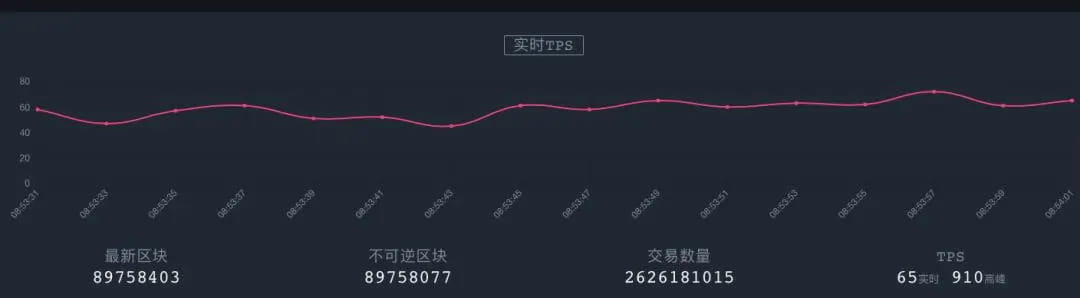
Although performance is not an advantage of blockchain technology, if it becomes a "shortcoming", it will undoubtedly delay the large-scale application of blockchain technology.
Therefore, in recent years, technical developers and project teams have continuously proposed various solutions. These solutions can be mainly divided into two categories: on-chain expansion and off-chain expansion.
On-chain expansion means directly "performing surgery" on the blockchain - modifying the rules, including block size, consensus mechanism, etc. For example, the block size of the Bitcoin blockchain can be directly expanded from 1M to 32M, 128M or even 2G (this is the difference between BTC, BCH and BSV on block size), or the sharding technology that will be adopted by Ethereum 2.0, which is now highly anticipated.
Off-chain expansion refers to the establishment of a second-layer transaction network outside the main chain, so off-chain expansion is also called "Layer 2".
If on-chain expansion is likened to widening a road, then off-chain expansion is to build new viaducts, tunnels, paths, etc. next to it.

The current off-chain expansion plans can be divided into three categories: one is used to expand payments, such as the Lightning Network on Bitcoin; one is used to expand smart contracts; and the other is used for off-chain computing.
So, what are the relatively well-known off-chain expansion solutions?
Without a doubt, the most well-known off-chain expansion solution is Bitcoin's Lightning Network. On January 14, 2016, the Lightning Network's "white paper" was published, and then a large number of developers developed and tested it. In January 2017, the first Lightning Network implementation, lnd, released its Alpha version. In the summer of 2017, the basic work of Bitcoin's Lightning Network was completed. As of now, the Lightning Network has a total of 10,423 nodes, 34,780 channels, and 821.1 BTC locked.

Of course, the current Lightning Network is still in the development stage and is not particularly mature. In March 2018, the Lightning Network nodes suffered a DDOS attack, causing about 200 nodes to go offline.
Similar to Bitcoin Lightning Network is the off-chain expansion solution on Ethereum - Raiden Network. Raiden Network supports instant transfer, low cost, scalability and privacy protection, but the underlying protocol is quite complex and difficult to implement.
Liquidity Network is a competitor to Raiden Network. Its main purpose is to transfer transactions from Ethereum to payment channels. Like Bitcoin's Lightning Network, users of Liquidity Network can also trade back and forth without paying any fees in the process. They only need to pay certain fees when opening and closing channels.
All of the above belong to payment extensions in off-chain expansion, while layered sidechain Plasma belongs to the extension of smart contracts. Plasma is an Ethereum layered sidechain co-written by developer Joseph Poon and Ethereum founder Vitalik Buterin. Its main goal is to transfer a large amount of smart contract calculations to the sidechain instead of executing them on the Ethereum main chain.
Celer Network is also a well-known off-chain expansion solution. Its main goal is to build a universal network system that runs on existing and future blockchains, allowing everyone to quickly build, operate and use highly scalable DApps.
So far, there are more than 30 known off-chain expansion solutions, but they are all in the early stages of development. It remains to be seen which expansion solutions will mature first and help existing public chains solve scalability problems.