

“MAP Protocol, with its mature, novel and stable cross-chain solution design, enables secure and seamless cross-chain communication and asset transfer between EVM chains and non-EVM chains. The relay chain architecture not only allows for multi-chain expansion, but also avoids the risk of insecure cross-chain messages; the unique light client design based on zero-knowledge proof reduces the difficulty of heterogeneous chain development while ensuring the security of cross-chain message transmission. By being compatible with almost all blockchains and supporting native deployment of DApps on the relay chain, MAP Protocol has become a core component of cross-chain operations and has the opportunity to be proven to be the true future of cross-chain solutions.”
——Professor Liu Yang, Director of the Cybersecurity Laboratory, Nanyang Technological University
L1 ecosystems are developing and prospering on their own. Ethereum will continue to be a giant in L1 in the future, but it will not be the only one. In the ever-changing multi-chain landscape, the cross-chain interoperability track has high certainty and can continue to expand its business with new chains and new dApps. It is an opportunity that investors cannot miss.
As of October 2022, there are more than 100 cross-chain bridge projects, among which the Stargate cross-chain bridge based on the LayerZero full-chain protocol has accumulated a total cross-chain amount of more than 450 million US dollars. Compared with the previous cross-chain bridge leader Multichain, LayerZero has broken the impossible triangle of cross-chain bridge asset redemption, optimized the cross-chain cost-effectiveness, and is an indispensable player in the cross-chain track. However, this popular solution still relies on off-chain privileged role oracles, and the cross-chain data feeding of oracles is not accurate enough, and the degree of decentralization cannot provide cryptographic proof, and there is a possibility of third-party collusion. From this point of view, the cross-chain mechanism is not perfect and not decentralized enough.
The MAP Protocol Labs team, which 100% follows the Nakamoto consensus mechanism and focuses on provable security and efficiency, has spent nearly four years on research and development, accurately grasping the cross-chain pain points under the current multi-chain landscape, and successfully overcoming the industry problem that light nodes cannot perform cross-chain verification between heterogeneous chains. It has developed a provably decentralized full-chain interoperability protocol MAP Protocol based on light nodes and zk technology that can cover all L1s.
MAP Protocol's Relay Chain mainnet was launched at the end of August 2022, and will officially cover all mainstream L1s by the end of the year. It has now received official support from well-known L1s such as NEAR, Polygon, Flow, ioTex, OKX Chain, and KuCoin Community Chain. At the same time, the MAP Protocol team is currently closely preparing a series of full-chain ecosystem construction projects open to developers and the community, rewarding developers or community members who have contributed to the MAP Protocol full-chain ecosystem and Web3 ecosystem. After fully connecting to mainstream EVMs and Non-EVMs such as Ethereum/Polygon/BNB Smart Chain/Klaytn/NEAR by the end of 2022, MAP Protocol will open up full-chain data flow and NFT full-chain flow, promote paradigm shifts in tracks such as DID, decentralized derivatives, and GameFi, and enable dApp to optimize users and resources in a multi-chain landscape.
In the future when multi-chain competition becomes increasingly fierce, full-chain infrastructure may be a more important blockchain expansion solution than L2. Through full-chain infrastructure, the performance of dApp can be multiplied according to the TPS of the number of blockchains covered, which is more free than its expansion method in L2, and the development of dApp is no longer restricted. If Web3 wants to make Web3 products as attractive to users as Web2 products, we believe that the MAP Protocol, which is about to be fully launched, is a full-chain interoperability protocol that is worth paying attention to at the moment.
01 Viewpoint
We are optimistic about the MAP Protocol, which will be fully launched after nearly 4 years of research and development. In addition to the market level mentioned at the beginning, the following aspects are also the reasons why we are optimistic about the MAP Protocol.
technical level
MAP Protocol is the most labor-saving full-chain communication infrastructure
The smart contract compilation layer of MAP Relay Chain has pre-compiled and written relevant signature algorithms, merkel tree proofs, and hash algorithms for all mainstream blockchains. At the same time, its cross-chain components, light clients and messengers, can be deployed across chains without disturbing L1. As a result, MAP Protocol is the only cross-chain technology project in the industry that has provable decentralized security and can instantly link all EVM and non-EVM light nodes through independent self-verification features. For developers, the development complexity of crossing to other chains through MAP Protocol is greatly reduced, and there is no need to worry about security issues. The SDK and other technical support provided by MAP Protocol can easily achieve full chain interoperability.
Provides continuous optimization of cost performance
MAP Protocl only charges the gas fee of its Relay Chain, and is further optimizing the data verification cost and reducing the gas fee required through the cross-chain verification method of zero-knowledge proof (ZK) + light client. This cost-effective method will significantly reduce the user's usage fee and also bring stronger cost advantages to the full-chain application established through MAP Protocol.
100% Nakamoto consensus blockchain-level cross-chain technology verification to minimize the possibility of malicious behavior
The light node on the MAP Protocol is a smart contract deployed on the chain, which has the characteristics of independent self-verification. The two inter-chain messaging programs Maintainer and Messenger also exist between the chains as independent programs. The entire verification process does not rely on any off-chain data verification, nor does it rely on any third-party privileged roles. It is a completely provable decentralized cross-chain mechanism. The light node, Maintainer, and Messenger check each other to ensure the authenticity and security of cross-chain verification in all aspects, and eliminate the possibility of Messenger and Maintainer doing evil from a mechanism perspective.
Project level
Pioneer in full-chain data and full-chain NFT circulation
MAP Protocol supports the full-chain flow of each L1 data in the form of an on-chain oracle. Compared with the off-chain oracle that the current data circulation of different blockchains mainly relies on, the data of the on-chain oracle can provide tamper-proof and provably secure cross-chain data to ensure the accuracy of the data; at the same time, the on-chain oracle can also prevent the existence of privileged roles, avoid the potential security risks of the oracle and the problem of ambiguity of the off-chain oracle proof data. The MAP Protocol full-chain NFT solution does not need to transfer NFTs in a "minting + destruction" manner, but starts from ownership and usage rights, and "splits" NFTs to link the entire chain. We believe that the innovation of the MAP Protocol team in full-chain data and full-chain NFTs will bring a paradigm shift for DID, on-chain derivatives, soul-bound tokens, GameFi, etc.
Actively promote the construction and development of the full-chain ecosystem and full-chain dApp
MAP Protocol Labs is preparing a series of activities for developers and the community to actively expand the influence of the full-chain concept. It is worth noting that the ecosystem that MAP Protocol helps developers cover includes not only Ethereum, but also Ethereum's L2 and all other prosperous L1 users and assets. For start-up dApps, if they can achieve full-chain deployment through MAP Protocol, they can have a greater chance of success; for growing dApps, they can achieve secondary growth and increase product usage.
02 Background
What is cross-chain and multi-chain?
Before we understand what cross-chain and multi-chain are, let’s first talk about the interoperability of blockchains.
Each blockchain is an independent ledger, and each blockchain has different consensus algorithms, data structures, security algorithms, and ledger types, making it difficult for them to communicate with each other. Interoperability allows different independent blockchains to actively communicate and interact with each other, allowing users to send information, metadata, and assets from one chain to another.
Cross-chain is an important means to achieve interoperability between different blockchains. Users can transfer assets and metadata from one chain to another through cross-chain without any intermediary. Multi-chain is an ecosystem where multiple blockchains are interconnected. However, with the increasing number of mainstream blockchains, even if multiple chains are interconnected, the overall blockchain ecosystem is still in a fragmented state. Although there are many cross-chain projects at present, the continuous theft of cross-chain bridges has raised questions about the security of cross-chain infrastructure. Therefore, neither cross-chain nor multi-chain can truly solve the interoperability problem of blockchains.
New form of multi-chain: the necessity of full chain
In order to solve the dilemma of cross-chain and multi-chain, an interoperable form called "Omnichain" came into being. Omnichain is the future of multi-chain. It allows dApps, protocols and users on different blockchains to interact seamlessly, which is the key to the growth of Web3. The emergence of this new multi-chain form is also inevitable:
Development of L1 Ecosystem
People’s expectations of the L1 ecosystem are affected by market cycles. In a bear market, people tend to be more pessimistic, believing that Ethereum is the only L1 that can survive; in a bull market, they are extremely optimistic, believing that one application can dominate the market. However, judging from the TVL data of major L1s in the past two years, multi-chain parallelism is the future development trend of blockchain.
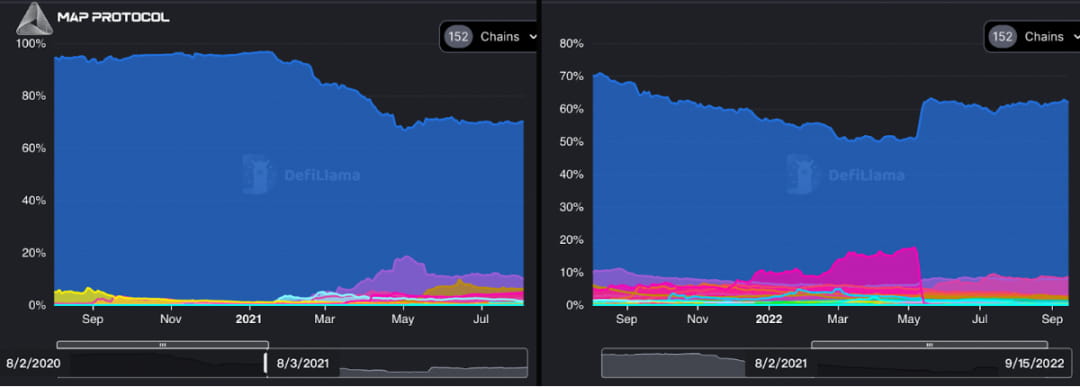
Comparison of TVL of various public chains from 2020 to 2022: The blue part is Ethereum TVL
From the TVL comparison of major public chains from August 2020 to August 2021 and from August 2021 to September 2022, we can see that although Ethereum's total TVL still ranks first overall, the total TVL of other L1s has increased. Although it cannot surpass Ethereum in asset value for the time being, the L1 ecosystem outside of Ethereum will continue to develop gradually. For example, the number of application services and daily active users on BNB Chain have exceeded that of Ethereum. With the continuous birth of new public chains, a full-chain ecosystem that is compatible with EVM and Non-EVM ecosystems will be an important development direction.
The dApp Growth Dilemma
According to DappRadar data, there are currently 12,670 dApps. Due to Ethereum's congestion and high fees, nearly three-quarters of dApps choose to be issued on public chains that are lighter and more cost-friendly, such as BNB Chain. However, Ethereum has the most on-chain users and assets, and single-chain dApps not issued on Ethereum still hope to obtain diverse user asset resources on Ethereum and other chains. If they choose to issue on multiple chains separately, dApps will face the problem of multi-chain assets not being interoperable and multi-chain ledgers being split, and users will also be discouraged by the complicated multi-chain addresses and high gas fees.
The full chain is the best growth plan for dApps in a multi-chain coexistence pattern. Through the full chain link, dApps can connect users and assets on all blockchains, multi-chain ledgers are no longer fragmented, and the entire dApp operation will be more orderly; at the same time, the user experience is better, and it can switch seamlessly between multiple L1s.
Ethereum’s computational bottleneck
From the perspective of computer history, any single computing entity has a bottleneck in computing peak. In other words, no matter how any computer improves its computing power, it cannot carry operations that exceed its bottleneck value. Ethereum, as the "world computer", is expected to further increase its computing capacity after future sharding, increasing TPS to 100,000, but its computing bottleneck still exists. In order for all users and products to enter Web3, the best strategy is for Ethereum and other public chains to expand the overall computing capacity.
Web3 Cloud Computing Infrastructure
As the number of users on the chain continues to increase, and more robots and smart devices interact through smart contracts; or further, if all Web2 users migrate to Web3 and enjoy the same interaction speed in Web2, the TPS required for the entire Web3 may be billions of times. To achieve this goal, it is necessary to carry a large number of L1s together, and use a cloud computing architecture similar to the Web2 field to distribute computing power. At that time, a full-chain network such as MAP Protocol will play the role of a cloud computing balancer, completing the seamless allocation of computing resources on various blockchains for dApp transaction requests. Therefore, the full-chain solution has greater application value in the long run.
Mainstream cross-chain communication solutions
Before analyzing the whole chain, let's first have a basic understanding of the foundation of the whole chain - cross-chain technology. As a distributed ledger system, the spirit of blockchain is decentralized and unprivileged roles exist. The core method is to record the ledger with a chain structure to ensure that the results are traceable and cannot be tampered with. The core of cross-chain is ledger alignment. The following are the three major solutions for ledger alignment:
* Here is a definition of decentralization: using Nakamoto consensus and blockchain structure to confirm distributed ledgers, rather than having privileged roles protected by "traditional cryptographic security attack and defense mechanisms" to confirm ledgers.
Centralization: Multi-party secure computing
MPC, or Secure Multi-Party Computation, is a privacy-preserving distributed computing technology in the field of cryptography. The main representatives of this cross-chain verification method include Axelar, Celer (cBridge), Multichain, Wormhole, and Thorchain.
In the MPC cross-chain solution, a number of fixed or regularly rotating witnesses designated by the project party serve as the final confirmation of the validity of the cross-chain. This means that if a hacker breaks into the witness server, they can steal all the funds locked in the cross-chain, or the project party can steal the relevant funds. Since the existence of privileged roles cannot be eliminated, the entire verification process cannot completely avoid the risk of malicious behavior.
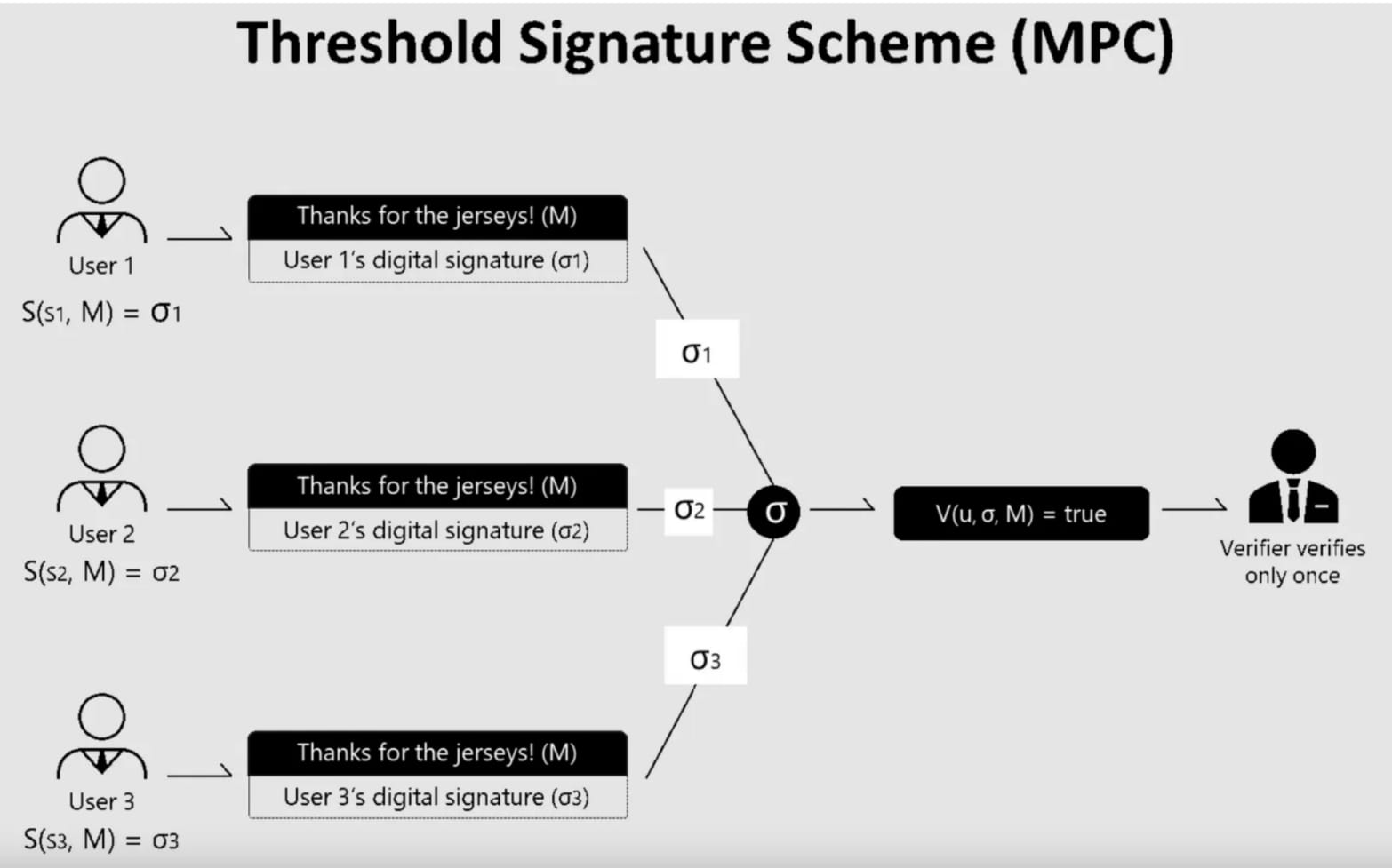
Threshold signature (MPC) example diagram
There are many variations of the MPC scheme, such as threshold signatures, or validator rotation mechanisms in MPC signature nodes, but these cannot change the essence of MPC: a centralized cryptographic scheme. According to a report released by Chainalysis in August this year, the amount stolen from cross-chain bridge attacks accounted for 69% of the total amount of stolen cryptocurrencies in 2022, with a loss of US$2 billion, and projects using MPC cross-chain were the first to bear the brunt.
Quasi-centralization: Oracle
Oracles are off-chain infrastructure that links off-chain data to blockchain. Oracles are widely used in quasi-centralized cross-chain solutions, the most representative of which is LayerZero: LayerZero uses Relayer and Oracle for cross-chain transmission and validity confirmation.
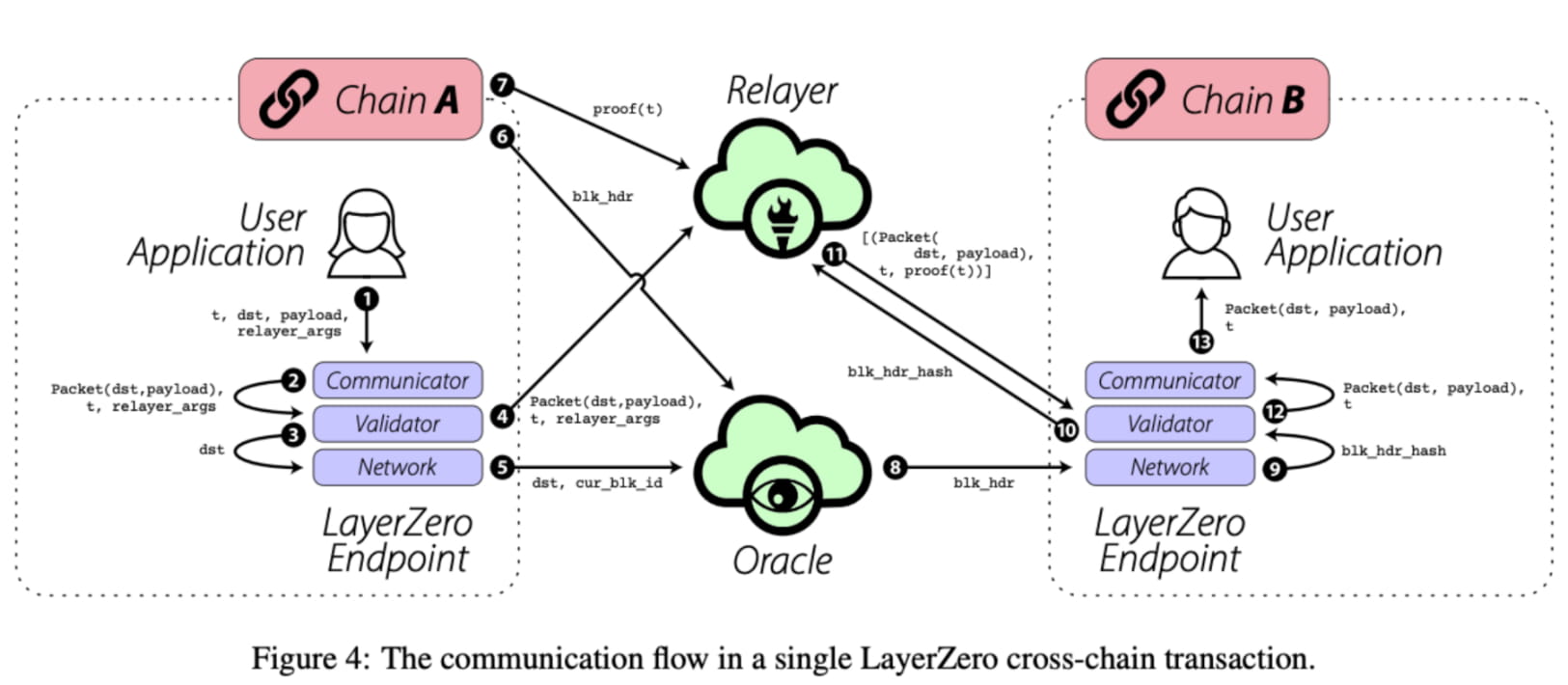
Specifically, LayerZero uses mutual verification between Chainlink nodes and community-built Relayers to ensure cross-chain security, but its white paper also mentions an extreme case: relayers and oracles work together to commit evil.
Although the oracle and relayer working independently can reduce this risk, the relayer is deployed by the project party, and choosing Chainlink's oracle is essentially trusting that Chainlink will not collude with the project party to do evil. However, the risk probability of collusion between Chainlink nodes and relayers is inherent. If it happens once in a billion times, the conspirators can steal all the assets of the system. At the same time, the security of the oracle is not reliable enough. For example, Chainlink's node was attacked in September 2020, resulting in the theft of at least 700 ETH.
In addition, cross-chain verification requires accurate data, while the data transmitted by the oracle is ambiguous, which is inaccurate data. For example, in September 2020, the oracle Pyth had a data failure and reported a Bitcoin price that was 90% lower than that of other data providers. Such inaccurate data will cause great trouble to dApp applications. It is worth mentioning that although the design of LayerZero includes light nodes, this is only for the speed of data verification on the same chain (the light node will be further explained in the next point). Its light node is not a cross-chain verification role, but an ambiguous privileged role-oracle.
Complete decentralization: cross-chain verification between light nodes
A light node is a light client, which is the SPV simple payment verification technology discussed in the Bitcoin white paper. It can quickly verify the legitimacy of a transaction in the entire ledger in a lightweight way. It has the characteristics of "independent self-verification" and does not rely on any privileged third party or authorize a third party to verify the legitimacy. A light node does not mean a client program in the literal sense. It can be a component or a smart contract. The current projects that use light nodes (light clients) for cross-chain include MAP Protocol, Cosmos, Polkadot and Aurora (Rainbow Bridge).
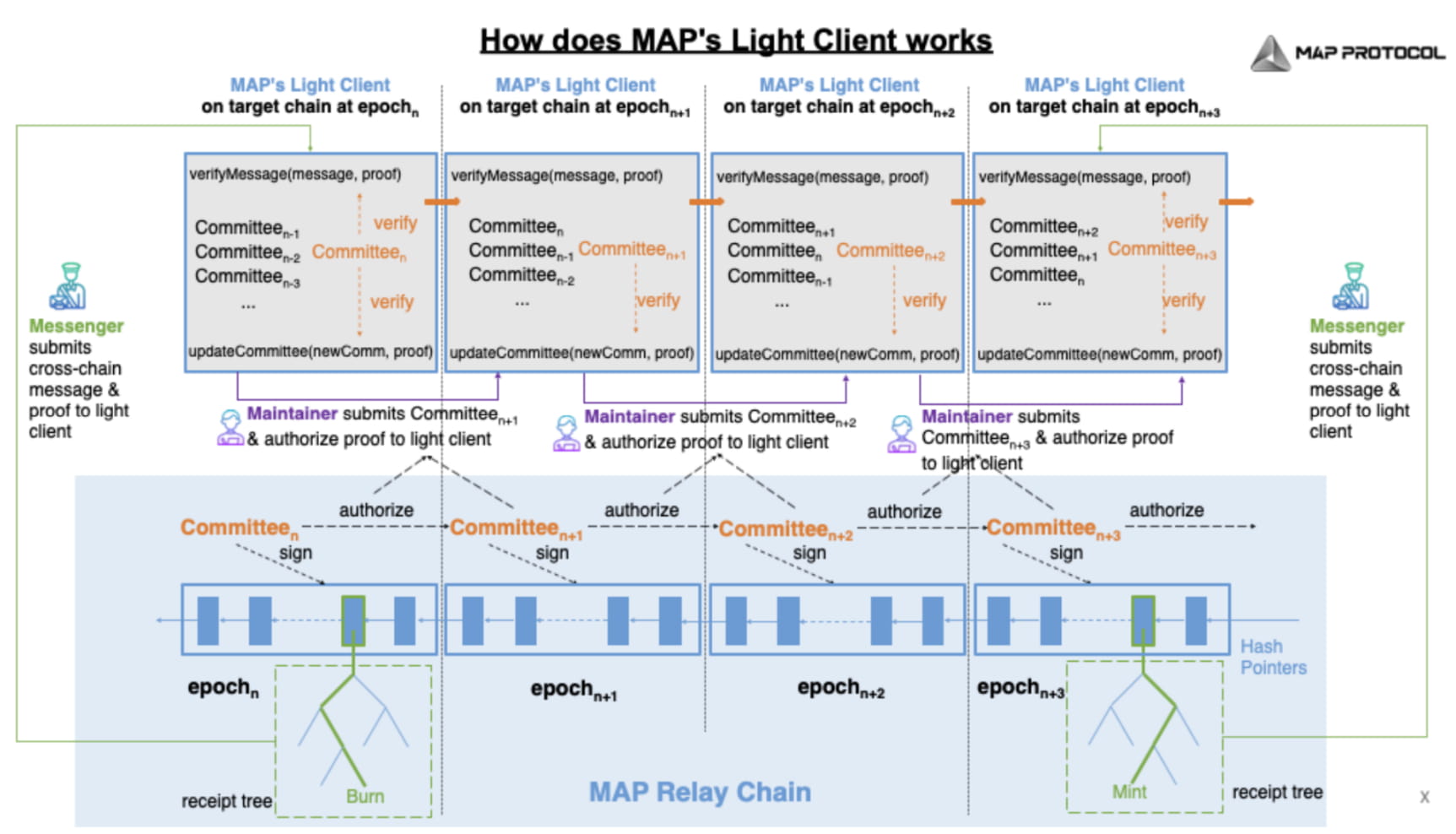
Light client technology cross-chain mechanism: Taking MAP Protocol as an example
During cross-chain verification, the block header information of chain A (including the validator signature verifier set information) is synchronized and updated to the light node of chain A on chain B by the inter-chain message transmitter every time the validator changes. (The light node will be built into the bottom layer of the chain or deployed on the chain as a smart contract). In this way, chain B also has the signature verifier set information of chain A.
If there is an illegal transaction that needs to be transferred from chain A to chain B by a hacker, this transaction will not be valid unless the hacker attacks chain A as a whole. In the design of light nodes, it is impossible for hackers to obtain the valid and legal signature of the validator of chain A, and chain B will not accept invalid cross-chain requests initiated by hackers. At the same time, the inter-chain message sender that sends the signature information of the validator (chain A) to the light node (chain A) deployed on or within chain B cannot write false signature information, because each set of signers is authorized by two-thirds of the signatures of the previous set of validators. If an attack is to be carried out here, the inter-chain message sender needs to attack the entire chain A, which is almost impossible in a production environment.
* Key point: Unlike Cosmos, Polkadot and Aurora (Rainbow Bridge), MAP Protocol is able to cover all L1s, not just ecologically homogeneous chains.
This is because MAP Protocol has made the following major innovative breakthroughs: 1) MAP Protocol makes all L1s and Relay Chains isomorphic by embedding the signature algorithm and hash algorithm of each prosperous L1 in the Relay Chain precompiled contract layer; 2) The Merkle Tree proof is implanted in the precompiled contract layer, and the light nodes of each L1 are deployed to each L1 in the form of smart contracts, realizing cross-chain validity verification between light nodes, but Cosmos and Polkadot cannot support heterogeneous chains such as Ethereum.
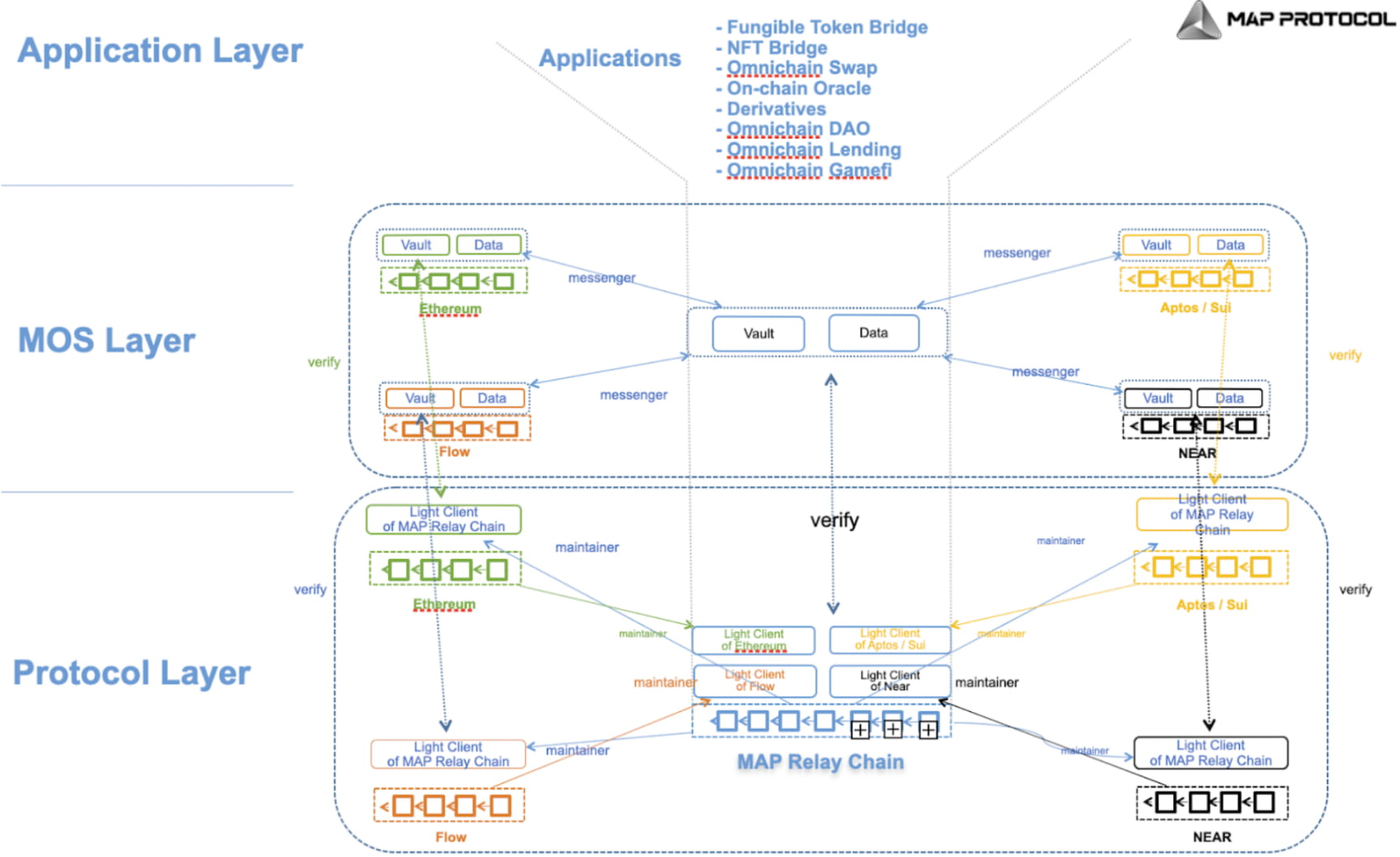
MAP Protocol light node cross-chain mechanism
03 Products and Business Model
MAP Protocol
MAP Protocol is a full-chain interoperability protocol for Web3. Its core lies in the light node technology and ZK technology that have been innovatively developed and deployed for four years. Based on the light node cross-chain verification mechanism, MAP Protocol successfully built-in major L1 signature algorithms, hash algorithms and Merkle Tree proofs in the form of pre-compiled contracts at the MAP Relay Chain virtual machine layer, making the MAP Relay Chain isomorphic with all chains. At the same time, the zk technology is introduced to further optimize the cross-chain verification rate and reduce the gas fee cost.
In short, MAP Protocol is the only full-chain infrastructure on the market that can cover all chains and has the highest security. For developers, MAP Protocol greatly reduces their learning and operating costs; for users, MAP Protocol provides blockchain-level security and reduces their usage fees.
MAP Protocol components
The MAP Protocol consists of three parts:
1. Protocol Layer — The core of full-chain communication verification
The MAP Protocol layer is the bottom layer and the core of the full-chain communication verification, responsible for cross-chain verification. This layer consists of the MAP Replay Chain, the light nodes deployed by each chain, and the inter-chain message transmission program Maintainer. The MAP Relay Chain virtual machine layer successfully built-in major L1 signature algorithms, hash algorithms, and Merkle Tree proofs in the form of pre-compiled contracts, making the MAP Relay Chain like a super language machine that is proficient in languages of various countries. Through the MAP Relay Chain, chains can communicate with each other, which lays an isomorphic foundation for the intercommunication of chains.
The light nodes deployed on each chain have the characteristics of independent self-verification and instant finality guarantee. Based on the isomorphic foundation of MAP Relay Chain, the light node cross-verification network can have the same data language and can be easily deployed to any corresponding L1 in the form of smart contracts, and then perform decentralized cross-chain validity verification.
Maintainer is an independent inter-chain messaging program that is responsible for updating the latest status of the light node and writing the consensus layer block header (Validator signature) information of each chain into the light node smart contract of the origin chain on the target chain in the form of a transaction, so as to ensure that the light node of the origin chain on the target chain is consistent with the Validator information of the origin chain.
MAP Relay Chain, which has multiple precompiled contracts embedded, is unique in the industry. Compared with other light node cross-chain technology solutions, MAP Protocol can cover all L1. Combined with its unique cross-chain communication component, MAP Protocol will greatly reduce the obstacles to the free flow of data across chains and assets across the entire chain.
2. MOS Omnichain as a Service Layer —— For dApp developers
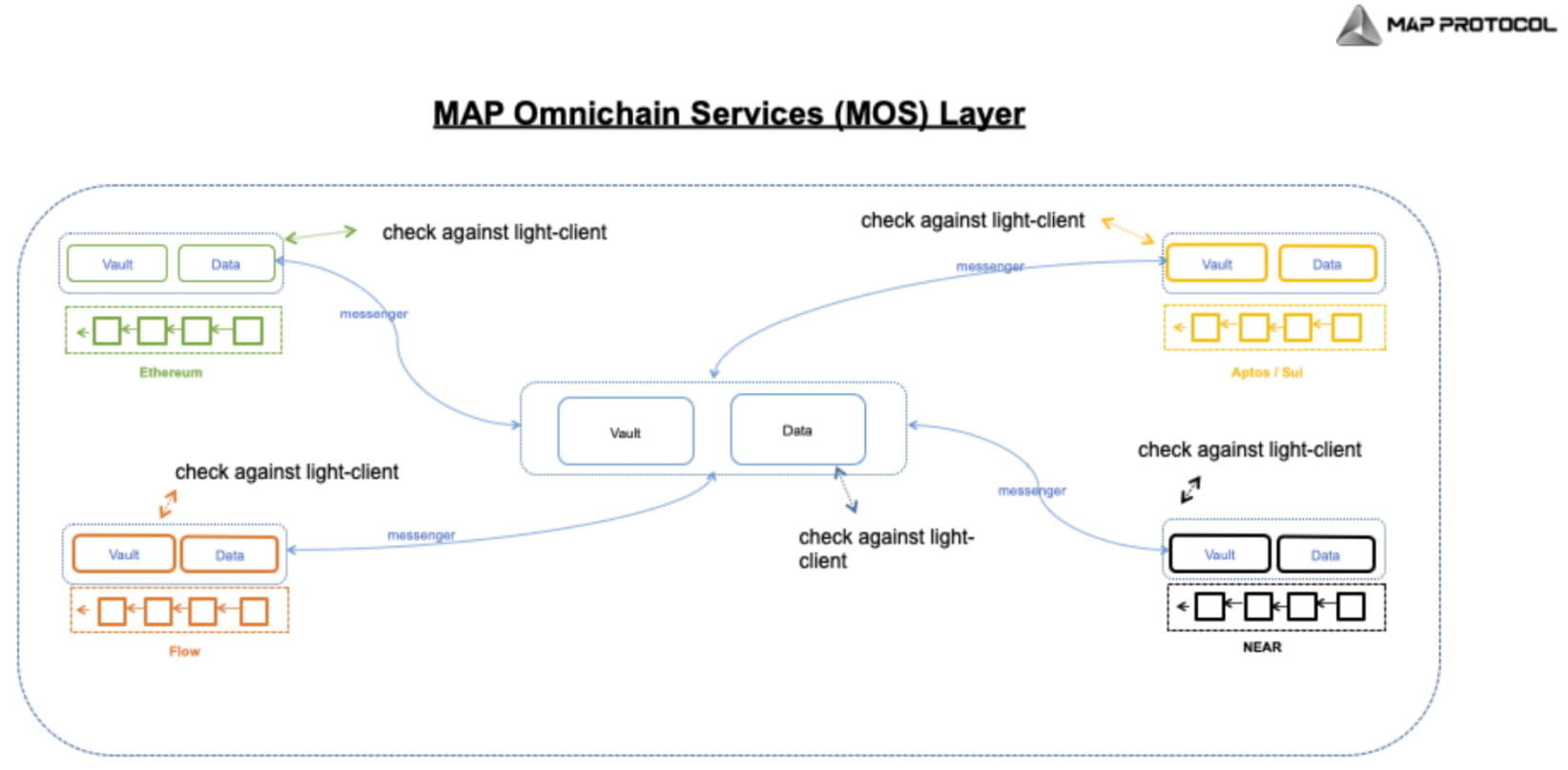
MOS layer diagram
The MOS layer is the second layer, similar to the Google Mobile Service for the Android ecosystem, providing full-chain development services for dApp developers. This layer has cross-chain asset locking smart contracts deployed on various blockchains and inter-chain messaging components Messenger. Developers can directly use this layer to build full-chain application scenarios, or further compile according to their own needs. The smart contracts at this layer are all open source components audited by CertiK. dApp developers can use them directly without worrying about security and development costs, thereby saving the development and learning costs of the entire chain.
3. Omnichain Application Layer - Expanding the Omnichain DApp Ecosystem
The full-chain application layer is related to the development of the dApp full-chain ecosystem. The full-chain service of the MOS layer enables dApp to achieve interoperability. At the same time, the verification network of data assets at the protocol layer can promote dApp to continuously expand its existing ecosystem, thereby realizing a full-chain ecosystem with interconnected chains.
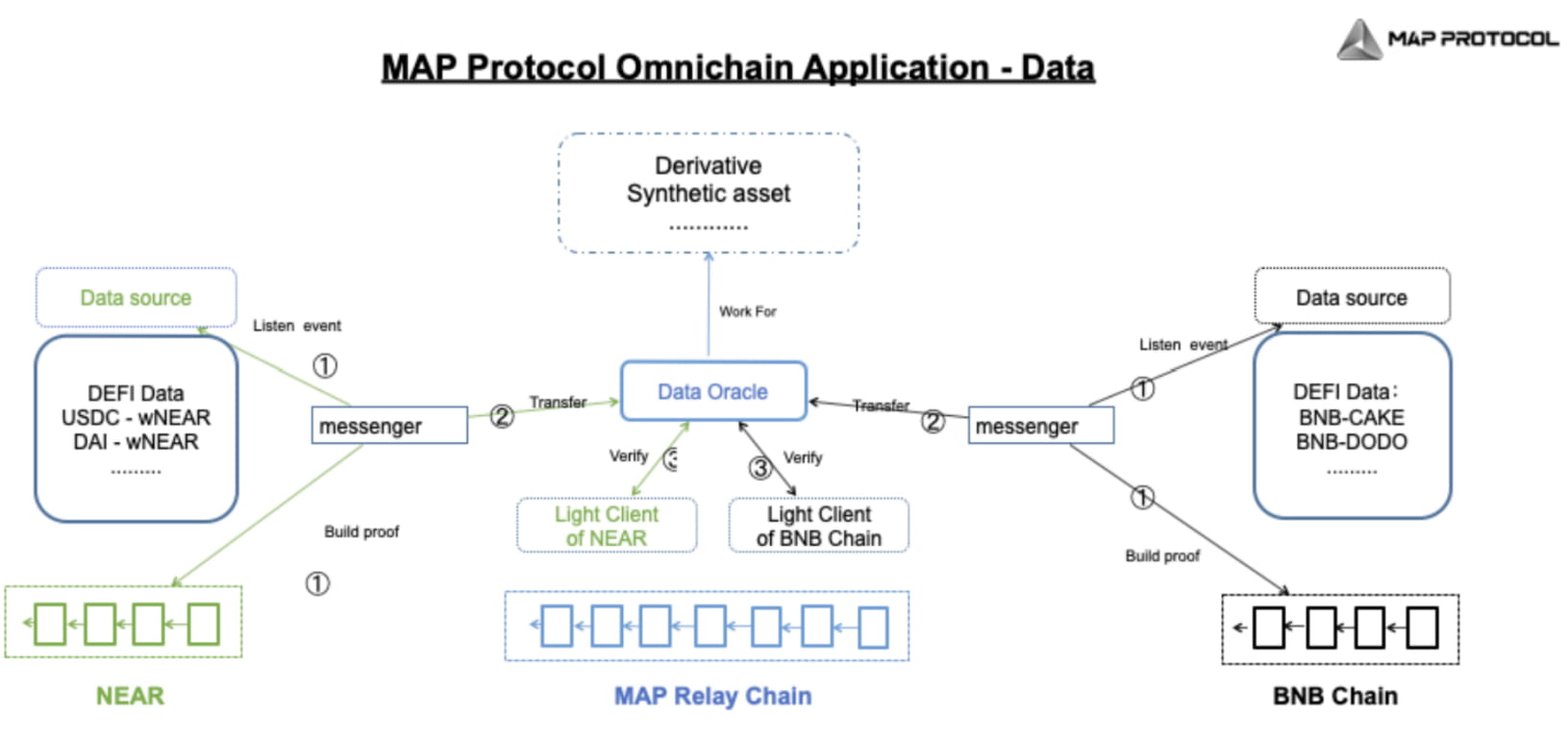
MAP Protocol full chain data flow diagram
Taking decentralized derivatives and synthetic assets as an example, they are currently subject to the price and quantity of assets on other chains. It is impossible to obtain accurate and timely asset data information through off-chain oracles, so liquidity and user experience are poor. Although multi-chain deployment can solve this problem, the process is time-consuming and labor-intensive, and will increase unnecessary development costs. If the deployment is completed on the MAP Replay Chain, decentralized derivatives and synthetic assets can obtain accurate multi-chain data from the MAP Protocol chain oracle, no longer subject to the obstacles of data flow, and easily realize the full chain flow of assets.
Similar application scenarios include full-chain DID, full-chain lending, full-chain Swap, full-chain GameFi, full-chain DAO governance, full-chain tokens and full-chain NFT. No matter which L1 the main business contract of the dApp is deployed on, through MAP Protocol developers can easily build full-chain applications capable of covering all chain users and assets.
business model
Tokenomics
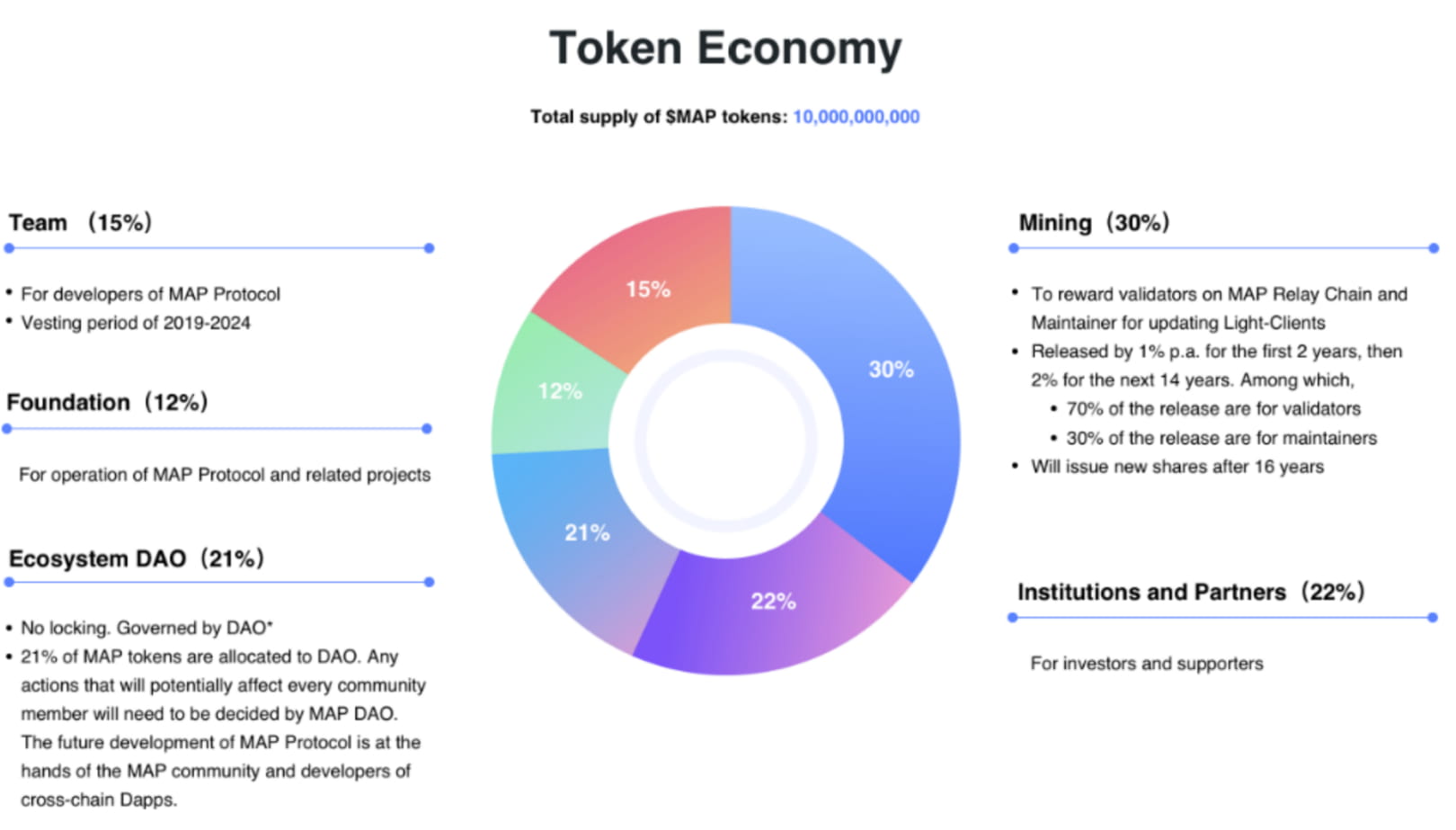
According to the contract settings of MAP Protocol, the total supply of $MAP token is 10 billion, and the total market value is about 105 million US dollars according to the data in November 2022. According to Coingeko data, the current MAP Protocol public market circulation is about 20%.
15% is for team incentives. The project started in 2019, and the team tokens will not be fully distributed until 2024. The lock-up period is longer than that of most projects.
21% belongs to Ecosystem DAO, which has no lock-up and the token usage strategy is entirely determined by the community. In the governance system of MAP Protocol DAO, all resolutions that affect community members must first be fully discussed and finalized on the MAP Protocol forum, and then moved to the chain for voting by MAP Protocol DAO.
12% is owned by the MAP Protocol Foundation and will be used for the construction of the MAP Protocol ecosystem and the expansion of the Web3 full-chain ecosystem.
22% is owned by investors and early backers.
30% is mining reward, which is issued to the validator who protects the security of MAP Relay Chain and the Maintainer who updates the status of light nodes between chains.
Gas fee model
As a public underlying infrastructure, MAP Protocol only charges the gas fee of the Relay Chain. Projects related to centralized mechanisms such as Oracle and MPC charge a fixed percentage corresponding to the cross-chain amount. For developers, the charging model of MAP Protocol is application-friendly.
04 Financing and Valuation
Financing
MAP Protocol did not conduct any primary market financing. Instead, it was listed directly on the Bithumb exchange after two years of silent research and development, so it lacks the endorsement of well-known capital. Compared with LayerZero, which became popular through Stargate and was later favored by giant VCs, MAP Protocol did not receive much attention from mainstream media. Of course, this is related to the fact that MAP Protocol has not yet fully launched the underlying layer and started running (the team revealed that it will fully connect all mainstream L1s by the end of the year).
James XYC, one of the founders, once said that when MAP Protocol was launched, Cosmos and Polkadot were in the limelight. The MAP Protocol team had initial contact with several institutional investors at the time, and almost all of them dissuaded MAP Protocol from giving up this track, believing that the high-profile Cosmos and Polkadot were already sufficiently complete in cross-chain. Therefore, the MAP Protocol team gave up seeking support from institutional investors at the time, and organized the team to raise funds on its own to start research and development.
Now it seems that Cosmos and Polkadot are currently constrained by technical bottlenecks and product positioning bottlenecks, and their development momentum has been reduced. The MAP Protocol team continues to find innovative solutions to solve the problems of privileged roles and the inability to connect all prosperous L1s. Now it has indeed turned its goals into reality and successfully developed a full-chain dApp infrastructure based on light client cross-chain verification that can cover all blockchains and is developer-oriented.
Valuation
Compared with other cross-chain technology-related projects, MAP Protocol’s current market value is severely underestimated.
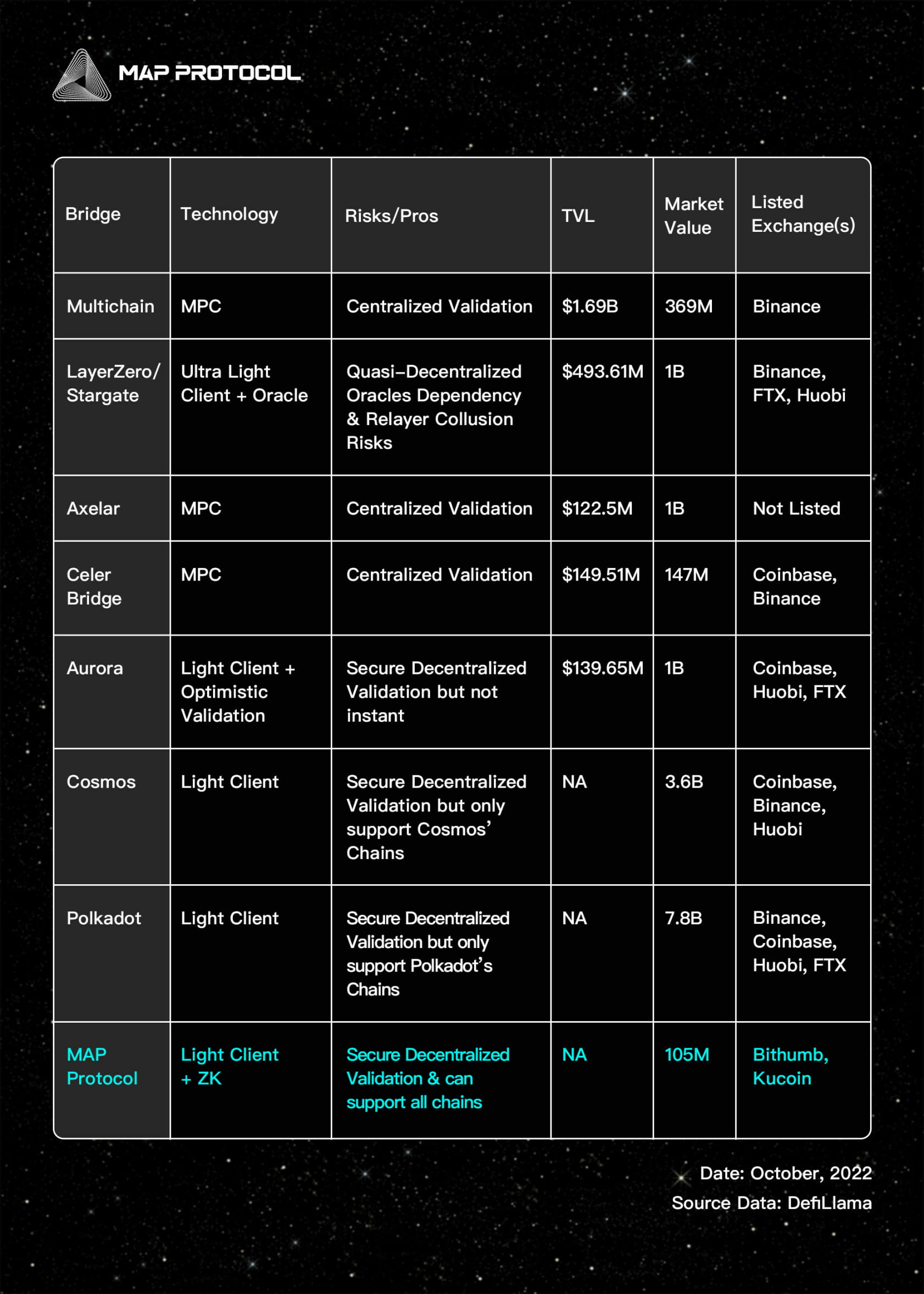
05 Team
Technology-focused geek culture
At the same time, the data shows that MAP Protocol was founded in 2019 and listed on the Korean compliant exchange Bithumb in early 2021. Judging from the pace of its capital market development, the MAP team chose to invest more time in construction rather than spending time on performances for investors. At the same time, before the announcement of its mainnet launch date, there was little public relations publicity on the market, which is a breath of fresh air in the current atmosphere of impetuous storytelling, and also shows that the MAP Protocol team has its own very clear development rhythm.
From MAP Protocol's completion of the extremely challenging light node cross-chain technology that can cover all chains, the implantation of multiple signatures and hash algorithm pre-compiled contracts on the Relay Chain EVM layer, as well as its large and comprehensive full-chain design, Github code, and the zk cross-chain technology that is being further developed, we can see that the MAP Protoco team is a team completely dominated by geek engineers and researchers, and more energy and resources are spent on technology. Although listing is the most direct way for Web3 projects to obtain native funds, institutional investors often have better partner empowerment, and we look forward to the MAP Protocol team being able to reach more cooperation with institutional investors.
06 Ecology
Mainnet and public chain
MAP Protocol's breakthrough innovative design in cross-chain technology allows various blockchains to freely and securely interconnect, but this solution is extremely challenging to research and develop. After nearly four years of development, the MAP Relay Chain mainnet was finally officially released at the end of August 2022, and the cross-chain docking of Prosperity L1 will also be officially launched before the end of the year, after which MAP Protocol will also officially start running.
MAP Relay Chain has many well-known validator service providers joining the verification, such as Ankr, InfStones, HashQuark, Citadel.One, Ugaenn, Neuler, and Allnodes. Officials of technically hardcore public chains such as NEAR, Flow, Ploygon, Iotex, and Harmony have expressed support and recognition for the technical solution of MAP Protocol and have also connected with MAP Protocol. As of early November 2022, the inter-chain between MAP Protocol and ETHW, Ethereum 2.0, NEAR, BNB Chain, Klaytn, and Polygon has entered the testing phase and has begun to be audited by CertiK. It is expected to be launched before the end of this year; at the same time, according to the MAP Protocol roadmap, Solana, Aptos, Sui, Iotex, Flow, Harmony, AVAX, Fantom, XRP and other prosperous L1 and L2 will also be launched in the second quarter of 2023 at the latest.
At present, the applications being developed based on MAP Protocol technology are mainly DeFi and GameFi projects, and on-chain data projects. The following applications are their more representative applications:
application
Omnichain Payment: Butter Network
Butter is positioned as the Visa or Stripe payment system in the Crypto field, aiming to provide developers and users with a seamless decentralized full-chain payment experience. Taking Gamefi NFT sales as an example, the current project's revenue loss in the collection link is between 30% and 50% due to limited supported currencies and cross-chain payment barriers, but if the full-chain payment can be opened, this loss will be greatly reduced. Just like in the fiat currency world, European tourists do not need to exchange specifically, but can directly use Euro bank cards to consume meals in Singapore, and Singaporean restaurant owners receive Singapore dollars.
Through the full-chain infrastructure provided by MAP Protocol, Butter has successfully built an absolutely decentralized cross-chain aggregated liquidity exchange network. In conjunction with payment products for dApps, Butter can fully provide decentralized payment infrastructure services, greatly improving the convenience of GameFi, NFT sales, and decentralized wallet exchanges.
Gamefi Service: Plyverse
Plyverse is a platform for the GameFi industry, serving both the C-end and the B-end. On the C-end, Plyverse provides GameFi players with an entry point for selecting and rating GameFi based on big data technology and the power of decentralized DAO, so that users are no longer at a loss when choosing GameFi. Plyverse cooperated with the cybersecurity-related laboratory of Nanyang Technological University to conduct security ratings and provide functions such as NFT transactions and game token transactions. On the B-end, an SDK wallet is provided for GameFi developers. This wallet uses the underlying layer of MAP Protocol, allowing GameFi to easily achieve full-chain coverage and issuance.
On-chain Oracles: SaaS3
Oracles are the bridge between blockchain and the real world, but off-chain oracles are ambiguous privileged roles that do not conform to the decentralized spirit of blockchain, nor can they guarantee absolute cross-chain verification security and accurate data information. SaaS3's on-chain oracle solution aims to solve this problem by transferring real-world data and computing to the blockchain world in a decentralized, secure, and unrestricted manner. Through the MAP Protocol, SaaS3 can connect major L1s, allowing L1 data to flow throughout the chain in the form of on-chain oracles, thereby helping dApp developers to easily deploy Web2 APIs in the SaaS3 serverless operating system and link them to the required chain.
ENS Service: Unstoppable Domain
Unstoppable Domain is a Web3 identity application platform dedicated to creating unique domain names for people, allowing Web3 users to better manage their digital identities. By adding a word of their choice to the suffix .x or .crypto, users can obtain their own domain name NFT on the blockchain and store it in their wallet as a normal username. Currently, UD users have registered more than 2.5 million domain names, of which 1 million are on Ethereum's L2 Polygon.
Although the way of minting domain name NFT has made Web3 interaction smoother, the use scenarios of single-chain domain names in a multi-chain structure are still relatively limited, and a single domain name cannot meet the cross-chain needs of users. Currently, Unstoppale Domain is conducting research and cooperation with MAP Protocol to expand the use scenarios of Web3 domain names, allowing users to enjoy the simplicity of interaction of NFT domain names and the convenience of secure cross-chain.
DID :Litentry
Litentry is a decentralized identity aggregation protocol in the Polkadot ecosystem. It aims to help users aggregate personal data on Web2 service providers, Web3 public chains, and centralized storage data while maintaining complete privacy and anonymity, maximizing the value of on-chain identity. DeFi credit lending is an important use case for Litentry. Through mutual login and credit data exchange between different public chains, users can choose to synchronize their data on other chains as their credit records. To speed up the implementation of this scenario, MAP Protocol and Litentry have cooperated to establish interoperability of cross-chain identity data and help users build their own diverse decentralized identities.
Wallet: BeFi Wallet
BeFi Wallet is a multi-chain wallet application based on MAP Relay Chain for dApp, DeFi, and NFT. Through BeFi Wallet, users can not only transfer money safely and conveniently, but also directly store or purchase NFT, connect to Web3 chain games, and log in to major dApps. Currently, BeFi Wallet has more than 700,000 users, and the average daily active users (DAU) remains above 20,000.
DAO:Click
Clique is a one-stop DAO tool launched by Verse Network. Through Clique, DAOs and projects on Ethereum can directly participate in decentralized on-chain governance without transferring their tokens. It is an innovative solution for DAO governance. Through MAP Protocol, Clique will support more EVM chains and their tokens, and link to Klaytn and BNB Chain, further expanding the existing community and dApp ecosystem.
Community
In terms of language and region, MAP Protocol's community is relatively international. Its Korean Kakao community has nearly 10,000 people, the English Telegram community has more than 30,000 people, the Turkish community has more than 4,000 people, the Russian community has more than 3,000 people, and the Vietnamese community has 2,000 people. Overall, the MAP Protocol community has more participants in English, Korean, Turkish, Russian, Indonesian, and Vietnamese. The following are the main activity platforms for community participants:
Twitter: MAP Protocol’s Twitter account was registered in 2019, but its activity has increased significantly since the mainnet went live. Currently, MAP Protocol’s Twitter account has more than 100,000 followers, and each tweet has an influence of more than 5%.
Discord: MAP Protocol’s Discord community was only opened this year, and the number of members has not yet reached 2,000, but the community management is perfect. Judging from the Discord settings, the team should release a series of community and developer activities in the Discord community in the future to further activate the community.
07 Market Competition
In the application of cross-chain technology, MAP Protocol chooses the full-chain field. Compared with Cosmos and Polkadot, which are also based on light node verification, MAP Protocol will be more attractive to dApp. This is because Cosmos and Polkadot are exclusive application chains, requiring dApp to build an L1 by itself, while MAP Protocol is a full-chain infrastructure that allows dApp to cover users and assets of all chains. The following is a comparative analysis of Polkadot and Cosmos.
Polkadot and Cosmos
Polkadot and Cosmos are discussed here in parallel because their mechanisms are very similar: 1) Both have a chain-issuing tool, and the L1 generated by the chain-issuing tool is an application-specific chain; 2) Both Polkadot and Cosmos only support cross-chain blockchains generated by the chain-issuing tool. Cross-chain must be in SDK, and the relay chains of both do not support smart contracts.
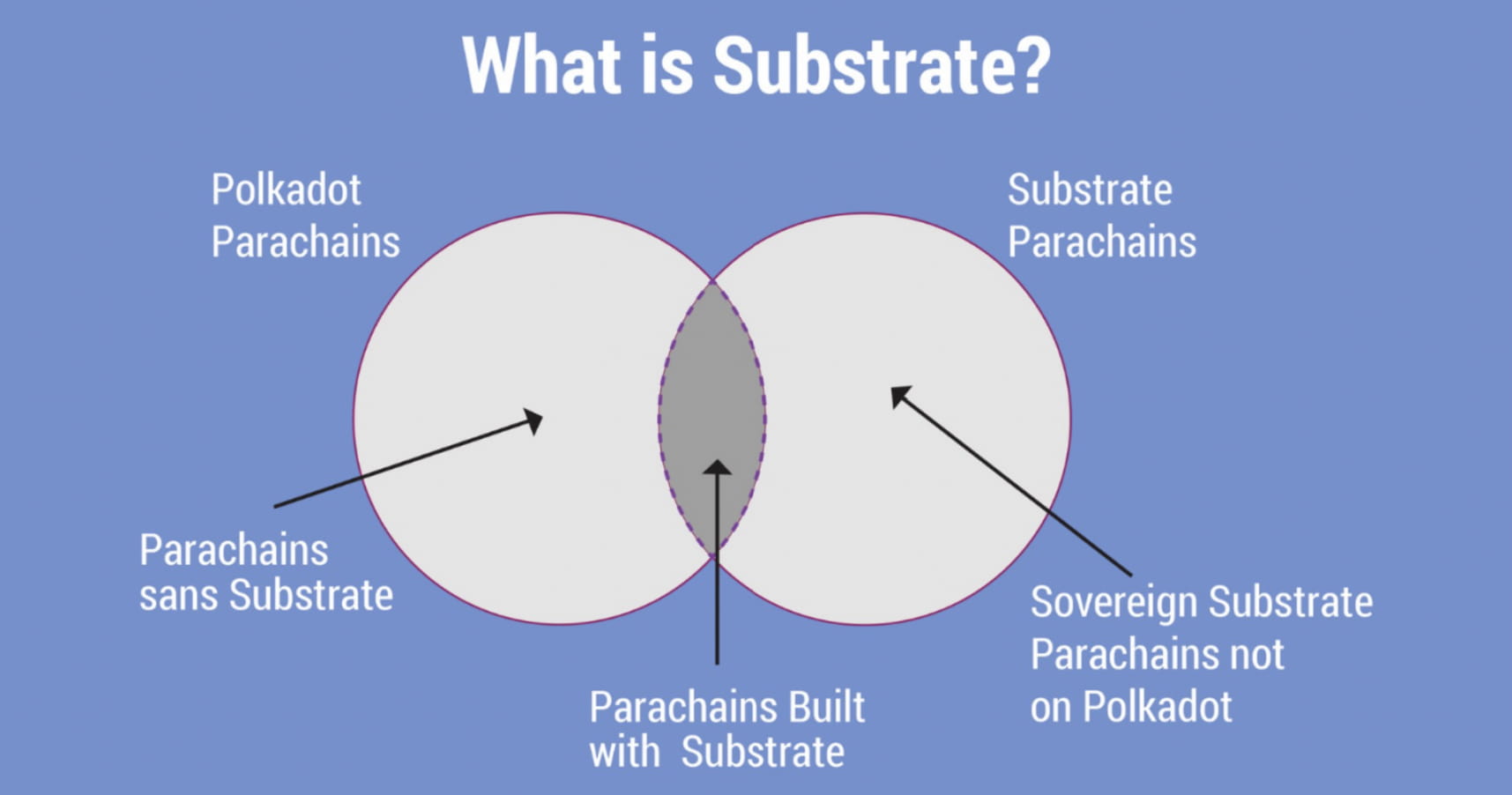
Polkadot chain launch tool Substrate: from Blackchain Simplified
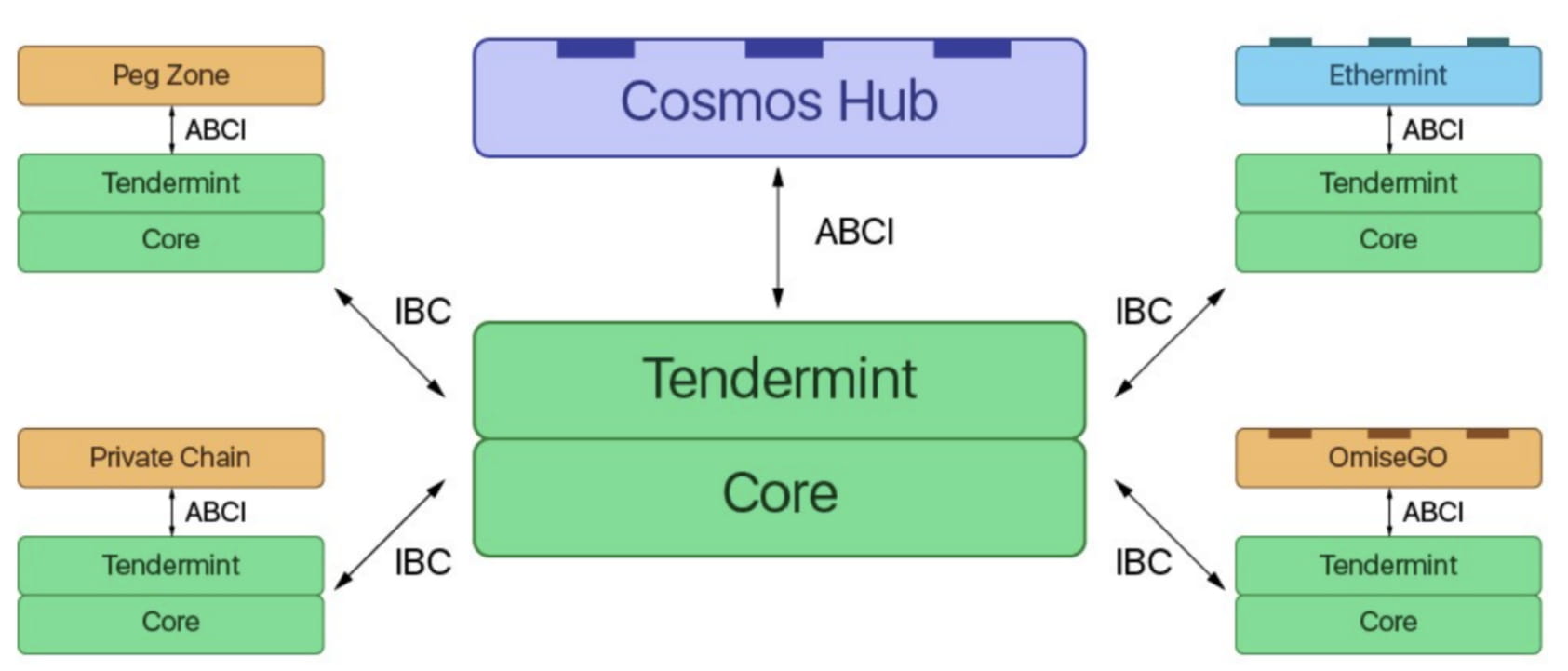
As the earliest representatives of cross-chain, when Polkadot and Cosmos were founded, there were not many L1s in the blockchain field. Both developed their own chain-issuing tools - Polkadot's chain-issuing tool is Substrate, and Cosmos's is Tendermint. Using chain-issuing tools, developers can quickly publish their own blockchains. After these L1s have built-in cross-chain SDKs at the bottom of the chain, they can be interoperable with other blockchains generated by the same chain-issuing tool through the Polkadot relay chain or Cosmos Hub. Through this chain-issuing and cross-chain logic, Polkadot and Cosmos have attracted many developers and formed a relatively rich ecosystem - Polkadot currently has more than 100 applications and services, and Cosmos has 263.
However, mainstream L1 cannot be interconnected with the two. It is difficult for dApps on Polkadot and Cosmos to connect users and assets on other chains. At the same time, both face challenges in operability and convenience:
The Polkadot relay chain and Cosmos Hub are not Turing complete and cannot compile smart contracts, which means that developers with cross-chain asset collections cannot build native full-chain applications.
The cross-chain SDK of the two chains requires the other chain to be implanted in the bottom layer of the chain. At the same time, for other heterogeneous chains, that is, Ethereum, BNB, Klaytn, Polygon, Avax and other blockchains generated by non-chain-issuing tools, it is necessary to actively modify the underlying structure of the blockchain to make it isomorphic with the two chains, and then implant the SDK into the bottom layer of the chain to achieve cross-chain. However, modifying the underlying structure is an extremely complex challenge, so there is currently no prosperous L1 to achieve chain connection with the Polkadot relay chain and Cosmos Hub.
To connect with the Polkadot relay chain, the accounting rights must be handed over to the relay chain, which means that security needs to be handed over to the relay chain, which is unacceptable to other L1s with prosperous ecosystems.
For dApp developers, using Polkadot and Cosmos requires building their own exclusive L1 first, and then deploying dApp on the L1 they built. However, building your own L1 is not the core requirement of dApp, but covering more users and assets is. Whether from the perspective of development cost, learning cost or security, it is not cost-effective to build L1 first and then seek a development path for cross-chain user assets of other chains.
Therefore, although Polkadot and Cosmos use a light client cross-chain mechanism and are very secure, they are more like building a huge internal ecosystem, and are not ideal in terms of real inter-chaining and expanding the dApp ecosystem. The design structure and technical mechanism of the two make it difficult for them to inter-chain with prosperous blockchains such as Ethereum and BNB. For dApps, although the two provide convenient chain-issuing tools, they do not really solve their demands for user and asset coverage.
Aurora
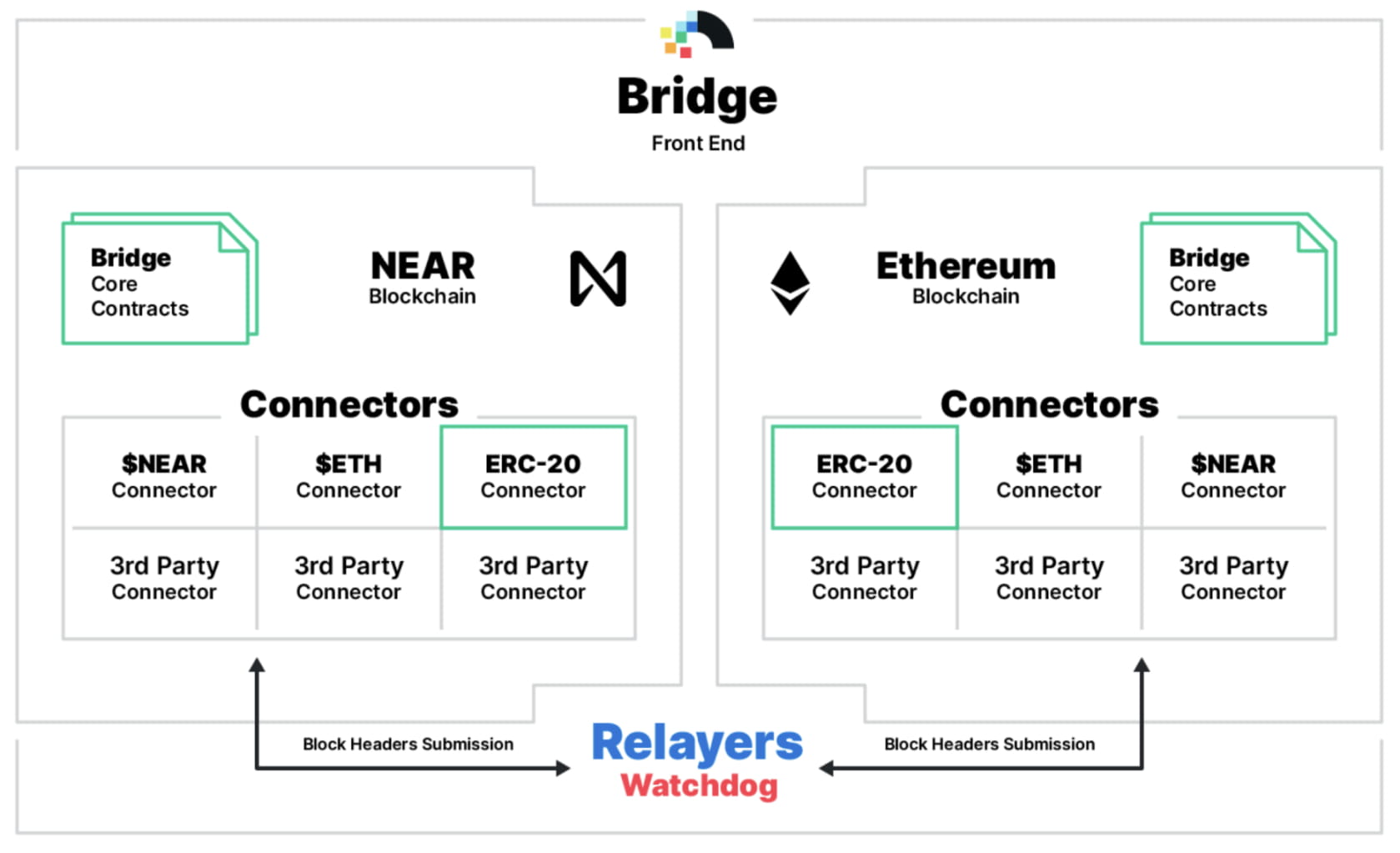
NEAR Rainbow Bridge cross-chain mechanism: from NEAR
Today, when people are afraid of the word "bridge", there is a cross-chain bridge that has not had any hacker theft incidents. This is the NEAR Rainbow Bridge, which uses a light node cross-chain mechanism and is built on the Aurora underlying layer. Although this solution ensures security to the greatest extent, Aurora is slightly weak in connectivity and convenience.
Currently, NEAR Rainbow Bridge only supports cross-chain from Ethereum to NEAR, and does not support cross-chain from other chains to NEAR. In terms of currency support, NEAR Rainbow Bridge supports one-way cross-chain from Ethereum to NEAR for all currencies, but only a few currencies can cross-chain from NEAR to Ethereum. In addition, due to Aurora's lack of ed25519 precompiled contracts (MAP Relay Chain is already built-in), the cross-chain solution from NEAR to Ethereum adopts the Optimistic mode instead of the automated ledger alignment solution, and a transaction needs to wait 4 hours to complete the cross-chain confirmation.
LayerZero
As mentioned above, LayerZero has solved the problems in the MPC cross-chain mechanism and optimized the cross-chain cost-effectiveness, making it an indispensable player in the cross-chain track. However, as mentioned in its white paper, the oracles and repeaters in its cross-chain mechanism may have collusion risks. In addition, the security of the verification method of ultra-light node + oracle + repeater cannot be proven: Max Planck Society researcher Alexander Egberts mentioned in the report that using an oracle is "two steps back in decentralization." At the same time, the use of oracles will bring two problems: first, the oracle cannot achieve accuracy in the process of data feeding, which will cause great trouble to the development of on-chain data applications; second, the oracle has engineering implementation barriers in the process of cross-chain data transmission, and heterogeneous chain ledger alignment verification cannot support heterogeneous chains. Today, when the multi-chain pattern has become a fixed trend, LayerZero cannot provide provable security guarantees, and it is difficult to dispel the concerns of dApp in terms of technical advantages.
However, in terms of market financing, LayerZero has a very strong appeal for capital, with strong capital endorsements such as FTX and A16Z. According to DeFi Lama's October data, the TVL of Stargate, a cross-chain stablecoin exchange application in the LayerZero ecosystem, has exceeded 450 million US dollars. Therefore, it is a strong competitor for the expansion of the MAP Protocol ecosystem.
08 Risk
safety
MAP Protocol has provable security and complies with the Nakamoto consensus. It relies on independent self-verified light nodes in cross-chain verification. It currently seems to be the most secure and cost-effective solution in the cross-chain track, but this solution is not without the possibility of being attacked. If the MAP Relay Chain is forked, this cross-chain solution may lose its security. Secondly, as a POS mechanism, the MAP Protocol Relay Chain, the Validator may do evil.
However, the complete security design of MAP Protocol can prevent these risks. As long as trusted nodes are set up, the security risk of forking can be completely avoided. Looking at the risk of Validator doing evil, Validator needs to stake at least 1 million $MAP to participate in the mainnet governance, and forking requires more than 70% of the nodes, which is difficult to achieve in terms of computing power. Therefore, overall, like all L1 public chains, MAP Protocol is not completely immune to attacks, but the security mechanism of MAP Protocol is the most complete.
Multi-chain landscape
Multi-chain competition is a necessary condition for the development of full-chain infrastructure. If the coexistence of multiple chains cannot be sustained, users' demand for cross-chain will also decrease. However, in reality, the current Ethereum fee performance problem has not been completely solved, and the popularity of new public chains has also cultivated users' habit of participating in multiple chains. We believe that the possibility of the multi-chain pattern no longer existing is still very small.
09 Evaluation
Flow’s chief developer Bohao commented on the full-chain scalability of MAP Protocol as follows, “MAP Protocol is helping Flow build the infrastructure for a full-chain application experience. It has non-privileged roles in cross-chain verification and covers all EVM chains and non-EVM chains. We believe it can bring more diverse possibilities to the Flow ecosystem.”
Professor Liu Yang, director of the Cybersecurity Laboratory at Nanyang Technological University, also believes that MAP Protocol's full-chain interoperability is safer and more compatible than other cross-chain solutions, and is also more friendly to dApps:
“MAP Protocol, with its mature, novel and stable cross-chain solution design, enables secure and seamless cross-chain communication and asset transfer between EVM chains and non-EVM chains. Compared with centralized cross-chain solutions without relay chains such as Axelar and Celer, MAP Protocol’s relay chain is not only easy to expand the multi-chain architecture, but also avoids the risk of super administrators controlling inter-chain communication.
Compared with the decentralized solutions of Polkadot and Cosmos that use relay chains, MAP Protocol uniquely incorporates a zero-knowledge proof solution, using a light client in the form of a smart contract to verify inter-chain messages. This lightweight implementation method not only eliminates the need for SDK embedding and structural compatibility between heterogeneous chains, but also ensures the security and confidentiality of inter-chain message transmission, making it compatible with almost all blockchains and interoperable.
Most importantly, MAP Protocol’s innovative cross-chain design enables dApps to be developed and deployed natively directly on the relay chain. By connecting assets on various blockchains, MAP Relay Chain becomes a key component for cross-chain asset and data interaction, and has the opportunity to be proven to be the true future of cross-chain solutions.”
10 Conclusion
We believe that MAP Protocol has incomparable superiority in cross-chain communication solutions. It is the only full-chain infrastructure in the current cross-chain track that can achieve full-chain coverage, 100% blockchain cross-chain verification based on the Nakamoto consensus level, and the highest security. It solves the problem that the cross-chain technology infrastructure track in the industry has always had privileged roles and cannot link all prosperous L1s.
This is inseparable from the MAP Protocol team's understanding and innovation of blockchain security and mathematics, as well as the team's emphasis on research and development and non-impulsive style of doing things, which provides dApp with a safer, more labor-saving, more cost-effective, and more user-rich full-chain ecosystem, and also provides users with a smoother and more capital-efficient full-chain experience.
The MAP Protocol full-chain infrastructure service will be officially operational before the end of 2022. As a unique and innovative full-chain infrastructure project for dApps, the launch of MAP Protocol is bound to bring huge changes to the industry and is worthy of the expectations and attention of investors and users.
References
“Episode 93: Light Clients & Zkps with Celo.” ZK Podcast, 10 Aug. 2021, https://zeroknowledge.fm/93-2/.
Team, Chainalysis. “Cross-Chain Bridge Hacks Emerge as Top Security Risk.” Chainalysis, 10 Aug. 2022. https://blog.chainalysis.com/reports/cross-chain-bridge-hacks-2022/.
Zarick, Ryan, et al. “LayerZero: Trustless Omnichain InteroperabilityProtocol.” https://Layerzero.network/, 26 May 2021, https://layerzero.network/pdf/LayerZero_Whitepaper_Release.pdf.
Nakamoto, S. (2008) Bitcoin: A Peer-to-Peer Electronic Cash System. https://bitcoin.org/bitcoin.pdf
Caldarelli G. Understanding the Blockchain Oracle Problem: A Call for Action. Information. 2020; 11(11):509. https://doi.org/10.3390/info11110509
Egberts, A. The Oracle Problem—An Analysis of how Blockchain Oracles Undermine the Advantages of Decentralized Ledger Systems. SSRN Electron. J. 2017.