
I. Overview of Ethereum
1. What is Ethereum?
Ethereum is a technology platform that supports the deployment of decentralized applications that is#1in the crypto market by capitalization and the ecosystem surrounding the platform.
Developed since 2013, Ethereum is constantly improving in terms of technology, thanks to which, Ethereum is not only at the forefront as a “Smart contract” platform, but has become a monument in the market.
Ethereum has helped the crypto market go further by helping to build a series of decentralized applications (DApps) with capitalization up to billions of dollars in a safe, secure and easy-to-use way.
Simply put, if Bitcoin's blockchain is called Blockchain 1.0, then in the market, there is no one more worthy than Ethereum as Blockchain 2.0.
This article shares important pieces in the Ethereum ecosystem, please follow along!
2. Statistics
Ether Price: $1956
Market capitalization: $225,295,659,748
VAT: $235,303,487,572
Circulating Supply: 120.219.082
Total Supply: 120.219.082
Max Supply: ∞ 2.2. Statistics about Ethereum:
Number of transactions: 2,020,410
TPS: 12.2
Mainnet: 2015
TVL: $26.99B
II. Important pieces in the Ethereum ecosystem
Overall, the Ethereum ecosystem has reached the stage of widespread adoption, all niches have had certain prominent projects. In this article, Theblock101 will mention important pieces of the puzzle and help you have a clearer view of the outstanding projects in it.
One of the pieces that cannot be ignored is DeFi.
1. DeFi
DeFi is the acronym for Decentralized Finance, referring to decentralized financial platforms on the blockchain. During the period from 2019 - 2021, DeFi has become a trend and received great attention from the investor and blockchain user community.
DeFi applications have gradually emerged and played an essential role in the boom of the entire crypto market in general, or the Ethereum ecosystem in particular.
In particular, the period from 2020 to 2021 is said to be the "peak" time when DeFi projects grow strongly and the amount of TVL in protocols increases.
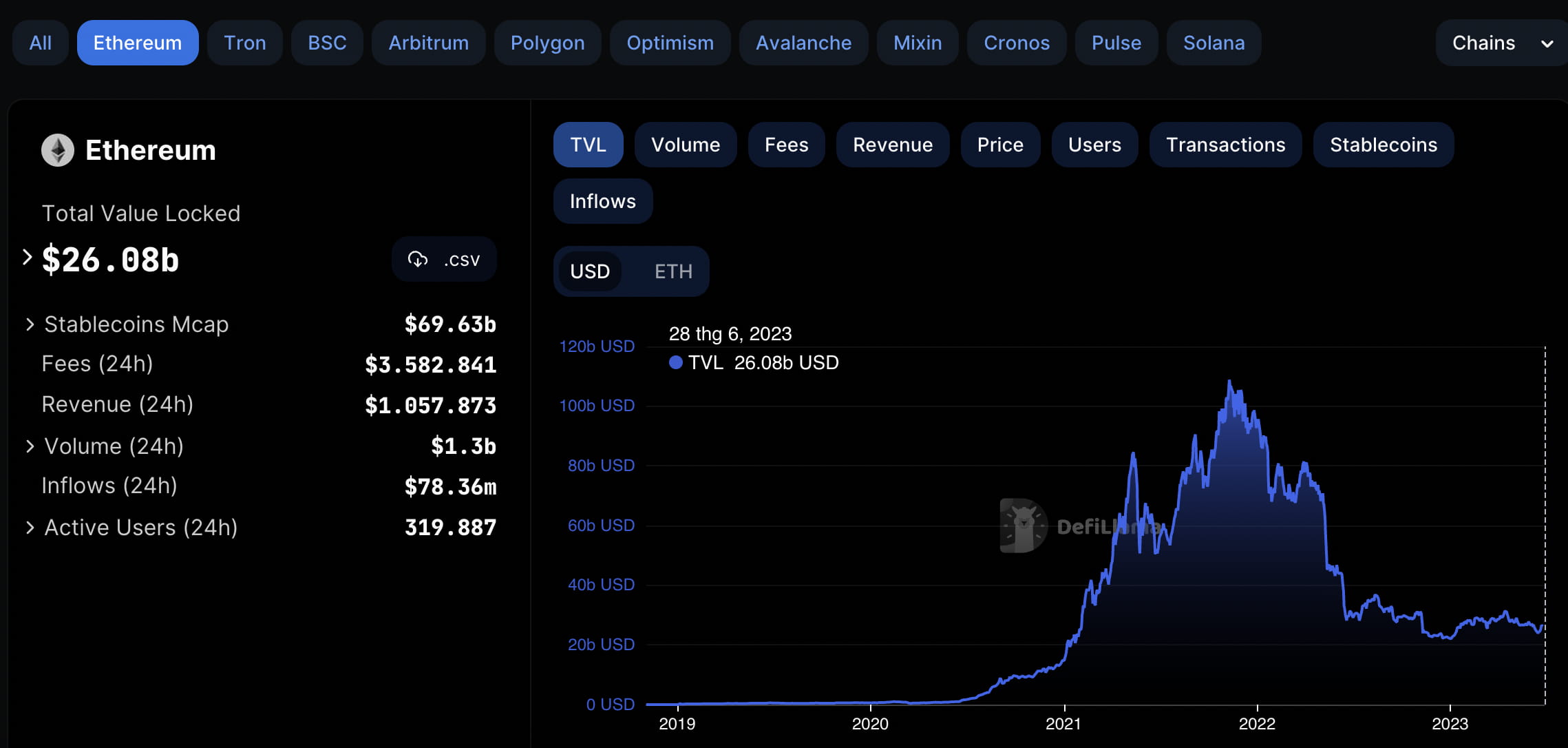
According to Defilama, up to now there have been more than 500 DeFi protocols developed on Ethereum with the total TVL of the entire system currently being $26.08B. The number of $26 billion is not small, especially in a bear market period like today.
Speaking of DeFi, the following are the niches that cannot be ignored: AMM/DEX; Yield Farming/Aggregator, Derivatives, Lending/Borrowing, Liquid Staking/Farming, Stablecoins, Bridge, Wallet. Let's go into detail about each niche.
1.1. AMM/DEX
Concept:
DEX is the acronym for Decentralized Exchange - a decentralized exchange built on blockchain, allowing users to exchange assets directly with each other without going through any intermediary organization.
On Ethereum, DEX includes 2 mechanisms: AMM and Order book. The Order book mechanism is effective for traders because they will know what the order matching price is. However, this mechanism is only suitable for markets with high liquidity like CEX. With the DeFi market with lower liquidity, AMM is considered the optimal mechanism for DEX, helping each transaction order to be matched more easily.
For example: Uniswap, Balancer, 1inch
AMM is an acronym for Automated Market Maker, which translated into Vietnamese means Automatic Market Maker. Instead of using a traditional exchange with an order book, users will trade with liquidity pools provided by liquidity providers.
Important features:
Notable points for AMM/DEX include: TVL, number of users, decentralization or liquidity.
Based on these factors, users can evaluate and choose the appropriate AMM/DEX for trading and investing.
Outstanding projects
For each ecosystem, it can be said that AMM/DEX is the first niche to receive cash flow from the market. And Ethereum is no exception. Among them, the most prominent project that can be mentioned is Uniswap.
Uniswap is the leading AMM DEX on Ethereum. Currently Uniswap's TVL is $4.1B, accounting for 14% of Ethereum's TVL. In addition, the number of monthly active users of Uniswap is up to 838.4K.
Other projects in the same niche:
Sushiswap: https://www.sushi.com/
Curve Finance: https://curve.fi/#/ethereum/swap
Balancer: https://balancer.fi/
1inch: https://1inch.io/
Kyber Network: https://kyber.network/
Bancor: https://bancor.network/
1.2. Yield Aggregator
Concept:
Yield Aggregator (also known as Yield Aggregator Protocol) is about optimizing yields from borrowing and lending transactions through automatically converting, finding and taking advantage of profitable opportunities from many transactions. Different DeFi formats.
Important features:
Automation: Yield Aggregator automatically executes trades and trading strategies to maximize returns for users. By combining and leveraging the features of different DeFi protocols, Yield Aggregator simplifies the process and helps users save time and effort.
Diversification: Yield Aggregator uses capital supply from various DeFi protocols to optimize yield and reduce risk. Dispersing capital across multiple protocols minimizes the risk of loss and provides more stable profits for users.
Flexibility and Scalability: Yield Aggregator is capable of integrating and interoperating with many different DeFi protocols and projects on Ethereum. This provides flexibility and scalability, allowing users to take advantage of lucrative opportunities from emerging projects and protocols in the DeFi ecosystem.
Outstanding projects:
Yearn finance: Yearn Finance allows users to optimize earnings on crypto assets through lending and trading services.
Instadapp: Instadapp helps users automatically execute borrowing, lending, and asset conversion transactions between DeFi protocols to take advantage of profitable opportunities. In addition, the project also provides analysis tools and strategic recommendations to help users make smart decisions in managing their investment capital.
1.3. Derivatives
Concept:
Derivatives are financial derivatives created from an underlying asset such as currency, stock, commodity or cryptocurrency. It is used to buy or sell a future asset at a previously agreed value.
Derivative contracts allow users to profit from the price fluctuations of the underlying asset without directly owning the asset.
Important features:
The most notable point for Derivatives is leverage: Users can buy or sell an amount of assets larger than the capital actually used, increasing the ability to generate higher profits. However, using leverage also carries great risks and can lead to losses.
Outstanding projects:
dYdX: founded in 2017, dYdX is a decentralized trading platform that allows users to trade derivative products such as: Spot, Margin and Perpetuals trading.
Synthetix: Synthetix is an open protocol that allows users to create synthetic assets linked to the value of different assets such as currencies, stocks, and commodities. Synthetix helps create a financial derivatives environment in the Ethereum ecosystem, opening up many investment and risk management opportunities for users.
1.4. Lending/Borrowing
Concept:
Lending/Borrowing is a form of allowing users to lend money or borrow cryptocurrency from others without the need for intermediaries like traditional banks.
Important features
Asset diversification: Users can use assets such as ETH, stablecoins or ERC-20 tokens to engage in lending/borrowing activities. This creates many investment and asset leveraging opportunities.
Assurance Mechanisms: Lending/Borrowing projects often apply assurance mechanisms such as smart contract transactions and provide transparency to ensure safety and reliability for users.
Outstanding projects:
Aave: https://aave.com/
Compound: https://compound.finance/
The most prominent project in the field of Lending/Borrowing on Ethereum is Aave. Aave is considered the “big brother” in the DeFi village. This is a protocol that allows users to deposit money into the system to earn interest and borrow ERC-20 types.
Aave has been widely recognized in the blockchain community as one of the pioneering projects in the field of Lending/Borrowing on Ethereum with a TVL of up to $6.01B and a monthly active user base of about 31K.
Besides Aave, we can mention Compound - a lending project that acts as an intermediary to support people who want to deposit assets to earn more profit and people who need assets and want to mortgage them to borrow.
1.5. Liquid Staking/Farming
Concept
Liquid Staking is a term used to refer to protocols that allow users to participate in staking (deposit) a specific asset and receive in return a token representing the staked asset proportionally. 1:1. For example, when users participate in staking ETH on the Lido protocol, they will receive stETH at a corresponding rate.
Important features
Bringing liquidity to staking assets: One of the reasons to develop liquid staking is to solve the problem of lack of liquidity. Users can use representative tokens to earn additional yield in many different ways such as lending or continuing transactions to increase capital efficiency for users.
Providing flexibility for staking assets: The main difference between Liquid Staking and direct staking lies in the fact that when participating in Liquid Staking, the user's assets are not completely locked. Instead, protocols will issue users a representative token at a 1:1 ratio.
This allows users to sell representative tokens at any time during strong market fluctuations, to limit losses to a minimum. An interesting example is the collapse of LUNA, when many users were unable to unlock their assets in time and suffered heavy losses.
Reduced risk in case of validator problems: Compared to direct staking, Liquid Staking offers significant technical benefits.
During the normal staking process, token holders delegate their tokens to a single validator, and the staked tokens can be lost if the validator takes actions that damage the network.
However, with Liquid Staking Pool, tokens will be delegated to many validators to reduce the risk of asset loss.
Furthermore, Liquid Staking protocols also have insurance funds to compensate customers in case of need. This increases safety and reduces risk for users participating in Liquid Staking.
Outstanding projects:
A prominent project in the field of Liquid Staking/Farming on Ethereum is Lido Finance. Lido Finance is a DeFi platform that allows users to stake crypto assets in a PoS protocol.
When users participate in ETH staking, they will receive stETH. This token will then be staked by the smart contract with node operators selected by Lido Finance's DAO.
User staking funds will be aggregated into the DAO's escrow account, ensuring that node operators do not have direct access to user assets.
Additionally, stETH can be reinvested on supporting DApps such as Curve, MakerDAO, Aave, Anchor Protocol, Balancer, Zapper and many more.
1.6. Stablecoins
Concept
Stablecoins are cryptocurrencies designed to have a stable value, typically equal to or close to the value of a traditional currency such as the US dollar. The main purpose of stablecoins is to help minimize price volatility and create a reliable means of payment and storage of value on the blockchain.
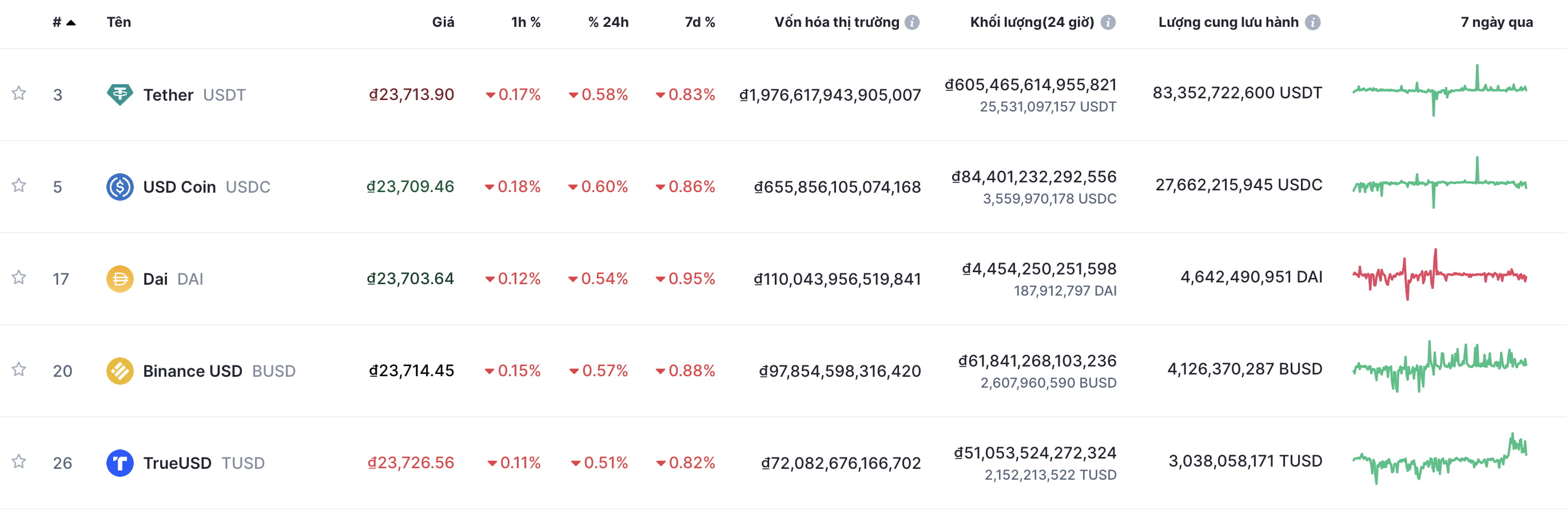
Featured projects: Top 5 stablecoins with the largest market capitalization include: Tether; USD Coin; TOUGH; Binance USD and TrueUSD.
1.7. Bridge
Concept
Bridge is a technology or protocol used to connect two different blockchains or blockchain networks, allowing the conversion and movement of assets from one blockchain to another.
The main purpose of bridges is to support the transfer/transaction of assets and information between blockchain networks
Important features: compatibility, safety and security.
Outstanding projects: Stargate Finance, Multi, Lifi, Celer, Boba,…
1.8. Wallet
Concept
A wallet is an application or platform used to store, manage, and trade electronic assets such as cryptocurrencies, tokens, and NFTs. Wallet provides a user interface through which users can create and manage personal accounts, make transactions, and interact with the blockchain.
Important features: safety and security; multi-asset management; blockchain integration.
Outstanding projects
Metamask: https://twitter.com/MetaMask
Trust Wallet: https://twitter.com/TrustWallet
MetaMask: MetaMask is a popular web browser-based wallet that allows users to create and manage multichain accounts, support EVM-compatible chains to conduct transactions, and interact with non-chain applications. concentrate.
Trust Wallet: Trust Wallet is an easy-to-use and secure mobile wallet that supports the storage and management of various types of electronic assets. It offers integration with multiple blockchains and allows users to make mobile transactions.
2. NFT
The next important piece of the puzzle is NFT. Ethereum is one of the ecosystems where the NFT segment is most strongly developed.
To learn more about the NFT niche, we can divide it into 3 small niches:
NFT collections
Financial applications for NFTs (NFTFi)
Marketplace
1. NFT collections
Concept:
NFT collectibles are collections of unique and irreplaceable digital works created on a blockchain platform. Each NFT work has a unique identifier and ownership information that is stored and validated by blockchain technology.
Key characteristics: uniqueness, ownership, value and community interest.
Outstanding projects:
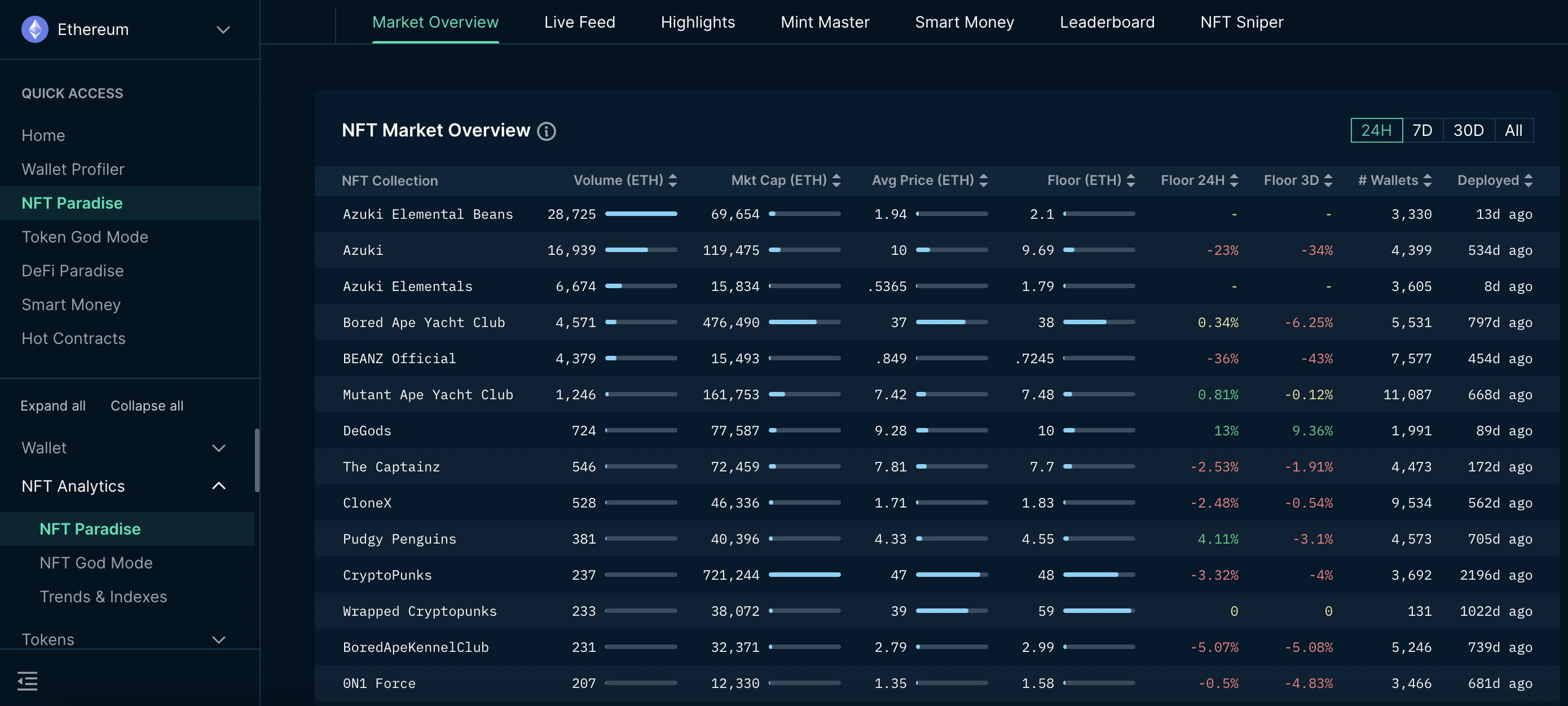
Featured NFT projects on Ethereum
As for NFT collections, the top ones include: Bayc, Azuki, Degods, Captainz, Punk, Pudgy Penguins, CryptoPunks...
However, recently, the entire NFT market has had certain fluctuations when many bluechip collections have sharply reduced prices, specifically:
Bored Ape Yacht Club reached a floor price of ~28ETH/ NFT
Azuki drops to ~5ETH/ NFT
Read more at: https://twitter.com/BigcoinVN/status/1673610883296276481*
2. Financial applications for NFTs (NFTFi)
Concept
Financial applications for NFTs (NFTFi) are a combination of two elements: NFT and Finance. This is the unique combination of NFTs with financial features such as borrowing, leasing, and trading, thereby helping to generate profits from NFTs.
Important features: With NFTFi, users can perform activities such as: borrowing, leasing, trading; thereby generating profits.
Outstanding NFT lending/Perps projects:
ParaSpace: this is an NFTFi protocol on Ethereum, allowing users to create, manage, and trade high-value NFTs. The protocol provides NFT borrowing, storage, and distribution features, facilitating profit generation from NFT assets.
NFTperp: NFTperp is a decentralized exchange (DEX) for NFTs on Ethereum. It offers infinite protocol trading and smart contracts specifically designed for NFT trading, allowing users to buy, sell and auction these unique digital assets.
Sudoswap: is a decentralized finance (DeFi) protocol on Ethereum, focused on generating profits from NFTs. It allows users to borrow, lease, and participate in NFT investment funds, facilitating value mining and generating profits from NFT assets.
Featured NFT marketplaces:
Blur: is a marketplace born after OpenSea but is considered a formidable competitor because of its high liquidity.
OpenSea: OpenSea is one of the leading NFT marketplaces on Ethereum, allowing users to buy, sell and explore thousands of NFTs from different asset types such as images, videos, music and games.
Rarible: Rarible is a decentralized NFT marketplace on Ethereum that allows users to create, buy, and sell unique NFT creations. It provides tools that allow users to create NFTs and profit from selling them.
SuperRare: SuperRare is an NFT marketplace focused on digital art, allowing artists to create, sell, and trade unique NFT works. This Marketplace places special emphasis on authenticating works and ensuring the uniqueness of each NFT.
3. Service delivery projects
3.1. Exchanges
Binance, OKx, Kucoin, Huobi,…
3.2. VCs
Polychain Capital is an investment fund focusing on blockchain and cryptocurrency projects, especially projects on Ethereum. In addition, we can name prominent funds such as: a16z, Polychain Capital, Coinbase Ventures, Pantera Capital, Delphi Digital, Hashed, Paradigm, Multicoin Capital, ...
3.3. Audits Parties
OpenZeppelin: a project that audits and ensures the security of projects on Ethereum.
ConsenSys Diligence: an open source authentication and security testing project on Ethereum.
CertiK: a project that provides security testing and smart contract validation services on Ethereum and other blockchain platforms.
3.4. Projects provide software services and tools
Infura: specializes in providing Ethereum blockchain platform node services, helping developers access and interact with the Ethereum network easily.
Truffle: a framework for developing and testing Ethereum-based applications.
Etherscan: a block browser, providing information about transactions, wallets, and other information on Ethereum.
III. Opportunities on the Ethereum ecosystem
Users have many opportunities when participating in the Ethereum ecosystem, specifically:
1. Invest in tokens/coins on Ethereum
Ethereum is a popular and widely used blockchain network, and offers potential investment opportunities. Ethereum has created the foundation for the development of DeFi projects, NFTs, and many other blockchain applications.
However, investing in any market has certain risks and the same goes for Ethereum. Because the value of tokens/coins can increase or decrease significantly at times of strong fluctuations. Investors need to consider and carefully research the project before making an investment decision.
2. Skin in the game to earn airdrops
Another opportunity in the Ethereum ecosystem is to participate in the community and earn airdrops from projects on Ethereum. Airdrop is the process of distributing free tokens/coins to individuals or communities to promote participation and enhance project development.
To receive the airdrop, users need to spend time "skin in the game". Participate in the community - showing interest and support for the project through holding tokens/coins will increase your chances of receiving an airdrop.
This also encourages users to participate in projects and become part of the Ethereum community, creating interaction and contributing to the development of the ecosystem.
3. Staking and Yield Farming
Ethereum provides opportunities for users to participate in staking and yield farming. Staking is depositing tokens into a smart contract to contribute to securing the Ethereum network and receive additional rewards. Yield farming is the practice of finding the best profitable opportunities by participating in transactions and providing liquidity on DeFi platforms. Both of these activities offer the opportunity to profit from holding and using tokens on Ethereum.
However, you need to learn carefully about projects before participating in staking/yield farming to avoid unnecessary risks.
4. Application development and smart contracts
Most of the above are opportunities for common users, so what about developers?
For developers with knowledge of Solidity and related technologies, they can leverage Ethereum's capabilities to build applications and smart contracts that can create new services and products. on the Ethereum platform and exploit the potential of the ecosystem.
5. Join DAOs
DAOs are decentralized organizations built on the Ethereum platform, where the community participates and makes decisions in a decentralized manner.
When participating in DAO, users will have the opportunity to participate in strategic decisions, resource allocation and earn profits from the organization's activities.
IV. Conclude
The Ethereum ecosystem has played an important role in promoting the development of blockchain and dapp technology.
With the ability to create and deploy smart contracts, Ethereum has opened a new door for building dapps and creating practical applications and technology solutions to serve users.
Ethereum is not simply a blockchain platform, but also a diverse and rich ecosystem with 3 important pieces such as NFT, DeFi and service providing projects. This has created a diverse and creative environment for both general users and developers.
However, each user should be aware that participating in the Ethereum ecosystem also comes with risks. The cryptocurrency market is volatile, and investing and participating in finding opportunities from projects on Ethereum requires users to master knowledge and conduct thorough research.
From an overall perspective, with its diversity and potential, Ethereum has been and will continue to create opportunities to explore many new fields in the future.
Reup: Theblock101