

Author: 100y, Four Pillars; Translation: Golden Finance 0xxz
Key Points
Polygon 2.0 is a ZK-powered L2 chain network that aims to become the value layer of the Internet, aiming to achieve scalability and interoperability through ZK technology.
According to the new blueprint, a new token economics of POL has been proposed, which is expected to play an important role before the Polygon 2.0 ecosystem matures.
1. The path to mass adoption
1.1 Introduction
Although the current cryptocurrency market price is still far below the highs of the last bull run, the blockchain space is more diverse than ever. In particular, the last bull run was largely due to a favorable macro environment and a lack of meaningful real-world use cases for blockchain, which saw many protocols focus their direction on mass adoption in the current market.
For mass adoption, there is not just one area to improve, but many areas. First, it is important to enhance the UI/UX of services such as wallets, which are often the initial touchpoint for users to use blockchain. Second, more practical blockchain services need to be provided to users. Finally, a sound infrastructure is needed to facilitate the easy use of blockchain by many users.
1.2 Different types of blockchain networks moving towards mass adoption
This article will explore the concept of mass adoption from an infrastructure perspective, but what should a network designed for mass adoption actually look like? So far, different blockchain networks have proposed unique approaches and strategies.
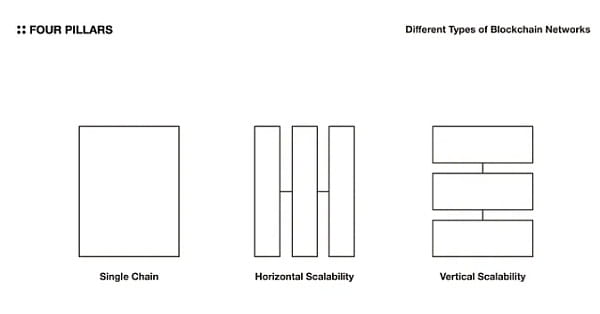
The first is to optimize on a single chain. This is the approach taken by Solana, Sei, Aptos, Sui, and others. The advantage of a single chain is that the various dApps in the chain can interact with each other in a seamless combination. However, the disadvantage is that the performance of the network is determined by the lowest-performing node, and the network may become centralized because nodes require higher-spec hardware to achieve high scalability.
The second is to build an ecosystem with multiple L1 networks and appropriate cross-chain protocols. Cosmos, Polkadot, and Avalanche are some examples of this approach. The advantage of this approach is that scalability can theoretically be infinitely increased through parallel expansion, but the disadvantage is that despite the existence of cross-chain protocols, the asynchronous nature of different networks reduces composability and fragments the ecosystem and security.
The third approach is to increase scalability vertically, such as rollup networks based on a single base layer. Examples of this approach include Optimism, Arbitrum One, and Starknet. The advantage of this approach is that it allows high scalability while still benefiting from the security of the base layer by performing off-chain computations, and it allows various applications to interact with high composability within one network. However, the disadvantage is that L1 limits the scalability of L2 to some extent, and as Vitalik Buterin pointed out, there is a limit to how much scalability can be increased vertically using the same vertical scaling structure.
All of the above approaches are important because they provide directions for mass adoption, but they all have distinct advantages and disadvantages. Therefore, in recent years, an approach has emerged that combines the advantages of the above approaches, as shown in the figure below.
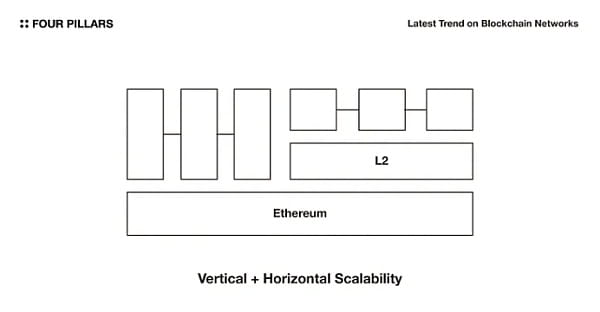
In addition to Polygon, which we’ll discuss in this article, all of the leading rollup networks — Optimsim’s OP Stack, Arbitrum’s Orbit, zkSync’s ZK Stack, and Starknet’s Fractal Scaling — are seeking to increase both vertical and horizontal scalability.
In the above approach, multiple L2 or L3 networks share the base layer, which has the advantages of 1) inheriting the strong security of the base layer and eliminating security fragmentation, 2) achieving theoretically unlimited scalability by running networks in parallel, and 3) achieving more seamless and secure interoperability and composability through a shared settlement or data availability layer.
In my opinion, this is the best model for blockchain mass adoption because 1) the security of the blockchain network needs to be unified and not fragmented in order for large amounts of money to flow, 2) it needs to provide a high level of scalability for users, and 3) asset transfers and interactions need to be seamless and secure even when there are multiple networks.
2、Polygon 2.0
(Source: Polygon)
2.1 The value layer of the Internet
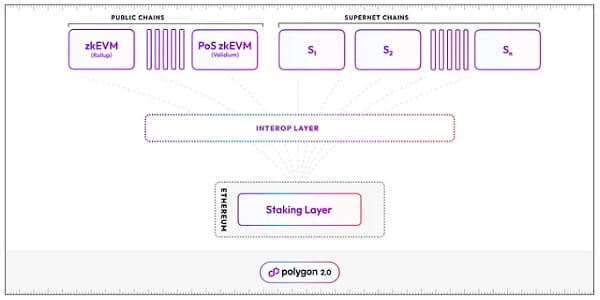
Recently, Polygon released the Polygon 2.0 blueprint, which builds on the above approach and has the vision of a "value layer for the Internet." Just as anyone can create and exchange information on the Internet, the value layer is a protocol that allows anyone to create, exchange, and program value.
The values of Polygon 2.0 are "infinite scalability" and "unified liquidity", which are achieved through a ZK-driven L2 chain network. On the user side, despite using multiple ZK L2 chains, the UX feels like using a single chain.
2.2 Polygon PoS → Validium
(Source: Polygon)
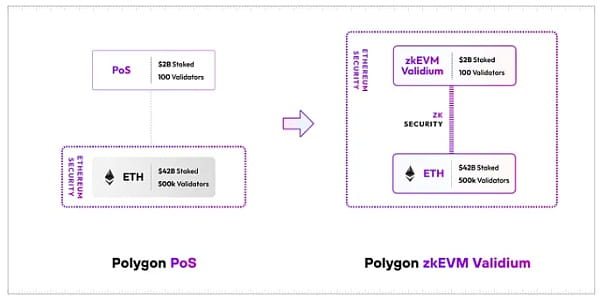
Before we dive into the architecture of Polygon 2.0, Polygon co-founder Mihailo Bjelic published a proposal on the governance forum to upgrade the existing L1 network Polygon PoS to validium to realize the vision of Polygon 2.0. Polygon already has a ZK L2 technology compatible with Ethereum, called Polygon zkEVM, which is currently running well.
First, the introduction of zkEVM can rely on the security of the Ethereum network to a certain extent, because the validity proof of the calculation results of the PoS network will be verified on the Ethereum network. Secondly, the existing Polygon PoS validators will manage transaction data instead of the Ethereum network, which can achieve lower fees and faster speeds compared to the rollup model.
This slightly changes the role of validators on the PoS network: first, they will continue to ensure the availability of transaction data, and second, they will act as sequencers to determine the order of transactions on the L2 network.
2.3 Polygon 2.0 Architecture: ZK-driven L2 Chain Network
(Source: Polygon)
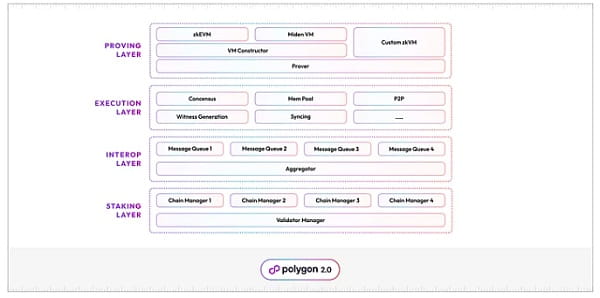
Polygon 2.0 is an ecosystem of ZK L2 chains based on Ethereum. These ZK-powered L2 chains are called "Polygon Chains". What does the structure of Polygon 2.0 look like in terms of vertical and horizontal scalability improvements? Just like the Internet has a layered structure called the Internet Protocol Suite, Polygon 2.0 also contains layers that perform different roles.
2.3.1 Pledge Layer
The Stake Layer is the layer responsible for all transactions of Polygon 2.0 validators. It exists as a smart contract on the Ethereum network and there are two types:
ValidatorManager - A smart contract that manages the validator pool in the Polygon 2.0 ecosystem, including a list of all validators, which validators participate in which Polygon chains, their stake sizes, stake/unstake requests, penalties, and more.
Chain Manager - A smart contract exists for each Polygon chain that manages the list of validators, verifies the configuration of that chain (e.g., maximum/minimum number of validators, slashing conditions, type/size of tokens required for staking), etc.
Validators can join the public validator pool in Polygon 2.0 by staking tokens and participate as validators on multiple Polygon chains as needed. Validators in Polygon 2.0 are basically responsible for sorting and verifying users' transactions to create blocks, as well as generating ZKP proofs and ensuring the availability of transaction data.
Validators are compensated for their various roles, including 1) protocol rewards, 2) transaction fees from participating in the Polygon Chain, and 3) additional rewards from Polygon Chains (e.g., native tokens).
2.3.2 Interoperability Layer
(Source: Polygon)
The interoperability layer enables seamless cross-chain messaging in the Polygon 2.0 ecosystem, making users feel like they are using a single network even though they are actually using multiple networks.
Each Polygon chain manages a message queue, which is a message sent to other Polygon chains, containing 1) content, 2) target chain, 3) target address, and 4) metadata. The message queue has a corresponding ZKP, and if the ZKP of a specific message is verified on Ethereum, the target chain can safely perform this cross-chain transaction.
However, since ZKP is expensive to verify on Ethereum, the interoperability layer also adds an aggregator component that brings together multiple ZKPs generated by the message queue in the Polygon chain and allows them to be verified cheaply on the Ethereum network. Since the aggregator needs to be decentralized to guarantee liveness and censorship resistance, it is managed by Polygon 2.0's universal validator pool.
In fact, cross-chain interactions are such that once the aggregator receives the ZKP, the target chain processes the transaction in the best possible way, providing users with a “unified liquidity” experience as transactions are processed almost instantly and atomically despite using multiple networks.
2.3.3 Execution Layer
The execution layer is the layer where actual computation occurs in Polygon Chains, and it has components similar to typical blockchain networks (e.g. P2P communication, consensus, Mempool, database, etc.).
Polygon Chains are highly customizable at the client level, including the native token, transaction fee flow, additional validator rewards, block time and size, checkpoint time (frequency of ZKP submissions), and rollup/validium selection.
2.3.4 Proof Layer
Since Polygon 2.0 is a collection of ZK-driven L2 chains, ZKP plays a very important role, and the proof layer is responsible for generating ZKP for each transaction on the Polygon chain. The prover uses Plonky2 developed by the Polygon team.
3. New Token: POL
3.1 Token Economics
While we have been taking a closer look at Polygon 2.0, it has become clear that achieving this vision involves both protocol economics and technology. In response, Mihailo Bjelic, Sandeep Nailwal, Amit Chaudhary, and Wenxuan Deng proposed a new token model called POL to the Polygon community.
In the white paper, they set the design goals of POL as 1) ecosystem security, 2) unlimited scalability, 3) ecosystem support, 4) frictionless, 5) community ownership, and proposed the following practical utilities:
Validator Staking: Validators in Polygon 2.0 must stake POL tokens to participate in the validator pool.
Validator Rewards: Predefined rewards must be provided to validators on an ongoing basis. Validators receive protocol rewards by default, and can also receive transaction fees or additional incentive rewards from Polygon Chains.
Governance: Tokens will be used for governance, the governance framework has not yet been disclosed. There will be a new community treasury that will be managed by POL token holders and will help support the ecosystem.
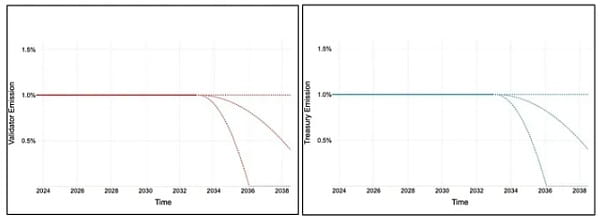
The initial supply of POL tokens is 10 billion, migrating 1:1 from MATIC, with a suggested annual inflation rate of 2%:
Validator Rewards: Validators will receive an additional 1% of the total supply for the first 10 years, after which the community can decide through governance whether to maintain or reduce this share.
Ecosystem Support: In the first 10 years, an amount equal to 1% of the total supply will be provided to the newly launched community treasury, which can be used for ecosystem support through community governance. After 10 years, the community can decide through governance whether to maintain or reduce this amount.
(Source: Polygon)
Unlike the existing MATIC token economy (where the total MATIC supply is fixed at 10 billion), the POL token will have an inflation rate of 2% per year for 10 years. This inflationary supply will serve the network well until the Polygon 2.0 ecosystem is mature enough. Once the Polygon 2.0 ecosystem is complete and sustainable through transaction fees, the community can reduce inflation through governance. Considering that the current inflation rate of the Bitcoin network is about 1.8%, 2% is not a huge number.
3.2 Simulation
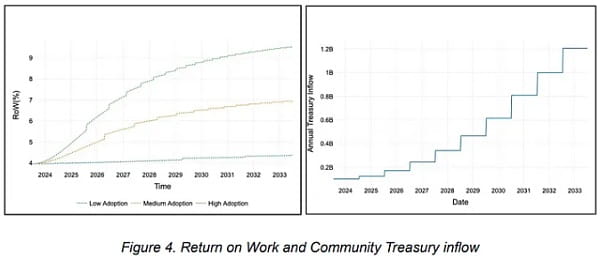
But how realistic are the token economics of the new POL token? Will the network be secure enough, will validators be sufficiently incentivized, and will the ecosystem be sufficiently supported? Polygon simulated these questions and included the results in the whitepaper.
Based on a number of assumptions, it is clear that even in the worst case scenario, validators can earn 4-5% annual incentives and the community treasury will be adequately funded. (Note that the size of the community treasury is calculated using an average price of $5 per POL).
The average transaction fee of Polygon public chain is US$0.01 (the current average fee of Polygon PoS), the average number of validators is 100, and the average TPS is 38.
The average transaction fee of Supernets Polygon Chains is $0.001, the average number of validators: 15, and the average TPS: 19.
Average annual operating cost per validator: $6,000 (applying a modified version of Moore’s Law, operating costs halve every three years)
(Source: Polygon)
3.3 Comparison with other tokens
At first glance, the proposed POL token economy is similar to Polkadot’s DOT, Cosmos’ ATOM, and Avalanche’s AVAX, but there are some differences.
First of all, there is a big difference between POL and DOT: for a network built on the underlying layer to become a parachain, a large number of DOT tokens need to be locked into the Polkadot relay chain through a process called a parachain auction. However, in Polygon 2.0, anyone can deploy a Polygon Chain, and validators who meet the verification requirements can participate.
Secondly, POL is slightly different from AVAX and ATOM (which supports ICS) because what all three have in common is that validators who stake the native token can participate as validators on multiple networks, but they differ in inflation rate, governance, etc. .
4. Final Thoughts
As the blockchain industry and technology mature, there are more and more attempts to improve the scalability of the network vertically and horizontally, and Polygon 2.0 is taking this path. Although other leading L2 projects (such as Optimsim, Arbitrum, zkSync, Starknet) are also making similar attempts, what makes Polygon 2.0 different is: 1) zkEVM technology with high Ethereum compatibility, 2) cross-chain solutions using ZKP.
While other projects have referenced cross-chain solutions for multiple L2/L3 chains, few projects have provided detailed cross-chain solutions. Recently, cross-chain projects have begun to use ZK technology (such as zkBridge, Electron Labs, Polymer Labs, etc.), and Polygon 2.0 also has the ability to utilize ZKP in its cross-chain solution, aiming to provide an excellent cross-chain user experience.
Let’s wait and see whether Polygon 2.0 together with ZK technology can achieve scalability and interoperability, potentially becoming a value layer for the Internet.