
As one of the first platforms to successfully introduce the concept of Smart contracts, Ethereum has gradually matured and become the largest ecosystem in the crypto market. The ETH ecosystem is not only built by thousands of DApps, but moreover, the number of users on the ETH network also reaches tens of millions of users. However, Ethereum's technological developments, even after many upgrades, still have many limitations, one of which is scalability. To solve this problem, Layer 2 was born, providing a long-term technology solution to help Ethereum receive billions of users in the near future. So what is Layer 2? What are the top 5 most outstanding Layer 2 projects...
I. Introduction to Layer 2 on Ethereum
1. What is Layer 2?

Before learning about Layer 2, we need to understand the definition of Layer 1. This is a blockchain architecture term that refers to the core layer of a main blockchain system. Layer 1 acts as the foundation, providing infrastructure to develop Dapps.
To put it simply, Layer 2 is a solution created to enhance the scalability of Layer 1, while also inheriting some important characteristics of Layer 1 such as security and decentralization.
In essence, Layer 1 handles security, data availability, and decentralization, while Layer 2 is in charge of providing network scalability solutions. Layer 2 offers the following advantages:
Lower fees: Layer 2 combines multiple off-chain transactions into a single Layer 1 transaction, reducing data load; additionally maintains security and decentralization by settling transactions on the native network.
Faster transaction speeds: Through the combined advantages of higher TPS and lower fees, Layer 2 projects can focus on improving user experience and expanding application scope.
You can imagine Layer 2 like a restaurant kitchen - if each order had to be filled by a single person from start to finish, the process would be very slow, only a few orders could be completed. For an hour.
However, Layer 2 is like the preparation stations – there is a cleaning and food preparation station, a cooking station, a food arrangement station – then the restaurant will centrally deploy and perform each task. efficient service; Helps the process of delivering food to customers faster.
2. Layer 2 classification
Layer 2 solutions are divided into 5 types:
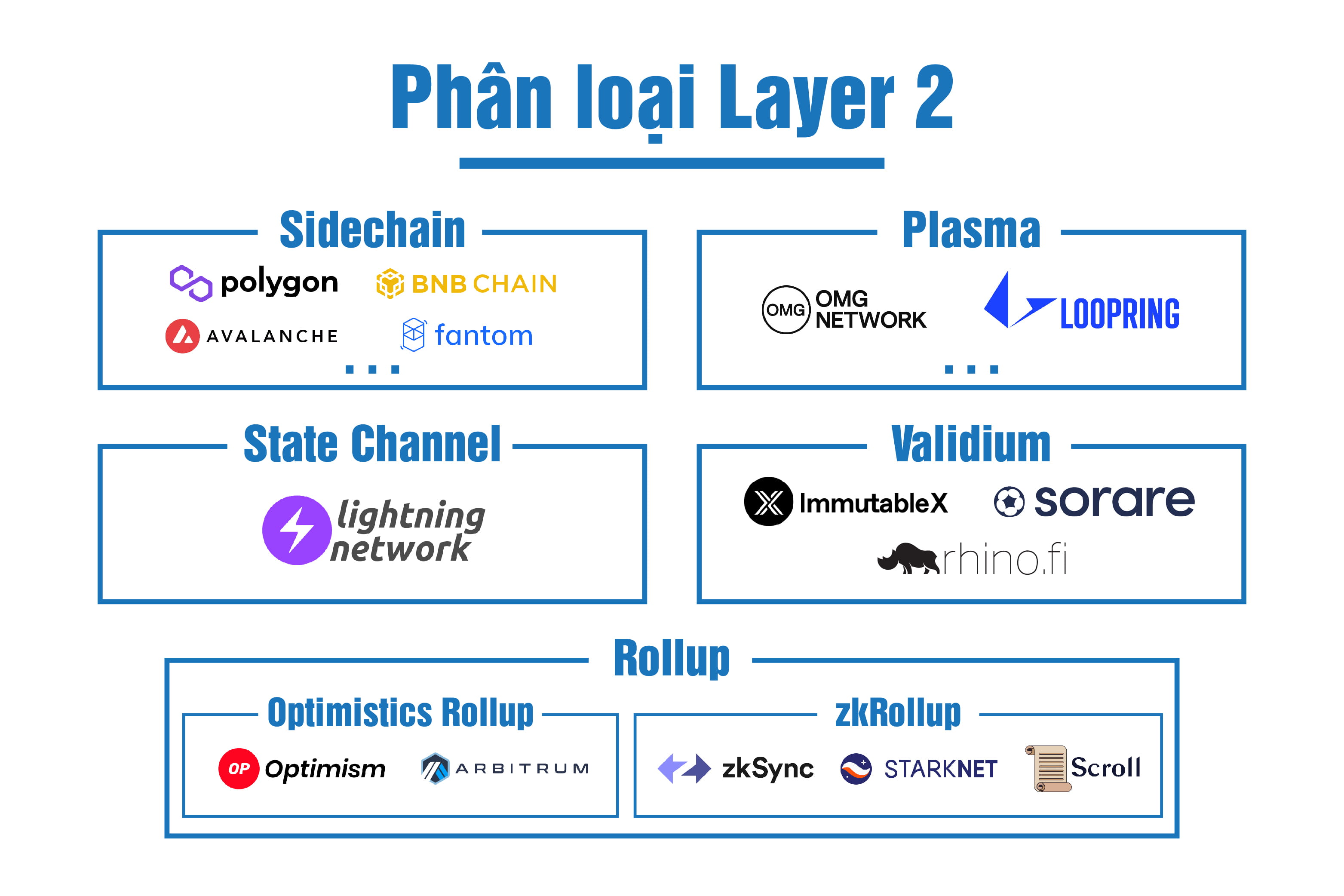
Sidechain: Polygon, Binance Chain, Avalanche C-Chain, Fantom,…
Plasma: OMG Network, Loopring,…
Rollups include:
Optimistics Rollup: Optimism; Decision
zkRollup: zkSync; StarkNet, Scroll
State Channel: Lightning Network
Validium: Immutable, Sorare, RhinoFi
In recent times, not all solutions have received attention and not all solutions have long-term growth potential. Among the 5 solutions, Rollup is the solution that has developed the most compared to the remaining solutions when Arbitrum and Optimism received attention from a large number of users both before and after the listing time.
So what is Rollup? And what is the reason for its outstanding development? Let's learn more in the next section.
In addition, to understand more about the remaining solutions, you can read the following article: 2 ways to help Ethereum improve Blockchain Trilemma.
3. The superiority of the Rollup solution
3.1. Concept:
Rollup is a solution that helps Ethereum increase speed and reduce costs by rolling transactions on Layer 2 into a form of data (as shown below, Tx), then the compressed data will be added to a block; The blocks will then be sent to Ethereum for validation. From there, Ethereum can reduce the large number of transactions that need to be authenticated - helping Ethereum gradually reduce network congestion.
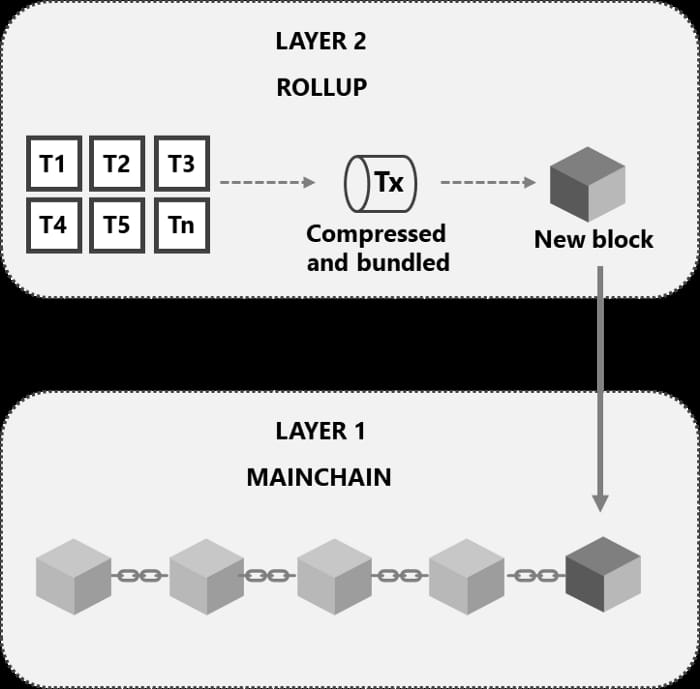
Rollup includes 2 solutions: Optimistic Rollup and zk Rollup. So which projects is each solution applied to? Let's find out through the next sections.
3.2. Optimistic Rollup
Optimistic rollup processes off-chain transactions combined with compression techniques to consolidate transactions. Compression reduces gas fees and optimizes block space by storing only necessary data on the Ethereum (L1) blockchain. Therefore, optimistic rollup allows the root chain to process more transactions while requiring less space.
Optimistic rollup relies on the “optimistic assumption” that most transactions are valid and only performs a costly verification process when there is a dispute. Network participants can raise disputes about faulty blocks for 7 days.
If there are any faulty blocks, the validator that approved them will lose their collateral. However, this complex fraud detection process also requires a week to process withdrawals from the chain.
L2s applying the Optimistic Rollup solution include:
Arbitrage ($ARB)
Optimism ($OP)
3.3. zk Rollup
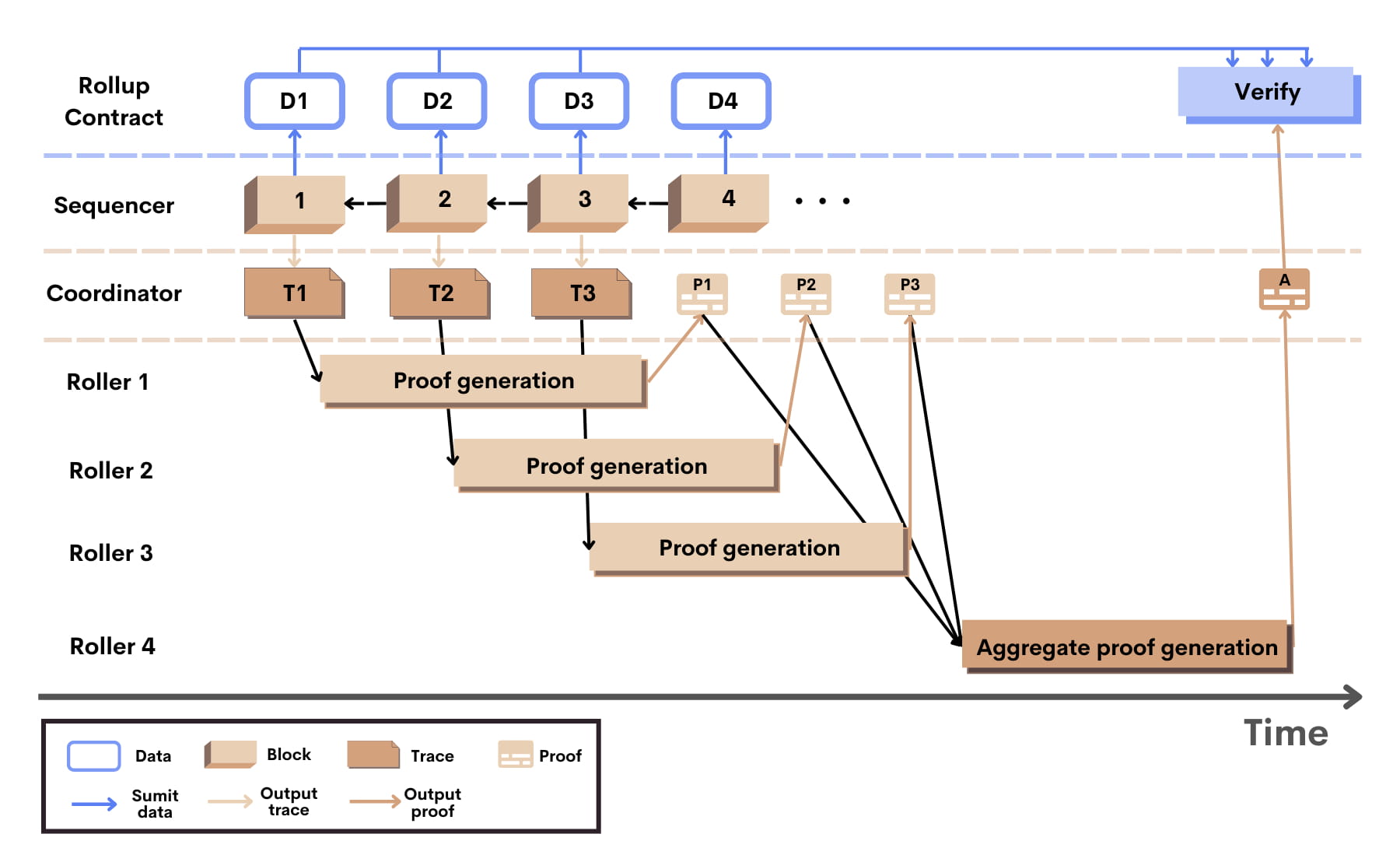
ZK Rollup is a solution that allows aggregating a large number of transactions into a Rollup block off the main chain and generating a concise proof for that block.
Instead of re-executing transactions on the main chain, smart contracts on Ethereum Layer 1 simply verify that proof.
This saves significant gas fees, as verifying proofs is often much cheaper than re-doing the calculations of transactions.
From there, ZK Rollup provides scalability and reduces the load on the Ethereum main chain, while saving costs and increasing transaction processing speed.
Projects applying the zkRollup solution include:- Polygon zkEVM
zkSync
StarkWare
Scroll
In this article, Theblock101 will explore the top 5 projects that have received the most attention recently: Arbitrum; Optimism, zkSync, StarkWare and Scroll.
II. Top 5 most prominent Layer 2 projects
1. Decision
1.1. What is Arbitrum?
Arbitrum was built by the Offchain Labs team, to provide a Layer 2 scaling solution for Ethereum, supporting fast smart contract transactions while reducing transaction costs.
According to the 2023 Developer Report, Arbitrum is one of the fastest growing Layer 2 solutions with the number of developers growing more than 50% annually.
Learning about Arbitrum, there are 3 versions that cannot be ignored: Arbitrum Nitro, Arbitrum Nova and Arbitrum One. Arbitrum Nitro can be understood as version V1; Arbitrum Nova is version V2 and the final version is Arbitrum One - this is also the current version of the network.
1.2. Highlights of Arbitrum
- Technology: Realizing the limitation of Optimistic Rollup technology, when it takes 7 days to withdraw money from Layer 2 to Layer 1 Offchain Labs - the team behind Arbitrum has changed to Anytrust technology - trust anyone .
Anytrust basically has the same mechanism as Optimistic Rollup, the only difference is that this technology will create a group to review transactions; From there, the data will no longer need to wait 7 days.
Suppose the group is operated by 20 people, when one person has finished processing the data and can prove it correct, another person will verify it one more time. After that, the remaining 18 people will completely trust and approve the transaction without needing to check again. If an unusual transaction occurs, the team can return to the traditional Optimistic Rollup mechanism.
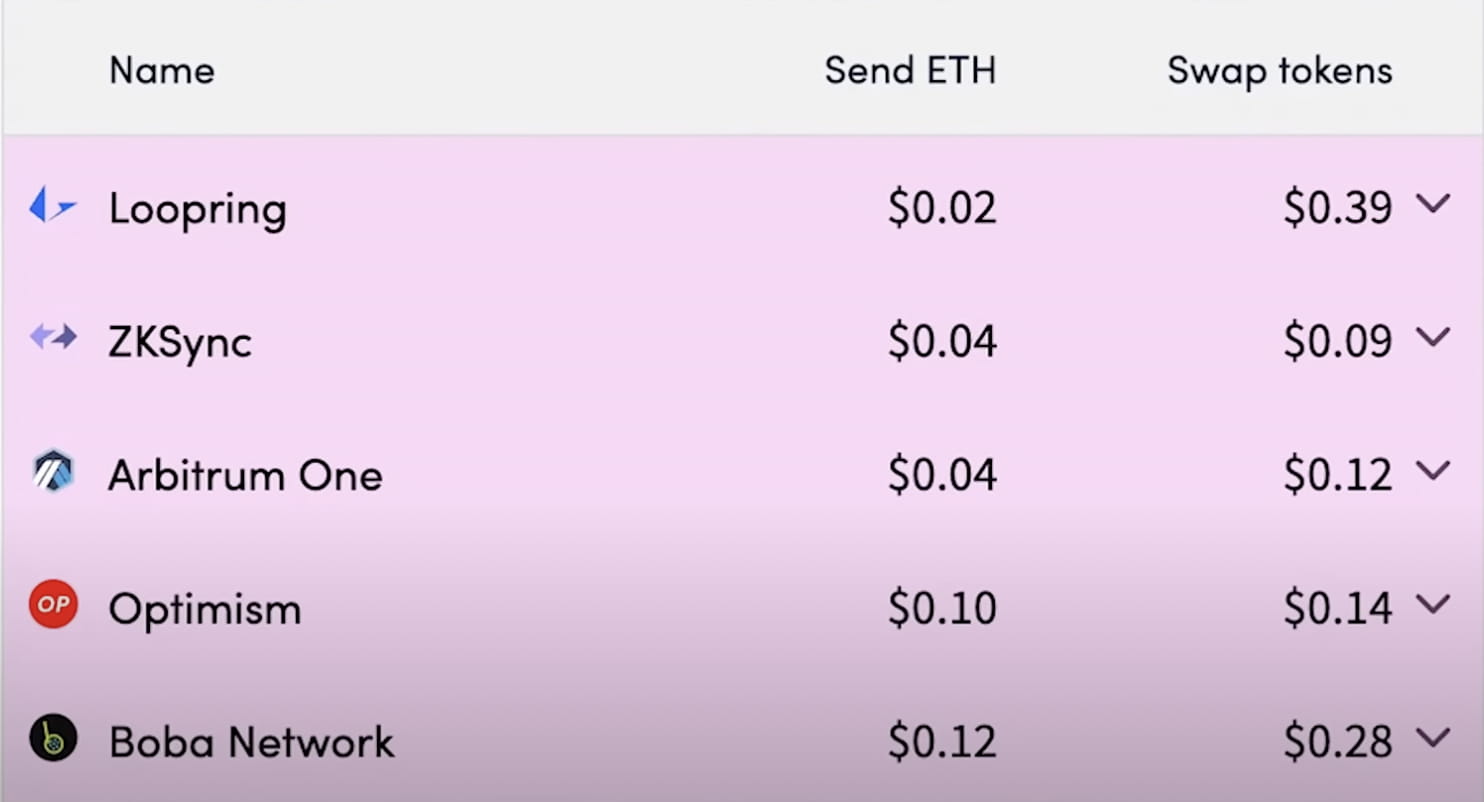
- Cheap fees: Arbitrum has much cheaper fees than Layer 1 blockchains like ETH or ADA. Arbitrum also has competitive fees compared to other blockchains in the same segment, specifically:
- Diverse and unfettered Dapps: the free development environment is maximized with Arbitrum. The policy that brings many developers to Arbitrum is no KYC. However, this difference is also a double-edged sword when it becomes an attraction for scammers.
2. Optimism
2.1. What is Optimism?
The second project using the Optimistic rollup solution is Optimism.
Optimism is a Layer 2 blockchain, which helps reduce transaction fees and transaction times on the Ethereum blockchain. Up to now, there are quite a few names using Optimism's technology such as Coinbase, Magi, Combo Network, ...; This is considered an advantage of the project.
2.2. Strengths of the project
Here are some of the benefits Optimism brings:
Scalability: Optimism can achieve a 10–100x improvement in scalability, depending on the nature of the transaction.
Reduced Fees: Optimism can assist in significantly reducing the overall cost of trading. The project's rolling technology combines multiple transactions into a single transaction, helping to reduce transaction costs.
Security: As Optimism's Layer 2 is built on Ethereum, transactions are settled on the Ethereum Mainnet allowing users to benefit from the secure and decentralized environment of the Ethereum blockchain.
Enhanced User Experience: New projects using Optimism's Layer 2 scaling solution benefit from lower fees, faster transactions, and a better overall user experience.
Compare the differences between Arbitrum and Optimism:
Although Arbitrum and Optimism are both projects applying the optimistic rollup solution, however, the two projects have certain differences:
Optimism and Arbitrum are both EVM compatible, but Optimism uses Ethereum's EVM and Arbitrum uses its own AVM (Arbitrum virtual machine). This results in Optimism only having a Solidity language compiler while Arbitrum supports all EVM compiled languages (Vyper, Yul,…)
The second difference is that Optimism relies on a single “proof of fraud,” which helps process transactions faster but is easy to counterfeit. Meanwhile, Arbitrum requires multiple proofs to confirm valid transactions to help ensure more security for the network.
3. zkSync
3.1. What is zkSync?
zkSync is a Layer 2 scaling solution that provides cheaper and faster transactions than the Ethereum blockchain. zkSync uses zero-knowledge proof technology to ensure privacy and security during transaction processing.
3.2. Strengths of the project
zkSync has many different pieces of the puzzle in place to become a full ecosystem. One of the outstanding benefits of zkSync is low fees and shortened transaction processing time compared to L1 or Optimistic Rollup, specifically:
Transfer fee: $0.02
Withdrawal fee: $1.59
One-time activation fee: $0.44
NFT mint fee: $0.05
The first benefit that zkSync brings is: the project supports “super gas-free transactions”, in which users pay gas fees with transferred tokens. For example, users depositing DAI will need to pay fees in DAI.
The second benefit is smart contract interoperability. Developers can reuse Solidity code. The third benefit is the support of atomic swaps and limit orders, something that is very important for cryptocurrency exchanges. zkSync also supports native layer 2 NFTs and is completely open source.
4. StarkWare
4.1. What is StarkWare?
StarkWare was founded in January 2018, helping improve blockchain scalability and privacy by using STARK technology to implement and verify zero-knowledge proof.
Up to now, StarkWare includes outstanding products such as: Cairo, Sharp, VeeDo, StarkEx, StarkNet.
Cairo is the generic computational programming language of Starkex à StarkNet
SHARP is a system that allows a collection of Cairo Programs to be collected to create a proof and put it on Ethereum for it to be verified. This is also a tool to help reduce gas fees for transactions.
Veedo: trustless randomness feature can be verified thanks to STARK technology, similar to Chainlink's VRF. This feature is used a lot in systems that need randomness such as card games.
Starkex and StarkNet are L2 zk Rollup solutions, which aim to improve the scalability and performance of Ethereum by transferring transactions from the main chain (on-chain) to the side chain (off-chain), reducing the load to the main chain and enhance security.
4.2. Strengths of the project
Cairo Programming Language: StarkNet is not zkEVM, which means smart contracts must be written in StarkNet's own programming language - Cairo.
This programming language is developed and upgraded from Solidity, so if developers can learn Cairo, building dapps on StarkNet is easy.
Smart contracts written for Ethereum can be converted to Cairo using the Warp tool.
High performance: Stark technology and StarkWare's Layer 2 solution enable processing of thousands of transactions per second; helps improve performance and increase system scalability.
Scalability: StarkWare solves Ethereum's scalability problem by moving a large portion of transactions and computations onto the sidechain (Layer 2). This helps reduce the load on the main chain and enhances the security of the system.
Security: StarkWare uses zero-knowledge proofs technology to verify the accuracy of transactions without revealing specific information. This ensures user privacy and security, while reducing the risk of attacks and fraud.
5. Scroll
5.1. What is Scroll?
Scroll is a Layer 2 project launched in early 2021, using zk-rollup technology to process transactions outside of Ethereum to help reduce costs and increase transaction speed.
5.2. Project highlights
Compatible with EVM: Scroll is a fully EVM compatible project, helping developers easily move dapps between layers without requiring too complicated coding skills, helping to save time for developers. developers. developers.
Scalability: Scroll zkRollup offers a more efficient and cost-effective trading experience than the native Ethereum blockchain.
By bundling multiple transactions into a single proof, Scroll helps reduce congestion, improve throughput, and reduce transaction fees. This enhanced extensibility opens up new possibilities for users and developers alike.
Security: Scroll zkRollup leverages the security of the Ethereum native network, ensuring the safety of user funds. By anchoring zkRollup transactions to the Ethereum mainnet, Scroll benefits from the robust security infrastructure already in place, providing users with a trusted environment.
III. Conclude
In summary, the top 5 potential Layer 2 projects on Ethereum including Arbitrum, Optimism, zkSync, StarkNet and Scroll have achieved significant achievements in improving Ethereum's scalability.
Arbitrum and Optimism already have tokens and are attracting community attention. In the group of L2s using zkRollup, zkSync stands out with its large fundraising and an ecosystem of potential applications.
In the long term, applying the zkRollup solution - a solution assessed by Vitalik as having superior potential compared to Optimistic Rollup. Nevertheless, all five projects make important contributions to the development and improvement of Ethereum's scalability. These Layer 2 solutions will be indispensable factors in the success and sustainable development of Ethereum in the future.
However, the cryptocurrency market is always changing and developing rapidly, so observing and updating information from projects as well as reactions from social channels is very important to not miss important information. Latest news and changes in the Ethereum ecosystem.