
Recently, when I wanted to take stock of the current situation of the Layer 2 track, I searched all over the Internet and found no decent investment research on Arbitrum. I thought to myself, forget it, let me do it. I can input a lot of official words and output in layman's terms. Understand and keep improving.
Arbitrum’s research report is as follows:
Before talking about this, let’s give an overview
Background of the birth of L2 track
Layer2 is a method for reducing costs and increasing the speed of the Ethereum network. It is mainly divided into two solutions: zero-knowledge ZK-Rollups and Optimistic Rollups. What is the difference between these two options? — Let me give an analogy: If the normal road is layer 1, such as the Ethereum main network, then layer 2 is the viaduct on the normal road. ZK-Rollups is equivalent to various monitoring equipment on the viaduct, constantly monitoring the identity and driving route of the passing vehicles. , to ensure safe driving of the vehicle. Optimistic Rollups, just like its name, optimistically believes that all vehicles are real and comply with traffic rules, but leaves a certain time window for everyone to report vehicle violations. If the time passes, everyone will default. All are running normally. Both have their own merits, Zk is more stringent, but optimistic is cheaper and faster. Arbitrum is a layer2 project based on the Optimistic Rollups solution.
Arbitrum’s team and development process
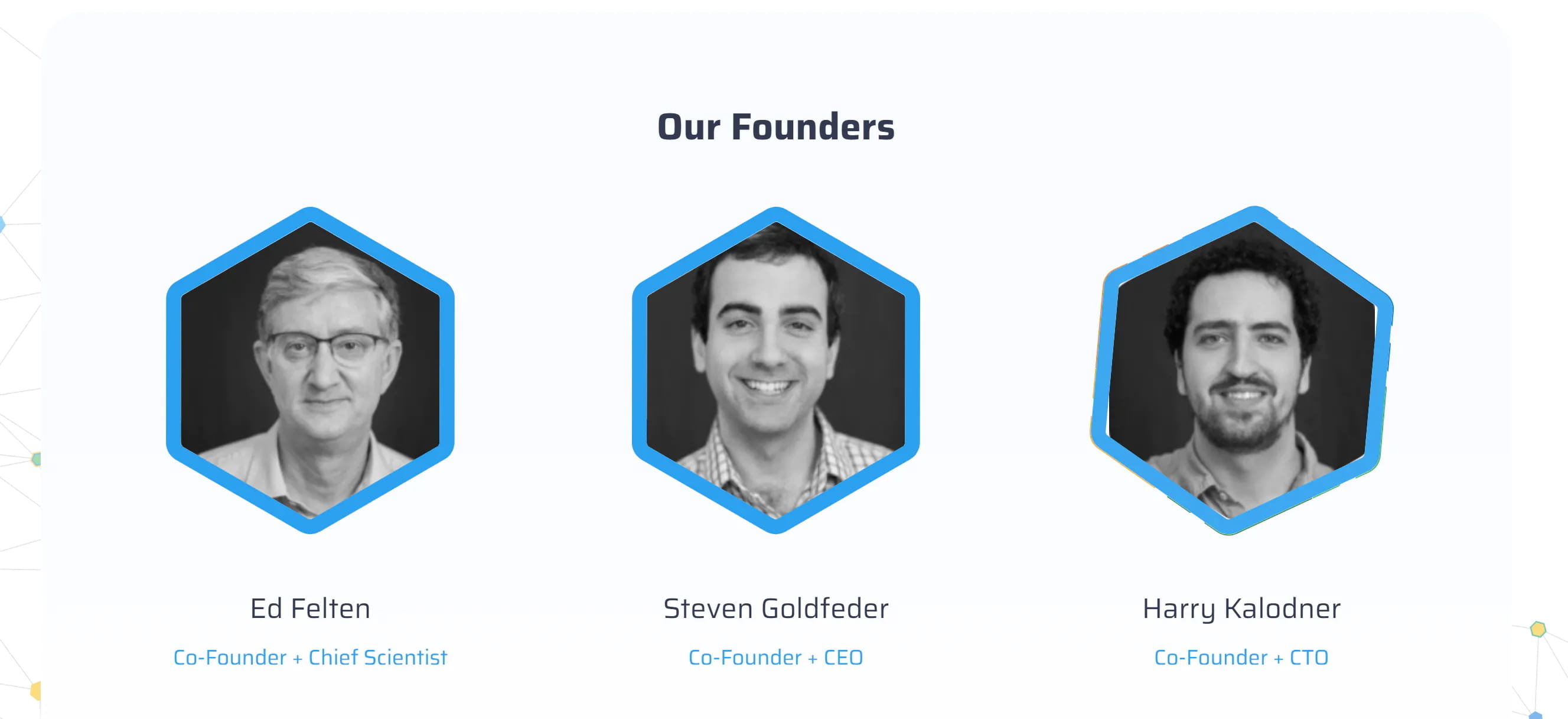
Arbitrum was launched by Offchain Labs. The founding team includes Ed Felten, a former White House technology official during Obama's tenure and a long-time professor at Princeton University, and Princeton doctoral students Steven Goldfeder and Harry Kalodner.
They began researching interactive fraud proof in 2017, and finally introduced the commercial product Arbitrum to people's horizons. This is the history of the project:
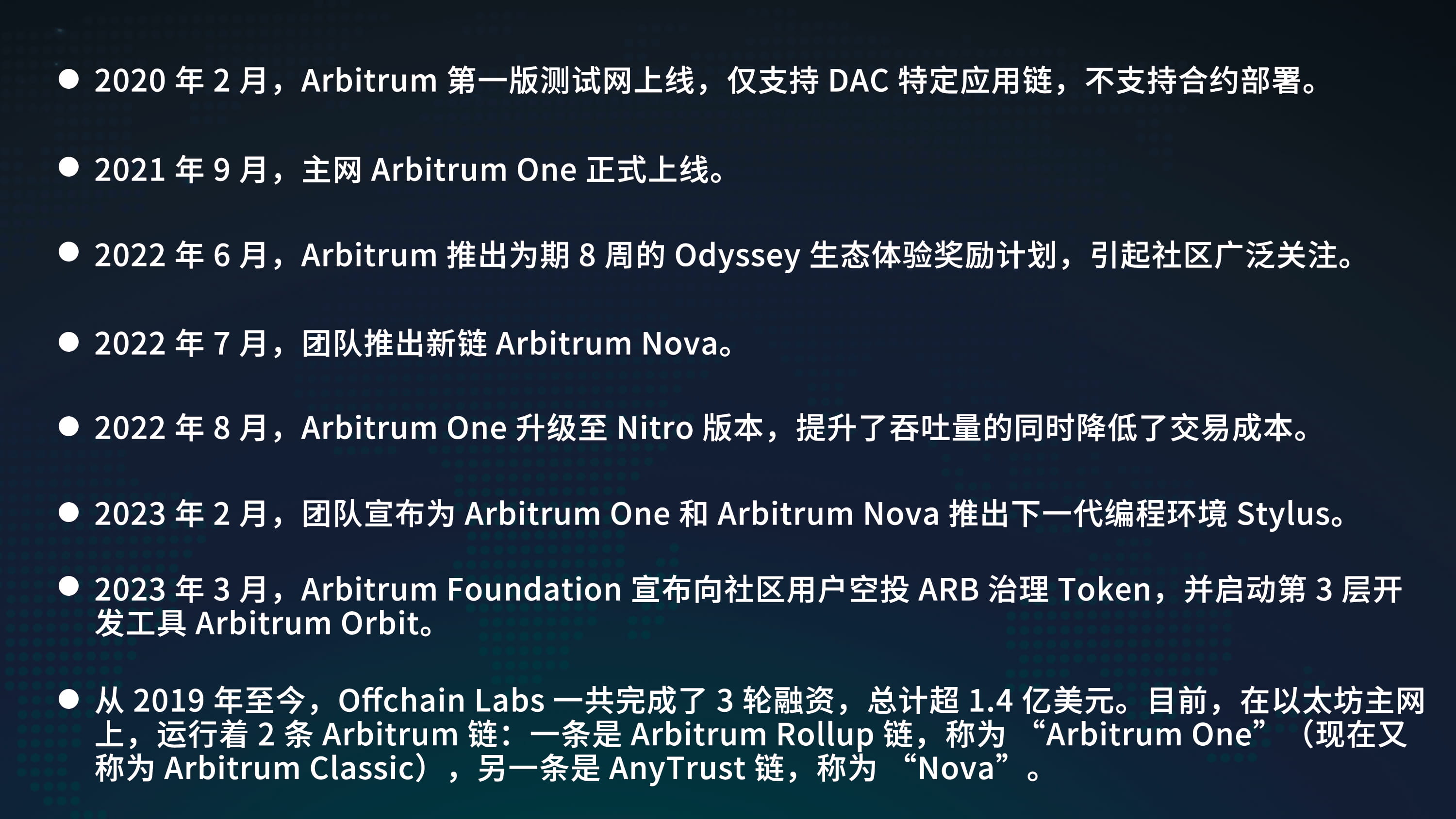
Let me highlight the key points: Since the first version of Arbitrum’s testnet was launched in February 2020, the project has experienced many critical moments. The most important thing is that it successfully obtained three rounds of financing, totaling more than 140 million US dollars, which shows the market's recognition and trust in the project.
In September 2021, Arbitrum One was officially launched, which is an important milestone in the development of the project. Next, the team carried out a series of innovations in 2022, including launching an 8-week ecological reward program, launching a new chain Arbitrum Nova, and upgrading Arbitrum One to the Nitro version.
In addition, in 2023, the team plans to launch next-generation programming and launch the third layer3 development tools for Arbitrum One and Arbitrum Nova.
Let’s expand on this: Arbitrum’s efficiency has indeed improved significantly after the upgrade. The throughput has reached 7 times that before the expansion, and the block generation time is about 0.25 seconds. This has helped Arbitrum seize the market.
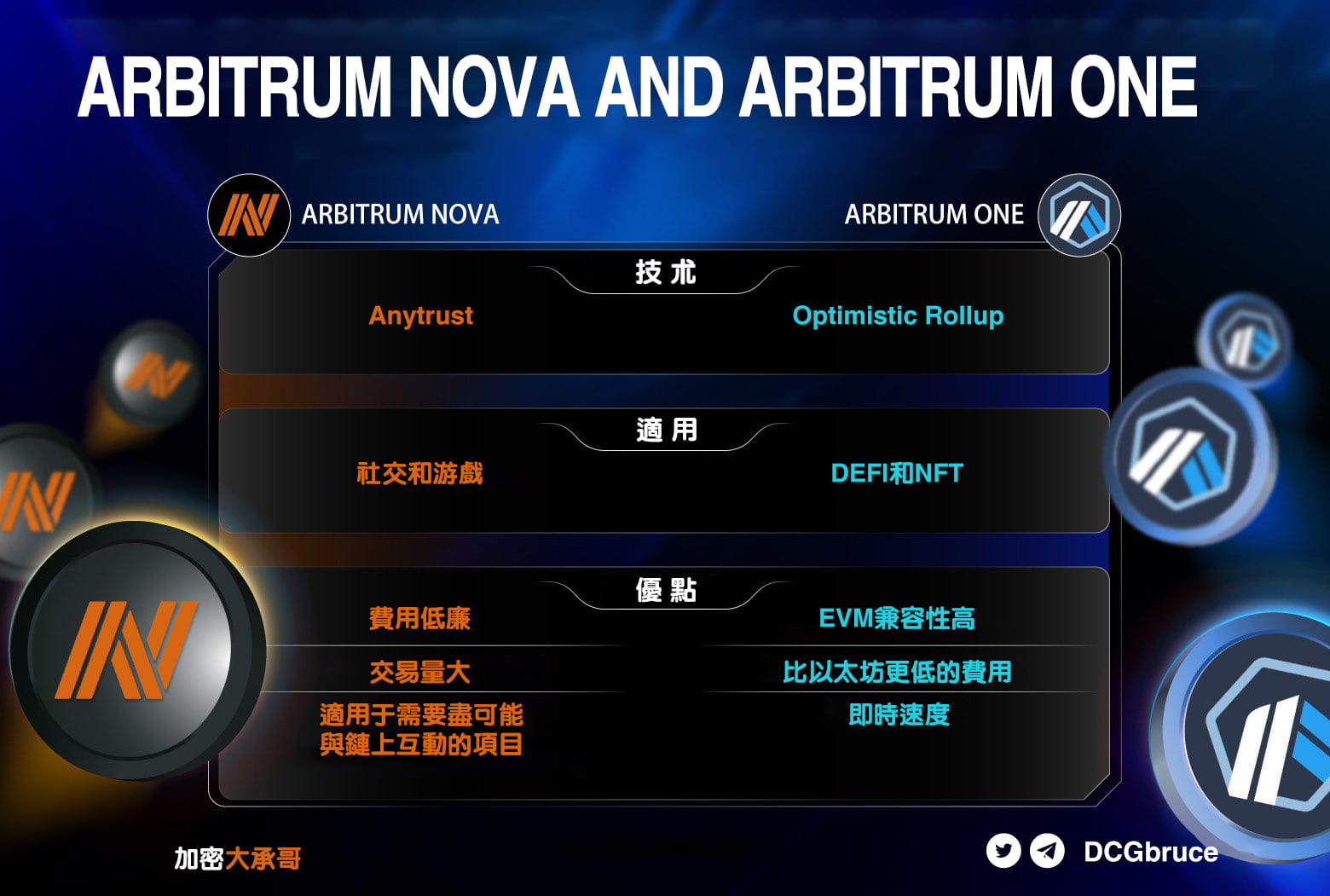
The arbitrum nova chain and arbitunm one chain launched by the team have their own characteristics. Nova is more suitable for games and social applications, with fast speed, lower fees, and a little more centralization, while arbitrum one is more suitable for DeFi applications and NFT transactions. activities because they have extremely high security requirements.
These processes show that the team has been working hard to improve the technology and ecological construction of the project. Therefore, at the team and development process level, my score is 85 points.
Arbitrum’s core technical aspects
Let’s take a look at Arbitrum’s three core technologies: multi-round interactive fraudulent proof, Arbitrum Virtual Machine (AVM), and engine based on WASM Geth software.
The first is multiple rounds of interactive fraudulent proofs. This technology is like when playing poker, we need to go through multiple rounds of checks to ensure the fairness of the game. Specifically, users need to pledge ETH in advance. After a dispute occurs, the validators of both parties to the dispute need to go through multiple rounds of proofs to discover the cheater and punish him. This process ensures safe and fair transactions.
Next is the Arbitrum Virtual Machine (AVM). It can speed up transaction processing, make transactions faster and cheaper, and provide an experience that is basically consistent with Ethereum. You can think of it as a big factory that can centralize and speed up the processing of transactions, just like a car factory can speed up the production of cars.
Finally, there is the engine based on WASM Geth software. It allows transactions to go through faster and increases Layer 2 execution speed, just like adding more lanes to the original road. You can think of it as a highway that allows transactions to go through faster.
Generally speaking, the technical level has made a lot of progress compared to other projects currently on the market. The white paper released by the founding team regards its technology as the second generation of Optimistic Rollup. I think it is pertinent, but it will take a longer time to experience the market. test, so my score is 80 points at the core technical level.
market competition level
Decision vs. Optimism
Arbitrum market share
Let’s talk about point 1 first. It is also an Optimistic Rollups solution. When it comes to arbitrum, we must compare it with optimization.
Their technical differences are mainly in two aspects: Optimism (OP) uses a single round of fraud proof, which is faster but more expensive, while Arbitrum (ARB) uses multiple rounds of fraud proof, which is slower but cheaper. Additionally, Optimism (op) uses Ethereum’s programming language, while Arbitrum (arb) supports all EVM compiled languages.
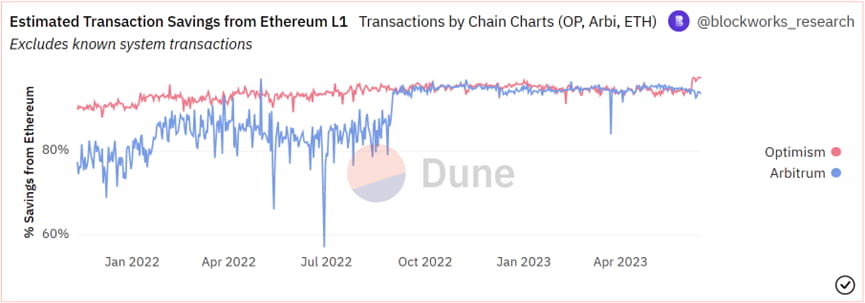
Although Arbitrum (ARB) once led Optimism (OP) in performance, as Optimism (OP) continues to be upgraded and optimized, the transaction fee gap between the two is getting smaller and smaller.
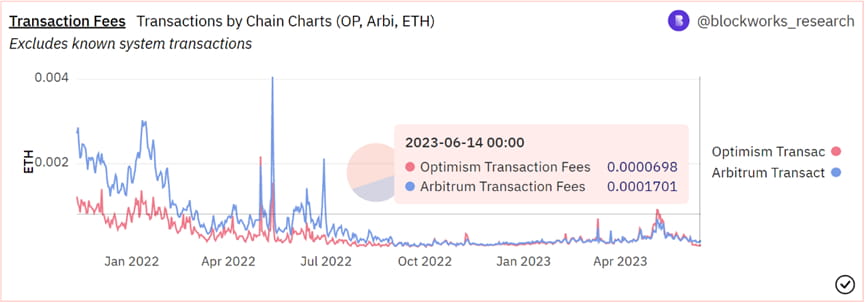
And now, Optimism (OP) has lower transaction fees than Arbitrum (ARB), thanks to optimized data compression, reduced deposit wait times, and improved node performance.
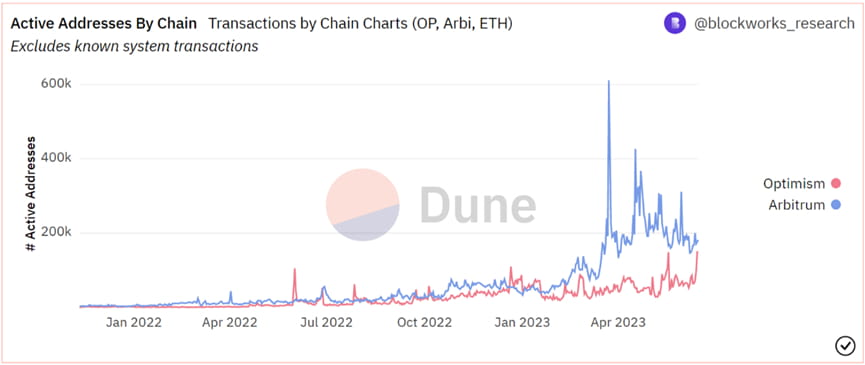
From the perspective of active addresses, as the active data brought about by the airdrop of Arbitrum (ARB) gradually calmed down, Optimism (OP) also gradually narrowed the gap between it and Optimism (OP).
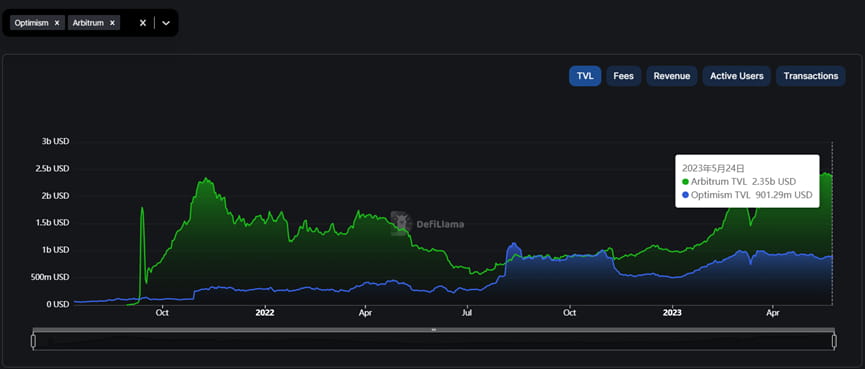
In terms of TVL (Total Value Locked) data, Arbitrum (ARB) still leads Optimism (OP) with an absolute advantage, and Optimism (OP) is still trying to catch up with the gap with Arbitrum (ARB).
According to DeFiLlama statistics, there are 312 ecological projects on Arbitrum (ARB), while there are 124 ecological projects on Optimism (op), which is nearly twice as many as ARB.
Both projects have their own clear plans. On the one hand, they optimize network efficiency to reduce costs, and on the other hand, they strive to develop the ecosystem. An open source blueprint launched by Optimism (OP) could help make transactions faster and cheaper. It is also working with Coinbase on plans to build a faster, cheaper, and more scalable trading network.
Arbitrum (ARB) is also working hard to expand the ecological scale on the Layer3 network. It recently changed its authorization mechanism to allow anyone to deploy Layer 3 networks without permission.
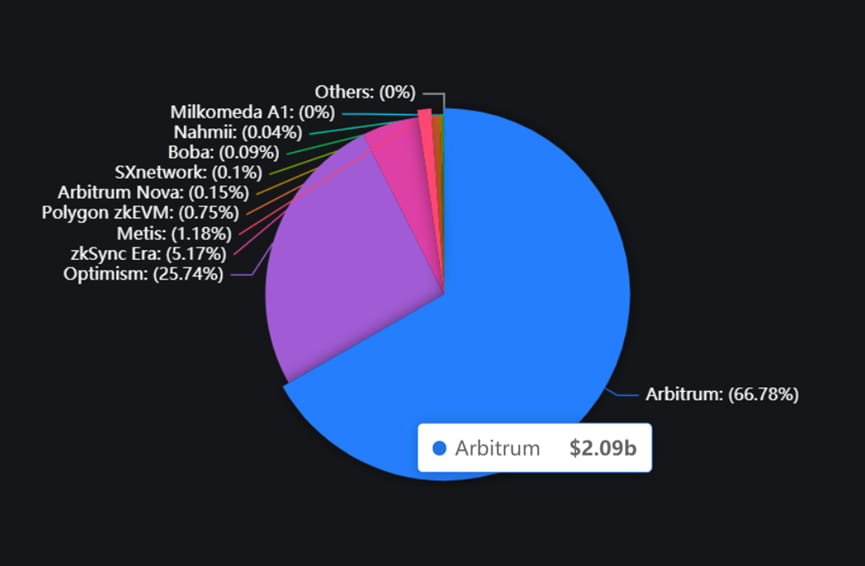
After talking about the current largest competitors, let’s look at the overall market share of Arbitrum (ARB). As of early July, Arbitrum (ARB)’s TVL (Total Locked Value) in Layer 2 far exceeds that of other projects, with its total value reaching US$2 billion, accounting for approximately 66.78%.
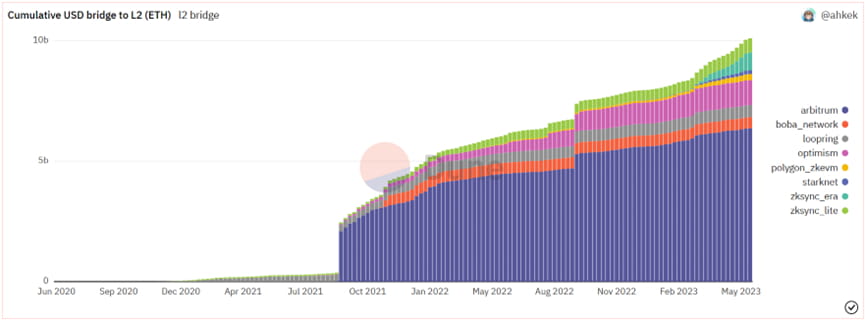
Judging from the cumulative transactions of layer2 bridges, Arbitrum (ARB) contributed the main force:
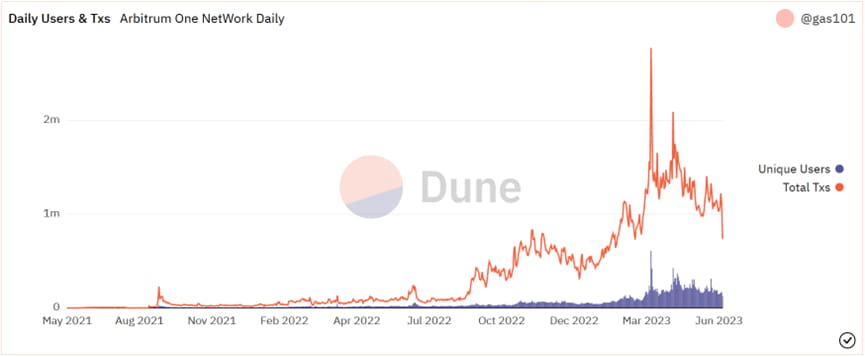
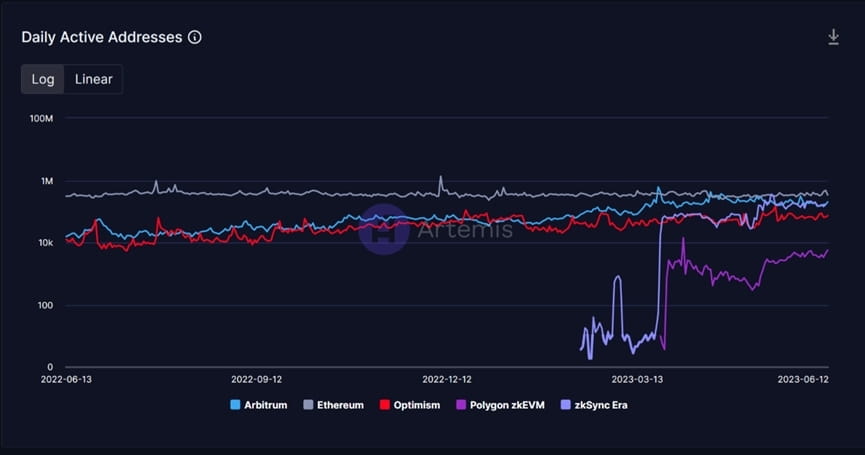
In addition, Arbitrum’s single-day active addresses are approximately 200,000, second only to the 338,000 on the ETH mainnet, and 174% ahead of the third-placed Optimism (OP):
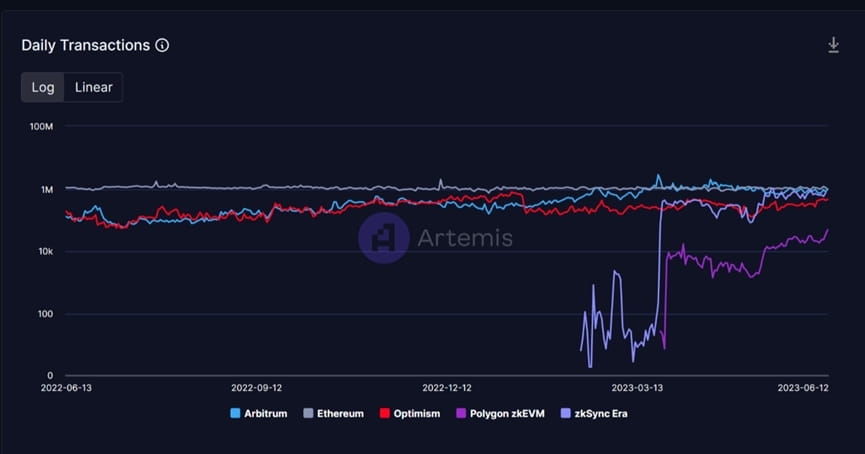
The total number of registered transactions on the chain in a single day has even exceeded the ETH main network and is twice that of Optimism (OP):
To sum up, in short, Arbitrum (ARB) is very competitive compared with other projects in Layer 2. Therefore, I gave a score of 85 points in terms of market competition of the project.
Arbitrum ecological development and key projects
Next, let’s take stock of the ecology. This is the code for wealth. Remember to like and forward it. After all, it’s not easy for me to code for you to get rich hh.
The project can have such a high lock-up volume, which is inseparable from strong ecological strength. With the projects currently being built, the total number has reached 360.
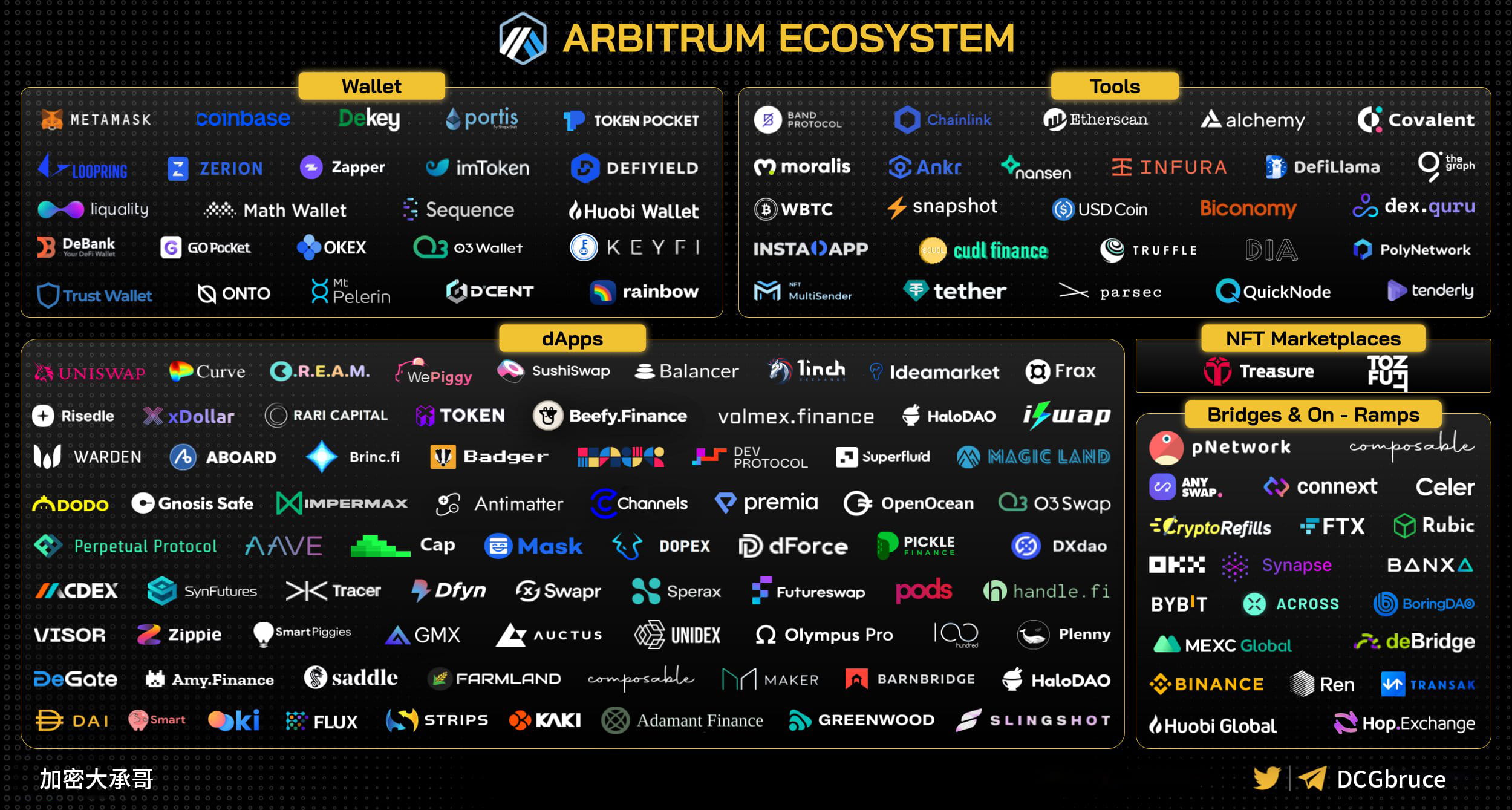
Here are the top 10 projects in the ecosystem:
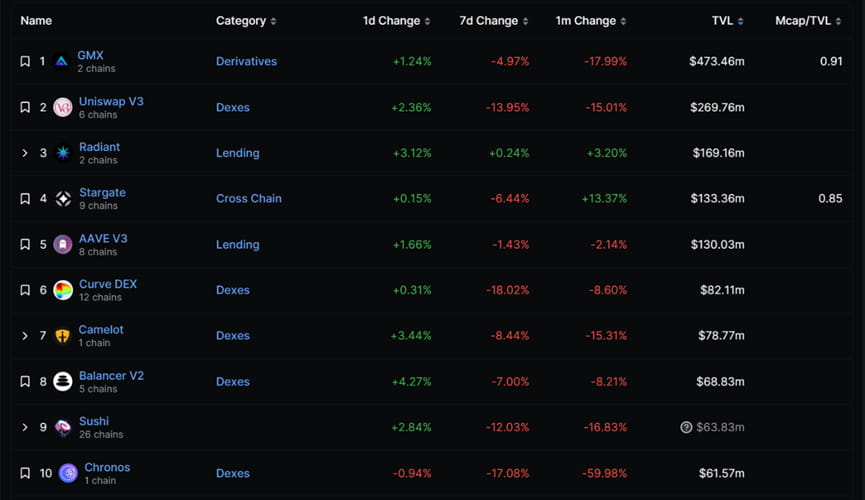
It can be roughly divided into three broad categories: DeFi, infrastructure, and entertainment and social networking. I will talk about 7 representative projects and quickly summarize their characteristics. If you are interested, you can try them out.
1. GMX, it is known as a dark horse project in derivatives in the DeFi sector. The lock-up of this project alone accounts for 20% of the ecology. It is like a large supermarket, providing users with services for trading spot and perpetual contracts. It is also a liquidity pool that reduces the risk of price fluctuations through original dynamic pricing methods, just like promotions and discounts in a supermarket. , to ensure the security of users’ assets as much as possible.
2. Dopex can be compared to an options trading market, just like options trading in the stock market. It provides a simple and easy-to-understand pricing model, just like market analysis in the options market. The newly launched product can also solve the liquidity problem of option collateral before exercise or expiration, which is very close to options trading in the stock market. mechanism.
3. Pendle, it is a DeFi protocol that allows you to bet on future returns. It is like a lottery ticket. You can bet on future returns. If your bet is established, you will make money. It is a platform where users can trade, just like gambling, betting on future earnings changes. At the same time, the project will also give 3% of all users' pledge income to project token holders to encourage users to continue betting.
4. Camelot, this is TVL’s No. 1 decentralized exchange in the Arbitrum ecosystem. It is like a vending machine that can provide different trading solutions according to different trading pairs, making transactions smoother.
5. Radiant Capital: Analogous to a lending platform, users can borrow assets and provide collateral as guarantee. The platform will adjust interest rates based on market conditions to encourage users to repay and provide more loanable funds.
6. Stargate: Analogous to a transfer station, it allows different stablecoins to be freely transferred between different chains, and at the same time provides a unified liquidity pool of assets to maximize capital efficiency.
7. Treasure DAO: Analogous to a game world, which provides various game scenarios, and also has community voting to determine the direction of ecological development.
It can be seen that arbitrum has indeed performed well in ecological development, and the key projects mentioned are worthy of attention. Therefore, in terms of the ecological development of the project, I gave a score of 85 points.
Potential risks and opportunities for Arbitrum
Fierce competition from Optimism
Scaled adoption of ZK-Rollups
Advancement of the decentralization process
future plan
Arbitrum is one of the dominant Layer 2 expansion solutions currently on the market, but it also needs to face up to external and internal challenges.
Let’s talk about the external challenges first: the fierce competition from Optimism (OP) that we mentioned earlier: Optimism’s upgraded transaction fees are already lower than Arbitrum (ARB), and the process of further compatibility with EVM is also progressing smoothly. Although Arbitrum relies on many ecosystems to maintain the absolute advantage of high TVL (total locked value), with the arrival of the Optimism (OP) "super chain", the competition between the two on Layer 3 will become more intense.
Secondly, although Arbitrum has attracted many developers to join, ZK-Rollups represented by zksync is considered the most important long-term solution for Layer 2 expansion and is favored by quite a few people, including Buterin. I believe that once ZK-Rollups is adopted on a large scale, OP faction Rollups including Arbitrum will also face strong challenges.
In terms of internal challenges, Arbitrum also faces the advancement of decentralization.
Although the Arbitrum community put forward a proposal to introduce an Arbitrum DAO managed by ARB holders, before the proposal was voted on, the Arbitrum Foundation actually created a multi-signature wallet in advance, transferred 750 million ARB tokens, and sold ARB in advance. The tokens were exchanged for stablecoins, raising questions from the community. (This is not a big deal in the currency circle, but it is disgusting...)
The foundation then had to limit and reduce its rights and expand the budget oversight and governance rights of ARB token holders. The biggest impact of this incident is that the community has questioned the principles of DAO, which makes the Arbitrum team need to promote the decentralization process as soon as possible.
In addition to the potential risks faced, the future planning of the project also deserves attention.
The project founding team mentioned in their speech last year that they will continue to reduce fees, increase TPS, strengthen Arbitrum’s advantages in the DeFi and gaming fields, and start incubating more Nova ecosystems and optimizing trading mechanisms.
As for the controversy over the excessive centralization in the Arbitrum Rollup solution, they have been exploring further decentralization.
Ecological expansion is their key development direction. Arbitrum’s Layer 3 solution Orbit will be more scalable and is mainly targeted at games and DeFi applications that require high throughput. The DeFi and game fields are also Arbitrum’s strengths.
Overall, the risks of the project are currently relatively controllable, and I am still slightly optimistic about future planning expectations. Therefore, in terms of risks and opportunities of the project, my score is 80 points.
Let me make a summary: Arbitrum has hot traffic, the community has a strong consensus and the ecological scale has been formed, and other competing products still have a long way to catch up. Its current success is inseparable from the team's operational strategy and technical capabilities. However, the rise of competitors such as the ZK faction may pose an intuitive threat. More efficient technologies may also be born in the future. Arbitrum's leading position can only be tested by time.
To sum up, my overall score for the Arbitrum project is: 83 points
Finally, remember to like and follow, your wealth will be further enhanced.