
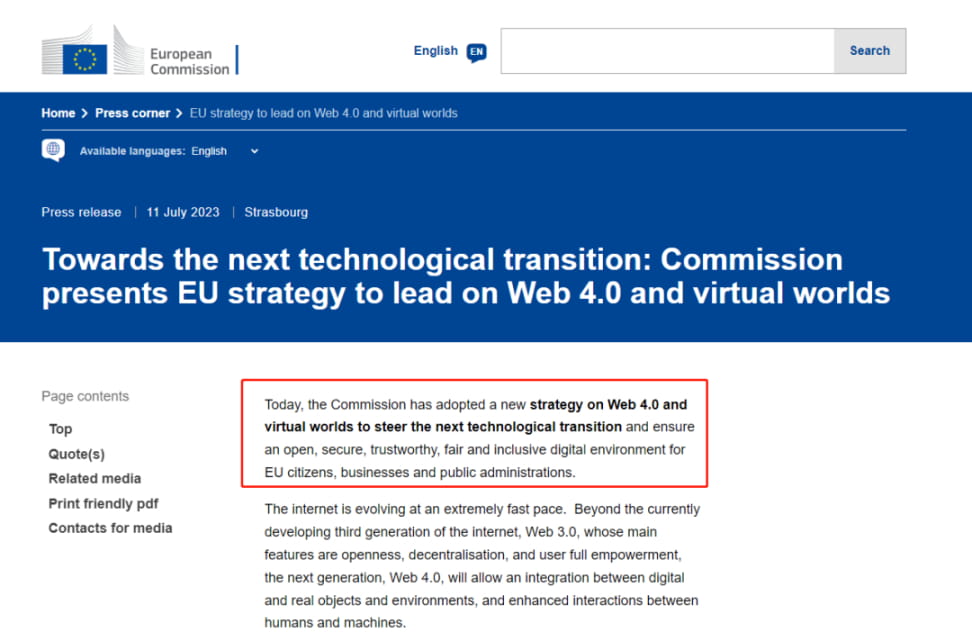
On July 11, the European Commission adopted a new strategy on Web4 and Virtual Worlds to guide the next technological transformation and ensure an open, secure, trustworthy, fair and inclusive digital environment for EU citizens, businesses and public administrations.
According to the introduction, the so-called Web4, which echoes and covers the term Web3, will be part of a new Internet vision that integrates virtual experiences, the Internet of Things and blockchain.
We haven’t figured out Web3 yet, and now here comes Web4. Today, let’s learn with us what the Web4 technology proposed by the European Commission is.
European Commission and Web4: Thinking about the future of technology
The strategic background released on July 11 wrote that the Internet is developing at a very fast pace. In addition to the currently developing third-generation Internet Web3, whose main features are openness, decentralization, and full user empowerment, the next generation Web4 will allow the integration between digital and real objects and environments, and enhance the interaction between people and machines.
The "EU Economic Outlook after 2030" released by the European Union in March emphasized that digitalization is one of its key drivers, and Web4 is a major technological transformation that will bring a seamlessly connected, intelligent and immersive world.

What is Web4? According to the description of this strategic report, we can understand it as the evolution of the concept of Web3, in which the Internet of Things, blockchain, virtual reality and augmented reality are integrated together.
While this sounds very promising, no details have yet been provided by the authorities to explain how all the technical facts were mixed together to give rise to this innovative concept.
As we all know, after the European Commission opened its doors to cryptocurrencies and blockchain with the approval of MiCA (Markets in Crypto-Assets) in April, it now wants to go a step further and try to compete with American technological innovations.
In the same announcement of the just-released Web4 strategy, a number of new initiatives were revealed.
For example, the agency has proposed a Horizon Europe program called "Partnership for Virtual Worlds" with an expected launch date of 2025.
The program's goal is to develop an "industrial and technological roadmap for virtual worlds" by helping developers, creators, and companies that use the internet broadly to understand this new trend.
Furthermore, this will require trialling new solutions with all EU member states.
As a second idea part of the technology expansion plan, a project called "CitiVerse" is envisioned, described as an urban virtual universe for managing and planning urban work and activities in alternative ways, but its target audience is not detailed.
Finally, another idea proposed by the committee involves a "European Virtual Human Twin," a virtual replica of the human body that could help doctors study disease outbreaks and treatments.
Regarding the introduction of the new Web4 technological frontier, EU Internal Market Commissioner Thierry Breton commented:
Is Europe Not Ready for Web3?
The European Commission even introduced the term Web4, which represents a completely new concept in the tech world.
Despite Europe’s regulatory framework being one of the most lenient in the world regarding cryptocurrencies and a willingness to allow the continent to excel in the context of new technologies, it seems premature to talk about Web4.
A survey conducted by Consensys in June showed that only 8% of the entire alliance felt they were familiar with the concept of Web3.
On the other hand, terms such as blockchain, cryptocurrency, and DeFi are still unfamiliar to the inexperienced and have not yet been understood by most people. For a large number of people who are not familiar with the basics of virtual currencies, understanding Web3 or Web4 still poses a serious barrier to entry.
Many European centers such as Berlin, London, and Lisbon are becoming centers of very high levels of cryptocurrency and blockchain technology, but other parts of the continent don’t even know what the word “cryptocurrency” means.
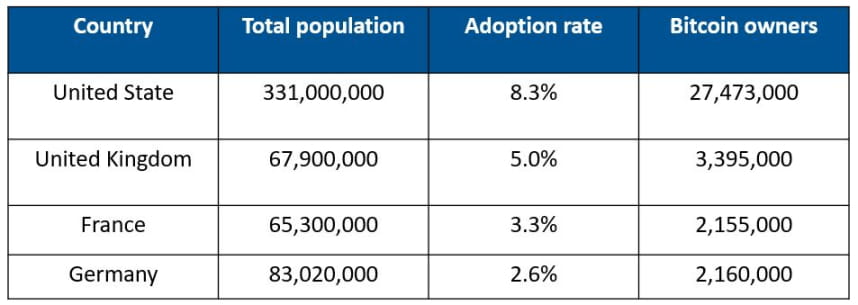
According to some data surveys, in 2021, the adoption rate of the Bitcoin standard in countries such as the United Kingdom, France, and Germany was much lower than that in the United States, where cryptocurrency is more "famous."
In recent years, we have seen positive initiatives and trends that will lead to the expansion of the use of blockchain technology in Europe.
For example, in the first quarter of 2023, the number of investments by venture capitalists in crypto projects came from 50% of startups in Europe.
However, while the data indicates growing interest among investors, entrepreneurs and developers on the continent, there are unfortunately concerns that the term “Web4” introduced by the European Commission remains a completely worthless concept.