

Binance will celebrate its sixth birthday tomorrow, but looking back on the past year, the road has not been smooth.
Written by Babywhale, Foresight News
On July 14, Binance, founded in 2017, is about to celebrate its sixth birthday. Six years ago, Zhao Changpeng founded Binance. Although Binance was not outstanding compared to other leading trading platforms at that time, with the firm implementation of the internationalization strategy and the influx of new users, Binance soon became the world's largest cryptocurrency exchange.
In the early years, all major exchanges issued so-called “platform coins”. Among them, BNB issued by Binance has become one of the most successful “platform coins” with the support of Launchpad and Binance Smart Chain (now known as BNB Chain). Launchpad launched by Binance has launched projects such as Polygon (MATIC), STEPN (GMT), Axie Infinity (AXS), The Sandbox (SAND), etc., which performed well in the last bull market.
On the other hand, BNB Chain has also become a force that cannot be ignored in the public chain field. According to DefiLlama data, at the time of writing this article, the total locked value of BNB Chain is close to US$3.5 billion, second only to Ethereum and Tron; and this data reached a peak of nearly US$22 billion in May 2021.
Although the achievements in the past are obvious to all, the past year has been a bumpy year for Binance and the entire Web3 field.
Layout in a "Bear Market"
Since 2022, as cryptocurrency prices have fallen sharply, high-leverage market participants have been liquidated in a centralized manner. We have witnessed Terra’s market value drop from tens of billions to zero overnight, and we have also witnessed the collapse of FTX. Although Binance also suffered a large outflow of funds due to extreme market panic after the collapse of FTX, it eventually withstood the pressure and completed all redemptions, increasing market confidence and preventing further market collapse.
I believe many people have experienced the following story. The entire market seemed to have lost its direction and became unusually quiet. But many people seem to have overlooked one point, which is that this moment should be a rare opportunity.
When the market was in a panic last year, Binance launched a $1 billion "Industry Recovery Fund" to support projects or companies in difficulty. The fund has received support from Tron DAO, Huobi, GSR, etc. Since then, there has been an endless stream of projects applying for support from the fund, and companies including the Korean exchange Gopax have received support from the fund.
In addition to financial support for projects in the industry, Binance has also been committed to exploring new growth for the industry and cooperating with various institutions around the world to carry out related educational activities. At the end of May this year, Forbes reported that Binance launched a blockchain-related course project at the Austral University in Argentina, covering the basic principles of blockchain and cryptocurrency, decentralization, Web 3.0, the metaverse, trading, and risk management. There are many similar actions, and we will not list them one by one here.
In addition, during a period when the amount of financing in the Web3 market fell sharply year-on-year, Binance Labs still maintained a relatively high investment frequency. In the past year, Binance Labs has led investments in projects including Web3Go, smart contract platform Neutron, and NFT game platform Gameta. From an investment perspective, Binance Labs' investments in the "bear market" are more inclined to platforms, infrastructure, security, and other directions, preparing for another possible outbreak in the future. According to Binance's 2022 year-end review report, Binance invested more than $500 million through Binance Labs last year to support Web3 and blockchain innovation.
In terms of BNB Chain, Binance has successively launched zkBNB, a BNB Chain expansion solution based on zero-knowledge proof, BNB Greenfield, a decentralized storage infrastructure that aims to provide storage services and serves as the third chain in addition to BNB Beacon Chain and BNB Smart Chain, and opBNB, a Layer 2 network based on OP Stack that was recently launched. Similar to Ethereum, BNB Chain has also established a "main chain + side chain + Layer 2 network" model, and the transaction cost and transaction confirmation speed of BNB Chain itself are relatively high. The side chain and Layer 2 are obviously built to be able to carry applications with higher speed and cost requirements. The infrastructure enables BNB Chain to gain a competitive advantage among many new public chains and "new new public chains" in the future.
In addition, the DeFi transaction volume on BNB Chain has increased significantly recently. According to DefiLlama, at the time of writing this article, the daily transaction volume of DEX on BNB Chain reached nearly US$525 million, second only to Ethereum and more than twice that of the third-place Arbitrum.
Although Binance has been making continuous moves during the market cooling-off period, Binance Launchpad has still been subject to considerable controversy among all these events.
The reason is that since the beginning of last year, Binance Launchpad has launched a total of four projects, namely the Move to Earn application STEPN, the gamified social learning platform Hooked Protocol, the identity platform Space ID, the educational content platform Open Campus, and the recently launched data platform Arkham.
Compared with the phenomenal public chains and projects in the past, Launchpad in the past two years may confuse many people. It seems that Binance’s choices are not in areas that are well known to everyone or popular tracks in the market.
In this regard, there is a voice in the market saying, should there be more tolerance for projects that dare to issue coins during the market cooling-off period?
Putting aside the yield rate, before the concepts of new public chains, blockchain games, metaverse, etc. really broke out, Polygon, Axie Infinity and The Sandbox were not favored by everyone. But when they really broke out, the potential of this market was seen. As for the author, although I can't imagine what kind of new business forms can be brought by the issuance of tokens in the fields of education, identity, and data, I think no one can perfectly predict the direction of the market, and no one can predict what kind of products will cause qualitative changes. These projects that have made some "transformations" to traditional fields other than finance may not be effective immediately, but they may be a good attempt.
Although the underlying construction of knowledge and data monetization and identity decentralization may not be the target of attracting a large amount of funds, it is still a touchstone for promoting Web3 to the mainstream. Binance also said that the focus on these areas is to promote the adoption of Web3 and ultimately achieve the global free flow of finance, rather than just focusing on immediate interests. The so-called tolerance is to hope that the market can give these projects some time, rather than making impulsive judgments based on the current environment.
How does Binance deal with FUD?
In the first half of the year, Binance was sued by the U.S. Commodity Futures Trading Commission (CFTC) and the U.S. Securities and Exchange Commission (SEC). After that, several countries announced that they had begun investigating Binance, and Binance also withdrew its compliance applications in some European countries. All these bad news made FUD rampant in the market, and everyone began to speculate whether the content of the lawsuit filed by the U.S. regulators was true, and whether Binance would become the next FTX.
To date, Binance is still the cryptocurrency exchange with the most compliance licenses in the world. The SEC has no evidence to prove some of the charges it has listed, and Binance has hired lawyers. Zhao Changpeng said in a previous Twitter Spaces that he is still looking for a solution.
And according to the community's speculation, the US regulator's "shooting the leading bird" behavior is not actually aimed at Binance alone, but at the entire cryptocurrency field. The cryptocurrency community also once supported Binance through various voices.
In addition, as to the impact of the regulatory crackdown on Binance, we can find out from some data.
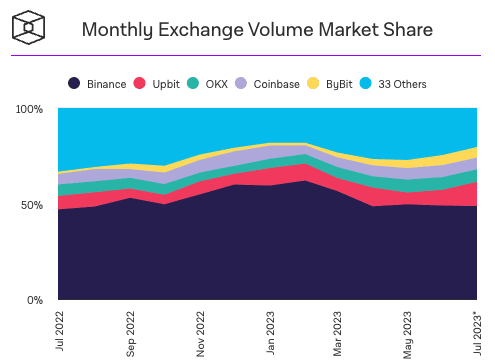
According to data from The Block, Binance currently accounts for about 50% of the exchange's monthly trading volume. Although it has declined from its peak of over 60% (some analysts speculate that the main reason is the end of Binance's BTC zero-fee activity), it is still nearly 4 times that of the second-ranked Upbit. In addition, after the regulator's investigation into Binance, the ratio has hardly changed much.
Within a few days of the news of the regulatory investigation, Binance did experience a certain amount of capital outflow, but according to data provided by Twitter user TVBee, the extent of the capital outflow at that time was less than during the bankruptcy of Silicon Valley Bank and the FTX crash, and it soon began to flow back.
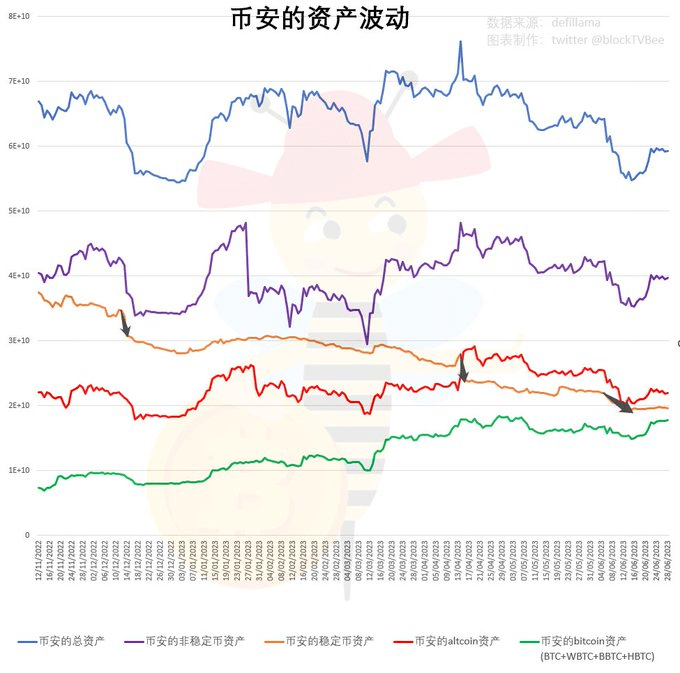
Judging from the data, we don’t seem to need to worry about the same thing happening to Binance as FTX. In fact, regulation is not negative. Certain rules are needed to regulate money laundering, tax evasion, market manipulation and other behaviors, but if the special industry of cryptocurrency is to be regulated, it will surely take some time to explore and adjust.
Waiting for the flowers to bloom
After 2022, we are welcoming the cryptocurrency market, which will perform well in the first half of 2023. However, it must be noted that the emotional and practical impacts of regulation cannot be eliminated in the short term, and there is still uncertainty in the macro market. It may take some time for Web3 to return to the "raging bull market" of 2020 and 2021.
At present, all kinds of noises are heard everywhere, but the current Web3 has undergone earth-shaking changes compared with the uncertainty in 2018 and 2019. With mainstream adoption, new concepts and tracks, the so-called bull market in 2021 may eventually cause the market to be over-leveraged, but a mature market needs to go through such pain. We still need to give Binance and the industry some time. A journey of a hundred miles begins with a single step. I hope everyone will not fall in the darkness before dawn, and I also look forward to Binance's seventh year bringing more imagination to the entire industry and ecosystem.