


Since the launch of Ethereum, the Layer-1 smart contract space has been competing for market share. This competition brings vitality to the market and inspires new choices. Different network architectures, market entry strategies and new use cases are all the result of competition. However, although Layer-1 has experienced some turbulent market cycles in its short history, such as user churn and network failures leading to hard forks (such as Ethereum and Terra), it remains an important space.
As an alternative to Ethereum, the BSC chain has developed rapidly since its establishment. It has managed to maintain its position as one of the most valuable crypto assets in the world, thanks to a number of reasons. The congestion of the Ethereum network, the slow rollout of Layer-2 scaling solutions, and the ability to bridge assets across chains give BSC Chain and other similar alternatives a competitive advantage. In addition, the adoption of the BSC chain may also be influenced by factors such as the funds Binance has, lessons learned from other networks, and the execution of some listing strategies.
In the article, we evaluate the history, evolution and current market position of the BNB chain. In order to maintain its position as the most valuable smart contract platform after Ethereum, BNB Chain plans to continue to develop its architecture and expand its user base.
background
The creation of the BSC chain and BNB token stemmed from the launch of the Binance centralized exchange. Binance exchange was founded in 2017 by Changpeng Zhao, commonly known as CZ. Before founding Binance, CZ earned a degree in computer science and developed advanced trading software for traditional financial companies such as the Tokyo Stock Exchange and Bloomberg.
In mid-2017, CZ used his passion for cryptocurrencies to create the Binance cryptocurrency exchange we know today. Binance conducted an initial coin offering (ICO) of BNB, raising approximately $15 million to support the development and operations of the exchange. By early 2018, Binance became the largest cryptocurrency exchange by trading volume, posting a profit of $200 million in the second quarter. Binance remains the largest cryptocurrency exchange by trading volume. As of this writing, Binance’s trading volume in the past 24 hours is $10.5 billion, while second-placed FTX has $1.6 billion. The BSC chain may successfully convert a large retail “CEX (exchange) only” user base into DeFi users through its brand value, thereby gaining market share.
Initially, the BNB token was an Ethereum-based ERC-20 utility token used to reward loyal users with discounted transaction fees. In early 2019, with the launch of Binance Chain, ERC-20 token contracts were replaced by native BEP (Binance Token Standard) token contracts. Binance and its community developed Binance Chain to realize the vision of a decentralized exchange (DEX).
In 2020, the community launched Binance Smart Chain, a modified proof-of-delegation EVM-compatible blockchain that hosts smart contracts using source code from the Ethereum network. Eventually, BNB became the native cryptocurrency of Binance Chain and Binance Smart Chain.
As of now, Binance Chain (renamed BNB Beacon Chain) and Binance Smart Chain (renamed BNB Smart Chain) have developed into a unified modular system called BNB Chain.
Network Architecture
Overview
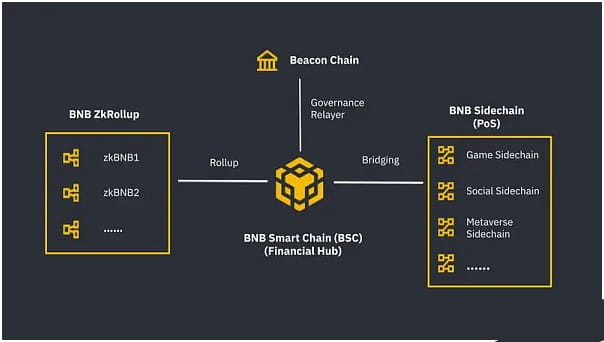
Understanding the background of the BSC chain helps us understand its evolution and current architecture. The BSC Smart Chain was developed for use with the BSC Beacon Chain, which is purpose-built and has its limitations. The Beacon Chain serves decentralized exchanges (DEX) and aims to achieve high transaction throughput and a more advanced user experience than centralized exchanges. However, the Beacon Chain is not optimized for smart contract functionality or anything to match a high-performance trading engine. Upgrading the beacon chain to introduce additional functionality will require additional transaction throughput, reducing network efficiency. Therefore, the Binance community decided to develop the BSC Smart Chain independently.
When the two blockchains merge, the Beacon Chain becomes the layer dedicated to governance (staking and voting), while the BNB Smart Chain becomes the layer dedicated to EVM consensus and execution. Although the governance relay connects the two chains, the BNB Smart Chain is not a Layer-2 solution. This connection is more similar to the upcoming Ethereum 2.0 merge, in which the execution layer of the currently running Ethereum mainnet will be plugged on top of the Ethereum Beacon Chain consensus engine running concurrently with it.
BSC beacon chain
The BSC beacon chain is mainly built on the DEX transaction matching engine on a point-to-point distributed system. It uses Tendermint Byzantine Fault Tolerance (BFT) consensus to connect multiple clients.
Additionally, the BSC Beacon Chain has a built-in governance module that allows BNB holders to submit proposals to add trading pairs and change network parameters. One of the parameters is burning BNB for Beacon Chain transactions according to the fee schedule. There are also plans to implement asset listings on other chains. This combined approach enables the Binance DEX to operate in a decentralized manner and enables the community to democratically change the beacon chain. It is managed in a way that brings value to the network and BNB tokens, and delivers these functions to the BSC Smart Chain and BSC Sidechain.
BSC smart chain
The network is based on the Proof of Stake (PoSA) consensus mechanism and is supported by 21 active validators. These validators (including delegated stakes) are responsible for validating transactions and generating blocks to secure the network and maintain the ledger. In addition to the 21 active validators, the BSC Smart Chain also introduces more inactive validators (called "candidates") as alternatives to the validator concentration. In this case, redundancy means that two candidate validators and 19 active validators are selected every hour to participate in the consensus process.
Validators only receive rewards from the gas consumption of transactions, not from newly issued tokens. Additionally, double signature detection and mitigation mechanisms have been implemented to ensure the security, stability, and finality of the network.
BSC sidechain and Zk-Rollup
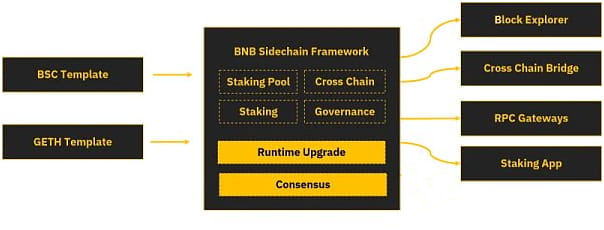
The BSC Sidechain Framework is a modular framework designed to create sidechains compatible with the BSC Smart Chain. It defines the requirements for integration with the BSC smart chain ecosystem and features development-ready EVM-compatible features such as staking, RPC-API, and smart contracts.
The main purpose of the BSC sidechain is to allow developers of any project to deploy their blockchain with custom specifications and validator sets. It also enables developers to connect to the BSC Smart Chain’s infrastructure. A validator set can operate with fewer validators than the BSC chain, depending on who deploys the BSC sidechain and the level of security required. Application owners or community stakeholders can run these validators. Developers and teams can create blockchains with their own business rules and economic models. Through this modular design and flexibility, the BSC chain can expand its ecosystem.
Future plans also include the introduction of zk-rollups to enable high-performance scaling, allowing the implementation of sidechains and more custom solutions. Currently, zk-rollups have not been launched yet, but there are already 3 sidechain pilot projects under development. These projects include Metaverse-based application Cube, Galaxy Project focused on bringing credentials to the blockchain, and gaming application MetaApes.
value proposition
Since 2017, the BSC chain has experienced a long development process. Its architectural evolution brings potentially significant value propositions. The overall design enables the network to handle transactions of varying complexity while maintaining governance and consensus functions. This flexibility enables workloads and upgrades processed on one sidechain to work in conjunction with consensus, independently ensuring the security and finality of the network without affecting other sidechains. Developers will be able to achieve the ideal balance between security and performance based on their specific business needs. Given this, separating beacon chains and smart chain networks, introducing modularity, sidechains and zk-rollups is not a new idea, but one that has already been proven to fit the product market.
Ultimately, if these design concepts can be successfully implemented, it will bring many benefits to the BSC chain. This includes greater flexibility, better scalability and stronger security. It will provide developers with more freedom and choice to build applications and solutions that fit their specific needs. Over time, BSC Chain is expected to further solidify its position as a smart contract platform and contribute to the development of the entire cryptocurrency ecosystem.
BNB token
In July 2017, 200 million BNB tokens were distributed between the founding team (40% or 80 million BNB), angel investors (10% or 20 million BNB), and the public sale (50% or 100 million BNB).
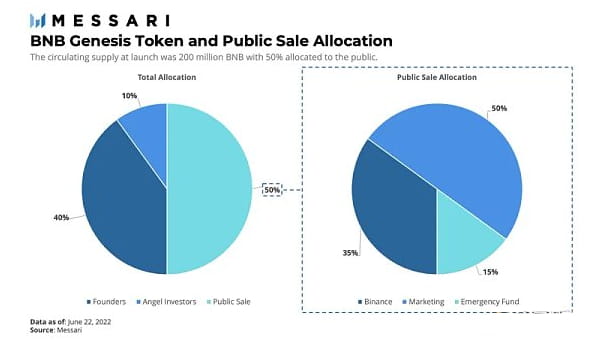
A public sale of 100 million BNB, priced at 15 cents per token, raised $15 million. Fundraising from the public offering is earmarked for:
35 million BNB (35%) will be used to upgrade the Binance platform and trading system.
50 million BNB (50%) will be used for Binance branding and marketing.
15 million BNB (15%) as emergency reserve.
All Genesis tokens have been distributed, so the liquidity supply curve is now flat. The completion of the distribution means there is no longer an illiquid supply and tokens held by the team or angel investors can be bought and sold.
Both types of BNB BEP tokens are interoperable on the Beacon Chain and BSC Smart Chain. BNB BEP-2 is the native token on the beacon chain, and BNB BEP-20 is the native token on the BSC smart chain.
Since the inception of the BNB token, its uses have continued to evolve. Initially, BNB tokens were primarily used to run validator nodes or obtain discounted trading fees on the Binance exchange. BNB tokens can now be used to stake, vote via on-chain governance, participate in token sales on Binance Launchpad, provide liquidity on Binance Liquid Swap, and pay trading fees on its flagship exchange. BNB tokens can also be used for credit card payments and processing payments for certain travel arrangements. They can also be used as collateral for loans and currency on selected platforms.
Staking involves token binding and delegation operations recorded on both chains simultaneously. Through voting delegation, users can vote for validators, receive staking rewards, run validator nodes, and compete for user transaction fees.
The BNB token also features a deflationary burn mechanism. Initially, Binance spent 20% of its quarterly profits on buying back and burning BNB, removing it from circulation. BNB Auto-Burn replaces quarterly burns to provide greater transparency and predictability. At the end of the burn function, Binance will burn 100 million BNB, accounting for 50% of the total supply.
Current status of BNB Chain ecosystem
Current status
Like many Layer-1 smart contract platforms, the BSC Chain has experienced exponential growth throughout 2021. However, similar to other blockchains, the network’s valuation has fallen by approximately 60% since the beginning of the year. Daily revenue has also dropped from approximately $4 million in protocol revenue at the end of 2021 to approximately $1 million over the past 30 days. While average daily revenue has declined, cumulative revenue has become a more important part of a network's value. This relationship suggests that fundamentals such as cumulative network revenue are closing the network value gap.
ecosystem
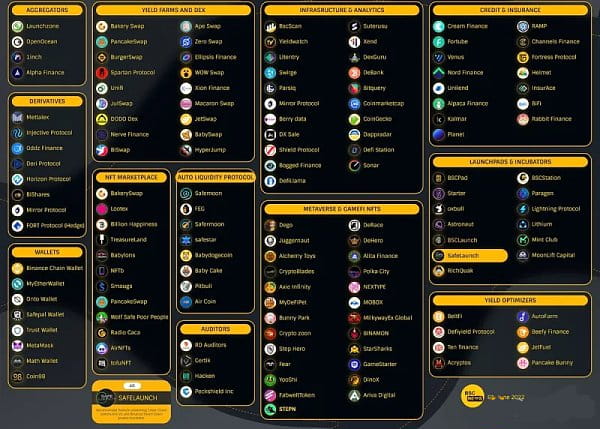
The BSC chain ecosystem evolves along with its architecture. While the ecosystem is expanding and consists of such applications, infrastructure, wallets, and tools, the initial traction in network activity stems from the launch of DeFi applications. Since the launch of the BSC Smart Chain, activity on the network has primarily come from DeFi activity, as the network now hosts activity from more than 400 DeFi protocols (according to the DeFi Llama platform) as well as approximately 1,000 projects from other industries. It is now the second largest network after Ethereum in terms of total value locked (TVL) and number of applications running on the chain.
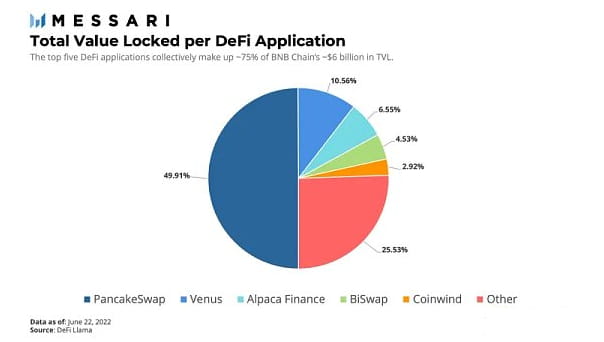
Shortly after the launch of the BSC Smart Chain, PancakeSwap (CAKE) came into being and is now the most used application on the network to date. PancakeSwap is a DEX that utilizes an automated market making (AMM) system. Since its launch, PancakeSwap has achieved over $6 billion in trading volume and over $6 billion in TVL revenue at its peak. It is obvious that the DeFi ecosystem of the BSC chain is highly dependent on the continued success of DEX, accounting for approximately 50% of the TVL of the entire DeFi ecosystem.
Venus (XVS) also contributed to the initial growth of the BSC chain. Venus is a lending platform and synthetic stablecoin protocol. Users can lend or borrow from the asset pool in a permissionless manner. Additionally, the interest rate is set by the agreement and automatically adjusts based on demand. Venus has received a whopping $6 billion in TVL and currently accounts for approximately 10% of the BSC chain ecosystem’s TVL.
The third largest DeFi application on the BSC chain is Alpaca Finance, the network’s first leveraged yield farming protocol. Lenders can earn income by providing borrowers with capital-inefficient mortgages on leveraged yield farming positions. Alpaca Finance has secured a whopping $1.8 billion in TVL and currently represents approximately 6% of the network’s TVL.
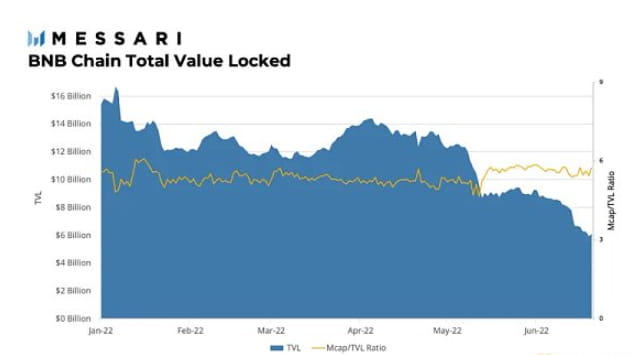
Despite the initial growth in the aforementioned applications and the DeFi ecosystem on the BSC chain, TVL is down 61% year-to-date, very similar to the network’s competitors, but less dramatic.
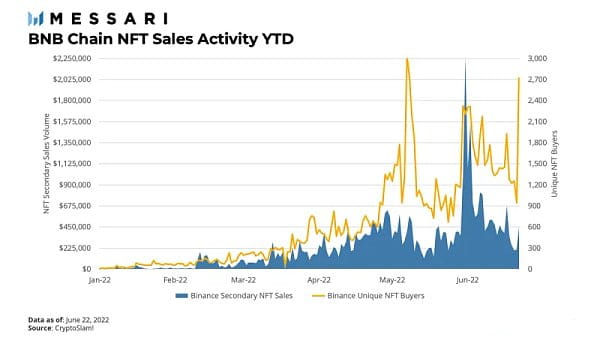
Unlike the lagging DeFi industry, 2022 is the year when the BSC chain NFT industry explodes. NFT secondary sales and unique NFT buyers are both growing exponentially. Despite the relative sluggishness of the overall market, NFT activity on the BSC chain has shown strong momentum.
competitive landscape
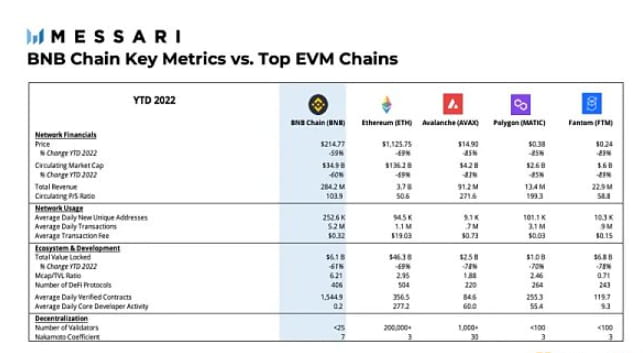
Technological advancements, developer activities, and ecosystem growth strategies separate different Layer-1 (L1) chains. When evaluating the key metrics of the BSC chain versus the other five EVM-compatible chains (including the BSC chain), we can use TVL (total value locked) and the number of DeFi protocols as indicators. This peer group is derived by grouping the EVM chains with the highest TVL and number of protocols, as in today’s cryptocurrency space, DeFi is the main area that drives the majority of the economic activity of each network.
Compared with its competitors, the BSC chain has performed well so far this year in terms of financial, network, ecosystem and development indicators. It is worth noting that the network value and TVL of the BNB chain have declined less. For example, as of June 20, 2022, Ethereum’s network value and TVL have dropped by approximately 69%, while the BSC chain has only dropped by approximately 60%. Other metrics to watch include the average number of daily new unique addresses, daily transactions and verified contracts on the BNB chain relative to the peer group. However, it should be noted that the BSC chain still has room for further improvement in terms of decentralization indicators relative to the number of validators and equity distribution.
Ultimately, the BSC chain’s key advantage over its competitors may lie in continuing to evolve its value proposition of a modular design, providing developers with the flexibility to build custom sidechains, and plans to expand the validator set. Executing on growth strategies will be critical in the coming months.
the road ahead
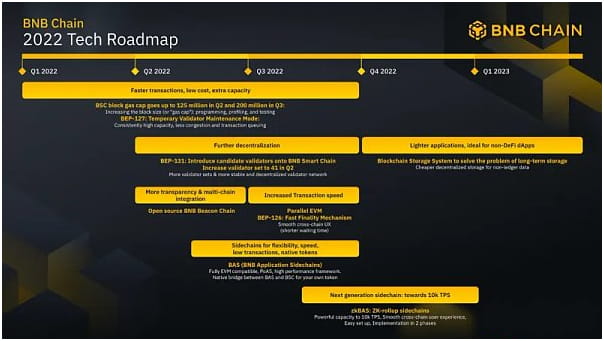
The future development of BSC chain will focus on helping users, projects and developers connect with the BSC chain community. Successful approaches include executing growth strategies to drive mass adoption in areas such as GameFi, SocialFi, and Metaverse. This also includes implementing technical developments such as scaling solutions, increasing the throughput of the BSC chain, and expanding the validator set of the beacon chain and smart chain.
It is worth noting that, as mentioned earlier, the BSC chain’s community plans to use L2-like solutions to expand the network. Plans include launching zk-rollups for high-performance scaling and enabling more customized blockchain solutions through the introduction of sidechains. Additionally, conscious steps are currently being taken to achieve greater decentralization. The team plans to open the beacon chain’s validator set, introduce different election cycles, and increase the number of validators on the BSC smart chain.
Positioning yourself in this competitive market can pose some challenges for many networks. For the BSC chain, the challenges may not only be technical or strategic, but also regulatory issues.
Beyond that, executing a growth strategy to achieve set goals can be the biggest challenge. To this end, BSC Chain and Binance Labs have launched the MVB V Accelerator Program, a BNB-focused accelerator program designed to help projects develop and grow organically through guidance, investment, and network support. The MVB V incubation program will start in July and last 6-8 weeks, and is designed to help top project teams deliver working products.
In the fourth quarter of 2021, Binance announced the launch of a $1 billion ecosystem fund that focuses on four main areas of the BSC chain ecosystem:
Talent development ($1 billion)
Liquidity Incentive Program ($1 billion)
Builders Program ($3 billion)
Investment and incubation programs ($5 billion)
Overall, BSC Chain plans to continue growing its network and ecosystem. To do this, it will implement technical solutions and sidechains and leverage resources from ecosystem funds and accelerator programs.
In summary, while Ethereum is continuing its architectural redesign, competition for adoption and market share is likely to remain in the realm of layer-1 smart contract platforms. New use cases continue to require alternative solutions, and the BSC chain is expected to continue to be one of these solutions. With its evolving architecture and deployment of zk-rollups and sidechains, BSC Chain is able to provide additional value proposition to its large user base. If the BSC chain can successfully implement its plans, the network will be able to maintain its position as one of the most valuable networks on the market.
However, technical and regulatory challenges may still exist in the process of expanding the user base and applying it to new areas such as GameFi and Metaverse. The BSC chain has developed strategies to address these challenges, including technology prospects, ecosystem funds, and accelerator programs.
Although many layer-1 networks like the BSC chain experienced exponential growth in 2021, the market fluctuations and bear market in 2022 have put some downward pressure on network usage and performance. In order to maintain stability during such turbulent times, the BSC chain needs to ensure the security and reliability of the network. Although candidate validators are introduced to ensure the reliability of the network, using so few active validators can also be risky. Therefore, the BSC chain will focus this year on building its validator set and connecting users and developers to its evolving architecture and value proposition. #荣耀时刻