



1.
Understanding Atomic Swaps
Atomic swaps eliminate intermediaries and centralized control, making cryptocurrency trading more decentralized.
Atomic swaps enable peer-to-peer (P2P) transactions between individuals using different cryptocurrencies on two separate blockchains, eliminating the need for intermediaries such as centralized exchanges. Atomic swaps allow users to exchange digital assets based on automatically executed smart contracts.
Centralized exchanges (CEXs) provide a trading experience similar to traditional stock and fiat exchanges - providing asset liquidity, managing trading pairs and order books, ensuring fair market prices, and connecting buyers and sellers on the platform. They have custody and exercise centralized control because they have access to user private keys.
CEXs are popular for their high trading volumes, but they go against the decentralized ethos of cryptocurrency and blockchain. This is where decentralized exchanges (DEXs) seek to embody non-custodial infrastructure. Atomic swaps enable greater interoperability between various blockchain networks. They enable decentralized multi-chain cryptocurrency exchange, fostering the true spirit of decentralized finance (DeFi).
2.
The Importance of Atomic Swaps
Atomic swaps make DeFi possible and solve the inefficiencies associated with exchanging cryptocurrencies in centralized finance (CeFi).
To exchange Ether ( ETH ) on the Ethereum network and Bitcoin ( BTC ) on the Bitcoin network, you can follow these steps when using a CEX such as Coinbase or Binance:
Register an account on a centralized exchange that supports the ETH/BTC trading pair. Depending on the CEX’s policy, this may require a registration process and KYC authorization.
Transfer ETH to a centralized exchange.
Converting ETH to BTC can incur transaction fees and sometimes long wait times.
Withdraw the earned BTC to a Bitcoin wallet, which may involve additional fees.
Finally, wait patiently for the exchange to process and the funds to arrive.
This typical CEX exchange presents a series of steps, uneconomical fees, and multiple possible complications. In addition, centralized exchanges may introduce unexpected security risks related to asset custody. CEX stores user funds in custodial wallets, and the exchange retains control of private keys. In the event of a security breach, hack, or regulatory withdrawal freeze, users' cryptocurrencies may be potentially threatened.
To address these issues, DeFi and DEX enable atomic swaps, which eliminate the need for intermediaries in transactions, simplify the process, and significantly reduce numerous potential security risk points for cryptocurrency users.
Related: How to Mitigate Security Risks Associated with Crypto Payments
3.
History of Atomic Swaps
Atomic swaps, also known as cross-chain atomic swaps, were theorized in 2013 but gained practicality after 2017.
Developer Sergio Demián Lerner produced an initial version of the trustless swap protocol in July 2012. However, Tier Nolan published a full working paper in 2013 and is widely considered the pioneering developer of atomic swaps due to his comprehensive description of the atomic swap process.
This concept was first realized in 2017 when Litecoin founder Charlie Lee tweeted the historic moment of the first successful atomic swap. He successfully performed a cross-chain atomic swap involving LTC/BTC, exchanging Litecoin ( LTC ) for BTC.
Since this milestone, numerous decentralized exchanges and exchanges have been leveraging this technology to create new cryptocurrency trading solutions. Popular DEXs and networks that support atomic swap transactions include AtomicDEX, Lightning Network, Liquality, and more.
4.
How do atomic swaps work?
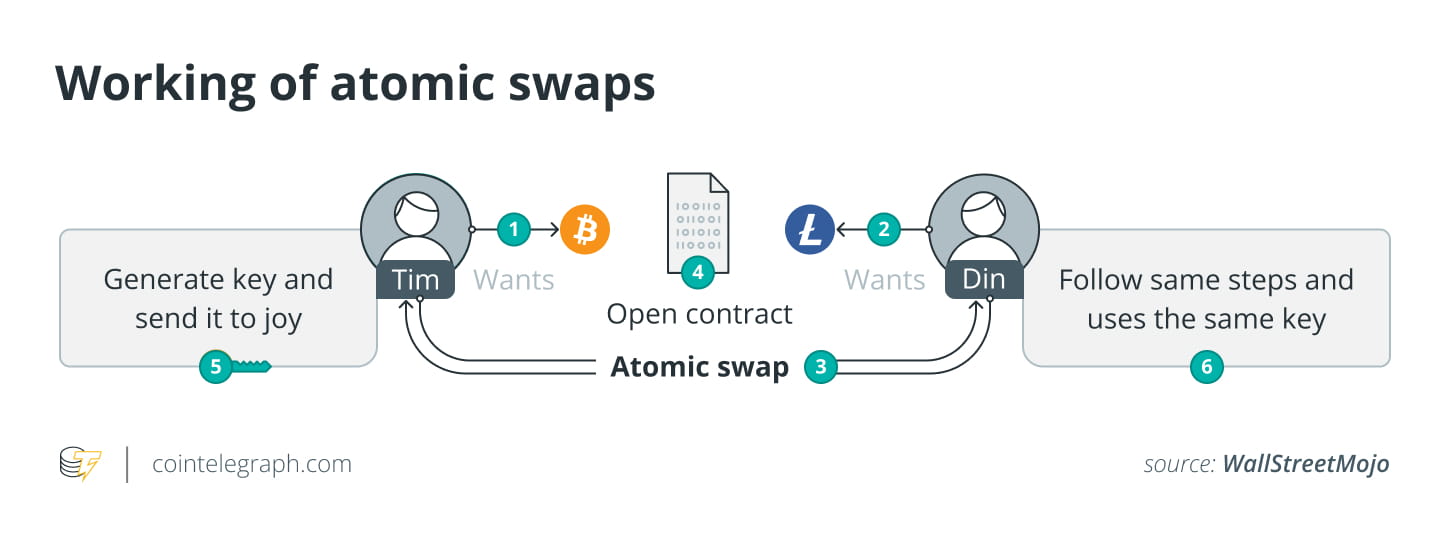
Atomic swaps secure digital asset exchanges by utilizing smart contracts and hash lock cryptography.
“Atomic” is a term used to describe a process that either ends successfully or does not start at all – there is no other choice. Atomic swaps for cryptocurrency transactions mean only two possible outcomes: either the transaction is successfully executed, or nothing happens.
In short, atomic swaps create a mechanism in which both parties to a cryptocurrency transaction must meet all predetermined conditions in order for the transaction to be completed. This is achieved through the implementation of smart contracts, which are self-executing programs designed to enforce the conditions required for a transaction to be successful.
Atomic swaps utilize hashed time-lock contracts (HTLCs), a form of smart contracts, to enable secure and trustless cryptocurrency exchanges. HTLCs essentially “lock” a transaction and require both parties to verify the information before the trade can proceed.
An atomic swap smart contract has two basic components:
Hash lock
The hashlock mechanism allows the contract to be locked with a unique cryptographic key that can only be generated by the cryptocurrency depositor. This key is a unique piece of data that ensures that the exchange is finalized only when both parties approve the transaction.
Time Lock
The timelock mechanism is like a deadline for an exchange. It ensures that the transaction is completed within a certain time, and if it does not happen, it returns the depositor's funds. Timelocks essentially help to protect the transaction. Both parties must approve the exchange within the specified time limit, otherwise the transaction is aborted and the cryptocurrencies are returned to their respective owners.
5.
Advantages of Atomic Swaps
Atomic swaps improve blockchain interoperability and reduce risk while providing traders with greater flexibility at a lower cost.
Benefits of atomic swaps include:
Fully decentralized nature
Atomic swaps provide traders with the advantage of decentralization. Peer-to-peer trading gives autonomy to funds and is independent of CEX platforms or centralized liquidity pools.
Enhanced security
The hash lock and time lock mechanisms in the self-executing smart contracts used by atomic swaps provide traders with an added level of security. Traders are confident that their cryptocurrency will be returned if there are delays or conflicts.
Interoperability and altcoin trading flexibility
Atomic swaps enable users on different blockchains to exchange. Many centralized exchanges do not allow traders to exchange various altcoins. Atomic swaps solve this problem by allowing the exchange of almost all forms of altcoins.
6.
Disadvantages of Atomic Swaps
Atomic swaps can be technically complex, with long blockchain wait times, leading to slow adoption.
Disadvantages of atomic swaps include:
The complexity of trade swaps
Atomic swaps require the exchange of data, information, and hashed passwords. This can be daunting for beginner traders.
Lack of fiat-crypto on-ramp
This can be challenging for traders looking to liquidate into fiat currency, as fiat-to-crypto and crypto-to-fiat conversions are not possible on atomic swap DEXs.
Currently, very few platforms support atomic swaps. Furthermore, specific programming skills and knowledge of hashing may be required to take advantage of atomic swaps. Nevertheless, cryptocurrency wallets may integrate this technology into their software in the future.
7.
Can atomic swaps be tracked?
Atomic swaps are designed to ensure user anonymity so that their identities are not revealed.
Unlike CEXs, atomic swaps do not require KYC. Atomic swaps themselves are designed to be trustless and private, meaning that they aim to ensure that transaction details and the identities of participants are not directly exposed.
However, it is important to note that the underlying blockchains used in atomic swaps (such as Bitcoin and Litecoin) are public ledgers where transactions are recorded and visible to everyone. While the atomic swap transaction itself may not be easily distinguishable from other transactions on the blockchain, the individual transactions involved in the swap can still be tracked on their respective blockchains.
To further enhance privacy, participants can use other techniques such as coin mixing or privacy-focused cryptocurrencies. Coin mixing involves obfuscating transaction history by combining multiple transactions, making it more difficult to trace funds. Privacy-focused cryptocurrencies, such as Monero ( XMR ) or Zcash ( ZEC ), offer built-in privacy features that can be used in conjunction with atomic swaps to enhance anonymity.
8.
Atomic Swaps and Bridging
Atomic swaps enable P2P exchanges, while cross-chain bridges provide connectivity between blockchains to facilitate asset transfers via tokenized representations.
While both cross-chain bridges and atomic swaps enhance blockchain interoperability and serve the purpose of transferring cryptocurrencies across different blockchains, their functions are different. Cross-chain bridges act as connections or links between multiple blockchain networks. They act as middlemen that facilitate the transfer of assets between these networks.
Cross-chain bridges require burning or locking tokens before they are available on different blockchains. Create a wrapped token and provide an equal amount of tokens in a liquidity pool on the target chain. These wrapped tokens can be transferred, traded on the target blockchain, or redeemed for the original assets on the source blockchain.
Cross-chain bridges have become popular due to their ease of use and good user interfaces, and are seen as a modern, accessible way to exchange cryptocurrencies on separate blockchains.