


Futures are one of the most popular instruments for trading cryptocurrencies. The volumes of this market are many times larger than the spot market, and traders use futures contracts to hedge risks, compensate for a shortfall in deposits, or make money on a downtrend.
In this article, we will look at what futures are, what concepts a novice trader should know so as not to “lose the lottery” of a deposit, and how to trade futures on the Binance derivatives platform.
This article was produced by Incrypted and is intended for educational purposes. We hope that the material will help you better understand and study the cryptocurrency market.
This material is for informational purposes only and cannot be interpreted as a guide to action or as a ready-made investment strategy! Reading this article will not make you a qualified trader or investor. The success of any trading strategy depends on a number of factors, including market conditions, experience and risk management skills!
What are cryptocurrency futures?
Cryptocurrency futures are contracts that allow traders to buy or sell a specified amount of cryptocurrency on a future date at a predetermined price. These are derivative financial instruments based on the price of an underlying asset (a specific cryptocurrency). The main characteristics of futures are as follows:
Contract type: settlement futures or delivery futures. The former provide for payment of the difference between the contract value and the value of the asset at the time of execution, the latter - direct delivery of the asset. The crypto market usually uses settled futures, although many sites also offer contracts for the delivery of an asset.
Performance period: there are fixed-term (usually quarterly) and open-ended contracts. The former are executed on time and cannot be continued, while the perpetual ones allow you to hold a position for a long time.
Price: indicates the price of the futures or underlying asset at the time of execution (depending on the type of contract). The futures price is set at the time of its opening.
This derivative is widely used in traditional markets, but has become widespread in crypto due to volatility: on the one hand, futures help protect against unpredictable price movements, and on the other hand, make money on it.
Futures example
To make it clearer, let’s look at futures using a specific example—the USD-M contract from Binance. According to the specification and the above criteria, it can be classified as follows:
Settlement: settlement is made in USDT or BUSD. This means that when opening a futures contract, margin can be deposited in stablecoins rather than the native asset. In addition, the trader’s income will also be paid in stablecoins.
Perpetual or quarterly: the user can choose which type of contract to open.
Price: Binance sets a minimum size for a futures contract depending on the asset being traded. The minimum futures price on Binance typically starts at $5.
At the same time, Binance Futures offers contracts with different types and expiration dates, and with different nominations, which we will discuss in more detail below. For now, let's move on to the terms associated with futures trading.
Basic Futures Trading Terms
Futures trading is more complex than spot trading due to the nature of the opening and execution of futures contracts, so even a spot trader should master the following terms:
Long and Short: Long (long) and short (short) positions are two types of futures contracts. Traders open a long position if they expect the price to rise in the future or a short position if they expect the asset to become cheaper. If we compare it with spot, long is a buy, and short is a sale, but this is a conditional comparison: the mechanics of the transaction and its consequences are completely different.
Leverage: allows you to increase the efficiency of capital use when trading futures. For example, to purchase 1 ETH on the spot market you need several thousand dollars. Leverage allows you to buy ETH futures by paying only part of the cost. The higher the leverage, the less money is required to open a position.
Initial Margin: The minimum amount paid by a trader to open a position, which is used as collateral when using leverage. For example, to buy 100 ETH with x10 leverage, you need to deposit an initial margin of 10 ETH.
Maintenance Margin: This is the minimum amount of collateral that a trader must hold in the wallet to maintain an open position. If the margin balance falls below the minimum amount, then either a margin call occurs (a request to deposit additional funds) or the position is liquidated.
To understand how leverage affects margin, take a look at these screenshots:

Note: The higher the leverage, the lower the initial margin the trader contributes, but the higher his margin ratio. The latter, in turn, affects the position liquidation price.
Financing Rate: These are payments between buyers and sellers based on price movements. The funding rate is used as a tool to support the price of perpetual contracts, which can be held for a long period and do not have a maturity date (and therefore are not tied to the value of the underlying asset). When the funding rate is above zero (positive), long traders pay short sellers. The opposite is true for negative rates.
Important: Funding rate payouts can be another reason for liquidation as they can push your wallet balance below the maintenance margin. We recommend that you study in detail how the funding rate works using Binance as an example.
PnL or profit and loss: reflects the profitability/unprofitability of the position. While the position is open, PnL is considered not realized, that is, the trader does not record any income or losses. But when the position is closed, the unrealized PnL becomes realized (partially or fully) and is reflected in the wallet balance. PnL is also taken into account when determining the margin level, so even if a loss is not realized, a negative PnL can result in liquidation.
Liquidation: forced closure of a trader's position by an exchange to prevent losses. Liquidation occurs when the margin balance falls below the maintenance margin level, in turn, the margin balance is the sum of the wallet balance and unrealized PnL. That is, when there are not enough funds in the wallet to pay the margin, the platform automatically liquidates the trader’s position.
Please note that these are just basic concepts. When trading on a derivatives platform, additional problems and details arise, so next we will look at a specific example of how to open an order on the Binance Futures platform.
How to trade futures on Binance - step by step guide with examples
Binance Futures is one of the most popular trading platforms on the market. It is in demand due to its user-friendly interface, deep liquidity and large leverage. There are 2 types of futures contracts available to derivatives exchange users:
USD-margined (USD-M): perpetual and deliverable contracts with up to 125x leverage and settlement in USDT and BUSD. That is, this is a futures denominated in stablecoins, the margin and profit from which are also paid in stablecoins.
Coin-margined (COIN-M): perpetual and deliverable contracts with up to 125x leverage and settlement in cryptocurrency. They differ from the previous type in that both margin and profit are paid in the currency for which the contract was purchased.
This is an important aspect because you will need to reserve some capital for margin payments to maintain your position. Collateral in stablecoins is considered risk-free, so USD-M contracts are worth using in the red market, while COIN-M is suitable for an uptrend when the dollar value of the collateral rises on its own.
Now that we have decided on the type of contract, we move on to opening an order. We will use a demo account on Binance Futures Testnet for this:
Opening a Long position on BTC/USDT
First, select the type of futures contract. To do this, on the main page just click on the ticker of the trading pair:

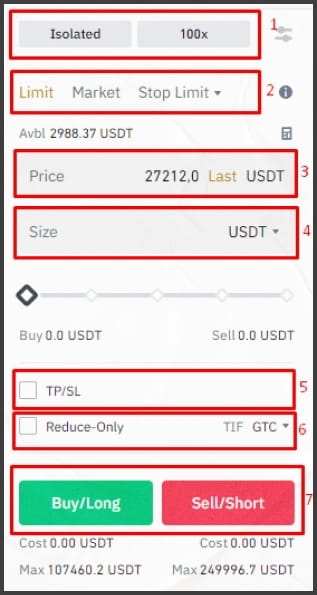
Now we proceed directly to opening an order. And let's go through the main parameters:

Margin Type and Leverage Amount: Isolated margin means that an amount specifically allocated for that position is used as collateral. Cross margin allows you to use all available assets in your futures wallet as collateral. Leverage may differ for different trading pairs.
Important: In isolated margin mode, a trader cannot reduce leverage after opening a position.
Order type: There are a total of 6 order types of varying complexity available. The basic ones include market, limit and stop-limit. If you are not familiar with order types, it is worth learning the basics of trading first before moving on to futures trading.
Value: The price of the futures contract, NOT the spot asset. The value of the contract and the asset may differ, although under normal market conditions these differences are quickly resolved by arbitrageurs and are virtually unnoticeable.
Size: The amount you want to buy the contract for. When choosing a size, consider the leverage as well as the margin size of the potential payout at the funding rate. The higher the leverage, the more you will have to pay in case of unpredictable price movements.
Take profit/stop loss: levels upon reaching which the position is automatically closed in order to fix profits or minimize the trader’s losses. These levels are optional.
Execution Options: Allows you to choose how the order will be executed. For example, the IOC (Immediate Or Cancel) option requires that the order be executed immediately or canceled at all. This allows you to avoid price slippage when execution is delayed or liquidity is low.
Order Type: You can open a contract to buy or sell an asset in the future, i.e. short or long position. A long position will allow you to receive income if the exchange rate rises, and a short position if the price falls.
Now we fill in all the parameters to open a long position on Bitcoin. The completed order looks like this:

At the end, click on Buy/Long and wait for the order to be executed. Once the order is filled, the open position will appear in the position management window below the price chart. Here you can track the cost of margin, PnL, liquidation level, and, if necessary, close the position:

Important: the Margin Ratio parameter shows the ratio of the maintenance margin level to the available margin. If the rate reaches 100%, this will mean that the funds in the wallet are not enough to maintain the position and it will be liquidated.
Opening a Short position on BTC/USDT
Now let's do the same thing, but instead of a buy contract, we'll open a sell contract. To do this, you need to repeat the same steps as in the previous section, but at the end, instead of Buy, click on Sell:

Note: This point is confusing for new traders who started spot trading. Unlike spot trading, Buy and Sell in futures refer to different types of contract rather than the action itself. To sell futures, you need to partially or completely close the position through the management menu.
After the order is executed, the short contract also appears in the position management field and looks like this:
It is also worth considering that when opening positions with similar parameters, but opposite, they are leveled out. So, if you opened a Long position on BTC in the amount of $1000, and then opened the same Short position, then these positions will be offset and as a result you will not have a single open position. But if the size of the Short order is $500, then after its execution there will be an open Long position of $500.
Important: We recommend that beginners start trading on the Binance Futures test platform to become better acquainted with the interface, functionality and other trading features. Also, this article only covers the highlights, for more complete information check out this Binance post.
Advantages and disadvantages of futures trading
The main advantages due to which traders often prefer futures trading to spot trading or other types of earnings are:
Leverage: futures platforms provide leverage up to x200, which allows you to maximize your results and receive significant income even with a small deposit.
Liquidity: Futures contracts, although linked to underlying assets, form a separate market. And this market is many times larger and more liquid than the spot market, so you can execute a large order here faster and with less slippage.
Greater potential income: the volatility of cryptocurrencies multiplied by leverage allows you to earn a lot, quickly and without large investments if you correctly predict price dynamics.
The main disadvantages of futures trading include:
Difficulty: Derivatives are more difficult to trade than underlying assets. In addition to price, you also need to take into account margin, the impact of leverage, repayment terms and a number of other parameters. Therefore, it is better for beginners to start getting acquainted with trading on the spot market.
Fees: To use leverage and maintain a position, the trader must deposit margin and make payments at the funding rate. When opening large positions, these are significant amounts, which increase the requirements for the starting deposit and the entry threshold.
High risks: leverage can become a multiplier not only of income, but also of losses. In addition, the value of futures may change more unpredictably than spot assets, increasing the risk of sudden liquidation.
It is also worth considering that at the moment only centralized exchanges can offer convenient futures platforms. Similar DeFi services are just beginning to develop and are inferior to CEX both in liquidity and in the quality of user experience.
Conclusion
Futures contracts are one of the most popular financial instruments in the cryptocurrency market. They are used both to protect against volatility and to extract income from it. However, trading the futures market is more difficult than trading the spot market, so even if you already have trading experience, it is important to learn additional terms and concepts related to futures.
One of the most popular futures trading platforms is Binance Futures. Above we looked at how to open short and long positions on this site, but this review does not include all the intricacies of futures orders. For a deeper study of the market and mastering practical skills, use a demo account on Binance Futures Testnet and training materials from the exchange itself.