

In fact, stablecoins are just a form of cryptocurrency. Their value is often anchored to real currency or regulated by algorithms to keep the token value and the anchor (such as the US dollar) within a roughly controllable exchange range. But this does not mean that stablecoins themselves can avoid fluctuations. When encountering a huge black swan event, stablecoins will also decouple from the pegged currency. This means that they will deviate from their pegged value.
Since a series of black swan events such as the collapse of LUNA and the collapse of Silicon Valley Bank, which triggered the decoupling of USDC, the world's second largest cryptocurrency stablecoin, the market's distrust of the concept of stablecoins seems to have reached a threshold.
Whether they are centralized stablecoins, algorithmic stablecoins or partially decentralized stablecoins, they are all regarded as scourges to a certain extent: Tokens known for their stability are unstable, so what else can we believe?
In fact, stablecoins are just a form of cryptocurrency. Their value is often anchored to real currency or regulated by algorithms to keep the value of tokens and anchors (such as the US dollar) within a roughly controllable exchange range. But this does not mean that stablecoins themselves can avoid fluctuations. When encountering a huge black swan event, stablecoins will also decouple from the pegged currency. This means that they will deviate from their pegged value.
The key to the problem is not whether the stablecoin will fluctuate, but whether the stablecoin itself has a scientific and reasonable self-correction mechanism that can promptly repair risks and maintain reasonable value when facing unknown risks.
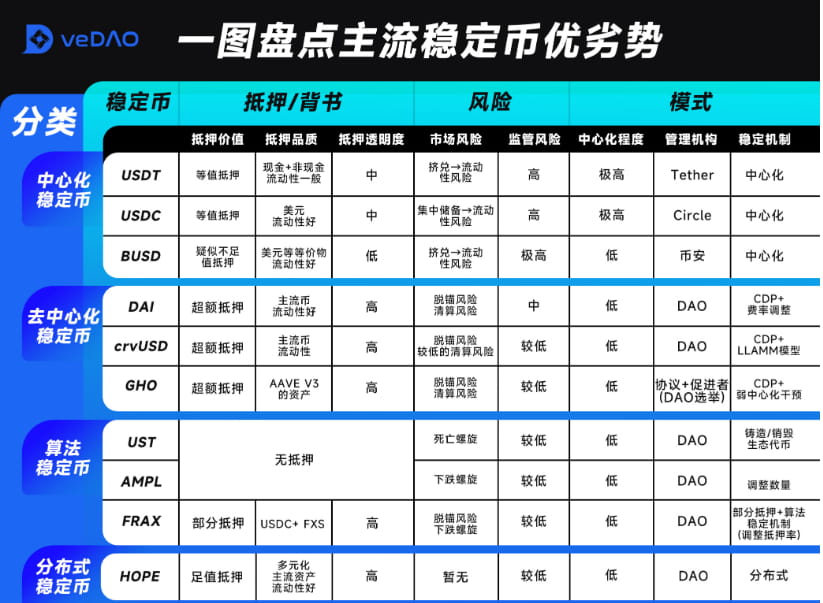
Therefore, the veDAO Research Institute has summarized several common stablecoins on the market. Through the analysis of stablecoins, we will explain to everyone the mechanisms of different stablecoins and their respective response methods when facing risks.
Centralized Stablecoins
The current stablecoin market is mainly divided into three categories: centralized stablecoins, algorithmic stablecoins, and decentralized stablecoins. So far, centralized stablecoins are still the mainstream of the market, and can even be called the cornerstone of the crypto world to a certain extent.
USDC, USDT, and BUSD are the three largest centralized stablecoins currently. All three are issued by off-chain entities and claim to be backed 1:1 by fiat collateral (i.e. “real” USD).
As of now, USDT, USDC and BUSD account for more than 80% of the market share of the entire stablecoin market. According to Dune data, USDT is still the undisputed leader, with a market share of 46.2%; USDC is closely behind with 36.7%; BUSD is 9%. Although centralized stablecoins have a huge market share and the scalability of centralized stablecoins is the best in the industry (almost all projects have built-in USDT or USDC trading pairs), this type of stablecoin is opaque and completely centralized, and cannot be audited on the chain, which means that we cannot know whether the number of centralized stablecoins issued matches the number of collateral. All we can pray is that we believe that centralized stablecoins really fulfill their promises.
For example, although Tether has always insisted that USDT is backed by assets of equal value (including cash and bonds) held by it, it has never provided a proper audit and has only "proven" its ability to fulfill its obligations.
However, an audit in June 2022 showed that the cash ratio of USDT collateral was not high.
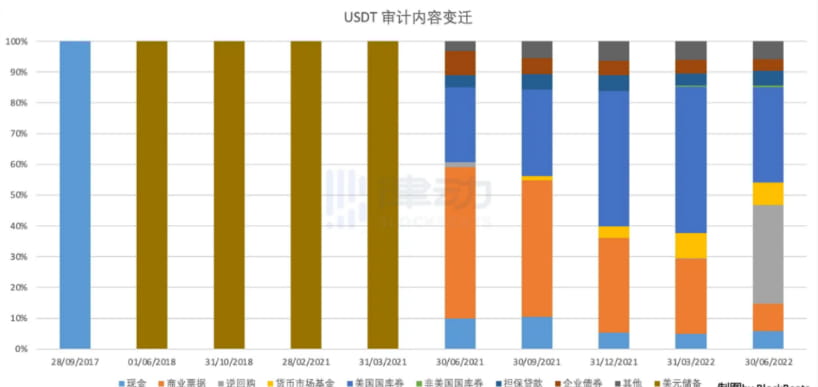
In general, there are differences in the liquidity of centralized stablecoin collateral. Once an extreme event triggers a run, there is a certain risk that USDT collateral can be redeemed in a short period of time. Also, due to the user group’s distrust of excessive centralization, a new demand has emerged in the market: algorithmic stablecoins.
Algorithmic Stablecoins
Algorithmic stablecoins are mainly represented by UST and OHM. These stablecoins maintain stability through a floating minting and destruction mechanism without any external collateral as support. For example, when the trading price of UST is higher than its anchor rate (i.e., $1), market participants have the motivation to expand its supply and lower its price by minting new UST, and vice versa.
The fatal weakness of algorithmic stablecoins is the downward spiral. For AMPL, when the price of the coin enters a downward range, holders may choose to sell AMPL in anticipation of a decrease in the number of coins they hold, causing the price of AMPL to fall further until AMPL falls to an extremely low level. For UST, we have already witnessed the historical moment of the death spiral. As for whether FRAX, a partially algorithmic stablecoin supported by part of USDC, can avoid the death spiral when it falls sharply, it remains to be verified by time.
The core problem of algorithmic stablecoins is that they have no value collateral, so they are more like a speculative product. In application scenarios such as trading and DeFi, algorithmic stablecoins find it difficult to fulfill the responsibilities of stablecoins.
Finally, there is the decentralized stablecoin that is gradually gaining favor in the market.
Decentralized Stablecoins
Decentralized stablecoins are represented by DAI, a decentralized, dollar-pegged stablecoin issued by Maker DAO. DAI is based on an overcollateralization mechanism, where users can deposit different forms of collateral (such as ETH) into the vault to mint DAI stablecoins. Users must keep their collateral positions overcollateralized because the collateral can be liquidated when it falls below a set collateral ratio (which varies depending on the collateral asset).
Compared with centralized stablecoins, decentralized stablecoins have several advantages:
Anyone has the opportunity to participate in minting decentralized stablecoins.
The mortgage status is on the blockchain, which is open, transparent, and cannot be tampered with or misappropriated.
With the blockchain protocol as the main executor, the possibility of human manipulation is very low.
Using DAO (decentralized autonomous organization) is more in the interests of holders.
Decentralized stablecoins issued based on blockchain protocols face lower regulatory risks.
But at the same time, decentralized stablecoins also have some shortcomings:
Most of them adopt over-collateralization, which reduces the efficiency of fund use.
Having a liquidation mechanism has raised the understanding threshold for participants to a certain extent.
It is impossible to break away from the relationship with centralized stablecoins. Among the collateral of decentralized stablecoins, it is an important component of centralized stablecoins. When Silicon Valley Bank collapsed in March 2023, USDC was depegged. Affected by this, DAI also continued to be depegged for several days.
Decentralization plus distribution, a new stablecoin player HOPE
In response to the problems of decentralized stablecoins, HOPE, as a rising star, has made some improvements. In the official definition, HOPE is a "pricing token supported by BTC and ETH reserves, with a multi-stage growth plan to evolve into a distributed stablecoin."
The specific operation logic will be divided into three stages:
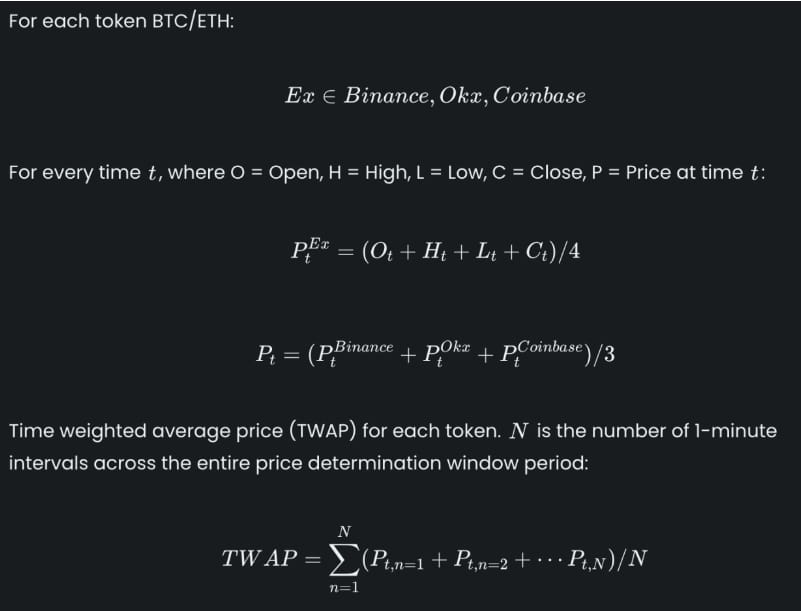
Phase 1: $HOPE will be supported by BTC and ETH in the early stages of development, and tokens will be minted and destroyed. Each time a HOPE is generated, a certain amount of BTC and ETH will be reserved. During this process, HOPE will also obtain the opening price, highest & lowest price, and closing price of BTCÐ from Binance, OKX, and Coinbase every minute, and determine the actual price of HOPE through average calculation.
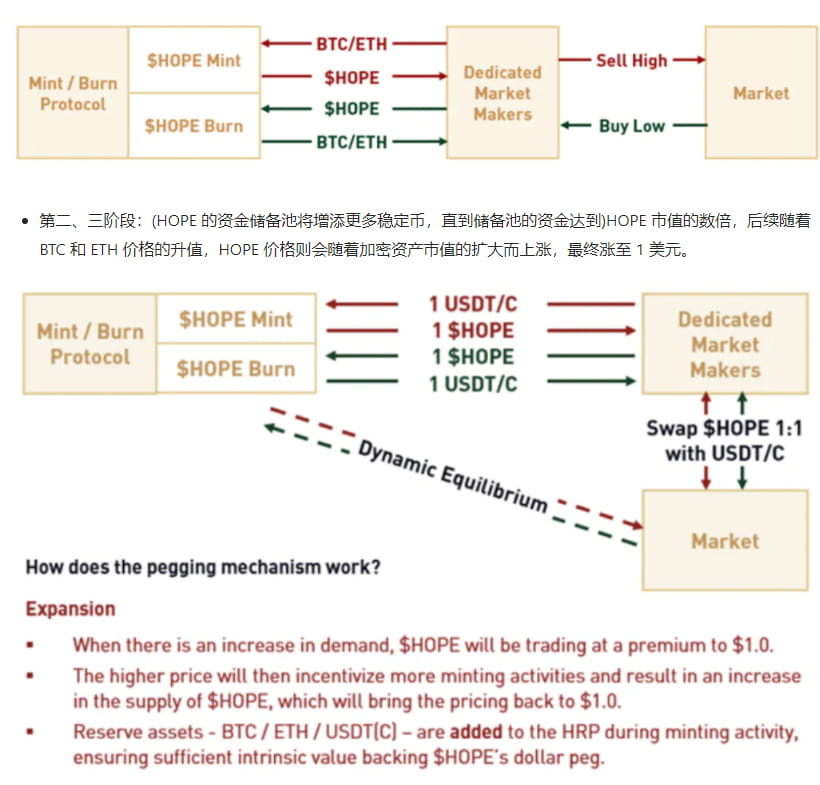
The second and third stages: (HOPE's fund reserve pool will add more stablecoins until the funds in the reserve pool reach) several times the market value of HOPE. Subsequently, as the prices of BTC and ETH appreciate, the price of HOPE will rise with the expansion of the market value of crypto assets, and eventually rise to $1.
It is worth noting that with the increase in the collateral market value of BTC and ETH, there will always be a node that will make the collateral value of HOPE exceed $1, but HOPE itself will choose to remain stable after rising to $1 and will no longer rise.

In this way, a global over-collateralization situation is formed between the BTCÐ collateral market value and the HOPE price. This can in turn prove the strength of the HOPE token's own value. More importantly, based on individual users, there is no need for over-collateralization when minting HOPE, which greatly improves the efficiency of fund use.
So the next question becomes: How can the market verify the actual BTCÐ collateral market value of the HOPE ecosystem? Currently, HOPE chooses to entrust its crypto assets to Coinbase, and at the same time discloses the custodian's wallet address, fund flow and amount. After that, HOPE will also entrust its crypto assets to other custodians and custody agreements, thereby further strengthening the distribution of collateral assets and reducing the impact of black swans.
In order to further expand the liquidity of HOPE and attract more BTCÐ Holders to enter the HOPE ecosystem with peace of mind, HOPE has also innovated its economic model:
$HOPE: is the ecosystem’s reserve-backed native pricing token, which will launch at a discounted price of $0.5 and gradually achieve a peg as the cryptocurrency market recovers.
(stHOPE: is) a tokenized representation of HOPE staking. Users can obtain stHOPE by staking (HOPE) and obtain LT rewards by holding (stHOPE).
$LT: It is the incentive and governance token of the HOPE ecosystem, used to motivate users to participate in the HOPE ecosystem and conduct governance.
veLT: It is a tokenized representation of vote lock when LT exercises governance rights, and veLT holders can obtain LT reward bonus.
At present, since there is a hard cap on the price of HOPE, and there is unlimited room for imagination in the number of BTCÐ pledged and the pledged market value, the value overflowed by the HOPE ecosystem based on the pledged market value will be carried by LT, and the source of LT itself comes from the increase in holdings and pledge of HOPE tokens made by users based on their optimism about the market and the HOPE ecosystem.
In other words, if users want to obtain more benefits from LT, they need to hold more HOPE and actively participate in the governance of the ecosystem (veLT exercise can also obtain LT rewards), which in turn promotes the operation of the positive flywheel of the entire HOPE ecosystem.
In addition, HOPE has launched four major protocols, providing a complete and rich set of application scenarios including exchange, lending, and margin around HOPE and stHOPE, and incentivizing users to participate in ecological applications and community governance through $LT.
HopeSwap: is an AMM Swap built on Ethereum, and is the gateway for users to the HOPE ecosystem. Users can quickly trade between (HOPE,)stHOPE, (LT and other assets, or provide liquidity for trading pairs to obtain)LT rewards and handling fee sharing.
HopeLend: It is a multi-liquidity pool non-custodial lending protocol. Lenders can earn interest by depositing liquidity, while borrowers can provide collateral assets to obtain over-collateralized loans.
HopeConnect: Allows users to trade derivatives on CEX through HopeConnect without centralized asset custody.
HopeEcho: Synthetic assets that track the prices of real-world assets (RWA), including stock indices, fixed income instruments, commodities, foreign exchange, etc., lowering the threshold for accessing TradFi services.
At present, the emergence of HOPE has borrowed some mechanisms from other products in the industry and has its own innovations on this basis, mainly providing a solution to the problem that individual users must over-collateralize and the utilization efficiency of funds is low. Summary:
In fact, while classic stablecoins have been questioned one after another, a number of new stablecoin projects have emerged in the industry, such as HOPE, which advocates decentralized distributed collateral; ANGLE, which chooses to anchor the euro and deeply imitates Curve; and Reflexer, which is favored by Vitalik and sets a dynamic redemption rate. However, despite the innovation of the latter two, they have not escaped the inherent logic of individual user over-collateralization. In this regard, HOPE is relatively better.
But at the same time, we should also note that HOPE, as a rising star in stablecoins, is remarkable, but there are also some considerations: for example, HOPE proposed an overall over-collateralization and distributed storage of collateral assets, but it may be necessary to give a clearer statement on how to prove the relevance of the public custodial address to the HOPE ecosystem. In addition, since HOPE itself places the actual collateral market value of BTCÐ on the HOPE stablecoin + governance coin LT, will this cause users to focus on LT and ignore the scalability and innovation of HOPE's own stablecoin?
Finally, there is a common problem faced by all decentralized stablecoins: how to gain more market share and user groups? For emerging stablecoin projects, this problem is a long and arduous journey. However, as the market recovers, BTC has returned to the $30,000 mark, and the subsequent development of HOPE is worth our optimism.