

It will redefine our notions of privacy, security, and verifiability.
Original title: Emerging ZK Use Cases
Written by: zkvalidator
Compiled by: Kate
In this article, we explore emerging ZK use cases.
introduce
In the past few months, we have witnessed a lot of hype around zero-knowledge use cases including zkevm, zkBridges, etc. However, in such a fast-paced environment, new use cases are emerging where zero-knowledge proofs (ZKPs) play a vital role. This article aims to explore the areas where ZKPs are gaining more traction in the minds of individuals.
ZKML Zero-Knowledge Machine Learning
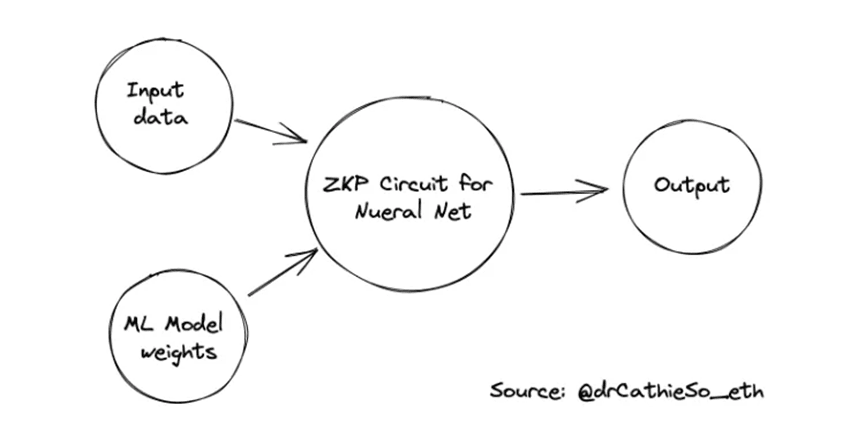
This diagram shows how zkML works.
ZKML (Zero-Knowledge Machine Learning) is an emerging technology with great potential in a variety of applications that has not yet been fully explored. From computational integrity and privacy protection to transparency and decentralized inference or training for machine learning as a service, ZKML opens new doors for innovation. Here are some potential use cases for ZKML:
Verifiability of ZKML: ZKML leverages validity proofs such as SNARKs and STARKs to ensure accurate execution of computations, especially in machine learning. By using these proofs, machine learning model reasoning can be verified to confirm the source of the output given the input. This feature allows machine learning models to be deployed off-chain while conveniently verifying ZK proofs on-chain.
https://youtu.be/odaUPMNqJs8
Privacy protection in ZKML: Privacy is a key issue in machine learning, and ZKML provides a solution. It can prove the accuracy of a model on test data without revealing the weights used, thus ensuring data privacy. In addition, ZKML facilitates privacy-preserving reasoning, allowing sensitive medical diagnoses, such as cancer test results, to be shared with patients without leaking their data to third parties.
Enhancing transparency in ML-as-a-Service: ZKML plays a vital role in improving transparency in ML-as-a-Service. By providing proofs of validity associated with ML model APIs, users can verify the authenticity of the models they use. This solves the problems associated with traditional APIs (which are often viewed as black boxes) and improves trust in the provided models.
Decentralized reasoning and training: ZKML enables the execution of machine learning tasks in a decentralized manner. The model can be compressed by leveraging zero-knowledge proofs, allowing public participation and data submission during reasoning or training. This opens up new avenues for collaborative and distributed machine learning.
ZKML Proofs: Proofs are an important aspect of ZKML, allowing for the incorporation of verifiable proofs from trusted external parties. By using zero-knowledge proofs to verify digital signatures from trusted sources, ZKML ensures the authenticity and provenance of the information being proven. This allows for the verification and use of trusted references in a variety of applications.
Application of ZK in games
 https://youtu.be/dLZbfTWLGNI
Zero Knowledge Proofs (ZKP) offer many advantages to game architecture and gaming experience. By integrating ZKP, game developers can benefit from reduced costs, enhanced privacy protection, effective anti-cheating measures, and improved scalability.
In terms of gaming architecture, ZKP has a significant impact on online multiplayer games by minimizing the amount of sensitive data stored on centralized servers, thereby reducing the expense of maintaining a client-server architecture. In addition, ZKP strengthens the privacy and security of peer-to-peer (P2P) gaming systems, eliminating the need for expensive servers while ensuring the authenticity of in-game events and preventing cheating.
ZKPs also address gaming scalability challenges by reducing server overhead in client-server architectures and enabling verifiable proof of game play in P2P multiplayer games. This expands the number of concurrent players that can be supported, leading to a more enjoyable gaming experience and appealing to a wider player base.
In terms of gameplay, ZKPs offer solutions for a wide range of game genres. In first-person shooters (FPS), ZKPs can verify a player’s skill level without revealing sensitive information, thereby improving matchmaking accuracy. In massively multiplayer online role-playing games (MMORPGs), ZKPs can enable secure ownership and exchange of virtual assets, creating a unified economy across different games. ZKPs also have applications in gambling and casino games, providing verifiable random results and protecting player privacy. In addition, ZKPs can ensure player progress and high scores in puzzle and strategy games while keeping sensitive information private.
Adoption of ZKP in the gaming industry can improve gaming experience, increase player stickiness, and generate higher revenue. As the use of ZKP continues to expand, specialized hardware may become essential to meet the growing demand for computing power.
ZK ID - Decentralized ID
 https://youtu.be/5TJ3BZEc1Ro
In today’s online environment, establishing digital trust and secure authentication is essential. The advent of zero-knowledge proofs (ZKPs) has revolutionized this space by providing greater privacy and security. Here, we will explore the properties and benefits of zero-knowledge proofs and their potential to redefine digital authentication.
Enhanced privacy protection: Zero-knowledge proofs excel in protecting sensitive information. Users can verify their identity or credentials without revealing specific details such as personal identification numbers or addresses. ZKP establishes a security framework that allows trustless interactions while maintaining confidentiality.
Secure and verifiable interactions: Zero-knowledge proofs enable users to participate in smart contracts and verify information on the blockchain while hiding their private data. Off-chain credentials like passports or educational degrees can generate zero-knowledge proofs. These proofs can then be used for trustless verification on the blockchain, ensuring data integrity while maintaining privacy.
Recently, Polygon launched Polygon ID, a zero-knowledge decentralized identity solution. Polygon ID uses the power of zero-knowledge proofs to allow users to verify their identity without revealing sensitive information. It provides a comprehensive toolset including a validator SDK, issuer node, wallet SDK, and wallet application, enabling developers to seamlessly integrate decentralized identity solutions into their applications.
in conclusion
All in all, the diversity of areas where ZK has a positive impact shows the potential of this technology to bring mass adoption to the blockchain industry. In fact, most of these applications - zkML, ZK games, ZK ID - are still in their infancy, and some of them remain largely in the theoretical realm. Nevertheless, it is only a matter of time before we see more activities and products coming from the areas of zkML, ZK games or ZK ID. As these areas mature, we expect a vibrant ecosystem of ZK-based applications that will redefine our notions of privacy, security and verifiability.