
introduction
The first dual-currency financial products in Crypto Circle were launched in October 2019. From the earliest 1.0 product line, which only had BTC as the target, to the current product line, which includes other mainstream currencies such as ETH (Binance has 10 token targets to choose from), the optional period ranges from 1 day to 1 year (as of the time of writing, the option is the end of December 2023). From the perspective of investors, if you can use the dual-currency financial management tool more skillfully, it can bring considerable income enhancement in bull markets, bear markets, and volatile markets.
This article will use plain language to introduce the various features of dual currency investment from the perspective of an options novice.
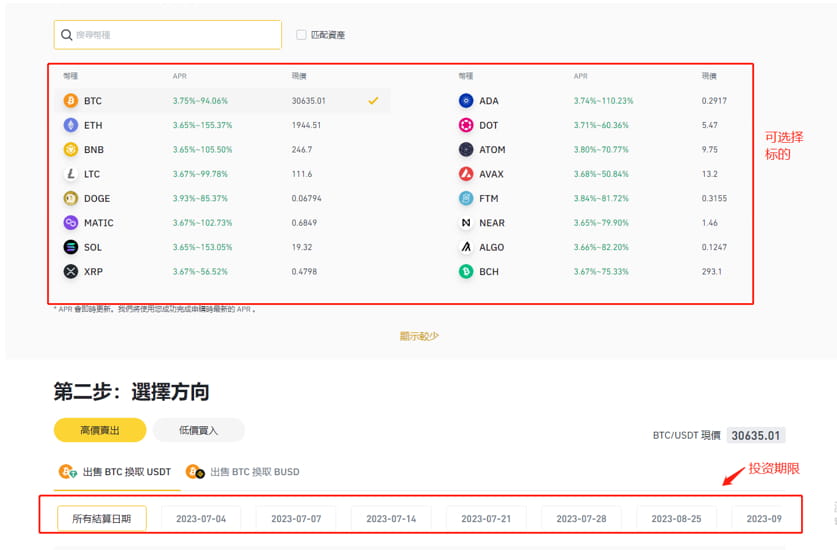
1. Product Definition
The underlying of dual currency financial management is an option strategy (selling European options with sufficient margin, Put or Call, the main income strategy is to earn option premiums. Of course, the risks related to selling options will also be detailed in this article).
The buyer and seller sign a contract based on the future price of the underlying asset. The closer the price is to the spot price, the greater the probability of conversion between U and Token. Therefore, dual-currency financial management is a non-principal-protected volatile financial management product (it is difficult to rate it using traditional financial R1-R6). Each Cex platform packages option products and sells them to investors, which can effectively reduce the difficulty of investors' operations while earning relevant handling fees.
The core elements of dual currency wealth management products include: expiration date (option delivery date), type (option type Put or Call), linked price (option strike price), rate of return (premium price converted to Apr), and investment quantity (number of options).
In fact, if you hold Token and convert it to U, it is equivalent to selling at a high price, and the linked price is the take-profit price;
Holding U is equivalent to wanting to buy, and the linked price is the purchase price (some platforms will define it as the "bottom price"). In the future, there will be 4 results for dual-currency financial products: holding tokens to continue to earn tokens, holding tokens to convert to U, holding U to earn U, holding U to convert to tokens, and no matter which result, the platform will pay the full amount of interest (i.e. option premium) agreed upon in the purchase product.
2. Risks
When choosing any investment tool, in addition to understanding the basic definition, the most important thing in my opinion is to understand the applicable scenarios and risk points of various investment tools. Specifically, there are the following risks:
①【Non-principal protection】
Traditional bank wealth management, if the underlying asset is a money fund with a risk level of R1, is equivalent to principal-guaranteed wealth management from the current perspective. However, as long as the underlying asset is R2 or above, there is a risk of loss. For example, in mid-November this year, a large number of underlying asset investments in bond wealth management products experienced a 3%-8% drawdown within a week. (For details, see: Thoughts on Saudi Arabia's counterattack and the sharp drawdown of bond wealth management products - 1123 [Concepts] - Article 070)
So, back to the dual-currency wealth management products we talked about. As structured products, the non-principal protection is mainly reflected in the fact that if you hold U and want to earn U, if the price drops sharply on the settlement day and exceeds the option contract price, U will be exchanged for tokens, resulting in the so-called "free loss" (I personally think the definition is not accurate enough); if you think from the token-based perspective, if you hold tokens and want to earn tokens, if the price rises sharply on the settlement day and exceeds the option contract price, tokens will be exchanged for U, resulting in short-selling.
②【Liquidity risk and early redemption slippage are large】
Dual currency investment products are fixed lock-up period products on most platforms and do not support early redemption. If an event such as the Cex crash is foreseen, it will result in the inability to withdraw funds in time. Currently, there are some platforms that support early redemption, but the slippage is large.
③【Home position switch】
If you choose a product whose spot price is closer to the agreed price and whose time is longer, there is a greater probability that the token and U will be exchanged. Whether it is a token-based or U-based product, it is easy to feel that you have lost money.
④【Roller Coaster Market】
For example: When the ETH price is 1800 on T day, you want to buy ETH at 1200. As a result, when the product expires on T+N day, you buy ETH at 1200, but the ETH price has fallen to 900.
To be continued
Note: This article is quite long and is expected to be published in 3 parts: upper, middle and lower.