

Bitcoin ETF

The full name of ETF is Exchange Traded Funds, which means trading platform traded funds. Literally understood, it is a fund that can be traded on a trading platform. Simply put, it is a basket of targets that tracks the trend of the market.
You can think of an ETF as a basket of stocks that are selected based on some index that indicates stock movements, such as the S&P 500, which records the overall movement of the stocks of 500 companies. So, the basket of stocks in the ETF is the stocks of these 500 companies.
One point that needs to be made is that you don't actually own those 500 stocks directly, you have a certificate to prove that you own the ETF. The best-known ETF is the SPY ETF, the world's largest exchange-traded fund that tracks the overall S&P 500 stock market index.
Bitcoin ETF is an ETF based on Bitcoin. If you buy a Bitcoin ETF, you are indirectly investing in Bitcoin. You own a tradable Bitcoin fund instead of directly owning Bitcoin. However, there is no difference in returns between buying a Bitcoin ETF and buying Bitcoin directly, because the Bitcoin ETF tracks the price of Bitcoin. If Bitcoin rises, the ETF will also rise, and vice versa.
ETFs are just a different way to invest in Bitcoin. The only difference is that we no longer have to worry about whether Bitcoin will be stolen, where to store Bitcoin, or go through cumbersome procedures.
ETP
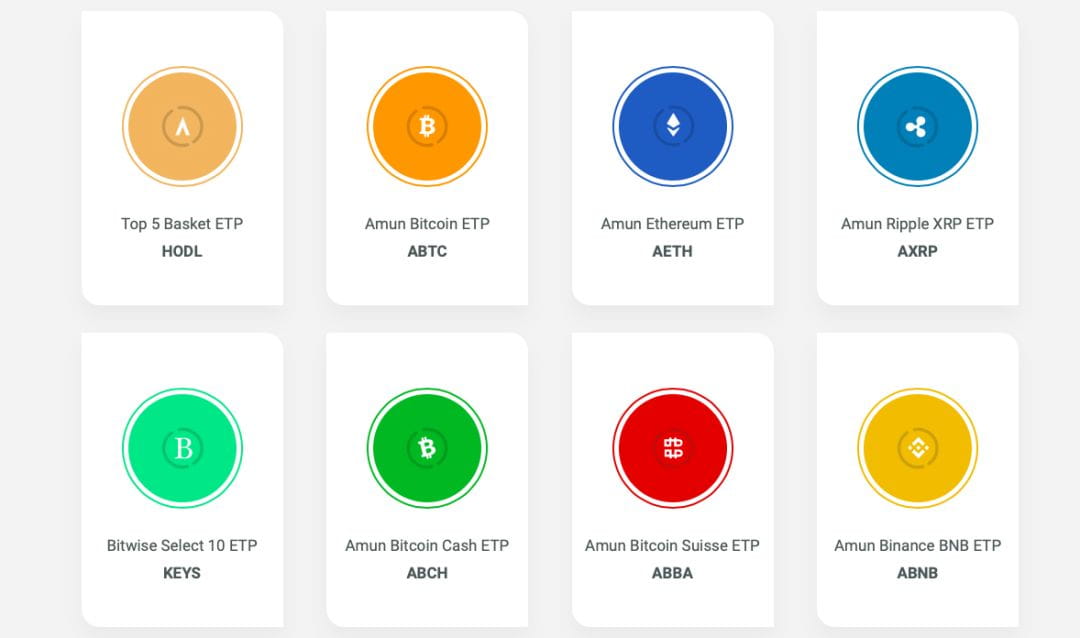
The full name of ETP is Exchange Traded Products, which means trading platform trading products.
ETPs are open-ended investment products listed on trading platforms, with derivative pricing, and are traded and settled on national trading platforms day-to-day like stocks. They are classified as preferred structured debt securities. Basically, they are linked in value to other securities, commodities or indices.
ETPs are passive investments that seek to replicate the performance of a specific market by tracking an underlying benchmark index and will outperform active investment products most of the time.
Swiss stock exchange SIX defines ETPs as follows: ETPs are collateralized, non-interest-earning bearer debt securities that replicate underlying assets (usually from commodities) in a fundamental or leveraged manner. Like ETFs, they are day-traded in multiple market maker fields, but legally speaking, they are not funds.
Take the first global multi-cryptocurrency ETP launched by the Swiss Securities Exchange in November 2018 as an example. The Amun ETP is based on the Amun Crypto Basket Index, which tracks the performance of the five best cryptocurrencies in terms of market capitalization and liquidity. At the beginning of the listing, the composition of the index was as follows: BTC (49.7%), XRP (25.4%), ETH (16.7%), LTC (3%) and BCH (5.2%).
A spokesperson for Swiss financial regulator Finma said: “It is important to distinguish between ETPs and ETFs, as ETPs are not subject to the Collective Investment Schemes Act (Cisa)”.
Conceptually, Amun ETPs are somewhat similar to ETFs in that they allow institutional and accredited retail investors to invest in digital assets without the need for a custodian or other regulatory hurdles.
However, in order to increase the chances of the U.S. Securities and Exchange Commission (SEC) approving ETFs, companies that apply for ETF products must prove that the cryptocurrency futures market is stable enough, which is also the reason why the SEC has repeatedly rejected the approval of Bitcoin ETFs. There is no such requirement for ETPs, because the United States already has ETP products, such as the Bitcoin Investment Trust launched by Grayscale Investment.
Conclusion
In short, ETFs and ETPs provide convenience for institutional investors and qualified investors to enter the cryptocurrency field and reduce risks. However, ETFs are funds, while ETPs are bonds, so ETFs are subject to stricter supervision.
If the Bitcoin ETF is also approved, what impact do you think it will have? Feel free to share your views in the comment section.