

Submitted by: DODO Research
Edited by Yaoyao & Lisa
Author:dt
Memecoin has always been a hot spot in the blockchain world, attracting the attention of many traders. The dream of getting rich overnight and the mentality of short-term speculation have driven many people to flock in.
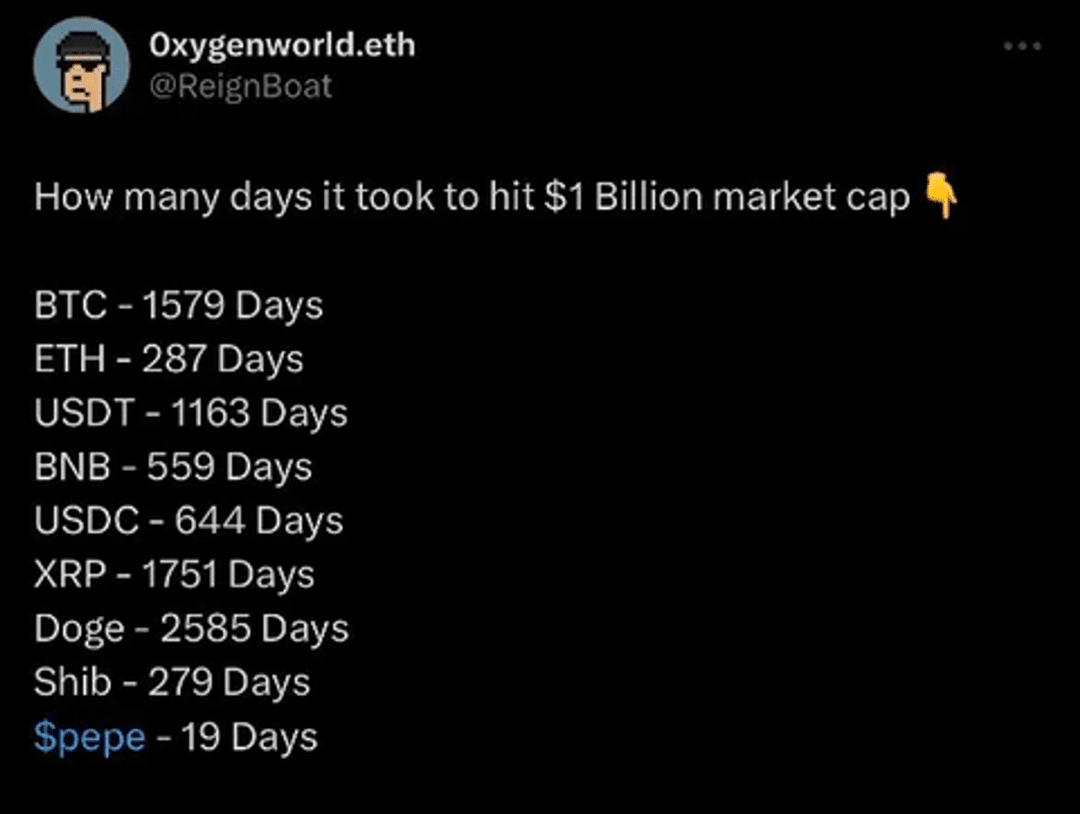
$PEPE, which came out of nowhere in April this year, increased by hundreds of thousands of times in just 19 days and was listed on Binance, becoming the fastest token in history to reach a market value of 1 billion US dollars. The emergence of $PEPE also triggered another wave of Memecoin Season in the crypto world. Various local dog tokens on the chain soared, Gas Fee soared, and new coins that increased by dozens of times appeared every day. This trend lasted for nearly two months until it calmed down at the end of June.
Memecoin is an attractive choice for many factors, from the meme attributes and community culture of the token name or the avatar itself, to the influence of social media and celebrity endorsement, as well as the nature of low market value and high volatility. However, it is also accompanied by extremely high risks. High volatility means that in addition to rising, falling or even disappearing is also common. In addition, factors such as celebrity calls and large investors controlling the market and incorrect information make Memecoin a field that is easy to participate in but difficult to master.
So as a retail investor, what projects are worth tracking and paying attention to if you don’t invest in Memecoin itself? Since the development of the Memecoin field, in addition to many tokens, many projects that serve Memecoin have also been derived, forming a unique Memecoin ecosystem. These projects are not invested by VCs. Most of them started as community projects and generally have inconspicuous backgrounds, but they have persisted to become a stable customer base and profitable.
Today, DODO Research will introduce you to five tools or platforms that many project developers or retail investors backing Memecoin will use when participating in Memecoin, and analyze their sources of profit.
1. Pinksale
Project Introduction
Pinksale is a pre-sale platform. The pink pre-sale often mentioned in the Tugou community refers to Pinksale. Its main feature is that everyone can issue coins and set pre-sale rules. It provides the most basic technical support for the Memecoin project. With Pinksale, the project party only needs to focus on community management and community marketing, and can complete one-click coin issuance without any code foundation.
In addition, for projects pre-sold on Pinksale, the platform guarantees that liquidity will be deployed and there will be no situation where the pre-sale funds are absconded with, which also makes many retail investors only willing to participate in pre-sale activities initiated on Pinksale.
Profit model and analysis
Pinksale's main profit method is to charge a minting fee of 0.01 ETH / 0.2 BNB, and 5% ETH / BNB of the total pre-sale token fundraising funds.
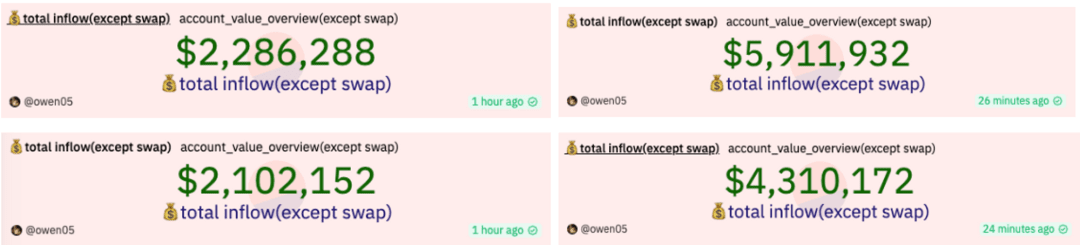
We analyzed its payment address 0x4b04213c2774f77e60702880654206b116d00508. From 2023 to now, in the six months, Pinksale has made a total profit of nearly 8M USD (ETH on the left and BSC on the right in the figure below), and the crazy Memecoin Season in the past three months has brought them 6.4M USD. It can be seen that the good or bad market of Memecoin has a huge impact on its protocol revenue. From the analysis of the two chains of ETH and BSC, it can be seen that Memecoin launched with platform pre-sale is much more popular on BSC than on the Ethereum mainnet. The reason may be that most Memecoin on the Ethereum mainnet choose fair launch or self-built pre-sale channels.
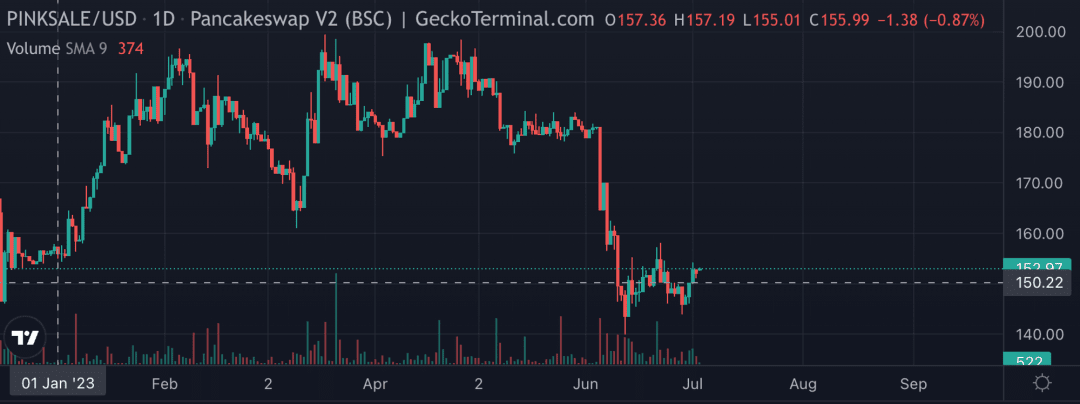
In addition, Pinksale also issues a governance token $PINKSALE. The official document only has unlocking information for this token, and states that 20% of the profits will be used to repurchase the tokens and burn them every quarter, but there is no official information on the repurchase and burning. Any announcement made, this token is more like a useless governance token with no value capture function, and there is no mechanism for sharing the profits between token holders and the project party, resulting in Pinksale making a huge profit in the first half of 2023 It is not reflected in the token price.
2. UNCX Network (原 Unicrypt)
Project Introduction
UNCX Network was formerly known as Unicrypt, and is commonly referred to as Green Horse in the Chinese circle. The service it provides is mainly a lock pool service. Memecoin tokens generally choose to deploy liquidity in AMM DEX. Liquidity is the only basis for the value of tokens. Therefore, whether liquidity can be removed at any time is a major point of consideration for traders, which also makes UNCX's lock pool service a must for almost every Memecoin.
When the project party's liquidity is not locked, few people will take the risk to trade. UNCX, as the first to propose the concept of lock pool in the market and also the most famous lock pool platform adopted by most projects, naturally becomes one of the reference standards for retail investors. Therefore, the project party would rather give up other cheaper solutions on the market and choose to pay to lock its liquidity on UNCX.
Profit model and analysis
UNCX Network's main income is 0.08 ETH / 0.3 BNB collected for pool lock services and 1% of locked liquidity.
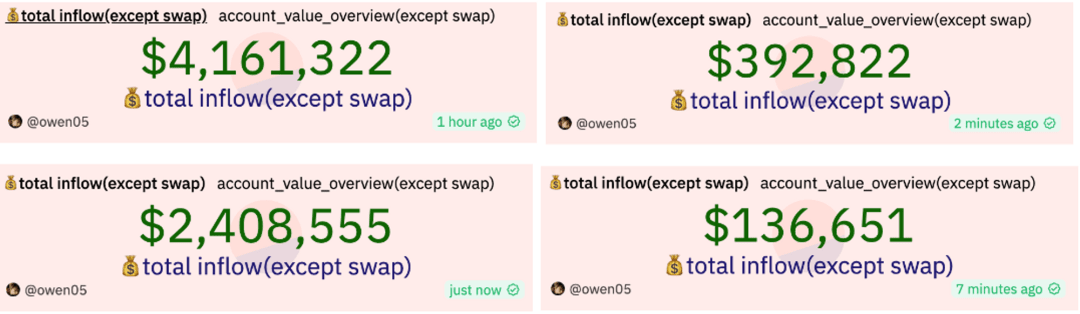
Analyzing its payment address 0x997cc123cf292f46e55e6e63e806cd77714db70f, it is concluded that the profit from the beginning of 2023 to now is more than 4.5M USD (ETH is on the left and BSC is on the right in the figure below), and in the past quarter, affected by the Memecoin Season, the profit was as high as 2.5M USD.
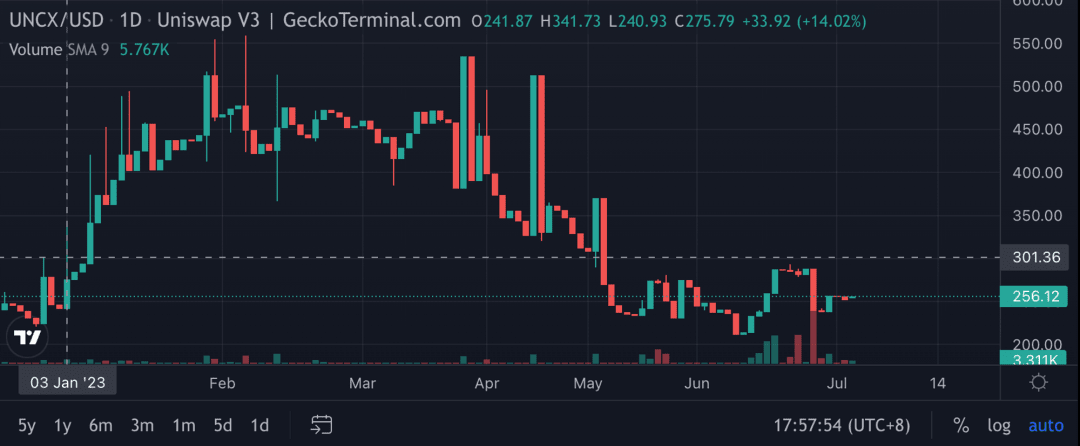
In addition, UNCX has issued the governance token $UNCX and reward token $UNCL of the same name, but has not focused on the token model and value capture. It only has the old-fashioned staking mining and repurchase burning token mechanism. There has even been no record of burning since April 2021. The project makes money but cannot effectively make token holders profit, which also causes the governance token $UNCX price to not change with the increase in project revenue.
3. Dextools
Project Introduction
Dextool is a K-line website and aggregated trading platform. In addition to the functions of K-line viewing and trading, it also provides various information about tokens, including project introductions, community links, etc. It also has trending hot searches and banner ads. Memecoin project owners can pay Dextools to update token information and appear on the hot search list or ads to provide project visibility.
Although there are many alternative and free platforms on the market, Dextools, as the oldest online aggregation trading website on the market, still maintains its leading position. For Memecoin players, paid Dextools is an important indicator to judge whether a project is marketing carefully. Therefore, in order to attract people, project parties will still choose to pay Dextools to update token information.
Profit model and analysis
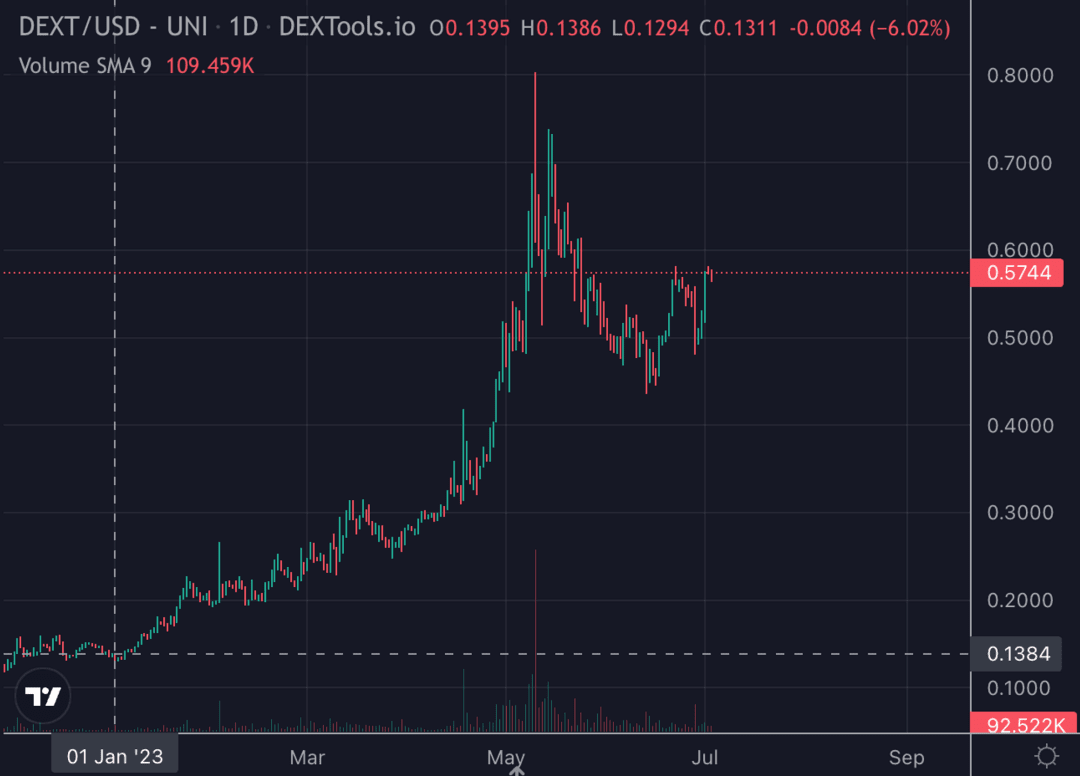
Dextools' main profit comes from the fees of 1300 DEXT, 3 BNB or 0.5 ETH required to request updated token information from the project party. Unlike Pinksale and UNCX, Dextools' token $DEXT has a stronger value capture ability. Dextools will dynamically adjust the payment method of the token $DEXT to ensure that it remains the cheapest payment method, and this part of the income paid in DEXT will be regularly destroyed for permanent deflation.
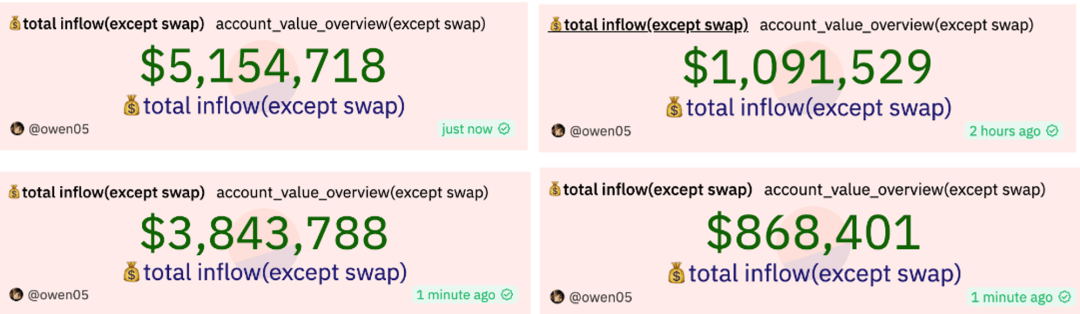
Based on the analysis of the Dextools charging address 0x997cc123cf292f46e55e6e63e806cd77714db70f, we concluded that from the beginning of 2023 to the present, a total of approximately 6M USD (ETH on the left and BSC on the right in the figure below) has been earned in revenue, and since the Memecoin Season ignited by $PEPE in April, nearly 4.7M USD has been earned.
Nearly 1/3 of the revenue is paid through $DEXT. Benefiting from its deflation mechanism (an average of about 15k $DEXT is destroyed every day), $DEXT has increased by as much as 6 times this year, and it still has a 4-fold increase after the current correction, making it a token that has performed very well in 2023.
4. Maestro
Project Introduction
Maestro is a Telegram chat room robot that provides retail investors with quick currency purchases and various stop-profit and stop-loss orders. Users deposit money into the wallet address provided by Maestro, and then they can talk to the robot on TG to complete currency purchase and sale transactions. Due to the high volatility of Dogecoin, the transaction speed has a significant impact on the returns. Therefore, the faster the transaction, or even the sniper purchase as soon as the project deploys liquidity, the more benefits can be gained. Maestro is a tool designed for professional Memecoin players.
However, users need to be very careful when using this type of tool and should not invest large amounts of money to avoid losses caused by concerns about private key leakage.
Profit model and analysis
Maestro's profit model is to charge a 1% commission from the amount of each transaction made by the user. When the user's accumulated commission reaches 0.01 ETH, it will be automatically transferred from the address to the Maestro payment address.
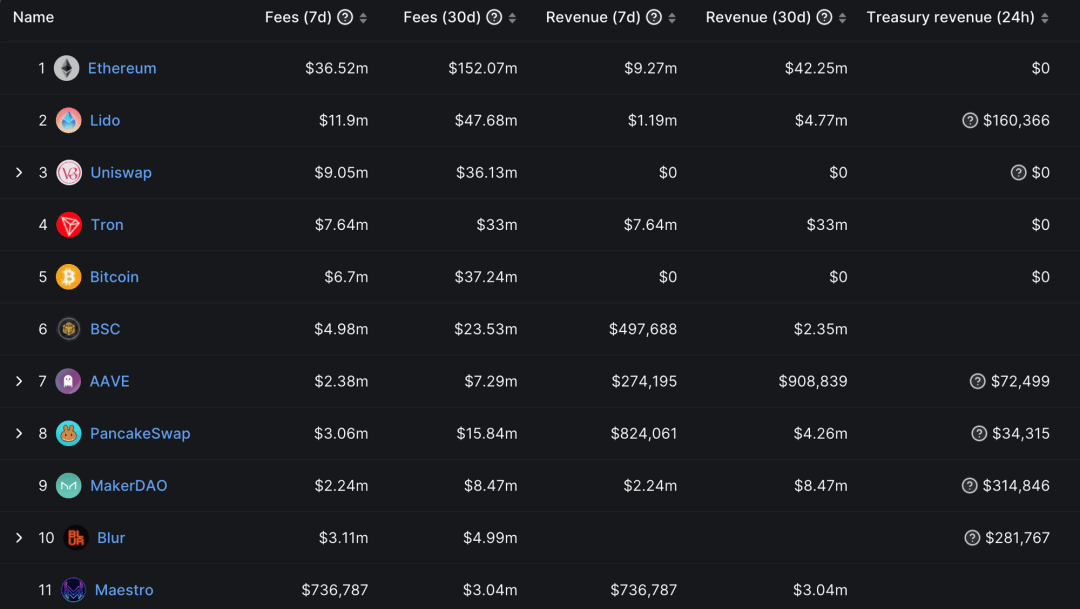
From Defillama's data, we can see that its cumulative revenue in 2023 is close to 12M USD, and in the past three months, Memecoin Season has quickly earned about 10M USD. It can be said that it is one of the most profitable projects this quarter.
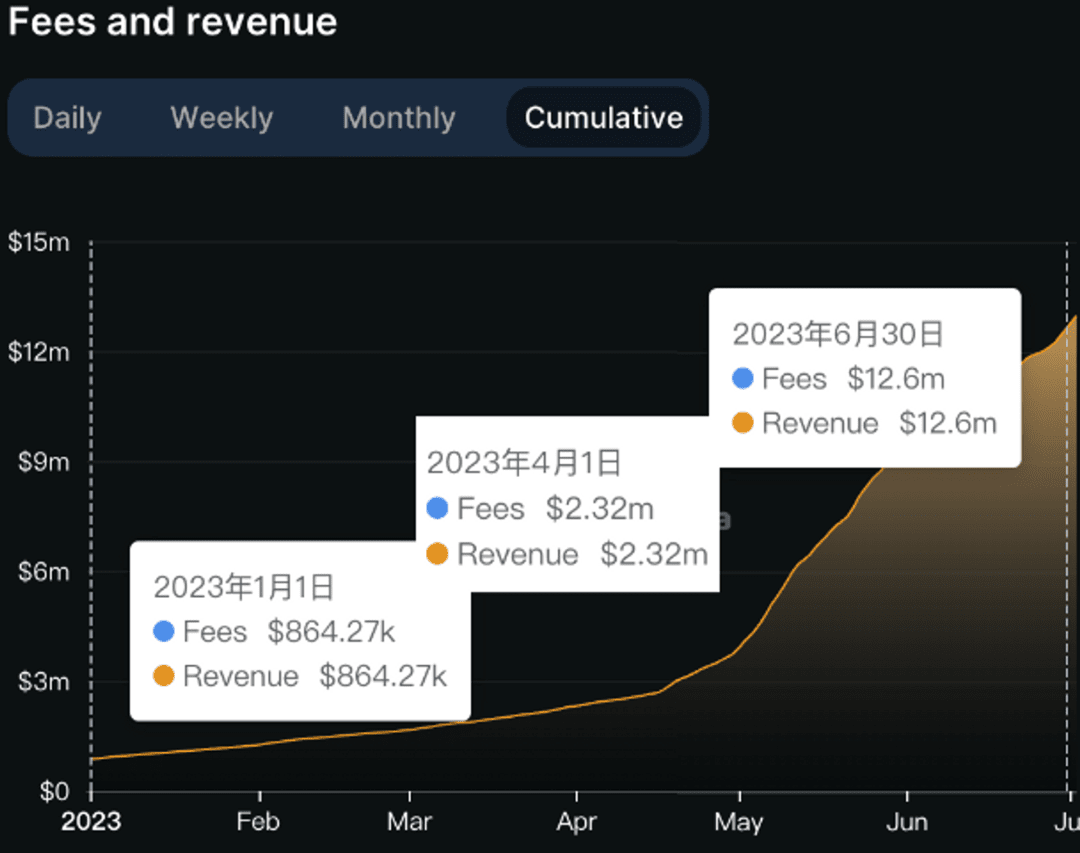
Although Memecoin has been relatively quiet this month, Maestro still ranks 11th on the Defillama fees and revenue dashboard, surpassing many well-known Defi protocols such as Metamask, Compound, and Curve, and even public chain projects such as Arbitrum, Optimism, Avalanche, and Polygon can only look up to it.
5. Unibot
Project Introduction
Unibot and Maestro have the same business content and are both TG trading robots. There is no difference in product functions. The only difference is that Maestro does not issue tokens, while Unibot has its own token with the same name and a token dividend mechanism. Retail investors have the opportunity to share the value captured by the agreement with the project party, and Unibot has a referral system, so its visibility in the Twitter community is relatively high. The next stage of product updates in the team roadmap will cooperate with GMX and Dopex, and GMX's perpetual contracts and Dopex's options products will be able to be used in TG robots.
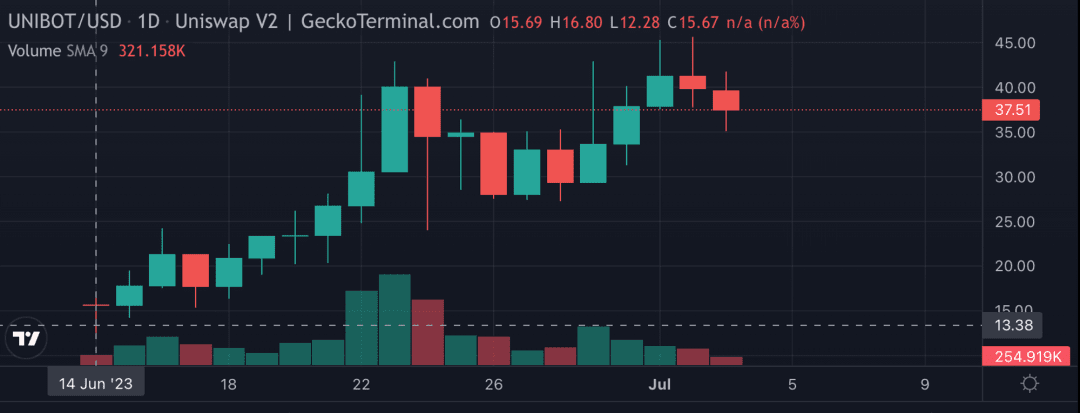
Compared with the above four projects, Unibot is relatively young. It was just launched in May this year. The product and token were launched at the same time. Its token adopts the fair launch method, with the highest increase of up to 400 times. It can be said to be the god coin of this quarter.
Profit model and analysis
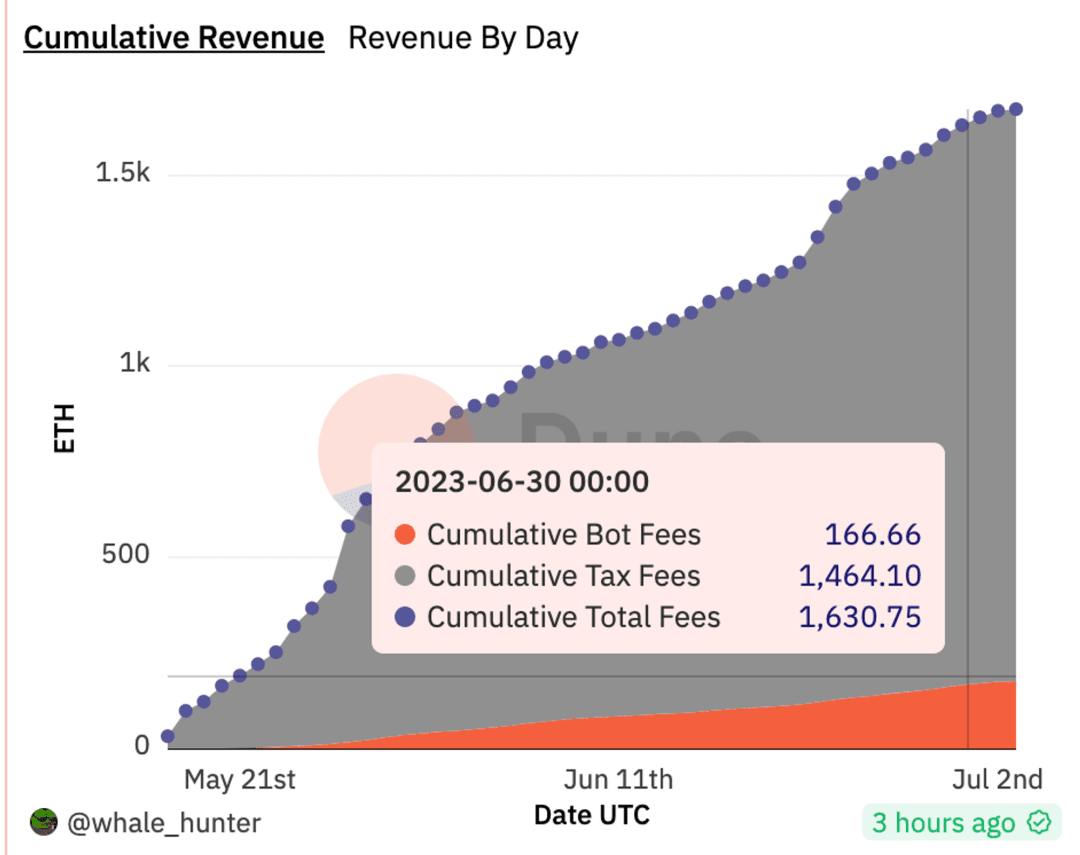
Unibot's profit model is the same as Maestro, both of which charge 1% of the user's transaction amount as a handling fee. However, due to the Unibot token mechanism, $Unibot itself is a tax-inclusive token, and 5% of the token must be paid as tax for both buying and selling in transactions, which is also regarded as the project's income. Since the project was launched, the cumulative income has exceeded 1630 ETH, about 3M USD, of which 166 ETH (300K USD) comes from handling fee income.
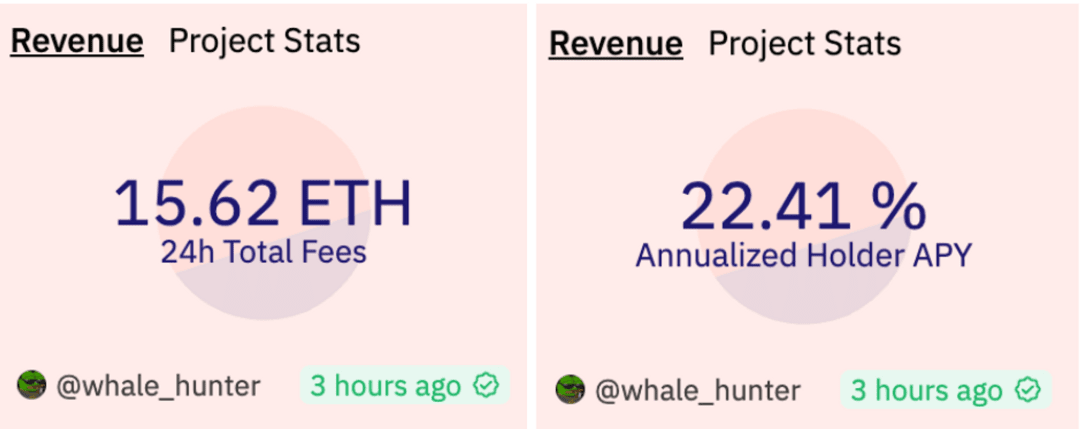
In addition, dividend rewards were implemented two weeks ago on June 14, and 40% of the project revenue will be distributed to token holders. A total of about 200 ETH (about 380K USD) has been distributed so far. As a result of the good news, $Unibot has risen nearly 3 times so far.
Summarize
The five projects introduced above may seem inconspicuous, without a strong background or a refreshing innovative mechanism. However, their earnings are amazing when analyzed. When the Memecoin market on the chain is good, the earnings of these projects can far exceed many Defi and even public chain projects. Having amazing profitability is the common feature of these five projects.
However, it should be noted that a good product is not necessarily a good investment target. This can be seen from the tokens of the above projects. Therefore, if a project has high profits but does not have a good token model, it will not help if the project profits cannot be distributed to token holders. On the contrary, if it has a token mechanism with a profit-sharing design, a project with such strong profitability is very likely to be a good investment target.