

"1. Education; 2. Compliance; 3. Products and services; 4. Ignore FUD, fake news, attacks, etc." Earlier this year, Binance founder and CEO CZ tweeted that he would focus on four things in 2023. Education ranks first, which shows how important it is to him.
Since then, CZ has repeatedly discussed the importance of Web3 education in different occasions and AMAs, saying, "Binance is still not doing well enough in the field of education, so education is something Binance should pay attention to." In addition to verbal emphasis, Binance also actively promotes Web3 education and launched Open Campus, a leading project in the Web3 education track.
As a community-led Web3 education protocol, Open Campus hopes to create a more equitable education system through the power of blockchain technology, returning control to educators and learners: by tokenizing educational content, it will promote the production of more high-quality educational content, increase the income of educational creators, and also allow learners to access more diverse educational content. Open Campus's innovation and foresight in the field of Web3 education will bring revolutionary changes to the global education market with a market size of up to US$5 trillion.
For the crypto market, Open Campus tokenizes high-quality educational assets outside the circle and introduces incremental value to the industry. On this basis, it creates a new model EduFi (Education+DeFi), which also opens up a new narrative for the bear market.
With the continuous development of Web3 technology and its application scenarios, the concept of EduFi will gain more recognition and application, and Open Campus will play an increasingly important role in it.
1. Web3 education becomes the most important new trend in 2023
From GameFi, NFT, and Layer 2 in the past two years to Bitcoin Inscription, BRC 20, and Real Assets (RWA) this year, one segment after another has become the focus of the market, and has also brought alpha returns (excess returns) to early participants. Now that the heat has subsided, the market is urgently looking for the next growth point.
Web3 education, which has an industry-based, leading, and global status, has attracted the attention of more and more institutions and individuals, including Binance, due to its short development time and not fierce competition. Web3 education is an emerging field with high development potential and opportunities, and will become one of the most important trends in the crypto market in 2023.
From the perspective of development prospects, compared with the scale of the traditional education market, Web3 education still has a lot of room for growth. According to World Bank data, the market size of the global education industry exceeded 5 trillion US dollars in 2020, and the amount of education investment in countries such as China is also increasing year by year; with the continuous innovation and application of technology, the scale of the traditional education market will continue to expand, and it is expected to reach 100,000 US dollars by 2030.
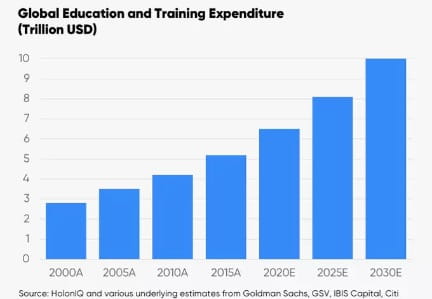
Although the scale of the traditional education market continues to expand, there are also many problems and challenges, such as high education costs, uneven education quality, scarce education resources, and lagging education management.
The operating costs and tuition fees of traditional educational institutions are high, which are difficult for some students with poor economic conditions to afford. For poor areas, the imperfect educational infrastructure affects students' opportunities to receive education. For educational creators, they do not get the income they deserve, and the income is not proportional to their efforts. Furthermore, the curriculum system and learning resources of traditional educational institutions are relatively rigid and closed. While meeting the basic needs of students, they lack flexibility and innovation and cannot meet the personalized needs of different students. In addition, the current social development environment is changing rapidly, and educational institutions are unable to update and adjust teaching content and methods in a timely manner. It is difficult to keep up with the times and adapt to social changes and development. There are differences in teaching levels and teaching quality among educational institutions, and students' educational benefits will also be uncertain.
The traditional education system has constrained both learners and educational creators, and the phenomenon of educational inequality is relatively common. On the basis of the traditional education model, the introduction of new technologies such as blockchain may effectively make up for the shortcomings of traditional education and adapt to the new demands of modern society for education.
Open Campus is a platform that combines educational creation with blockchain technology. The platform allows educators to create and share their own innovative teaching materials, students can choose the corresponding teaching materials according to their needs, and the community can create, own and promote the content they want to know around the world. Especially for educators, tokenization technology can help them turn traditional educational courses into on-chain assets for students to choose freely, reduce the difference between middlemen and effectively increase the income of educational creators, and gain recognition of their contributions from learners and platforms.
The emergence of Open Campus is of great significance for optimizing the traditional education model and meeting the educational needs of modern society. Therefore, Open Campus is highly anticipated by all parties, and Binance also promotes it as the 31st Launchpad project and a benchmark for the Web3 education track.
2. Open Campus: Tokenization of educational resources to achieve educational equity
"Publisher NFT earned me $9,767 in 5 months, and users paid real money for educational content. There are no more middleman costs, and teachers/creators now reap the value directly." A content creator named "Misa Matsuzaki" shared his intuitive experience of using Open Campus on Twitter.
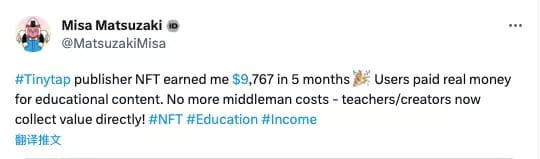
Misa Matsuzaki’s experience is not an isolated case, but a microcosm of the thousands of educational creators at Open Campus. Their sincere gratitude is also the original intention of Open Campus: through tokenizing educational content, educators’ contributions and efforts can be “seen” and “recognized” and receive substantial returns, which in turn promotes the production of more high-quality educational content.
Open Campus has built a complete protocol layer infrastructure for schools, technology education platforms and other educators to use, allowing them to bring their educational content to students around the world. Educational content and courses can be tokenized into NFTs, and the income generated by the content will be distributed to creators, NFT holders and other contributors through smart contracts. The platform users are divided into three categories:
Communities (learners) can create, own and promote educational content they want to know about the world, and use blockchain technology to fund, co-own and monetize educational content that meets their needs;
Creators, who offer promotional rights through Publisher NFTs, promote their content under an agreement where co-publishers can earn revenue based on their contributions, with creators and marketers sharing publishing rights;
Philanthropists can support such educational causes directly through donations, and their donated assets can be tracked through on-chain data.
For example, Xiao Qin sees AI is very popular now, and as an AI technology expert, he wants to monetize his knowledge. However, due to his own connections and fame, the knowledge payment platforms in the market did not recommend him for traffic, and Xiao Qin has been ignored for several months.
At this point, Xiao Qin can register as a content creator on Open Campus, and then generate educational content for his AI technology tutorials through the Open Campus platform and submit them. After passing professional review (note: mainly to prevent spam from polluting the platform), Xiao Qin needs to pay the platform token EDU, cast his content into a Publisher NFT, and sell the NFT in the market.
After NFT entered the market, learner Xiao Wang found it very interesting and used EDU tokens to purchase the course. Xiao Qin also earned income by selling the NFT. After Xiao Wang completes the course, he will receive platform course certification.
Of course, it doesn’t end here. The “co-publishers” on the platform think that Xiao Qin’s AI content is of high quality, so they buy the NFT and promote it at their own expense. The NFT is understood and purchased by more learners. At this time, Xiao Qin, as the original content creator, can continue to receive secondary royalties - but a certain percentage of the income needs to be given to the co-publishers and partner platforms.
To sum up, the biggest highlight of Open Campus is that it combines the traditional education model with blockchain technology to create an NFT-based education content market. In this way, Open Campus can not only protect the copyright and circulation of educational content, but also meet users' demand for high-quality educational resources.
The first company to adopt the Open Campus protocol is TinyTap, which is also a leader in the global education industry and one of the top ten highest-grossing mobile apps for children on the App Store and Google Play. Currently, the TinyTap platform has more than 250,000 interactive courses, has been used by more than 9 million families and has more than 100,000 creators, and has cooperated with many well-known publishers such as Sesame Street and Oxford University. In addition, TinyTap is also a star project on the BNB Chain - ranked by the number of active wallets, TinyTap ranks among the top five most active dApps on the BNB Chain.
Last November, TinyTap’s first batch of Publisher NFT sales generated revenue of 138.926 ETH (about $228,000), with 12 teachers (creators) receiving half of the revenue; the highest-selling NFT brought its creator $37,600 in revenue, which is 13.4 times the average monthly salary of elementary school teachers in Israel’s public education system.
In addition, in May this year, Open Campus announced the launch of a $10 million Global Educator Fund, which aims to reward teachers and creators around the world to develop K-12 educational content for Open Campus and its partner platforms. Applicants can be qualified teachers, educational institutions, and individuals or teams with subject matter knowledge.
By introducing blockchain technology, Open Campus creates a fairer and more inclusive ecosystem for educators, learners, publishers, and co-publishers, providing them with more access to Web3 expertise while safeguarding the ownership of educational content and promoting the continued growth and development of the ecosystem. In this thriving environment, innovation, creativity, and knowledge sharing are promoted and nurtured, creating a brighter future for education and bringing billions of educators and learners around the world into the world of Web3.
3. Introducing incremental growth, EduFi expands new DeFi formats
After launching on Binance in April, the price of Open Campus’ native token EDU rose to 1.69 USDT, a 3,300% increase from the IEO issue price of 0.05 USDT. The current price of EDU is about 0.74 USDT, which is still nearly 14 times higher. In fact, EDU plays a key supporting role in the entire Open Campus ecosystem, with use cases including:
Governance: EDU holders can submit DAO proposals for the protocol and vote on them (for example, participate in planning the token usage allocated to the ecosystem, etc.).
Payment: EDU can be used as a form of payment for products and services provided using the Open Campus Protocol (such as TinyTap, where a percentage of revenue is allocated to the Open Campus Protocol).
On-chain revenue sharing: Contributors (including content creators, publishers, platforms) receive a share of the protocol revenue in EDU.
User Acquisition: EDU can be used to incentivize and onboard Web2 users to Web3 as they can receive discounts when accessing products provided by protocol ecosystem partners (e.g. TinyTap).
Content ownership: Users can purchase co-publishing rights with EDU through publisher NFTs.
The question is, would EDU be a good investment target?
From the perspective of development prospects, EDU, as an ecological payment token, is inseparable from the expansion of Open Campus's business territory. In fact, in addition to TinyTap, Open Campus has also reached cooperation with many top education companies to move these educational contents to the chain, forming a huge pool of educational content.
For example, GEMS Education, one of the private school networks, has more than 60 schools and more than 130,000 students in North Africa and the Middle East. Many other partners include but are not limited to Animoca Brands, Sandbox, etc. Since these Publisher NFTs can only be minted using EDU tokens, and sales must also be paid for using EDU, EDU tokens have become an indispensable part of this ecosystem.
Take TinyTap as an example. The revenue from the last Publisher NFT auction was about 5 times the normal revenue. The company's annual revenue is close to 10 million US dollars. After cooperating with Open Campus to tokenize educational resources, the revenue of Publisher NFT may have the opportunity to grow to 50 million US dollars. The auction of these NFTs will also generate tens of millions of dollars of buying orders for EDU, and tens of millions of dollars worth of EDU tokens will eventually return to the project treasury. Since then, with the entry of these top education companies, the purchase and consumption of EDU will also become larger.
More importantly, these high-quality educational assets enter the crypto ecosystem through tokenization, have liquidity and tradability, and can also derive more new ways of playing. For example, the Publisher NFT generated by educational assets can be pledged on the chain; if it is a scarce resource, it can also be fragmented and decomposed into more tokens for trading. High-quality educational assets will also bring a new round of incremental funds to the crypto market. All of these further provide new ideas and opportunities for the DeFi ecosystem, so it can be called "EduFi" (Education+DeFi)
Of course, the market is generally concerned about the selling pressure of new projects, especially with the current high price increase, early investors may flee with profits or project parties may sell off and cash out. At the end of May this year, a large number of EDUs were transferred to a new wallet address, causing panic in the community. Subsequently, Open Campus officially announced that an error occurred when transferring tokens, no tokens were sold, and the tokens had been returned to the initial wallet, and then unlocked according to the release schedule on the 28th of each month.
According to token.unlocks data, the current circulation of EDU is about 187 million, with a circulation market value of $130 million. But in fact, its actual circulation is only about 110 million. The fundamental reason is that most of the unlocked tokens are still in the wallet and have not flowed out of the market. On July 4, Open Campus tweeted that in view of macro fluctuations and market environment, the unlocking time of early contributors, liquidity providers and ecological tokens will be extended by 3 months, and the release time of other tokens will remain unchanged. Therefore, the actual circulation market value of EDU is only about 80 million US dollars, and the income of TinyTap alone can drive EDU to a good increase.
As a community-driven on-chain protocol platform, Open Campus will have unique advantages in attracting partners compared to centralized platforms. Clearer and more transparent revenue distribution will make more partners willing to join the network, expand the user base, and allow educators to enjoy more network benefits. Thanks to the incentive mechanism, the supply and quality of educational content will also be improved, ultimately creating a sustainable economic model and achieving a long-term win-win situation. Whether from the perspective of Token economy or practical application, Open Campus is a very high-quality Web3 education project.
Final Thoughts
Now that the crypto market has entered a bear market and the overall market trading enthusiasm is not high, the entry of high-quality educational assets can effectively stimulate the internal motivation of the market, especially the concept of EduFi is expected to stimulate and lead a new wave. With the development of Web3 education, the concept of EduFi will be more recognized and applied, and Open Campus will play an increasingly important role in it.
For Open Campus, it shapes a new educational paradigm, ensures that educational content is shared while retaining ownership of the work, and helps increase educators' income-generating channels, providing them with incentives to continue to produce high-quality content.
In general, Web3 education can break through the limitations of traditional education geographical boundaries, open up new traffic entrances, promote the borderless development of education, truly realize educational equity, and give everyone equal opportunities to receive education.